The drive from Walter Reed to downtown DC usually took forty minutes, but tonight it felt like seconds. My hands trembled on the steering wheel, and it wasn’t the traffic on 395. It was the Manila envelope on the passenger seat. Inside sat the pathology report.
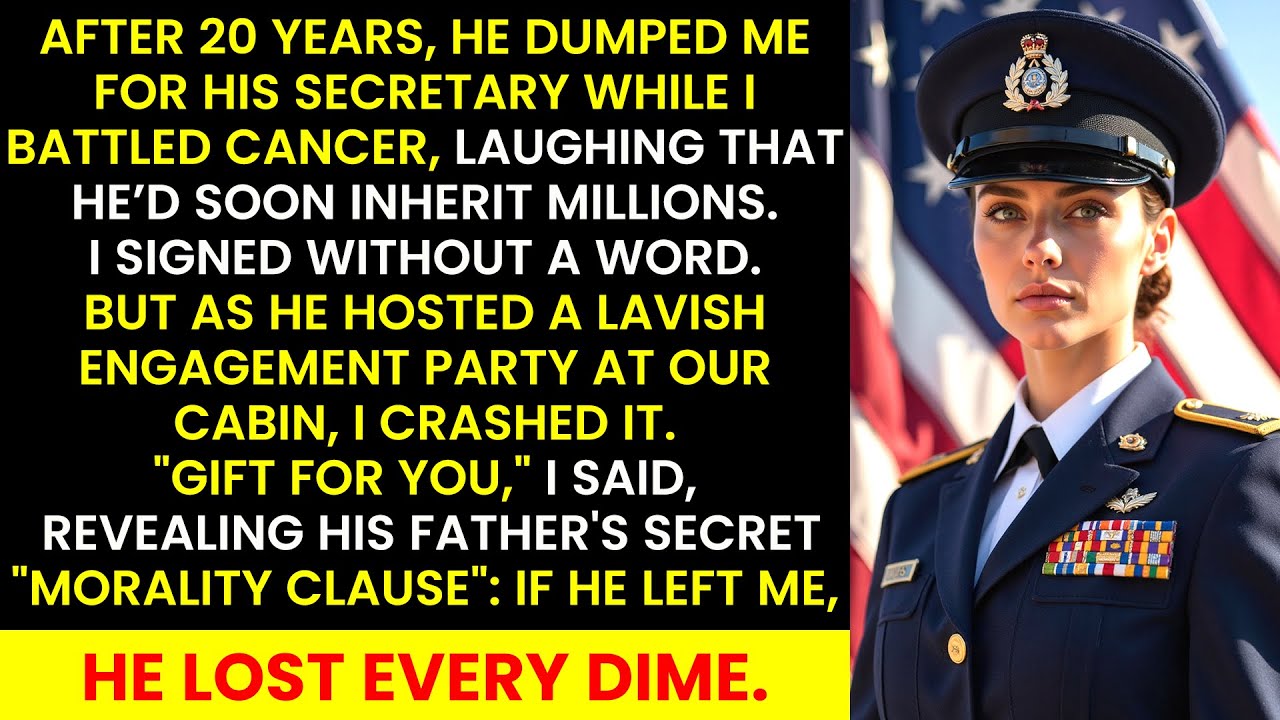
Stage two. Aggressive. For twenty years I had been the strong one, the soldier, the one who deployed and came home covered in dust and duty. But tonight I needed my husband.
I needed Robert to hold my hand and tell me we would face this together. I parked outside Gavani’s, the most expensive restaurant in the capital, and checked my reflection in the rearview mirror. Pale. Tired.
Composed. I tucked the medical file into my leather tote and walked inside. The place smelled of truffle oil and old money, and Robert was already seated at our usual table by the window, swirling a glass of pinot noir. He looked impeccable in his bespoke navy suit.
He didn’t stand when I approached. He didn’t smile. He checked his Rolex. “You’re late,” he said.
“Traffic was bad near the hospital. ”
“Tegan, I have to tell you something. I saw the specialist today, and he—“
He held up a hand, silencing me. “Please don’t start with the drama.
I’ve had a hell of a day at the firm. ” He looked at me then, his eyes scanning my charcoal pantsuit with undisguised distaste. “Is that what you wore to our anniversary dinner? Look around.
The other women here are wearing dresses. They look soft. You look like you’re about to court-martial me. ”
I felt the words die on my tongue.
I have cancer. I swallowed them. “I came straight from work,” I managed. “That’s the problem.
It’s always work. It’s always the mission. Living with you is like living with a superior officer, not a wife. I need a woman who knows how to be a woman.
”
His phone buzzed. He glanced at it and his face softened in a way I hadn’t seen directed at me in years. “Is that her? ” I asked.
“Your secretary? ”
He didn’t deny it. “She’s twenty-six, Tegan. She’s full of life.
She doesn’t look at me with those judging eyes of yours. ”
The waiter arrived, setting down two plates of tiramisu. Robert picked up his spoon. “I want a divorce.
I’ve already spoken to the lawyers. I’m taking Jessica to the Hamptons next week, and I want the papers signed before I leave. I need a clean slate. ”
I stared at the dessert.
Next week I would be sitting in a chemo chair while he played tennis with a girl young enough to be his daughter. My hand moved toward my bag. I could pull out the file. I could slam the diagnosis on the table and make him stay through guilt.
But I looked at him, really looked at him, and I saw he didn’t care. He would stay out of pity and resent me for dying too slowly. Then I remembered his father. Colonel George Mitchell, a true Marine.
Years ago, over whiskey in the Vermont cabin, George had told me about the morality clause in his will. If that boy ever dishonors his vows, he gets nothing. Robert had never read the fine print. He was so arrogant, so sure of his inheritance, that he had never looked.
A strange calm settled over me. The calm of a sniper waiting for the wind to settle. I released the file and picked up a pen instead. “You’re right, Robert,” I said, my voice steady.
“You deserve that freshness. ” I signed my name on the white linen napkin and slid it across the table. “You have your freedom. Go to the Hamptons.
Be happy. ”
He blinked, surprised by my surrender, then smiled a triumphant smile. “I knew you’d be reasonable. You’re always so pragmatic.
” He signaled for the check and stood. “I’ll have the papers sent to the house tomorrow. You’ll need to move out, of course. I’m selling the place.
”
He walked away without looking back. I whispered to the empty chair, “Semper fi, Robert. You were never faithful. ”
Two days later, a process server showed up at my door at 0700.
He handed me a thick envelope from a shark-tier law firm. An emergency motion for exclusive use and possession of the marital residence. The reasoning: to prevent psychological conflict and maintain a stable environment. I was the one with cancer, the one who had paid the mortgage for fifteen years out of my army salary while Robert blew his bonuses on tailored suits, and I was being declared the stressor.
I didn’t fight it. I bought twenty cardboard boxes and began dismantling my life. By noon on the second day, the living room was a maze of brown cardboard. I was packing my dress blues when the front door opened.
Robert and Jessica walked in together, her clutching a Starbucks cup like a scepter. She wore designer yoga pants and an oversized sweater. “I thought she’d be done by now,” Jessica said, her voice loud on the hardwood I had refinished myself. Robert stood by the fireplace, pretending to check his emails.
Jessica wandered around, touching things. She ran a finger over my leather reading chair. “This has to go,” she said, scrunching her nose. “It’s absolutely hideous.
We need something modern. This whole room smells like old people. ”
“Yeah,” Robert said, eager to please her. “We’ll call the junk haulers tomorrow.
Mark whatever you want gone, Jess. ”
Junk. My sanctuary was junk. I didn’t say a word.
I grabbed the box with my uniforms, hoisted it onto my shoulder, and walked out. My new base was a studio apartment in a decaying complex in Alexandria. The hallway smelled of boiled cabbage and stale cigarette smoke. I carried the boxes up two flights of stairs, the chemo port in my chest throbbing.
That night the bone pain hit. The white blood cell booster they had given me felt like my skeleton was trying to expand inside my skin. I curled up on a bare mattress, sweating, whispering Robert’s name out of old habit. But there was no Robert.
There was only the hum of the refrigerator and the sirens on the highway. I was alone. I dragged myself to the bathroom. My hair was thinning.
My skin was gray. I opened the medical kit, pinched the skin of my stomach, and pushed in the blood thinner needle. The burn was sharp and grounding. It cut through the bone pain.
Back in the main room I unpacked a box and found our wedding photo, Robert and me under the crossed swords of the honor guard. I looked at it for a long moment, then placed it face down. I took the X-ray of my chest from the Walter Reed envelope and taped it to the wall opposite the bed. This was my reality now.
Not the man who betrayed me. The enemy inside my chest. They call chemotherapy the red devil. The drug dripped into my veins at Walter Reed, bright crimson, looking less like medicine and more like engine coolant.
I sat alone in the infusion center while a young Marine’s wife held his hand and an elderly veteran’s daughter read to him. I had my phone and a lukewarm ginger ale. The drive home was the real battle. I made it to the parking lot before I lost the fight, leaning out of the car to vomit onto the hot asphalt.
Two weeks later, in the shower, I ran my hands through my hair and pulled away clumps of wet blonde strands. It wasn’t just hair. It was my armor. I found Robert’s old electric trimmers in a box and shaved my head in the small tiled bathroom.
Ten minutes later, a stranger stared back at me. Pale scalp. Huge eyes. I looked like a chemo patient, and there was no hiding it now.
I sat on the cold tile floor and opened Instagram. The algorithm put her right at the top of my feed. Jessica. Location: the Hamptons.
She was holding a mimosa against a backdrop of a golf course, but the focus was the ring on her finger. Robert’s grandmother’s ring. The one I had worn for twenty years. He had asked for it back for cleaning a month ago, and I had trusted him.
Her caption read, “Finally found my forever. True love. Blessed. Upgrade.
”
Then a text came in from Brenda, a mutual friend. Robert was at the club telling everyone we split because I was having a mental breakdown. Menopausal. Unstable.
He said he feared for his safety. I screamed, a raw sound from the bottom of my poisoned lungs, and punched the cheap drywall. My knuckles split. The plaster crumbled.
Pain shot up my arm, and it felt better than the numbness. The knock on my door came a week later. Three sharp wraps. I knew that knock.
I opened the door and found Colonel George Mitchell, USMC retired. Seventy-five years old and standing like he was still on the parade deck at Quantico. He looked around the studio apartment at the unopened boxes, the peeling paint. “Robert said you wanted space,” George said.
“He said you were having a midlife crisis. ”
“Is that what he said? ”
He tilted his head, sniffing the air. “I know that smell.
I smelled it on my Martha for two years before she passed. It’s the smell of metal. The smell of a fight. ” He reached out.
“Take off the hat, Tegan. ”
I pulled off the beanie. He stared at my bald head, the pale skin stretched over my cheekbones, the dark circles under my eyes. “Stage two,” I whispered.
“Breast cancer. Aggressive. ”
The stoic mask crumbled. Tears spilled over his weathered cheeks.
He crossed the room and pulled me into a desperate embrace, shaking with silent sobs. When he pulled back, his eyes held a cold, terrifying rage. “Does he know? ”
“I tried to tell him at dinner.
He asked for a divorce before I could get the words out. ”
George reached into his coat and pulled out a thick sealed envelope. “Robert thinks I’m senile. He thinks I’m just an ATM waiting to expire.
He doesn’t know about the amendment I made five years ago. The morality clause. It says my son only inherits if he maintains honorable standing in his marriage. If he divorces without just cause, or if the dissolution is proven to be a result of his own infidelity or abandonment during a time of crisis, he gets nothing.
Not a dime. It all goes to the Wounded Warrior Project. ”
I stared at the envelope. “So we can’t tell him.
If he knows, he’ll stay married to me and wait for you to die. ”
“Exactly. We need him to finalize the divorce. We need him to nail his own coffin shut.
” He gripped my hand, the one with the split knuckles. “He threw you away like garbage, Tegan. In my eyes, you are my child. Don’t beg him.
Don’t ask for help. Let him think he’s won. Give him hell, Tegan. ”
“Semper fi, Dad.
”
A few days later, the notifications on my phone were relentless. Jessica had posted a video from the Vermont cabin. She had painted everything. The dark, majestic wood paneling that had held a century of Mitchell history was now a blinding, sterile white.
She was erasing a legacy with a bucket of cheap paint. Then the camera panned to the coffee table. Under a box of Domino’s pepperoni pizza, beneath a can of White Claw, sat the burial flag. The flag that had draped the coffin of Robert’s grandfather, a Normandy veteran.
Jessica had pried it out of its glass case and was using it to catch the grease from her pizza. I took a screenshot. Then another. A text message dropped down from the top of the screen.
Robert. I see you haven’t signed the quitclaim deed for the Vermont house. I need that property liquid. If I don’t have your signature by Friday, I’m removing you from the firm’s health insurance policy.
Good luck paying for your treatments out of pocket. He knew chemo cost twenty thousand dollars a session. He was holding a gun to my immune system. I called my lawyer, a woman named Helen who ate narcissists for breakfast.
“He just threatened to cut my insurance,” I said. “That’s illegal. We can file an emergency motion. ”
“No.
Let him threaten. I have something better. I have him letting his mistress use a World War II burial flag as a placemat. ”
Helen let out a low whistle.
“A jury in Virginia is going to hate him. ”
“We are not selling the Vermont house. We are not negotiating. Hold the line.
”
The invitation arrived two weeks later. Heavy cream card stock, my name calligraphed in gold ink. The future Mr. and Mrs.
Robert Mitchell requests the honor of your presence at an engagement and housewarming celebration. Location: The Mitchell Estate, Vermont. Robert called that night, drunk. “Dad’s not doing well,” he said, slurring.
“Congestive heart failure. He’s kicking the bucket soon. Once the old man checks out, the trust releases everything. The house, the portfolio.
It’s all mine. ” He laughed. “So stay in your little apartment. Fade away.
I’ve won. ”
I opened my pocket Bible to Psalm 144. Blessed be the Lord, my rock, who trains my hands for war. I picked up a pen and flipped the RSVP card over.
Name: Lieutenant Colonel Tegan Willis. Accepts with pleasure. The morning of the party, I dropped the six-hundred-dollar wig into the trash can. I applied the makeup like war paint, contouring my hollow cheeks to sharpen them, lining my eyes with coal.
Then I stepped into the dress I had ordered from New York. Marine blue. Deep midnight navy. High neckline to conceal the port in my chest, low back to reveal the muscles built over twenty years of service.
It fit like armor. I drove to the nursing facility where George was staying and found him in his wheelchair by the window. “You look dangerous, Tegan,” he whispered through his oxygen mask. “That’s the plan, sir.
”
He handed me the envelope with the will. “I had my lawyer notarize the timestamp. It’s bulletproof. Tonight is not about money.
It’s about honor. Teach that boy that actions have consequences. ”
I kissed his forehead and walked out. The drive to Vermont took three hours through a blinding nor’easter.
My sedan fishtailed on black ice, but I corrected it with muscle memory from driving Humvees in bad terrain. I was the only car on the highway. I was not a ghost. I was the storm.
The house was blazing with light when I arrived. Expensive cars lined the driveway. I pulled my rusted sedan up to the valet stand and stepped out into the freezing wind. I walked through the heavy oak door, and the laughter died.
Heads turned. The jazz band trailed off into silence. I stood in the entryway, snow melting on my shoulders, the marine blue gown shimmering under the chandelier. Robert dropped his hand from Jessica’s waist.
The color drained from his face. He rushed toward me and grabbed my arm. “What the hell are you doing here? You’re making a scene.
”
“Unhand me, Robert, or I will break your wrist. ”
He flinched and released me. Jessica appeared at his elbow, sneering. “Did you escape from the ward?
”
“This is a private residence,” I said, my voice projecting without shouting, “and since my name is still on the deed, I have every right to be here. ” I stepped around them and walked to the stage where the jazz band was set up. I took the microphone. The feedback pierced the room.
“Good evening, everyone. I apologize for the interruption. I know you are all here to celebrate the future of Robert and Jessica. But I felt it was important to bring a gift.
A housewarming gift to clarify exactly whose house you are warming. ”
Robert was charging toward the stage. “Tegan, stop. Don’t you dare.
”
I tore open the manila envelope. “Robert has told you all that his father is near death. He has told you he is celebrating his imminent inheritance. Five million dollars.
The portfolio. This estate. However, Robert seems to have forgotten a crucial detail of the Mitchell family trust. Specifically, the morality clause.
Section four, paragraph B. In the event that the primary beneficiary dissolves his marriage due to his own infidelity, abandonment, or dishonorable conduct, he shall be immediately disqualified from the estate. ”
The room went deathly silent. I held up a second packet.
“I have date-stamped photographs of Robert Mitchell and Jessica Davis entering the Hotel Monaco on dates that correspond to my chemotherapy sessions. Credit card receipts. Text messages. The will states that in the event of disqualification, one hundred percent of the assets, including this house, are to be liquidated and donated immediately to the Wounded Warrior Project.
”
I dropped the papers. They scattered at Robert’s feet. “You don’t get the house, Robert. You don’t get the money.
You don’t get the legacy. You are disinherited. ”
Jessica spun around, her face contorted in horror. She grabbed Robert’s lapels.
“What did she say? You told me it was five million. You told me the house was ours. ”
“Jess, baby, she’s lying.
”
“You said he was dying and we would be rich! ” She shoved him backward. He stumbled, knocking over a tray of champagne flutes. “I painted this damn house for you.
You told me you had the money. ”
“It’s gone, Jessica,” I said from the stage. “It’s all going to the veterans. The only thing Robert owns is the suit on his back.
”
She looked at the ring on her finger, the only asset he had left. “You loser,” she spat. She stormed out into the snow without looking back. The guests fled.
They grabbed their furs and designer coats, eager to distance themselves from a disinherited man. Then it was just the two of us. Robert picked up a bottle of scotch and took a long pull. “Are you happy now?
” he screamed, hurling the bottle into the whitewashed wall. “You vindictive witch. You wanted to humiliate me. You wanted to destroy my life because I stopped loving you.
”
I looked at him, really looked at him. He truly believed he was the victim. I reached up to the neckline of my gown and found the zipper. “I didn’t want to kill you, Robert.
I’m not the one dying. ”
I pulled the silk down, exposing my shoulder. The port sat below my collarbone, surrounded by bruises. A thin tube ran from it under my skin into my jugular vein.
He recoiled. “Stage two,” I said. “Invasive ductal carcinoma. Aggressive.
I started chemotherapy the week you served me with the eviction notice. ”
“No,” he whispered. “That’s not true. ”
“I tried to tell you at Gavani’s.
I had the file in my bag. You cut me off. You told me I wasn’t fresh enough. You ordered dessert while I was trying to tell you I was fighting for my life.
”
His legs gave out. He collapsed onto the floor among the shattered glass. “Tegan,” he choked, reaching for the hem of my dress. “I can fix this.
I’ll fire the lawyers. I’ll take care of you. Please don’t leave me here. ”
I stepped back so his hand couldn’t touch the silk.
“You aren’t sorry you hurt me, Robert. You’re sorry you lost the money. ”
“No, no, I love you. ”
“The Tegan you married, the one who would have forgiven you, she died in that apartment in Virginia when she had to shave her own head alone.
” I pulled my dress back up. “I have a long drive back. And I have chemo on Tuesday. Unlike you, I have a battle to win.
”
I turned and walked to the door. “Tegan, wait. ”
“Semper fi, Robert. But you were never faithful.
” I opened the door and walked out into the storm, leaving it wide open behind me. Six months later, I stood in the Walter Reed infusion center and rang the brass bell. The sound echoed through the hallway, louder than the monitors, louder than the hushed conversations. My hair had grown back, a thick, textured silver pixie.
The port had been removed. My oncologist had closed my file. No evidence of disease. I drove home to Vermont.
The blinding white paint was peeling, but the sign at the end of the driveway no longer read “Mitchell Estate. ” It read “The George Mitchell Sanctuary for Women Veterans. ” On the front porch, a former medic who had lost her leg in Afghanistan and a young Navy vet with PTSD were sitting in rocking chairs, laughing. George had passed away peacefully in his sleep a few weeks after the party.
We gave him a full military funeral, and when the Honor Guard folded the flag, they handed it to me. My lawyer called with an update. Robert had been let go from his firm. He was selling term life insurance over the phone, commission only.
He had moved out of his condo into a cheap apartment in Alexandria, Virginia. The same complex. The same peeling hallway. The same thin walls where I had shaved my head alone.
He was two doors down from my old unit. I hung up and walked to the mantle. The fireplace was restored, the white paint stripped away to reveal the warm brick. Inside the shadow box sat the flag from George’s coffin, his Navy Cross, and a handwritten note.
To my daughter, Tegan, the only Mitchell with a spine. Keep the fire burning. I touched the glass. “I’m keeping it burning, Dad.
”
I walked down the stone path to the lake. The sun was setting, painting the water gold and violet. I took a deep breath, filling lungs that were clear and healthy and free. I didn’t need a husband to define me.
I didn’t need a wig to make me beautiful. I had my sisters in arms in that house. I had my health. I had my dignity.
The war was over. The ambush was survived. Mission accomplished.