The wealthy man followed his employee and saw her under a bridge with her children. The oldest one revealed everything. For three weeks, Lars Hansen had noticed something he couldn’t name. It wasn’t anything concrete.
Not a mistake in the kitchen, not a stain on the floors, not a complaint, not a delay. It was something about Mette. Something that was fading from her, the way light fades from a flame when someone leaves the window open. Slowly.
Silently. Until the flame is almost gone. Her hands were the first thing. Lars watched her serve breakfast to the triplets one Monday morning and stopped in the kitchen doorway, because Mette’s hands were red and cracked, the skin split at the knuckles, as if she had dipped them in ice-cold water for hours.
She set out the three plates of fruit with the same precision as always. Banana sliced for Emil, yogurt for Victor, pear without seeds for Ida. But her hands shook when she let go of the spoon, and her fingers closed stiffly, like something that hurt. Then it was her eyes.
The dark circles. She always had the normal dark circles of a working woman, but from six in the morning they were something else. Something deeper, darker, like the color of a bruise that never heals. Her eyes themselves had sunk into her face, as if her skull was absorbing whatever was left of her.
And her clothes. The same clothes under her uniform, always the same. A gray blouse and black trousers that grew looser every week, because Mette was shrinking into them like a tree losing its leaves in a season that wasn’t autumn. Lars said nothing.
Not because he didn’t care, but because he didn’t know what to say. How do you ask the woman who cleans your house if she’s okay? With what words? With what right?
He paid her a good wage, or so he thought. She arrived on time and left on time. The triplets were bathed and fed, and the house was immaculate. That was all Lars needed to know.
Or all he wanted to know. Or all he allowed himself to know. It was a Thursday at eleven in the morning when Mette’s body decided it couldn’t go on. She was in the kitchen preparing Ida’s bottle.
The triplets were four years old, and Ida still drank warm milk before her nap, because she was the youngest of the three by minutes, and because Mette knew that warm milk helped her sleep better. Even though no one had asked her to know it, or remember it, or prepare the bottle at the exact temperature Ida liked. Mette stood at the stove, stirring the milk with one hand while holding the counter with the other, because her legs had been shaking since morning and the kitchen floor seemed to move beneath her as if the house were on a ship. The bottle fell first.
Then her knees. Then her whole body. The sound Mette made when she hit the kitchen floor was dry. Muffled.
The sound of someone collapsing without putting out their hands to break the fall, because the body no longer had the strength to protect itself. The milk spilled across the tiles. The bottle rolled to the leg of the cabinet, and Mette lay on the floor with her eyes closed, her face gray, her uniform covering a body that weighed less than any adult woman should. Lars found her seconds later.
He came from his office with his phone in hand and a folder of inventory under his arm. When he entered the kitchen and saw Mette on the floor with milk pooled around her like a white lake, he dropped everything. He knelt down, touched her forehead. It was burning.
He searched for her pulse at her wrist. It was there. Weak. Irregular.
The pulse of something still functioning but about to stop. He called Dr. Jensen and told him to come immediately. He carried Mette to the sofa in the living room, and what he felt when he lifted her squeezed something in his chest he couldn’t identify.
She weighed nothing. She weighed like a ten-year-old child, not like an adult woman. Dr. Jensen arrived twenty minutes later and examined her on the sofa with his stethoscope and blood pressure cuff, his fingers pressing against ribs that showed through her uniform like piano keys.
He took a blood sample, examined her cracked hands, opened her eyelids with his thumb, and looked at her pupils with a small light. When he was finished, he stood up, gestured for Lars to follow him out of the room, and spoke in the low voice doctors use when delivering news they shouldn’t have to deliver. “Severe malnutrition and the beginning stages of hypothermia. That woman isn’t eating, Lars.
And based on her hands and her core temperature, I’m asking you seriously. Is that woman sleeping on the street? ”
Lars stared at him without understanding. “That’s impossible, Doctor.
I pay her a full salary every two weeks. ”
Dr. Jensen didn’t answer. He put his stethoscope in his bag, left some instructions on the table, and left.
Lars stood in the hallway of his villa in Rungsted Kyst and looked into the living room, where Mette slept on the sofa in her milk-stained uniform, the old coat she never took off covering her shoulders. The same coat she wore in the middle of May, even when it was warm, as if it owed her something, or as if the coat mattered more than the temperature. For the first time in three years, Lars Hansen asked himself the question he should have asked on day one. How did the woman who cared for his children live?
Lars didn’t sleep well that night. Or the next. Or the one after that. Dr.
Jensen’s question had lodged itself in his head like a buzzing he couldn’t silence. That woman on the street? It couldn’t be. He paid Mette twelve thousand kroner every two weeks.
A good salary for a housekeeper in Copenhagen. Enough for a room, food, and transportation. He knew this because he signed the household payroll himself on the first and the fifteenth of every month. The same document that listed Mette’s full name, Mette Johanne Nielsen, and the amount he gave her in cash every two weeks, because Mette didn’t have a bank account.
Helle gives it to her. That sentence floated through his thoughts Friday evening as he ate alone in the dining room, because Helle was out to dinner with her friends and the triplets were asleep. Lars stared at his plate with his fork lifted, and the sentence circled. Helle gives it to her.
He signed the payroll, but Helle gave her the money. He had never seen the transaction, never been present, never asked Mette if she received what she was supposed to. Why would he ask? It was his wife who managed the household.
It was his wife he trusted. Saturday morning, Mette arrived at seven o’clock. As every Saturday, she prepared breakfast, bathed the triplets, left the kitchen immaculate, and at noon, when her shift ended, she changed out of her uniform in the staff room, put on the gray blouse and black trousers and the coat she never took off, and left through the back door of the villa with a plastic bag in her hand. Lars watched her leave through the office window on the first floor.
He waited a few seconds, grabbed his car keys, and followed her. Mette walked four blocks along the road toward the train station in the Rungsted Kyst area, then to the main road. Lars followed in his car, three cars behind, feeling ridiculous and guilty at the same time. Ridiculous because he was a forty-year-old man tailing his employee like a film detective.
Guilty because the very fact that he had to follow her to learn how she lived meant that for three years he had never thought to ask. Mette boarded the bus at the stop on Strandvejen. Lars followed in his car. The bus crossed the city toward the east, passing Frederiksberg, the city center, Vesterbro, and with every kilometer the streets grew narrower.
The sidewalks more broken. The facades grayer. She got off at a stop near Østerbrogade and walked three blocks to another stop, where she boarded a second bus heading south, toward neighborhoods Lars only knew from the news when there was flooding or when someone found a body. The second bus dropped her on an unpaved street in an industrial area in Sydhavnen.
Lars parked two blocks back and followed on foot, walking along a dirt sidewalk full of potholes and puddles of dirty water and a smell of rot that stung his nose. Mette walked without looking back, the plastic bag beating against her leg, her coat buttoned to the chin even though it was two in the afternoon and Copenhagen’s summer heat pressed against his back like an iron. She walked for ten minutes. Fifteen.
Twenty. Until the street ended at a concrete viaduct that crossed over a harbor canal. A canal that was no longer a canal but a ditch of black water with foam and mud. It concentrated everything the city flushed out and forgot.
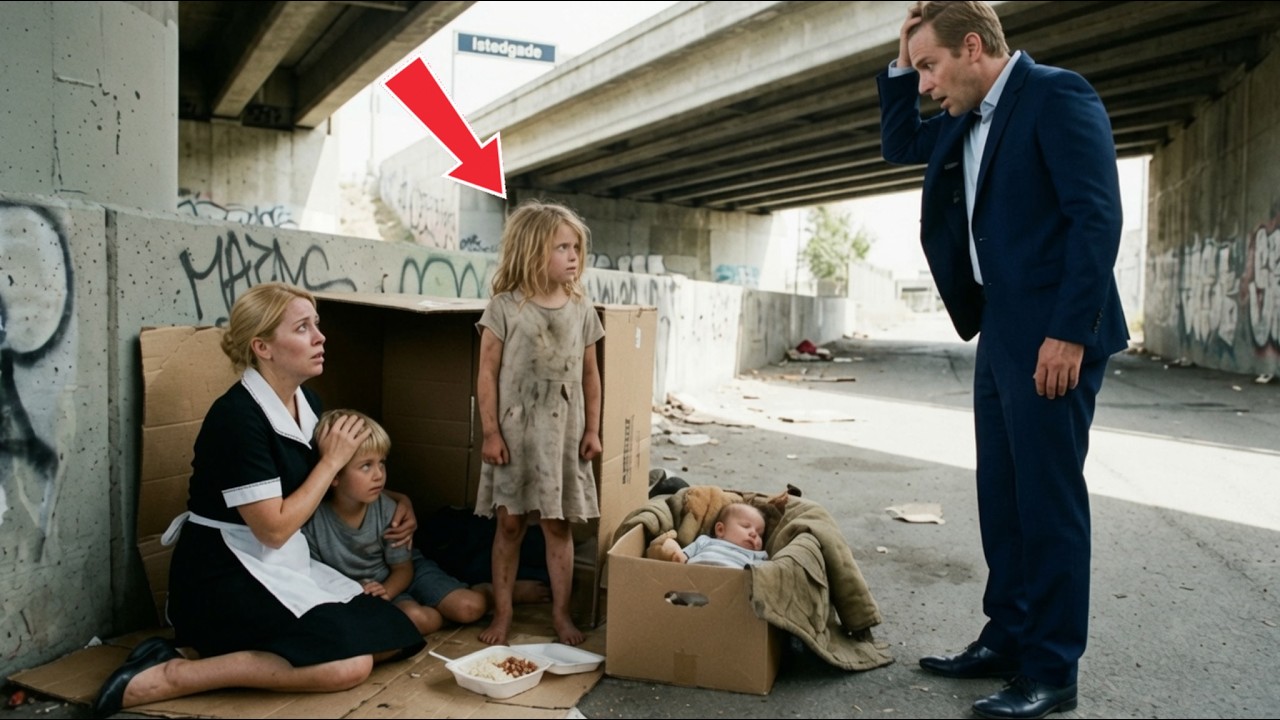
Mette didn’t cross the bridge. She stopped at the edge, looked around, and walked down a dirt path under the bridge. Lars stopped behind a concrete pillar ten meters away, and what he saw from there changed the way he understood every morning of the last three years. Under the bridge, on a rectangle of flattened cardboard boxes that was meant to be a floor, sat three children.
The oldest, a girl of about seven with her hair braided tightly and a clean blouse that was slightly too big, sat on an upside-down bucket combing the hair of a smaller boy with a comb missing three teeth. The boy was maybe five or six, sitting against the bridge’s concrete wall with an open notebook on his lap and a short pencil stub he was writing with, concentrating like someone performing the most important task in the world. And in the corner, inside a cardboard box lined with newspaper, lay a baby. A baby covered with a coat.
A coat. Lars recognized it before he understood what it meant. It was the same coat. The same coat Mette wore at the villa every day.
The coat she never took off. The coat everyone in the house had considered a harmless quirk of the employee. Mette and her coat. She doesn’t take it off even in May.
The coat that covered Mette’s shoulders during the day while she mopped floors and made bottles and bathed the triplets covered the body of a baby sleeping in a cardboard box under a bridge at night. The children saw Mette and ran toward her. The two older ones. The girl dropped the comb.
The boy closed the notebook. They ran with the speed children have when they’ve been waiting for hours and see the person they’ve been waiting for. Mette bent down and embraced them both at once. A tight, hungry embrace.
The embrace of someone who hasn’t seen the people she loves most in twelve hours and doesn’t know, every time she leaves them, if she’ll find everything the same when she returns. The girl pulled away first. She walked to a corner where a bucket of water and a plastic cup stood, and came back with the cup full. “Mom, we saved bread from breakfast for you.
It’s in the blue bag. ”
Mette drank the water, stroked the girl’s braid, then opened the plastic bag she had brought from the villa and took out a foam container of food. Lars recognized it. It was the lunch Mette prepared for herself every day in the villa’s kitchen.
The meal she served herself at noon while the triplets napped. The meal Lars had seen on the kitchen counter hundreds of times without ever asking himself whether Mette actually ate it. She didn’t eat it. She saved it and brought it here.
Mette opened the container, took out a spoon, and began feeding the boy with the notebook first. Then the girl. Spoonful after spoonful, distributing the food with the precision of someone who knows exactly how much each of them eats and how much needs to be left over to make it last. And she didn’t eat.
She didn’t bring the spoon to her mouth once. She broke off pieces of the bread the girl had saved from breakfast, cold and hard, bread that had been sitting half a day in a plastic bag under a bridge, and dipped them in the stew to soften them, and gave one to each. When the two children had finished eating, Mette walked to the cardboard box, carefully lifted the baby without waking him, cradled him to her chest, and fed him the rest of the soup. Small spoonfuls, the way you feed a baby who has just started eating solid food.
Spoonfuls the baby took half asleep, eyes closed, mouth opening on reflex. Lars stood behind the pillar, his hand on the concrete, his jaw so tight it hurt his teeth. What he was seeing wasn’t a scene of poverty. It was a system.
An organized survival system functioning with the precision of something repeated many times. The saved bread. The water in the bucket. The distribution order.
The baby last. A system Mette had built to keep three children alive under a bridge while she worked twelve hours a day cleaning a villa where everything they lacked existed in abundance. Then Lars noticed the details. The details that hurt more than the hunger, more than the cardboard box, more than the coat.
He looked at the children’s clothes. Clean. Not new. Not nice.
But clean. The girl’s blouse had a hand-sewn patch on the elbow. The boy’s trousers were patched at the knee. The baby’s clothes were tiny and faded, but clean and dry.
Someone washed those clothes. Someone hung them up. Dried them. Folded them.
Someone preserved the dignity of three children living on the street as if they lived in a house. He looked at the corner by the bridge wall. There was a cloth bag with books inside. The spines stuck up, worn with bent corners, but arranged by size.
There was an open pencil case with three short pencils and a pencil sharpener. There was a transparent plastic sheet laid over the cardboard to protect it from moisture. There was a covered container where they probably stored bread so the rats wouldn’t get it. Mette fed her children food she didn’t eat.
She gave them her coat so they could sleep. She washed their clothes somewhere Lars couldn’t imagine. She kept their books organized and their pencils ready and their homework done. She lived under a bridge and maintained the structure of a home where there was no home.
And she came every morning at seven to the villa in Rungsted Kyst with her pressed uniform and her shy smile and her cracked hands from washing clothes in cold water. And no one, neither Lars nor Helle nor the doctor nor anyone else, had ever asked where she came from or where she was going. Lars leaned against the pillar, closed his eyes, and felt something that had no name but resembled shame multiplied by three years of unasked questions, multiplied by every breakfast Mette served while her own children ate cold bread, multiplied by every night he slept in Egyptian cotton sheets while a baby slept in a cardboard box covered with its mother’s coat. He opened his eyes, wiped his face with his hand, and when he took a step forward, the girl with the braid saw him.
She saw him standing behind the pillar in clothes that didn’t belong in that neighborhood, with a face that didn’t belong in that world. And her eyes, dark, steady, serious in a way that didn’t fit her seven years, fixed on him with the look of someone who recognizes a threat before it’s declared. The girl stood up and positioned herself in front of her siblings, looking at Lars without blinking, waiting with clenched fists and a rigid back. The posture of a girl who has learned that strangers appearing near one’s home, even if one’s home is under a bridge, never bring anything good.
Three seconds later, Mette, who was sitting on the cardboard with Noah in her arms feeding him the last spoonfuls of soup, felt the change in her daughter’s body. The stiffness. The posture. The fists.
She lifted her gaze where Freja was looking, and when she saw Lars Hansen standing behind the viaduct’s pillar in his shirt and leather shoes, his face like a man who had just seen something he couldn’t process, the color drained from her face. Like water running out of a drain. She stood up from the cardboard with Lukas still in her arms. The baby woke from the movement and made a soft sound.
Not crying. Complaining. The complaint of a one-and-a-half-year-old who was asleep and now feels something has changed in his mother’s body. The tension.
The trembling. The heart beating so hard the baby could feel it against his ear. “Sir,” Mette said, and the word came out broken, half swallowed by fear. The total fear of someone who has just lost the only thing she had left.
The secret that held everything together. “Sir, please don’t fire me. I know I should have told you. I know I should have said I have children, and that I live, that we live.
” Her voice cracked. Tears began to fall, but she didn’t wipe them away, because she was holding Lukas with one arm and reaching out her other hand, as if her open palm could stop what was happening. “If you know I live like this, you’ll think I’m a bad mother. That I can’t take care of your children if I can’t take care of my own.
And I need this job. This job is all I have. If you take it from me, we have nothing. Nothing.
”
Lars didn’t answer. Not because he didn’t want to, but because he couldn’t. His jaw was locked, and his eyes were fixed on something in front of Mette. Something that had caught his attention even before Mette began to speak, and now occupied all his awareness.
Freja. The girl stood between Lars and her siblings, barefoot on the damp ground, her arms slightly spread at her sides. Not like a seven-year-old girl, but like someone who has learned that when there’s danger, the first thing you do is position yourself between the danger and what you want to protect. Behind her, Noah sat against the bridge wall, his notebook pressed to his chest, big open eyes watching Lars with the stillness of a child who has learned that when a stranger appears, it’s best not to move.
Freja looked at him. She looked him straight in the eyes without lowering her gaze, without stepping back, with a look that wasn’t a child’s, but someone forced to grow up too soon because circumstances gave her no other choice. And when she spoke, her voice was steady in a way that didn’t match her age or her size. “If you want to yell at my mother,” Freja said, “yell at me.
”
Lars blinked. The sentence hit him with a force he hadn’t expected, not because of the words, but because of the way she said them. Without hesitation. Without trembling.
With the absolute certainty of someone who has made a decision and won’t change it, no matter what happens next. “She works all day for you,” Freja continued, without moving her feet from where she was planted. “She leaves at six in the morning, when it’s still dark, and comes back at seven in the evening, when it’s already dark again. She gives us her food.
She gives us her blanket. ” The girl pointed at the coat in the box without turning around. Turning would mean stopping looking at Lars. And Freja wouldn’t stop looking at him.
“She doesn’t sleep. I hear her at night. She lies down when we sleep and gets up before we wake. She lies on the cardboard with nothing over her.
Because everything she has, she gives to us. ”
Mette took a step forward with Lukas in her arms. “Freja, be quiet, my daughter. Don’t talk to the master like that.
”
“No, Mom,” Freja said without turning. “You always tell me to be quiet. To not say anything. To endure.
But I don’t want to be quiet anymore. ”
The girl looked at Lars again. Tears had started to fall, but her voice didn’t tremble, as if her tears and her voice were two separate things that could function simultaneously without affecting each other. “My mother isn’t lazy, sir.
It was those people who threw her out of the other house. My mother paid her rent every month. She never owed anything. But three months ago she didn’t have enough money anymore, and the man in the house threw us out.
Threw us out with all my siblings, with the baby and my mother. She looked for another room, but she couldn’t afford it, because her money got smaller. Her money got smaller from one month to the next, and she doesn’t know why. ”
Lars felt something move in his chest.
A cold, heavy movement, like a stone shifting at the bottom of a lake. “What do you mean, her money got smaller? ”
Freja looked at him with wet but steady eyes. “My mother earned twelve thousand.
I know because she taught me to count money. She says women should always know how much they earn, so no one can cheat them. Three months ago she started earning six thousand from one day to the next. ”
The cold in Lars’s chest became something heavier.
Something that wasn’t cold. But the shadow of a suspicion he didn’t yet want to face. “Did your mother say why her salary was lowered? ”
“My mother doesn’t talk about it,” Freja said.
“My mother doesn’t talk about anything that makes her cry in front of us. But I heard her on the phone with my aunt one night. She said the lady of the house told her she would pay her less from now on. And when my mother asked why, the lady said if she complained, she would fire her and tell the master she was a thief.
”
Lars closed his eyes. He closed them with the force of someone who needs a moment of darkness to process something too bright and too terrible at the same time. The lady of the house was Helle. His wife.
The woman he slept next to every night and ate breakfast with every morning and had been married to for eight years. She had halved Mette’s salary without telling him, pocketed the difference. And when Mette tried to speak up, she silenced her with the threat of termination and an accusation of theft. And the result of that decision stood in front of him.
Three children living under a bridge. A woman collapsing from hunger in his kitchen. A baby sleeping in a cardboard box, covered with the coat his mother didn’t take off during the day. Because if she took it off, her son would have nothing to cover himself with at night.
He opened his eyes, looked at Freja, looked at Noah still sitting against the wall with his notebook pressed to his chest, and spoke to the boy in the soft voice of someone trying not to scare someone already afraid. “May I see your notebook? ”
Noah looked at Freja. Freja looked at him, and with an almost imperceptible nod, gave silent permission between siblings who have their own language.
The language of children who have learned to communicate without words, because words sometimes attract trouble. Noah stood up from the wall, walked three steps to Lars, and held out the notebook with both hands. Lars opened it. On the first page, in a woman’s handwriting, in his mother’s handwriting, written in blue ink: “Read, my darling.
One day we’ll have a real home. ” And below it, in a child’s handwriting, the trembling, crooked handwriting of a five-year-old boy who hasn’t yet mastered the curves of letters, written with the blunt pencil: “I want to be a doctor to heal my mother. ”
Lars closed the notebook. Closed it slowly with both hands and gave it back to Noah.
And when the boy took it and pressed it to his chest again, Lars turned toward the canal so nobody could see his face. But Freja saw it. And Mette saw it. And what they saw was a forty-year-old man crying silently in front of a canal of black water, his shoulders shaking, his hands clenched at his sides.
His jaw tight with something that wasn’t cold. But the accumulation of everything he had seen in the last hour. The cardboard. The box.
The coat. The distribution of food. The organized books. The blunt pencil.
The nine words in the notebook from a five-year-old boy who wanted to be a doctor to heal the woman who was killing herself to keep him alive. Lars wiped his face with his shirtsleeve, turned, walked to Mette, and without saying a word took off his own coat. Not Mette’s coat. His own.
His expensive wool coat that cost more than Mette earned in a month. And he placed it over her shoulders with the delicacy of someone performing the first correct action after three years of absent actions. Mette looked at him with red eyes, Lukas in her arms, Lars’s coat over her shoulders, fear still on her face, but now mixed with something that looked like confusion. The confusion of someone who expected a blow and received something else.
Lars bent down in front of the cardboard box. He looked at it. He looked at the crumpled newspaper that served as a mattress. He looked at the imprint Lukas’s body had left in the cardboard from sleeping there so much.
Then he stood up, walked to Mette, extended his arms, and Mette, after a moment’s hesitation, gave him the baby. The hesitation of a woman who hasn’t trusted anyone for three years. Because the last time she trusted someone, her salary was halved. Lars held the baby against his chest with the awkwardness of a man who has four-year-old triplets but has never held someone else’s child.
And Lukas settled against him with the ease of babies who don’t distinguish between rich and poor, who only distinguish between arms that hold and arms that don’t. He looked at Freja. The girl still stood in the same spot, fists at her sides, braid tight, eyes wet but dry at the same time, the posture of someone who still doesn’t know if what’s happening is good or bad, and won’t lower her guard until she’s sure. “No one will yell at your mother,” Lars said, looking her in the eyes.
“Never again. No one. ”
Freja didn’t answer. Didn’t move.
She looked at him for another second with those eyes that had seen too much for a seven-year-old, and something loosened in her face. Not a smile. Not yet. But the first sign that the tension holding her jaw tight was beginning to give way.
“Come,” Lars said. “Get your things. You’re coming with me. ”
Freja looked at her mother.
Mette looked at Lars, and across her face passed something that wasn’t gratitude yet, but something before gratitude. Something like the relief of someone who has been holding her breath for months and finally, finally lets the air out. Freja was the first to move. She walked to the bridge wall, grabbed the cloth bag with the books, the pencil case, the bag with the clean clothes.
She folded the plastic that protected the cardboard. She put the comb with three teeth in her trouser pocket, and picked up a plastic grocery bag from the ground that Lars hadn’t noticed before. A crumpled bag tied with a knot, which Freja carried with both hands, pressed to her body with the care of someone carrying something more valuable than anything else. Lars didn’t know what was in the bag.
He didn’t ask. He walked toward the car with Lukas in one arm and the book bag in the other. Behind him walked Mette with Noah by the hand, and Freja last in line, looking back one final time to make sure they hadn’t left anything behind. Because children who have lived with nothing learn that nothing should be left behind.
The drive home took forty minutes. Forty minutes during which Lars drove the car through the same streets Mette traveled twice a day by bus. The unpaved streets of the industrial area in Sydhavnen. Then Østerbrogade.
Then the city center. Then the tree-lined boulevards of the west. And for every kilometer the car moved toward Rungsted Kyst, the contrast became more stark. The sidewalks became nicer.
The facades painted. The trees more numerous. The world transformed into the world Lars lived in, forty minutes and an entire universe away from where Mette slept with her children on cardboard. Mette sat in the passenger seat with Lukas sleeping in her arms, her gaze fixed straight ahead, not speaking, with the posture of someone who still doesn’t know if what’s happening is real, or if she’ll wake under the bridge with gravel stuck to her cheek and the sound of the dirty canal behind her.
Noah sat with his notebook on his lap, his face pressed to the window, watching the passing houses with eyes as big as saucers. Because for a five-year-old child who sleeps under a bridge, the existence of houses with gardens and garages and white-painted fences is not something you know. And discovering it suddenly, while the car drives at eighty kilometers per hour, is like discovering the world is bigger and more unfair than you imagined. Freja sat behind Lars in silence, the grocery bag on her lap, her hands on the bag, her gaze fixed forward.
Without looking at the houses, without looking at the gardens, without looking at any of the things that could amaze a child. Because Freja was seven, but she had the gaze of someone who stopped being amazed by the world the day a man knocked on the door of the room they lived in and said they had twenty-four hours to move out. “How long did you live there? ” Lars asked, without taking his eyes off the road.
Mette didn’t answer. She pressed Lukas against her chest and looked out the window. And the silence she left was the silence of a woman who doesn’t know how to say what she needs to say. Because saying it aloud makes it more real.
“Three months,” Freja said from the back seat. “Eighty-seven days. I counted them. ”
Lars adjusted the rearview mirror to see the girl.
“You counted them? ”
“Every night, before I sleep, I make a mark on the bridge wall with a stone,” Freja said, with the naturalness of someone explaining something she does every day, like brushing her teeth or combing her hair. Except what she did every day was count the days she had lived on the street. “Mom doesn’t want me to.
I do it when she sleeps. ”
“Eighty-seven marks, Mom,” Freja continued. “Eighty-seven days of sleeping on cardboard. ”
The silence that followed filled the entire car.
Lars gripped the wheel. Freja kept talking, not because anyone asked her to, but because she had held it inside for eighty-seven days and the dam had broken, and the water flowed out with all the force that had been stored up. “Before, we lived in a room in Nørrebro,” Freja said. “It was small, but it had a door with a lock, and a stove, and a bathroom we shared with the neighbors.
Mom paid thirty-two hundred a month. It was enough. There was nothing left over, but it was enough. Mom bought a chicken on Sundays, and it lasted until Wednesday.
From Thursday to Saturday we ate beans with bread, and on Sunday, chicken again. ”
Lars listened to her. He listened to a seven-year-old girl’s accounting, who knew exactly what the room cost, what the chicken cost, how many days the food lasted. Because in families where money doesn’t stretch, children learn to count before they learn to read.
“Three months ago, Mom came home one Friday with less money,” Freja continued. “She didn’t tell us why, but that week there was no chicken on Sunday. Or the next. And then the man from the room came three times to demand money.
And Mom asked for time, and he said no. And one evening he came with a locksmith and threw our things out on the sidewalk. ”
“At night? ” Lars asked, his voice restrained.
“It was around ten. Noah was already sleeping. Mom carried him with one hand and grabbed the clothes bag with the other. I took the books and Noah’s notebook and the bag with the papers.
Lukas was on Mom’s back in a scarf. ”
Freja paused. “We walked a lot that night. Mom looked for a place where it didn’t rain.
She found the bridge. There was cardboard underneath. It was empty. Mom put Lukas on the cardboard.
She covered us with the coat and the blanket we managed to bring, and sat next to us without lying down. She didn’t sleep that night. Neither did I. I pretended to sleep, but I watched her sit and look at the canal all night with Lukas in her arms.
”
Lars ran a red light. He didn’t see it. He saw nothing except the image Freja was drawing in his head. A woman sitting on cardboard under a bridge at night with a baby in her arms, looking at a canal of black water, not sleeping, not crying, not complaining.
Just sitting in the dark and deciding that the next day she would get up and go to work in a villa where everything she lacked was in abundance. “The first nights it rained,” Freja said. “The water came in from one side of the bridge. Mom moved us all to the other side and put the plastic over the cardboard, but the water seeped in underneath.
Lukas got sick with a cough the second week. Mom took him to the pharmacy on the corner and bought cough syrup with the little she had left. I put wet cloths on his forehead, the way Mom taught me. ”
Noah looked at his sister.
“Freja, don’t tell about the rats. ”
“Yes, I’ll tell it,” Freja said. “One night rats came. Two big ones.
They came up under the cardboard looking for bread. Mom scared them away with a stick, but Noah couldn’t sleep that night. Or the next. Or the one after.
Now he sleeps with his shoes on, because he says rats don’t bite through shoes. ”
Lars looked in the mirror at Noah. The boy had his head down, his hands gripping the notebook tightly. And his feet.
The feet with shoes. The shoes he wore inside the car, the shoes he didn’t take off, even now, pressed against the floor. They arrived in Rungsted Kyst at three fifteen. Lars parked the car in the driveway.
He got out, opened the passenger door for Mette. And when they walked toward the entrance of the house, Mette automatically turned toward the service door. The side door. The door she had used to enter and leave every day for three years.
The door that was not the front door, because the front door wasn’t for her. “This way,” Lars said, standing in front of the front door with his hand on the handle. “You come in this way today. ”
Mette looked at him, looked at the door, and walked in with Lukas in her arms and her eyes full of something that wasn’t gratitude yet, but confusion.
The confusion of a woman who has used the service door for three years and doesn’t know how to walk through the front door of a house she knows by heart but has never seen from this angle. What followed in the next three hours was something Lars observed from the sidelines with a tight stomach and open eyes, because every single detail revealed something he should have known and didn’t. Mette bathed the three children in the guest bathroom, one by one, with warm water the children touched as if it were something extraordinary. Noah put his hands under the stream and looked at his mother with an expression Lars would never forget.
The expression of a five-year-old discovering that water can be warm. Freja washed her own hair standing in the shower with her eyes closed and her head back, her hands rubbing in the shampoo with an adult’s efficiency. Because Freja had gone months without shampoo and warm water and a shower, but she hadn’t forgotten how to do it. And Lukas cried when the water hit his back, not from pain, but from surprise.
The surprise of a baby who only knew the cold water from the bucket and didn’t know another temperature existed. Mette dressed them in clean clothes, the same patched and mended clothes, but clean. Always clean. Lars sent Birgitte, the other employee who came on Saturdays, out to buy new clothes for the three children.
Birgitte came back with bags, and Freja looked at the new clothes without touching them, her hands at her sides, with the expression of someone who doesn’t know if she’s allowed to take what’s offered, because she’s never been offered anything. “They’re for you,” Lars said. Freja looked at her mother. Mette nodded with red eyes, and Freja took the blouse with both hands and looked at it the way you look at important things.
Carefully, attentively, with the gravity of a girl who knows what everything costs, because she has watched her mother count coins in the dark under a bridge. Lars’s triplets came down the stairs at four o’clock, when they woke from their nap. Emil was the first to see them. He stopped on the bottom step, looked at the three children sitting at the kitchen table eating hot soup, and shouted up the stairs: “Victor, Ida, come down.
It’s Mette’s children. She always told us about them. ”
And the three ran down and sat at the table with Mette’s children and ate together. Six children around a table with bowls of soup.
Lars leaned against the kitchen wall and watched the scene with a tight jaw. Because his triplets knew Mette had children, and he didn’t. His four-year-old triplets knew more about the life of the woman who cared for them than he did. He, who signed the payroll every two weeks.
At eight o’clock, Mette’s children were sleeping in the guest room. Noah fell asleep in three minutes, buried deep in the pillow with a depth only children who have slept on cardboard for months achieve, and who suddenly discover that beds exist. Lukas slept in Mette’s arms in a bed without a box, without newspaper, without the cold of the concrete under the cardboard. But Mette placed the coat over him.
The old, worn coat that smelled of the villa by day and the bridge by night. She placed it over Lukas, even though the room was warm and the duvets were sufficient. Because the coat was no longer just a coat. It was a promise that his mother was near.
The scent of what remained of a home when there was no longer a home. Freja was the last to lie down. She lay in bed with the grocery bag next to her pillow. Mette told her to put it on the table.
Freja said no. Mette didn’t insist. She knew her daughter. She knew the stubbornness that wasn’t stubbornness but a protective instinct.
The same stubbornness that made her stand in front of Lars with clenched fists to defend a mother who couldn’t defend herself. At ten o’clock, with the house silent and the six children sleeping, Lars sat at his desk on the first floor, opened his computer, and logged into the household accounting system. He searched for Mette’s salary record, and what he found confirmed everything Freja had told him under the bridge. The salary record showed twelve thousand every two weeks.
That was what Lars approved. That was what left his account. But when he opened the expense file Helle managed, the file over the household’s variable expenses, which included supermarket purchases, the gardener, dry cleaning, and cash payments to staff, he found something that shouldn’t be there. A weekly withdrawal of six thousand under the category “personal supplement, CEO” for the last three months.
Helle Jørgensen. Six thousand every two weeks, which Helle paid to herself with the money she took from Mette. Lars did the math. Three months.
Six thousand each time. Six withdrawals. Thirty-six thousand kroner. Helle had stolen thirty-six thousand kroner from a woman who earned twelve thousand, who had three children, who had no husband, who had no family in Copenhagen, who had nothing except a job and the dignity to keep her children clean and fed and schooled on half the salary she was owed.
And when the money no longer stretched to the room, and Mette was thrown out onto the street with her three children, Helle continued to sit at the dining table eating dinner with Lars as if nothing had happened. She continued to spend money on restaurants and handbags and beauty salons. She continued to live in a villa in Rungsted Kyst while the woman she stole from slept under a bridge with a baby covered by a coat. Lars closed the computer.
Turned off the lamp. Sat in the dark of his office with his hands clasped and his jaw clenched, knowing that the woman sleeping ten meters away in the bedroom was not the woman he thought he had married. At two in the morning, he got up for a glass of water. He walked to the kitchen in silence, without turning on lights, guided by three years of habit.
And when he reached the kitchen, he found someone sitting at the kitchen table. Freja, her legs dangling from the stool because they didn’t reach the floor, the grocery bag on her lap, her eyes open in the dark, looking out the kitchen window at the illuminated garden, with the expression of a girl who can’t sleep, because she’s been without a roof for three months, and suddenly she has a roof and walls and a bed and blankets, and her body doesn’t know how to process the difference. “Can’t you sleep? ” Lars asked, sitting on the stool next to her.
Freja shook her head. “Are you scared? ”
“No,” Freja said. “It’s just that the bed is so soft, and I feel strange.
Under the bridge, I fell asleep quickly, because I was tired. Here I’m not tired, and the bed is so soft I don’t know how to lie in it. ”
Lars looked at her. He looked at the grocery bag on her lap.
“What do you have in there, Freja? ”
Freja squeezed the bag. She looked at him with narrowed eyes, assessing him, measuring him with the gaze of someone who has learned not to trust anyone, and who needs a moment to decide if this time is different. After a silence that lasted as long as an important decision takes, three seconds, four, five, she spoke.
“My mother always says one thing,” Freja said. “She says the truth always needs proof, Freja. If you don’t have proof, your truth is worth nothing. ”
The girl looked at the bag.
“My mother keeps every pay slip she gets. All of them, since she started working here. She keeps them in a plastic bag, and I keep them in mine. My bag, because my mother says important papers should be kept by someone you trust.
”
Lars felt the air in the kitchen grow heavier. “Here are all the slips from the last three months,” Freja said, opening the bag slightly so Lars could see inside. Folded papers. Handwritten pay slips in Helle’s handwriting.
With dates and amounts and Mette’s signature. Each one saying six thousand. “But my mother taught me she used to get twelve. The lady of the house began giving her half, and when my mother asked, the lady said if she talked, she would fire her and tell the master she was stealing.
My mother doesn’t steal, sir. My mother has never stolen anything. She doesn’t even eat the food from this house. She takes it to us.
”
Lars reached out his hand. “May I see them? ”
Freja looked at him. She squeezed the bag for another moment, and then, with the slowness of someone handing over something she has protected for eighty-seven nights under a bridge, she loosened her hands and gave him the bag.
Lars opened it, took out the slips, spread them across the kitchen table, one next to the other. Six slips. Six times two weeks. Each in Helle’s same handwriting.
Each with the same amount. Six thousand. Each with Mette’s trembling signature and the date and the note “salary, every two weeks, housekeeper. ”
Six pieces of paper that told the whole story of what had happened.
A rich woman stole half of a poor woman’s salary for three months, and the poor woman said nothing, because the rich woman threatened her. And the result was three children sleeping on cardboard under a bridge, while a baby used an adult’s coat as a blanket. “Freja,” Lars said quietly, looking at the slips on the table. “Tomorrow I’ll need to borrow these papers for a moment.
I’ll give them back to you. Do we have a deal? ”
Lars looked at her. He looked into the eyes of a seven-year-old girl who had hidden six pay slips for three months under a bridge, because her mother had taught her that truth needs proof, who had slept with the plastic bag under her head like a pillow so no one could take it from her, who had carried that bag from the cardboard to the car and from the car to the bed, and who now sat in a kitchen that cost more than everything her family had ever earned, offering the evidence that could change everything, in exchange for one thing.
That it be given back. “I promise,” Lars said. Freja nodded, climbed down from the stool, walked toward the kitchen door, and before she left, she turned around and said something Lars heard as if it were a verdict. “My mother doesn’t need you to save her, sir.
My mother saved us herself. What my mother needs is for someone to see the truth. And the truth is in those papers. ”
She walked silently down the hallway, barefoot on the cold tiles, her back straight like a girl who just handed over the most valuable thing she had, and disappeared into the darkness of the guest room, where her mother and her siblings, for the first time in eighty-seven nights, slept under a roof that wasn’t concrete.
Helle came down the stairs Sunday morning at nine, in her silk robe, her hair in a loose bun, her face makeup-free, like someone expecting an empty kitchen, coffee ready, the newspaper on the table. What she found was something else. The six children sat around the kitchen table. The triplets on one side, Emil, Victor, and Ida.
And Mette’s children on the other. Freja, Noah, and Lukas, in the high chair Lars had taken from the cupboard, the one Ida no longer used and Lukas needed. Mette stood at the stove, serving scrambled eggs onto six plates with the same precision as always, the same care as always. Except this time she wasn’t serving three plates.
She was serving six. And the three extra plates were for her own children, who for the first time in eighty-seven days were eating warm eggs at a table. Helle stopped at the kitchen entrance. Her gaze scanned the scene with the speed of someone processing something that wasn’t in her plans.
The unfamiliar children. The new clothes. The high chair. The extra plates.
Mette serving food with an expression Helle had never seen on her. Not the usual shy, downcast expression, but something that looked like calm. The minimal, fragile calm of a mother who can watch her children eat warm food. “What is this?
” Helle said, her voice not yet a shout, but already carrying the edge of something about to become one. “Good morning, Helle,” Lars said from the table, where he was drinking coffee, his newspaper folded, his gaze fixed on his wife. “These are Mette’s children. They’re staying.
”
The silence lasted two seconds. Then Helle crossed the kitchen in three steps and positioned herself in front of Lars with narrowed eyes, her voice rising in volume with every word. “What are those children doing in my house? Who brought them?
Who approved this? ”
Emil lifted his head from his plate, confused. “Mom, these are Mette’s children. She always tells us about them.
Freja is the big one. Noah is the one with the notebook, and Lukas is the baby. Right, Mette? ”
Mette didn’t answer.
She stood at the stove with the pan in her hand, her eyes fixed on the floor, because Helle’s presence in the kitchen activated the same reflex that had been activated every time she was near her for three months. The reflex to make yourself small. To not take up space. To disappear.
“Lars,” Helle said, lowering her voice to a tone that was worse than a shout, because it was the tone she used when she was calculating, when she was measuring, when she was choosing words as tools. “I want to talk to you in the living room. Now. ”
Lars set down his coffee.
Stood. Walked into the living room. Helle closed the door behind them, and before Lars could sit, she spoke with the speed of someone who needs to control the narrative before it slips away. “I don’t know what that woman has told you, or what story she’s invented, but those children can’t stay here.
This is our house, Lars. Our family’s house. It’s not a shelter. It’s not a refuge for the employee’s children.
If Mette has personal problems, she has to solve them herself. We pay her to work, not to bring her family to live with us. ”
“How much do we pay her, Helle? ” Lars asked.
The question came with the calm of someone who already knows the answer, and who asks it not to be informed, but to observe the reaction of the person answering. And the reaction was exactly what Lars expected. A blink. Minimal, almost imperceptible, lasting a tenth of a second, but containing everything.
Surprise. Calculation. Recalibration of someone who has just understood that the conversation isn’t going the way she thought. “Twelve.
Every two weeks,” Helle said, without blinking again. “What we’ve always paid her. ”
“And that’s what you give her every two weeks? The full twelve?
Where are you going with this, Lars? ”
Lars looked at her. He looked at her with the gaze of a man who had spent the night reviewing numbers on a computer and found a column that said “personal supplement, CEO,” and who now needed to hear the complete lie from his wife’s mouth before he destroyed it with the truth. “Nowhere,” Lars said.
“I just want you to confirm that you pay her the full twelve. ”
“Yes, Lars. The full twelve. Satisfied?
”
Lars nodded. He said nothing more on the subject. And that silence, the calculated silence of a man who has evidence but chooses not to show it yet, was what changed Helle’s tone. Because Helle recognized silences, and she knew Lars’s silences were more dangerous than his words.
“I want those children out today,” Helle said, shifting strategy, returning to direct attack. “And I want Mette to understand that her job is to clean this house, not to install her family here. ”
“Mette and her children are staying,” Lars said. “If they stay, I go.
”
“That’s your decision. ”
Helle looked at him. The threat of divorce was her strongest card. It had always been, in every discussion, every disagreement.
The possibility of leaving was the weapon Helle pulled when she needed to win, because she knew Lars was afraid of the breakup, the scandal, the disorder of a separation. But this time Lars’s face didn’t change. He didn’t tense. He didn’t hesitate.
He didn’t lower his gaze. And that destabilized her. “I’m leaving, Lars. And I’m taking the triplets with me.
”
“You’re taking no one. They’re my children. ”
“They’re our children. And no judge will give you custody when they see what you’ve done.
”
The sentence fell into the living room like a coin on a glass table. Helle stood still. Her face changed. It went from strategy to fear in an instant.
The rapid, sharp fear of someone hearing something she didn’t expect, needing three seconds to calculate how much the other person knows and how much the other person is guessing. “I don’t know what you’re talking about,” Helle said. And for the first time, her voice wasn’t calculated or cold, but defensive. The voice of someone building a wall with bricks she doesn’t yet have.
“I think you do,” Lars said. Helle clenched her jaw, shifted her weight, crossed her arms, and threw the last thing she had. “If you insist on this, I’ll call my lawyer and say the employee stole from us. I have proof.
I can say things went missing in the house, that food disappeared, that I found less money. Who will they believe, Lars? Your wife, or the maid? ”
The word “maid” came out of Helle’s mouth with the same contempt she had used three months earlier when she told Mette that if she complained, she would accuse her of theft.
The same contempt that allowed her to halve her salary without losing any sleep. The same contempt that allowed her to eat dinner at a restaurant in Gentofte while the woman she stole from slept under a bridge with a baby in a cardboard box covered with a coat. “They would believe the evidence,” Lars said, his voice steady. “And the evidence exists.
Helle. ”
Something broke in Helle’s face. It wasn’t a visible break. It was something beneath the surface, like a crack in a wall that can’t be seen from outside but weakens the entire structure.
She stood in front of Lars, arms crossed, jaw clenched, eyes darting left and right, calculating, recalculating, searching for an exit she couldn’t find. “You’re making a mistake,” Helle said, in a voice that tried to sound threatening but came out thinner, more fragile. The voice of someone who knows she’s losing and is trying to buy time. “A mistake that will cost you dearly.
”
She turned, left the living room, went up the stairs, and from the first floor her voice came down with a clarity intended to be heard. “Mette. Pack your things and your children’s things. You’re leaving today.
And if you don’t, my lawyer will report you for theft tomorrow. ”
Lars walked out of the living room and into the kitchen. What he found squeezed his chest like a fist. Mette was packing.
She was on her knees on the staff room floor, stuffing her children’s clothes into the cloth bag with shaking hands and tears falling on her hands. The quick, mechanical movements of someone who has learned to pack in minutes. Because the last time someone said “you’re leaving,” she had twenty-four hours, and this time she wouldn’t wait a second. “I don’t want to cause more problems, sir,” Mette said without lifting her gaze, her voice broken, her hands packing one of Noah’s t-shirts that still smelled of shampoo from yesterday’s bath.
“You’ve already done more for us than anyone ever has. But I know the lady. She’ll follow through. She’ll report it.
And if I’m accused of theft, I won’t be able to work anywhere. And my children, we have nothing. ”
“Mette,” Lars said, kneeling in front of her. “Stop.
Put the bag down. No one is going anywhere. ”
“But the lady—”
“The lady no longer makes decisions in this house. ”
Mette looked at him from the floor with red eyes and hands gripping Noah’s t-shirt, the expression of a woman who wants to believe but hasn’t been able to believe anything for three months.
Because every time she believed things would get better, they got worse. In the kitchen doorway, leaning against the frame, stood Freja with the grocery bag in her hands, pressed to her chest, watching her mother on the floor, watching Lars kneeling, watching the stairs where Helle’s voice had come from. And in her eyes, those seven-year-old eyes that had counted eighty-seven marks on a bridge wall, there was something that wasn’t fear. It was decision.
The decision of someone who has hidden something for eighty-seven nights and knows the time has come to bring it out. Freja squeezed the bag, looked at her mother, looked at Lars, and walked into the living room without being asked. Freja stepped into the living room with bare feet on the marble floor and the grocery bag pressed to her chest with both hands. Helle was coming down the stairs with a small suitcase, phone to her ear, talking to someone, probably her lawyer, probably preparing the report.
Lars stood in the living room, saw Freja enter, saw the bag, and understood what was about to happen before it happened. Because the conversation at two in the morning in the kitchen had taught him something about that girl. Freja did nothing without purpose. Every movement was calculated with the precision of someone who has learned that in the lives of the poor, there is no room for mistakes.
Helle lowered the phone when she reached the bottom step. She looked at Freja standing in the living room with the bag. “And what is that child doing here? Mette, take your children and go.
”
“Lady,” Freja said. The word came out of the girl’s mouth with a clarity that stopped Helle mid-sentence. It wasn’t a shout. It wasn’t a challenge.
It was the voice of a seven-year-old girl who had rehearsed this moment eighty-seven times in her head. Once for each mark on the bridge wall. Once for each night. Freja walked to the coffee table in the living room, placed the bag on the table, opened it, and began taking out the pay slips.
She took them out one by one, with both hands, with the same delicacy you use to take out important things. Not fast, not suddenly, but slowly, carefully, placing each paper on the glass table with the solemnity of evidence placed on a judge’s desk. Six slips. Six paydays.
Six pieces of paper folded in four, which had survived three months under a bridge, inside a plastic bag, inside the hands of a girl who protected them the way other children protect their favorite toys. “My mother doesn’t lie,” Freja said, her voice steady, her eyes fixed on Helle. “My mother has never lied. My mother has never stolen.
Here is the proof. ”
Helle looked at the slips. Her face went through three expressions in two seconds. Confusion.
Recognition. Panic. Confusion, because she didn’t expect a seven-year-old girl to have documents. Recognition, because she saw her own handwriting on every slip.
The amount. The date. Mette’s signature, which she had forced her to give every two weeks when she handed over half of what she was owed. And panic, because in that moment she understood that what lay on the table was the proof that wasn’t supposed to exist.
The proof she thought didn’t exist. Who keeps pay slips when you live under a bridge? Mette kept them. Mette kept every paper she received.
Because a woman who grew up with nothing learns that papers are the poor’s only defense against the rich’s words. And she gave them to Freja, because Freja was the most reliable person she knew. More reliable than any adult. More reliable than any bank.
More reliable than any locked drawer. Because Freja was seven years old and had the wildness of a creature that protects what it’s entrusted with, with her life. Helle reached out her hand toward the slips. A quick, instinctive movement.
The hand of someone wanting to remove the evidence before it was too late. But Lars was faster. He placed his hand on the papers before Helle touched them, gathered them from the table, and took out his phone. He photographed them one by one, all six, one after another, with the date visible, the amount visible, Helle’s handwriting visible, Mette’s signature visible.
Six photos automatically saved to the cloud, which could no longer be deleted, torn, or denied. “Thirty-six thousand,” Lars said, putting his phone away and looking at Helle with a calm more devastating than any shout. “Six times two weeks. Six thousand you took each time.
Thirty-six thousand kroner. You stole from a woman who earns twelve, who has three children, who has no husband, who has no family, who has nothing except this job. Thirty-six thousand you spent on your dinner in Gentofte, your bags, your salon, while she slept under a bridge with a baby in a cardboard box, covered with a coat, because she had no blanket. ”
Helle didn’t answer.
Her hand was still extended toward the table where there were no more slips. Her mouth was slightly open. Her eyes moved rapidly between Lars and Freja and the door and the stairs, searching for an exit that didn’t exist. Because exits close when truth has evidence.
“And when she asked you why,” Lars continued, “you threatened her. You said that if she spoke, you’d fire her and tell me she stole. You silenced her with fear. You made her choose between staying quiet and living on the street, or speaking and losing her job.
And she stayed quiet for three months. She stayed quiet while her children slept on cardboard and ate cold bread. She stayed quiet while she collapsed from hunger in my kitchen, preparing a bottle for my daughter. ”
The living room was silent.
The kind of silence that exists after the truth has taken up all the space, and there’s no room for anything else. Freja still stood at the table, hands at her sides, gaze fixed on Helle. Without hatred. Without revenge.
With the expression of a girl who has just completed the only mission she had, and now waits to see what happens to the truth once it finally has proof. Mette appeared in the living room doorway. She stood in the frame with Lukas in her arms, Noah clinging to her trousers, her eyes red, her face wet with tears, because she had heard everything from the kitchen. Every word from Freja.
Every number from Lars. Every silence from Helle. And what was in her face wasn’t shame or fear, but something Mette hadn’t allowed herself to feel in three months. The feeling of being seen.
Helle looked at Mette. She looked at the woman she had stolen thirty-six thousand kroner from, standing in the doorway with a baby in her arms and a child clinging to her leg, in the clean clothes that were always clean, holding the dignity that was always intact. And what passed across Helle’s face wasn’t remorse. It was the discomfort of someone seeing herself reflected in the eyes of the person she has harmed, and not being able to hold the gaze.
“Tomorrow my lawyer will contact you,” Lars said. “You will repay every kroner, and you will sign what needs signing. Tonight, you leave. ”
Helle went upstairs without answering.
She packed two suitcases, called a taxi, and left the villa in Rungsted Kyst at eleven o’clock on Sunday morning, through the same door she had entered eight years earlier. Except this time no one walked her to the door, no one carried her suitcases, and no one said goodbye. The triplets didn’t understand why their mother was leaving with suitcases. Lars told them their mother needed a few days away.
Emil asked if Mette and the children would stay. Lars said yes. And Emil took Noah by the hand and pulled him into the living room and said, “Come, I’ll show you my cars,” with the naturalness of a four-year-old for whom things are simple. The people who stay are the people who matter.
The six children gathered in the living room that afternoon. The triplets showed Noah their toys, and Noah looked at them with the same expression he had looked at the warm water. The expression of someone discovering that there are things other children take for granted. Freja sat on the sofa with Ida on her lap and read her a story with the patience of a girl who has read stories to her siblings for years and doesn’t distinguish between her own siblings and borrowed ones.
And Lukas crawled around the living room floor chasing a ball Victor rolled to him again and again. Every time Lukas caught it, Victor clapped, and Lukas laughed the laugh babies have that fills houses with something furniture and curtains and marble floors can’t fill. Lars watched them from the living room door. Six children.
Three who had everything and three who had nothing, laughing together on the floor as if the difference didn’t exist. Because for children, the difference doesn’t exist. Difference is an invention of adults that children haven’t yet learned to see. That night, when the six were asleep, Lars went down to the kitchen.
Mette sat there, on the same stool where Freja had sat the night before, her hands on the table, her eyes looking out at the garden through the window, the coat folded over her lap. Because Lukas was sleeping in a bed and no longer needed the coat. But Mette had it on her lap anyway, the way you hold something that no longer serves the purpose it once served but means too much to let go. Lars sat next to her.
He didn’t speak. Mette didn’t speak. And the silence they shared was the first silence in three years that wasn’t filled with the things one didn’t know and the other couldn’t say. It was a clean silence.
The silence between two people who are finally on the same side of the truth. Eight months later, on a quiet street in Nørrebro, the same neighborhood where Mette lived before Helle halved her salary and her world collapsed, there was a small house with a blue door and a window facing a courtyard, with room for a drying rack and a pot of basil and nothing else. But for Mette and her children, it was bigger than any villa, because it was theirs. Lars paid the rent for the first six months and the complete renovation.
Paint, plumbing, a new stove, a water heater, so Noah would never again have to discover that hot water exists. Mette said she couldn’t accept it. Lars said it wasn’t a gift but a debt. The debt of a man who signed pay slips for three years without checking that the money reached where it was supposed to.
Mette accepted on the condition that once she was stable, she would pay the rent herself. Lars accepted the condition, knowing Mette would keep it, because Mette kept everything she said. That was something he had learned too late, and he wouldn’t forget it. Freja started at the triplets’ school in third grade, and after the second month she was the best student in her class.
The teacher told Lars at the parent meeting that Freja had something she hadn’t seen in thirty years of teaching. A discipline that didn’t come from fear but from conviction. The conviction of a girl who had learned under a bridge that education was the difference between the cardboard box and the house with the blue door. On Fridays, Freja went to the villa in Rungsted Kyst with the triplets, and the five of them did homework together at the dining table.
Freja explained division to Victor with a teacher’s patience and the authority of someone who knows that knowledge is the only thing no one can take from you. Noah had a complete pencil case with twenty-four colored pencils, which Lars gave him on his first day of school. He kept them organized by shade, warm on one side, cold on the other, with the same sense of order he had when he arranged his three pencil stubs under the bridge. The old notebook was still kept.
Mette didn’t throw it out. She placed it on the shelf in the living room next to a photo of the three children, open to the first page, where her handwriting in blue ink could still be read: “Read, my darling. One day we’ll have a real home. ”
And underneath, in Noah’s handwriting, no longer trembling but steady, because a child who writes every day at a desk improves his handwriting the way a trained muscle grows stronger: “We already have a real home, Mom.
”
Lukas slept in a wooden crib Lars had bought at a furniture store on Østerbrogade. It had clean sheets, a little pillow, and a mobile of stars Noah had made for him from cardboard and yarn. But every evening, without exception, Mette placed the coat over him. The same old, worn coat that no longer needed to cover anyone, because now there were blankets and duvets.
Mette placed it anyway. Sometimes she stood for a moment with her hand on the coat, looking at Lukas as he slept. And if anyone had asked her why she still placed it on him, she would have said out of habit. But it wasn’t habit.
It was memory. The memory of eighty-seven nights when that coat was the only thing separating her son from the cold. And the act of placing it softly, slowly, with both hands, smoothing the fabric over the baby’s body, was Mette’s way of reminding herself where they came from, so she would never forget what it cost to get here. Lars came every week with the triplets.
The six children played in the courtyard of the blue house with the same naturalness they had in the villa’s living room those first days. Without distinguishing, without measuring, without calculating who had more and who had less. Because children aren’t born with that calculator. They only acquire it when adults install it.
Emil taught Noah to ride a bike on the sidewalk. Ida and Freja invented a secret language only they understood. Victor made faces at Lukas until the baby laughed the laugh that filled the whole courtyard. And Mette continued to work at the villa.
Not because she had no other options, but because she wanted to. She arrived at seven, left at four. Lars adjusted her working hours so she could pick up her children from school. The triplets greeted her every morning with the same joy as always.
To them, Mette wasn’t the employee. She was the person who cared for them, who cut fruit the way each of them liked, who knew Ida needed warm milk, that Victor was afraid of bees, that Emil wouldn’t eat anything green unless Mette cut it so small it couldn’t be seen. Mette knew everything about those children. She had always known it.
The difference was that now someone else knew it too. On the desk on the villa’s first floor, in the drawer where Lars used to keep supermarket receipts and supplier contracts, lay an object that didn’t belong to any accounting category. It was a small, flattened cardboard box with bent corners and a damp stain on one side, the crumpled newspaper still stuck to the bottom. The box where Lukas had slept for eighty-seven nights under a bridge over a harbor canal.
Lars had brought it from the bridge that day, when he returned to collect the things they’d left behind. He had kept it, and glued a photograph to the inside of the lid, a photo Mette had sent him on the phone one Sunday. The six children sat in the courtyard of the blue house, legs dangling from the low fence, arms around the shoulders of the one next to them. Freja at one end with her serious face, Lukas at the other on Emil’s lap.
And the four in the middle smiled with the smile of children who don’t know they’re being photographed, and therefore smile genuinely. Under the photo, in his own handwriting, Lars had written: “To never forget what I didn’t see. “