Maja Jensen was twenty-six years old with a small rented room, a tired face, and a heart that would not let her walk away from three crying babies. Alexander Møller was a wealthy widower who had been blind for eight months, blind with grief, blind to what was happening under his own roof. The night he finally saw it, he hid behind the nursery door and watched Victoria Schmid, the woman he had trusted to raise his daughters, handle them like objects she wanted to get rid of. The clock had passed two in the morning.
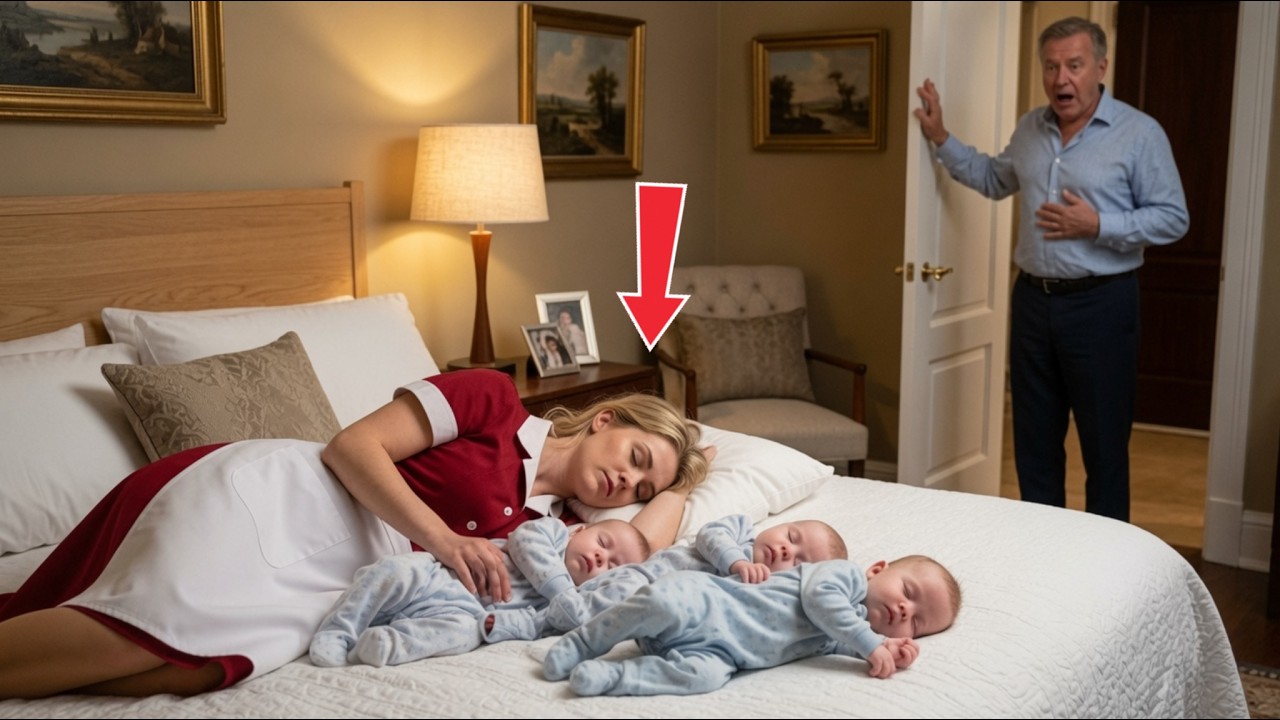
Solvej, Clara, and Louise cried without pause, their tiny faces swollen, their small bodies exhausted. The doctors said it was just a phase, but something inside Alexander, the same instinct that had built his business, whispered that something was deeply wrong. He held his breath and watched. Victoria entered the room with her phone glowing in her hand.
She did not lift the babies gently, did not cuddle them or sing. She moved them from side to side with rough motions, as if they were dolls in her way. When Clara reached out her little arms for comfort, Victoria did not even look at her. She grabbed a bottle, tested it against her wrist, and shoved it into Louise’s mouth without care.
“Be quiet with this,” Victoria muttered between her teeth. Alexander had to bite his lip not to storm in. But the businessman in him, the part that had learned to observe before deciding, kept him hidden. He told himself he had to be sure.
He watched Victoria take out her phone, laugh at a message, and whisper, “Damn kids. I hope they sleep soon so I can get some peace. ” He watched her leave the room without once soothing any of the babies. He had hired Victoria in his desperation after his wife Regitze died giving birth to the triplets.
She had come with impeccable references, all sweetness and patience. He had even begun a relationship with her, convincing himself the girls needed a mother figure. Now he stood in the shadows with his stomach turning, thinking of his wife’s last words: “Take care of them, my dear. Take care of them the way I would have.
”
He checked the formula. He found the bottle sterilizer full of dirty water. He pressed a hand over his mouth, held his daughters close, and made a decision. That morning he asked Kirsten, the cook who had been with him for twenty years, whether she had noticed anything strange about Victoria.
The older woman hesitated, then admitted she had seen how Victoria treated the girls when no one was looking. “It’s not with love, Mr. Møller. ” He was not crazy.
It was not his imagination. He had been drowning in his own grief and had failed his daughters. He needed help, real help, and that afternoon he found it in a small restaurant called Blomsterknoppen. He wandered into the faded yellow room with the hand-written menu, tired and hungry, and sat by the window.
A young woman with dark hair in a ponytail took his order. Her eyes were deep brown, kind but sad, as if they had seen too much pain for someone so young. She recommended the meatballs and served him with a warmth that felt genuine. He was halfway through his meal when he heard arguing from the kitchen.
The waitress, whose name was Maja, owed three months of rent. The owner, Mrs. Nielsen, was not cruel, but she needed money too. Maja promised to pay everything, to find extra hours, to do anything.
She came out with slightly red eyes and excused herself toward the bathroom. Alexander left a five hundred kroner tip for an eighty-kroner meal. Maja tried to refuse, but he insisted. When she looked at him with tears she held back with dignity, something shifted in him.
Mrs. Nielsen came out and told him about Maja, how she had lost her mother young, been abandoned by her father, raised by an aunt on a farm in Funen. How she was extraordinary with children, how she had calmed her own unruly twins in seconds. The words clicked in Alexander’s mind.
“I have triplets,” he heard himself say. “About that age. They cry a lot. The person taking care of them is not the right one.
” Before he could take it back, Mrs. Nielsen had called Maja over and explained everything. Maja’s eyes lit up. “I love babies.
”
That evening at eight o’clock, Maja stood outside Villa Solbakken, checking twice that she had the right address. The house was enormous, white walls covered in pink roses, a fountain in the front garden. A butler let her in, and she felt terribly out of place in her best blouse and worn shoes. Then she heard the crying from upstairs, not the normal demanding cry of healthy babies, but the desperate sound of small beings who had long gone without real comfort.
She knew that cry. She had cried like that herself as a child. Alexander led her into the nursery, a beautiful pastel room with three white cradles. “They’re identical,” he said.
“We tell them apart by the colored bracelets. Pink, purple, and blue. ” Maja went to Solvej first. She lifted her gently, held her against her chest, and began to sing a lullaby her grandmother used to sing.
She rocked her slowly, steadily, murmuring kind words. Within minutes the baby’s hiccups faded. Her tiny hands clutched Maja’s blouse as if to make sure this person would not let go. Alexander watched from the doorway, holding his breath.
He had watched dozens of professionals try and fail. But Maja had a gift. She sat in the rocking chair, took both girls in her arms with natural skill, and even Alexander, copying her movements on the floor with Louise, was amazed to find the whole room finally calm. “Can you come tomorrow?
” he asked, his voice almost desperate. “Yes,” she said. She did not know that with that one word she had changed her life forever. She also did not know that Victoria had returned home early and was listening from the stairs below.
The next days passed in a tension that could be cut with a knife. Maja came every evening after her shift, exhausted but smiling, and the babies calmed within minutes. On the fifth evening, she arrived early and heard Victoria’s voice through the open nursery door: “Why do you keep taking that waitress home? Women like her always have an agenda.
Look at her clothes. Look where she comes from. ” Alexander defended her, but Maja walked back down to the kitchen, humiliated. Kirsten warned her.
“That woman is not a good person. I’ve seen how she treats the babies when no one is looking. She ignores them, talks horribly to them. One day I saw a bruise on Clara’s arm.
”
Maja began watching more closely. She found a tiny scratch on Louise’s neck, expired formula in the pantry, dirty bottles in the sterilizer. Then one afternoon, hidden on the landing, she saw Victoria sitting in the rocking chair, ignoring the crying babies while she scrolled through her phone. When she finally grabbed Solvej, she shoved the bottle into the baby’s mouth so roughly that the baby choked.
Maja stepped in, her heart pounding in her ears. Victoria smiled sweetly and warned her: “Rich men don’t marry waitresses, understand. Don’t get any illusions. ”
A few days later, Maja found a crumpled receipt in the bathroom trash.
Premium formula, diapers, expensive creams, all paid with Alexander’s card, but none of it in the house. She found more receipts, then she heard Victoria on the phone selling the products for cash. Worse, the babies were being given the expired, inferior leftovers. Maja photographed everything, but she knew she needed proof that could not be denied.
She asked Alexander if the baby monitor recorded. It did. The Sunday arrived with bright sunshine. Alexander had arranged a lunch with important business partners, and Victoria claimed a terrible migraine.
Maja came to help and calmed the triplets within minutes. She was encouraged to eat in the dining room, feeling out of place among the designer dresses and practiced laughter. Then Victoria entered, perfectly dressed, no sign of a headache. She looked at Maja with something dark in her eyes.
During the meal, Victoria gasped theatrically. Her gold bracelet, her mother’s bracelet, was missing. “Only three people were in my room today,” she cried. “Me, the girl from the temp agency, and her.
” She pointed at Maja. Alexander did not want to search her bag, but the pressure of the guests and Victoria’s tears forced him. He emptied the contents onto the table. A worn purse, an old phone, keys, a handkerchief, a gold bracelet.
The air left Maja’s lungs. She swore she had never taken it, that someone had planted it. But Victoria’s performance was perfect. The guests murmured.
Alexander’s face was torn, confused, torn between the woman he had known for months and the waitress he had known for two weeks. “I think it’s best if you go,” he said, “at least until we sort this out. ”
Maja walked out with her chin high, even though she was broken inside. Victoria whispered as she passed: “I warned you.
This is not your place. ” The sound of the triplets crying followed Maja all the way to the bus stop. At her small, shabby apartment, she fell onto her bed and finally let the tears come. But then she thought of the babies, and she got up.
She took out her phone. She had all the evidence: the receipts, the photos, the messages. And at the bottom of an old box under her bed, she found an envelope she had forgotten. A thank-you card from Regitze Møller, written years ago, after Maja had volunteered at a charity campaign for childcare.
“You have a special gift,” Regitze had written. “A light in your eyes when you care for them. I hope the world had more souls like yours. ”
Meanwhile, at Villa Solbakken, the babies had cried for hours.
Victoria had locked herself in her room with another convenient migraine. Alexander sat alone with his inconsolable daughters and knew he had made a terrible mistake. He went to his office and opened the baby monitor recordings. He watched video after video: Victoria ignoring the crying, preparing expired formula, shaking Louise’s cradle, saying, “Do I have to sing songs for you like the stupid waitress?
” Then he found a video from Sunday morning, before the guests arrived. Victoria walked into the empty nursery with the gold bracelet in her hand and slipped it into Maja’s bag. Alexander saved everything to a USB drive, went upstairs, and forced Victoria to watch the footage. Her excuses crumbled.
He told her she was finished, that he would file formal charges of child mistreatment and theft. Victoria left the house screaming threats, none of which he heard. At three in the morning, he called Maja. She heard the desperate crying of the babies in the background and was already putting on her shoes.
“Please come,” he said. “They need you. ”
She took the last of her money for a taxi. When she arrived, he opened the door, exhausted and broken.
She ran past him to the nursery. For the next half hour, the two of them worked together, singing, rocking, until all three girls finally fell asleep. Then they sat and talked. He showed her the videos.
She showed him her evidence. He read Regitze’s card and wept. “She trusted you,” he said. “I should have trusted you from the start.
”
He offered her a formal contract as the triplets’ nanny, with a real salary, insurance, paid vacation. She could even move into the house. Maja hesitated, then agreed, on three conditions: a formal contract, authority to act if the babies were in danger, and a promise that Alexander would be present, not an absent father buying his way out. He nodded solemnly.
“It’s a deal. ” She slept that night in a guest room softer than any bed she had ever known. The next morning, the formal report against Victoria moved forward. Her mother came to the door, shouting threats and defending her daughter.
Alexander stood firm, and Maja stood with him. The life of Villa Solbakken transformed. The triplets thrived, crawling, babbling, sleeping peacefully through the night. Alexander learned to change diapers, to prepare bottles, to be present.
In the process, something blossomed between him and Maja, though neither of them dared name it. He bought her a proper wardrobe, made excuses to make her feel valued. She organized the girls’ first birthday party as he requested, surprised by her own confidence. The night before the party, they sat in the garden under the pink roses.
Alexander took her hand and told her he had fallen in love with her. She pulled back, afraid of what people would say, that they would call her an opportunist. “I don’t care what people say,” he said. “Regitze taught me that real love is not about last names or bank accounts.
” And then he took out the old card and told her what he believed: that Regitze had somehow known, that she had chosen Maja long before Alexander even knew he needed someone to choose him. Maja wept and admitted she had fallen in love with him too. He kissed her, and it felt like the universe had settled into place. A year later, the triplets turned one, and the garden party was a success.
The girls wore matching dresses in different colors and smeared their faces with cake frosting. Alexander introduced Maja with pride as “the most important woman in my daughters’ lives. ” Six months after that, a lawyer arrived with an envelope Alexander had never opened, addressed to him in Regitze’s handwriting. Inside was a letter his wife had written before her death, a letter about a young volunteer she had met years ago at a charity campaign, Maja Jensen.
“If you are reading this,” Regitze wrote, “it means I was not there to see our daughters grow up. Find Maja Jensen. Ask her to care for them. She has the purest heart I have ever known, and if something more grows between you, then you have my blessing.
”
There was also a letter for Maja. Regitze had written: “You are not an intruder. You are a gift I chose for them. Take care of them.
All four of them deserve it. ” Alexander read both letters with tears streaming down his face, then went out to the garden and handed them to Maja. She read them with disbelief. Regitze had planned this all along.
It was not an accident. It was her final gift. Maja threw herself into Alexander’s arms, and the triplets, sensing the joy, crawled over and hugged their legs. Alexander knelt right there in the garden, among the grass and the roses, and asked Maja to marry him.
She said yes, over and over, through her tears. The breeze moved through the climbing roses and let the pink petals fall over them like a blessing. Regitze had fulfilled her last wish, to make sure her family had real love.
And somewhere beyond the stars, she was smiling.