The silence in our Beacon Hill brownstone had become a physical presence over the last three days. It was heavy, suffocating, clinging to the high ceilings and the antique furniture Cole and I had chosen together. I sat in his favorite armchair, a deep leather wingback that still smelled faintly of his sandalwood cologne and old books. A cold cup of coffee sat in my hands, my gaze lost in the patterns of the Persian rug.
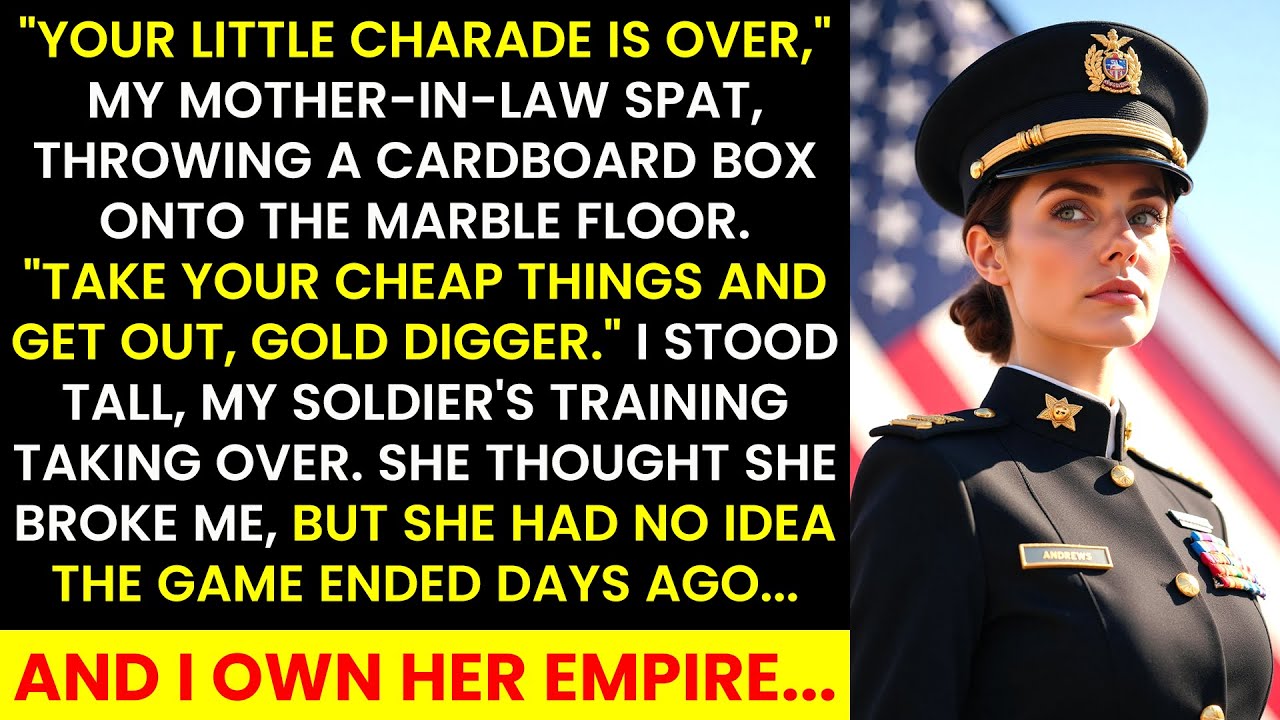
The silence was a fragile shield for grief so new it felt like an open wound. Then Vivien Blackwood shattered it. She didn’t knock. The heavy oak door was pushed open, and she entered as if she owned the air inside.
She was flanked by two large men in dark suits who looked more like private security than movers. Vivien herself was dressed in a severe black Chanel suit. It wasn’t morning attire; it was a uniform, the kind a general wears when surveying conquered territory. Her eyes, the same piercing blue as her son’s but utterly devoid of his warmth, swept the room and dismissed me entirely.
“Start with my son’s study,” she commanded, her voice crisp and devoid of emotion. “I want everything in there inventoried and sealed. ” Her men moved with quiet efficiency. She treated me not as her daughter-in-law, the woman who had just lost a husband, but as an illegal occupant who needed to be purged.
My own voice, when I finally found it, was a broken thing, hoarse and cracked from days of unshed tears. “Vivien, please. Cole was—”
She cut me off with a flick of her wrist. “Do not speak my son’s name,” she snapped, turning her full attention to me for the first time.
She walked toward me, her heels clicking like tiny sharp hammers on the marble inlay. She stood over my chair, forcing me to look up at her. “You have no right. Did you really think I didn’t know what you are?
A little mechanic’s daughter from somewhere in the middle of nowhere, Ohio. You thought you could climb your way into this family. My son may have been blinded by that uniform, but I was not. The performance is over.
You were an unfortunate incident, and now you are over. ”
Every word was a calculated strike designed to strip away my dignity, to invalidate my marriage, to erase my love for her son. I felt the blood drain from my face, a cold numbness spreading through my chest. She gestured to one of her men.
He stepped forward holding a single flattened cardboard box. Vivien took it and, with a look of profound distaste, threw it onto the floor in front of me. It landed with a hollow thud. “This,” she announced, “is all you are permitted to take.
The worthless things you brought with you into this house. ”
The contrast was brutal and deliberate. The cheap brown cardboard against the polished veined marble that Cole and I had picked out in Italy. The box was an insult, a clear message that I didn’t belong, that everything I was and everything I had was cheap.
Something inside me shifted. At West Point, my first instructor for SERE training had a saying: “In the eye of the storm, the best soldier doesn’t fight the wind. He watches, he waits, and he finds the path through it. ” Vivien was my storm, and she was making a rookie mistake.
Instead of crying or begging, as she so clearly expected, I rose from the chair. I moved slowly, deliberately, my spine straight. I stood to my full height, meeting her cold gaze with an unnerving calm. My silence was heavier, more absolute than any scream could have been.
In my eyes, the raw grief gave way to something else: assessment. My training took over, overriding the pain. I was analyzing an adversary, logging her every move, her every word, her every vulnerability. I was no longer looking at a mother-in-law.
I was looking at a target. Her perfectly composed face faltered for a fraction of a second. She wanted tears. She wanted a scene.
She was getting steel instead. I bent down, my movements fluid and controlled, and picked up the empty box. I held it in my hands, feeling its flimsy weight. Then I looked straight back at her, my voice perfectly level, stripped of all emotion.
“Understood,” I said. “Orders received. ”
She had made a fundamental tactical error. She had completely underestimated her opponent.
She saw a grieving widow from Ohio. She failed to see a captain in military intelligence. Cole saw it. He always had.
He’d seen it from the very first day I ever stood up to her. That single empty cardboard box in my hands felt heavier than it had any right to be. It was a flimsy weapon, but it had landed its blow, tearing open the past and pulling me back five years to the very beginning, to the day I met Cole Blackwood. It wasn’t a romance that brought us together.
It was a security threat. I was a captain then, too, briefing high-level corporate targets on potential vulnerabilities. I walked into his corner office overlooking Boston Harbor in my Army Service uniform, my report tucked under my arm. He wasn’t what I expected.
The heir to the Blackwood Empire, I’d pictured someone older, softer. Instead, the man who stood to greet me had a kind, intelligent face and an air of quiet exhaustion, as if he’d been fighting a long, silent war. I gave my briefing, direct and to the point. I outlined how a rival corporation was using industrial espionage to target one of their subsidiaries.
He listened intently, not with the defensive posture of a typical CEO, but with the focused attention of a commander receiving battlefield intelligence. When I was done, he didn’t question my findings. He simply pushed my report to the side, leaned forward, and looked at me with a startling intensity. “Captain,” he said, his voice thoughtful.
“Have you ever considered commanding a campaign in the civilian world? ”
I was taken aback. “Sir? ”
“I’m under siege here,” he explained, a tired smile touching his lips.
“Corporate politics, hostile takeovers, and the commanding general of the opposing force is my own mother. ” He saw the surprise on my face and nodded. “I need a chief of staff, someone who can see through the chaos and map out a strategy, someone who isn’t afraid of a fight. ”
He wasn’t just offering me a job.
He was recruiting an ally. That was Cole. He didn’t see a woman or a soldier. He saw a strategist, a partner.
He saw me. And that was the moment a different kind of campaign began. A few months later came the inevitable trial by fire: dinner with Vivien. She didn’t deign to have us at her home.
Instead, she chose the Somerset Club on Beacon Street, a place so steeped in old Boston Brahmin tradition that the air itself felt heavy with the weight of forgotten fortunes and unspoken rules. It was a fortress of old money, and I, in my simple black dress, was the barbarian at the gate. The dining room was hushed, all dark wood paneling and oil portraits of stern-faced men. The clinking of silverware on porcelain was the only sound.
This was not the cozy intimacy of a family dinner. It was an interrogation. Vivien didn’t ask about my hobbies, my interests, or my job. She conducted a surgical dissection of my pedigree.
“So, Andrews,” she began, not even bothering with my first name. She swirled a glass of deep red Barolo, the wine itself probably costing more than my father’s weekly paycheck. “Your family is from Ohio, I understand. I hear it’s mostly farms out there.
”
I remembered my dad’s words as I’d been getting ready for the dinner, his voice warm over the phone: “Don’t ever be ashamed of hands calloused from honest work, Maria. Shame is for those who do nothing at all. ” I held on to that thought like a shield. “My father is a mechanic and my mother is a nurse,” I answered calmly.
Vivien raised a perfectly sculpted eyebrow. “A mechanic and a nurse. How quaint. They must be so terribly proud that you managed to get out.
”
Every word was a precisely aimed dart designed to mark me as an outsider, an inferior specimen who had somehow wandered into her rarified world. She wasn’t trying to get to know me. She was trying to put me in my place, a place far beneath her, and certainly far beneath her son. The silence that followed was thick with tension.
Then, a sharp clink cut through the air. Cole placed his fork down on his plate with a deliberate, resounding noise. “Mother,” he said. His voice was quiet, but it had a core of steel I had never heard before.
Vivien’s gaze shifted to him, annoyed at the interruption. “Maria is a decorated officer in the United States Army,” he continued, his eyes locked on his mother’s. “She has served this country in places you couldn’t find on a map. Her father taught her about honor, and her mother taught her about compassion.
Those are values I admire. Values this family seems to have forgotten. ”
Under the table, out of Vivien’s sight, he reached over and took my hand. His grip was firm, a silent message of unwavering support.
“And I love her,” he said, his voice leaving no room for argument. “If you can’t respect that and respect her, then this will be our last dinner together. ”
The rest of the meal passed in a frigid, suffocating silence. It was the first time I’d ever seen anyone stand up to Vivien Blackwood.
She was furious, not with the explosive anger of a tantrum, but with the cold, silent rage of a queen whose authority had been challenged. Later that night, Cole took me to the rooftop of the Blackwood Corporation building. The city of Boston spread out below us, a glittering tapestry of lights against the dark water of the harbor. The cool night air was a relief after the stifling atmosphere of the club.
“I’m sorry,” he said, his hands in his pockets as he stared out at the view. “For her. ”
I shook my head. My military training was a strange comfort in that moment.
A hostile environment was something I understood. “Cole,” I said, a small smile playing on my lips. “I’ve faced tougher generals than your mother. ”
He turned to me and laughed, a genuine, relieved sound that echoed in the quiet of the rooftop.
“That,” he said, stepping closer, “is exactly why I love you. You’re not afraid. ”
He reached into his jacket pocket and pulled out a small velvet box. My breath caught in my throat.
He opened it, and inside, nestled on a bed of white satin, was a vintage engagement ring: a magnificent sapphire, deep and blue as the midnight sky, flanked by two diamonds. “This was my grandmother’s,” he said softly. “She was the real deal. Built a life based on integrity, not just inheritance.
” He looked from the ring to my eyes. “I don’t want that life anymore, Maria. The fake smiles, the backroom deals, the constant pretense. I want a real life with you.
” He paused, his expression vulnerable and completely open. “Will you be my teammate? ”
He didn’t ask me to be his wife, not in the traditional sense. He asked me to be his teammate, his partner, his ally.
In that moment, high above the city, we weren’t a CEO and a captain. We were just two people who had found refuge in each other, forging an alliance against a world that neither of us truly belonged to. I looked down at the ring, then back at his face, and I said, “Yes. ”
That sapphire was his promise of a real life.
But to Vivien, it was never a blessing. It was a declaration of war. When Cole told his mother we were engaged, she offered no congratulations. There was no faint smile, no hollow pleasantries.
There was only the cold, hard reality of her disapproval. He had gone to her office alone, a courtesy he felt he owed her. He later told me she was sitting in her leather throne of a chair in her penthouse office, gazing out at the panoramic view of the city she considered her kingdom. She didn’t even turn to look at him.
“I will not be attending this circus,” she stated, her voice flat and gray as the winter sky outside. “The Blackwood name will not be disgraced by a wedding to a soldier. ” Finally, she swiveled her chair to face him, her expression unreadable. “But I will offer her an honorable exit.
” She opened a drawer in her massive mahogany desk. “I will write her a check. Seven figures, enough for her and her entire family of mechanics to live comfortably for the rest of their lives. Tell her to consider it a severance package.
”
A severance package. That’s what our love was to her. A business transaction that had run its course. It wasn’t just an insult.
It was a declaration of war. It was Vivien’s way of saying that in her world, everything and everyone had a price tag. Cole walked out of that office without another word. And in that moment, the final bridge between their worlds was burned.
We decided then and there that our wedding wouldn’t be for her, or for Boston society, or for the Blackwood name. It would be for us. It would be real. So instead of a lavish thousand-guest affair at the Four Seasons, we chose a small white clapboard chapel in Chatham on the elbow of Cape Cod.
It stood on a bluff overlooking the Atlantic, so close you could taste the salt in the air and hear the constant rhythmic crash of the waves against the shore. It was simple, historic, and honest. It was everything Vivien’s world was not. The night before the wedding, as Cole and I sat on the porch of the small cottage we’d rented, he read to me from a book of poetry.
He found William Ernest Henley’s “Invictus,” and his voice was steady and strong in the twilight as he read the final lines: “I am the master of my fate. I am the captain of my soul. ” It became the unspoken theme of our marriage, a quiet vow we made to each other before the official one. Our wedding day was perfect.
My parents and my two younger brothers made the twelve-hour drive from Ohio, their minivan packed with coolers and heartfelt handmade decorations. My dad, in his slightly too tight suit, looked prouder than I had ever seen him. My best friends from my old unit showed up, their dress blues immaculate. They formed an impromptu saber arch for me to walk through as I entered the chapel—a silent, powerful display of a bond forged in dust and deployment, not boardrooms.
There were no designer gowns or string quartets. I wore a simple ivory dress I’d found in a small boutique. Our music was the sound of the ocean and the laughter of the fifty people who truly loved us. At the reception on the lawn, we didn’t serve champagne and caviar.
We served lobster rolls on buttered, toasted buns and cases of local craft beer from Sam Adams. It was a celebration of love, not of status. It was a family gathering defined not by blood, but by presence and support. But Vivien, of course, had to have the last word.
That afternoon, a courier on a motorcycle roared up the gravel driveway. He was holding a signature Tiffany blue box tied with a perfect white ribbon. My heart sank. For a foolish, hopeful second, I wondered if it was an olive branch.
It was not. Inside, there was no card of blessing. Instead, there was a set of exquisitely cut crystal champagne flutes, the kind you’d see in a palace, and a small, elegantly engraved card. It contained a single chilling sentence: “Congratulations on getting what you wanted, VB.
”
The gift wasn’t a truce. It was a final parting shot—a condescending, cynical reminder of the class divide she was so desperate to maintain. It was her way of saying, “You may have my son, but you will never, ever be one of us. ”
Cole took the box from my hands.
He didn’t smash the glasses or curse his mother’s name. He just looked at the box for a long moment, his expression hardening. Then, without a word, he walked inside and quietly placed it in the back of a closet, shutting the door. That simple, silent action said everything.
His mother’s world, with its transactional relationships and its empty, expensive gestures, was no longer his. He had closed the door on it for good. The war, however, was just beginning. A week later, we were back in our home in Boston.
Vivien called. I was across the room, but I could hear the venom in her voice, sharp and clear through the phone’s receiver. “You’ve chosen your side, Cole. Fine,” she spat.
“But you remember this. The Blackwood Corporation is mine. Everything you have, you have because I gave it to you. And what I give, I can take away.
Don’t you dare think that little girl can protect you from me. ”
It wasn’t the voice of a wounded mother. It was the cold, calculating threat of a business rival. The lines had been drawn.
The silent conflict was now an open war. That belief was the only armor Cole and I had as we walked into the storm she was about to unleash. After Vivien’s threat, the air in our Boston home felt charged, heavy with the unspoken reality that we were living on a battlefield. We needed a retreat.
We needed a sanctuary. We found it that November, not in some exotic resort, but in a small, bustling house in the heart of Ohio. Cole had never experienced a Thanksgiving like it. His Thanksgivings were catered affairs, stiff and silent, where conversations revolved around stock prices and corporate mergers.
My family’s Thanksgiving was chaos, noise, and love. The moment we walked through the door, the smell of roasting turkey, sage, and my mom’s famous green bean casserole hit us. The television was blaring. The Ohio State Buckeyes were playing Michigan, and my two younger brothers were already yelling at the screen.
My dad immediately pulled Cole into the garage to look at a sump pump that was acting up, treating him not as the CEO of a multi-billion dollar corporation, but just as another guy who might know a thing or two about motors. I watched Cole as he stood in my childhood kitchen, a dish towel slung over his shoulder, genuinely fascinated as my mom showed him how to make her pumpkin pie from scratch. Later, I saw him out in the backyard, his suit jacket off and his sleeves rolled up, tossing a football with my brothers. He was laughing, a deep, carefree sound that I rarely heard in Boston.
At dinner, we all squeezed around my mom’s extended dining table. No one asked Cole about his portfolio. They asked him about his stories, his dreams, what it was like to grow up in a house that looked like a museum. He, in turn, asked my dad about the years he spent working at the Ford plant and my mom about her toughest shifts as an ER nurse.
For the first time, I saw the tension leave his shoulders. He wasn’t a Blackwood heir. He was just Cole. He was part of a real family.
While he was there, he found a book on local history on my dad’s bookshelf. He became captivated by the stories of the pioneers who settled the Ohio River Valley—people who built communities from nothing but grit, trust, and mutual support. “This is the real America,” he told me one evening, his eyes shining with an almost reverent light. He saw a strength in my family’s world that his had never known.
A wealth not measured in dollars, but in connection. That night, after everyone else had gone to bed, my dad found Cole sitting on the front porch swing. I watched from the doorway as dad handed him a bottle of Sam Adams, the same Boston lager Cole was used to, but it felt different here. Dad sat down beside him, the old wooden swing creaking softly.
For a long time, they just sat in silence, watching the fireflies flicker in the yard. “I know you come from a different world, son,” my dad said finally, his voice low and steady. He looked over at Cole, his gaze direct and honest. “And I’m not going to pretend I understand it, but I see the way you look at my daughter.
She’s been through a lot. She needs a teammate, not a boss. You that man? ”
Cole met his gaze without hesitation.
“Sir,” he said, his voice thick with emotion. “I will spend the rest of my life trying to be. ”
My dad nodded slowly, a small smile touching his lips. He reached over and clapped Cole firmly on the shoulder.
“That’s good enough for me,” he said. “Welcome home, son. ”
That simple phrase, “welcome home,” was something Cole had craved his entire life and never received from his own family. In that moment, on a quiet porch in Ohio, he found it.
My other family, my military family, was also there for us. My best friend, Sergeant Sarah Jenkins, who’d been with me through two tours in Afghanistan, would call regularly. She never asked about the Blackwood drama. She didn’t need to.
Her questions were more important: “Status check, Captain. Morale holding steady. You need fire support? ” Our conversations were a shorthand of shared experience, a language forged under pressure.
Sarah was my rear guard, a constant reminder of the strength I owned, a strength that had nothing to do with money or status. She’d always end her calls the same way: “Remember, Maria, I’ve always got your six. ”
Having a family that had your back, that would stand with you no matter what—it changed Cole. After that trip to Ohio, he became more resolute.
He started quietly moving his personal assets, setting up private trusts, making strategic financial moves that at the time I didn’t fully understand the purpose of. He was fortifying our position, preparing for a siege I didn’t even know was coming. One evening, a few weeks later, we were sitting on the couch in our living room in Boston, looking at the photos from our trip. There was one of him and my brothers, all three of them covered in mud, grinning at the camera.
He paused on that picture, a soft smile on his face. He turned to me, his expression serious. “You and your family,” he said, his voice quiet but filled with conviction. “You showed me what a real life is supposed to feel like.
I will never let anyone, not even my mother, take that away from us. I promise you. ”
That promise, made in the quiet of our home, felt more binding than any legal contract. It was the oath of a soldier to his teammate, a vow to protect the small, warm sanctuary they had built together, no matter the cost.
The promise Cole made to me that night, surrounded by the warm glow of our shared memories, became the last good moment. It was the final pocket of peace before the world imploded. The call came on a Saturday. I was at Fort Devens for a weekend reserve training exercise.
I was in the middle of a land navigation course, the familiar weight of my pack a strange comfort, when my commanding officer pulled me aside. He had a satellite phone in his hand, his expression grim. The voice on the other end was a Massachusetts state trooper. He was professional, his tone calm and measured.
But every word he spoke was a piece of shrapnel tearing through me. “Ma’am, there’s been an accident on the I-90. A semi jackknifed in the storm. We’re so sorry.
”
The world didn’t just stop. It ceased to exist. The trees, the damp earth, the shouts of other soldiers—it all faded into a roaring, colorless void. I don’t remember the drive back to Boston.
I only remember the hypnotic, merciless rhythm of the windshield wipers fighting against the driving rain, their monotonous swish-swish keeping a cruel beat with the silent sobs trapped in my chest. He’s gone. He’s gone. He’s gone.
By the time I reached the hospital, it was over. A kind, tired-looking doctor led me to a small, sterile room and confirmed what the roaring in my ears was already telling me. Cole was gone. My teammate, my ally, my husband—gone.
The first rule of SERE training is to assess the situation. But there was nothing to assess. There was only a gaping hole where my future used to be. The second rule is to control your emotions.
I tried. I really did. But the grief was a physical force, a tidal wave that swept me under. And into that storm of shock and pain walked Vivien Blackwood.
She arrived at the hospital not with the open arms of a grieving mother, but with the brisk efficiency of an event planner. She carried a leather-bound notebook and a Mont Blanc pen. Her eyes, dry and sharp, scanned the room and barely registered my presence. She ignored my swollen, red-rimmed eyes and the tremor in my hands.
She was already in command mode. “The funeral will be at Trinity Church in Copley Square,” she announced to the empty room as if issuing a press release. “I’ve already spoken with the bishop. The press will be notified at the appropriate time.
”
My voice was a faint whisper. “Vivien, no. Cole wanted a small service, just family. He told me.
”
She finally looked at me, her expression one of utter disdain, as if I were a bothersome insect. “Cole was a Blackwood,” she declared, her voice like chipping ice. “He will have a funeral befitting that name. You,” she added, her eyes narrowing, “have no say in the matter.
”
And just like that, my grief was hijacked. She stole our tragedy and turned it into a high-society spectacle. Cole’s funeral became a PR event for the Blackwood Corporation. I had to stand in the front pew of that cavernous, historic church, a sea of Boston’s elite behind me, and listen to strangers eulogize my husband as a business asset, a corporate legacy.
They spoke of stock values and acquisitions. Not one of them mentioned his kind heart, his quiet laugh, or the way he’d read poetry to me on a porch in Cape Cod. I was a prop in the theater of her grief, a widow in a black dress playing a part. The moment the last guest offered their hollow condolences, Vivien’s next campaign began.
I went home, desperate for the sanctuary of our quiet brownstone, aching to curl up in his armchair and just breathe in the last remnants of him. But our home was no longer a sanctuary. It was occupied territory. A team of movers was already there, methodically packing Cole’s belongings into boxes under Vivien’s watchful eye.
His books, his records, the worn leather briefcase he’d carried every day—all of it was being erased. “These items are going into a secure storage facility,” Vivien informed me, her tone final. “I will decide what to do with them later. ” She then held out a thin white envelope.
Inside was a one-way plane ticket to Columbus, Ohio, for the next day. “I think it’s best you return to your own people,” she said, the words coated in a thin veneer of false concern. “There’s nothing left for you here, Maria. ”
It was a systematic, ruthless purge.
She wasn’t just removing his things. She was trying to scrub the last four years of his life—my four years—from the record. But something in me broke through the fog of grief. It was the third rule of SERE training: survive.
“No,” I said, my voice quiet but firm. “This is my home. I’m not leaving. ”
The next day, I met with a lawyer, a friend of a friend from my unit.
When I returned that afternoon, the key no longer fit in the lock. My security card was useless. The small green light on the panel remained stubbornly red. She had changed the locks.
I stood on the rain-slicked brick sidewalk of Beacon Hill, the place I called home, and I was locked out. The cold, damp Boston drizzle started to seep into my coat. I had nothing but my wallet and my phone. My hands shaking with a mixture of cold and fury, I called her.
“You can’t do this,” I said, my voice trembling. Her laugh on the other end of the line was the cruelest sound I had ever heard. It was triumphant, mocking. “Oh, my dear, I can and I have,” she chirped.
“I’ll see you at the reading of the will. Though I wouldn’t expect any pleasant surprises if I were you. ”
The line went dead. I stood there in the chilling rain, locked out of my home, locked out of my life, with nothing but her taunting words ringing in my ears.
The grief was still there, a raw, screaming agony. But now it had a companion: a cold, hard, and dangerously focused rage. The battle lines had not just been drawn. They had been fortified.
And I was on the outside. The law offices of Martin Reeves felt like a neutral zone in a long and bitter war. Located in a historic Beacon Hill building, the room was a sanctuary of old-world gravitas. The air smelled of aged leather, lemon oil polish, and old paper.
Floor-to-ceiling mahogany bookshelves lined the walls, filled with legal tomes that seemed to absorb all sound, creating a heavy, expectant silence. High on one wall, a portrait of Supreme Court Justice Oliver Wendell Holmes Jr. stared down, his gaze a stern reminder of order and consequence. The conference room table was a vast expanse of polished wood that reflected the dim light.
It was less a piece of furniture and more a battlefield map. On one side sat Vivien Blackwood, flanked by her team of three corporate lawyers from Ropes & Gray, her general staff. She was the picture of arrogant confidence, dressed in a navy blue suit with a diamond brooch pinned to the lapel. She didn’t look at me.
Instead, she impatiently shuffled through a stack of papers, occasionally tapping a perfectly manicured nail on the table’s surface. To her, this was a mere formality, the final administrative step before she could consolidate her power and erase me completely. She was certain she had already won. I sat on the opposite side, alone.
I had chosen my clothes carefully that morning: a simple, well-tailored charcoal gray suit. It was professional, understated, and anonymous. It was my armor. As she reviewed her documents, I reviewed her.
I noted the slight tension in her jaw, the dismissive way she waved off a comment from one of her own lawyers. She was radiating smug certainty. It was her greatest weakness. Just before the proceedings began, she deigned to speak in my direction, though she addressed her lead counsel.
“I hope she isn’t expecting much,” Vivien said, her voice loud enough for the entire room to hear. “Cole knew his duty to this family. ”
Martin Reeves, Cole’s personal attorney for years, entered the room and took a seat at the head of the table. He was an older man, perhaps in his late seventies, with kind eyes that held a sharp, intelligent glint.
He nodded solemnly to me, then to Vivien. He placed a thick document bound in a blue legal cover on the table in front of him. “We are gathered today,” he began, his voice a calm, steady baritone, “to read the last will and testament of Cole Porter Blackwood. ”
The air thickened with animosity.
Mr. Reeves adjusted his spectacles and began to read. His voice was methodical, a slow, deliberate cadence that built the tension with every word. The will started with minor bequests: donations to a few local Boston charities Cole cared about, a vintage watch to his best friend from college, a few other sentimental items.
Vivien’s impatient tapping grew slightly faster. This was all just noise to her. She was waiting for the main event: the transfer of the empire. Then Mr.
Reeves cleared his throat and read a new clause. “To my mother, Vivien Blackwood,” he read slowly, “I leave my great-grandmother’s collection of Impressionist art, with the hope that its beauty may remind her of the legacies that cannot be measured in monetary value. ”
The tapping stopped. Vivien’s brow furrowed.
It was a subtle, exquisitely crafted insult, and she knew it. Cole was reminding her from beyond the grave of the very values she had accused me of lacking. One of her lawyers shifted uncomfortably in his seat. Mr.
Reeves paused for a moment, letting the words settle in the silent room. He took a sip of water. Then he continued to the final, critical section. “All the rest, residue, and remainder of my estate, including all personal property, all investment holdings, and most importantly—” he paused, his eyes lifting from the page to briefly meet mine, “—my entire controlling interest of 42% of the shares in the Blackwood Corporation, I leave to my beloved wife, Captain Maria Andrews.
”
Silence. It was not a normal silence. It was an absolute void, a vacuum where sound ceased to exist. Vivien’s face, which had been a mask of smug composure, froze.
The color drained from her cheeks, leaving behind a pasty, mottled white. Her lawyers sat as if turned to stone, their mouths slightly agape. I heard a soft click followed by a clatter as one of them dropped his expensive pen onto the hardwood floor. Vivien’s head snapped towards me, her eyes wide with a mixture of disbelief and pure, unadulterated hatred.
“No,” she hissed, the word a ragged tear in the silence. “That’s impossible. He would never. What did you do to him?
”
Mr. Reeves continued, his voice calm and unflappable, as if he were reading a weather report. “The will is signed, witnessed, and legally sound. Vivien, Cole made these changes six months ago.
” He looked directly at her now, his kind eyes turning to steel. “As the majority shareholder, Mrs. Andrews now holds the decisive vote in all corporate matters. ”
The bomb had detonated.
The battlefield had been instantly reconfigured. In the space of a single sentence, the entire balance of power had irrevocably shifted. I, the woman who had been locked out of her own home, now held the keys to the entire Blackwood Empire. Vivien staggered to her feet, her chair scraping harshly against the floor.
She pointed a trembling finger at me, her face contorted in a mask of rage. “This is not over,” she snarled. “I’ll sue. I’ll fight this.
I will ruin you. ” She stormed out of the room, her legal team scrambling to gather their papers and follow in her wake like a scattered, defeated army. I remained seated, the sound of my own heart hammering against my ribs. I stared at the copy of the will that Mr.
Reeves had slid across the table to me. My eyes traced the elegant, familiar signature at the bottom. Cole’s signature. The room was quiet again, but this was a different kind of silence.
It was filled with the weight of what had just happened, the enormity of the trust he had placed in me. And a single overwhelming question echoed in my mind: Cole, what did you do? The question hung in the air of the silent conference room long after Vivien had gone. It was a question born of shock.
But as I sat there, the answer began to arrive. It came in the form of Martin Reeves. After the room was empty, he walked over and placed a small, plain manila envelope on the table in front of me. It was thin and surprisingly light.
“Cole instructed me to give this to you, and only to you, after the will was made public,” he said, his kind eyes now filled with a deep, knowing sadness. Inside the envelope, there was no lengthy explanation. There was only a single, old-fashioned brass key for a safe deposit box and a slip of paper with the address of a private bank in Boston’s financial district. “He said you’d know what to do,” Mr.
Reeves added. A jolt like an electric current shot up my spine. This wasn’t a coincidence. This wasn’t a simple inheritance.
This was a plan, a contingency. Cole hadn’t just left me his fortune. He had left me a mission, a posthumous command. I drove to the bank alone, my mind a whirl of confusion and dawning realization.
The bank was the kind of discreet, old-money institution that didn’t have signs. It was all polished granite and hushed reverence for wealth. The security procedures were intense. It took Mr.
Reeves’s master key, my key, my signature, and a biometric thumbprint scan before a silent attendant led me deep into the vault. The air in the vault was cold and still, smelling faintly of steel and recycled air. The attendant used both keys to unlock a narrow metal door and slid out a heavy stainless steel box. He placed it on a small private viewing table and left, closing the heavy door behind him with a soft but definitive click.
My heart hammered against my ribs. I lifted the lid. Inside, there were no jewels, no stock certificates, no cash. There were only three items.
The first was a thick, cream-colored envelope sealed with the Blackwood family’s wax signet. The second was a heavy, brushed metal USB flash drive, completely unmarked. And the third item made my breath catch in my throat: it was the sapphire from Cole’s grandmother’s ring. The deep midnight blue stone that Vivien had pried from its setting before the funeral.
Its presence here was a message, a powerful and defiant statement from Cole. This is the true inheritance, it seemed to say. Not the money. The truth.
I didn’t open the letter there. I couldn’t. I took the box, drove to a quiet spot overlooking the harbor where Cole and I used to walk, and shut off the engine. With trembling hands, I broke the wax seal.
The handwriting was his, so familiar it was a fresh wave of grief. The letter began with words of love, words that I will keep for myself. They were a reminder of the man, of the love that fueled this entire devastating plan. But then the tone shifted.
The loving husband became the strategist, the CEO, the commander laying out a mission briefing. He explained that about eight months ago, a financial report had crossed his desk with an anomaly he couldn’t explain. He said that my analytical mind, the way I taught him to look for patterns and question assumptions, made him dig deeper. He didn’t delegate.
He investigated it himself, after hours, in secret. What he found, he wrote, was worse than he could have ever imagined. It wasn’t a simple case of embezzlement. It was a sophisticated, deeply embedded network of shell corporations, offshore accounts in the Cayman Islands, and systematic fraud—a massive money laundering and tax evasion scheme that ran into the hundreds of millions of dollars.
And at the center of it all, pulling every string, was Vivien. “She built an empire on lies, Maria,” he wrote. And I could feel the agony in his words, the heartbreak of a son discovering the true nature of his own mother. “An empire that was poisoning everything it touched.
I couldn’t be a part of it anymore. I confronted her. She laughed. She told me it was how the real world worked and that it was time I grew up.
”
He had known then that she would never stop. He began gathering evidence, creating a meticulous, undeniable record of her crimes. “I knew what she would do if anything ever happened to me,” the letter continued, and this is where the words blurred through my tears. “She would try to destroy you, to erase you, to pretend you never existed.
She fears you, Maria. She fears you because you represent a world of honor and integrity she can’t buy or control. That’s why I did all this. I’ve given you the power of the company, not for the wealth, but for the access, for the standing.
This is your armor. And the flash drive, that is your sword. It has everything,” he wrote. “Encrypted bank records, transaction logs, names of the shell corporations, secret ledgers.
It’s our intelligence file. ”
The letter ended not with a command but with a question that placed the entire weight of his legacy, of his own moral struggle, squarely on my shoulders. It was the ultimate expression of his trust in me. “Justice or mercy, the choice is yours.
I trust your judgment, my captain. ”
The tears that fell onto the page were not tears of grief or weakness. They were the tears of a soldier who had just received her final orders from the commander she loved and respected more than anyone. He had known his enemy.
He had known his most trusted ally. As my old Sun Tzu textbook said, “Know your enemy and know yourself, and you need not fear the result of a hundred battles. ” Cole had known. I folded the letter, my hands steady now.
The grief was still there, a permanent ache in my soul. But the rage had solidified into something cold, clear, and absolute: purpose. I started the car and pulled out my rugged military-grade laptop. It was encrypted, shielded, and untraceable.
I took the heavy metal flash drive, Cole’s sword, and slid it into the USB port. The small light on the drive blinked once, and the screen prompted me for a password. I knew what it would be. I typed the five letters: I-N-V-I-C-T-U-S.
Access granted. Operation Justice had begun. Vivien, true to form, did not wait. The day after the will was read, she launched her counteroffensive.
She called for an emergency meeting of the Blackwood Corporation’s board of directors. The agenda was simple: a vote of no confidence in the new majority shareholder. Her strategy was blunt force—to publicly declare me incompetent and legally sideline me before I could even find my footing. She spent the next three days calling every board member, poisoning the well.
I knew exactly what she was saying: that I was an opportunistic gold digger, a grieving and unstable widow, a simple soldier who knew nothing of finance or corporate governance. She was counting on their loyalty, their old boys’ club solidarity, and their inherent prejudice against an outsider like me. But she made a critical error. She assumed I would be on the defensive.
She had no idea that my own operation was already well underway. For those same three days, the small corporate apartment I was staying in became my command center. With Cole’s intelligence file, his sword unlocked, I didn’t just have accusations. I had data.
Using the skills the army had taught me, I conducted a full intelligence analysis of the board. The ten men and women who held the fate of the company in their hands. I profiled each one: their professional histories, their voting records, their personal investments, their loyalties, and most importantly, what they truly valued. I quickly identified a faction of four board members who were holdovers from Cole’s grandfather’s era.
These were people who had been loyal to the original Blackwood vision—innovation, integrity, and long-term sustainable growth. They were increasingly disturbed by Vivien’s aggressive profit-at-any-cost strategy. They were my opening. I studied Abraham Lincoln’s “team of rivals,” how he managed a cabinet of adversaries by understanding their motivations and appealing to their shared interests, not their fears.
I would not threaten them. I would recruit them. I didn’t call. A phone call could be dismissed.
I arranged face-to-face meetings, one by one, in neutral locations: a quiet coffee shop in the Back Bay, a discreet corner table at a hotel bar. I didn’t ask them for their vote. I didn’t ask them to choose a side. Instead, I presented myself as a concerned shareholder fulfilling her late husband’s final wishes.
To each of them, I laid out a concise, factual summary of Cole’s concerns about the company’s direction. Then I showed them a single piece of evidence from the drive: a carefully selected, irrefutable transaction record linking the corporation to an anonymous shell company in the Caymans. It wasn’t enough to expose the entire scheme. Not yet.
But it was enough to plant a seed of serious doubt, to prove that there was a credible internal threat to the company’s stability and reputation. I never mentioned Vivien’s name. I didn’t have to. I framed the issue not as a personal vendetta, but as a fight to protect the Blackwood legacy from corruption.
I turned my private war into their battle, a fight for the soul of the company their friend, the elder Mr. Blackwood, had built. When I walked into the boardroom on the top floor of the Blackwood building, the atmosphere was electric with tension. It was a vast, intimidating space, ironically nicknamed “the war room,” with a floor-to-ceiling glass wall that offered a commanding view of Boston Harbor.
I took my seat, not as the grieving widow Vivien had painted me to be, but as the company’s single largest shareholder. Vivien began the meeting with a condescending speech about the need for experienced leadership and the dangers of emotional decision-making. It was a thinly veiled attack on my gender, my grief, and my background. She concluded by formally proposing a vote of no confidence to strip me of my voting rights on the board.
A heavy silence fell over the room. This was the moment she expected her allies to fall in line. Instead, Arthur Vance, a kind, white-haired man who had been best friends with Cole’s grandfather, cleared his throat. “Vivien,” he said, his voice calm but firm, “perhaps before we vote on such a drastic measure, we should allow Mrs.
Andrews to speak. ”
All eyes turned to me. This was my moment. I stood up, not with a speech, but with a plan.
On the room’s large display screen, I presented a clear, coherent 100-day plan for the company. It was a strategy based on military precision. Phase one: assessment—a full forensic audit. Phase two: stabilization—restructuring of vulnerable departments.
Phase three: growth—reinvestment and innovation in R&D. The cornerstones of my plan were radical transparency and a return to the ethical principles the company was founded on. Vivien tried to dismiss it. “A lovely presentation from a complete amateur,” she sneered.
But it was too late. Another board member, a sharp woman named Eleanor Royce, whom I had met with, spoke up. “I find this plan to be comprehensive and exactly what this company needs to restore investor confidence. ” Then another, and another.
Vivien looked around the table, her face a mask of disbelief. She was watching her power crumble in real time. The allies she had counted on were abandoning her—not for me, but for the logic and integrity of the plan I presented. She had lost control of the room.
Arthur Vance called for the vote, but not on Vivien’s motion. On a new one. “I move,” he announced, “to table the vote of no confidence indefinitely. Furthermore, I move to appoint Captain Maria Andrews as interim chair of the board with full oversight authority, effective immediately.
”
The vote was a landslide, 8 to 2. Vivien sat frozen in her chair, utterly defeated. The war room had lived up to its name, and she was the sole casualty. I stood at the head of the table, in the seat that was now mine.
I looked directly at Vivien, my voice steady and cold as steel. “My first act as chair,” I announced to the board, “is to authorize a full independent forensic audit of all Blackwood subsidiaries and foreign accounts, effective immediately. ”
Checkmate. I hadn’t just defended my position.
I had taken the castle from within. My first act as chair of the board was not to fire anyone or to make a grand speech. It was to make a quiet phone call. I didn’t dump Cole’s entire intelligence file on the authorities.
That would have been messy—a declaration of war from a grieving widow. An intelligence officer doesn’t operate that way. You don’t hand over the whole puzzle. You give them a single, irresistible thread to pull.
I called Mark Davidson. We’d worked together years ago on a joint financial crimes task force. He was now a senior field director at the IRS’s Criminal Investigation Division. I didn’t call him as Maria the widow seeking revenge.
I called him as Captain Andrews, the new interim chair of the Blackwood Corporation, a concerned fiduciary who had uncovered alarming irregularities and was fulfilling her legal duty to report them. I gave him a silver bullet: a single, impeccably documented, untraceable transaction from a Blackwood subsidiary to a shell corporation in the Cayman Islands—a shell corporation I knew was wholly owned by Vivien Blackwood. “This is the thread, Mark,” I told him over an encrypted line. “I have a strong belief that if you pull on it, the entire network will unravel.
”
I gave them the means to discover the truth for themselves. By doing so, I made the investigation theirs, not mine. It was now a legitimate federal inquiry, one that even Vivien’s immense political influence could not quash. Then I waited.
Three weeks later, at dawn, Operation Sunrise began. At 6:00 a. m. , coordinated teams of FBI and IRS agents raided the Blackwood corporate headquarters downtown, several satellite offices, and Vivien’s sprawling, opulent mansion in Chestnut Hill.
Having been given a heads-up by Mark, I was already in my office at headquarters. I cooperated calmly and professionally, directing the IT staff to give the agents full access to the servers and records they requested. My role was simple: to be the responsible leader, cleaning house. Meanwhile, across town, Vivien was awakened not by her personal staff, but by the hammering of federal agents at her front door.
The image, as it was described to me later, was symbolic of her entire downfall. The great Vivien Blackwood, standing in a silk nightgown and robe, her face a mask of shocked fury as agents put evidence tags on her priceless artwork and seized her personal computers. The empire of fear and secrets she had so carefully constructed was being dismantled piece by piece under the harsh, unflinching light of the law. Her frantic call came an hour later.
Her voice was no longer the imperious command of a queen, but the terrified shriek of a cornered animal. “What have you done? ” she screamed into the phone. “You’ve ruined this family.
”
“No, Vivien,” I replied, my voice cold and even. “You did that a long time ago. I just turned on the lights. ”
I thought that would be the end of it.
I would let the justice system do its work. But I had underestimated her capacity for self-preservation, her willingness to sacrifice anyone and anything to save herself. She played her final, most despicable card. Through her lawyers, she leaked a story to the press.
The narrative was as cowardly as it was insidious: she was a trusting mother, betrayed. The complex financial schemes were the brainchild of her brilliant but reckless son, Cole. She had merely followed his lead, unaware of the illegalities. She was willing to desecrate the memory of her own dead son to save her skin.
That was the breaking point. As an officer, I took an oath to support and defend the Constitution against all enemies, foreign and domestic. I realized in that moment that some of the most dangerous enemies aren’t on a battlefield. They are the ones who corrupt our most sacred bonds of family and trust.
The ones who attack the very principles of honor we are sworn to uphold. Vivien was such an enemy. I drove to her mansion. It was crawling with federal agents.
I found her in the grand drawing room, a chaotic scene of open drawers and overturned cushions. She was sitting amidst the wreckage of her life. She looked up as I entered, her eyes burning with hatred. “Here to gloat?
” she spat. “No,” I said, my voice low and carrying an authority that silenced the room. “I came to deliver a final warning. ” I walked closer, standing directly in front of her.
“I was prepared to let the legal system handle this, Vivien. I was prepared to allow you a quiet exit, to keep the worst of this from the public eye for the sake of the family name. I was even prepared to let you keep some small piece of your dignity. ” I paused, letting the weight of my words sink in.
“But then you lied about him. You dared to tarnish his memory to save yourself. ”
I took out my phone. I pressed play.
Cole’s voice filled the room, clear and strong, from a phone recording. It was his last conversation with Martin Reeves. “She’s a cancer, Martin,” Cole’s voice said, filled with a weary disgust. “The rot goes all the way to the core.
We have to build a firewall, protect the company, and protect Maria. If anything happens to me, you know what to do. ”
I stopped the recording. Vivien’s face had gone completely white.
“That was Cole’s directive to his lawyer,” I said, my voice dropping to a near whisper, but each word was a hammer blow. “If you ever mention his name again in connection with your crimes, if you so much as breathe a hint of that lie to another reporter or lawyer, that recording, along with the entire unredacted contents of the USB drive, will be sent to every major news outlet in this country. You won’t just go to prison, Vivien. You will be known to the world forever as the criminal who tried to blame it all on her dead son.
”
She stared into my eyes, searching for a bluff, for a flicker of weakness. She found none. And in that moment, she finally understood. She had no moves left, no power, no influence, no one left to betray.
She had lost, utterly and completely. A sound—a low, guttural sob of pure defeat—escaped her lips. She sagged in the ornate chair, shrinking into herself. The queen was dethroned.
The empire had fallen. I turned and walked away, not looking back. As I stepped out into the cold, clean air, I reached into my pocket and closed my hand around the sapphire. It was a solid, reassuring weight, a piece of the true legacy.
My mission was complete. The fallout from Vivien’s downfall was swift and decisive. Faced with the mountain of undeniable evidence and the damning recording of her own son, she did what all cornered narcissists do: she took the path of least resistance. To avoid a humiliating public trial, Vivien Blackwood accepted a plea deal.
She was sentenced to seven years in federal prison and hit with hundreds of millions of dollars in fines and restitution, effectively stripping her of the personal fortune she had built on deceit. The empire was gone. The Blackwood Corporation, under my temporary leadership, went through its own painful but necessary reckoning. We cooperated fully with the federal investigation, a process that felt like a radical corporate cleansing.
We cut away the rotten limbs of the company—the shell corporations, the fraudulent departments—and established a rigorous new ethics oversight committee. My final act as chair was to help the board appoint a new, highly respected CEO to lead the company forward. I had no desire to run the company day-to-day. My mission had been to expose the corruption and protect the legacy.
Now I was its guardian. As part of Vivien’s settlement, a significant portion of her seized assets was returned to the corporation. I knew immediately what Cole would have wanted done with that money. It wasn’t his and it wasn’t mine.
It was ill-gotten gain that needed to be repurposed for good. I established the Cole Blackwood Foundation. Its mission was clear and focused: to help veterans navigate the often brutal transition from military to civilian life. We partnered with established, incredible organizations like the Wounded Warrior Project and the Travis Manion Foundation to fund vocational training programs, college scholarships, and, most importantly, mental health services for soldiers and their families.
We didn’t launch the foundation with a black-tie gala in a Boston ballroom. We held a simple ceremony at a local VFW hall. The room was filled not with billionaires and socialites, but with veterans, their families, and the people who genuinely cared for them. When I stood up to speak, my remarks were brief.
“My husband believed in service, honor, and second chances,” I said, my voice steady. “This legacy isn’t about money. It’s about rebuilding. It’s about ensuring that those who have our six abroad have someone to have their six when they come home.
”
A year to the day after Cole’s death, I stood before his grave at Arlington National Cemetery. The sky was a brilliant, cloudless blue, and a profound quiet settled over the endless rows of white headstones. In my Army Service uniform, I felt a sense of order and purpose amidst the overwhelming grief. I placed a single white rose on the cool marble.
I didn’t cry. Instead, I stood at attention, as if reporting to my commanding officer. “Hey, you,” I whispered to the silent stone. “It’s all secure now.
The objective has been taken. ” I told him about the foundation, about the first round of scholarships we’d awarded, about the lives that were being changed because of him. “Your legacy is alive, Cole. It’s making a difference.
Mission complete. ”
A deep sense of peace washed over me then—not the absence of pain, which would always be there, a quiet companion. But it was the feeling of a duty fulfilled, of a promise kept. I had honored him in the only way that truly mattered.
The story ends, but my life continued. A few months later, I’m sitting on the front porch of a small house I bought in rural Virginia, nestled in the foothills of the Blue Ridge Mountains. The air here is clean and smells of pine and damp earth. It’s a world away from the noise and ambition of Boston.
It’s quiet. It’s mine. In my hands, I’m holding a letter. It’s from a young former Marine who received the first Cole Blackwood Foundation scholarship.
He’s in his first semester of engineering school at Virginia Tech. He writes about his classes, about his struggles with PTSD, and about the hope he finally feels for the future. “Thank you,” he writes at the end. “You didn’t just give me a scholarship.
You gave me a reason to believe in tomorrow. ”
A genuine smile touches my lips. I fold the letter and look out at the mountains. Their ancient, hazy blue shapes are a constant, calming presence on the horizon.
Eleanor Roosevelt once said that a woman is like a teabag: you never know how strong she is until she gets in hot water. The water had been boiling, but it had revealed a strength I never knew I possessed. I reach up and touch the simple silver chain around my neck. On it hangs Cole’s grandmother’s sapphire, no longer in a ring, but as a simple, elegant pendant.
It catches the afternoon sun, sparkling with a deep internal fire. The war is over. The pain is still a part of me, but it no longer defines me. I am a soldier.
I am a widow. I am a leader. And now, finally, after everything, I am free to begin my next chapter—alone, but not broken.
Looking forward to a new, self-made dawn.