The winter had been long and bitter, but they said he was long gone from the area, having been sent away to family far north. Søren’s son had been bundled off that very night, hidden away from the shame and the danger. Father Klemmensen stood at the church door, his face pale as the paper trembled in his hands. The villagers gathered in silence as he read the words aloud.
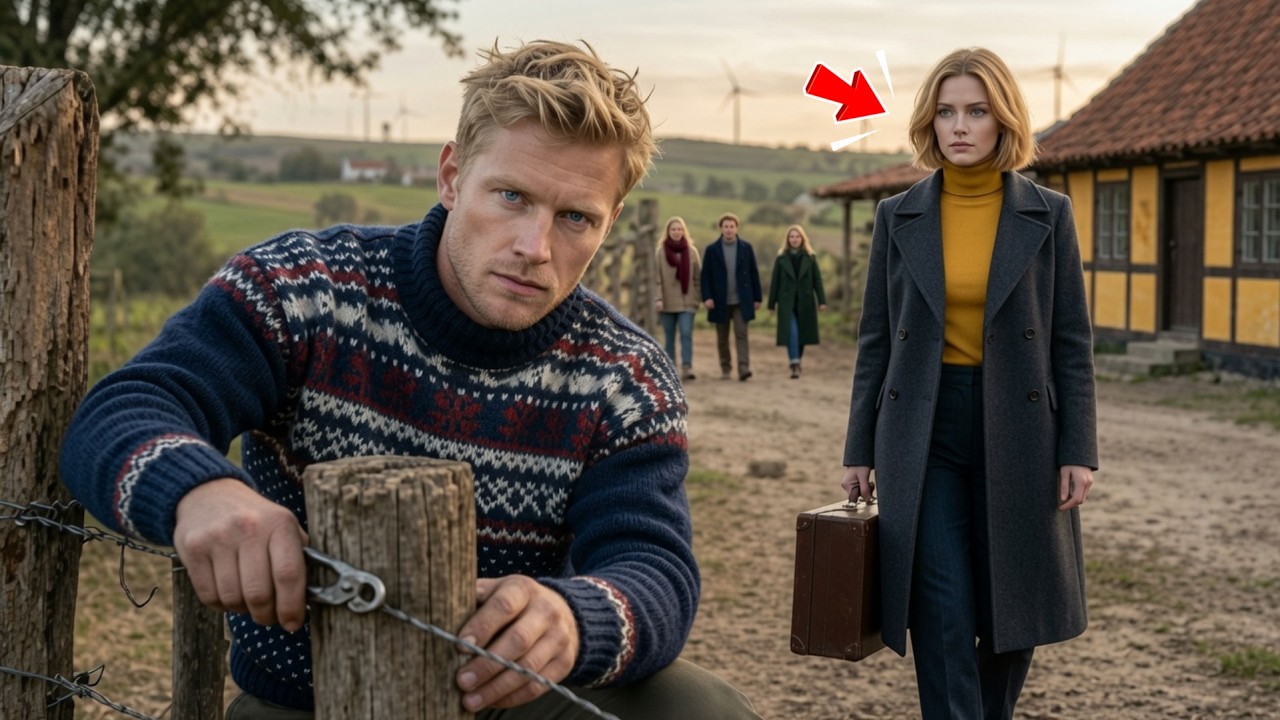
The landsthing, the high court, had taken the matter seriously. They would send a commissioner to investigate the claims made against the estate. A formal summons had been issued. Axel stood at the edge of the crowd, his old coat patched at the elbows, his hands resting on a fence post he’d fixed that morning.
Lærke stood beside him, thinner than she had been a month ago, but her back was straight and her eyes no longer cast down. “It’s done,” Axel said quietly. “The words are out. No one can un-say them now.
”
Lærke watched the other villagers, the ones who had looked at her with hatred and suspicion just days ago, now shifting their weight from foot to foot, uncertain. They didn’t know whether to condemn her or thank her. “What happens now? ” she whispered.
“Now the stones start turning,” Axel said. “And we’ll see what crawls out from under them. ”
But the commissioner didn’t come alone. He brought a clerk, a bailiff, and a young woman from the city who walked through the village with a leather satchel and asked questions no one wanted to answer.
She spoke to the servants at the big house, the tenants, the farmhands who had kept their mouths shut for decades. One by one, the walls began to crack. And when they finally crumbled, the things that came out of them made Pastor Klemmensen lock his church doors and stand outside with a face like stone, refusing to let anyone in until he had said his piece aloud. “This parish,” he declared in a voice that carried across the green, “has been blind for a very long time.
And now the sun is up, and some of you cannot bear the light. ”
But it was the last thing he said that echoed in Axel’s ears all the way home:
“There is more than one kind of stolen land. And more than one kind of thief who calls himself righteous. ”
That night, Axel sat on his bench and looked out over the heath, the moon thin as a sickle above the dark line of the horizon.
“We started something,” Lærke said from the doorway. “We can’t stop it now. ”
Axel shook his head slowly. “I never wanted to stop it,” he said.
“I only wanted to see the day when they had to look me in the eye and know I wasn’t afraid. ”
He turned to her, his face lined but not unkind. “What about you? Are you afraid?
”
Lærke looked past him, at the road that led to the village, at the big house that sat on the hill like a hawk waiting to strike. “I’m afraid of what happens when they don’t have the church to hide behind anymore. ”
Axel followed her gaze and said nothing. But he didn’t go inside, and he didn’t sleep.
Two days later, a rider came down the road carrying a second letter, this one sealed with the estate’s own mark. Axel opened it in front of Lærke, read it once, read it twice, and then folded it with hands that were perfectly steady. “What is it? ” Lærke asked.
Axel looked at her, and for the first time, a small, hard smile appeared at the corner of his mouth. “The godsejer’s answer,” he said. “He wants to meet. Alone.
At the old stone bridge on the estate’s north boundary. At dusk. ”
“Alone? ” Lærke’s voice sharpened.
“That’s a trap. ”
Axel shook his head. “No. It’s an offer.
He thinks he can buy me off. Or scare me off. ” He tucked the letter into his coat. “Either way, he’s about to learn something about me.
”
“I’m coming with you,” Lærke said, her hand on his arm. Axel put his hand over hers. “No,” he said gently. “You have to stay here.
If I don’t come back, I need you to take that paper—the sealed copy of what the commissioner took down—and ride to the landsthing yourself. You can do that. You know you can. ”
Lærke stood stock-still, her throat tight.
“You’re the only person in this parish who was ever good to me,” she said. “You didn’t have to stand up for me. You didn’t have to give me a roof. ”
Axel shrugged.
“A roof’s just wood and straw,” he said. “A man’s word—that’s something else. ”
He went inside to get his coat, and Lærke looked down the road toward the stone bridge, where the shadows were already gathering. Dusk came slowly, as if the sun itself was hesitant to go down.
Axel walked down the field path alone, his boots crunching the frost-hardened grass. There was a figure waiting at the bridge, a tall man in a dark coat, standing beside a horse that stamped impatiently in the cold. As Axel drew closer, the man turned to face him. And everything the village had believed for twenty years suddenly twisted into something else entirely.
Because standing there, waiting for him, was not the godsejer Vasgard. It was a woman. “Good evening, Axel,” said Marta Vasgard, the godsejer’s wife, her voice low and even. “I believe we have a great deal to discuss.
”
Axel stopped a few paces from her, his hands loose at his sides. “Is your husband not coming? ” he asked. Marta smiled a thin, sharp smile.
“My husband,” she said, “left this country three days ago. He took a ship to Hamburg, along with a considerable sum of money that the estate absolutely does not have. I have spent the last forty-eight hours going through his accounts. I suspect you already know what I found.
”
Axel did not answer. Marta stepped closer. “You started this, Axel. You and that girl.
The commissioner’s report has been everywhere. The bank has now sent its own examiner. The church has turned against the estate. My husband fled because he could not face what you unearthed.
”
Her eyes narrowed. “Did you know he was embezzling from the estate’s tenant fund? That he had been taking the money set aside for widows and orphans for over a decade? ”
Axel’s jaw tightened.
“I knew there was something rotten,” he said. “I didn’t know the shape of it until the books were opened. ”
Marta laughed, but there was nothing soft in it. “And now I am left to pick up the pieces of a house that was never truly mine.
I married him for stability, and I got a crumbling manor and a mountain of debt and a husband who abandoned me the moment the walls began to close in. ”
She looked at Axel with something almost like respect. “I did not come here to fight you, Axel. I came here to ask you a question.
”
Axel waited. Marta drew a folded document from inside her coat. “The estate’s north pasture,” she said. “The one that borders your property.
The one you’ve always claimed your father lost in an unfair agreement, and which my husband’s father never properly purchased. ”
Her eyes met his. “If I deeded it back to you, legally and permanently, would you testify in front of the landsthing that you believed my husband acted without my knowledge in the embezzlements? That I was not complicit.
”
Axel was quiet for a long moment. Then Lærke stepped out from behind a hawthorn tree, where she had followed him in the dark despite his words, and Marta’s expression flickered with surprise. “No,” Lærke said. “You don’t get to buy us off with land that was never rightfully his.
”
Marta went still. “You’re that girl,” she said slowly. “You’re the one from the estate. The one my husband—“
“Yes,” Lærke cut in, her voice hard.
“And I am not a bargaining chip you can trade to save your own skin. ”
Marta stared at her, and something in her face shifted—not pity, not guilt, but calculation. “I see,” she said quietly. “So you know more than you have said.
You know what he did with the servants. The one your sister—“
“Don’t. ” Lærke’s voice cracked like ice. “Don’t you dare.
”
The words hung in the cold air. Axel slowly turned to Lærke, a question in his eyes that he did not dare put into words. Lærke’s face was pale, but her eyes blazed. “I didn’t tell you,” she said, her voice rough.
“Because I wanted to see if they would ever pay for anything on their own. ”
She looked at Marta. “Your husband took my sister’s life. Not with his own hands, but through his steward, through his policies, through how he let the house treat its people.
She was sixteen, Marta. She was sixteen, and they said she was a thief, and they threw her out in the middle of winter without a coat, and she was found frozen in the hedge three days later. ”
Marta’s lips parted, but no sound came. Lærke continued, her voice shaking but unbroken.
“And you knew. You know it now, I can see it in your face. You may not have signed the order, but you knew what kind of man he was, and you chose to look the other way. So no.
You don’t get to make a deal. You don’t get to whisper your way out of this. You will sit in front of the landsthing, and you will answer every single question they ask you, or I will tell them everything about what I saw in that house for the three years I worked there. ”
Silence fell like a heavy stone.
Marta’s composure cracked at last. Her shoulders slumped, and the document in her hand trembled. “I did not know,” she whispered. “I—I did not ask.
But that is not the same as not knowing, is it? ”
Lærke did not answer. Axel stepped forward and gently took the document from Marta’s hand. “This is not a bribe,” he said.
“It is a confession. You are going to sign this as a full statement of what you knew and when you knew it, and you are going to do it in front of notar Brand and the commissioner when they arrive tomorrow. ”
Marta looked up at him with something like despair. “And if I refuse?
”
Axel folded the document and placed it inside his coat. “Then I will take this to the landsthing myself,” he said, “and I will tell them that you approached me in an attempt to buy my silence. I do not think they will look kindly on that. ”
Marta closed her eyes.
Then she laughed again, a hollow sound that carried across the dark fields. “You know,” she said, “I think I liked you better when you were just the man who fixed fences on the heath. ”
Axel shrugged. “I didn’t like myself much then either,” he said.
“But a man can change. Even before the frost sets in for good. ”
Marta opened her eyes and looked at him, and then at Lærke. “There is a ledger,” she said quietly.
“In my husband’s study. Hidden behind a loose panel in the fireplace. It contains the names of everyone who received money from the tenant fund, and the dates of every withdrawal he made. It will show that the money went to his personal account, and to his gambling debts in Ribe.
There is also a correspondence with a man named Karel, who was the one who arranged the removal of your sister. ”
Lærke swayed, and Axel put a hand on her arm. Marta continued, her voice lifeless. “I will give all of it to the commissioner.
I will testify to everything I know. It will not bring your sister back, and it will not erase what was done. ”
She paused. “But it will make the truth impossible to deny.
”
Lærke looked at her for a long moment. Then she nodded, a single, sharp movement. “That is all I ask,” she said, her voice barely a whisper. “That the truth be told.
”
Marta turned and unclenched the reins of her horse. “Then it is done,” she said, and mounted in a rustle of dark fabric and cold air. “I will be at the house when the commissioner arrives. ”
She rode off into the night without looking back.
Axel and Lærke stood in the dark together for a long time. Then Lærke spoke, her voice small and tired, the weight of years cracking in her tone. “I should have told you the truth about why I ran away from the estate. ”
Axel shook his head.
“You told me what you needed to tell me,” he said. “That was enough. ”
She turned and looked at him, her face half in shadow. “Why do you stand by me?
” she asked. “You didn’t know me. You owed me nothing. And you stood up in front of the whole village and spoke out for a girl nobody would even look at.
”
Axel was silent for a long moment. Then he said, quietly, almost to himself:
“Because once, a long time ago, someone stood up for me when I was a boy. And I have spent my whole life regretting that I never stood up for him in return. ”
He looked at her.
“You don’t get to choose when a moment matters,” he said. “You only get to choose whether you step forward or step back. ”
Lærke swallowed hard. “And you chose forward,” she said.
“Every time,” Axel said. They walked back to the house together under the cold stars. The next morning, a deep frost covered the heath, and the whole village came to the church square to see the commissioner arrive with his clerk and his seals. Marta lived up to her word.
The ledger was produced. The testimonies were given. The truth, at last, was laid bare before the landsthing and the parish alike. And on the day they finished their investigation, the commissioner stood in front of the gathered people and read the findings aloud.
The godsejer Vasgard would be arrested upon his return or extradited from Hamburg. His properties, including everything he had held under false title, would be reclaimed by the crown and redistributed to those who had been wronged. He named Axel first. The north pasture, which had belonged to his father and his grandfather before him.
The village was silent. Axel felt the weight of it settle in his chest, not as happiness, but as something quieter. Justice, at last, stitched unevenly over the scars of decades. Lærke stood beside him, and when the crowd turned to look at them, it was not with hatred, but with something closer to shame.
Pastor Klemmensen approached him after the announcement, his face grave and tired. “I misjudged you, Axel,” he said. “The parish misjudged you. I am sorry for it.
”
Axel, who had lived with the memory of cold shoulders and closed doors for most of his life, could not bring himself to accept the words fully. But he nodded. “We all do what we think we must,” he said simply. “Now we do it better.
”
He went home to his fence, to his stones, to the northern pasture that was his again. And that evening, Lærke sat on his bench beside him, overlooking the heath where frost glittered under a thin sun. “What will you do now? ” she asked.
“The land is yours. ”
Axel turned the soil between his fingers, old habit, a lifetime of waiting for something to grow in hard ground. “I’m going to plant,” he said. “Maybe it will take.
Maybe it won’t. But there’s a kind of peace that comes from planting, no matter what the harvest brings. ”
Lærke looked at the field, at the distance. “And me?
” she asked softly. Axel considered the question, and then appeared to settle on an answer. “There’s a house here,” he said. “It might be small.
The roof leaks, and the small kitchen can’t hold two people at once, but it holds. And there’s work, if you want it. Fields don’t tend themselves. ”
Lærke looked down at her hands, then back at him.
“I would like that,” she said. Axel stood up and dusted his hands. “Then it’s settled,” he said. “Welcome to the north pasture.
”
They stood together in the cold, looking out at the frost-covered land that had been through fire and fury, through secrets and silence, and had finally, finally come home. —