The millionaire lay back as the waitress said she spoke languages, but what happened next destroyed him forever. People like her don’t learn languages; they learn to wash floors. The Patek Philippe Nautilus watch worth three million kroner glittered on Sebastian Westergard’s wrist, his fingers drumming impatiently on the white tablecloth. A gesture of impatience is power from a man used to the whole world bending to his rhythm.
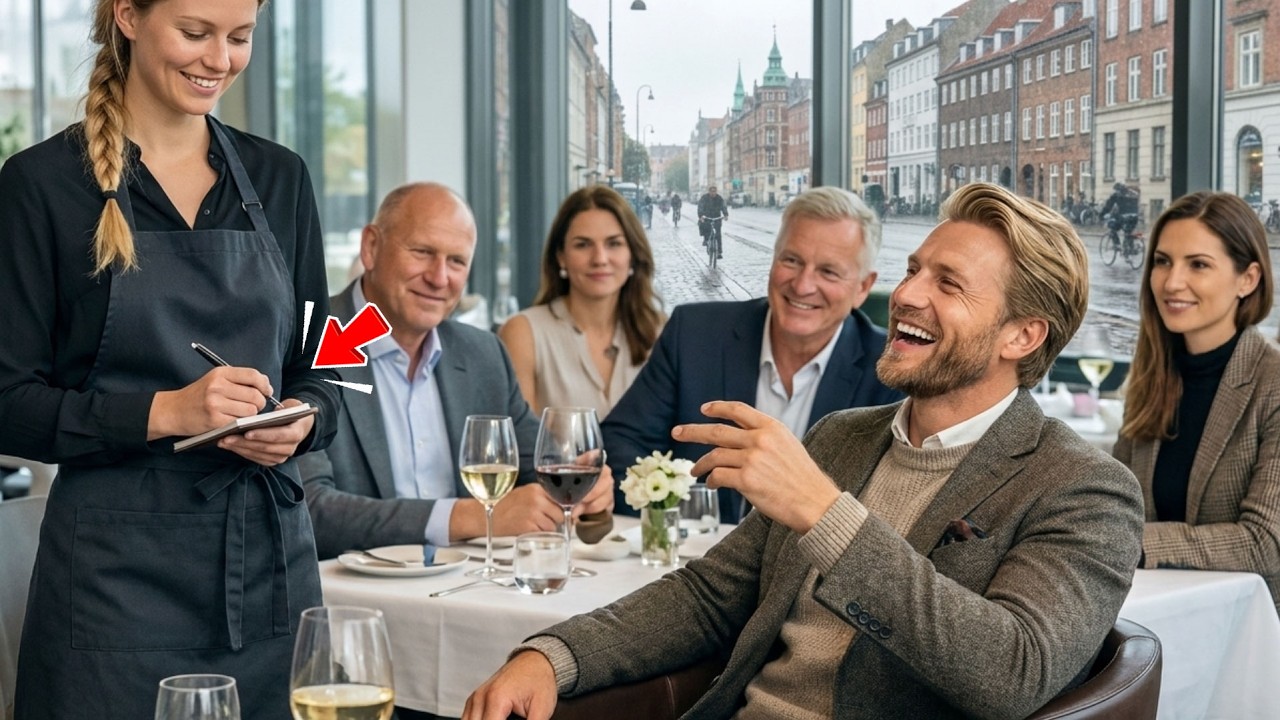
Sofia Lindgren had been on her feet for six hours. Her feet burned in the black shoes with medium heels that were half a size too small, but they were the only presentable shoes she owned. The uniform—the starched white blouse, the black knee-length skirt, the stiff apron—hid the truth that she had only drunk weak coffee for breakfast because her salary didn’t stretch to Friday. It hid that her grandmother Gudrun was waiting at home with swollen knees and no money for medicine.
And that every step she took in this luxury restaurant was a silent act of resistance against hunger, against defeat, against being forgotten. But no one saw Sofia Lindgren. They saw the waitress, a nameless body that served dishes for three kroner and bottles of wine for six hundred. A person who disappeared as soon as she had filled the glasses and who only existed when they needed something.
Sofia’s hands trembled as she carried the tray to the table where Sebastian Westergard sat with his business partners. Her palms were sweating, and the silver domes clinked softly. She placed the dishes with practiced precision, but her fingers brushed against his glass, and a single drop of water splashed onto the white cloth. Sebastian’s eyes narrowed.
He looked at the drop, then at her. “You should be more careful,” he said coldly. “Or do they not teach that where you come from? ”
Sofia bowed her head.
“I’m sorry, sir. It won’t happen again. ”
He studied her for a moment longer, then turned back to his guests. Sofia exhaled and began to retreat, but then she heard him say to his colleague, “These people are all the same.
They never learn anything useful. They just wash floors and serve food. ”
The words hit her like a slap. She wanted to say something, to defend herself, to scream that she spoke six languages and was studying law at night school.
But she said nothing. The words died in her throat. That night she came home to the cramped apartment in the worker’s quarter, where her grandmother Gudrun was sitting at the kitchen table with her aching hands folded. Gudrun had been a language teacher her whole life, but now she could barely afford her medicine.
“Grandmother,” Sofia said quietly, “I’m going to do something. I’m going to fight. ”
Gudrun looked at her with tired eyes. “How, my child?
We have nothing. No money, no connections, no proof. ”
“We have the letters,” Sofia said. “The ones grandfather hid before he died.
The ones that show Westergard stole our land. ”
Gudrun’s face went pale. “Those letters were buried with him. They were never found.
”
“No,” Sofia said, and she pulled out the old metal box she had found in the cellar months ago. “I found them. And I’m going to use them. ”
The next day Sofia went to the free legal clinic, a small office run by young lawyers who helped people who couldn’t afford representation.
She sat across from a young woman with kind eyes who read through the letters carefully. These documents,” the lawyer said slowly, “if they are authentic, they prove that the Westergard family took your family’s property illegally. This could be the basis for a legal claim. But it would be a long fight.
”
“I don’t care how long it takes,” Sofia said. “I have to do this. ”
The case began. Sofia continued working at the restaurant, swallowing her pride every time Sebastian Westergard came in with his loud laughter and expensive suits.
She worked double shifts, studied at night, and used every spare moment to meet with lawyers and gather evidence. She faced threats from Westergard’s lawyers, warnings that she should drop the case or she would regret it. But Sofia didn’t stop. She couldn’t stop.
Then one day, Dmitri Volkov arrived at the restaurant. He was a Russian businessman with cold eyes and an expensive suit, and he was interested in the case. “I have a business dispute with Westergard,” he told Sofia in perfect Danish. “Rumors say you have evidence that could hurt him.
I’m willing to help you. In exchange, you’ll help me. ”
Sofia was wary. “What kind of help?
”
“I need information that could expose his financial fraud. Your letters mention a hidden account in a Swiss bank. If I can access it, I can expose him, and you can win your case. ”
Sofia thought for a long time.
She was putting her whole future in the hands of a man she didn’t trust. But she had no other choice. “Deal,” she said. The months that followed were a storm.
Evidence leaked to the press. Sebastian Westergard’s financial empire began to crumble. His partners abandoned him. His lawyers tried to bury the case in delays.
But the truth kept coming out, like water seeping through cracks in a dam. One cold morning, the court delivered its verdict. The land that belonged to the Lindgren family for generations was legally returned to Sofia. The courtroom was silent, and then the judge’s voice cut through the air.
“This court finds that the property in question was taken illegally and orders it returned to the rightful heirs. ”
Sofia didn’t cry. She just sat there, feeling the weight of years lifting off her shoulders. She turned to look at her grandmother, and Gudrun was crying, tears streaming down her face.
“We did it,” Gudrun whispered. “We did it. ”
Outside the courthouse, the reporters surrounded her, but Sofia only had one thing on her mind. She walked home with Gudrun, through the streets where they had lived so long, and finally stood at the edge of the estate that was hers again.
The land stretched out before her, green and quiet. She placed the empty metal box on the nightstand in her new room, the room that had belonged to her great-grandfather a century before, now restored with old furniture and family photographs. She kept the box as a memory, a reminder that justice is possible—slow, painful, and expensive, but possible. Two years later, followed by the opening of Gudrun Lindgren’s language school with two hundred students, all with full scholarships.
Young people from rural areas, children of workers, grandchildren of people who had been pushed out of society, all with the same light in their eyes that Sofia had had years before, when she discovered that words in other languages could open whole worlds for her. Gudrun cut the red ribbon with a large pair of scissors that trembled in her eighty-five-year-old hands. Her health had improved noticeably since they returned to the estate. “I declare this school officially open,” she said with a clear, firm voice.
The applause rang like thunder. Sofia watched from the side with folded hands and felt something that resembled complete happiness. Dmitri Volkov stood by her side, having flown in from Moscow for the inauguration. He smiled more now.
The partnership with Sofia had taught him that not everything in the business world needed to be ruthless. One day, Sofia went alone behind the estate. Under an old poplar, there was a new, dignified grave. Rodrigo Lindgren, 1900–1995, schoolteacher, husband, grandfather, finally home.
Sofia had moved her grandfather’s remains from the communal grave where he had been buried. Now he rested in the land he had loved. She knelt beside the grave and touched the cold stone. “Grandfather, if you could see this.
The estate is alive again, but not as before. It’s better now. It doesn’t belong to one family. It belongs to everyone who needs it.
”
The wind blew gently and moved the poplar’s leaves. She closed her eyes and swore she could hear her grandfather’s voice. “That’s how it should always have been, my child. Land isn’t owned.
It’s shared. ”
When she opened her eyes, she saw a man standing about twenty meters away. He was thin, haggard, with short-cropped hair, dressed in simple clothes, worn jeans, and a denim jacket. Sebastian Westergard had been released from prison three months earlier.
His years in prison had transformed him into a different person. Sofia rose slowly. She felt no fear. No hatred.
Only curiosity. Sebastian approached with slow, uncertain steps. He stopped five meters from her, as if he knew he didn’t have the right to come closer. “I know I shouldn’t be here,” he said with a voice that had lost all its old arrogance.
“But I needed to see this. To see what you’ve done with the land. ”
Sofia didn’t answer. “I walked through the village.
I saw the school. I saw the families. You’ve helped them,” he continued, his voice cracking. “I saw what it could have been if my father had been an honest man.
”
“Why did you come? ” Sofia finally asked. “To ask for forgiveness. ”
The words hung in the air like heavy bells.
“I can’t give you back the years I took from you,” Sebastian continued. “I can’t bring your grandfather back to life. I can’t erase the pain my family caused. But I can tell you the truth.
What I did was wrong. And I’m sorry. I’m so sorry it hurts to breathe. ”
Sofia looked at him for a long time.
She saw the early wrinkles. She saw the calloused hands of someone who had learned to work. She saw eyes that had lost all arrogance and contained only shame. “What are you doing now?
” she asked. “I work at a café. Washing dishes, wiping tables. Earning minimum wage.
I live in a one-room apartment. ” He smiled without warmth. “It’s exactly what I deserve. ”
He took something out of his pocket—a folded piece of paper—and gave it to Sofia.
It was his father’s will, the page he had read during the trial. Words from a man who regretted being forced to return what had been stolen. “I carry it with me every day,” Sebastian said, “to remember what my father asked me to do and what I didn’t do until it was too late. ”
Sofia was silent for a long time.
Then she spoke not with anger but with truth. “I won’t say that I forgive you, because forgiveness isn’t something you just give. You earn it over time, with actions, with real change. ”
Sebastian nodded.
“I know. ”
Sofia paused. “But if you really want to make things right, there’s something you can do. ”
“What?
”
“The school needs teachers. I can’t pay much. But if you have something worth teaching, you can come—not as a punishment, but as a contribution. ”
Sebastian looked at her as if she were speaking a language he didn’t understand.
“You’re offering me a job. ”
“I’m offering you a chance to be useful, to build instead of tear down. To teach instead of humiliate. ”
“I don’t know if I deserve it.
”
“It’s not about deserving,” Sofia interrupted. “It’s about deciding who you want to be from here on. ”
Sebastian closed his eyes, and tears ran down his face. “I accept.
”
“Good. You start Monday at seven in the morning. Sharp. ”
“I’ll be there.
”
He turned to go, then stopped. “Sofia. Thank you. ”
“Don’t thank me.
Prove it. ”
He nodded and walked toward the village with lighter steps than when he had arrived. Sofia returned to her grandfather’s grave. “I hope this is in your spirit, Grandfather.
I hope this is what you would have wanted. ”
The wind blew again. And this time, Sofia knew the answer. Five years later, Skovgard Estate had become a reference point in the entire country.
One hundred and fifty students, three dozen teachers, fifty families under legal counseling, twenty cases of reclaimed land. Gudrun Lindgren died peacefully at the age of ninety in her own bed with a smile on her lips and her silver cross between her hands. They buried her beside Rodrigo under the same poplar. Hundreds of people attended her funeral—students she had inspired, families she had helped, and neighbors she had touched with her wisdom.
Karen Rasmussen spoke at the ceremony with a trembling but firm voice. “Gudrun taught me that it is never too late to do the right thing, that forgiveness is stronger than guilt, and that justice isn’t about revenge but about restoring dignity. ”
Sofia cried, but not from sorrow. From gratitude.
Her grandmother had lived long enough to experience all of it—to walk on the reclaimed land and to see her granddaughter become the woman she had always known she could be. After the funeral, Sofia went up to the estate’s viewpoint, the highest place. From there she could see all four hundred hectares—the buildings, the fields, the old trees. Dmitri stood beside her looking at the horizon.
“It’s beautiful,” he said. “Yes,” Sofia answered. “It is. ”
“What will you do now?
”
“More of this. Help more families. Open more schools. Prove it’s possible to win back what was stolen.
Prove it’s possible to fight the powerful and win. ”
“You’ll always need help,” Dmitri smiled. “Count on me. ”
As the sun set over the estate, coloring the sky orange and purple, Sofia Lindgren closed her eyes and breathed deeply.
She breathed in the scent of the soil—her ancestors’ soil, the soil she never should have lost but that was now finally home. And she knew that everything—the humiliation, the tears, the sleepless nights—had all been worth it. Because in the end, truth always wins, and dignity can never be stolen. It can only be forgotten.
And she had remembered it—for all those who came before and for all those who would come after.