The cart stopped at the manor gate as the sun dipped behind the hills. Zofia climbed down carefully, brushing road dust from her earth-colored skirt. Then she heard it—the desperate, piercing cries of small children. She had only wanted to ask for water before continuing her journey, but then she saw him.
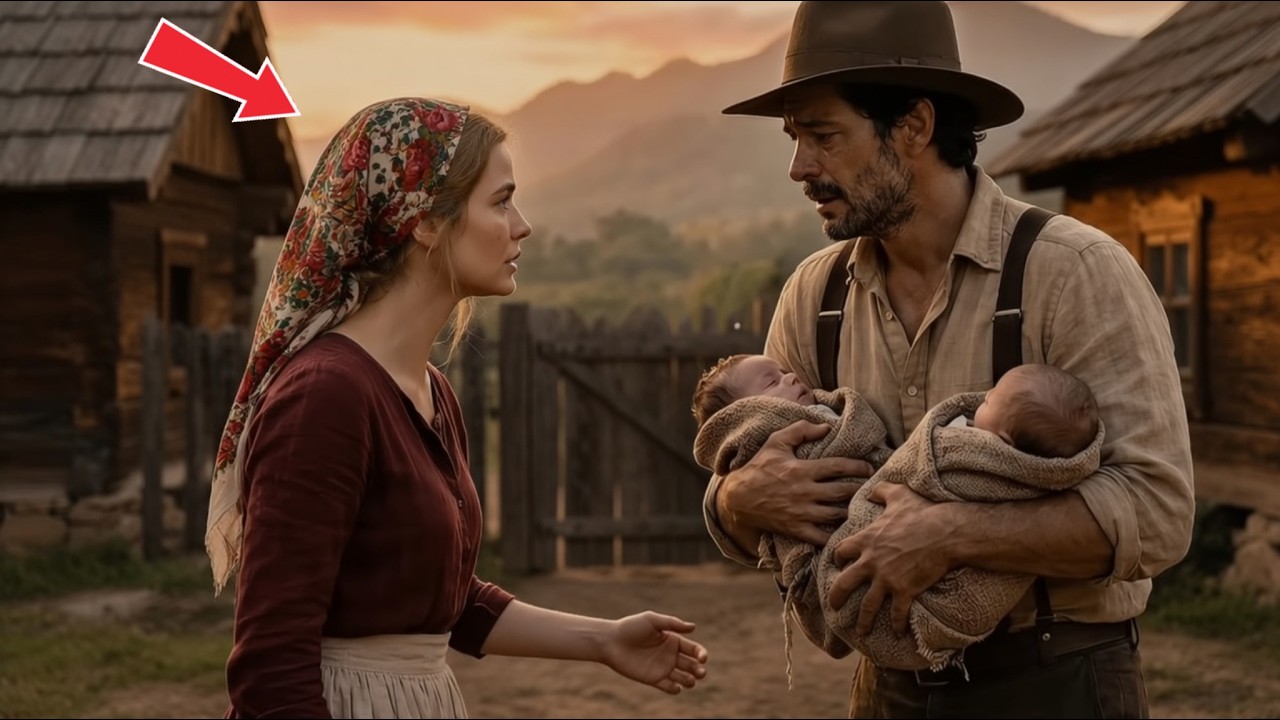
Stanisław stood on the porch, a tiny child in each arm, swaying as if the world might collapse at any moment. His face was carved with exhaustion. He hadn’t slept properly in months. Taking a deep breath, Zofia said the words that would change both their lives: “If you let me stay, I will take care of them.
”
—
It was 1947. Poland was still rising from the ashes of war, and the countryside carried its scars. Zofia had been traveling for four days since losing her last job. She carried a worn leather suitcase, her mother’s rosary, and a stubborn hope that tomorrow might be better than yesterday.
When her parents died of fever in the same winter, she cried for two weeks, then wiped her tears with the quiet determination of someone who understands the world waits for no one. She worked for nearly a year caring for an elderly woman until that woman’s heart gave out one October morning. The nephews came, sold everything in three days, and Zofia found herself on the road again with a few coins and the bitter certainty that there was no safe place for a woman without family. The manor beneath the Old Oak appeared almost by accident at the end of a hot August afternoon.
Zofia’s feet ached, her throat was dry, her body begged for rest. She saw a wooden gate, a large house with whitewashed walls, a cowshed, chickens scratching in the yard. It smelled of wet earth and fresh-cut grass—the smell that meant life and work and possibility. She had rehearsed her words—“Good day.
I’m looking for work. I can cook, wash, sew”—but they died in her throat when she heard the crying. Two children, wailing together, a sound that echoed through the rooms. Zofia knew that cry.
It was the cry of hunger, dirty diapers, abandonment. She knocked and waited. After a few minutes, the door opened and a man appeared. Stanisław was tall, broad-shouldered from years of field work, with tousled black hair.
His face mixed exhaustion with something like shame. In his arms, wrapped in yellowed linen, were two small beings squirming and crying as if the end of the world had come early. “Good day,” Zofia said, her voice steady despite her nerves. “I’m sorry to trouble you.
I only wanted to ask for some water, if that’s possible. ”
Stanisław came down the porch steps with the awkward care of someone unused to carrying two babies at once. “Water is there,” he answered hoarsely. “But I can’t put them down right now.
If you want, the jug is in the kitchen. You can help yourself. ”
Zofia hesitated only a second before opening the gate and stepping into the yard. She saw the children more clearly—twins, a boy and a girl, no more than five or six months old.
Faces red from crying, tiny fists clenched. “They’re hungry,” she said, unable to stop her instinct. Stanisław sighed, exhausted. “Everything is hungry, dirty diapers.
I don’t know. I don’t understand children. Ma’am, I’m trying,” but his voice broke and he turned aside, ashamed to show weakness before a stranger. Zofia looked around.
The house stood, but disorder was visible everywhere. Clothes hung haphazardly on the line, the garden was overrun with weeds, chickens wandered onto the porch unchased. It was the chaos of a man trying to carry the whole world with two hands. “Are you here alone, sir?
” she asked, already guessing the answer. “Yes,” Stanisław replied, trying to soothe the babies with an uncoordinated motion that only upset them more. “My wife left right after these two were born. I have helpers who come during the day to work with the cattle, but with the house, the children—I’m alone.
”
Zofia felt something move in her chest. She knew what it meant to need help and have no one. Without thinking too long, she held out her arms. “Give me one.
”
Stanisław stared at her in surprise, then with something like desperate relief handed her the little girl. Zofia took her with confidence, settling the small body against her chest, fitting the head to her shoulder, and began to rock in the gentle rhythm she had learned from her mother. She hummed a soft old folk song. The girl, feeling the sure touch and the right rhythm, began to calm.
First the crying stopped, then it became intermittent whimpering, until finally the small creature rested her head on Zofia’s shoulder with a quiet sigh. Stanisław watched as if seeing a miracle. For six months, he had never managed to quiet them so quickly. “How did you do that?
” he asked, astonished. Zofia smiled slightly, still rocking. “Children feel when a person is nervous. You’re tense, exhausted.
They feel it and get worse. It takes calm and knowing how to hold them. ”
She looked at the boy still crying in his arms. “This one is hungry.
When did they last eat? ”
Stanisław looked up, trying to remember. That in itself was a sign that too much time had passed. “In the morning, I think.
I gave them cow’s milk diluted with water, but they spit up almost everything. ”
Zofia frowned. “Pure cow’s milk is too heavy for such small creatures. It must be well diluted, warm, and given slowly, with patience.
”
She walked to the porch, still rocking the now-dozing girl. Stanisław followed. The kitchen was exactly what she expected—the mess of a man living alone. Dirty pots piled up, food scraps on the table.
But there was structure, potential. She sat down, the girl on her lap, and looked at Stanisław with the expression practical women have when they assess a situation and already know exactly what needs to be done. “Do you have fresh milk, clean water, clean cloths for diapers? ”
Stanisław nodded to all three questions, still standing, awkwardly rocking the boy.
“Then I’ll prepare the food, and you light the stove. Afterwards I’ll change the diapers and bathe them. ”
Stanisław watched this woman who appeared from nowhere taking everything upon herself with a naturalness he hadn’t seen in months. He should refuse.
He didn’t know her. But the exhaustion was so great, the need so deep, and for the first time in six months he felt that maybe he didn’t have to carry everything alone. “I can’t pay you,” he said with sudden brutal honesty. “I don’t have money to hire anyone right now.
There’s very little money. ”
Zofia looked at him. She looked at the children. She looked at the house that begged for care.
She thought of the road ahead. Then she looked at this tired-eyed man holding a child that had finally stopped crying, and she knew this was where she needed to be. “If you let me stay, I will take care of them,” she said, her voice clear and certain, not begging, not asking, just offering. “You don’t have to pay me with money.
Give me food and let me stay. These children need a mother. You need help, and I need a roof over my head. We can help each other.
”
Stanisław was silent, processing her words. He searched her face for any sign of bad intentions. All he found was fatigue, honesty, and calm determination. “You don’t even know my name,” he said, testing her.
“No more than you know mine. I’m Zofia. And you’re Stanisław. ”
They stood looking at each other—two strangers connected by need and the crying of beings that had finally gone quiet.
“All right,” Stanisław said at last, surprising himself. “You can stay. But only until I get myself organized better, until I find someone permanent. ”
Zofia smiled slightly, knowing that the word “permanent” rarely works out in life.
“All right,” she agreed. And so, without contracts, without witnesses, without grand promises, the story of Stanisław and Zofia began. —
That first evening, Zofia prepared warm, well-diluted milk. She fed the twins with endless patience, changed their dirty diapers, bathed them in a large basin in the kitchen, quietly singing as she washed every fold of delicate skin.
Stanisław watched, learning, seeing how easily she did what had been impossible for him. When the children were clean, fed, and sleeping in their improvised cradles, Zofia looked around and sighed. “Tomorrow I’ll tidy this kitchen. All that laundry needs washing, and the garden needs weeding.
”
“Tomorrow,” Stanisław interrupted with a gentler voice. “You’ve already done a lot today. You must be tired from the road. ”
She saw something new in his eyes—real gratitude.
“The guest room is at the end of the hall,” he said, gesturing. “It’s simple, but it has a clean bed and a window. ”
The room was more than Zofia had possessed in months. She lay down fully dressed, exhausted, listening to the sounds of the night—crickets, an owl, the low murmur of a cow.
For the first time in a long time, Zofia fell asleep feeling she might have found a place where she belonged. —
Days passed in a rhythm that formed itself without many words. Zofia woke before the sun, lit the stove, made strong coffee and hearty food, fed the children, changed diapers, bathed them, sang songs while doing housework. Stanisław worked in the fields, returned for meals, saw his children clean and content, and felt the weight on his shoulders diminish daily.
He didn’t say much, but he watched. He watched how Zofia talked to the children as she changed their diapers, explaining every movement as if they understood. He watched how she quietly sang old melodies while hanging laundry in the midday sun. He watched how she arranged the house with care, respecting Helena’s things, not trying to erase her presence.
On the tenth day, something happened that Stanisław didn’t expect. He was on the porch adjusting the harness when he heard laughter—a child’s high, crystal-clear laugh of discovery. He dropped the reins and ran inside. In the sitting room, Zofia sat cross-legged on the floor, Jaś on her lap.
She made funny faces, hid her face behind her hands, then appeared suddenly with shouts of surprise. The baby laughed that thick, shameless laugh only infants have. Ania, lying nearby, kicked her legs in the air, trying to get attention. Stanisław stood in the doorway, his heart squeezing differently than ever before.
His children were laughing. For six months of their lives, he had never heard that sound. Only crying, whimpering. And here it was, drawn out by this woman who had arrived less than two weeks ago and knew his children better than he did.
Zofia noticed his presence and stopped, slightly embarrassed. “I’m sorry, I was making too much noise. ”
“No,” Stanisław said, his voice more charged with emotion than he intended. “For them, no.
”
She smiled a small, genuine smile and made her faces again. Jaś laughed again, and this time Ania giggled too. Stanisław sat in the rocking chair that had belonged to Helena and simply sat there, watching this simple scene that meant so much. Life was returning to the house.
Joy was filling the corners that grief had so long occupied. —
The first difficulty came one afternoon at the market in town. Stanisław had to sell cheese and buy supplies. Zofia asked to come along—she needed thread and cloth for new diapers.
They all went together, the four of them. Stanisław drove the cart, Zofia beside him holding Ania, Jaś in a basket in the back. Old Wierzbno was a small town of about sixty houses. Stanisław knew everyone, and everyone knew his misfortune—the young wife who died in childbirth.
So when people saw the widower with a young woman beside him, gossip started immediately. Pani Krystyna, the blacksmith’s wife, was the first to approach. “Stanisław, how nice to see you at market. And who is this lady?
”
“This is Zofia. She helps me with the children,” he answered formally. Pani Krystyna’s eyebrows rose. “She lives at the manor?
”
“She does,” Stanisław confirmed, his voice hardening. “Because I needed help, and she needed work. Is there a problem, Pani Krystyno? ”
The woman backed off slightly but didn’t give up.
“A problem? No. But what will people say? An unmarried woman living with a young widower.
Both of you of age. It doesn’t look good. It doesn’t serve either of your reputations. ”
Zofia, who had been silent until now, spoke for the first time.
“My reputation is that of a hardworking, honest woman, and Mr. Stanisław’s is that of an honest man who is raising his children alone and needed help. If people want to speak badly of someone who works and cares for children, the problem is not on our side, but on the side of the one with a loose tongue and an empty head. ”
The answer was so firm and quick that Pani Krystyna was rendered speechless.
Stanisław hid a smile and moved on, but the damage was done. Throughout the market, he felt stares and heard whispers. On the way back, Zofia was silent. Stanisław noticed the tension in her shoulders.
“Don’t pay attention to what they said,” he said when they were on the main road. “Country people are like that. They talk about everyone. ”
“I don’t care what they say about me,” she answered in a controlled voice.
“But I don’t want you to have problems because of me. If you prefer, I can leave. ”
“No,” Stanisław interrupted faster than he intended. “I don’t prefer that.
Stay. ”
The silence that followed was different from those before. It had weight—the awareness that this situation was not simple. It wasn’t just an employer-worker relationship.
It was becoming something essential, important, and therefore dangerous. —
That night, Stanisław looked at her properly for the first time—not as a helper, but as a woman. He saw she had beautiful eyes, dark and expressive. He saw that her smile, when it appeared, brightened her whole face.
He felt something move in his chest, something he hadn’t felt in so long he’d forgotten its name. Frightened by his own thought, he quickly looked away. “I’m going to wash my hands for dinner,” he muttered and went out back. One evening, almost a month after Zofia’s arrival, the moment came that changed everything.
Ania developed a fever that afternoon and worsened by night. Zofia did what she knew—cold compresses, linden tea—but the girl cried inconsolably, her small body burning. Stanisław was frantic, pacing the sitting room. “I must go for the doctor in town,” he said, grabbing his hat.
“It’s two hours away, Stanisław. The night is dark. It could be dangerous. The fever isn’t that high yet.
Let’s do more compresses. If it hasn’t gone down by morning, then you’ll go. ”
He looked at her. He saw calm in her eyes, the certainty of someone who knows what she’s doing, and he trusted her.
They spent the night awake, taking turns applying compresses, rocking the girl, checking her temperature. Stanisław watched Zofia work with a devotion that went beyond duty—it was pure love. She sang to Ania, whispered words of comfort, kissed her hot forehead with motherly tenderness. When finally, near dawn, the fever began to break and Ania fell into a peaceful sleep, Zofia leaned her head back and sighed with such deep relief that her shoulders trembled.
Stanisław came over and crouched beside her. “Thank you,” he said hoarsely, thick with emotion and exhaustion. “You saved her. ”
Zofia opened her eyes and looked at him, so close, and felt her heart quicken.
“Our little girl,” she corrected quietly, then realized what she’d said and opened her eyes wide. “I’m sorry, I didn’t mean to say that. ”
“Don’t,” Stanisław interrupted, without hesitation taking her hand. “You’re right.
Our little girl. You care for her as if she were your own. ”
And there, in that touch of hands, in that gaze exchanged in the middle of the night, something shifted between them forever. —
The next morning, the sun came up differently.
Stanisław woke on the chair where he’d fallen asleep, neck stiff. The first thing he did was look at Ania’s cradle. She slept peacefully, no trace of fever. Zofia was already in the kitchen, despite the sleepless night, making coffee and kneading bread dough.
When she saw him come in, she smiled wearily but with relief. “The fever has completely gone down. She’s fine. ”
Stanisław felt his knees go weak with gratitude.
He stood by the stove, not knowing what to do with his hands or the words that stubbornly lodged in his throat. “Zofia,” he began, his voice quieter than usual. “What happened last night, what you said…”
She cut him off quickly, kneading the dough with unnecessary force, eyes fixed on her work. “I spoke without thinking.
Stanisław, I know these are your children, that I’m only…”
“You are not only anything,” he interrupted, startling them both with his firmness. “You’re the person who cares for them like no one else, who stays awake for them, who loves them. ”
The word “loves” hung in the air like a dangerous confession. Zofia stopped kneading.
Her flour-covered hands trembled slightly. “Yes, I love them,” she admitted quietly, not looking at him. “I know I shouldn’t. I know I have no right.
But I can’t help it. They entered my heart from the first day. ”
Stanisław took a step toward her. “And did I?
” he asked, his voice hoarse. Zofia finally looked up, and what Stanisław saw there made him forget how to breathe. There was fear, yes, but also hope. Stanisław slowly raised his hand, as if approaching a frightened animal, and touched her face with fingers still dirty from field earth, leaving a mark on her pale skin.
“I don’t know when it happened,” he confessed. “I don’t know if it was watching you care for my children, or laughing while you hung the laundry, or when you answered Pani Krystyna at the market. I only know that when I think of you leaving, I feel a tightness in my chest that I haven’t felt since Helena…”
He didn’t finish the sentence, but he didn’t need to. Zofia understood.
And there was the problem—the delicate specter of the woman who was wife, mother, mistress of this house. “Do you love her? ” Zofia asked, not as an accusation but as a fact. “I will always love her,” Stanisław answered with a sincerity that hurt.
“She gave me children. She gave me happy years. That can’t be erased. ”
Zofia nodded, understanding the pain on his face.
“I know. And I would never try to take her place. I would never try to make you forget her. ”
“It’s not about forgetting,” he said, still holding her face.
“It’s about moving on, letting the heart heal and feel again. You taught me that without knowing it. You taught me I can honor the past without dying with it. ”
The moment might have become something more—a kiss, perhaps a final confession.
Then Jaś began to cry from the other room. The cry came like a bucket of cold water, bringing them both back to reality. Zofia quickly stepped back, wiping her hands on her apron, face flushed. “I’ll go see to Jaś,” she muttered and nearly ran out of the kitchen.
—
The following days were strange, full of new tension neither knew how to handle. They avoided each other without really avoiding each other. They spoke only of what was necessary but caught themselves looking at each other when the other wasn’t watching. In that tense atmosphere, the second difficulty came, and this time it was bigger than village gossip.
It was real, it was dangerous, and it came with the face of family. One Tuesday afternoon, an elegant carriage stopped before the manor gate. From it descended a woman of about sixty-five, dressed in black from head to toe, with a widow’s veil and the bearing of someone accustomed to being obeyed without raising her voice. It was Pani Jadwiga, Helena’s mother.
Stanisław felt his stomach clench. He hadn’t seen his mother-in-law since his wife’s funeral. She had left after the burial, saying she couldn’t bear to see the grandchildren who had cost her daughter her life. “Pani Jadwiga,” he greeted, removing his hat in a gesture of respect.
“What a surprise. ”
The woman looked at him with cold gray eyes. “I came to see my grandchildren. Enough time has passed that I should get to know them.
”
When they entered the sitting room, Zofia was on the floor playing with the twins. Jaś was trying to crawl, Ania was clapping her hands and laughing. The scene was full of domestic joy, but it froze the moment Pani Jadwiga entered. Zofia quickly stood, smoothing her skirt, eyes wide.
Stanisław introduced them tensely. “Pani Jadwigo, this is Zofia. She helps me with the children. Zofia, this is the twins’ grandmother.
”
The two women measured each other in silence. “Helps,” Pani Jadwiga repeated, her voice full of meaning. “I see. And does she live here?
”
“She does,” Stanisław confirmed before Zofia could answer. “In the guest room. ”
The older woman approached the children, knelt with difficulty, and examined them with a critical eye. She touched their faces, checked their clothes, clean nails, combed hair.
“They are well cared for,” she admitted at last, and there was genuine surprise in her voice. “I expected to find them different. ”
“Zofia cares for them with great affection,” Stanisław said. “They are healthy, they are happy.
”
Pani Jadwiga stood, smoothing her skirt with precise gestures. “Can we speak privately, Stanisław? ” It was not a question but a command. They went to the porch, doors closed behind them.
Pani Jadwiga got straight to the point. “How long has this woman been here? ”
“Almost two months. ”
“And do you think, Stanisław, that it’s proper for an unmarried woman to live with a young widower?
”
Anger began to rise, but he controlled it. “I think it’s proper when the alternative was leaving my children without care while I worked. Zofia came when I needed her most. ”
“I’m sure,” the woman said with a bitter smile.
“But appearances matter. What will people think? What will they say about my daughter’s memory? ”
“With all respect, Pani Jadwigo, Helena’s memory is not being dishonored.
Zofia cares for her children with a love Helena herself would have given. She cooks the food Helena cooked. She keeps the house as Helena would have kept it. If anyone here honors your daughter, it is Zofia.
”
The silence that followed was heavy. Pani Jadwiga studied her son-in-law’s face. She saw determination, fierce defense. “You love her,” she stated, more as a fact than a question.
Stanisław didn’t answer, but the silence was answer enough. “I came here with the intention of taking the grandchildren to Rzeszów,” she confessed. “I came believing I would find chaos, neglect—enough reason to take the children from you. ”
Stanisław felt the ground give way beneath his feet, but she continued, turning to face him.
“Instead, I found children who are happy, healthy, loved. I found a home that functions, that has human warmth. And though it’s hard for me to admit, I found a woman who cares for my grandchildren as if they were her own. ”
She paused, eyes moist for the first time.
“My daughter chose well in a husband. You are a good man, Stanisław. And if this Zofia makes you and my grandchildren happy, then perhaps this is what Helena would have wanted. ”
Her voice broke at the end, and she had to brace herself against a pillar.
Stanisław, surprised by this sudden vulnerability, gently placed his hand on her shoulder. “Pani Jadwigo, the twins will always be your grandchildren. You can visit them whenever you wish. You can be part of their lives.
You don’t have to take them to be present. ”
Pani Jadwiga wiped her tears with a lace handkerchief. “I know. It’s just—I miss her so much, Stanisław.
And seeing these little ones is like seeing my daughter again. ”
“I miss her too,” he admitted, his voice cracking. “Every day. But I’ve learned that missing someone doesn’t mean stopping living.
”
Pani Jadwiga collected herself. “I’ll stay at the inn in town for a few days. I want to spend time with my grandchildren before I return to Rzeszów. But Stanisław,” she looked at him seriously, “if you intend to go on with this woman, do it properly.
Marry her. Give her the respect she deserves. Don’t let her live in my daughter’s shadow as an ashamed mistress. ”
The words were hard, but the advice was sound.
Stanisław nodded. When Pani Jadwiga left, he returned to the house and found Zofia in the kitchen with trembling hands, peeling potatoes. She had heard everything. The thin walls of the house kept no secrets.
“She was going to take the children,” Zofia whispered, tears finally flowing. “She was going to take them, and I would never have seen them again. ”
Stanisław crossed to her, turned her by the shoulders, and did what he had wanted to do for weeks. He pulled her into a firm embrace, holding her tears against his chest.
“She didn’t take them. I will never allow anyone to separate this family. ”
Zofia clung to him, crying out all the accumulated fear, all the uncertainty of not having the right to the children she loved. And Stanisław, holding this woman who had become irreplaceable, knew the decision had already been made.
—
That night, after the children slept and the house fell quiet, Stanisław asked Zofia to sit with him on the porch. “Zofia, you came here two months ago asking only for a roof and food. But you gave much more than you received. You gave love to my children.
You gave order to my home. You gave me a reason to get up every day. And at some point, between dirty diapers and warm soups, you returned to me something I thought I’d lost forever—the will to truly live. ”
Zofia watched him, eyes wide, heart in her throat.
“I’m not a man of beautiful words,” he continued. “I can’t promise I’ll love you the same way I loved Helena, because every love is different. But I can promise respect, care, companionship. I can promise to honor you as my wife, to defend you, to build a life at your side.
”
He took her hand, interlacing their fingers. “Marry me, Zofia. Not out of necessity. Marry me because I want you to stay forever.
Because my children need you. Because I need you. ”
Tears flowed freely down her face. “Stanisław, I never expected this.
I never thought a man like you would look at a woman like me. ”
“A woman like you,” he repeated with a small smile, “is exactly what I need. Strong, brave, loving. Will you have me?
”
Zofia looked at the house where two children slept peacefully, where she had found purpose after losing everything. She looked at the man before her, who had learned to smile again because of her. There was only one possible answer. “Yes,” she said, her voice certain despite her tears.
“Yes, I’ll marry you. I’ll be a mother to your children. I’ll build this life with you. ”
And when Stanisław kissed her there on the porch under the Podkarpacie stars, it was a kiss of promise, of new beginning, of a love born from ashes—and made stronger for it.
—
The wedding was set for three weeks later. It would not be a grand affair. The manor was still recovering economically, and the recent mourning for Helena required discretion. But it would be a real wedding, with a priest, with witnesses, with the blessing of the local church.
To everyone’s surprise, Pani Jadwiga became an ally during those weeks. She came to the manor daily, spent hours with the grandchildren, and talked long with Zofia. One day she brought a lacquered wooden box and called her future daughter-in-law to sit on the porch. “Zofia, I brought you something.
” Inside was a wedding dress—not white, as was fashionable, but a delicate sky blue, with subtle embroidery and silver thread on the sleeves and neckline. “It was the dress I wore when I married Helena’s father. Then it was hers when she married Stanisław. And now,” her voice trembled slightly, “I would like it to be yours.
”
Zofia’s eyes opened wide, touching the fabric with reverence. “Pani Jadwigo, I can’t take this. This is your memory. It’s Helena’s memory.
”
“And it will remain so,” the older woman said firmly. “But memory isn’t meant to be locked in a chest. Memory is meant to live on. You’re marrying my daughter’s husband, raising her children.
Wearing this dress isn’t erasing Helena—it’s honoring her. It’s continuing the story she began. ”
Tears flowed before Zofia could stop them. She hugged the woman tightly, and Pani Jadwiga returned the embrace with an emotion she rarely showed.
“Take care of them well,” the grandmother said, pressing her head to the young woman’s hair. “Take care of Stanisław and my grandchildren. And be happy, girl. You deserve happiness.
”
On the wedding day, the sky was cloudless. The ceremony was modest in the church in Old Wierzbno, with Pani Jadwiga, Pan Kazimierz and his wife, and the priest who had known Stanisław since boyhood. Zofia prepared early with Pani Jadwiga’s help, who insisted on arranging her hair and pinning it with jasmine flowers from the manor garden. When Zofia entered the church holding a modest bouquet of wildflowers, Stanisław felt he couldn’t breathe.
She walked to the altar with confident steps, without anyone to give her away—she no longer had family—but with her head held high, because she didn’t need anyone to validate her choice. The priest spoke of second chances, of the human heart’s ability to love again without diminishing earlier love. When the priest declared them husband and wife and Stanisław kissed his bride, some of those present discreetly wiped tears. It was not a wedding overflowing with passion.
It was a wedding of maturity, of conscious choice, of love born from respect and shared life. And in a way, it was more beautiful for that. —
The small reception was held at the manor itself. When the sun began to set and the few guests departed, Stanisław and Zofia were left alone on the porch, watching the last golden rays color the hills.
Stanisław put his arm around her. They sat in comfortable silence until Zofia quietly asked, “Do you think Helena would accept this—me caring for her children, marrying you? ”
Stanisław thought carefully before answering. “I think she would be grateful.
Helena was too good to want me to remain alone and suffering. She would want her children to have love. She would want me to be happy again. And you give both of those things.
”
—
Months after the wedding were a time of adaptation and learning. Zofia had to learn to be not just a caretaker but a true mistress of the house. Stanisław had to learn to share, to listen, to accept that he was no longer carrying everything alone. They had arguments, of course—about how to raise the children, how much to spend, about Pani Jadwiga’s visits that sometimes ran too long.
But they learned to talk, to give in when necessary, to fight without hurting each other. And with every obstacle they overcame together, the bond between them grew stronger. Jaś took his first steps at eleven months, wobbling three steps to his father, who caught him with a cry of joy. Ania spoke her first word at twelve months, and the word was “mama,” looking straight at Zofia.
Stanisław saw tears roll down his wife’s face and understood what it meant—confirmation, belonging, recognized love. —
Nearly two years after Zofia’s arrival at the manor beneath the Old Oak, one summer afternoon, Stanisław was on the porch cleaning his tools when Zofia sat beside him with that expression he had learned to recognize—she had something important to say. “Stanisław, I need to tell you something. ” She took a deep breath.
“It’s about needing a new cradle. The twins are too big now, they need beds. ”
Stanisław frowned, confused. “All right, I can make new beds.
But why do we need a cradle? ” Then it dawned on him. He looked at her still-flat stomach, then at her face, which smiled with nervousness. “You’re…?
”
“Yes,” she confirmed, her voice trembling with emotion and fear. “About three months, I think. I saw the midwife yesterday and she confirmed. ”
The world stopped for a second.
Stanisław was going to be a father again, but this time differently. This child would be his and Zofia’s, the fruit of their love, the final proof that life had moved on. He cupped her face in his hands and kissed her forehead, her nose, her lips, laughing and crying at the same time. “Our child,” he murmured, astonished.
“Truly ours. ”
“Are you happy? ” Zofia asked, uncertain. “I know we didn’t plan this, that it happened quickly, that it might be complicated when the twins are still small.
”
“I am more than happy,” he interrupted. “I am fulfilled. You gave me everything, Zofia. You gave me back my children, you gave back joy to this house.
And now you’re giving me another child. How could I not be happy? ”
They laughed and cried together, embraced on the porch while the sun set over the manor that had seen so much pain and now overflowed with hope. —
A little girl was born one March morning when the apple blossoms filled the air with sweet scent.
It was a peaceful birth, quick, without complications. She was tiny and perfect, with a tuft of black hair like Zofia’s and eyes that promised to be bright like Stanisław’s. They named her Aurora, because she was the new dawn of that family, light after darkness. Pani Jadwiga, who had come to help with the birth, held her great-granddaughter in her arms with tears in her eyes.
“She has Helena’s nose,” the woman commented, and there was no sadness in her voice, only tenderness. The family continued, and she was right. —
The years passed, and that family stitched together from scraps of pain and love grew strong. Jaś and Ania grew up knowing that Zofia wasn’t the mother who gave birth to them, but she was the mother who raised them—and they loved her with all the intensity children can love.
Aurora grew up listening to stories about Aunt Helena, who was in heaven, learning that love isn’t a limited thing, that one person can love many others in different ways and fully. The manor prospered. With Zofia at his side, advising and supporting, Stanisław made better decisions. They bought more land, increased the cattle herd, planted new orchards.
The house was renovated, gained more rooms, a wider porch, large windows that let in the sun and mountain wind. But the most important thing wasn’t material prosperity—it was the laughter that echoed through the home daily. There were family meals at the big kitchen table. There were evenings when everyone gathered in the sitting room to listen to Stanisław’s recounted stories or Zofia’s singing.
There was the certainty that here was love, safety, home. Pani Jadwiga began visiting regularly and, in her later years, moved into a small cottage that Stanisław built for her at the edge of the property, in the shade of the old oak that gave the manor its name. The woman who had arrived stiff and judgmental softened over time. She allowed herself to simply be a grandmother.
She allowed herself to love Zofia like a daughter and Aurora like a true granddaughter. When she died at eighty-one, she passed peacefully, surrounded by the family she had learned to accept and love. —
Many years later, when Stanisław’s hair was completely white and Zofia had well-defined laugh lines on her face, they sat on the same porch where everything had begun. Jaś had married and worked the land beside his father.
Ania had become a teacher in town, living nearby with her husband and children. Aurora, the youngest, had gone to study in Rzeszów but always returned, bringing new stories and books. “Do you regret it? ” Zofia asked suddenly, leaning her head against her husband’s shoulder.
“Letting me stay that day? ”
Stanisław laughed quietly, taking her hand and interlacing their fingers, worn from a life full of work. “I regret not asking you myself to stay sooner, not understanding sooner who you were. ” He paused.
“Despite all the difficulties we had—perhaps because of them—they made us stronger. They taught us that true love isn’t the one that comes easily, but the one built brick by brick, day by day. ”
Zofia smiled, that peaceful smile of someone who knows she made the right choices. She looked at the manor that had become her own, at the home she had filled with life, at the garden she had planted and seen bloom year after year.
She remembered the frightened young woman who had arrived asking only for water and a ride, never imagining she would find a home, a family, a love that would last her whole life.