The 500-kroner note skimmed across the polished floor and settled at the cleaning lady’s feet. “I’ll give you this if you serve me in Japanese,” Flemming Albertsen said without looking up from his menu. “My partners want to see if anyone in this country can do anything besides scrub floors. ”
His three companions laughed.
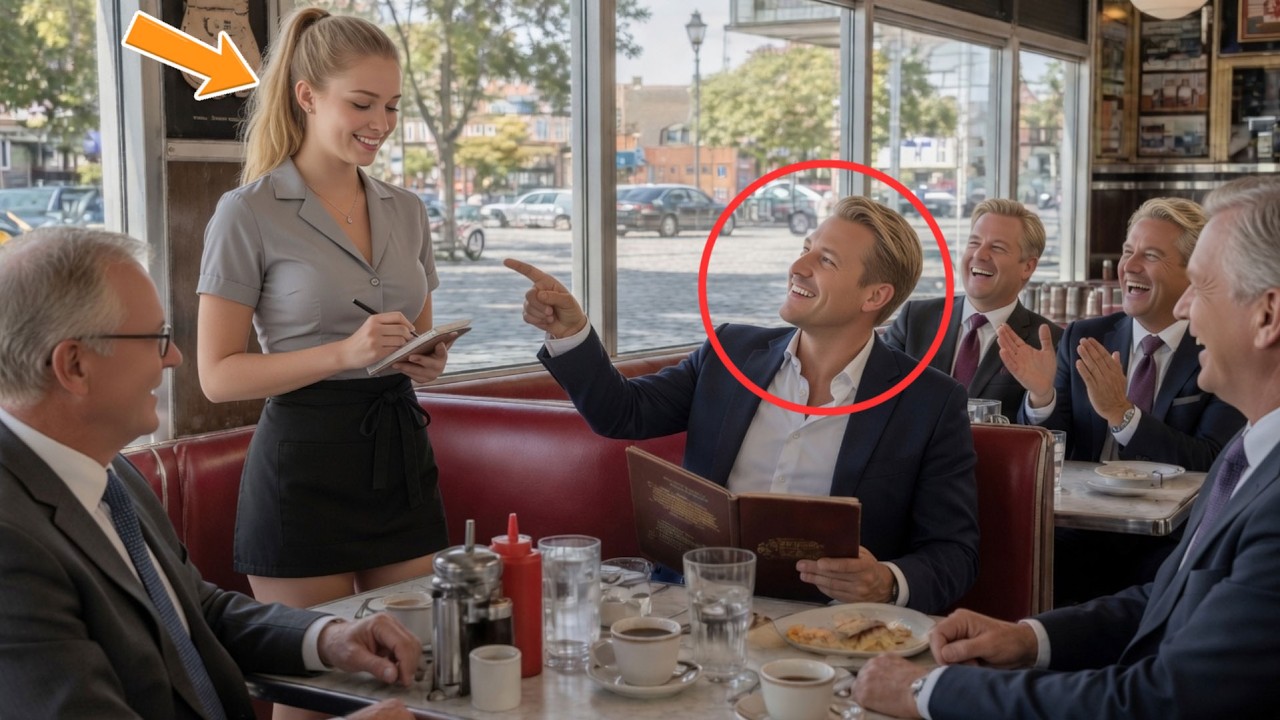
The two Japanese businessmen at the far end of the table did not. One of them, the one with gray-flecked hair and a dark suit, lowered his gaze to his water glass. Connie Watanabe finished wiping the last section of the mosaic floor. She rolled the mop around its handle, picked up the note, folded it four times, and slid it into her apron pocket.
“Hey, did I ask you something? ” Flemming’s voice sharpened. “No,” she answered quietly. “You didn’t ask me anything.
” She walked toward the kitchen. That was it. Quiet. Invisible.
Just like always. The restaurant at the Hotel d’Angleterre was one of those places where silence costs money. Linen tablecloths. Heavy cutlery.
Windows overlooking Kongens Nytorv, as if the world outside were merely decoration. The waiters smiled with the correct part of their faces. The guests spoke in low voices, not because they had anything private to say, but because they had learned that speaking quietly was another way of showing you belonged. Flemming Albertsen came in two or three times a month.
Always with important people. Always with the expression of a man who knew the table was ready before he asked for it. That Tuesday, he had a meeting he claimed was worth 380 million dollars. His company wanted an alliance with Tanaka Import AS, a Japanese distribution firm.
He had courted Kenji Tanaka for months—emails, dinners, wine bottles sent to Tokyo with handwritten notes. And Tanaka had come. What Flemming never understood was that Japanese businessmen observe before they speak. Silence isn’t discomfort.
It’s evaluation. Connie knew that. She had learned it from her grandmother. She was forty-four years old.
Eight months at the hotel. Before that, offices in Gladsaxe. A clinic in Valby. A fitness center in Vanløse, where the smell of chlorine never left her hair.
Always cleaning. Always invisible. Always the same pair of white sneakers she bleached every Sunday with toothpaste, because there was no money for new ones. Some evenings she came home to her room on Nørrebro with aching knees, raw hands, and no strength left to take off her shoes.
But the next morning, she got up. She always got up. Her hotel badge read: Connie Watanabe, Cleaning Department. No one asked what Watanabe meant.
No one had ever asked her mother either. Her mother, Bodil, was Danish. Her father, Hiroshi Watanabe, had come to Denmark at twenty-six with a suitcase, a Spanish-Japanese phrasebook, and a quiet belief that something good was waiting for him. They had been happy—the discreet kind of happiness that doesn’t need witnesses.
Connie remembered the smell of rice. The way her father folded newspapers into perfect rectangles before throwing them out. The letters he wrote to his mother in Osaka every two weeks, in dense, even handwriting. And she remembered the day he didn’t come home for dinner.
She was nine years old. She never heard from him again. When Connie entered the kitchen, Maria looked at her with a face that knew something had happened but didn’t want to ask first. “You okay?
”
“Yes,” Connie said, hanging up her mop. “You could hear what that man said all the way back here. ”
“Everything can be heard here,” Maria said, glancing at the corridor. “That’s Flemming Albertsen, from the textile group.
He’s in the papers a lot. They say he has more money than shame. ”
Connie poured herself a glass of water. She drank slowly.
“They speak the truth,” she said. Nothing more. But she kept the note. Not because she needed it.
Not yet. She kept it because a note folded four times is evidence. And Connie Watanabe had learned her lesson as a small child: you never know when you’ll need proof of something. Her grandmother Yuki had taught her that.
Obāchan Yuki, who lived in a small apartment in Osaka filled with plants and boxes, where she hid things—letters, photographs, old cassette tapes, documents carefully folded in manila envelopes. “Don’t throw anything away, Con-chan,” she used to say. “Things that look worthless are sometimes the only things left. ”
Connie hadn’t understood that as a child.
Now she did. At two in the afternoon, the restaurant manager, a thin man named Jens Møller who always smelled of aftershave and water, stuck his head into the kitchen. “Connie,” he said. “Mr.
Albertsen at table twelve asked if you could bring more water. ”
She looked at him. “He specifically asked? ”
“He requested it be you.
”
Connie wondered if it had been Albertsen or one of the Japanese who asked. She didn’t ask. She took the pitcher of cold water, dried her hands on her apron, and went out. Table twelve was by the window.
From the street, anyone walking by on Kongens Nytorv would have seen just a group of businessmen at an important meeting. They wouldn’t have noticed the cleaning lady with the water pitcher. No one ever notices the people who clean. As she reached the table, Flemming didn’t even look up.
He was still talking, gesturing, building castles in the air with his own narrative. His Danish partners nodded with the exact cadence of men who didn’t want to contradict the one signing the checks. The two Japanese listened with the kind of polite attention that can be mistaken for approval if you don’t know how to read it properly. But Tanaka looked at her as she approached.
One second. Just one second. And in that second, Connie felt something strange. Not pity.
Not sympathy. More like recognition—like spotting someone on the metro reading a book no one else has read. Tanaka was a man who could tell the difference between noise and the silence that carries weight. And Connie’s silence carried weight.
He saw it immediately. She didn’t know he’d seen it. She found out later. She filled the glasses in silence.
“Hey,” Flemming said abruptly, now looking directly at her. “You still have the note I gave you? ”
“Yes. ”
“And you won’t say something in Japanese to earn it?
”
His partners expected a reaction. That was the kind of moment Flemming collected—other people’s discomfort, the frozen silence, the small victory of making someone stumble. Connie finished the last glass. “The water is cold, sir,” she said.
“Enjoy. ” And she withdrew. What would you have done? Kept your mouth shut, or said something he would never forget?
Ib, the doorman, saw her leave the restaurant with the empty pitcher and a calm face. “Did he say something nasty to you? ” he asked, far too loudly, as two guests walked past behind him. “Everyone heard it, my girl.
I’m just saying—that type looks like someone who’ll end up in the news for the wrong reasons. ”
Connie almost blushed. Almost. Because in her apron pocket she had a 500-kroner note folded four times, and somewhere in her memory, buried so deep it barely made a sound, she had her father’s voice speaking Japanese in the kitchen on a Sunday morning, with the smell of rice in the air and the certainty that the world was a place where a man like him could be heard.
A quiet man with a restrained smile who believed honest work had its own dignity. Who believed good things came slowly—but they came. Hiroshi Watanabe had believed that until the day he disappeared. Connie still didn’t know if he’d been right.
She was about to find out. The staff locker room was in the basement, next to the machine room. It smelled of cleaning chemicals and reheated lunches. Six metal lockers.
A wooden bench with peeling paint. A narrow mirror over the sink. Connie sat on the bench. She didn’t cry.
She wasn’t the type who cried at work. She’d learned that at the fitness center in Vanløse, when the owner shouted at her in front of everyone for leaving a smudge on a mirror she hadn’t touched. She hadn’t cried then either. She went to the bathroom, splashed water on her face, and when she came out, her face said exactly what it always said.
Nothing. But some days, nothing cost more. She opened her locker. Next to her backpack and jacket was a plastic bag with a pink zipper.
Inside, with almost ritual care, she kept three things that had no value to anyone but her: a worn photograph, a dark blue notebook with almost no pages left, and a manila envelope with three letters inside. The letters were from her grandmother Yuki, written in Japanese in small, dense characters on thin, almost translucent paper that had aged to the color of tea. Connie didn’t need to reread them. She knew them by heart.
But on days like this, she took them out just to feel them between her fingers. The precise weight of the paper. The texture of the envelope. As if touch could bring back something that words no longer could.
The photograph was of her father. Hiroshi Watanabe was twenty-five in that picture. He stood in front of what appeared to be an office—a desk in the background, a window with plants, a plant on the filing cabinet. And he smiled in his own way.
Mouth nearly closed. Eyes more expressive than the mouth. He wore a suit and tie. He looked serious and calm at the same time, like a man who knew exactly where he stood.
Connie had never known where that office was. She had never been able to ask him. She was nine years old when her father didn’t come home for dinner. Her mother waited until ten, then eleven, then dawn.
She called his work. No answer. She called the two friends she knew. Nothing.
The next day, she went to the police. They told her to wait seventy-two hours. She waited. She went back.
They told her to fill out a form. She filled it out. Nothing ever happened. Hiroshi Watanabe simply ceased to exist in the Danish civil registry.
No accident report. No leads. Just the clean bureaucratic void of a man the system had never quite considered real. Her mother spent two years accepting he would never come back.
Connie spent twenty-two. There was something perverse about not having a grave—no concrete date to remember him by. A disappearance without closure is like a wound that never quite heals. Sometimes months go by without pain.
Then something small—the smell of rice, a Japanese word overheard on the metro—opens it up again. At four, when she finished her shift in the restaurant and was heading up to the second floor to clean the corridors, Jens Møller appeared again. This time he didn’t look apologetic. “I need to talk to you, Connie.
”
“Yes? ”
Jens Møller looked around, as if the corridor might be listening. “Mr. Albertsen spoke with Director Hansen.
He says… he says you had a disrespectful attitude toward him during service. ”
Connie waited. “He says,” Jens continued, “that you deliberately ignored him in front of his international guests, and that it could damage the hotel’s image. ”
The silence that followed was long.
“And what did Director Hansen say? ” she asked. “That he understands it wasn’t like that—but that Mr. Albertsen is a frequent guest, and…” He left the sentence unfinished, where the part no one wants to say aloud always lives.
“I understand,” Connie said. “I won’t sanction you, that should be clear. But if he asks to see you before he leaves, I need you to… be polite, Connie. Nothing more.
”
She nodded once. Said nothing. Took her cleaning cart and walked toward the elevator. The worst part about “be polite,” she thought, was that it always came from those who had never been the ones enduring it.
The second floor was quiet at that hour. Business guests were at meetings or in the bar. Connie pushed her cart down the corridor, went into the empty rooms, worked with the precision of someone who had spent years learning exactly how long each task takes. While she folded towels, she thought in Japanese.
She had done that since she was little, almost without noticing. When she wanted to think seriously, when she wanted her thoughts to be slower and more orderly, she thought in Japanese. Her father had taught her to speak it before she knew it was unusual. To her, it was just another language she existed in.
Maybe the language she existed in most. In Danish, she thought fast—with the traffic and the debt and the rhythm of double shifts. In Japanese, she thought differently. More space between one thing and the next.
More respect for the silence left behind when a sentence ends. Her grandmother had kept teaching her over the phone, through letters—the sheer stubbornness of an eighty-year-old woman who refused to let her granddaughter lose the only thing that connected this family scattered across an ocean. Connie spoke Japanese with an Osaka accent. She read kanji.
She had studied three years of international economics at CBS before the money ran out and she had to drop out to work full-time. No one at the hotel knew. Not because she hid it, but because no one had ever asked. At six-thirty, while she was cleaning room 217, she heard voices in the corridor.
She recognized one of them. Flemming Albertsen speaking quietly, but without the real care of a man who doesn’t want to be heard. The tone of a man used to his private conversations having no witnesses, because witnesses didn’t count to him. “—irrelevant what they say, Brandt.
I need it to disappear before Thursday. Understand? There’s no record. ”
A second voice, more muted.
“And if they ask? ”
“No one will ask. What do you think we pay lawyers for? ”
Footsteps.
The conversation moved away. Connie kept cleaning the bathroom mirror. Circular motions. In from the edges, out.
She didn’t file what she’d heard as important. Not yet. Rich men always made things disappear. It was part of the landscape, like traffic or pollution.
But she kept it. At seven, as she was putting on her jacket to go home, her phone vibrated. Unknown number. The country code: Japan.
“Moshi moshi,” she answered slowly. From the other end, with the specific weight of eighty years of carefully led life, came her grandmother’s Japanese. “Con-chan. Today I dreamed about your father.
”
Connie sat down on the locker room bench. The machine room hum. The smell of cleaning chemicals. The metal lockers.
All of it faded. “What did you dream, Obāchan? ”
“I dreamed that someone was looking for him. ” A long pause.
“And it wasn’t me. ”
Connie pressed the phone to her ear. “What do you mean? ”
“I mean,” her grandmother said, with the particular patience of someone who has waited a long time to say something, “there are things I kept for the right moment.
And I think the moment is approaching, Con-chan. I don’t know why I feel it today. But I feel it. ”
Ib stuck his head through the locker room door without knocking.
“Connie! The man in the suit asked for you at reception! ” he announced in his natural megaphone voice. She held up a finger to quiet him.
“Obāchan,” she said in Japanese. “What have you kept? ”
An even longer pause. “A tape, Con-chan.
Your father sent me a tape before he disappeared. I’ve always wanted to listen to it with you. ”
The machine room hummed on. Ib still stood in the doorway, unsure whether to stay or go.
And Connie Watanabe felt something she didn’t know she could still feel: the cold, precise edge of something that had been sleeping for a long time, just waking up. A tape. Her father had sent a tape to Osaka before he disappeared. That meant he knew something was going to happen.
That he had time to prepare. To leave something behind. To trust that someone would hide it. This wasn’t the end of a story.
It was the beginning of one she had never been told. She gripped the phone with both hands. “Obāchan,” she said slowly in Japanese. “When can you send it to me?
”
Her grandmother’s voice was small and firm, as always. “I’m not sending it, Con-chan. I’m waiting for you. Come when you can.
But don’t wait too long. I’m eighty now, and the things one keeps should be handed over in person. ”
Ib was still in the doorway. He had the look of a man who had heard everything and decided it was best to pretend he hadn’t.
“Everything okay? ” he whispered, which in his case meant speaking at the same volume but with a whispery expression. Connie slowly hung up. She sat for a moment with the phone in her hand, staring at nothing.
“Everything’s fine, Ib. ”
“You sure? Because you look like someone who just remembered something very important. ”
She looked at him.
He shrugged. “Just saying. ”
Connie stood, hung her apron in the locker, closed it. Outside, on the floor above, Flemming Albertsen was still the most important man in whatever room he entered.
He still believed the world was ordered by what you could buy and what you could erase. He didn’t know that in the basement of his favorite hotel, a forty-four-year-old woman had just received a call from Osaka. He didn’t know that the woman spoke Japanese with an Osaka accent. And he didn’t know that an old cassette tape hidden by an eighty-year-old grandmother could weigh more than 380 million dollars.
But he would find out soon enough. —
No one expected her to talk. That was what Connie had learned all those years: invisibility has its rules. And the first rule is, no one expects anything from you.
You can stand two meters from an important conversation and, for all practical purposes, be part of the furniture. A piece of furniture with an apron, a moving part of the landscape that sometimes makes noise with the cleaning cart, but doesn’t think, doesn’t listen, doesn’t collect evidence. It was Wednesday afternoon when everything changed. Jens Møller had sent for her with his apologetic expression.
Mr. Albertsen had another meeting in the restaurant. The Japanese partners were still staying at the hotel. The negotiations apparently required more time than planned, and someone at reception had made the mistake of telling Flemming that the private salon on the third floor was available.
Flemming had reserved it immediately and specifically requested that the cleaning staff prepare the room before the meeting. Cleaning staff: Connie. As if it were a coincidence. It wasn’t.
She drove her cart up to the third floor. The private salon was a rectangular room with large windows facing the street, a long dark-wood table, upholstered chairs, and an abstract painting on the back wall that no one ever looked at. It smelled of air conditioning and floor wax—the wax she herself had applied a few days before. She started with the windows.
Spray, cloth, circular motion: from the inside out. Behind her, the door opened without a knock. “Oh good. You’re here.
”
Flemming Albertsen’s voice had the specific texture of a man who had never had to wait for anyone to open a door for him. He stepped in, followed by his two Danish partners—Brandt, the one from the phone call, and another man Connie didn’t recognize—and finally, with slower steps and a calmer posture, Kenji Tanaka and his colleague, Mr. Inu. Connie continued cleaning the window.
“Please, have a seat,” Flemming said, as if the room were his own. He turned to her without looking at her. “Bring coffee and mineral water—not from the tap. ”
“Yes, sir,” Connie said to the glass.
She heard them sit down. The creak of chairs. The sound of a briefcase opening. Flemming began talking before everyone was seated—his way of establishing, from the first second, who controlled the room’s rhythm.
“Gentlemen, what I’m proposing today is an alliance that will redefine the distribution of Japanese products across the entire American continent. We’re talking about an operation with a twenty-year projection, backed by my consortium and sup—”
Connie stopped listening. She focused on the glass, on her own faint reflection, on the muffled noise from Kongens Nytorv five floors below. Then she heard something.
Tanaka spoke. And he wasn’t speaking Danish. “Inu-san…” Two words, so soft they barely interrupted Flemming’s speech, though he paused for half a second before continuing. Mr.
Inu responded in Japanese, low and neutral. A short question. Tanaka answered, also in a low voice, also in Japanese. Flemming cleared his throat.
“Gentlemen, if you have questions, you can ask them in—ah, excuse me,” Tanaka said in flawless, perfectly polite Danish. “One moment. ” And he resumed speaking with Inu in Japanese. Connie stopped moving the cloth.
She listened. Tanaka said: “The contract numbers don’t match what we received last week. The margins he’s proposing are different from the ones in the document. ”
And Inu answered: “Yes, I noticed that too.
How do we handle it? ”
Tanaka: “Carefully. This man doesn’t tolerate public corrections. ”
A pause.
Then Inu, very softly, almost to himself: “If only there were someone here who understood what we were saying. ”
Connie gripped the cloth, counted to three, and turned around. “Excuse me for interrupting,” she said in Japanese. The whole room froze.
It wasn’t a gradual silence. It was immediate, like when someone cuts the music at a party and the weight of the room suddenly presses in. Flemming Albertsen opened his mouth and closed it again. Brandt dropped his pen.
The other Danish partner stopped typing on his phone. Tanaka looked at her. His eyes didn’t show surprise. They showed something harder to name: the confirmation of something he already suspected.
Connie continued in Japanese, with the Osaka accent her grandmother had polished through phone calls and letters filled with red corrections. “If you’ll permit me, Mr. Tanaka, I believe the document you received last week and the one in front of you today are two different versions. The distribution margin changed by three percentage points.
I don’t know if it was a mistake or a decision, but I thought you should know before you continue. ”
Silence. Tanaka blinked once. Then, in Japanese: “How do you know?
”
“I listen,” Connie said simply. “And I remember what I hear. ”
Flemming Albertsen did not stand up abruptly—but slowly, with the slowness of a man calculating exactly how angry he could afford to be in front of international witnesses. “What did you say?
” he asked in Danish, looking directly at her for the first time since he’d entered the room. “It doesn’t concern you,” she answered in Danish, in the same voice as always. Without raising her tone, without lowering her gaze. “Are you here to clean?
”
“Yes. And I’m done. ” She picked up the cloth, folded it over the cart, and walked toward the door with normal steps. Not fast.
Not slow. The steps of someone who knows exactly where she’s going. At the door, she stopped. “Mr.
Tanaka,” she said in Japanese, without turning around. “There’s an expression my grandmother always repeats: Ishi ni wa yonen, neta ishi wa atatamaru. ‘Three years on a stone, and even the stone grows warm. ’ Be patient with this country.
There are valuable things here too. ”
And she left. —
The corridor was empty. Connie wheeled the cart into the storage room, stepped inside, closed the door, and stood in the dark for about ten seconds.
Her hands trembled slightly. Not from fear, but from something more like the adrenalin of someone who had just jumped from a high place and still didn’t know exactly how she’d landed—but could feel the fall had been clean. She’d done it. She’d spoken Japanese in front of Flemming Albertsen, in front of his partners, in front of Kenji Tanaka, who had looked at her as if he were seeing her for the first time.
She hadn’t planned it. Or maybe she had, somewhere deep where decisions are made before you notice them. Mr. Inu had said, “If only there were someone here who understood what we were saying,” and something in her simply couldn’t stay silent.
Not because she wanted to show off. Because there was something unfair in that room. And the specific unfairness—that two honest men were being presented with altered numbers while she polished the windows—was too concrete to ignore. Her father would have done the same.
She was sure of it. She turned on the light, put the cloth on the rack, the spray bottle on the shelf. Everything in its place. She breathed.
—
Twenty minutes later, when she came down to the lobby, Ib was standing at his usual spot by the main entrance. He saw her coming and looked at her with eyes slightly wider than normal. “Hey,” he said with his usual voice—the voice of a man who didn’t know he had a usual voice. “What the hell happened on the third floor?
The guy in the suit came out forty minutes ago looking like someone spat in his coffee. And his buddies in suits too. But the Japanese gentlemen stayed upstairs and asked for water and biscuits, which is the universal sign that a meeting has gotten long. ”
Connie adjusted her backpack strap.
“Nothing, Ib. I just did my job. ”
He looked at her a moment longer. “My girl,” he said finally, in a tone that for the first time in a long time sounded lower than necessary, “I don’t know what you did, but the Japanese gentlemen’s faces when they came down in the elevator looked like people who just found something they didn’t expect to find.
”
Connie walked toward the exit. “Sometimes that happens,” she said. “Sometimes you find things where you least expect them. ”
She pushed through the glass door and out onto Kongens Nytorv.
The air smelled of the city. The trees on the central strip were blooming in April with a beautiful but stubborn persistence, as if the city didn’t exist around them at all. Connie walked three blocks before she took out her phone. She called Osaka.
While she waited for an answer, she thought about Tanaka’s expression when she spoke. It hadn’t been surprise. It had been recognition—the same sensation she had felt the day before, when he watched her fill the water glasses. Two people who carry more than they show, recognizing each other in the most unlikely place.
Her grandmother answered after the third ring, and before Connie could say anything, Obāchan Yuki said, in a voice that seemed to come from somewhere deeper than her throat: “I knew you would call today. ”
Connie almost smiled. Almost. “How did you know?
”
“Because it smelled different today. ” A pause. “Did something happen? ”
Connie looked at the street, the cars, the stubborn April trees.
“I spoke Japanese today, Obāchan. In public. In front of people who didn’t expect that I could. ”
A short silence.
Then her grandmother’s voice, softer: “How does it feel? ”
Connie took a moment to answer, like someone taking off a very heavy coat she’d forgotten she was wearing. “Light. ”
Her grandmother didn’t respond immediately.
When she did, her voice had the specific temperature of someone who had just confirmed something she had long been waiting to confirm. “Good,” she said simply. “It was time, Con-chan. It was time.
”
—
The envelope arrived the next day. It wasn’t an ordinary envelope. It was thick, cream-colored paper with Connie’s name written in dark blue ink in a small, precise script. It had been delivered to reception by someone from Mr.
Tanaka’s team, Jens Møller told her, with the expression of a man who didn’t know exactly what he was handing over but sensed it was important. Connie opened it in the locker room, sitting on the usual bench, the machine room hum in the background. Inside was a card written in Japanese with a handwritten translation into Danish on the back, as if the writer had wanted to be sure she understood in both languages. *What you did yesterday required something money can’t buy.
I thank you for your honesty. If you ever wish to speak, here is my contact. *
Kenji Tanaka. And a phone number.
Below, in Japanese, without translation:
*Your accent is from Osaka. How curious. *
Connie read the card twice, folded it carefully, and added it to the plastic bag with the pink zipper, along with her grandmother’s letters and the photograph of her father. It was her archive of things that had no price.
Now she had one more item. —
She didn’t call that day. Or the next. Not because she didn’t want to, but because Connie Watanabe had learned something from a very young age, in a way that hurt: good things that come suddenly almost always have a hidden cost.
The friendly man who suddenly gives you a job wants something he didn’t ask if you could give. The opportunity that appears without being sought is sometimes just a trap with better presentation. So she waited. She watched.
Three days later, while she was cleaning the second-floor corridor, she saw Kenji Tanaka come out of the elevator alone—no assistant, no phone in hand, which was already unusual. He walked slowly, looking at the paintings on the wall, not like a tourist but like someone looking for something specific he didn’t know how to name. He stopped in front of a lithograph of a Danish market square, vivid colors, dense figures, an ordered chaos caught in the moment just before everything moves. He studied it for a long moment.
Connie continued mopping. “Do you know which square that is? ” Tanaka asked without turning around, in Danish. “Torvehallerne,” she said.
“On Nørrebro. The oldest in the city. ”
Silence. “I grew up near it,” Connie said.
Tanaka nodded slightly, still looking at the painting. “In Osaka we also have such a square. Kuromon Ichiba. My mother took me there on Saturdays when I was a child.
It smelled of vegetables, like this one, I imagine. ” A pause. “Market chaos has its own order. ”
Connie stopped mopping.
“My father said the same thing about the market square once. That the chaos was a facade—that everything had its precise place. You just had to know where to look. ”
Tanaka turned and looked at her.
For the first time since they’d met, it was full eye contact. Without business meeting protocol. Without intermediaries—just two people in a hotel corridor in front of a painting of a square. “Your father spoke Japanese,” Tanaka said.
It wasn’t a question. “Yes. ”
“What did he do in Denmark? ”
Connie hesitated a moment.
“He lived here. Started a family. ” Another pause. “He disappeared when I was nine years old.
”
Tanaka didn’t say “I’m sorry. ” Japanese men of his generation didn’t put it so directly. Instead, he inclined his head a few centimeters in a specific uki—gravity meaning, *I understand there is a burden there that I will not touch without permission. *
“May I ask you your full surname?
” he said. “Watanabe. ”
Tanaka’s face changed. So quickly that Connie almost didn’t see it—like a shadow passing over water and disappearing before you could be sure you’d seen it.
Connie eyed him. “Why? What is it? ”
Tanaka didn’t answer immediately.
He looked back at the painting of the market square for a long moment. When he spoke, his voice was careful. “Your surname appears in my company’s archives. From a time I didn’t expect to find it here.
”
Connie’s heart beat once. Hard. “My father’s name was Hiroshi. ”
Tanaka was silent for a moment.
Then: “Miss Watanabe. Do you have time this afternoon for a cup of coffee? ”
“I work until seven. ”
“It’s six-thirty now.
There’s a café in the lobby that seems quiet. ”
It wasn’t a request, nor exactly an order. It was something in between, with its own tone in Japanese. “Six-thirty,” she said.
—
Flemming Albertsen arrived at the hotel at five. No one had invited him. Or maybe his partner Brandt, who still had a room reserved until Friday, had. But Flemming himself, in a dark suit and with the tense jaw he had when something wasn’t going his way, went straight up to the third floor without passing reception.
“That man isn’t here for dinner,” Ib said to no one in particular, in a voice loud enough for three guests crossing the lobby to hear perfectly. “That man is here to fix something. ”
—
At six-thirty, Connie entered the lobby café in her ordinary clothes. Jeans.
Gray sweater. Freshly bleached white sneakers. Tanaka was already seated at the corner table, with two cups of green tea in front of him. He stood slightly as she approached.
“Thank you for coming,” he said in Japanese. “Thank you for inviting me,” she answered, also in Japanese, and sat down. There was a moment of silence that neither of them tried to fill. Then Tanaka said: “Miss Watanabe.
What did your father do when he lived in Denmark? ”
Connie wrapped both hands around the cup. “He worked with import. Distribution.
I don’t know the details—I was very small. ”
Tanaka nodded. “Did he have Danish partners? ”
A pause.
“I don’t know. Why are you asking me this? ”
Tanaka looked at his cup for a moment. When he raised his eyes, he had the expression of a man about to open a door, unsure of what’s on the other side.
“Because,” he said carefully, “your full surname, Watanabe, seems familiar to me in a context I didn’t expect to find here. And before I tell you more, Ineed to verify something. ”
Another pause. “Do you trust me enough to give me a few days?
”
Connie looked at him for a long moment. She thought of her grandmother and the cassette tape. She thought of the folded 500-kroner note. She thought of her father, smiling in the photograph.
“I’ve waited twenty-two years,” she said. “A few more days won’t change anything for me. ”
Tanaka nodded slowly. And on his face, for the first time since Connie had known him, something that could be called relief appeared—as if he, too, had been waiting for something, even if he hadn’t known exactly what.
—
The next morning, Connie found a note slid under her locker door. Not an elegant envelope like Tanaka’s. A sheet torn from a spiral notebook, folded four times, in a hasty handwriting that wrote faster than it thought:
*It’s best you stay quiet. What you know doesn’t belong to you.
There are things better left unburied. Consider this friendly advice. *
Unsigned. Connie read it once.
Twice. Then she folded it with the same care she folded everything she kept, and added it to the pink plastic bag, next to Tanaka’s card and her grandmother’s letters. Evidence. She always kept evidence.
She told no one. —
At two in the afternoon, Maria came in with a face that had overheard something and couldn’t hold it in. “Hey,” she said, sitting down without asking. “Do you know who Fleming Albertsen really is?
Not the one from the business pages—the real one? ”
Connie took a bite of her rye bread. “Tell me. ”
Maria lowered her voice, she spoke so softly that Connie had to lean in.
“My brother-in-law works in the court’s civil case division. He says the name Albertsen appears in three cases from the nineties about forced acquisitions. He bought companies at rock-bottom prices from people who were in trouble. Some say he created the trouble himself.
Nothing ever happened. The cases just closed themselves. ”
Connie put the bread down. “What kind of companies?
”
“Import. Textile. Distribution. Something with import.
” Maria shrugged. “Old cases. He says they’re time-barred and nobody will touch them. But that name, together with two or three other guys who got rich the same way at the same time…”
*Import.
*
Connie finished her meal in silence. Maria looked at her with the expression of someone who had just realized the conversation had taken a turn she hadn’t expected. “Why are you asking? ” she said.
“Curiosity,” said Connie. Maria kept looking at her. “My girl, you don’t look like someone asking out of curiosity. ”
Connie stood.
“Thank you for telling me. ” And she left. —
That afternoon, at five, her phone rang. Tanaka.
“Miss Watanabe,” he said in Japanese, “I need to see you today. This evening, if possible. I found something you should know before I make any decisions about my business in this country. ”
His voice had a different texture than at the coffee.
More restrained. The tone of someone handling heavy information carefully. “When? ” Connie asked.
“Eight o’clock. Same place. ”
“I’ll be there. ”
—
At six-thirty, Jens Møller called her over the intercom.
Anxious voice. Shorter than usual. “Connie. Up to three now.
”
“What’s happened? ”
“Just come up. ”
The third floor was different. Not visibly different—the paintings in place, the carpets clean—but there was an energy in the room that made it feel like something had just happened.
Jens Møller was waiting in front of the private meeting room. Beside him stood Director Hansen, whom Connie had seen exactly four times in eight months. “Miss Watanabe,” Hansen said, extending his hand she took. “Thank you for coming up.
We received a formal complaint from Mr. Albertsen this afternoon. He claims you interfered with a confidential business meeting. That you disclosed confidential information to third parties.
And that your presence in that room constituted a violation of the participants’ privacy. ”
Connie waited. “Furthermore,” Hansen continued, in the voice of a man reading, “he notes that you have access to information about his operations through your work on the premises, and that this poses a risk to his interests. ”
Silence.
“What is he asking for? ” Connie said. Hansen cleared his throat. “He’s asking us to terminate your employment immediately.
”
Jens Møller didn’t look at her. He looked at the floor. “And what are you going to do? ” Connie asked directly.
Hansen blinked. He wasn’t used to cleaning staff asking direct questions in that tone. “We need to consider,” he began. “Mr.
Albertsen is a frequent customer,” Connie said. “I’m a permanent employee with eight months’ seniority, clean results, and no disciplinary record. What I did in that room was inform a hotel guest—Mr. Tanaka, also a guest—about an inconsistency in documents that could affect him.
If that’s grounds for dismissal, I think you have a bigger problem than me. ”
Hansen looked at her. Jens Møller kept looking at the floor, but something changed in his shoulders. “I’ll ask you,” Hansen said finally, “to have no further contact with any of the parties involved while we resolve this internally.
”
“Understood,” Connie said. And she left to change for her meeting. At eight o’clock, Tanaka was already in the café when she arrived. There was no tea this time.
There were two glasses of water and a closed paper folder on the table. “Are you all right? ” he asked in Japanese when she sat down. “Yes.
I heard what Albertsen did this afternoon. ” A pause. “I’m sorry. ”
“You don’t need to be sorry.
”
Tanaka placed his hand on the folder. “What I’m about to show you,” he said slowly, “is something I found in my company’s archives this morning. Archives I hadn’t gone through in twenty years, because they belonged to an era I considered closed. ” His eyes didn’t leave hers.
“Miss Watanabe, do you know exactly what your father did in Denmark? ”
“No,” Connie said. And for the first time in a long time, the word truly hurt. Tanaka opened the folder.
Inside were photocopies—documents in Danish and Japanese, stamps, signatures, dates. And on the first page, at the top, in the founding documents of a distribution company registered in Denmark in 1987, was a name she recognized instantly:
Hiroshi Watanabe. Founding partner. And on the line below, in the box for additional partners:
Flemming Albertsen.
The air in the café didn’t change. Conversations continued at the other tables. Someone asked for the bill. Connie heard none of it.
Her father and Flemming Albertsen had been partners. And her father had disappeared. “There’s more,” Tanaka said quietly. “But you need to be prepared for what comes.
”
Connie raised her eyes from the document. Her hands on the table were completely still. “I’ve been preparing for twenty-two years,” she said. “Tell me everything.
”
—
The story Tanaka told her that evening was not long. Stories of betrayal never are. They’re always shorter than they deserve to be, because betrayal itself is an efficient act. It takes one step, and something whole becomes broken.
In 1987, Hiroshi Watanabe and a Japanese partner representing Tanaka Import AS, together with Flemming Albertsen, had founded a distribution company for Japanese products—sake, handcrafted ceramics, luxury textiles. A small but solid operation. Hiroshi provided the cultural bridge and the language. Albertsen provided the Danish market contacts and start-up capital.
Tanaka Import AS provided the suppliers and international backing. For four years, the company grew. In 1991, the Japanese partner had to return home to Japan for family reasons. That was when the pieces moved.
First, Albertsen isolated Hiroshi from communication channels with Japan—intercepted emails, blocked calls, built the narrative that Hiroshi had made unilateral decisions that damaged supplier relations. Then he presented documents of transfer of company shares, allegedly signed by Hiroshi, transferring 100% of his share to Albertsen for a ridiculously small sum. And then Hiroshi Watanabe disappeared. No missing person report.
No accident. No trace. The company operated under Albertsen’s exclusive control for another three years, until he liquidated it and kept the assets. The total value of that liquidation—according to the records Tanaka had found in his own company’s archives—was around four million dollars in 1994.
Money Albertsen used to build his textile conglomerate. The base of everything he was today. Connie listened without interrupting. Tanaka spoke slowly in Japanese, in the tone of someone who knows that what he’s saying is changing something permanently.
On the table lay the photocopies. The stamps. The dates. Her father’s signature on documents that, according to Tanaka, an expert could analyze to determine whether they were genuine or forged.
When Tanaka had finished, there was a long silence. “Why do you have this? ” Connie asked at last. “Because the Japanese partner who returned to Japan in 1991 was the father of my current operations director.
When that man died last year, his son went through his personal archives and found a box of documents from Denmark he’d never seen. He brought them to me three months ago. I didn’t read them—we were in the middle of a large expansion. ”
Silence.
“Until this week, when you said the name Watanabe. And something in my memory moved. ”
Connie looked at him. “Mr.
Tanaka. My grandmother in Osaka has a cassette tape my father sent her before he disappeared. We’ve never listened to it together. She’s been waiting for over twenty years for me to come.
”
Tanaka looked at her steadily. “When can you travel to Osaka? ”
“I don’t have money for that trip. ”
“That,” Tanaka said with a quiet firmness that didn’t allow discussion, “is a problem I can solve.
”
—
That night, Connie arrived at her room on Nørrebro after ten. She boiled water for tea—the April chill of the city seeping through the poorly sealed window—and sat at the kitchen table with the pink plastic bag in front of her. She took out the photograph of her father. The restrained smile.
The eyes more expressive than the mouth. The same face she’s seen in the founding documents that afternoon. “I know what happened now,” she said in Japanese, softly, as if he could hear her. “Almost.
I’m missing your voice. I need to hear you say it. ”
Her phone rang. Unknown number.
Copenhagen area code. “Hello? ”
A man’s voice, tight, like someone speaking from a place he shouldn’t be speaking from. “Is this Miss Watanabe?
The one who works at D’Angleterre? ”
“Who is this? ”
“My name is Rasmus Brandt. I work for Mr.
Albertsen. ” A short pause. “I need to talk to you. Not on his behalf—on my own.
Tonight, if possible. ”
“Why should I trust you? ”
“Because this afternoon, he asked me to do something I don’t want to do. And before anyone else does it, I think you should know what it is.
”
The silence lasted exactly as long as Connie needed to decide. “There’s a grill bar on Nørrebro called Den Gode Hyrde. Half an hour. ”
“I’ll be there.
”
—
Rasmus Br Brandt was forty-something and looked like he hadn’tt slept well in days. He arrived in his jacket, no tie, hair slightly damp, as if he’d washed his face hurriedly. He ordered mineral water and didn’t touch it. “This afternoon,” he said, elbows on the table, voice low, “Mr.
Albertsen asked me to contact someone who does surveillance. To find out where you live, who you talk to, what you do outside work. ”
Connie didn’t change expression. “And you said yes.
”
“I said yes. ” He rubbed his face. “But I didn’t do it. I’ve been working for that man for five years.
There are things I’ve done that I shouldn’t have done. This is the line I won’t cross. ”
“What kind of things? ”
Brandt looked at her.
“Administrative things. Documents. ” A pause. “Some of the documents from that company in the nineties went through my hands—not the originals.
Digital copies that should have been deleted. I deleted them, because I was told to. But they weren’t completely deleted. ”
“What do you mean?
”
“I kept backups. ” He looked at her. “I don’tt know why. Maybe because I always suspected something was wrong.
”
Connie felt her pulse quicken. “What are you telling me? ”
“And there’s something else. ” Brandt swallowed.
“A recording of a meeting. 1992. Albertsen and his then-lawyer, discussing the takeover of Mr. Watanabe’s company share.
On that recording, very clearly, they discuss the fact that the signature on the transfer document was not Mr. Watanabe’s—and what to do to make sure he couldn’t contest it. ”
The grill bar’s noise continued. Sports on the TV.
Someone ordering falafel. Connie felt something that wasn’t exactly anger. It was colder, more ordered. The feeling of all the pieces that had been floating for years finally falling into precise place.
“Where is the recording? ” she asked. Brandt reached into his jacket’s inner pocket and placed a small USB stick on the table—no bigger than a fingernail. “There.
And here. ” He slid it toward her. Connie looked at it. She didn’t take it yet.
“Why are you giving this to me? ”
“Because you’re the only person in this situation with nothing to gain from lying to me. ” Pause. “And because I’ve known for five years that that man owes someone something.
I just didn’t know who. Now I do. ”
Connie picked up the USB stick. She held it in her palm.
So small, and yet so heavy. Twenty-two years of silence. The price her mother had paid with quiet work and bleached sneakers and the pink plastic bag that held everything. “Thank you,” Connie said.
Brandt nodded, drank his water, stood up. He looked at her for the last time. “What are you going to do with it? ”
Connie closed her hand around the stick.
“What should be done. ” No more, no less. He nodded once and left without looking back. Connie stayed behind, alone in the grill bar with the noise of the city pressing in from outside.
And for the first time in a very long time, she knew exactly—with a clarity she could feel from her stomach to her hands—what she was going to do. —
She’d hadn’t been on a plane before. But air travel, as she discovered on the flight to Osaka, was not that different from other difficult things she had done: you fasten your seatbelt, you close your eyes, you trust that the machine knows where it’s going. Tanaka had bought the ticket the same morning without making a scene over it—with the same naturalness as paying for someone’s coffee when you’re at the front of the line.
He’d given her a printout of the itinerary. He’d told her that a driver with a sign with her name would be waiting at Kansai Airport. And he’d asked her to record everything her grandmother would tell her. “Why do you trust me so much?
” she’d asked him before she left. Tanaka had looked at her for a moment. “Because you speak Japanese with an Osaka accent,” he said. “Something you only learn from someone who loved you deeply.
That tells me everything I need to know. ”
—
Obāchan Yuki’s apartment was in the Namba district, in a four-story building without an elevator. Potted plants on every landing. It smelled of old wood and plants and something Connie couldn’t immediately name—until she reached the third floor and the door opened and she recognized it.
The same smell as the letters. The paper, aged, kept with care. Her grandmother was smaller than Connie remembered. Or maybe Connie had grown more than she realized.
Obāchan Yuki was eighty years old, with pure white hair in a low bun, wearing a dark blue home kimono with tiny, almost invisible flowers. She stood in the doorway as Connie reached the landing, as if she had known exactly when she would arrive—which she probably knew. For a moment, neither spoke. Then the grandmother slowly opened her arms.
And Connie stepped into the embrace, closed her eyes, and felt something that had been taut inside her for over twenty years—the invisible thread you don’t know you carry until someone loosens it. Only a little. But it was enough. “Con-chan,” her grandmother said in Japanese, cheek against hair.
“Finally. ”
—
They drank tea at a low table, seated on flat cushions. Her grandmother asked about the trip, the flight, whether she’d slept, whether she’d eaten something at Kansai Airport—“the food there is good but expensive and you have to know where to look. ”
Connie answered everything patiently, in her Japanese.
Her grandmother listened with slightly narrowed eyes, like someone listening to music she knows well. “Your Japanese has kept its weight,” she said at last. “You gave me the words. ”
“I gave you the words.
You gave them the weight. And without weight, words are useless. ”
Connie wrapped her hands around her teacup. “Obāchan.
Tell me about my father. ”
Her grandmother didn’t answer immediately. She rose with the careful slowness of eighty years, walked to one of the shelves, and brought out a smaller box—black lacquer with mother-of-pearl inlay. She placed it between them on the table.
Inside lay an old cassette tape, its label handwritten in Japanese: *October 2, 1992. * Beside it, folded four times, a letter. “This came three weeks before your mother called to tell me Hiroshi had disappeared. ” Her grandmother’s hand rested on the box.
“The letter—I’ve read many times. The tape—I could never listen to alone. I always knew I should listen to it with you. ”
Connie looked down at the box.
“Do you have something that plays it? ”
“I have the same player I had in 1992. I never threw it out. I knew I would need it one day.
”
The letter was written in her father’s own hand—to his mother—in the same dense, even script Connie remembered from when she was a child:
*Mother, I write because I need someone to know what is happening. My partner here in Denmark is moving the company’s documents. I can no longer access them. Signatures are appearing on papers I did not sign—ten days ago, a signature appeared on a document I had never seen.
I asked a lawyer for help, and the lawyer rang three days later to tell me he couldn’t take my case. *
*I don’t know what will happen. Perhaps nothing. Perhaps everything.
But I want you to keep the family safe if I can’t be there. *
*The girl is named Connie. She is nine years old and speaks Japanese better than her father. Take care of her if something happens.
Take care of her with the language. *
*I’m sending you a tape as well. On it, I say everything in more detail. *
*Hide it well.
Not in a bank—at home, where you can find it. *
*Don’t be afraid for me. I am not afraid. I am angry, which is different.
Anger is at least good for something. *
*Your son, Hiroshi. *
When her grandmother finished reading, the room was completely still. Connie didn’t cry.
Her eyes were dry. Her fists clenched against her thighs. “Anger is at least good for something,” she repeated aloud. “Yes,” her grandmother said.
“That was your father. He was always like that. ”
—
They placed the tape in the player. A small gray plastic device with worn buttons.
Her grandmother inserted fresh batteries, pressed play, and for a moment there was silence—then a click, then background noise, like an office with an open window—and then her father’s voice. Connie had not been prepared for that. Hiroshi Watanabe’s voice was deep, calm, with the soft Japanese of a man who spoke the language as a second language but had made it fully his own. He spoke with pauses, with care, as if every word should register without ambiguity.
He described meetings. Dates. Names. Amounts.
The way Albertsen had begun to isolate him from the communication channels. The documents that had appeared with his signature. A conversation Hiroshi had recorded without Albertsen’s knowledge, in which the name of Albertsen’s lawyer appeared together with very concrete instructions on what to do if Hiroshi decided to become a problem. Twelve minutes of voice.
Twelve minutes that were twenty-two years of his life. When the tape ended, the player clicked, and silence returned. Her grandmother said nothing. She just placed her small, dry hand over Connie’s and let it rest there.
Connie looked out the window. Outside, Osaka did what big cities do: existed with productive indiffrence. “What are you going to do? ” her grandmother asked after a long while.
Connie squeezed her grandmother’s hand. “What he would have done. Document everything. And don’t stay silent.
”
Her grandmother looked at her for a long time with eyes that had seen eighty years of things and were no longer easily surprised, but still recognized when someone was ready. “Good,” she said. “Then eat something first. You’ve come a long way, and you can’t achieve justice on an empty stomach.
”
Connie made a sound that was half laugh, half something else. That was also Japanese: love said not in words, but made into food. —
Connie returned to Denmark with three things she hadn’t had when she left:
Her father’s recording, digitalized onto two USB sticks—one in her backpack, one in the inner pocket of her jacket, because she didn’t trust that the backpack would arrive at the same time. A letter from her grandmother Yuki addressed to whom it may concern, written in Japanese with the certified translation of a notary in Osaka, whom her grandmother had known for forty years and who had refused payment because, as he said: “There are things a man cannot charge for in good conscience.
”
And a clarity she had not carried with her before: the clarity of someone who knows exactly what she has, what it’s worth, and what she wants to do with it. Tanaka was waiting for her at the airport alone, without an assistant, in the same gray suit. He listened without interrupting as she told him everything in the car. “My lawyers have spent the last three days reviewing the documents I found in the archives,” he said when she finished.
“They say there is sufficient basis to contest the liquidation of the company from 1994. Your father’s company share was never legally sold. The signature was forged. That means the share never stopped belonging to him—and through inheritance, to you.
”
“How much is it worth today? ”
Tanaka looked at her. “The assets derived from the original company, plus twenty-two years of compounded profitability, plus the value of the business connections built on that basis. ” A pause.
“My lawyers speak of an amount that could exceed forty million dollars in claims. ”
The car continued. “I don’t want Albertsen’s money,” Connie said at last. “I know,” Tanaka said.
“But the law doesn’t ask what you want. It asks what belongs to you. ”
—
What followed was neither quick nor cinematic. Legal justice never is.
Documents, waiting times, lawyers, requests for certified copies of files untouched for two decades, waiting for the court to make room. But this time, something changed the weight on the scales. Tanaka had top lawyers in Copenhagen. And those lawyers knew exactly how to present a corporate law claim with documentary evidence from three countries.
And Rasmus Br Brandt, who had decided to cross the line he said he wouldn’t cross, gave a formal statement before a notary describing the files he had handled and the recording he had kept for five years. The recording from 1992 was authenticated by an expert in three days. “It is Flemming Albertsen’s voice,” the expert wrote, “and it states with the careless precision of a man who never imagined being recorded exactly what he planned to do with Mr. Watanabe.
”
Flemming found out on Tuesday morning, when his assistant informed him of a legal notice at his office. According to a witness that day, Flemming read the notice twice, placed it on the desk with exaggerated care, and said, very quietly: “This is a mistake. ”
Then he called his lawyer. The lawyer told him it was not a mistake.
The hearing was set for Thursday. —
It wasn’t a dramatic courtroom trial. It was a legal hearing, six people seated around a long table, a judge slowly reading each document as Tanaka’s lawyers presented. Connie wore simple clothes—the same jeans, a different sweater, the white sneakers she bleached every Sunday.
Flemming arrived with two lawyers and a suit worth more than Connie’s monthly salary. He looked at her when he entered the room—a quick second, calibrated by someone sizing up how much the threat had grown. Connie met his gaze. She didn’t look away.
The presentation of evidence took two hours. The original founding documents of the company, with her father’s signature. The transfer documents with the forged signature. The liquidation records.
Brandt’s notarized statement. And finally, the recording. Tanaka’s lawyer placed it in a small player and connected it to the room’s speakers. Flemming Albertsen’s voice from 1992 filled the room.
He spoke to his then-lawyer. He talked about the documents. About the signature. About what to do if Watanabe talked.
The voice was younger. But the tone was the same—the same texture of a man who had never needed to hide what he was thinking, because he had always believed the room belonged only to him. The recording ended. The silence that remained was the kind that doesn’t need interpretation.
The judge granted a recess. —
The recess lasted forty minutes, not twenty. When Flemming’s lawyers returned, the senior one spoke with the calm tone of a man who had learned to deliver bad news with a neutral voice: his client was willing to begin negotiations for an out-of-court settlement. Tanaka’s lawyer looked at Connie.
Connie looked at Flemming. Flemming looked at the table. For the first time in the entire hearing, he wasn’t looking directly at anyone. “No,” Connie said.
Flemming’s lawyer blinked. “Mr. Watanabe,” he said carefully, “an out-of-court settlement would guarantee you an immediate compensation without the need for a process that could take years. ”
“No,” Connie repeated, in the same voice as always.
Without raising it. Without lowering her gaze. “My father didn’t disappear in private. What you did to him wasn’t a misunderstanding between partners—it was a calculated betrayal that destroyed my family.
That deserves a full process, with all evidence, with everything recorded in the records. Not a deal signed in silence that no one can read. ”
The room fell quiet. The judge looked at her over his glasses, and then at Flemming’s lawyer, and then back at Connie with something that, in a judge in that context, was the closest thing to respect.
Flemming did not look up from the table. And Connie thought of something her father had written in the letter: *Anger is at least good for something. *
Yes, Father, she thought. It’s good for this.
For staying in the room when everything tells you to leave. For not accepting silence. —
The case lasted eleven months. It wasn’t easy.
It wasn’t fast. There were days when the lawyers called with delays, with legal technicalities, with the grinding weight of the system that moves by its own timetable. But the evidence was sufficient. In the end, it always was.
The district court delivered its ruling one Wednesday afternoon:
The transfer of company shares from 1992 was declared void. Hiroshi Watanabe’s original company share was recognized as part of his legal successor’s estate. An damagess claim was opened for an amount the lawyers would spend months calculating precisely. Flemming Albertsen was not in court that day.
He sent his lawyers. —
Connie used the first part of the compensation to do three things. First: to pay for her education. She re-enrolled at CBS.
Tanaka had a scholarship agreement. Not to prove anything—because it was hers. Second: to rent a bigger apartment on Nørrebro. Two bedrooms, with a window facing a tree.
Third: to buy a one-way flight from Osaka to Copenhagen. Obāchan Yuki arrived on Thursday morning with a medium-sized suitcase and a cardboard box sealed with packing tape that she wouldn’t let anyone else carry. Ib stood at the entrance of the apartment building—not the hotel, but Connie’s building—because Connie had invited him that day specifically. When the taxi stopped, he watched a small, white-haired woman step out in a navy blue travel kimono walking with a firmness that didn’t allow anyone to help her with anything.
“That’s Connie’s grandma? ” he asked the air, because there was no one specific to ask, but that had never stopped him. Ib stood up straight. “She’s eighty years old and walks better than me, and I’m seventy.
”
Obāchan stopped in front of him and looked at him. He looked at her. “Good day,” Ib said, his usual voice. The grandmother nodded a slight bow that carried the dignity of a thousand years of culture condensed into two centimeters of movement.
“Good day,” she said in perfect Danish. Ib’s eyes widened. “You speak Danish? ”
“A little,” she said.
“Some of a lot. ”
He gestured at the building. “Connie is upstairs. Second floor.
Blue door. I’m Ib, if you need anything. Anything at all. ”
The grandmother looked at him another moment more.
“Thank you, Ib-san,” she said, and went inside. Ib stood on the sidewalk with the face of a man who had just received the best gift of the year. “Ib-san,” he repeated, loudly. “She called me Ib-san.
” A pause. “That must be something good. ”
—
That same afternoon, Connie and her grandmother drank tea in the living room of the new apartment. The cardboard box, now open, stood on the table.
It contained more letters, more photographs, a few items that had belonged to Hiroshi and that Yuki had kept, waiting for the moment to pass them on. That moment was now. Connie held an old mechanical wristwatch. A silver face, gold-plated hands, darkened by time.
On the back, a sentence engraved in Japanese. She read it aloud:
*Jibun no michi wo ayume. * “Go your own way. ”
Her grandmother nodded.
“That was your grandfather’s watch. Your father wore it always. ”
Connie held it for another moment. Then she slowly put it on her wrist.
It was slightly too big. Her grandmother looked at her with eyes that no longer read as easily surprised, but still recognized when something important had just occurred. “Good,” she said in Japanese. And nothing more, because sometimes one word was exactly enough.
Outside, Nørrebro did what it always did. It existed, with its faithful noise and its market chaos that had its own order—if you knew where to look. Connie looked at the watch on her wrist. *Jibun no michi wo ayume.
*
Twenty-two years had passed for her to understand that the path had always been hers—from the beginning. That no one had truly taken it from her, though they had tried. That a hidden language, a pink plastic bag, an eighty-year-old grandmother who never threw out a cassette tape—all of it had been the path. With an old watch on her wrist, with tea warming her hands, and with her grandmother sitting across from her in the new apartment, Connie Watanabe did not feel victory.
She felt something calmer than that. She felt as if she were standing exactly where she was supposed to be.