I sat through five empty chairs for three hours at Savannah’s fanciest restaurant, wearing a silk dress that made me feel ridiculous. My husband Patrick, my sister Victoria, my in-laws Ethan and Haley, my best friend Elizabeth — none of them walked through that mahogany door. Not one message. Not one call.
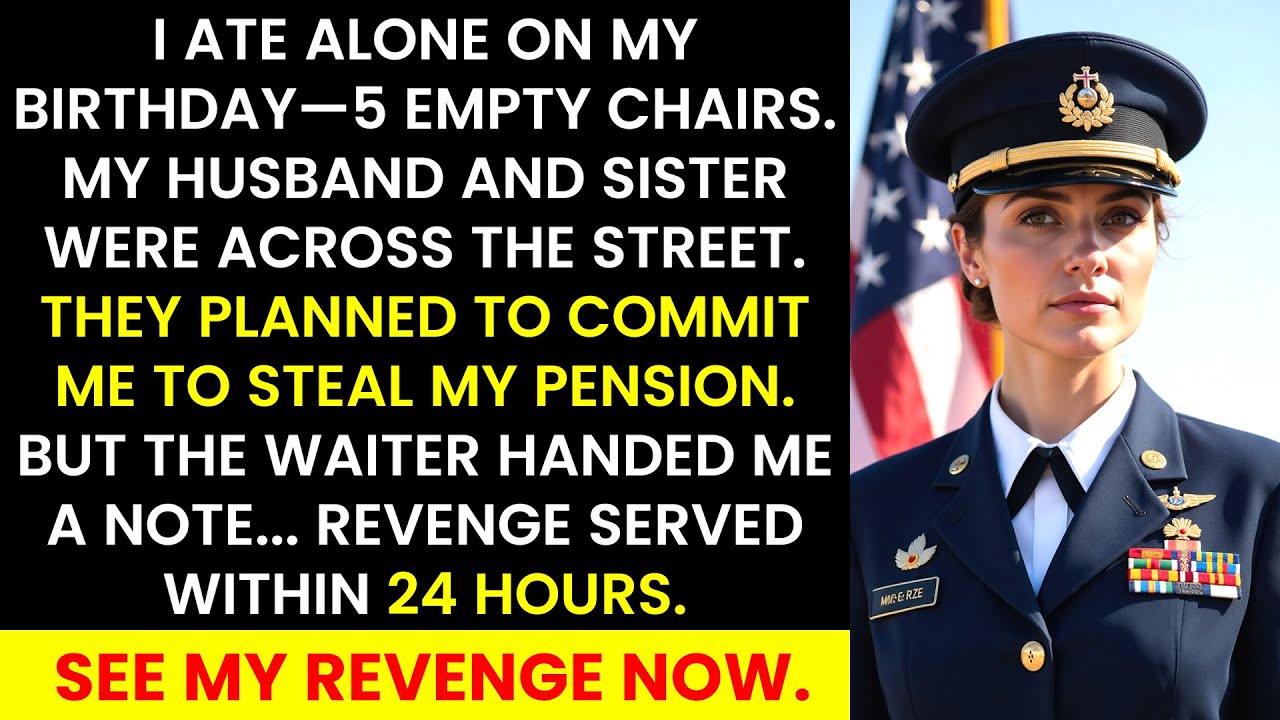
The table was set for six. Six glasses, six plates, five empty seats that felt like judgment. The water in my glass had gone warm and bitter hours ago. I could feel the other diners watching me, pitying me.
A woman in pearls whispered to her companion, something about being stood up. The pity stung worse than any physical pain. I checked my phone again. My text to Patrick sat there, delivered but unread.
I called him — four rings, voicemail. Victoria went straight to voicemail. My mother-in-law Haley answered once and hung up. I felt sick, a cold, sliding fear in my stomach.
Not battlefield adrenaline. Something worse. Maybe I had gotten the date wrong. I checked the calendar.
No, it was my birthday. Maybe I had done something to offend them. Maybe I had another episode and didn’t remember. Patrick had been telling me for months that my memory was slipping, that the job stress was making me unreliable.
Maybe he was right. Maybe they were all punishing me for something I didn’t even know I’d done. *Ma’am. *
The voice was soft, hesitant.
I looked up. It was Leo, the busboy — a law student working double shifts. But his eyes held a strange mixture of pity and urgency. He placed a folded receipt on the tablecloth, and his hand trembled.
“I’m sorry, Sergeant,” he whispered, using my rank. “You don’t deserve this. ”
He glanced nervously at the large window facing Broughton Street. “Don’t look out the window,” he hissed.
“Read this and check your phone right now. The text that’s coming is from my number. ”
Before I could ask anything, he was gone. I unfolded the paper.
Scrawled handwriting: *They’re at the Oyster Bar across the street. You need to see the truth. *
My phone buzzed. An unknown number.
A photo file. I tapped it. The world didn’t spin. It stopped.
The photo was grainy, taken through the bar’s glass window, but unmistakable. Patrick was there, laughing, a glass of expensive red wine in his hand. And leaning into him, her arm wrapped around his waist — Victoria, my sister. But my eyes weren’t on their faces.
They were drawn like a magnet to Victoria’s hand on Patrick’s chest. On her ring finger, gleaming in the bar’s dim light — my mother’s diamond ring. Three months ago, I had torn our house apart looking for that ring. I had sat on the floor and sobbed, and Patrick had held me and stroked my hair.
“Oh, Alexa,” he had said, his voice full of practiced sympathy. “Don’t you remember? You lost it during your panic attack last week. You threw it in the garden.
We looked everywhere. You really need your medication, sweetheart. ”
I had believed him. I had swallowed the pills he gave me.
I had believed I was falling apart. But I wasn’t crazy. He had stolen it. He had stolen my mother’s memory, my sanity, my dignity.
And now he was across the street, putting that stolen ring on my sister’s finger, while I sat here waiting for a birthday cake that would never come. The grief that had been drowning me evaporated. In its place rose a cold, hard fury. A focus I hadn’t felt since Iraq.
I signaled Leo. I didn’t wipe my eyes. I didn’t smooth my dress. I stood.
“Take me to the security room,” I said. “I need to see what they’re paying with. ”
The pieces started falling into place. For the past 90 days, I hadn’t felt like myself.
Fatigue, forgetfulness, a mental fog. Patrick was so attentive, so careful. Every night after dinner, he would give me two little blue capsules in a paper cup. “Brain vitamins from Dr.
Miles,” he would say, his voice smooth as velvet. “To help you adjust. You need your sleep to heal. ” Twenty minutes later, I would be unconscious on the couch, limbs heavy as lead.
And then Victoria would usually show up. He wasn’t treating my PTSD. He was chemically incapacitating me. Dosing me with sleeping pills and calling them vitamins.
I used the restaurant’s landline to call my in-laws’ house. Haley answered, her voice trembling. “Mom, it’s me. It’s Alexa.
”
A choked silence, then a gasped sob. “Oh, God. Alexa, where are you? Are you safe?
Do you have your gun? ”
*Gun? * “Mom, what are you talking about? ”
“Patrick called us ten minutes ago,” she said, frantic.
“He said you had a breakdown at the restaurant. That you were screaming, overturning tables, threatening staff with your service pistol. He said he had to call paramedics to sedate you and take you to Memorial’s psych ward. We’re just getting our coats to come see you.
”
The restaurant temperature seemed to drop ten degrees. It was a perfect crime, a masterclass in character assassination. While I sat here quietly drinking water, Patrick was painting me as a dangerous lunatic to everyone we knew. “Mom,” I said, my voice low and steady, “I’m sitting at table six at Cha Bella.
Everything is fine here. I’m drinking water. I have no weapon. I haven’t raised my voice once.
”
“But Patrick said —” she stammered. “And Victoria, she called saying she had a migraine, and then she called back crying saying she was terrified you might hurt yourself. ”
“They’re lying, Mom,” I said, my words bitter as ash. “Patrick is not with me.
He’s across the street at the Oyster Bar with Victoria, drinking a $300 Cabernet. She doesn’t have a migraine. She’s sitting on his lap. ”
“No,” Haley whispered.
“Not Victoria. Not his own sister-in-law. ”
“Haley, she’s wearing my mother’s ring. The one Patrick said I lost.
I need you to trust me. Don’t call him. Don’t let him know I know. Just stay near the phone.
”
The overwhelmed, abandoned wife was gone. So was the disoriented patient. In their place stood Sergeant Macki. Leo tapped on the keyboard, pulling up a security feed.
“I’ve been watching them for weeks,” he said. “They come here every Tuesday. Table twelve at the Oyster Bar, the darkest corner. The feed is high definition, clearer than your phone.
”
There they were. Patrick and Victoria, toasting with red wine. The label — I recognized it from Patrick’s study’s wine list. Three hundred dollars a bottle.
I had drunk tap water so they could drink expensive wine. “Take a look at this, Sergeant. ” Leo slid some crumpled receipts across the desk. “I printed them from the system history.
They always pay with the same card. ”
I looked at the last four digits. 4190. My blood ran cold.
It was my Army-issued Visa Platinum card. The one I had added Patrick to as an authorized user for emergencies and groceries while I was deployed. I opened my banking app and scrolled through the credit card history. The Ritz-Carlton, $800.
Spa Bella Day Spa, $450. Savannah Luxury Imports, $2,500. The list went on — dinners, hotels, designer clothes. “Thirty thousand dollars,” I whispered.
Over three months. This wasn’t just money. This was my hazardous duty pay. I bled for this money.
I missed Christmases, birthdays, anniversaries for this money. But the final blow was still to come. I clicked on my long-term savings account — the one I had built over 20 years of service to supplement my military pension. It should have had over a hundred thousand dollars.
The current balance was zero. Patrick had power of attorney — signed before my final deployment, standard procedure for soldiers. And he had used this legal weapon to strip me bare. All of it, gone, transferred out under the guise of real estate investments.
There were no investments. Just Victoria’s new Hermès bag and Patrick’s delusion of being a wealthy playboy. I leaned back in the chair, the leather creaking under the weight of my devastation. 47 years old.
Two decades of service. And now I was destitute. The house wasn’t even in my name — Patrick had refinanced it in both our names. No cash.
Destroyed credit. And tomorrow morning, they planned to have me committed to a psychiatric ward so I’d never talk again. “I’m not sorry anymore,” I said, my voice flat. “I’m operational.
” I looked at the monitor. Patrick was laughing at something Victoria said. He looked complacent. Victorious.
He thought I was either panicking in a hospital waiting room or crying on the couch at home. He thought he’d won. “Leo,” I said, no emotion in my voice. “Can you pull this video footage and get audio from that listening device you have?
”
“Yes, ma’am. Crystal clear. ”
“Good. Send those files to my phone right now.
”
“But why? ” Leo asked. “To start a war,” I replied, my eyes fixed on Patrick’s smiling face on the screen. They took my money.
They took my love. They took my trust. But they made one huge mistake. You can take away a soldier’s weapon, but you can never take away her training.
The audio feed came in clear. First, I heard Victoria’s laugh — not the sweet laugh of our childhood, but a harsh, cruel sound. “Oh my God, baby. Did you see her?
” Victoria’s voice slurred with wine. “She’s sitting over there in that ridiculous blue dress. She looks like she’s about to burst out of a sausage casing. I told you to let her wear her camouflage.
At least it hides how ugly she is. ”
I closed my eyes. This was the sister I had practically raised. I’d skipped lunch for a month to buy her prom dress.
And now she was laughing at me, calling me a sausage, dismissing me as a human being to please my husband. “Forget about the old hag,” Patrick’s voice, heavy with alcohol. “You’re ruining the mood. ”
“I don’t know how you do it, Patrick,” Victoria giggled.
“Sleeping with her. It must be so disgusting. ”
I held my breath, waiting for him to defend me. Could a cheater still have some shred of loyalty?
“You have no idea,” Patrick said with contempt. “I have to keep the lights off. Touching her back. It makes me want to vomit.
It’s like touching a frog’s skin. All those ridges and scars. She keeps saying they’re her battle medals. But honestly, they’re just disfigured flesh.
It’s grotesque. ”
My hand went instinctively to my left shoulder. Beneath my silk dress, I could feel the ridges of my scars. Afghanistan, 2010.
A mortar shell hit our convoy. I had thrown myself over Private Miller, a 19-year-old kid from Ohio, so he could go home to his newborn daughter. I was proud of those scars. Patrick used to kiss them, trace them with his fingers, whisper that I was his hero.
Now, I was just a frog to him. A disgusting object he tolerated for the money. The conversation shifted from mockery to cold planning. “Are we all set for tomorrow?
” Victoria asked, ice clinking in her glass. “One hundred percent,” Patrick replied. “I slipped Dr. Miles an envelope this afternoon.
He’s already signed the preliminary observation papers. ”
“And the police? ”
“I’ll call at 9 a. m.
,” Patrick said, sounding very pleased with himself. “I’ll tell the 911 dispatcher that Alexa’s having a flashback, that she’s armed and threatening suicide. By the time the police arrive, she’ll be sedated because I’ll have put a double dose of sleeping pills in her water tonight. They’ll find a confused, unresponsive vet with a gun on the table.
They’ll restrain her for her own safety. Once she’s on a 72-hour hold, I’ll petition for emergency guardianship. I’ll argue her mental state is deteriorating rapidly and she can’t handle her own finances. When she gets out — if she gets out — I’ll have full control of the assets, the house, the pension.
Everything. All ours. ”
“You’re a genius, baby,” Victoria whispered. I removed the earpiece and set it gently on the desk.
My hands were steady as stone. The shake, the tears, the heartbreak — all gone. Replaced by a sniper’s calm focus. They didn’t just want a divorce.
They wanted to erase me. I opened WhatsApp. I didn’t dial 911. Police would require testimony, investigations, enough evidence.
Bureaucracy takes time, and I didn’t have time. I needed something with immediate, irreversible impact. I scrolled through my contacts with surgical precision. Haley Macki, mother-in-law.
Ethan Macki, father-in-law. Aunt Martha, the family gossip. Pastor John, First Baptist Church. Colonel Thompson, Patrick’s boss.
Cousin Sara, the neighborhood watch leader. I named the group: “The Truth About the Macki Family. ”
I wrote a caption that was concise, brutal, and left no room for misunderstanding. *Happy birthday to me.
This is what my husband and sister bought me with my life savings tonight. Please listen to the audio file carefully. They’re planning to have me committed to a psychiatric ward tomorrow morning on false pretenses to steal my pension. If I go missing or end up arrested tomorrow, you’ll know who’s behind it.
*
My thumb hovered over the send button. For one moment of hesitation, I wasn’t a sergeant. I was a wife, grieving the death of a 20-year marriage. Goodbye, Patrick.
I pressed send. Ten seconds of silence. Then my phone began to vibrate — a flood of notifications. Aunt Martha: “Oh my God, is this true?
” Cousin Sara: “I feel sick after listening to that audio. ” Pastor John: “Alexa, please tell me this is some mistake. ”
I didn’t open any of them. I was waiting for one specific reaction.
Five minutes later, a call lit up the screen. Caller ID: Dad Ethan. Patrick’s father was a retired general — a man of few words and immense pride. I answered.
“Hello. ”
No greeting. Heavy, unsteady breathing. The sound of a man fighting to control himself.
“Alexa,” his voice rumbled, low but dangerous, like an approaching storm. “Where are you right now? ”
“I’m at the restaurant, Dad. ”
“Are you safe?
Are you in any trouble? ”
“No,” I said firmly. “I’m in the back office. I’m fully conscious.
I’m calm and of sound mind. ”
“Good. Although your mother is now lying on the floor. She just heard the audio.
She’s wailing. Alexa, I’ve never heard that sound come out of her in my life. ”
I gripped the phone tighter, guilt washing over me. “I’m sorry, Dad.
I didn’t want you to find out this way. ”
“Don’t you ever apologize,” Ethan barked. “Did he really say that? About your scars?
The ones you got saving a 19-year-old kid — it makes him want to vomit? ”
“Yes. ”
“That son of a bitch,” Ethan roared. I heard something shatter in the background.
A glass, maybe a vase. “As far as I’m concerned, he’s dead to me. Do you hear me? He’s no son of mine.
He’s disgraced this family and disgraced the uniform. Alexa, go home. Right now. Get a locksmith and have every lock changed.
Don’t let him in tonight. Your mother and I are driving down from Charleston. We’ll be at your door at 9 a. m.
sharp. ”
“Okay,” I said, tears finally streaming down my face. Not from grief — from relief. “See you at 9 a.
m. ”
“Stay ready, soldier,” he said, and the line went dead. I turned to Leo. He was standing by the door, pretending not to listen, but his eyes were wide.
I opened my wallet and pulled out all the cash I had — $500 in emergency bills. I pressed them into his hand. “Sergeant, no,” he said, stepping back. “I can’t take this.
I just did what was right. ”
“Take it, Leo,” I said, taking his hand and forcing the bills into his palm. “You didn’t just serve water tonight. You saved my life.
You gave me the weapons to fight back. If not for you, I’d be in a psych ward by tomorrow afternoon. ”
“Don’t let them get away with it, Sergeant. ”
“I won’t.
”
I slipped out the back door into the warm Savannah night. The air smelled of jasmine and impending rain. A beautiful night. I walked to my car, my heels clicking rhythmically on the pavement.
The party was over, but the eviction process had just begun. I drove home and arrived at ten. The house looked exactly as I’d left it. Perfectly manicured lawn, white picket fence gleaming under the streetlights.
It looked like the American Dream. But inside, it was the scene of a broken marriage. I didn’t cry. I didn’t fall apart.
I called Mark, my old friend from my unit who now ran a 24-hour locksmith business. “Mark, this is an emergency,” I said. “I need every lock changed tonight. Front, back, garage, side gate.
”
By 11 p. m. , the deadbolts were replaced. Mark didn’t ask questions.
He just looked at my face and said, “Stay safe, Sergeant. ”
The house secured, I began the purge. I pulled out a roll of heavy black garbage bags from under the sink. I didn’t fold Patrick’s Italian silk suits.
I didn’t neatly arrange his designer shoes. I ripped them from the closet armful by armful. His limited-edition Titleist golf clubs. His vintage cologne collection.
I didn’t break anything — I wasn’t going to give him an excuse to call me destructive. I just threw it all in bags with his dirty gym socks. I dragged all fifteen bags to the back lawn and stacked them like a trash heap, because that’s what they were. I didn’t sleep.
At 6 a. m. , I made a pot of black coffee strong enough to wake the dead. I went to the guest room closet, past the casual clothes Patrick liked me to wear, and reached for my dress blues uniform.
I put it on with care. Shirt tucked, tie straight, jacket buttoned. I pinned my ribbons and medals onto my chest. The weight of them steadied me.
This wasn’t just a uniform. It was my armor. I sat in the armchair facing the front door. On the coffee table, I placed my service pistol.
Magazine open, chamber empty, safety on. It wasn’t there to be used. It was a message. At 9:15 a.
m. , the familiar silver BMW pulled into the driveway. Patrick got out, looking disheveled but trying to compose himself. He held a wilted bouquet of carnations wrapped in cheap plastic, clearly bought at a gas station.
He walked to the door and tried to insert his key. The door didn’t budge. He frowned and jiggled the key again. Nothing.
“Alexa? ” he called, his voice muffled through the wood. He knocked, then pounded. “Alexa, are you in there?
Open the door. You’re scaring me. ”
He was shouting now, loud enough for the neighbors to hear. The concerned husband, the mentally unstable wife.
I smoothed my jacket and walked to the door. I opened the wooden door but kept the metal security screen firmly latched between us. Patrick leaned in, then stopped short. He saw my uniform.
He saw the cold, dead look in my eyes. “What’s going on? ” he asked, his composure cracking for a moment. “Why are the locks changed?
” Then his eyes landed on my medals. A crooked smile spread across his face. “Oh, Jesus, Alexa, you’re in uniform? Are you having a flashback?
Do you think you’re in Baghdad? Did you take your medication? ”
“Go home, Patrick,” I said, my voice calm and clear through the screen. “Your things are bagged up on the back porch.
The gate will be open for fifteen minutes. ”
The passenger door of the BMW opened. Victoria stepped out, wearing oversized sunglasses to hide her hangover, clutching an expensive designer purse that was probably purchased with my hazardous duty pay. “Cici!
” she cried, running up to the porch, fake tears starting. “Oh God, we’ve been so worried. We went to three hospitals last night trying to find you. Please, just let us in.
You’re not well. ”
A cheap soap opera was playing out on my front porch. “Enough! ” Patrick shouted, his face turning red.
He could sense he was losing control of the situation. He pulled out his phone, brandishing it like a weapon. “You’ve left me no choice, Alexa. You’re mentally unstable.
You’re a danger to yourself. I’m calling 911 right now. ” He jabbed at the screen furiously. “I’m going to have you committed for 72 hours.
When you wake up in the psych ward, remember that you did this to yourself. ”
He held the phone to his ear, a triumphant glint in his eye. “There’s no need for that, Dad. ”
The voice was deep, gravelly, coming from the street.
Patrick spun around. He’d been so focused on his performance that he hadn’t heard the truck pull up. A black Ford F-150, engine idling. My father-in-law’s truck.
The driver’s door opened. Ethan Macki stepped out. A 70-year-old Vietnam vet, looking like an approaching storm. In his right hand, resting casually on his shoulder, was a Louisville Slugger baseball bat.
From the passenger side, Haley stepped out. She wasn’t crying anymore. She held her smartphone up, volume at maximum. Patrick’s own voice blasted out into the quiet morning, echoing off the house walls.
*“It’s like touching a frog’s skin. All those ridges and scars. ”*
Patrick’s face went from bright red to paper-white. He dropped his phone; it clattered onto the concrete porch and shattered.
A deep crack split the air. It was the sound of Ethan’s fist connecting with Patrick’s jaw. The punch lifted Patrick off his feet. He stumbled backward, flailing for balance, and crashed into the rose bushes beside the walkway.
The thorns tore his expensive shirt and raked across his cheek. He looked up at his father with wide, terrified eyes. He had never seen Ethan raise a hand to anyone in his life. Ethan stood over him, chest heaving, the baseball bat still resting ominously on his shoulder.
The 70-year-old veteran was shaking — not with weakness, but with volcanic rage. “I did not raise a liar,” Ethan roared. “I did not raise you to sleep with your wife’s sister. And I certainly didn’t raise you to mock the scars of a soldier who took shrapnel for her country.
”
“Dad, please —” Patrick whimpered, wiping blood from his lip. “Don’t you call me Dad,” Ethan thundered. “You are a stain on the Macki name. A stain on this family.
As far as I’m concerned, you’re dead to me. ”
Seeing her lover flat on the ground, Victoria panicked. She ran to Haley, tears streaming down her face. “Aunt Haley, please,” she sobbed, dropping to her knees on the concrete.
“You have to listen to me. This isn’t my fault. It was Patrick. He seduced me.
He said they were already separated. I didn’t mean for this to happen. ”
Haley Macki, the woman I’d known for 20 years who never uttered a harsh word in her life, took a step back. She looked at Victoria not with anger, but with cold, absolute revulsion.
“Get away from me,” Haley whispered. “Don’t you touch me with your filthy hands. ” Victoria froze, her hand still extended. “You’re wearing your dead mother’s ring,” Haley said, her voice trembling.
“You’re wearing it while sleeping with your sister’s husband. You’re not a victim, Victoria. You’re not even human. Get out of my sight before I forget I’m a Christian woman.
”
Haley turned her back on her and extended her arms to me. I walked down the steps and collapsed into her embrace. She held me tight, smelling of lavender detergent and safety. For the first time in 24 hours, I sobbed.
Not a breakdown. A release of a weight I’d been carrying alone. But the moment of relief was brief. I had to secure the perimeter.
I pulled away from Haley, wiped my face, and walked over to the rose bushes where Patrick was still disentangling himself from the thorns. I reached into my pocket and pulled out a key — the key to the back service gate where we kept the recycling bins. I threw it on the ground in front of him. “You have fifteen minutes,” I said, my voice calm, authoritative.
“Your belongings are in black trash bags on the back porch. Take them and get off my property. ”
Patrick struggled to his feet, trying to muster the last shred of his dignity despite the blood on his face and leaves in his hair. “You can’t evict me, Alexa.
This is marital property. I have rights. I’m not going anywhere until I talk to my attorney. ”
“Wrong,” I said, a cold smile spreading across my lips.
I stepped forward, into his personal space. “I bought this house in 2001, Patrick. Two years before we got married. I put down the down payment with my Army enlistment bonus and savings.
The deed is solely in the name of Alexa Anderson. I never added you to the title. I never refinanced. In the eyes of the state of Georgia, you are a tenant, and your lease is terminated for criminal behavior.
”
I gestured toward the silver BMW in the driveway. “And leave the car keys. That sedan is leased in my name with my credit card, because your credit score was too low. How am I supposed to get around?
” he stammered. “However you can manage,” I said. “Your bank accounts have been frozen. I suggest you start walking.
”
Neighbors had gathered by now. Miss Higgins from across the street was on her porch with her morning coffee. The neighborhood watch captain stood on the sidewalk with folded arms. Patrick looked around, realizing he had lost all support.
His reputation, the thing he valued more than his marriage, was in ashes. He picked the key up from the dust and limped toward the backyard. Ten minutes later, a pathetic spectacle unfolded. Patrick dragged heavy black trash bags down the driveway, sweating profusely.
He called an Uber. When the driver, an aging Toyota Camry, popped the trunk, Patrick tried to shove his Armani suits inside. They didn’t fit. He had to cram them into the back seat, crumpled and twisted.
Victoria stood at the curb, waiting. “Patrick, are my bags in there? ” she called. “Can I come with you?
”
Patrick slammed the car door. “Get your own ride, you idiot. You ruined everything. ” He jumped into the front seat, and the Uber sped away, leaving Victoria alone on the sidewalk clutching her designer bag.
She looked at me, then at the neighbors. No one moved to help her. Finally, shame overcame her. She pulled out her phone and frantically typed for a taxi.
Ethan watched the Uber disappear around the corner. He spat on the asphalt, as if getting the taste of his son out of his mouth. He turned to me, his face softening back into the loving father. “All clear, Sergeant,” he said, his voice thick with emotion.
He put his heavy hand on my shoulder. “Let’s go inside. I picked up some rib-eye steaks on the way. I’m firing up the grill.
We’re going to do this birthday right. ”
I looked at the empty driveway. The enemy was gone. My family was here.
“Yes, sir,” I said. “I prefer mine medium rare. ”
I wasn’t just kicking Patrick out of my house. I needed a hunter to make sure he never came back.
The next morning, I walked into Mia Chin’s glass-walled office. She was a legend in Savannah. They called her the Red Shark because she always wore blood-red stilettos to court, and when she smelled blood, she didn’t just bite — she devoured. Mia was a petite Asian woman with precision-cut hair and eyes that appraised me and my assets in one glance.
She flipped through the file I’d prepared — bank statements with circled fraudulent charges, affair photos, transcripts of the audio recording. She stopped at the credit card statements. A slow, dangerous smile spread across her lips. “He used your military VISA Platinum?
” she asked silkily. “The one issued by the Federal Credit Union? ”
“Yes. ”
“And he filed a false police report to have a decorated veteran committed to a psychiatric hospital in order to gain power of attorney?
”
“He planned to. He didn’t get the chance. ”
Mia tapped her red manicured nails on the mahogany desk. Click, click, click.
It sounded like a countdown. “Sergeant, this isn’t a divorce case,” she said, closing the folder. “This is a legal execution. Unauthorized use of a military credit card is fraud.
It’s a federal crime. I can put him in prison for five years to start. ” She waved her hand dismissively. “I’m waiving my fee.
If he has any assets left when I’m done, I’ll take my payment from those. I want to see his face when I serve him with notice. ”
Mia moved with the speed of a snake. Within 24 hours, she filed an emergency petition to freeze all marital assets on the grounds of extraordinary waste of funds.
The results were immediate and humiliating. Leo called me that evening, laughing so hard he could barely speak. His roommate worked the reception desk at the Perry Lane Hotel, the most luxurious place in town, where Patrick had gone to lick his wounds and wait for me to come back. “He tried to check in,” Leo said between gasps.
“He slammed his platinum card on the counter like he owned the place. The machine beeped so loud the whole lobby heard it — declined. He tried three more cards. All frozen.
The receptionist said he started screaming about the bank’s mistake, but they kicked him out. He had no cash because you took his savings. He ended up sleeping in the back seat of his rental sedan because his credit score bottomed out the moment you took your name off the account. He ate a gas station sandwich for dinner.
”
The dominos didn’t stop falling. The next morning, Colonel Thompson, Patrick’s boss at the real estate firm, summoned him to his office. I hadn’t needed to say a word. My group chat had done the work.
“You’re fired, son,” the Colonel said, not even offering Patrick a seat. “We sell homes to military families. Trust is our business. I can’t have a man who steals from an active-duty soldier representing my company.
”
Patrick walked out of that office with his belongings in a cardboard box, unemployed and homeless. Victoria’s situation was no better. The Southern church community was tight-knit and spread gossip faster than the news. By Sunday’s prayer service, she was an outcast.
When she walked into the sanctuary, the entire third row stood up and moved to the other side of the aisle. By Monday, she’d been let go from her job at the luxury nail salon. The wealthy wives of Savannah didn’t want a known husband-stealer touching their hands. She had become untouchable.
Three weeks later, the war ended in a conference room. Patrick sat across from me at a long oak table. He looked a decade older. His tan had faded, his suit was rumpled, and his arrogance had curdled into nervous fear.
Mia slid a document across the table. “This is an uncontested divorce decree,” she said. “It states that you, Patrick, relinquish all rights to the house, the pension, and any spousal support. You walk away with only your personal belongings and the debt you’ve accrued on your own cards.
In exchange, Sergeant Macki agrees not to press federal charges for credit card fraud and identity theft. ”
Patrick stared at the paper, then at me. “Alexa, please don’t do this. I have nothing.
”
“You have your freedom,” I said evenly. “Something you weren’t planning to give me. ”
He picked up the pen. His hand shook as he signed.
And just like that, he was gone. I walked out of the office into the bright Georgia sunlight. I had my house. I had my pension.
I had my name. But there was one unresolved issue, a piece of the puzzle that kept me up at night. My mother’s ring. Patrick claimed he didn’t have it, that he’d given it to Victoria and lost track of it when he kicked her out of the rental car.
I knew they were lying. That ring was their only remaining asset. Three months after the divorce was finalized, I walked into Whole Foods. My calendar no longer had court dates or attorney appointments.
It had yoga classes and volunteer shifts at the local veterans center. I pushed my cart toward the back dairy section, where they kept the last-chance clearance bins. An old habit from childhood I couldn’t fully shake. And then I saw her.
At first, I didn’t recognize the person bent over the refrigerated bins. She wore a faded yellow t-shirt two sizes too big, the collar stained. Her hair, once perfectly coiffed, was now a greasy, tangled knot. She looked skeletal, her collarbones jutting out over pale skin.
She was searching through a pile of discounted yogurt and stale salad. It was Victoria. My breath caught, but not from fear. It was shock.
The glamorous, arrogant woman who had mocked my dress had vanished. In her place was a ghost. I watched her pick up a container of marked-down potato salad, check the price tag, count her crumpled dollars, and sigh. I almost turned around.
I almost walked away. But then, as she reached for a carton of milk, something glinted on her left hand in the supermarket’s neon light. She was still wearing it. My mother’s ring.
The diamond was jarringly out of place on her neglected hand, glimmering above her dirty nails. It looked grotesque, like a crown on a corpse. The anger didn’t explode this time. It rose like a tide, cold and steady.
That ring didn’t belong in a discount bin. It didn’t belong to a traitor. I pushed my cart forward with purpose, blocking her exit. Victoria looked up, startled.
Her eyes went wide with fear. She flinched so hard she dropped the potato salad. It hit the floor with a splat, the plastic lid popping open. “A-Alexa,” she stammered, backing up until she hit the refrigerated case.
“I… I didn’t know you shopped here. ”
“Take it off,” I said. My voice was low, without warmth.
It wasn’t a request. Victoria instinctively covered her left hand with her right. “What? Alexa, please, listen.
I’m having a hard time. Patrick, he kicked me out of the rental car that day. He blocked my number. I lost my job.
I’m being evicted. ”
“I don’t care,” I said flatly. “I don’t care if you sleep on a park bench. I don’t care if you go hungry.
The day you got into my bed, you forfeited any right to my sympathy. ”
“I need it,” she cried, tears streaking through the grime on her face. “I tried to sell it at a pawn shop, but they wouldn’t take it without the original paperwork or provenance. They thought I’d stolen it.
”
“Did you? ” I said coolly. “Patrick stole it from me, and you received stolen goods. That makes you a criminal, Victoria.
”
People were starting to stare. I extended my hand. “I’m going to count to three. If that ring isn’t in my hand, I’m calling the police and pressing charges for theft right here, in front of the organic vegetables.
One. ”
Victoria was trembling. She looked at the onlookers, then at my face. She found no mercy there.
“Two. ”
“Fine, fine, take it,” she sobbed. She struggled to pull the ring from her finger. It was too tight.
She had to twist it over the knuckle. She dropped it into my palm. It felt heavy and warm from her skin. “I’m sorry, Alexa,” she blubbered.
“Please, can you spare $20 so I can buy food? ”
I reached into my purse. I pulled out a pack of tissues. I took one and, very carefully, with slow, deliberate movements, I wiped the ring clean.
I rubbed the band, the diamond, the setting, as if her sweat and betrayal were physical dirt. I didn’t look at her. I only looked at the ring. “Don’t ever call me sister,” I said, wrapping the ring in the tissue and putting it in my pocket.
“Mom would have been heartbroken that she gave birth to someone like you. ” I turned my cart around and walked away. I didn’t look back at the clearance bin. I didn’t look back at the crying woman.
I paid for my groceries and walked out into the blazing sunlight. I stood on the sidewalk, clutching the tissue in my pocket. I thought I would break down. I thought I would cry for my mother.
But as I unwrapped it in the sunlight, I felt nothing. The stone was cold. Its magic was gone. It had been on Victoria’s finger.
It had been part of their relationship. It was tainted. I looked across the street. There was an old family-owned jewelry shop that bought gold and diamonds for cash.
I didn’t hesitate. I crossed the road. The bell above the door chimed as I walked in. An older jeweler with a loupe around his neck looked up.
“I’d like to sell this,” I said, placing the ring on the velvet counter. Fifteen thousand dollars, he said after five minutes of inspection. I said, done. Ten minutes later, I walked out with a thick envelope in my bag.
I felt light as a feather. I had traded a heavy, tainted memory for $15,000 of freedom. But I didn’t want to keep the money for myself. I knew exactly where it was going.
Exactly one year after the worst night of my life, I walked back through the mahogany doors of Cha Bella. The maître d’ greeted me with a warm smile, not as an object of pity but as a regular. He led me past the crystal chandeliers and whispering couples to table six, by the window. The table was the same.
The view was the same — the street where I had watched my world fall apart through the glass. But tonight, everything else was different. There were no empty chairs. On my right sat Ethan, telling one of his terrible jokes, his deep laugh making the nearby tables smile.
He was no longer just my father-in-law. He was the father I’d always hoped for. On my left sat Haley, stunning in an emerald green dress. She was drinking champagne and actually glowing.
Across from me sat Mia Chin. She wasn’t wearing her signature sharkskin court suit. She was in a silk blouse, hair down. We were no longer attorney and client.
We were jogging partners, running 5k three mornings a week in Forsyth Park. And next to Mia sat Leo. He wasn’t in his waiter’s apron. He was in a crisp navy blazer, looking older, more confident.
He was at the top of his class. The $15,000 from my mother’s ring hadn’t gone into a savings account. It had gone straight to the university registrar — to pay for Leo’s final year of tuition. My mother’s heirloom was no longer a lifeless stone on a swindler’s finger.
It was an investment in the future of the young man who had the courage to tell the truth. “Steak and eggs, Sergeant,” Ethan announced, raising his glass as I sat down. “At ease, soldier,” I laughed, placing my napkin on my lap. The table was filled with warmth.
We ordered appetizers — calamari, crab cakes — the things we liked, not what Patrick preferred. No one mentioned his name. No one spoke of Victoria. They were ghosts, faded memories with no place in this warm circle.
We talked about Mia’s upcoming trial, Haley’s garden club, Leo’s mock trial victory. These were my people. Not by blood, but by choice. These were the ones who stood by me when the house was burning.
They saw me when I was invisible, believed me when I was branded deranged. Their love had no conditions, no hidden agendas. It was steadfast. It was real.
“Time for dessert,” Leo said with a grin, gesturing to his former colleagues. A waiter approached, carrying a cake stand. It wasn’t the vanilla sponge that Patrick had made me eat for twenty years because it was *his* favorite. It was a rich, delicious, dark chocolate flourless cake, dusted with cocoa powder and raspberries.
In icing on the plate: “Happy Freedom, Sergeant. ”
My throat tightened. It was a small thing, but it meant everything. It meant I was seen.
“Make a wish,” Haley whispered, squeezing my hand. I closed my eyes, but realized I had nothing left to wish for. I had my health. I had my home.
I had my dignity. And in front of me, I had a table full of people who would fight for me. I blew out the candle. “Before you eat,” I said, reaching into my bag, “I have something to show you.
” I pulled out a small, square piece of paper. It was the receipt that Leo had given me a year ago: *Don’t look out the window. Check your phone. * I had had it laminated.
The paper was creased and the ink fading, but protected in plastic, it was indestructible. “I keep this in my wallet next to my military ID,” I said, holding it up. “People ask why I keep this junk. I tell them it’s not junk.
It’s my new medal of honor. ” Leo ducked his head, embarrassed. “It reminds me that insight is a weapon,” I said, looking around the table. “And the truth is the only shield that matters.
All of you gave me that truth when it would have been easier to stay silent. ”
I poured myself a glass of dark, bold Cabernet — one that I now had the right to enjoy. I stood up. The restaurant faded away, leaving only me and the audience of my life.
I looked forward, picturing all the women sitting at tables like mine, waiting for messages that would never come. “If you’re sitting in the dark right now,” I said, my voice steady and clear. “If you’re waiting on someone who will never come, if you’ve been told you’re crazy, or too old, or too much trouble — stand up. ” I raised my glass higher.
“Don’t let them take your worth. Don’t let them rewrite your history. You are the soldier of your own life. Fight back.
Secure your boundaries. And I promise, when the smoke clears, you will look around and see exactly who belongs at your table. ”
I took a sip of wine. It tasted like blackberries, oak, and one terrifying, beautiful freedom.
“Happy birthday to me,” I whispered. And for the first time in my life, I truly meant it. We all carry a Patrick or a Victoria in our pasts — someone who mistook our kindness for weakness. The most expensive lesson I learned wasn’t about the $30,000.
It was about the heavy cost of silence. Don’t hand over your financial or emotional power to anyone just to keep the peace. Peace bought with your own surrender isn’t peace — it’s annexation. Check your accounts.
Keep your name on your deeds. And most importantly: if your intuition whispers that something is wrong, listen. You’re not paranoid.
You’re prepared.