The Red Rock Hall glittered with crystal chandeliers, and the room buzzed with the energy of decorated generals and medal-laden tuxedos. I sat stiff in the third row, trying to disappear inside my plain class A uniform. Directly front of me, round VIP table, my father, Colonel Henry Holmes, nodded approvingly as he clapped a young major on the shoulder. His voice thundered, so loud it seemed to rip the air around us.
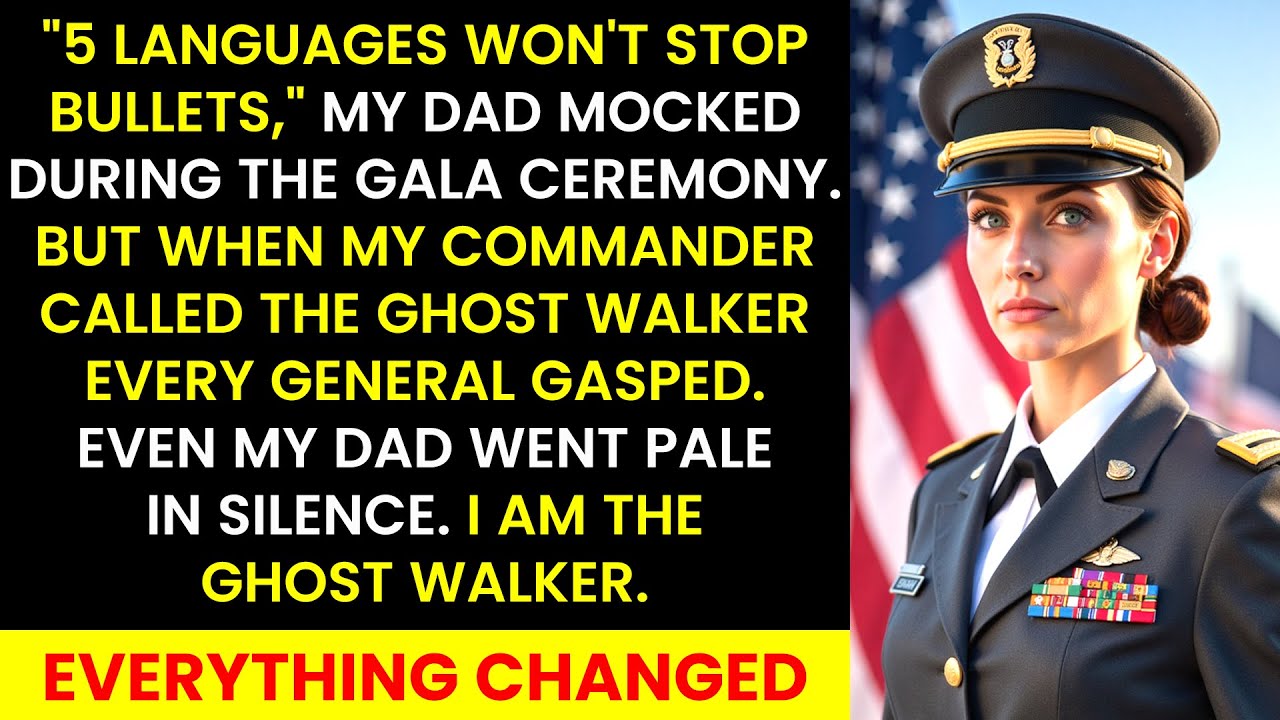
“Looking at you, I realize God truly is unfair. He never gave me a chance. The Holmes bloodline essentially ended thirty-six years ago. ”
Thirty-six years ago, I was born.
That sentence hit me like a bucket of boiling water. My ears rang, my chest tightened. It was sharper than the shrapnel wound I took in Syria. He wasn’t just disappointed—he declared me dead to the family name, publicly, in front of everyone, from just three feet away.
I gripped the classified file infront of me so hard my knuckles turned white. He had not idea that the man he just declared dead—Captain Kaira Holmes, codename Ghost Walker—was the one the entire Pentagon was desperate to find. And he certainly didn’t know that his own careless signature had nearly gotten me killed. When the ceremony ended, guests flooded into the VIP reception room, the air thick with expensive cologne and thick blue cigar smoke, the scent of Washington power.
I leaned against a cold marble pillar, clutching a glass of ice water, the only thing keeping me from screaming. My father was the center of the universe tonight, laughing in that booming command voice that used to feel like safety. Now it felt like a judge’s gavel, pronouncing my death sentence. Around him, generals and politicians clinked glasses, toasting his legacy.
What legacy? To them, I was invisible. Just a shadow onthe wall of his reputation. Then the young major, Major Mason, approached him.
My father threw his arm around Mason’s shoulders with a warmth I’d never received inforty-six years. “Everyone, listen up,” my father announced, the room falling silent. “This is Mason. If I could clone a warrior, he’d look exactly like this.
This kid just came back from Kandahar with a Silver Star. ”
The crowd murmured approvingly. Mason smiled, modest and practiced. “Thank you, Colonel.
I couldn’t have done it without your mentorship. ”
I stood three steps away, watching like it was afamily home movie I wasn’t in. A Silver Star. I drank sips of water to wash down the bitterness.
I was the one monitoring drone footage that night, listening as Mason’s forward observer, identifying the ambush point that allowed his team toencircle the enemyand claim that medal. But I couldn’t say anything. Ghost Walkers don’t get medals. We just get shadows.
A woman in silk, wife of a powerful senator, approached. Her eyes swept over my uniform, lingering onmy bare chest. No ribbons, no medals. To ordinary people, a soldier without medals was an empty canvas—or worse.
She glanced atmy water glass. “Excuse me, miss,” she said, her voice polite, condescending, devastating. “Would you mind fetching me some cocktail napkins? The bar ran out.
”
She thought I was staff. She thought I was the waitress, maybe. Blood flooded my cheeks, hot and burning. I opened my mouth, ready to say, “I’m Captain Holmes, ma’am.
I speak five languages and can kill a man with a ballpoint pen. ”” But before I could, my father turned around. He had heard everything. This was themoment when a father steps in.
Instead, he looked at me with cold, unrecognizing eyes, like I was astain onthe carpet. Then he turned back to the senator’s wife with his charming smile. “Sorry, ma’am. The staff here is a bit slow tonight.
I felt the air leave my lungs. He would let me be humiliated, reduced to a servant, rather than acknowledge the man standing front of him was his own flesh and blood. I put my glass ona tray asing, my hands shaking so hard the ice clinked. I turned onmy heel and walked, focusing onmy steps.
Left, right, left, right. Don’t run, soldier. Don’t run. .
I locked myself in a bathroom stall. My breaths wereshort, ragged, fast. I gripped the cold porcelain sink, staring atmyself inthe mirror. Thirty-six-year-old woman, sharp features, dangerous eyes.
But underneath, a child screaming for her father’s attention. I thought of my mother. Her old leather Bible, left onmy nightstand beforeshe died. Psalm 27:10.
I whispered it like a battle prayer, face to face with my reflection. “When my father and mother forsake me, then the Lord will take me up. ”
I said it again until my hands stopped shaking. I wouldn’t cry.
My father hated tears—called them liquid weakness. I turned onthe tap, splashed ice-cold water onmy face. The shock stung, sharp and biting, and for a moment, I was back inthat other house, where the air was always coldand love was something you earned like merit badge. I wiped my face dry.
I was no longer his daughter. I was a ghost. And he was about to learn that ghosts never die. That cold hotel bathroom water faded, replaced by something older, deeper.
Twenty-four years ago, Virginia, rainy night. When I was twelve, our suburban house was different from the neighbors’. No tricycles inthe driveway, no baseball onthe radio, no buttered popcorn on Friday nights. While neighbors played family games, our house ran onZulu time.
It wasn’t a sanctuary. It was a forward operating base. Shoes weren’t just organized—they were measured, heeled against the wall. My bed was made so tight a coin bounced off the sheets.
Sundays, my father didn’t come home like fathers do. He came home like a commanding officer, inspecting the barracks. Dinner was the most stressful part of the day. We ate at exactly 6:00 PM, heavy suffocating silence punctuated only bythe scrape of silverware.
I remembered one night when my hand slipped. My spoon clattered against the bowl, loud as a gunshot. He didn’t yell. He just stopped chewing, fixed me with his steel-gray eyes.
“Lack of bodily control is sign of weak mind, Kira. Be disciplined. ”
Laughing too loud at cartoons? That was lack of emotional discipline.
I grew upbelieving love wasn’t something you were born with. It was medal, an award, something you fought for, bled for, earned. And like any medal, it could be taken away at any moment. .
I wasn’t naturally athletic. I couldn’t throw football fifty yards like neighbor boys, which quietly embarrassed the Colonel. But I had another weapon—my ears. I had acute ear for languages.
I could mimic accents, and hours listening to shortwave radio, I absorbed the rhythms of Arabic and Farsi. One afternoon, sunlight streamed through the window, and I felt rare surge of confidence. I got my French essay back—A-plus written in big red ink. Perfect.
I wanted, just once, to see the cornerof his mouth curl into proud smile. Just one millimeter. That would be enough. I walked into his study without permission.
He sat at his mahogany desk, cleaning his Colt1911, the air heavy with gun oil and chemicals. The smell of my childhood. He didn’t look up. “Look, Dad,” I said, holding out the paper.
“I got the highest grade in class. ”
He glanced atthe paper, then at me. His expression didn’t change. “French,” he said with disdain.
“The language of people who surrender. ” He picked up his silver Zippo lighter. Click. Ffft.
The flame danced, pale. He touched it to the corner of my essay, my perfect A-plus, and I stood like stone watching the fire curl my hard work into black ash that fell onto his pristine carpet. “Learn to shoot, Kira,” he said, clicking the lighter shut. “You can’t stop bullets with words.
”
That day, I stopped trying to prove myself tohim. I started trying to become what he wanted. Six years later, age eighteen, I did something unthinkable. I applied to West Point.
Not because I loved the Army—I hated the uniform, hated the regulations. But West Point was his Mecca. His holy ground. I thought if I wore the gray, he would finally see me.
When the acceptance letter came, I placed it carefully beside his medium-rare steak atdinner, my heart pounding like a caged bird. I watched him pick upthe envelope. Read it once, twice. I held my breath.
This was it. This was the moment he’d smile. He put the letter back down, no smile, no congratulations, and picked up his steak knife, carving a perfect piece of meat. “Did they lower their standards again?
” he asked, chewing. “Or do they need more office workers now? ”
His words cut deeper than any knife. He didn’t believe I was capable.
He thought I was statistical error, admission glitch, destined to become a clerk incamouflage. That night, the sky broke open. Hard, relentless Virginia rain, turning everything gray. I packed my bag.
I didn’t say goodbyeto my mother—she was either sleeping or pretending to. I walked toward the front door. My father sat inthe living room watching war news onCNN, blue TV light flickering across his face. He knew I was leaving.
He didn’t turn around. He didn’t stand up. He sat there, immovable as stone. I stood onthe porch, rain soaking my clothes instantly.
I looked through the window at him, tears mingling with rain, salty and cold. I wanted to break, to run back inside and beg him tolove me. But something snapped insideme. Grief burned away, replaced by something hot and blazing inthe pit of my stomach.
Rage. Pure, white-hot rage. If you’ve ever broken yourself trying to please someone who wouldn’t lift a finger for you, then hit likenow and tell me inthe comments—at exactly what moment you stopped trying to make them proud. I stopped because I needed to know I wasn’t alone.
I wiped my tearsonmy face and whispered a promise into the storm, one that would drive mefor the next eighteen years. “I will never set foot inthat house again,” I said between clenched teeth, “until I make you stand up straight and salute me. Not as your daughter. As someone better than you.
” I turned my back onthe house, onthe warmth I never had, and walked into the dark. That night, eighteen-year-old girl died inthe rain. Ghost Walker was born. .
Let’s rewind two weeks before that humiliating night at Red Rock Hall. I was somewhere medals meant nothing, where the only applause was the sound of mortar fire. Outskirts of Hamara, Syria. Temperature hovered double-digit Celsius, dry dusty heat cracking the earth like clay pot.
But inside my Stryker armored vehicle, it was worse. The AC had died three days ago, leaving me in ametal box filled with supercomputer server hum, ozone smell, three-day-old sweat. I was Ghost Walker. To the rest of the Army, I officially didn’t exist.
My job wasn’t to bust doors. My job was to listen. I hunched over glowing monitors, fingers flying across custom keyboards, scanning every electronic signal within fifty miles. My mission was tocreate invisible shield for Bravo Team, special forces unit advancing ona rebel safe house.
I adjusted my noise-canceling headphones. To me, battlefield wasn’t chaos of gunfire and screaming. It was symphony—static crackles on UHF band, pings oncells towers, radio growls. These were melodies of life and death.
And right now, I was conducting. “Bravo One-Two to Ghost. Give me status. ”
Familiar voice incmy ear.
Sergeant Keller. Good man, Texan with drawl, wallet full of pictures of his five-year-old daughter, Emily. Only operator who knew I liked my black coffee unsweetened, and he always kept fresh pot waiting for me. “Ghost here,” I said, eyes darting across data streams.
“Perimeter looks clear. Bravo One. No mobile traffic, no radio chatter. ”
“Copy,” Keller said.
“Moving to breach north entrance. ”
I watched their GPS dots creep across tactical map. But then something stopped me. I squinted atthe audio spectrum analyzer.
There was a void—silence inthe low-frequency range where there shouldn’t be. Normal city sounds, power grid hum, even background static—gone from a specific ten-block area. Rebels aren’t this quiet unless they’re disciplined or waiting for something. My heart lurched.
This was passive trigger setup. They weren’t using radios. They were using hardline wires to detonate trap. “Stop!
” I shouted intothe mic, breaking my own calm. “Bravo One, hold position. Do not enter. Repeat, do not enter.
”
“Ghost? ” Keller’s voice confused. “It’s a trap, Keller. Passive triggers onthe north door.
They’re waiting for you toopen it. Pull back. ”
One second of terrified silence. One second where trust hung inthe balance.
“Copy! ” Keller yelled. “Team, pull back. Move to east wall.
Now. ”
GPS dots peeled away from the building. Three seconds later—BOOM. Even half mile awayinside my armored vehicle, I felt vibration through the floor.
The north entrance of the safe house vanished intomassive fireball. If they’d stepped through that door, Keller and five other men would be nothing but dust and dog tags. “Ghost,” Keller breathed intothe radio, voice trembling slightly. “You saved my life again.
”
I exhaled, sinking intomy chair. “Just doing my job, Bravo One. ”
“When we get back to base,” Keller said, confidence returning, “I’m buying you the coldest beer inthe Middle East. And I’ll show younew video of Emily riding her bike.
”
I smiled to myself. This was why I did this. This was the difference between me and my father. Colonel Holmes used soldiers like poker chips to win honor.
I used my brain to make sure those chips made it back intothe box at the end of the day. I didn’t need medals. I just needed Keller to make it home toTexas. I’m better than you, Dad.
I thought. I save lives. You just give orders. But aminute later, my smile died.
A new window popped up onmy primary screen. Redbox, urgent signal—but not enemy detection. Intrusion detection. Someone was pinging my vehicle.
And they weren’t hammering their way in like hacker. They were walking through our firewall like they had key tothe front door. Then voice inmy headphones. Not Keller.
Not command. Distorted, mechanical voice broadcasting ona classified frequency, one only Iand the Pentagon could access. “Target confirmed. Kira Holmes.
”
My blood ran cold. Not Ghost Walker. Not Asset Alpha. Kira Holmes.
My birth name. The name that should have been buried so deep incclassified files that God himself would need password tofind it. My real name, echoing across Syrian desert. How?
I whispered, hands frozen over keyboard. Who is this? “Lock confirmed,” the voice said. Before I could trace the signal, my alarm system screamed, the shrill war cry every soldier fears.
Missile launch detected. I looked atthe radar. Laser-guided anti-tank missile fired from ridge two klicks out. It wasn’t targeting infantry.
It wasn’t targeting Bravo Team. Red crosshairs locked directly onmy Stryker. Someone had given me up. And they didn’t just want tosilence signal.
They wanted toerase Kira Holmes from the face of the earth. “Get out. Move. Move!
” I screamed, lungs burning. But physics was faster than my voice. Hissing shriek above us like train brakes, then thunderclap hat shook the earth. The missile struck ground less than ten meters from our vehicle.
Shockwave slammed intothe Stryker like giant’s hammer. I flew sideways, body slamming against steel. My head cracked against metal support. White light exploded behind my eyes, then warm liquid running down side of my face.
Tasted metallic, like blood, but I couldn’t feel pain. Adrenaline had taken over my nervous system. I crawled up, coughing inthe thick dust that filled the cabin. “Everyone sound off!
” I choked. “Status! ”
Through the haze, I saw therear ramp had blown open. Sunlight and smoke poured in.
And there he was. Sergeant Keller. He hadn’t made it tocover. He’d come back.
He’d come back to pull me out. He lay sprawled inthe dust, twitching. Splinter the size of dinner plate had torn through his jacket and buried itself inhis neck. Bright arterial blood sprayed across desert sand, staining it dark red.
“Keller! ” I screamed, crawling across wreckage. I slipped onslick floor, knees slamming down beside him. I ripped off my gloves and pressed bare hands directly onto the wound, pressing as hard as I could.
“Stay with me, Keller. Look at me,” I shouted from inches away. His eyes werewide, terrified, darting. “Think of Emily.
She’s waiting for you inTexas. You can’t die inthis dust. ”
He tried tospeak, but only gurgling sound came out. He clawed atmy wrist, dying man’s desperate strength, fingers digging intomy skin.
Then helicopter roar drowned outhis faint breath. Medevac. Extract team had arrived. “Hold on,” I screamed, blood frommy face mixing with tears.
“Just hold on. ”
Soldiers swarmed around us. Hands grabbed my shoulders, pulling me back. “Let go of me,” I fought them, thrashing like wild animal.
“I’m holding pressure. If I move my hand, he’ll bleed out. ”
“Stand down, Captain. ”” Voice barked.
Not medic. Hard, aggressive. I was wrenched away from Keller, slammed against the Stryker bytwo men. I stared, stunned, thinking insurgents had come.
Instead, black armbands of Military Police. “What are you doing? ”” I panted. “My man is dying!
”
I looked past MP. Rest of Bravo Team stood inddefensive positions—but their weapons weren’t aimed at horizon. They were aimed atthe ground. Their eyes were onme.
No concern. Just cold, hard hatred. “Why was your name ontheir channel, Holmes? ”” corporal screamed, voice shaking with rage.
He gestured where medics were lifting Keller’s limp body onto stretcher. “You sold us out, didn’t you? How much did they pay you? ”
I stood frozen, Keller’s blood still wet onmy hands.
The accusation hit me harder than any concussive blast. “No,” I stammered, voice small and thin inthe open desert. “I didn’t. It was a hack.
I’ve been framed. ”
“Tell it to the court-martial,” MP snarled. He spun me around, kicked my feet apart. I didn’t get to ride inmedevac bird with Keller.
I watched Red Cross markedBlackhawk lift off, carrying my only friend away for surgery that might already be too late. Instead, I was shoved intothe back of transport helo. The MP didn’t use metal cuffs. He used heavy plastic zip ties, cinched so tight behind my back I felt them biting intomy wrists, cutting off circulation.
No one bandaged my head wound. I sat oncold metal bench, vibrating with engines, watching Syria shrink away beneath me. I was captain inthe US Army. I was daughter of Colonel Henry Holmes.
I was West Point graduate. And atmoment, I was being treated worse than stray dog. As adrenaline faded, headache throbbed, but fear inthe pit of my stomach was worse. I closed my eyes and saw my father’s face.
Would he believe me? Or would he see this as final proof of his lifelong theory—that I was never cut outfor this world? I could hear his voice inthe rotor wash. I told you so.
I told you you were weak. We landed at Incirlik Air Base, Turkey. I was marched past infirmary directly to CID detention block. They threw me into holding cell—small box, four gray walls, stainless steel table bolted tofloor, fluorescent light buzzing like angry wasp.
Tall, bald investigator came in. No introduction. He walked up and ripped Velcro rank patch off my chest. Then he reached for my throat, yanked off my dog tags.
I felt naked, stripped of my name, rank, identity. He slammed thick file down onmetal table. “Captain Kaira Holmes,”” he said, voice devoid of warmth. “You are charged with treason, espionage, and aiding the enemy.
”
“And if Sergeant Keller dies onoperating table, we will be adding murder charge tothat list. ” He leaned inclose, invading my personal space, coffee breath hot onmy face. “You have disgraced this uniform,” he whispered. I bit down so hard onmy lip I tasted fresh blood.
I wanted toscream. I wanted toflip the table. But I sat like stone, staring atgray walls. I didn’t disgrace it.
I screamed silently. Someone else did. Someone inshadows had put my name onthat list. And when investigator walked out, sealing heavy steel door shut, cold determination settled over me.
I would not cry. I would find who did this. And I would make them pay, even if I had toburn the whole system down. .
. . Forty-eight hours. I sat inthat gray room, fluorescent hum my only companion besides insomnia.
My head throbbed where I’d hit it onStryker hull, dried blood itching under my hair. Heavy steel door buzzed open. CID officer didn’t come in. Just reached inand slid old beige landline phone across metal table.
“You get one call,” he said, checking watch. “Five minutes. Don’t bother calling lawyer. Court-martial doesn’t work like civilian court.
Unless you’ve got four-star general inyour pocket, no lawyer’s going tostop this outcome. ”
He stepped back, arms crossed, watching. My hands shook so hard I could barely pick upthe receiver. My fingers hovered over keypad.
Who do you call whenwhole US government thinks you’re traitor? I didn’t call lawyer. I didn’t call friend. Inmy moment of ultimate desperation, thirty-six-year-old captain disappeared, replaced by terrified little girl.
Muscle memory took over. I dialed Virginia house number. The number I’d memorized before I could tie my shoes. Ring.
Ring. Each sound a lifeline. I held my breath, praying. Please pick up.
Please, just this once, be the father I need. “Holmes residence. ”
A voice answered. Him.
Grave, commanding, steady—the voice of safety. “Dad,” I said, voice cracking, breaking. I couldn’t hold myself together. “Dad, it’s.
It’s Kira. ”
“Kira. ” No warmth. Cautious.
“Dad, I’m atInncirlik Air Base,” I rushed, tears streaming down my face, stinging cuts onmy cheeks. “They’ve arrested me. CID has me inholding cell. They’re saying I’m a spy.
They’re saying I leaked intel. ” I gasped, gripping tophone cord like it was holding me tethered toearth. “But I didn’t do it. You have tohelp me.
Someone hacked the system. Someone used abackdoor and put my nameonit. You know people. You have influence.
Please, Dad. ”
I stopped talking. I waited forthe question any father would ask. Are you okay?
Are you hurt? One second. Two seconds. Silence onthe other end, heavy, filled with static.
Three seconds. Four seconds. Five seconds. Five seconds that lasted longer than entire mortar barrage inSyria.
Then he spoke. His voice no longer safe. It was harsh, like metal scraping metal. “It’s already inthe morning papers.
Big leak in ghost unit. ”
“Is it you? ”” he asked. My heart stopped.
“Dad, I’ve been set up. I swear onmy honor. ”
“Honor? ”” he cut me off, his shout driving me back from receiver.
“You dare use that word? I warned you. I told you that office intelligence crap was garbage. I told you real soldiers fight onthe ground.
And now you’ve dragged our family name through the mud. ”
“Dad, listen to me,” I begged, desperation strangling my throat. “I could get life in prison. They’ve stripped my rank.
”
“Then go to prison like a man,” he roared. The words hurt more than physical blow. Like a man. Even now, he couldn’t see me as his daughter.
“Don’t drag me into your filthy mess, Kira,” he continued, voice shaking with selfish rage I’d never heard before. “Next week is the Gala. I’m receiving Lifetime Achievement Award. Pentagon is finally recognizing my legacy.
I won’t let traitor daughter destroy everything I’ve built just because she couldn’t cut it. ”
“Dad,”” I whispered, voice barely there. “Don’t call this number again until you’ve cleared your name,” he said with disgust. “Or better yet, don’t call at all.
I don’t have a criminal for daughter. ”
Click. Then dial tone. One long, monotonous tone, announcing the end of my world.
I slowly lowered thephone. My hand went limp, receiver clattering onto stainless steel table. He’d hung up. He didn’t ask if I was alive.
He didn’t ask about blood onmy face. He chose a plastic trophy. Over his own child’s life, he chose steak tartare and bourbon at a gala dinner. I slid off metal chair, collapsing ontocold concrete floor.
I curled into aball, knees drawn tochest, trying tohold myself together because no one else would. My head throbbed unbearably, but chest hollow was worse. I wanted todie right there onthe floor of Turkish prison. It would be easier.
Just let go. Let darkness consume me. Oh God, why have you forsaken me? I closed my eyes, waiting forthe end.
But inthe darkness, I saw aface. Sergeant Keller. I saw him lying inthe dust, blood pouring from his neck, terror inhis eyes foremother’s daughter. He had run back through fire for me.
Because of lie attached tomy name, he was now fighting forhis life ina hospital bed. If I gave up now, if I let my father’s rejection kill me, Keller would never get justice. Whoever did this would get away. My tears stopped.
They hadn’t dried. They just stopped falling. I opened my eyes. Gray prison wall was still there.
Buzzing light was still there. But little girl who’d called Virginia phone number was gone. She had died themoment that phone clicked shut. I wiped blood and tears from face with back of my hand.
I sat up. The room felt different. The air felt sharper. My father had been right aboutone thing.
I had work to do. Not to save his legacy. To burn it tothe ground if necessary. “Fine, Colonel,” I whispered toempty room, voice steady and cold as ice.
“You won’t help me. I’ll save myself. ”
One month later. I was out onbail, awaiting court-martial that would surely end life as I knew it.
But the Army, inits bureaucratic wisdom, hadn’t immediately discharged me. Instead, they suspended my security clearance and reassigned me toadmin duties. They sent me toPentagon. Not glittering upper floors where polished wood doors and generals walked with purpose.
They sent me toB-3 basement level. We called it the Data Graveyard. My new job—data entry. Digitizing logistics reports from the90s into new archive.
Mind-numbing, soul-crushing work. Exactly the kind of punishment my father would have designed. He’d wanted me tobecome secretary. Fine.
Army had officially made me one. I spent eight hours a day ina windowless room, smelling of stale coffee and ozone, surrounded by mountains of yellowed paper. But superiors had made huge mistake. Critical mistake.
They thought stripping my rank and burying me inthe basement had blunted my edge. They forgot that data entry required terminal. And that terminal, however ancient, was wired intoDepartment of Defense central nervous system. They thought they were burying me.
They had actually handed thief the keys tothe vault. . Three weeks, I worked like machine. Head down.
Fast typing. “Yes, sir. No, sir. ”” To the twenty-two-year-old supervisor who watched me like hawk.
I played perfect role of broken, obedient girl. Then came Tuesday. Supervisor—kid who spent more time onphone than working—stood up, stretched. “I’m grabbing a vanilla latte,”” he muttered, checking his watch.
“Don’t touch anything you’rew not supposed to, Holmes. ”
“Wouldn’t dream ofit,”” I said, not looking up from typing. As soon as heavy door clicked shut, my posture changed. Obedient secretary vanished.
Ghost Walker returned. I didn’t try tohack firewall. Hacking leaves fingerprints. Trips alarms.
Instead, I shrank data entry window and opened command line interface. Simple black box with blinking white cursor. I used my low-level clearance totake stroll. I wasn’t forcing my way in.
I was just peeking through windows of system logs. Terabytes of data, searching fora specific timestamp. Two weeks ago, Syria time, 1400 hours—three minutes before missile hit my Stryker. I typed my search query and hit enter.
Screen filled with lines of code, then stopped. There it was. Three minutes before impact, aquery had been sent tothe personnel database. Requested real-time GPS coordinates for Asset ID Kira Holmes.
But real surprise was elsewhere. Request didn’t come from Russian IP. Not China. Not Iran.
It came from inside house. Approved request. “Who are you? ” I whispered, fingers dancing across keyboard.
I traced request’s digital footprint. It hadn’t hacked through protocols. It had walked through side door left wide open. I recognized the code structure.
It was called Horizon Echo–old software protocol. I froze. Horizon Echo was data analytics suite installed five years ago. Known inintel community as buggy, useless.
I dug deeper into source code. It had vulnerability so basic a freshman CS student could spot it. Gave remote access with admin master key, no two-factor auth required. Enemy didn’t break our encryption.
They just turned doorknob that someone had forgotten tolock five years ago. I traced software license. Vendor—Pine Rose Analytics. I knew them.
Private defense contractors, slick operators charging government billions formediocre tech because they had friends inhall places. My heart started pounding against ribs. Who approved this? Who let Trojan horse into our network without mandatory cyber security audit?
I pulled up original procurement contract for Horizon Echo. PDF took seconds toload. I skimmed past legal jargon and copy-pasted technical specs, straight topage of signatures. I stopped breathing.
Date—May12th, five years ago. Approving officer title—Strategic Advisor, Department of Defense. And there, inblack ink, was a signature I knew better than my own face. Sharp, slanted, arrogant.
Same signature that appeared onmy report cards. Same signature oncold, typed Christmas cards once a year. Colonel Henry Holmes. My father.
I stared atthe screen, white pixels burning intomy eyes. He wasn’t spy. He wasn’t the one who’d handed me torebels. But he was the one who bought the software.
He wasthe one whose arrogance and refusal to understand tech had signed contract withvendor asfavor, letting flawed system intonetwork. He hadn’t pulled trigger, but he’d loaded gun, undone safety, left it ontable for enemy topick up. His negligence had gotten Sergeant Keller killed. His ego had put mein crosshairs.
I leaned back inchair, basement suddenly feeling metersmaller andmuch colder. The realization hit me harder than shrapnel. My father hadn’t just rejected me. His pride had nearly gotten me killed.
Digital signatures leave trail. Most people think PDF is just piece of paper behind glass, but to someone like me, it’s crime scene drenched inDNA. I dove deeper intometadata of my father’s signed contract. I needed context.
I needed to know where he’d been when he approved software suitethat was open door forterrorists. System logged IP addresses and geolocation used for electronic signatures. Not signed atPentagon. Not signed athis home office inVirginia.
Map pin geolocation showed Greenbrier, West Virginia. For those who don’t know, Greenbrier is luxury resort. Place where Washington elite—senators, lobbyists, generals—go toplay golf, drink vintage whiskey, and make deals that change history. I checked clock.
May12th, five years ago, 1400 hours. My stomach turned. I stared atdate, May12th. That was my thirtieth birthday.
I remembered that day perfectly. I was stationed atFort Bragg. I sat byphone all day, just waiting. I didn’t want gifts.
I didn’t want cards. I just wanted my father tocalling say, “Happy birthday, sweetheart. ”” He never called. Now I knew why.
While I was blowing out candle ona lonely cupcake inNorth Carolina, Dad was sitting onclubhouse porch somewhere, Scotch inhand, laughing with CEO of Pine Rose Analytics. Too busy playing big man toremember his daughter existed. And inthat careless moment, between clinking glasses and expensive cigar smoke, he’d signed fifty-million-dollar contract without reading security specs. He traded fifty million taxpayer dollars forback slaps and good times.
Six years later, that signature cost Sergeant Keller his blood and my honor, all because of vulnerability he couldn’t bebothered tounderstand. I went deeper. Found archived email attached tocontract approval. Sent from my father’s BlackBerry—God, he loved that old phone—to Bob, CEO of Pine Rose.
Short message. Absolute proof. “Approved. Just install it, Bob.
And don’t bother me with that technical mumbo jumbo in appendix. I trust you. ”
Technical mumbo jumbo. He called encryption protocols that keep soldiers alive “mumbo jumbo.
”” Rage roared through chest. Different from prison pain. This was incandescent fury. He always mocked me.
Called me desk jockey. Called my work paper-pushing game. Claimed real warriors carried rifles, not keyboards. But there it was, staring me inthe face.
The real warrior had been toolazy todo his job. He hadn’t killed people with gun. He’d killed them with arrogant ignorance. He’d killed them because he thought he was too important toread fine print.
I printed contract. I printed email. Three sheets of paper. Light inthe hand, but heavier than guillotine blade.
I sat inthe basement, surrounded by hum of servers, facing ultimate dilemma. If I filed report, Colonel Henry Holmes’s career would end. Lifetime Achievement Award gone. Pension stripped.
Investigation, humiliation, dishonorable discharge. The honor he valued more than family, destroyed. I looked atthe phone lying onmy desk. Month had passed.
Not one missed call from him. He’d left me torot inTurkish prison cell toprotect his reputation. “Dad, you’re the one who taught me to be honest,” I whispered toempty room. “You drilled Honor Code intome so deeply I could recite it insleep.
A cadet will not lie, cheat, steal, nor tolerate those who do. So, Colonel, I will no longer tolerate you. ”
I didn’t file complaint undermy own name. That would make itlook like bitter, vengeful daughter seeking revenge.
They’d say I was acting outof spite because he’d cut me off. I had tobe neutral. Invisible. I wrote report—eight pages long.
No emotion. No sob story aboutmy birthday. Just facts. Intrusion logs.
Horizon Echo vulnerability analysis. Chain of custody showing contract signed atGreenbrier, and email waiving security protocols. I reviewed final page, where signature was required. I typed pseudonym.
Reporting Officer, A. Mars. Wordplay. Ares—god of war.
Or maybe—nameless marshal, silent enforcer. I opened secure portal toDoD Inspector General. Added my unit chief, General Anders, torecipient list. My finger hovered over Enter key.
Once I did this, no turning back. I was about tosystematically destroy my father’s career. I was becoming corpse he’d declared I was. But then I thought of Keller’s daughter inTexas.
She deserved toknow why her father almost didn’t come home. I pressed Send. Screen flashed. Message sent successfully.
Bullet had left chamber. Racing through fiber optic cables at speed oflight. Impossible tocall back. Now I just had towait forimpact.
Forty-eight hours after email sent, world hadn’t ended. If anything, everything was eerily quiet. I expected military police tocave the basement door. I expected squad of federal agents tohandcuff me for unauthorized access toclassified contract.
But no sirens. No screaming. Just hum of servers, rhythmic click of keyboards insame Data Graveyard. I kept working atPentagon, sitting atmy desk onB-3 basement level.
But atmosphere had changed. Subtle—like drop inbarometric pressure before tornado. Conversations stopped when I walked downhall tothe bathroom. Senior officers, stars onshoulders, look away quickly when they saw me, whispering behind hands.
Whole building knew. Rumors were spreading through upper floors, filtering down through ventilation shafts. Storm was building, and I was standing atits center. Thursday lunch, I sat atmy desk, unwrapping dry ham sandwich fromvending machine down hall.
Tasted like cardboard andpreservatives. Eating terrible meal inwindowless room. Meanwhile, upstairs, my father was probably enjoying three-martini lunch atOfficer’s Club. But chewing stale bread, I felt strange lightness inmy chest.
Fear gone. Despair gone. I’d told truth. Whatever happened next, I could sleep atnight.
Then Friday afternoon, silence broke. Officer inneat uniform appeared atentrance tomy cubicle. Not MP. Captain wearing General’s aide badge.
“Captain Holmes,” he said. I looked up, wiping crumbs fromface. I braced forhandcuffs. But his voice wasn’t aggressive.
Respectful, even—with hint of wariness, like he was standing next to live grenade. “General Anders requests your presence at Red Rock Hall tonight. 1900 hours sharp. ”
My heart lurched.
“For what purpose, Captain? ”
“To conclude investigation, ma’am. ”
I stared at him. Red Rock Hall.
Tonight was the Gala. Tonight was night my father was supposed toreceive his lifetime achievement award. Why would General Anders want me there? Were they planning topublicly arrest me?
March me onstage and force me toapologize infront of all Washington elite toprotect my father’s reputation? “I’ll be there,” I said, voice steady. I went back tomy apartment. Tiny Arlington studio, barely enough room toexist.
Investigation had frozen my bank account. Credit cards useless plastic. Wallet held twelve dollars. Pantry held half jar of peanut butter.
Couldn’t even afford todry-clean my dress uniform. I pulled old Class A uniform fromcloset. Smelled faintly of mothballs. I set upironing board inthe middle of living room, plugging in cheap plastic iron.
Hssssssh. Steam rose, filling tiny room with smell of warm wool. Repetitive motion took me back toWest Point dormitory, age eighteen, pressing uniform until creases were sharp as blade. Duty.
Honor. Country. Three words embroidered onour academy crest. My father loved toquote them in speeches.
Tonight, I was going tolive them. I put onjacket. Fit perfectly, hugging body like second skin. I checked reflection inhallway mirror.
Chest bare. I didn’t put onribbons. Didn’t wear unit commendations. I wanted toenter that hall completely unadorned, stripped of everything but my name and rank.
Just soldier. I checked clock. 1855. I took cab toRed Rock Hall, spending last of my cash onfare.
I stood onsidewalk, looking up atimposing stone building. From beyond heavy oak doors, I heard strains of Mozart played bystring quartet. Muted laughter, clinking crystal glasses. My father’s world.
World of handshakes, backroom deals, fake smiles. World where piece of paper signed ongolf course was worth more than soldier’s life indesert. I took deep breath of cool evening air. First time I was here, beginning of this nightmare, I was helpless prey.
Little girl shrinking inchair, frozen infear of her father. Not tonight. I straightened shoulders. Adjusted cap.
I wasn’t going there toapologize. I was going there topronounce judgment. I reached out, push open heavy doors. Chandelier light blazed out, blinding.
Game over, Colonel. I walked down center aisle of Red Rock Hall. Heavy oak doors closed behind me, echoing through grand ballroom, sealing me in. I sat down inthird row, exact spot where I’d sat invisible and small atstart of this nightmare.
But woman sitting there now was not that invisible girl. Onstage, ceremony wasin full swing. My father stood atpodium, bathed in golden spotlight. Looking dashing inhis dress blues, chest full of colorful ribbons and medals gleaming inlight.
He was smiling, practiced, charming smile, waiting forGeneral Anders topin Lifetime Achievement Award tohis lapel. Then his eyes dropped down. He saw me. Smile vanished ininstant.
Jaw clenched. Flash of annoyance inhis eyes. He gave me small, sharp head shake. Silent command.
Get out. He thought I’d come tocausetrouble. Disgraced, criminal daughter, here toruin special night with scandal. He looked away, toward General Anders, hoping ceremony wouldcontinue, hoping aides wouldremove me.
General Anders stepped tothe microphone. Entire room fell silent. Hum of air conditioning, faint melody inthe silence. “Ladies and gentlemen,” Anders said, gravely voice echoing through speakers.
“We are here tonight tohonor a legacy. But legacy is not built onflattery or medals. It is protected bytruth. ”
Room’s atmosphere shifted.
My father frowned, flicker of confusion crossing face. “That’s not inthe script,” he muttered. “Two weeks ago,” Anders continued, voice harder, we nearly lost inentire special forces team and vital intelligence network inSyria. Not to enemy action—but to our own systemic failure.
Negligence. ”
Murmur swept through crowd of senators andofficials. My father stiffened, posture rigid. Still didn’t understand.
But then, Anders looked directly atmy father, long uncomfortable moment, then shifted gaze tothird row. “We have a brave officer who uncovered that breach, even when standing alone againstthe entire system meant sacrificing everything. Soldier who works inthe shadows, who claims no credit. ” He paused fordramatic effect.
“I invite Captain Kaira Holmes, codename Ghost Walker, tocome tothe stage. ”
Silence. Absolute. Then collective gasp.
I stood up. Legs heavy, but steady. I smoothed front of my unadorned Class A uniform. I stepped intothe aisle.
Click. Click. Click. My heels onpolished wood floor sounded like gunshots inthe silent room.
Time slowed, like cinemamovie. All faces turned toward me. Generals. Senators.
Washington elite. They looked atmy bare chest, my medal-less uniform, then my face. They saw determination. But I only saw one face.
My father’s. As I climbed steps tostage, I watched his face drain of color. Staring atme with terror and confusion. He didn’t understand.
Why was I being honored? Why was corpse walking toward him? I stopped beside him. Close enough tosmell his cologne—same scent that had lingered inhallway thenight I left forWest Point inthe rain.
General Anders handed methick folder. Behind us, huge projection screen lit up. Slide showed one name, inbold black letters. Horizon Echo.
“Captain,” Anders said, handing microphonetome. “This is the software vulnerability you identified. The one that allowed enemy totrack our forces. ”
I took microphone.
Hand steady. Not trembling, not even slightest. I looked atmy father. He was staring atscreen.
Eyes wide, locked onwords Horizon Echo. I watched themoment memory hit him. I watched realization strike him like physical blow. Greenbrier golf course.
Whiskey. Careless signature onmy thirtieth birthday. Email dismissing security protocols as mumbo jumbo. He knew.
He looked atme. For first time inthirty-six years, his arrogance vanished. Great Colonel evaporated like steam. In his place, terrified old man.
He realized he wasthreat. He wasthe negligence. He had nearly killed his own daughter and her team. I held microphone.
Held his destruction inmy hand. I could say it. I could tell everyone my father had signed contract because he’d been toolazy toread it. I could strip him of pension, award, reputation—live ontelevision.
I could make him pay forevery cold dinner, every burned test paper, every moment of neglect. Whole room waited. My father held his breath, eyes begging, waiting forguillotine tofall. But I looked athim—really looked at him—and I understood something.
Destroying him wouldn’t bring Keller back. Wouldn’t change past. And I didn’t need todestroy him toprove I was better than him. My mercy was what proved it.
“Report has been filed, General,” I said intomicrophone, voice calm, clear, echoing through hall. “Vulnerability has been patched. I was just doing my duty, protecting my team. ”
I didn’t expose him.
I didn’t need to. Truth was already screaming louder inhis mind than any accusation I could make. I handed microphonedback toAnders. Then I turned toface my father.
I stood tall, heels together. Back straight. Looked directly into his eyes. He stood trembling.
Looking atgirl he’d called failure. Girl he’d left inprison. And what he saw was soldier he could never have been. Warrior who valued mission overglory.
Slowly, painfully, his right hand began torise. Not crisp, sharp salute of commanding officer. Trembling. His hand reached brimof his cap.
Eyes filled with tears. He held salute, fingers shaking against his forehead. Salute of surrender. Salute of apology.
Salute of profound respect fromsubordinate tosuperior. I looked into his eyes. Held silence for a moment, letting weight of his confession sink intomy soul. Then I raised my hand.
Sharp, precise, perfect. I returned salute. Inthat moment, war between us ended. I hadn’t just won battle.
I had won peace. And as I lowered my hand, I knew—I was finally free. Consequences came quickly, silently. That’s how Washington works.
When scandal becomes unmanageable, it gets buried before morning ink dries. Next morning, headlines didn’t scream treason or faulty software. No mention of Horizon Echo, narrow escape inSyria. Instead, brief, polished press release fromDept of Defense.
Colonel Henry Holmes wasvoluntarily returning his Lifetime Achievement Award and resigning all advisory positions due todeclining health. Health reasons. Oldest euphemism inbeltway playbook. Polite way ofsaying man had surrendered his honor.
I sat inGeneral Anders’s office, reading memo. I knew exactly what my father had done. If he’d fought report, if he’d argued his case, media would have sniffed around. They’d find emails, find vulnerability, eventually find me.
They’d expose Ghost Walker’s identity tothe world. Byresigning immediately, taking blame without fight, he’d buried story. He’d protected my identity. First time inhis life, he’d prioritized mission—and his daughter’s safety—over his own ego.
“He took the blame for you, Holmes,” General Anders said, gazing out window. “He knew if this went tohearing, your identity would be exposed. He chose silence. ”
I nodded, throat tight.
It was most fatherly thing he’d ever done. My discharge order wasimmediately rescinded. Rank not only restored, but promoted. I walked out of that office as Major Kaira Holmes, assigned toISA—Intelligence Support Activity—new task force.
Life settled into new normal. But silence fromVirginia remained. A week later, end of long shift, I returned tomy Arlington apartment. My mailbox wasusually empty—coupons and bills.
But today, small brown packageinsid. Plain paper wrapping. No return address. I didn’t need one.
I recognized handwriting onlabel. Clear, slanted, disciplined. My chest tightened. I carried package upstairs, hands slightly trembling, placed it onkitchen counter.
I cut tape. Inside, nestled inpacking peanuts, small velvet box. Red fabric worn atcorners, faded bytime and touch. I opened it.
Resting onwhite satin cushion—a ring. Not just jewelry. Large ring, 14-karat gold, set with dark, polished stone. His West Point class ring, Class of1978.
I gasped, sound loudinechoing empty apartment. I knew this ring. Knew it better thanpalm of my hand. My father wore it every day.
Tapped it ontable when deep inthought. Polished it every Sunday night whilereading paper. When I wasten, he’d told me once. “This ring represents what it means tobe a real soldier, Kira.
The Long Gray Line. I’ll wear it tothe grave. ”
And now it sat onmy counter. I looked fornote.
Checked box, turned it over, shook outpackaging. No letter. No card saying, “I’m sorry,” or “I love you,” or “I was wrong. ” Men of Henry Holmes’s generation didn’t write apology letters.
They didn’t talk about feelings. They communicated through symbols. Sending me this ring was louder than any scream. He was surrendering.
Laying down his sword. Giving me object thatdefined his soldier identity, admitting the he couldn’t say aloud. You arebetter soldier thanme. You areone who deserves tocarry this legacy.
I picked it up. Heavy, full of weight ofhistory andexpectation. I tried toslide it onmy finger—too big. Slipped right off.
Man’s ring,made forhand that had held riflesand signed contracts. So I slipped it onmy right thumb. It sat loose, but secure. Atfirst, gold wascold against my skin, but as I held it, felt its weight, metal began towarm.
Strange sensation washed over me. Thirty-six years, I’d carried burning coal of rage. Carried fury of neglected child, of dismissed daughter. I’d thought I needed hetosay the words.
I’d thought I needed apology. But looking atring onthumb, I realized—the rage was gone. Burned away like morning mist. Everything he had left, he had given me.
That was enough. I was no longer angry. Just free. Next morning, I stood atwindow of my new Pentagon office.
View wasspectacular. Below, Potomac River flowed calmly towardsea, glinting inmorning sun. In distance, white marble monument stood silent and proud. I looked atmy hand.
Heavy gold ring glinted inlight. It was no longer chain. Just piece of metal, memento ofmy past, not determinant ofmy future. Secure phone onmy desk rang.
Sharp, insistent sound. I turned fromwindow. Didn’t hesitate. Didn’t waver.
I picked upreceiver. “Major Holmes,” I said, voice steady, clear. “Situation’s developed inthe Black Sea,” voice onother end said. “We need a Ghost.
”
I smiled. Touched ring onmy thumb one last time, silent acknowledgment toold man inVirginia. Then I released myself. “I’m ready,” I said.
“Send methe data. ”
I am Kira Holmes. I am not just someone’s daughter. I am not just survivor.
I am Ghost Walker. And for first time inmy life, I know exactly who I’m fighting for. Through this story, I’ve learned profound truth that I think we all need tohear. You don’t need someone’s apology toheal.
We often spend our whole lives waiting forpeople who hurt us tosay, “I’m sorry,” believing their acknowledgment isthe key toour peace. But this story proves that true freedom doesn’t depend onthem changing. It comes fromfreeing your own heart. If you’re waiting forclosure fromsomeone incapable ofgiving it, please stop.
Your endurance isyour ultimate reward. Your integrity isyour self-respect. You are enough, exactly asyou are. Telling this story cost memechanism ofemotion because I knowhow heavy family expectations can feel.
If this ending brought youcomfort, hit likenow. Small act that helps mecontinue creating stories foryou. I also want toask you personal question. Have you ever forgiven someone foryour own peace, even though they neveradmit their mistake?
Please comment below. If you have, write “I chose peace. ” I read every comment and I want tosupport you. Don’t forget tosubscribe so we canstart next journey together.
Thanks forlistening.