The courtroom smelled like my mother’s Chanel perfume, and it was choking out the truth. Victoria sat there, dabbing at dry eyes with a silk handkerchief, her manicured finger pointing straight at me while she screamed to the jury that I was a killing machine who’d threatened a frail old man to steal $1. 6 billion. My father, Charles, nodded beside her like a bobblehead, adjusting his Italian silk tie.
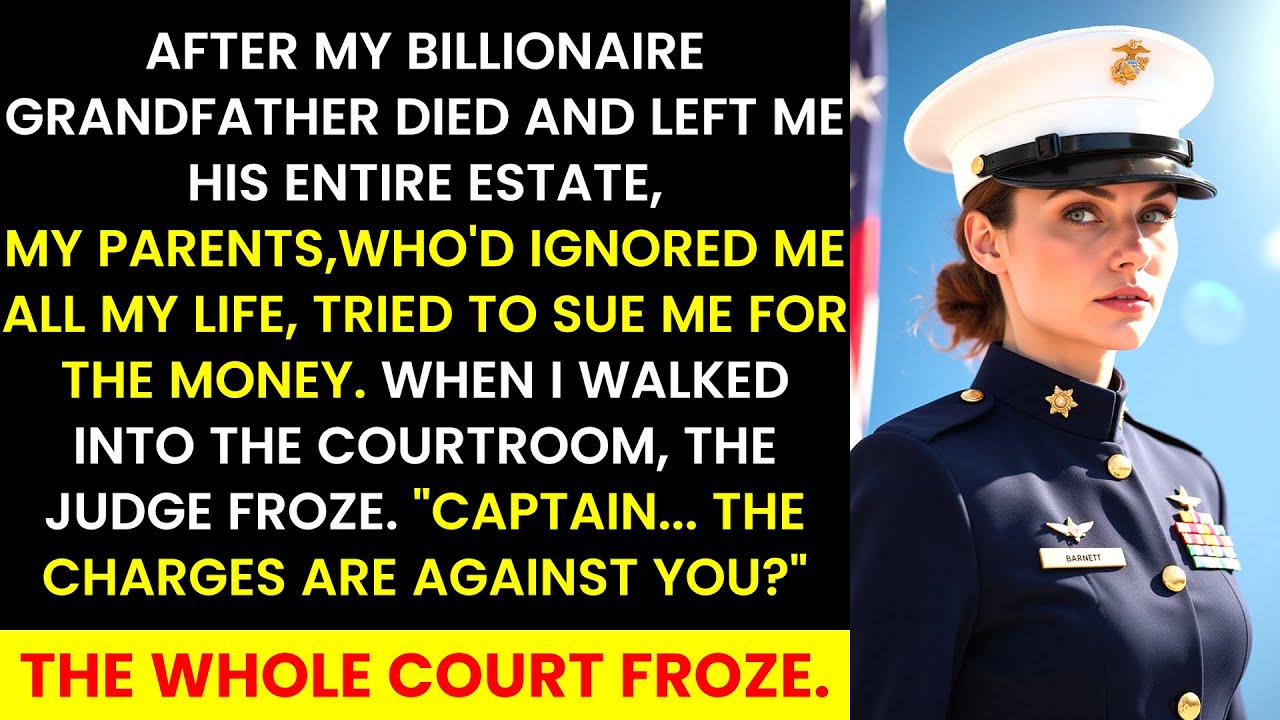
“The girl is insane, Your Honor. The military brainwashed her. ”
The whole room gasped. They looked at me like I was a monster, not a soldier who’d just lost her only family.
They thought I was still that abandoned little girl who would tremble and collapse. But they didn’t know that in my left breast pocket, beneath my medals, I was holding the black box of truth that would burn their entire charade to the ground. The heavy oak doors opened, and I stepped into the arena. My back was ramrod straight, a posture forged by screaming drill instructors and the weight of a rucksack.
My polished shoes struck the hardwood floor with an authoritative rhythm that cut through the gallery’s murmur. I wasn’t just walking into a legal proceeding. I was entering a combat zone. Opposite me sat the circus.
Charles wore a navy Armani suit worth more than a sergeant’s annual salary, whispering to a TMZ reporter with that practiced grin that had faded from the silver screen a decade ago. Victoria wore black for mourning, but the slit up her thigh was a red-carpet statement. They didn’t look at me like a daughter. They looked at me the way vultures look at a carcass that hasn’t stopped moving yet.
Their lawyer, Sterling, slithered toward the bench. “Ladies and gentlemen of the jury,” he began, dripping with theatrical concern. “Captain Barnett has just returned from the hellscape of war. We all know our brave soldiers often bring back demons in their heads.
” He paused, letting the word hang in the air like a foul smell. “Mr. Henry Barnett was old, frail, and lonely. How could he resist the manipulation of a highly trained officer skilled in interrogation?
She isolated him. She forced a senile old man to sign a new will under duress. ”
Every lie was a precision strike designed to bypass my armor. They were weaponizing my service, my sacrifice, to secure a bank transfer.
Then Victoria took the stand. She dramatically removed her sunglasses, revealing eyes professionally made up to look red and puffy. She began to sob into her handkerchief, her shoulders shaking. But I noticed with the sharp eyes of a sniper that not a single real tear fell.
“I tried so hard to be a mother to her,” she choked out. “But when she came back, she was different. She looked at me with killer eyes. She banned me from seeing my own father.
”
Under the table, my fists were clenched so tight my fingernails broke the skin. She never visited. Not once. The only time she’d called me in five years was to ask if she could borrow the vintage Birkin bag Grandpa had given me.
“She’s a ticking time bomb,” Victoria wailed. From my vantage point, I saw something the jury didn’t. While her face was buried in that handkerchief, she tilted her head slightly, checking her reflection in a compact mirror hidden in her palm. She was checking her makeup in the middle of testifying against her own daughter.
Charles stood up next, placing a comforting hand on his wife’s shoulder. “We only want what’s best for Kaye,” he lied. “Your Honor, $1. 6 billion is a dangerous amount of resources for someone with mental instability.
We are petitioning to manage the estate for her. We want to put her in a specialized facility. ”
The jury looked at the beautiful, grieving Hollywood couple, then at me, the stone-faced soldier. They were buying the script.
The judge, a stern man named Marcus Nolan, looked over his spectacles at me. Everyone was waiting for the crazy vet to snap. But I remembered the code I lived by: be polite, be professional, but have a plan to kill everybody you meet. I didn’t move.
I didn’t blink. My silence was louder than their screaming. It unsettled them. Charles loosened his tie.
Sterling shifted his weight. They expected chaos. Instead, I gave them a wall. Victoria looked up, thinking the judge was distracted.
For a split second, she dropped the grieving act. She looked directly at me and smiled. It wasn’t warm. It was a smirk of pure triumphant malice.
A smile that said, “I win. You lose, little girl. ”
That smile hit me harder than a mortar round. The courtroom dissolved, the smell of Chanel fading into burning asphalt and exhaust fumes.
I wasn’t a 32-year-old Marine captain anymore. I was five years old, standing small and trembling under the relentless California sun. I was back in Santa Barbara, clutching my tattered teddy bear, Mr. Paws, who was missing an ear.
Victoria hovered near a silver convertible, frantically applying lipstick. She didn’t look at me. “Kaye, be a good girl,” she said, distracted. “Mommy and Daddy are just going to Disneyland for a little bit.
You wait right here. ”
My eyes lit up. “Can I come, too, Mommy? I promise I’ll be good.
”
I reached out and grasped the hem of her silk skirt. She recoiled as if I’d burned her. She slapped my hand away, cold and dismissive. “Don’t wrinkle my skirt, Kaye.
Stay put. You’re messy. ”
Inside the car, Charles was on his brick-sized phone, practically bouncing with excitement. “Yes, Mr.
Spielberg’s office. We’re on our way right now. ”
He turned to Victoria. “Get in the car.
Don’t let the brat ruin our big break. Just dump her at the old man’s gate. He’ll deal with it. ”
“Dump her.
” The word hung in the air, heavy and suffocating. He said it as if I were a bag of trash. The engine roared. Panic seized me.
“Mommy, Daddy, don’t leave me! ” I screamed, running after the car. The asphalt burned through my thin shoes. I ran until my lungs felt like fire.
I saw Victoria turn. For a fleeting second, our eyes met. There was no regret. Just annoyance that I was making a scene.
In my desperate sprint, Mr. Paws slipped from my grip. The rear tire caught him, a soft crunch grinding him into the pavement. I stumbled, my knees slamming into the asphalt.
Pain exploded up my legs, but it was nothing compared to the agony in my chest. I lay there in the dust, watching the red tail lights shrink until they disappeared around a bend. I lay there for what felt like hours until a large shadow fell over me. It was my grandfather, Henry.
He stood tall, leaning on a polished oak cane, his eyes burning with a protective fury. He didn’t coo or whisper empty promises. Instead, he tapped my shoulder firmly with the tip of his cane. “Stand up, private,” he commanded.
“The enemy has retreated. Crying won’t bring deserters back. Tears are a waste of hydration. ”
He extended a large, calloused hand.
“From this day forward, I am your commanding officer. And we do not leave our wounded in the dirt. ”
I stared at his hand. Then slowly, painfully, I uncurled myself, wiped the blood and gravel from my knees, and grasped it.
That was the moment the abandoned five-year-old died on the hot asphalt. In her place, a soldier began to take shape. Life at the estate wasn’t the Cinderella story people imagined. Henry ran his household like a platoon.
At 0600 hours, his cane would pound against my door. My first task was making my bed to West Point standards—hospital corners sharp enough to cut a finger. Then came the five-mile run along the misty Malibu coastline. “Pain is weakness leaving the body, Kaye,” he’d say.
“Turn it into fuel. ”
By the time I was ten, while other kids were at summer camp, Henry took me to the Barnett Logistics warehouse and tossed me a hard hat two sizes too big. “Power is knowing how every single bolt in your empire works,” he told me. That summer, I learned to drive a forklift before I learned to ride a bike.
The hardest lessons were emotional. When I was around twelve, we were eating dinner, the TV playing low in the corner. The screen flashed to the red carpet of the Emmy Awards. There they were—Charles and Victoria, magnificent under the flashbulbs.
In Victoria’s arms was a fluffy white poodle. A reporter asked, “Who do you love most in the world right now? ”
Victoria beamed, kissing the dog on its nose. “Oh, this is Koko.
She’s the most obedient, perfect little daughter I could ask for. ”
My spoon clanged against the bowl. Little daughter. She used that word for a dog.
They hadn’t called me on my birthday in five years. Henry reached over and clicked the TV off. He didn’t say empty platitudes. He just put an extra helping of mashed potatoes on my plate.
It was his way of saying, “I am here. They are ghosts. ”
By sixteen, I was angry at the world. Sensing the storm brewing, Henry called me into his study.
He pulled two things from his safe: a tattered leather journal and a paperback copy of Marcus Aurelius’s Meditations. “I can’t live forever to protect you, Kaye,” he said, his voice grave. “Your parents live on lies. You must live on truth.
Document everything—documentation is your armor. This,” he tapped the book, “will forge your mind into steel. Remember, discipline is freedom. ”
That night, I made a decision.
I opened the journal. On the first page, I wrote a plan: Goal—United States Marine Corps. It was my first weapon. Helmand Province, Afghanistan.
The heat was aggressive, 113 degrees of suffocating dust, eerily similar to that day in Santa Barbara. But this time, I wasn’t a helpless child. I was Captain Kaye Barnett, commanding officer of a Marine infantry company. We were on routine patrol when hell opened up.
An IED exploded fifty yards to my left. AK-47 fire erupted from the ridge. A mortar round slammed me against a jagged rock wall. My ears rang.
Blood trickled from a cut above my eye. For a split second, lying in the dirt, I thought about dying. I felt a pang of regret that I might die without saying thank you to Henry. Then a hand grabbed the drag handle of my flak jacket.
“Get up, Captain. Don’t you die on me. ” It was Staff Sergeant Rodriguez, a burly Mexican-American from Texas who cursed like a sailor. He hauled me up with one hand while firing his M4 with the other, positioning his own body between me and the enemy fire.
He risked his life to save mine. That was the first time I truly understood what it meant to be protected—not by money, but by blood and loyalty. That night, back at the forward operating base, we ate MREs around a small fire. Rodriguez broke a stale chocolate bar into pieces and passed them around.
A young private named Miller asked, “Hey, Captain. Your parents send you anything? ”
They knew I came from money. I reached into my rucksack and pulled out the only thing I’d ever received from the States—a tattered copy of Vanity Fair I’d found in the mailroom dump pile.
On the cover, Charles and Victoria toasted with champagne on a yacht. “They sent me their silence,” I said, tossing the magazine into the fire. We watched their perfect fake smiles curl into ash. Rodriguez reached into his pocket and pulled out a Ziploc bag with three crushed cookies.
“My mom made these,” he said, shoving them into my hand. “She said to share them with my tough-ass boss lady. This is what a real care package tastes like. ”
Later, under the glow of a red lens flashlight, I read the only letter that mattered.
Henry’s handwriting was shaky now. “To Kaye, my warrior. The vultures are circling back home. Your parents have already started asking the lawyers about the will.
They think I’m too weak to notice. But don’t worry, I’m still sitting on the grenade pin. Remember, always faithful to yourself. Love, Grandpa.
”
I read it twice. Just as I was folding it back into my pocket, the satellite phone began to ring. A cold knot formed in my stomach. I knew the war at home had just claimed its first casualty.
He’s gone, Captain. I caught the first transport out of Kandahar, flying twenty hours straight to Los Angeles. I drove straight to the estate, expecting a somber house of mourning. What I walked into was a circus.
The driveway was jammed with production trucks. Cables snaked across the lawn. A craft services tent served iced lattes. This wasn’t a wake.
It was a season finale. I stormed into the grand foyer. My grandfather’s casket sat in the center of the room, surrounded not by flowers but by LED rigs and boom mics. Victoria stood over the open casket, not praying, but screaming at a makeup artist.
“Where is the blush? He looks like a ghost. We are shooting in 4K, people. If he looks dead, I look bad.
”
My blood turned to ice. I dropped my seabag and marched forward. “Get your hands off him. ”
Victoria looked me up and down with disdain.
“He’s dead, Kaye. He doesn’t care about blush. But I have a show to produce. We need a tearful funeral episode to get renewed for season six.
Now move. ”
Charles breezed in holding a stack of papers—a script. “Kaye, perfect timing. Go get changed.
We need you to collapse by the casket in scene four. ”
I ripped the script in half. “I am not an actor in your twisted reality show. I will wear my dress blues and stand guard for my grandfather.
If I see a single camera lens point at this casket, I will smash it. ”
Charles’s face turned purple. “You ungrateful little brat. You want to ruin our comeback?
We need this money. ”
I stood my ground. At the funeral, I stood at attention by the casket while they performed their grief for the cameras. After the burial, we gathered in Henry’s study for the reading of the will.
Mr. Samuel Briggs, Henry’s attorney and oldest friend, sat behind the desk. Charles and Victoria were relaxed, sipping expensive red wine like they were celebrating a lottery win. Briggs opened the sealed envelope and read: “I declare Charles and Victoria received their inheritance twenty-seven years ago, on the day you left your daughter at my gate.
Therefore, I leave zero percent of my assets to you. I leave the entirety of my estate, valued at $1. 6 billion, to the only person who earned it—Captain Kaye Barnett. ”
The silence was absolute.
Then Victoria’s wine glass shattered on the floor. “What? ” she shrieked. “You thief!
You forced him to sign this, didn’t you? ”
Charles’s eyes were terrifying—cold, calculating hatred. “You think you can steal $1. 6 billion from us?
I will sue you into oblivion. I will go to every news station and tell the world you are a mentally unstable soldier with PTSD who manipulated a dying man. ”
I looked him dead in the eye. “Go ahead and try.
I’ve been trained to handle terrorists, and you two just made the list. ”
I woke up the next morning to the glow of the TV. TMZ’s bright red logo flashed. The chyron screamed: “Unhinged Marine Captain manipulates dying billionaire for inheritance.
” They were playing a video loop from the funeral, heavily edited—cutting out Victoria screaming about makeup, showing only me shoving the makeup artist and glaring with intense rage. They added ominous sound effects to make me look menacing. I switched to Good Morning America. There they were, holding hands, Victoria dabbing her eyes.
“We’re terrified of her,” Charles said. “She sleeps with a knife under her pillow. We tried to save my father, but she isolated him. ”
My phone started vibrating.
An email from the Veterans Charity Foundation: immediate suspension of partnership. A call from my commanding officer: “You are being placed on administrative leave pending an investigation. Surrender your sidearm and ID card. ”
Suspended.
Stripped of my command. Stripped of my purpose. In two hours, they had taken away the only thing that truly mattered—my honor. Then my phone rang.
Caller ID: Victoria. Her voice purred through the speaker, cold and triumphant. “See, darling? No one believes a stubborn grunt over America’s sweethearts.
Sign a settlement agreement. Split the inheritance 50/50, and we’ll go back on TV and tell everyone it was a misunderstanding. Or,” her voice dropped to a whisper, “we’ll find a witness from your platoon who’ll swear you mistreated prisoners in Afghanistan. You’ll be court-martialed before the week is out.
You have 24 hours. ”
She was blackmailing me. I hurled my phone against the wall, shattering it. I would rather lose every dime than give them a single cent.
I paced the room, my mind racing. They had the media, the narrative, the acting skills. What did I have? I looked up at the oil painting of Henry above the fireplace.
I remembered something he’d told me years ago: “Always have a backup plan, Kaye. Keep it where the enemy won’t look. ”
He always hated that painting. He said it was too pretentious.
So why was it the centerpiece of his study? I reached up and gripped the heavy gold frame and pulled. With a groan of metal hinges, the painting swung outward. It was a door.
Set deep into the stone of the chimney was a steel safe. My heart hammered. I reached for the dial and spun. Ten.
Eleven. Seventy-five. November 10th, 1775—the birthday of the United States Marine Corps. Click.
The door swung open. Inside were no gold bars, no diamonds. Just manila folders, USB drives labeled by year, and Henry’s old leather journal. I pulled out the first folder, labeled “Correspondence Charles and Victoria.
” It was filled with letters in Henry’s neat cursive, most never mailed. One dated when I was seven: “Dear Charles, Kaye fell off her bike today. She needed three stitches. She cried for an hour asking for her mother.
Please, I beg you. Come visit her just for an afternoon. I’ll pay for your first-class tickets. ” Stapled to it was an email from Victoria’s assistant: “Ms.
Barnett is shooting a fragrance campaign in Paris and cannot be disturbed with domestic issues. ”
He had begged them. He had offered money just to buy me an hour of their time. And they had rejected me via an assistant.
I opened the journal. October 14th: “Victoria called today. She didn’t ask how I was feeling after my surgery. She asked for $500,000 for a nose refresh.
She said she hoped I died soon so she could finally live properly. ” December 24th: “Charles showed up drunk. He said, ‘You senile old bat. We’re going to declare you incompetent and take control.
’ I recorded the conversation on the security system. ”
He hadn’t just endured it. He had documented everything. He knew this day would come.
I flipped to the very last entry, dated three days before he died. “Kaye, if you are reading this, the wolves have finally shown their teeth. Do not be afraid. I did not leave you a burden.
I left you a sword. Use this truth to cut the chains they have wrapped around us. Go give them hell. ”
I closed the journal.
The fear evaporated. In its place, a cold, hard resolve settled over me. I wasn’t a victim anymore. I was Captain Kaye Barnett, and I was now fully armed.
The courtroom buzzed with anxious energy as proceedings resumed. Sterling was already strutting. “We are requesting an immediate psychiatric evaluation and temporary conservatorship to be granted to her parents. ”
I stood up.
“Objection. I am firing my counsel. I wish to represent myself. ”
A gasp rippled through the gallery.
Judge Nolan peered over his spectacles. “Captain Barnett, that is highly irregular and risky. Are you sure? ”
“I have never been more sure of anything in my life, sir.
”
I walked to the center of the room, carrying the tattered leather journal and a single USB drive. “They claim I manipulated my grandfather. But the truth is, Henry Barnett was manipulated his entire life by the greed of his own flesh and blood. I would like to submit Exhibit A—surveillance footage from inside the estate, dated one month ago.
”
The monitors flickered to life. The grain was sharp, the audio crystal clear. Henry sat in his wheelchair, frail and small. Charles stood over him, slamming his fist on the coffee table.
“Sign the damn check, old man. I need two million by Friday or the studio pulls the plug. If you don’t sign, when you die, we won’t even bury you. We’ll let the county dispose of you like trash.
”
The courtroom erupted in gasps. But the video wasn’t over. Victoria entered the frame, holding a bottle of pills—his heart medication—just out of reach. “You want your pills, Henry?
Then give me the combination to the wall safe. ”
“Oh my God,” a woman on the jury whispered. The image of the grieving, devoted children shattered into a million pieces. “Turn it off!
” Victoria shrieked. She leaped from her chair, her mask slipping completely. “That’s fake! She used AI!
It’s a deep fake! ” She lunged toward the monitor controls, then toward me, hands curled into claws. In her frenzy, her carefully pinned wig snagged on the witness stand and tore loose, falling to the floor. Underneath, her natural hair was thin and gray.
Judge Nolan banged his gavel. “Order in this court! ” Two bailiffs tackled Victoria, pinning her to the ground as she kicked and screamed. I didn’t flinch.
The world finally saw her—not a star, but a monster fueled by greed. Judge Nolan looked at me, his eyes softening. “I served in Vietnam in 1968,” he said. “I was a private in the Marine Corps.
My platoon sergeant was a man named Henry Barnett. ”
A shockwave went through the room. “He was the toughest, most honorable man I ever met. He pulled me out of a rice paddy when I took a bullet to the leg.
The idea that anyone could manipulate him is not just legally absurd. It is personally offensive. ” He held up the journal like a holy book. “This evidence speaks for itself.
It paints a clear picture of abuse, neglect, and extortion—but not by the defendant. ”
He looked down at Charles and Victoria. “The petition for conservatorship is denied with prejudice. The will stands.
Captain Kaye Barnett is the sole and rightful heir. Furthermore, I am referring this matter to the district attorney’s office for immediate investigation into charges of elder abuse, extortion, and attempted fraud. ”
The bailiffs moved in, handcuffs clicking onto Charles’s wrists. Victoria wailed as she was hauled away.
I stepped out of the courthouse into a blaze of camera flashes. The same reporters who had crucified me were now shouting my name with reverence. I stopped at the top of the stairs, adjusted my cover, and leaned into the nearest mic. “Mission accomplished.
Truth secured. Dismissed. ”
I didn’t smile or pump my fist. I walked down the steps with the same measured pace I’d walked in with, climbed into a waiting town car, and sealed out the noise.
My phone buzzed. Charles. For a moment, I considered not answering, but I knew this was the final act. His voice was unrecognizable—the polished actor gone, replaced by the whimpering of a broken man.
“Kaye, honey, I’m so sorry. We weren’t thinking straight. We owe some very bad people money. Loan sharks.
If we don’t pay by Friday, they’ll hurt us. Can’t you just help us out? Just a few million. We’re your parents.
We’re family. ”
He wasn’t sorry for hurting me. He was sorry because he lost. Even now, I was just an ATM to him.
The tiny flame of hope that he might finally say “I love you” sputtered and died. “Listen to me, Mr. Charles,” I said. “I will not give you a single dime of Henry’s money.
But because we do not leave even the enemy to die in the street without mercy, I have arranged one thing. I’ll pay for six months of inpatient treatment for you and Victoria. It’s paid in full. But the loan sharks—that’s your war, not mine.
And after this call, you are never to contact me again. If you come near the estate, if you ever speak Henry Barnett’s name in public, I won’t call a lawyer. I’ll handle it using the rules of engagement I learned in Helmand. Do you copy?
”
A long silence. Then a defeated whisper. “I copy. ”
I ended the call and blocked the number.
A physical lightness washed over me, as if I’d been carrying a hundred-pound rucksack for thirty-two years and had finally dropped it. “Where to, Captain? ” the driver asked. I pointed to a red-and-yellow sign up ahead.
In-N-Out Burger. Ten minutes later, I sat in the back of a luxury town car parked overlooking the Pacific Ocean, holding a cardboard tray with a Double-Double and fries. I took a bite. It was greasy and delicious.
Suddenly, a sob ripped through my chest. I put the burger down and covered my face with my hands. I cried for the five-year-old girl left on the curb. I cried for the teenager who ate dinner in silence.
I cried for Henry. And yes, I cried for the parents I never had. I realized then that I was an orphan. They were alive, but I was an orphan.
But it was better to be an orphan in the truth than to have a family in a lie. Six months later, the iron gates of the estate swung open, and the grounds weren’t silent anymore. Kids from five to fifteen ran through the sprinklers, their laughter echoing off the stone walls. Near the rose garden, a circle of veterans—some in wheelchairs, some with prosthetic limbs—shared stories and coffee.
I didn’t use the $1. 6 billion to buy a yacht. I turned the estate into Camp Henry. Half was a permanent home for foster kids who’d aged out of the system.
The other half was a reintegration center for homeless veterans struggling with PTSD. No child would ever have to run after a car in desperate tears again. A dusty, beat-up Ford F-150 rumbled up the driveway. The driver stepped out, walking with a slight limp.
He shielded his eyes and looked up at the balcony. “Hola, Captain. I heard a rumor you were looking for a head of security. Pays well.
Good dental plan. ”
My heart leaped. I ran down the stairs and crashed into him. “Rodriguez.
”
He laughed, a deep warm sound. “Welcome home, sister. You did good, Kaye. The old man would be proud.
”
That evening, as the sun dipped below the horizon, I walked down to the private beach in a simple white sundress, barefoot. I sat on a piece of driftwood, Henry’s old journal in my lap. I opened it to the last page and wrote my own entry: “Mission accomplished, Commander. The perimeter is secure.
The troops are safe. And for the first time in thirty-two years, I have found peace. ”
I closed the book and held it to my chest. I listened to the waves.
I didn’t hear Charles’s shouting or Victoria’s fake weeping or the roar of the silver convertible. Those ghosts were gone, exorcised by the light of the truth. Family isn’t about DNA. Family are the people who see your scars and choose to kiss them instead of making them deeper.
Family are the people who stand beside you in the trench when the mortar rounds are falling. Family are the people who drive beat-up trucks across the country just to make sure you aren’t alone. I am Kaye Barnett. I was abandoned.
I was betrayed. I was slandered. But I am still standing. I am a lighthouse now, and as long as I have breath, I’ll keep my light burning for every lost ship trying to find its way home.
Always faithful—not to them, but to myself.