The crystal glass shattered against the marble floor, and the fifty people in the restaurant held their breath. But it wasn’t the noise that froze time. It was what came after. Agnes Møller, the mother of the country’s most powerful billionaire, rose slowly from her chair.
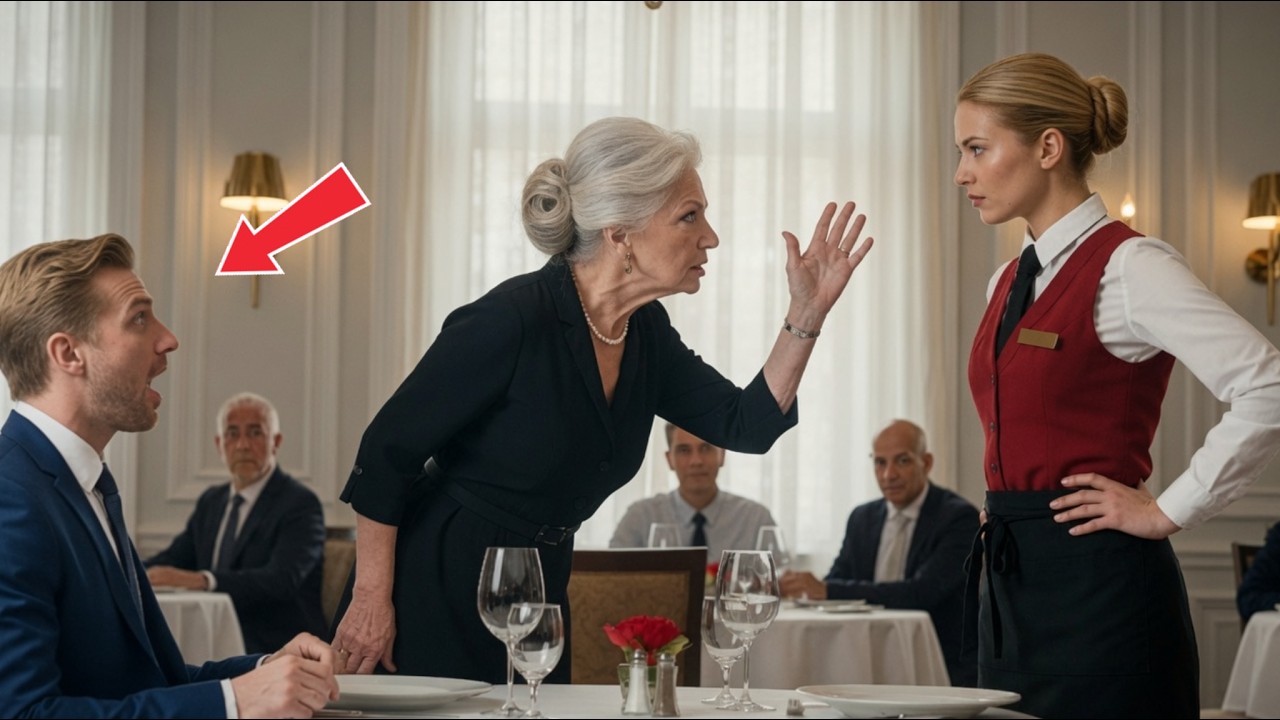
Her gray eyes, the ones that had crushed business empires, locked onto me. I had three seconds to decide whether I wanted to keep my job or my dignity. I chose dignity. “Mrs.
Møller,” I said, my voice steadier than my shaking hands. “Pick up your own glass. ”
The Black Pearl restaurant had never known such absolute silence. Not even the clinking of cutlery could be heard.
The guests stared at me as if I had just signed my own death warrant. In this town, you didn’t cross the Møllers. That was professional ruin. Let me rewind three hours to the moment my life still made sense.
At six o’clock, I arrived at the restaurant, dragging myself in my worn-out uniform that already showed signs of too many washes. Chef Rasmus caught me at the kitchen entrance with the look that meant trouble. “Maja, table twelve. You’re taking it.
”
My stomach tightened. Table twelve was the only table in the restaurant with its own crystal chandelier and a direct view of the private garden. They reserved it for only one person. “Her?
” I whispered. Rasmus nodded. His mustache trembled slightly. “Agnes Møller arrived ten minutes ago with her son Gustav.
She’s already made two waitresses cry. ” He leaned closer, lowering his voice. “I need you to be invisible. Serve, smile, and for God’s sake, don’t look her directly in the eye.
The last waitress who did… let’s just say she’s now cleaning toilets at the bus station. ”
I nodded, even though something in my chest was already tightening. I had worked at the Black Pearl for six months—six months of dodging exactly this situation.
But the universe has a cruel sense of humor. When I approached table twelve, the first thing I saw was her back. Agnes Møller was sixty-three years old, but her posture was steel. Silver hair pinned up in a perfect bun.
A black Chanel suit that probably cost more than my rent for a year. And the hands—God, the hands—with diamond rings that glittered like warnings. To her right sat her son Gustav, heir to the Møller empire, with a look in his eyes I recognized instantly. Contained shame.
I had seen it before in other children of powerful families. It was the expression of someone who knows their mother is a monster but is too afraid—or too comfortable—to do anything about it. “Good evening,” I said with my best professional voice, placing the menus on the table. “Welcome to the Black Pearl.
My name is Maja, and I’ll be your waitress this evening. ”
Agnes interrupted without even looking at me. Her voice was cold, precise as a scalpel. “Do they not teach at this restaurant that water should be served at four degrees?
”
I looked at the glass. I could see the condensation droplets. The water was perfectly cold. “Forgive me, Mrs.
Møller. I’ll bring a new one. ”
She lifted the cutlery with two fingers, as if it were contaminated. “There is a microscopic stain.
Do you even inspect your things? ”
Gustav shifted uncomfortably in his chair. “Mother, please. ”
“Be quiet, Gustav.
” The words came out like the crack of a whip. “I didn’t ask for your opinion. ”
She turned to me and, for the first time, truly looked at me. Her gray eyes scanned my worn uniform, my hair pulled back in a simple ponytail, my old shoes that I had polished three times that morning trying to make them presentable.
And in her gaze, I didn’t see contempt. I saw nothing. As if I were so insignificant that I didn’t even deserve her contempt. “Bring everything new,” she ordered.
“Water, cutlery, plates, everything. And when you come back, make sure you don’t breathe near the food. I don’t know what cheap perfume you use, but it’s offensive. ”
I didn’t use perfume.
I couldn’t afford it. “Right away, Mrs. Møller. ”
I turned around and felt the gazes of the other guests.
Everyone had heard. In the kitchen, Chef Mats shook his head. “What did the witch want now? ”
“Everything new.
She says the water is lukewarm and my perfume is offensive. ”
“You don’t wear perfume. ”
“I know. ”
The next forty minutes were a masterclass in systematic humiliation.
Every time I approached the table, Agnes found something new to criticize. The bread was too warm, the butter too cold, the candles too bright. The way I walked was too noisy, my apologies too frequent, my silence too rude. Gustav said nothing to defend me.
He just stared at his plate, cutting his food into perfect squares, chewing in silence while his mother tore my dignity apart piece by piece. But what truly broke me wasn’t any of that. It was when I brought her salad. I had checked it three times in the kitchen.
Chef Mats had personally timed the tuna searing to exactly forty-five seconds on each side. The presentation was perfect. I placed the plate in front of her with hands that no longer trembled from nerves, but from something deeper, something darker. Agnes looked at the salad, picked up her fork, cut a piece of tuna, brought it to her mouth, chewed slowly.
Her eyes never left mine. Then, with a deliberate, calculated motion, she spat the food into her napkin. “It’s dry,” she declared. “Completely unacceptable.
”
It wasn’t dry. I knew it. Mats knew it. Gustav knew it.
Everyone in that damned restaurant knew it. But this wasn’t about food. It had never been about food. It was about power.
The kind of power exercised when you’re so bored with your perfect life that your only entertainment is destroying people who can’t defend themselves. “I’ll prepare a new salad,” I started. “No. ” Agnes leaned back in her chair.
A small smile curled her dark red lips. “I want to speak with the manager. I want them to know what kind of mediocre service they offer. And I want,” she paused, savoring every word, “you to be fired right now, in front of everyone.
”
The restaurant had fallen silent again. The silence of spectators waiting to see blood. “Mother, this is excessive. ” Gustav finally found his voice, but it was weak, pathetic.
“I told you to be quiet, Gustav. ” Agnes didn’t even look at him. Her eyes were fixed on me, waiting to see me tremble, cry, break down. And something in me cracked.
But not the way she expected. “You know what, Mrs. Møller? ” The words came out before I could stop them.
“You’re right. ”
That surprised her. Her eyebrows lifted slightly. “You’re right,” I repeated, and now my voice was louder, clearer.
“This service is unacceptable, because truly good service shouldn’t include tolerating a customer who treats people like garbage. ”
The silence was now absolute. I could hear my own heartbeat in my ears. Agnes went pale, then red.
She rose slowly from her chair, and that was when her hand swept the water glass off the table. The crystal exploded against the marble with a sound I will never forget. “How dare you? ” Her voice was pure venom.
“Do you know who I am? ”
“Yes,” I said. And now the tears were in my eyes. But they weren’t tears of fear.
They were tears of years of pent-up rage. Years of watching people like her destroy people like me. “I know exactly who you are. You’re Agnes Møller.
The woman who built an empire on the backs of employees she never learned to see as people. The woman everyone fears but no one respects. The woman who raised a son so scared of her that he can’t even defend what’s right when he sees it. ”
Gustav had risen.
His face was a mask of shock. “Maja! ” Rasmus’s voice came from somewhere behind me, filled with panic. But I couldn’t stop.
The floodgates had opened. “And you know what the saddest part is, Mrs. Møller? You have all the money in the world, all the power, all the opportunities one could wish for.
And yet the only thing you know how to do with it is make people who have the misfortune of crossing your path feel small. ”
Agnes stared at me as if I were some kind of insect that had just spoken. Her mouth opened and closed, but no sound came out. “So yes,” I continued, now caring about nothing.
“Pick up your own glass. For once in your privileged life, do something yourself instead of expecting the rest of the world to kneel at your feet. ”
The entire restaurant had stopped pretending they weren’t watching. Everyone was staring at us with open mouths.
Even the other waiters had come out from the kitchen. And then something extraordinary happened. A woman at table five began to clap. Then another person at table eight.
Then a businessman at table three. Within seconds, the whole restaurant was applauding. It wasn’t a polite applause. It was an applause of liberation.
For every person who had ever been humiliated by someone with money and power. For every employee who had had to bite their tongue. For every human being who had dreamed of saying exactly what I had just said. Agnes Møller was, for the first time in probably years, completely speechless.
But as the applause continued, I saw something that made my blood freeze. Gustav Møller was looking at me, and in his eyes, there wasn’t anger. There was something more disturbing. There was gratitude.
“My father,” he said quietly, but in the silence after the applause, everyone heard it. “My father died six months ago. Do you know what his last words were? ”
He turned to his mother.
“He said, ‘Gustav, don’t let your mother become the monster I fear she already is. ’ ”
Agnes took a step back as if she had been struck. “Gustav, how dare you—” she started. “I came too late, Father,” Gustav continued, and now tears were running freely down his face.
“I came five years too late. ” He looked at me again. “But this woman—this waitress—had the courage I never had. ”
He took out his wallet and laid several bills on the table.
Enough money to pay the bill ten times over. “Let’s go, Mother. ”
But Agnes didn’t move. She looked at me with an expression I couldn’t decipher.
It wasn’t rage. It wasn’t humiliation. It was something more complex. Something almost like recognition.
“What’s your name? ” she finally asked. Her voice was barely a whisper. “Maja Christensen.
”
She nodded slowly, as if memorizing the name. Then, without another word, she turned and walked toward the exit. Gustav followed her, but before he left, he stopped beside me. “Thank you,” he murmured.
“For what I should have done years ago. ”
And then they were gone. The restaurant exploded in conversation. Rasmus approached me, his face a mixture of admiration and absolute terror.
“Maja, that was the bravest and the stupidest thing I’ve ever seen in my life. ”
“I know,” I said. And for the first time in years, I smiled genuinely. “I’m fired, aren’t I?
”
“The Møller family probably owns half this city. They could destroy this restaurant with a single phone call. ”
I nodded. I knew there would be consequences.
But for the first time in my life, I had told the truth—the whole truth, unfiltered, without fear. And it felt like freedom. What I didn’t know, what none of us knew, was that this was only the beginning. Because Agnes Møller wasn’t the kind of woman who left things unfinished.
And I had just become her most interesting project in years. Three days after the incident, my life was in shambles. The video had appeared on the internet exactly eighteen hours after that night. Someone at the restaurant had filmed the whole thing.
I didn’t know who, and honestly, I didn’t care. The title was dramatic and perfectly designed to go viral: “Waitress Destroys Billionaire with the Truth. You Won’t Believe What Happened Next. ”
Three million views the first day.
Seven million the second. By the third day, it had passed fifteen million and was on every social media platform. I had become a meme, a symbol of everything I wasn’t in reality—a poor woman who had just lost her job and was two weeks away from not being able to pay her rent. Rasmus had called me the morning after.
His voice was shaking. “Maja, I’m so sorry. The Møller family has investments in the group that owns the Black Pearl. They ordered me to fire you immediately.
I can’t even give you a recommendation. I’m so sorry. ”
I didn’t blame him. I knew how that world worked.
The powerful crushed, and the rest of us learned to dodge or died trying. But what I didn’t expect was the second phone call. It came two hours later from a private number. “Maja Christensen?
”
“Yes? ”
“I am Richard Frederiksen, HR director for the Møller Group. I regret to inform you that you have been added to a blacklist in the city’s hotel and service industry. No restaurant, hotel, café, or similar establishment will hire you.
This is effective immediately. ”
I felt the floor disappear beneath my feet. “A blacklist? Is that even legal?
”
“It’s a private recommendation between associated companies. Good day, Miss Christensen. ”
Click. And so, in less than twenty-four hours, the irony was not lost on me.
Now, three days later, I sat in my tiny one-bedroom apartment, staring at my laptop with a mixture of fascination and rage. The comments on the video were overwhelming. “Absolute queen. ”
“Finally, someone tells these people the truth.
”
“Where can I donate to help this girl? ”
“The son crying broke me. Imagine having a mother like that. ”
There were thousands more.
Some defended me. Others said I had been disrespectful and deserved what happened. A few—the ones that scared me the most—had found my address and posted it in the comments. Knock.
Knock. Knock. My heart stopped. I wasn’t expecting visitors.
I never expected visitors. My apartment was on the fourth floor without an elevator, in a building that had seen better days in the eighties. The only people who knocked on my door were the landlord when he wanted rent, or food delivery drivers who had the wrong address. Knock.
Knock. Knock. More insistent this time. I rose from the sofa—which also served as my dining table and desk—and went to the door.
There was a peephole, but it was so scratched you could barely see through it. “Who is it? ” I asked, my voice firmer than I felt. “Miss Christensen, we need to talk.
”
It was a woman’s voice. Cultivated, with an accent I’d heard from the city’s upper classes. My stomach tightened. “I’m not interested in interviews,” I said.
“I’ve already turned down three TV shows. ”
“I’m not a journalist. I’m Else Kolding. A lawyer.
I represent Mrs. Agnes Møller. ”
The world tilted slightly. I opened the door with the security chain still on.
Through the gap, I saw a woman in her forties, dressed in a pale gray suit that probably cost more than six months of my old rent. She carried a leather briefcase and an expression that revealed absolutely nothing. “What do you want? ” I asked.
“Five minutes of your time. That’s all. ”
It wasn’t a plea. It was a statement of fact, as if my acceptance were merely a formality.
Against all my survival instincts, I opened the door. Else Kolding stepped into my apartment with the same expression she would probably use to enter a boardroom or a courtroom. Her eyes scanned the room in two seconds. The kitchen that was essentially an electric hotplate and a mini-fridge.
The fold-out sofa against the wall. The small table with my laptop surrounded by empty coffee cups. The window overlooking an alley where cats fought over trash every night. She said nothing about the apartment.
Point for her. “I’ll get straight to the point, Miss Christensen. ” She placed her briefcase on the table and took out a folder. “My client, Mrs.
Agnes Møller, wishes to make you an offer. ”
I almost laughed. “An offer? Your client put me on a blacklist, and now she wants to make me an offer?
”
“Precisely. ” Else opened the folder, revealing perfectly organized documents. “Mrs. Møller acknowledges that her actions may have been excessive.
The blacklist will be removed effective today at five o’clock. In addition, you will receive compensation of 350,000 kroner for loss of employment and damage to your professional reputation. ”
Three hundred and fifty thousand kroner. That was more money than I had seen in my entire life.
“What’s the catch? ” I asked. Because there was always a catch with people like Agnes Møller. Else smiled slightly.
It was a smile perfected in expensive law schools and boardrooms where fates were decided. “Mrs. Møller wants you to work for her. ”
The silence that followed was so thick you could cut it with a knife.
“Excuse me? ”
“As her personal assistant. Starting salary of 800,000 kroner annually, plus full benefits, housing included, and a signing bonus of an additional 210,000. ”
She pushed a contract across the table.
“It’s an extremely generous offer. ”
“This is insane,” I said, finding my voice. “Your client hates me. I confronted her publicly, humiliated her.
Why in the world would she want me to work for her? ”
“Why? ” said a voice from the doorway. A voice I recognized immediately.
“Because you’re the first person in thirty years who has told me the truth. ”
I turned so fast I almost lost my balance. Agnes Møller stood in the doorway of my apartment. I had no idea how I hadn’t heard her coming up the stairs.
No idea how she had gotten past the building’s main door, which supposedly required a code. I knew nothing—except that the most powerful woman in the city was suddenly standing in my tiny apartment, looking at me with those gray eyes that had haunted my nightmares for three nights. But there was something different about her. Something I hadn’t seen at the restaurant.
She looked tired. The lines around her eyes were more pronounced. Her perfect makeup couldn’t quite hide the dark circles. And her posture, though still upright, carried an invisible weight on her shoulders.
“Mrs. Møller,” I said, hating that my voice sounded shaky. “Maja. ” My name sounded strange on her lips.
“I can leave, if you want. Else can handle the details. But I came personally because I wanted you to see that this isn’t a trap. ”
“Not a trap?
” I repeated, finding some of my earlier courage. “You destroyed my career in less than twenty-four hours. You made me untouchable in the entire city. And now you want me to believe this is what?
An act of charity? ”
“No,” said Agnes. And to my complete surprise, she stepped into the apartment and closed the door behind her. “It’s pure selfishness.
”
That stopped me. She walked to the window and looked out at the alley. When she spoke again, her voice was different. Softer.
Almost human. “That video had fifteen million views. I’ve watched it 143 times. ” She turned to look at me.
“Do you know how many people in my life have spoken to me like that? With that brutal honesty, that unfiltered truth? ” She paused. “None.
Not once. Until you. ”
She slowly took off her leather gloves, a gesture that seemed more vulnerable than it should have been. “My husband died six months ago.
Henrik. We were married for forty years. And on his deathbed, do you know what he said to me? ”
I didn’t answer.
I didn’t know if I should. “He said that he had lost me. That the woman he fell in love with had disappeared so long ago that he couldn’t even remember her laugh. ” Her eyes glistened, but not with tears—with something harder.
“He said I had become exactly what I feared most. My own mother. ”
The air in the apartment felt heavy, filled with truths I wasn’t sure I wanted to hear. “For six months,” Agnes continued, “I’ve tried to understand what he meant.
I’ve analyzed every decision. I’ve replayed every word. I’ve counted every person I hurt on my way to success. And I found no answers, because everyone around me tells me what I want to hear.
They tell me I’m brilliant, powerful, inspiring. ”
“But you know that’s not true,” I said quietly. “I know. It’s only part of the truth.
The convenient part. ” She looked directly at me. “And then you came along. A twenty-eight-year-old waitress with nothing to gain and everything to lose.
And yet you told me exactly what no one else dares to say. And I ruined you for it. Yes, I don’t deny it. I don’t apologize for it, because that’s what I do.
That’s what I’ve done my whole life. Someone challenges me, and I crush them. It’s instinct at this point. ”
“And now?
” I asked. “You want me to be your personal conscience? Your mirror of uncomfortable truths? ”
“Yes,” said Agnes, and now there was something almost desperate in her voice.
“I want someone to stop me before it’s too late. Gustav looks at me with fear. My employees avoid me. My friends are only people who want something from me.
And I am alone in a twenty-room villa, slowly becoming the kind of person my own son can’t love. ”
The silence that followed was broken by Else, who had been observing everything with a professionally neutral expression. “The contract is for one year,” she said, returning to the practical details. “With a mutual termination clause after three months if both parties agree it’s not working.
Full confidentiality, of course. ”
I looked at the contract. The numbers danced before my eyes. 840,000 kroner a year.
210,000 in bonus. 350,000 in compensation. It was a completely different life. It was also potentially a golden cage.
“Why should I trust you? ” I asked Agnes directly. “You demonstrated exactly what you’re capable of when someone challenges you. ”
“You shouldn’t trust me,” Agnes replied with surprising honesty.
“You should go in with open eyes, knowing that I am difficult, demanding, and that I will probably make your life miserable at least half the time. ”
“And the other half? ”
For the first time, I saw something that might have been a genuine smile on her face. “The other half, you’ll learn how the world really works at the top.
You’ll meet people who can open doors you didn’t even know existed. And who knows? ” Her expression softened slightly. “Maybe we’ll both learn something.
”
I looked at Else, who maintained her perfectly neutral expression. I looked at the contract with all those zeros. I looked at my tiny apartment with its fold-out sofa and its view of the alley. And I looked at Agnes Møller—this complex, broken woman who had been my personal villain three days earlier.
“I need twenty-four hours to think about it,” I said finally. “Of course. ” Else closed her briefcase with a satisfied click. “My number is on the first page of the contract.
Call before five tomorrow. ”
Agnes put her gloves back on and prepared to leave. But she stopped at the door and looked at me one last time. “Maja, I’m not asking you to forgive me.
I’m not even asking you to like me. I’m just asking you to consider that maybe—just maybe—we could both benefit from this madness. ”
And then she was gone, leaving behind the scent of her expensive perfume and a contract that could change my life. I sat on my fold-out sofa for hours after they left, staring at the papers.
My phone rang constantly with messages from friends who had seen the video, journalists who wanted interviews, strangers on the internet who had opinions about my life. But there was one message that made me stop. It was from an unknown number. “It’s Gustav.
I got your number through Tina. It doesn’t matter how. I just want to say that if you decide to work for my mother, be careful. But also, thank you.
For the first time in years, I saw her truly look at herself in the mirror. Whatever comes next, you started something. ”
I looked out my window at the alley, where two cats were fighting over a piece of old pizza. I thought about Henrik Møller, a man who had spent forty years watching his wife transform into something he didn’t recognize.
I thought about Gustav, a son who loved his mother but feared becoming like her. And I thought about myself—the girl who had grown up in neighborhoods like this, who had worked three jobs to pay for university, who had learned that dignity was sometimes the only thing they couldn’t take from you. I was willing to risk that dignity for 1. 4 million kroner and the vague promise of learning something.
My phone rang again. This time it was my landlord. “Maja. I need to talk to you about the overdue rent.
Tomorrow. No excuses. ”
I looked at the contract. Sometimes the universe doesn’t give you a clear choice between good and evil.
Sometimes it only gives you a choice between surviving or sinking with your pride intact. And I had always been a survivor. The Møller mansion wasn’t a house. It was a declaration of war against humility.
I passed through the enormous wrought-iron gates at exactly seven in the morning, as Else had instructed. A silent chauffeur had picked me up from my apartment three minutes earlier, driving a black Mercedes that smelled of new leather and old money. He hadn’t spoken to me. He hadn’t even looked at me in the rearview mirror.
Apparently, that was the tone I should expect. The driveway wound through gardens that looked like they came from a European magazine. Marble fountains, perfectly trimmed hedges in geometric shapes, statues that were probably worth more than my entire life. And at the end of it all—the mansion.
Three stories of neoclassical architecture with white columns, wrought-iron balconies, and enough windows that the sun never found a dark corner to hide in. “Miss Christensen. ” A woman appeared at the main door before I could ring the bell. She was in her fifties, gray hair in a strict bun, wearing a single black dress that screamed, I’ve seen things that would make you quit on your first day.
“I’m Tina Mortensen, the head of staff. Follow me. ”
There was no welcome. No congratulations on the job.
Only a “follow me” that made it clear we didn’t waste time on unnecessary pleasantries here. Inside, it was exactly what you would expect. Marble floors that reflected everything like mirrors. A curved staircase leading majestically to the upper floors.
Crystal chandeliers that probably required an entire team just to clean. Art on the walls that I recognized from my art history classes—a Monet, a Renoir, a damned Picasso in the hallway, as if it were a common poster. “Mrs. Møller is waiting for you in her office,” said Tina as we climbed the stairs.
“She arrives at six every morning. You are to be available from six-thirty. Understood? ”
“Understood.
”
“It’s not a question, Miss Christensen. It’s a non-negotiable reality. Mrs. Møller does not accept lateness, excuses, or incompetence.
Is that clear? ”
“Crystal clear. ”
Tina stopped in front of a dark wooden door with inlays of what looked like real gold. She knocked twice, waited exactly three seconds, and opened it.
“Mrs. Møller, Miss Christensen has arrived. ”
The office was four times the size of my old apartment. Floor-to-ceiling windows gave a panoramic view of the city.
Mahogany bookshelves filled with volumes that looked more like decoration than actual reading material. And in the center, behind a desk that probably belonged to a nineteenth-century magnate, sat Agnes Møller. She didn’t look at me immediately. She was writing something on a tablet, her fingers moving with a precision that spoke of years of practice.
She wore an impeccable white dress that contrasted dramatically with her silver hair. Not a wrinkle, not a hair out of place. Ten seconds passed. Twenty.
Thirty. Finally, she looked up. “You’re on time,” she said, as if that were barely acceptable. “That’s more than I can say for your predecessor.
She lasted four days before resigning. ”
“Good morning to you too,” I replied, catching the slightest glimmer of something in her eyes—amusement, irritation. It was impossible to tell. “Sit.
” She pointed to a chair in front of her desk. “We have a lot to cover and little time to do it. ”
I sat, keeping my back straight. I wouldn’t give her the satisfaction of seeing me intimidated, even though my heart was pounding like a war drum.
“Your role,” Agnes began, “is not to be my friend. Not to be my confidante. Not to make me feel better about myself. Your role is to keep my life organized, to anticipate problems before they arise.
” She paused, her eyes fixed on mine. “And to tell me when I’m about to do something Henrik would have hated. ”
The last part surprised me. “Excuse me?
”
“You heard correctly. ” She leaned back in her chair. “My husband had a moral compass that I lost somewhere in the last twenty years. You demonstrated at the restaurant that you have one.
I need that. ”
“I’m not your hired conscience,” I said cautiously. “You’re my assistant who happens to have the backbone that most people in my life lost long ago. ”
She rose and walked to the windows.
“Today I have four meetings. One with the board of the children’s hospital that my family founded. Another with the investors in the new real estate development project in the historic district. Then lunch with the mayor.
And finally, a video call with our partners in Singapore. ”
She took a folder from her desk and pushed it toward me. “Read this. It’s the background for each meeting.
You have twenty minutes. ”
I opened the folder. There were at least a hundred pages of densely packed information—financial reports, biographies of key people, market analyses, forecasts. My head began to spin.
“Twenty minutes? ” I repeated. “Eighteen now,” she said, looking at her watch. “Time is running.
”
The next eighteen minutes were a flood of information I could barely digest. I learned that the children’s hospital was in financial crisis, that the real estate development threatened to displace hundreds of low-income families, that the mayor was pushing for regulations that would affect Møller’s businesses, and that the Singapoore partners were considering pulling out of a deal worth 350 million kroner. When Agnes came back, I had a massive headache and had taken feverish notes in a notebook Tina had given me. “Summary,” Agnes ordered.
“Three points. ”
I took a deep breath. “The hospital needs money, but you won’t just write a check because that would set a precedent. The real estate development is profitable but ethically questionable.
The mayor wants something from you, and you want something from her. Singapore is a power struggle, and whoever blinks first loses. ”
Agnes studied me for a long moment. Then, to my complete surprise, she smiled.
A small, genuine smile. “Henrik would have said exactly that,” she murmured, more to herself than to me. “Good. Let’s begin.
”
The first meeting was with the hospital board. Eight people around a conference table in the mansion’s east wing. All impeccably dressed. All with carefully neutral expressions.
All clearly terrified of Agnes. My role was simple. Sit on a chair against the wall, take notes, and remain invisible. For forty minutes, I listened as they discussed numbers, forecasts, and budgets.
The hospital needed 14 million kroner to stay open another year. Agnes offered them 3 million with strict conditions—staff reductions, closing two departments, increased fees. “That means the poorest families won’t be able to afford treatment,” said one board member, a doctor in his sixties with a concerned expression. “Then the hospital will close completely, and no one will receive treatment,” replied Agnes coldly.
“That’s basic economics, Doctor Henriksen. ”
“It’s inhumane,” he muttered. The silence in the room was absolute. Everyone looked at Agnes, waiting for the explosion, for Doctor Henriksen’s destruction.
And then I followed something. The same impulse that had brought me here in the first place—the one I had felt at the restaurant. “Excuse me,” I said. My voice cut through the silence like a knife.
Everyone turned to look at me. Agnes raised an eyebrow but didn’t stop me. “What if, instead of closing departments, you sought additional donations? Fundraising events specifically aimed at keeping treatment accessible for low-income families.
The Møller family could match every krona raised. ”
Doctor Henriksen looked at me as if I had just suggested flying to the moon. The other board members seemed confused about whether to listen or ignore me. Agnes said nothing for five whole seconds.
Then, “Leave us, Maja. ”
My stomach sank. I stood and walked toward the door, my legs barely carrying me. I had lasted exactly one hour and twelve minutes in my new job before ruining it completely.
But just as I reached the door, Agnes spoke again. “Wait outside. I’ll call you back in ten minutes. ”
I closed the door behind me and breathed heavily.
Tina was in the hallway, her expression as neutral as ever. “How much do you bet she fires me before lunch? ” I asked her. “I don’t bet, Miss Christensen,” she replied.
“But if I did, I’d bet that you’ll last longer than you think. ”
I saw her look at me when she said it. And it wasn’t the look she gives people before she destroys them. It was the look she gave Henrik when he challenged her.
Tina almost smiled. Almost. “That’s the look of someone who remembers what it’s like to be human. ”
Exactly ten minutes later, the door opened.
Doctor Henriksen came out first, and when he saw me, he nodded slightly—respect, perhaps, or gratitude. The other board members followed. Agnes was the last to come out. She looked directly at me.
“Next time you have an idea during a meeting,” she said, her voice cold but not angry, “write it down and give it to me. Don’t interrupt. ”
I nodded. “Yes, Mrs.
Møller. ”
Then she paused. “Your idea was good. We’ll implement it.
The hospital will receive the full 7 million kroner on condition that they raise an additional 7 million within six months. We will match it. ”
I didn’t know what to say. I had expected to be fired, humiliated, destroyed.
“Thank you,” I murmured. “Don’t thank me. Henrik would have done the same. You just reminded me—” She turned to go.
Then stopped. “And Maja, the next meeting is in thirty minutes. Get ready. It won’t be as easy.
”
As I watched her walk away, Tina approached me. “Welcome to the Møller mansion, Miss Christensen,” she said with the slightest hint of warmth. “I think you might survive here after all. ”
The second week at the Møller mansion, I learned that hell has many faces, and they all wore my boss’s face.
I had begun to believe, in a naïve corner of my mind, that Agnes Møller might actually want to change—that the moment at the restaurant had been a turning point, that her late husband’s words had planted a seed for transformation. How stupid I was. It was Tuesday afternoon when everything fell apart. I was in Agnes’s office, going through the day’s correspondence, when I heard screaming.
Not just screaming—a woman’s voice tearing through the mansion’s walls like a knife. “I need to see her. I need to see that woman right now. ”
I jumped up, my heart already beating faster.
Tina appeared in the doorway, her usually calm face now tense with something that looked like fear. “Miss Christensen, Mrs. Møller needs—” but she didn’t finish the sentence, because the main door burst open and a woman stormed into the office like a human hurricane. She was in her forties, with unruly dark hair, eyes rimmed with red, and clothes that had once been elegant but were now crumpled, as if she had slept in them for days.
In her right hand, she clutched a manila envelope. In her left, she was shaking. “Clara. ” Agnes’s voice sounded cold as arctic air from her desk.
She hadn’t moved. She hadn’t even looked up from her computer. “You have no appointment. ”
“Appointment?
” Clara laughed, but there was no humor in that sound. Only distilled pain in the form of laughter. “I need an appointment to ask you why you destroyed my life? ”
Now Agnes looked up.
And the expression on her face made my blood freeze. It wasn’t surprise. It wasn’t guilt. It was boredom.
Absolute boredom. As if this broken woman standing before her were barely a minor irritation on her perfectly planned day. “Tina,” said Agnes calmly. “Call security.
”
“No. ” Clara stepped toward the desk and threw the envelope down in front of Agnes. Photographs scattered across the mahogany surface. “Look at them.
Look at them. ”
For the first time, I saw Agnes hesitate. Her eyes moved over the photographs, and something small but undeniable flickered in her expression. I shouldn’t have done it.
It wasn’t my place. But I moved close enough to see the pictures. A girl, maybe eight or nine years old, dark hair in braids, a huge smile showing a missing tooth. In one picture, she was on a swing.
In another, she held an ice cream. In a third, she hugged a woman I recognized as a younger, happier Clara. “Her name was Viola,” said Clara, her voice cracking on every syllable. “My daughter.
She was ten years old when she died. ”
The weight of the past hit me like a punch to the stomach. “Clara, this is not appropriate,” Agnes began. “Not appropriate?
” Clara slammed both hands on the desk, making the photographs jump. “Do you know what’s not appropriate? Firing a single mother because she took three days off when her daughter was in the hospital. Do you know what’s not appropriate?
” Her voice rose to a scream. “That my daughter died because I couldn’t afford her treatment. Because you took everything from me. ”
The silence that followed was so thick it hurt to breathe.
I looked at Agnes. I expected—I don’t know what I expected. Shock. Anger.
Guilt. But what I saw was worse than anything I could have imagined. Nothing. “Clara,” said Agnes, her voice professionally distant, as if she were declining a fundraising request.
“You worked in the finance department. You knew the rules. Three unexcused absences are grounds for immediate termination. ”
“My daughter was dying.
”
“And I sincerely regret your loss. But rules exist for a reason. If I make an exception for you, I’d have to make one for everyone. ”
Something inside me broke at that moment.
It wasn’t a loud crack. It was quiet, like thin ice finally giving way under the weight. “Mrs. Møller,” I said, my voice shaking.
“Could we speak privately? ”
Agnes looked at me as if she had just remembered I was in the room. “Maja, this doesn’t concern you. ”
“With all due respect,” and now my voice was firmer, “it does concern me.
I’m your assistant. And part of my job is to prevent you from doing things that—I searched for the right words—that Henrik would have hated. ”
Her late husband’s name fell into the room like a bomb. Agnes’s mask cracked for just a second, long enough for me to see something dark and twisted underneath.
Pain, perhaps, or anger, or both. “Leave,” she said to Clara. “Now. ”
“I’m not finished.
”
“Yes, you are. ” And now there was fire in Agnes’s voice. “You have entered my house without invitation. You have made accusations.
You have interrupted my day. Security will escort you out. ”
Two security guards had appeared in the doorway. Large, intimidating, professional.
Clara looked at me then, and in her eyes, I saw something that would haunt me for weeks. Hope. Hope that I—this stranger who worked for her enemy—could do something. Anything.
“Please,” she whispered. “I just wanted you to know what you did. I just wanted you to see my Viola. ”
The guards took her gently by the arms.
She didn’t resist. She had no fight left in her. Only raw, exhausted pain remained. As they led her away, I picked up one of the photographs from the desk.
There was Viola with the ice cream. Her smile was so pure, so full of life. And now she was dead. Ten years old.
Dead because her mother couldn’t afford treatment that, for Agnes Møller, would have been equivalent to a tip at an expensive restaurant. “Put that photograph down,” Agnes ordered. “No. ” I used her first name for the first time.
“Agnes. Will you really sit there and pretend this woman was wrong? I applied corporate policies. Policies that exist for specific reasons.
”
“A girl is dead. ”
“A girl died,” Agnes corrected. “And the fact that she can make that grammatical distinction at this moment made me physically ill. It’s a tragedy, but it wasn’t caused by me.
”
“Seriously? ” I threw the photograph onto her desk. “That’s what you tell yourself to sleep at night? ”
Agnes rose so fast her chair rolled backward.
“Careful, Maja. You’re crossing a line. ”
“Good. ” Now I was writing too.
All professionalism, all caution I had maintained for two weeks, evaporated. “Because someone needs to cross your damn lines. You said you hired me to stop you, to tell you the truth. Well, here’s your truth.
”
I walked to her desk and looked her directly in those gray eyes that had lost all warmth. “You are exactly the monster your husband feared. You don’t change. You don’t learn anything.
You’re still the same woman who destroys lives without blinking. Because policies are more important than people. Rules are more important than compassion. Your damn pride is more important than a child’s life.
”
“Enough. ”
“No. ” And now tears were running down my face. But I didn’t care.
“Because you know what? I was starting to believe that maybe—just maybe—there was something worth saving in you. The talk about Henrik. About wanting to change.
About needing someone to stop you. All of that was real. But it’s not. You’re just a lonely woman who wants to feel better about herself without actually doing the work to become better.
”
The silence that followed was absolute. Even Tina, who had been standing in the doorway the whole time, seemed to have stopped breathing. Agnes looked at me with an expression I couldn’t read. It wasn’t anger.
It wasn’t shame. It was something deeper, something darker. When she finally spoke, her voice was frighteningly low. “Are you finished?
”
“Yes,” I said, turning away. “I’m finished with this speech. With this job. With this charade that you actually want to change.
”
“Good. ” Agnes walked to the windows and turned her back to me. “Then you can leave. Pack your things and go tonight.
”
I should have felt victorious. I should have felt like I had done the right thing. But all I felt was emptiness. I walked toward the door, but Agnes’s voice stopped me.
“Maja. ”
I turned. She was still facing the window, looking out over the city. “That girl,” she said, and for the first time, her voice cracked, just a little.
“Her name was Viola Sørensen. She suffered from an aggressive form of leukemia. She needed an advanced medical procedure that cost 1. 4 million kroner.
Her mother worked for me for eight years. She was good at her job. Efficient. Never asked for anything.
”
She turned to face me, and what I saw in her face made me take a step back. It wasn’t the ice mask. It wasn’t professional boredom. It was pain.
Raw, unfiltered pain. “And I fired her because the rules said I should. Because I had built an empire on rules and structures and never made exceptions. Because if I started seeing my employees as people—people with lives and families and tragedies—then I would have to admit that I built my empire on the broken backs of people just like Clara.
”
She sat down heavily in her chair, suddenly looking much older than her sixty-three years. “Viola died three years ago. And I knew. Clara sent me an email when it happened.
I didn’t respond. I filed it and continued with my life, because that’s the kind of person I am. ”
She covered her face with her hands. And for the first time since I met her, I saw Agnes Møller cry.
It wasn’t delicate tears. It was sobs that shook her entire body. “Henrik knew. I don’t know how, but he knew.
And he looked at me differently after that, as if he had finally seen who I really was. And he was right to fear it. He was right about everything. ”
I didn’t know what to do.
Every instinct told me to leave—to let this broken woman sit in her million-kroner office with her tears and her guilt, to take my dignity and flee before I drowned in this darkness. But I had seen something in her eyes. Something I recognized, because I had felt it myself. It wasn’t just guilt.
It was desperation. The desperation of someone who finally sees the monster in the mirror and doesn’t know how to stop it. Slowly, I walked to her desk. I picked up the photograph of Viola with the ice cream.
“Where is Clara now? ” I asked quietly. Agnes looked up. Her eyes were red and swollen.
“What? ”
“Clara Sørensen. Where does she live? Does she have other children?
Work? ”
“I don’t know. After Viola died, she disappeared. No one knows where she went.
”
“Then find her. ” It wasn’t a suggestion. It was an order. “Use all your resources.
All your money. All your power. Find her, Agnes. ” I looked at her directly.
“I can’t give her daughter back. You can’t give her daughter back. But you can acknowledge what you did. You can apologize.
And you can do everything in your power to help her now. Not because it changes the past, but because that’s what a decent person would do. ”
Agnes looked at me for a long moment. Then she nodded slowly.
“Tina,” she called. Her voice was still thick with tears. “I need you to find all information about Clara Sørensen. Current address, work situation, everything.
”
Tina stepped in, her expression carefully neutral despite the surprise in her eyes. “Right away, Mrs. Møller. ”
When she left, Agnes and I sat in silence.
Finally, she spoke. “I still want you to leave. ” My heart sank. “But not today,” she continued.
“I need you here when we find Clara. I need you to make sure I do this right. Because clearly, if left to my own devices, I’ll find a way to destroy it. ”
It wasn’t an apology.
It wasn’t a full acknowledgment. But it was something. A microscopic step in the right direction. “Okay,” I said.
“But on one condition. ”
“What? ”
“Every time you make a decision that affects someone’s life—firing someone, denying someone help, using your power to crush someone—I want you to remember this photograph. ” I placed the picture of Viola in the middle of her desk.
“I want you to remember that policies and rules and the empire you built—they have faces. They have names. They have lives. ”
Agnes looked at the photograph for a long moment.
Then, with shaking hands, she picked it up and placed it in an empty frame on her desk. A frame that, I now realized, had been empty since I started working here. “Viola Sørensen,” she whispered. “I won’t forget again.
”
That evening, as I was preparing to leave, Gustav appeared in the doorway of the office I had been assigned. “I heard what happened,” he said. “Tina told me. And for the first time in three years, I saw my mother cry.
”
He looked at me with a strange expression, something between gratitude and fear. “My father tried for forty years to make her see. To make her feel. You accomplished it in two weeks.
”
“I’m not sure that’s a good thing,” I admitted. “Maybe some monsters can’t change. ”
“Or maybe,” said Gustav softly, “they need to see how much damage they’ve caused before they can begin to repair it. ”
He left, leaving me alone with my thoughts.
I didn’t know if Agnes Møller could truly change. I didn’t know if we would find Clara, or if an apology would mean anything after three years of pain. But I knew one thing. I had seen Agnes Møller break down.
I had seen the cracks in her armor. And through those cracks, for the first time, I had seen something that looked like a human being. The question was whether that would be enough. Finding Clara Sørensen took exactly four days.
When you have the resources that Agnes Møller has, there aren’t many places you can hide. Private investigators, bank contacts, access to databases that people like us didn’t even know existed. Money opens doors. And when those doors don’t open, money simply tears them down.
Clara lived on the outskirts of the city in an apartment building that made mine look like a palace. Fourth floor, no elevator, walls with damp, hallways that smelled of frying food and decades of accumulated desperation. I stood in front of the door with Agnes at my side. Neither of us had spoken during the car ride.
The chauffeur had dropped us off at the entrance, and Agnes had insisted on walking up the stairs with me. No bodyguards. No lawyers. Just us.
“Are you sure about this? ” I asked her for the third time. “No. ” Her voice was steady, but her hands were shaking slightly.
“But I think that’s exactly the point, isn’t it? If I were sure, it would mean I didn’t understand the severity of what I did. ”
I knocked on the door. Nothing.
I knocked again, harder. This time, we heard movement inside—shuffling footsteps. Then a hoarse, cautious voice. “Who is it?
”
“Mrs. Sørensen,” I said, keeping my voice as soft as possible. “My name is Maja Christensen. I’ve come with someone who needs to speak with you.
It’s important. ”
Silence. Then the sound of multiple locks being undone. The door opened a crack, held by a security chain.
Clara’s face appeared in the gap. She looked worse than when she had stormed into the mansion. Deeper dark circles under her eyes, sallow skin, as if the last two days had consumed her from within. And then she saw Agnes.
“No. ” The word came out as a whisper. “No. No.
No. ”
She tried to close the door, but I put my foot in the jamb. “Please,” I begged. “Just five minutes.
If you want us to leave after that, we will. I promise. ”
“What more can you take from me? ” Clara’s eyes were hollow, but not of tears.
Something deeper, more dangerous. “You’ve already taken everything. My job. My dignity.
My daughter. ”
“I know,” said Agnes, and her voice was barely a whisper. “And I didn’t come to ask for your forgiveness, because I know I don’t deserve it. I came to tell you that you were right about everything.
”
Clara looked at us for what felt like an eternity. Then, slowly, she closed the door. We heard the chain being removed. The door swung open.
The apartment was small. One room that served as both living room and bedroom. A tiny kitchen in one corner, a door that probably led to a bathroom. The walls were bare—except for one thing.
Photographs of Viola. Dozens of them, covering every inch of wall space. Viola as a baby. Viola on her first day of school.
Viola blowing out birthday candles. Viola in a hospital bed, her head bald from chemo, smiling bravely at the camera. It was a shrine. That’s what this place was.
A shrine to a dead girl. Agnes stopped in the middle of the room, looking at the photographs. I watched her mask of control—the armor she wore so naturally—begin to crack. “She was beautiful,” she said finally.
“She was. ” Clara didn’t sit. She stood by the door, arms crossed, as if ready to run or fight at any moment. “Clever, too.
She got the best grades in her class. She wanted to be a veterinarian. ”
“Clara. ”
“No.
” Clara lifted a hand. “You said five minutes. Don’t waste them with empty words. Say what you came to say.
”
Agnes took off her gloves. A gesture I had learned meant she was lowering her defenses. “You worked for me for eight years. In that time, you were never late.
You never made a serious error in your reports. You were efficient, professional, loyal. ” She paused. “And when your daughter became sick, when your world fell apart, I didn’t fire you because it was necessary.
I fired you because my policies were more important to me than your life. ”
Her voice cracked on the last word. “I could have made an exception. I could have given you paid leave.
I could have helped with the treatment costs. God knows the money didn’t matter to me. But I didn’t. Because I was more concerned with maintaining control, with not showing weakness, than with seeing the person in front of me.
”
Clara said nothing. She just watched Agnes with an expression I couldn’t read. And then Agnes continued. “When you wrote to me about Viola, I read that email.
I read it three times. And then I filed it away and continued with my life, as if it meant nothing. As if your pain meant nothing. ”
Now tears were running down Agnes’s face.
She didn’t wipe them away. She let them fall freely. “I can’t give you your daughter back. I can’t give you back those three years.
I can’t change the kind of person I was. But I can tell you this: you were right. I am responsible. Not directly, not legally, but morally.
I am responsible. And that will haunt me every day for the rest of my life. ”
The silence in the apartment was absolute. I could hear traffic on the street below, the drip of a faucet somewhere, my own breathing.
And then Clara spoke, and her voice was full of years of pain. “Do you know what the worst part is? It’s not that you fired me. It’s not even that you blacklisted me so nowhere else would hire me.
The worst part is that when Viola asked me why we couldn’t afford her treatment, I had to lie to her. I had to tell her everything would be okay, even though I knew it wouldn’t be. ”
She wiped her eyes angrily. “And in her final days, when she was in that horrible public hospital, she looked at me and said, ‘Mom, it’s okay.
It’s not your fault. ’ ”
Clara’s voice broke. “But it was my fault. It was my fault for not being strong enough to fight more.
For accepting your decision. For not making more noise. For not demanding justice. And now she comes here with her tears and her apologies.
And what am I supposed to do with that? ”
“Nothing,” said Agnes simply. “I didn’t come to demand your forgiveness. I came because you deserved to hear it from my mouth.
That you were right. That you’re not crazy. That your daughter died because I valued rules more than life. ”
She took a thick envelope from her bag.
“This is not a bribe. It’s not compensation. It’s—I don’t know what it is. A pathetic attempt to do something.
Anything. ”
She placed it on the small table. “It’s enough to live comfortably for years. To study again, if you want.
To start over. ”
Clara looked at the envelope as if it were poison. “Do you think your money fixes anything? ”
“No,” replied Agnes immediately.
“I know it doesn’t. But it’s the only thing I have to offer. ”
“What you had to offer,” said Clara, her voice shaking with a mixture of anger and pain, “was compassion. Humanity.
And you refused me that when I needed it most. ”
“You’re right. ”
“Stop saying that. ” Clara finally exploded.
“Stop agreeing with me. Fight. Justify yourself. Be the monster I need you to be, so I can hate you cleanly.
”
But Agnes just shook her head. “I won’t do that. Because you’ve carried enough pain. I won’t add the burden of my ego to it.
”
Clara broke down then. She literally collapsed to her knees, sobs shaking her entire body. And to my complete surprise, Agnes knelt beside her. She didn’t touch her.
She didn’t try to comfort her. She just stayed there, kneeling on the floor of this horrible apartment, crying beside this woman whose life she had destroyed. I stood frozen at the door, feeling like an uninvited guest in this moment of shared pain. I don’t know how long it went on.
Five minutes. Ten. An eternity compressed into a moment. Finally, Clara spoke, her voice hoarse.
“I want you to do something for me. ”
“Anything,” said Agnes immediately. “I want you to establish a fund in Viola’s name. For families who can’t afford medical treatment for their children.
And I want to be involved. I want to know every application. I want to make sure that no other mother has to choose between working and saving her child. ”
Agnes lifted her head, her eyes red.
“Clara, I will do that. You have my word. ”
“Your word means nothing to me,” said Clara sharply. “But you’ll do it anyway.
Because if you don’t, I’ll go to every newspaper, every TV channel, every platform that will listen, and I’ll tell them this story. ”
“You don’t need to threaten me,” replied Agnes. “I’ll do it because it’s right. ”
“And why?
”
Agnes hesitated. “Because Henrik would have wanted me to. And maybe—if I do enough things he would have approved of—I’ll be able to look at myself in the mirror without hating what I see. ”
Clara reached out and picked up the envelope.
She opened it. I saw her eyes widen at the amount. “That’s 7 million kroner,” said Agnes. “For you.
The Viola Fund will be an additional 70 million initially, plus each year. ”
“Why? ” whispered Clara. “Because none of this should have happened.
And even though I can’t change the past, I can make sure the future is different. ”
We left shortly after. Clara didn’t follow us to the door. She just sat on the floor of her apartment, holding the envelope and looking at the photographs of her daughter.
In the car on the way back, neither of us spoke for the first ten minutes. Then Agnes broke the silence. “Why? ” she asked.
“Why did you force me to do that? ”
“Because you needed it. Because if I let you walk away, if I let you pretend it didn’t happen, you would have become exactly what you were before. And you came to me asking to be stopped.
”
“Even though I didn’t want it. ”
“Even though you didn’t want it. ”
“Was it worth it? ” I asked.
“Do you feel better? ”
“No. ” Her answer was immediate. “I feel worse.
Because now it’s real. Before, it was just something I had filed away in my mind. Now it’s a real person with real pain that I caused. And I have to live with that.
”
“Good,” I said softly. “Because that’s the beginning of change. Not feeling better. Feeling more.
”
Agnes looked at me with something that could have been respect, or maybe gratitude. It was hard to tell. “Henrik used to say something like that,” she murmured. “He said I had built walls so high to protect myself from pain that I had also blocked myself from joy.
That I had chosen to feel less instead of feeling more. ” She looked out the window at the city she practically owned. “And now I feel too much. And it’s terrifying.
”
The next day, I walked into Agnes’s office and found her staring at the photograph of Viola on her desk. “I didn’t sleep last night,” she said without looking up. “Every time I closed my eyes, I saw her face. That smile.
And I thought about all the other Violas out there. All the children I could have helped but didn’t. All the families I destroyed without even noticing. ”
She looked at me.
“How do I live with that? ”
“You don’t,” I said. “You carry it. And you let it change how you act from now on.
That’s the only thing you can do. ”
Three weeks after the meeting with Clara, life at the Møller mansion had found a strange rhythm. It wasn’t peace. It wasn’t harmony.
It was more like an uncomfortable ceasefire, where we all walked on eggshells waiting for the next explosion. But it didn’t come. Agnes had changed. Subtly, but undeniably.
She said please and thank you to the staff. She asked about their families. She implemented a program of paid sick leave across all her companies. The Viola Sørensen Fund was officially announced with a press conference where Agnes, surprisingly, stood beside Clara and spoke openly about her mistakes and her commitment to making things right.
The media called her “the billionaire with a heart. ” Social media celebrated her inspiring transformation. Requests for interviews came in droves. And I should have been happy.
I should have felt victorious. But something gnawed at me. Maybe it was too easy. Maybe people didn’t change that fast.
Or maybe I was just waiting for the other mask to fall. It was Friday afternoon when everything fell apart again. I was in Agnes’s office going through applications for the Viola Fund when I heard the scream. Not of pain, but of absolute rage.
“How dare you? ”
Agnes’s voice tore through the walls like a missile. I dropped the papers and ran to her office. Tina was already there, along with Gustav and three executives who looked like they wanted to disappear into the floor.
In the middle of it all stood a man in his thirties, crumpled suit, red-faced, visibly tremblng. “Mrs. Møller, I just want to explain. ”
Agnes stood behind her desk, hands resting on the surface, leaning forward like a predator.
“You lost 21 million kroner because of a basic arithmetic error. An error that a first-year university student wouldn’t make. ”
“It was a problem with the software. ”
“I don’t care if it was the software, your incompetence, or divine intervention.
The result is the same. 21 million kroner. ”
I recognized that voice. That tone.
It was the same voice she had used on me at the restaurant. Cold, cruel, designed to destroy. The man—Kasper, according to his ID badge—had tears in his eyes. “Please, Mrs.
Møller, I have two children. My wife is pregnant. I can’t lose this job. ”
“You should have thought about that before you were so careless and stupid.
”
And there it was. The contempt. The dehumanization. The absolute dismissal of a human being’s worth.
“Agnes! ” My voice was louder than I intended. Everyone turned to look at me. The executives with relief.
Gustav with something that looked like desperate hope. Tina with warning in her eyes. And Agnes. Agnes looked at me with those gray eyes that had returned to their usual coldness.
“Maja. This doesn’t concern you. ”
“Yes, it does. ” I walked toward the center of the office.
“Three weeks ago, you knelt on the floor of an apartment and promised you would be different. Remember? ”
“This is different. This is business.
”
“That’s exactly what you said before. ” I stepped closer. “That’s exactly what you said when you fired Clara. When you destroyed my career.
When you made two waitresses cry. ‘This is business. ’ But it’s never just business, is it? It’s always about power.
About making people feel small. ”
A muscle tightened in Agnes’s jaw. “This man made a mistake that cost millions. And it was a mistake.
”
“I’ll accept that,” I said. “But you don’t have to destroy him for it. He’s a human being. He has a family.
He made an error. You made errors too. We all do. The difference is what you do after.
”
“I do what needs to be done. ”
“No,” I said quietly. “You do what comes easily. Destroying someone is easy.
It’s the coward’s way out. It takes real strength to show mercy, to give someone a second chance, to see them as more than a mistake. ”
Agnes stared at me. The room was silent.
Then Gustav stepped forward. “Maja’s right, Mother. ” His voice was firm. “This is exactly what Father was talking about.
You’re doing it again. The same pattern. The same cruelty. And I won’t watch it happen again.
”
Agnes turned to him. Something dangerous flickered in her eyes. “You have no right to talk about what your father said. ”
“No?
” Gustav faced her. “I was with him every day for the last six months. Do you know what he told me two weeks before he died? ” No one moved.
No one breathed. “He said, ‘Gustav, your mother was the most compassionate woman I knew when we married. But power changed her. Success changed her.
And I was so afraid of losing her that I never stopped her. That’s my greatest regret. ’ ”
A tear rolled down Gustav’s cheek. “He made me promise him something.
He made me promise I wouldn’t make the same mistake. That I wouldn’t let fear paralyze me while you transformed into something unrecognizable. ”
“Gustav. ”
“I’ve had nightmares my whole life, Mother.
Nightmares that I become you. That I treat people as objects. That I value money and power over basic humanity. And every time I wake from those nightmares, I promise myself I’ll be different.
”
He wiped at his tears angrily. “But do you know what’s the scariest part? Sometimes—when I’m under pressure—I hear your voice in my head, telling me to be tough, not to show weakness, that people who make mistakes don’t deserve second chances. ”
He looked at Kasper.
“And I have to fight that voice every single day. ”
The silence was broken by a sob. But it didn’t come from Gustav. It came from Agnes.
She sank into her chair and covered her face with her hands. Her shoulders shook. “What do I do? ” she whispered.
“What in the world do I do? ”
I walked slowly to her desk. The executives had discreetly left. Only Gustav, Tina, Kasper, and I remained.
“Agnes,” I said softly. “Change isn’t linear. It’s not a single decision you make and then it’s done. It’s a choice you have to make again and again.
Especially when you’re stressed. When you’re scared. When you feel like you’re losing control. ”
She looked up.
Her makeup was smeared. She looked vulnerable. Human. “I was so scared,” she confessed.
“21 million is a huge responsibility. It’s broken trust. And my first instinct was to destroy. Because that’s what I know.
”
She turned to Kasper, who was still standing by the door, paralyzed. “Kasper, how many years have you worked here? ”
“Five years, Mrs. Møller.
”
“And in those five years, how many times have you exceeded expectations? ”
“I believe many. My evaluations have always been excellent. ”
Agnes nodded slowly.
She picked up the framed photograph of Viola from her desk and looked at it for a long moment. “Five years of expertise shouldn’t be erased by a single mistake. Especially not one caused by a software fault. ”
She took a deep breath.
“You’re not fired, Kasper. But you will work with the IT team to ensure this problem doesn’t happen again. And you’ll take a system verification course. The company will pay for it.
”
Kasper looked like he might faint with relief. “Thank you, Mrs. Møller. Thank you.
”
“And,” Agnes added, her voice softer, “I apologize for how I spoke to you. For calling you stupid. It was unprofessional and unfair. I hope you can forgive me.
”
Kasper was openly crying now. He nodded repeatedly as he left the office. When the door closed, Agnes looked at Gustav. “Your father was right about everything.
And you deserve a mother who isn’t the lead character in your nightmares. ”
Gustav crossed the office and, to everyone’s surprise, embraced his mother. She froze for a moment, then her arms wrapped around him, holding him as if he were the little boy he once was. “I’m sorry,” Agnes murmured into his hair.
“For all the years. For all the times I made you feel like you weren’t enough. For being the reason for your nightmares. ”
“You can be different, Mother,” said Gustav.
“You just proved it. ”
Later that evening, Agnes called me into her office. She was alone, looking out the window at the city. “I thought it would be easier,” she said without preamble.
“I thought once I decided to change, I would just change. ”
“Real change is the hardest thing there is,” I said. “Because you’re fighting decades of patterns, instincts, defense mechanisms. ”
“You almost destroyed me today.
” She turned to face me. “But you didn’t. That’s the difference. ”
“What’s the difference?
”
“You had the power to let me destroy another person. To let me slip back into being the monster. And you didn’t. You held up the mirror again.
”
She paused. “I am so tired of looking in that mirror, Maja. But I’m more afraid of not looking. ”
The night before the anniversary, I stood in my apartment, looking at the invitation that had arrived by courier.
It was an invitation to the Viola Sørensen Foundation’s annual gala, to be held at the Black Pearl restaurant. The same restaurant where everything had begun. Clara had called me the week before, her voice no longer carrying the weight of those three years. “We need you there, Maja.
I need you there. To see what we’ve built. ”
Six months after that night at the Black Pearl, I stood in the same hall where it all began. But this time, I wasn’t wearing a worn waitress uniform.
I was wearing a navy blue dress that Agnes had insisted on buying for me. And I wasn’t serving at tables. I was being honored. The hall was packed—over two hundred people.
Business leaders, philanthropists, families who had been helped by the Viola Sørensen Fund, journalists from the country’s biggest media outlets. And at the head table sat Agnes Møller, Gustav, and Clara Sørensen, together. The road here hadn’t been easy. It had been six months of steps forward and occasional steps back.
Of small victories and painful relapses. Of Agnes learning to truly see people instead of resources, to feel instead of calculate, to be vulnerable instead of invincible. But somehow, against all odds, we had made it. “Maja Christensen.
” The emcee’s voice rang through the hall. “Please come forward to receive the Viola Sørensen Prize for the Defense of Human Dignity. ”
My legs shook as I walked toward the stage. The applause was deafening.
But what made me cry was seeing Clara stand up and clap with tears running down her face. At her side, Agnes also stood, with an expression I had learned to recognize—pride mixed with gratitude. It was Clara who presented me with the award. It was a crystal sculpture with an image of Viola engraved on it—the same photograph that had been on Agnes’s desk for months.
“Thank you,” Clara whispered as she hugged me. “For seeing what everyone else chose to ignore. For not letting power win. ”
When I took the microphone, I looked out over the audience.
I recognized so many faces. Tina, who had given me my first warning. Chef Mats from the restaurant. Kasper, the manager who had nearly lost his job.
Doctor Henriksen from the hospital. And in the back row, almost hidden—Rasmus, the manager from the Black Pearl who had fired me six months ago. “I don’t deserve this award,” I began, my voice echoing through the hall. “Because everything I did was just what any decent person would do.
Telling the truth when silence was more convenient. Defending dignity when it was easier to look away. ”
I paused and gathered my thoughts. “But if this award represents anything, I hope it represents this: none of us is beyond redemption.
That people who seem like monsters are often just people who have lost their way. And that sometimes, all they need is someone—anyone—brave enough to hold up the mirror. ”
I looked directly at Agnes. “Six months ago, I met a woman everyone feared.
A woman who had built empires but lost her humanity in the process. A woman her own husband feared had become something unrecognizable. ”
Agnes didn’t look away. Her eyes glistened, but she held her composure.
“And today, that woman is here. Not because she’s perfect. Not because she’s erased all her mistakes. But because she chooses—every day—to be different.
To be better. To be the person her husband always knew she could be. ”
The applause started slowly and grew until it filled the hall. Agnes rose, and to my surprise, she walked toward the stage.
This wasn’t planned. It wasn’t on the program. But when Agnes Møller decides to do something, rules don’t matter. She stood next to me, took another microphone, and spoke.
“Good evening, everyone. I know I wasn’t scheduled to speak, but there are things that need to be said. ” Her voice was steady but soft. “Most of you know me as Agnes Møller.
The businesswoman. The billionaire. The woman who built an empire from nothing. What you don’t know is how much I lost in the process.
”
She looked at Gustav, who smiled encouragingly. “I lost my marriage, even though my husband never left me. I lost my relationship with my son, even though he never stopped loving me. I lost my humanity, even though it was always there.
Buried under layers of ambition and fear. ”
Her voice cracked slightly. “And I lost—I almost lost the chance to be someone my family could be proud of. Someone I could be proud of.
”
She turned to me. “Maja didn’t save me with sweet words or gentle understanding. She saved me with brutal truth. She showed me the monster I had become.
And then, incredibly, she gave me the chance to be something more. ”
Tears were running freely down her face now, but she didn’t wipe them away. “The Viola Sørensen Fund isn’t just about helping families with medical costs. It’s my promise that no other mother will have to choose between working and saving her child.
It’s my acknowledgment that power without compassion is just cruelty disguised as success. ”
She stepped to the edge of the stage and looked directly at the audience. “And I want all of you to know something. If you’ve ever worked for me, and I treated you with cruelty—if I fired you without compassion—if I made you feel less than human—I am sorry.
Deeply, sincerely, completely. I am sorry. ”
The silence in the hall was absolute. “I can’t change the past.
But I can change the future. And that is my promise to all of you. To this city. To the thousands of people who work in my companies.
Every day, I will choose to be better. Not perfect. Better. ”
She stepped down from the stage and walked directly to Clara.
In front of two hundred people, she knelt. “Clara Sørensen, I don’t deserve your forgiveness. I will never deserve it. But I want you to know that Viola will not be forgotten.
Her name will be in every life we save, every family we help, every decision I make. And I will remember that policies are never more important than people. ”
Clara was crying too. She knelt down in front of Agnes and took her hands.
“You can’t give me my daughter back,” she said, her voice shaking. “But you can make sure her death wasn’t in vain. And you are doing that. ”
She paused.
“So yes, Agnes. I forgive you. Not because you deserve it, but because Viola would have wanted me to. She always forgave.
”
They embraced, two women broken by tragedy, choosing to build something beautiful from the ashes. There wasn’t a dry eye in the hall. After the ceremony, as the hall slowly emptied, I found myself on the balcony looking out over the city. The lights glittered like earthly stars.
Somewhere out there, families were safe because the Viola Fund had paid for their treatments. Employees were going to work without fear because their managers had learned that humanity matters more than profit. “A beautiful view, isn’t it? ”
I turned.
Agnes stood there, holding two glasses of champagne. “It is,” I said, accepting a glass. “Clara asked me to be the godmother of her next project,” said Agnes softly. “She’s writing a book about Viola.
About forgiveness. And I told her yes, and that I would use all my contacts to make sure it gets published. So it reaches all the people who need to hear that pain doesn’t have to define you. That you can choose to build something beautiful.
Even from the most devastating loss. ”
We drank in silence for a moment. “Maja, there’s something I need to ask you. ”
“What?
”
“Why did you do it, really? Why did you risk everything? Your job, your future, your safety—to confront a woman who could destroy you? ”
I thought back to that night at the restaurant.
The shattering glass. The decision to choose dignity over safety. “Because,” I said finally, “I had seen too many times how power crushes good people. I had worked for bosses who treated employees as objects.
I had seen colleagues cry in the bathroom because someone with money decided their feelings didn’t matter. ” I looked directly at Agnes. “And I was tired. Tired of being invisible.
Tired of people who had to accept terrible treatment because they needed the jobs. Tired of a world where money buys the right to be cruel. ”
“So you decided to change it? ”
“I decided to try.
I didn’t know if it would work. Honestly, I expected to be destroyed. ”
Agnes smiled. A real, warm smile.
“Henrik used to say that the bravest people aren’t those who aren’t afraid. They’re those who are afraid but act anyway. You’re that person, Maja. ”
“I did what anyone should do.
They just don’t. ”
“Which is exactly the point. Most people choose safety. They choose silence.
They choose to look away. You chose to confront the monster. ”
She turned to face me fully. “That’s why I want to offer you something.
Not as your boss, but as your partner. ”
My heart beat faster. “I’ve been thinking about expanding the Viola Fund. Making it a full-fledged foundation that doesn’t just help with medical costs, but also advocates for changes in labor market policies.
For protection of employees. For corporate responsibility. And I need someone to lead it. Someone who understands what it feels like to be on the other side of power.
”
“Agnes, I have no experience. ”
“You have something better than experience. You have conviction. You have courage.
And you have the trust of the people we want to help, because they know you’re one of them. ”
She extended her hand. “What do you say, Maja? Will you change the world with me?
”
I looked at her extended hand. Six months ago, this woman had been my enemy. My nightmare. The symbol of everything wrong with power and privilege.
Now she was something different. Not perfect. Never perfect. But trying.
Straining. Choosing every day to be better. I took her hand. “Yes.
But on one condition. ”
“What? ”
“If you ever start to become the old Agnes again. If you start treating people as objects.
If you forget why we’re doing this—promise you’ll listen when I tell you. That you won’t fire me. That you won’t silence me. ”
Agnes squeezed my hand firmly.
“I promise it in Henrik’s memory. In Viola’s honor. I promise it. ”
That night, as I was getting ready to leave, Gustav met me in the parking lot.
“Maja, wait. ”
I turned. He looked lighter somehow, as if a weight he had carried for years had finally been lifted. “I just wanted to say thank you.
For giving me my mother back. For teaching me that courage doesn’t always come in grand gestures. Sometimes it comes simply from telling the truth when everyone else is lying. ”
“Your father would be proud of you, Gustav.
Of both of you. ”
He smiled—a smile that looked like Agnes’s when it was genuine. “I know. And I think I can finally sleep without nightmares.
”
As I drove home that night—in my own car now, not public transport—I thought about everything that had changed in six months. I had started as an anonymous waitress at an elegant restaurant, serving people who never truly saw me. I had ended as the director of a foundation that would change thousands of lives. I had met Agnes Møller as a monster.
Now I knew her as a complex human being who had lost her way but found the courage to search for it again. And I had learned something fundamental: real change is possible. Not easy. Not fast.
Not perfect. But possible. When people are willing to look in the mirror. When they’re willing to admit their mistakes.
When they’re willing to choose—again and again—to be better. Before I fell asleep that night, I received a message from Agnes. “Henrik was right about everything. But especially this: the right people arrive exactly when you need them.
Thank you for coming, Maja. And for staying. For not giving up on me when it would have been easier. ”
I smiled.
“Thank you for being willing to change. That’s the hardest part of all. ”
And as I closed my eyes, I thought of Viola Sørensen. A girl I never knew, but who had changed everything.
A smile on a photograph with an ice cream. A reminder that behind every policy, every decision, every action, there are real lives. Real people who deserve to be seen, to be valued, to be treated with dignity.
And if a waitress and a billionaire could learn that lesson together, then maybe—just maybe—so could everyone else.