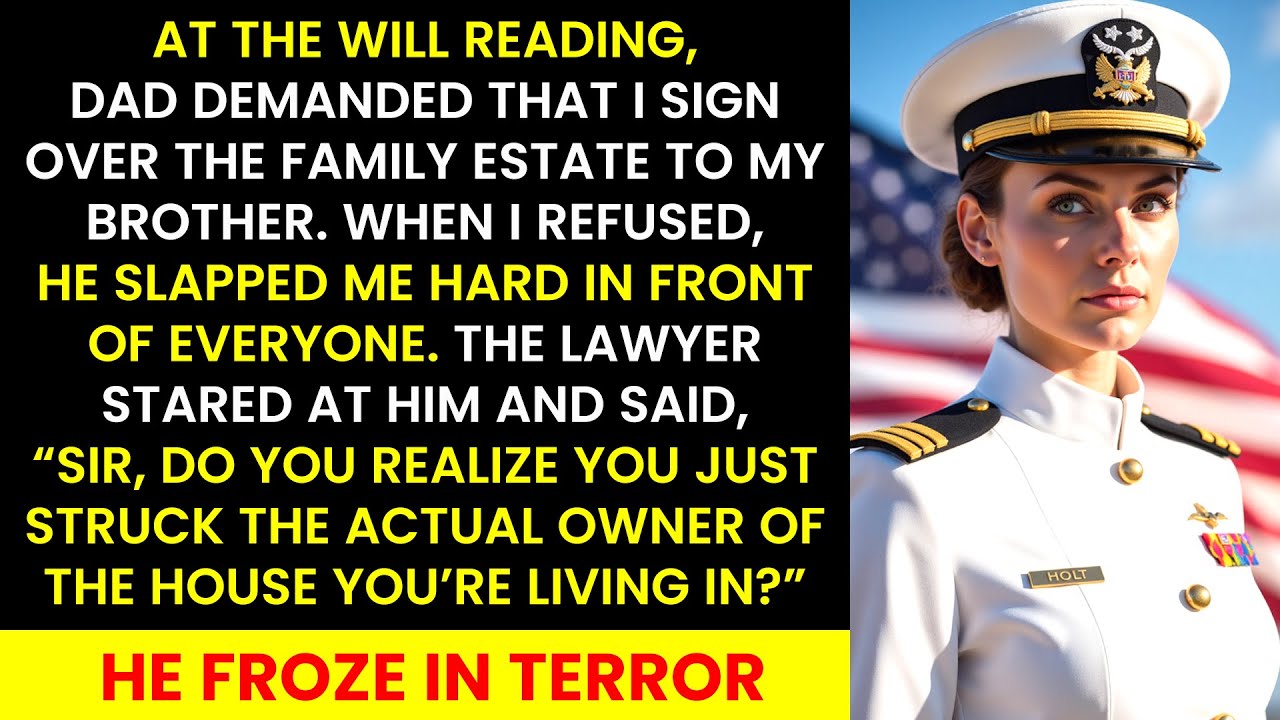
My father’s slap echoed off the wood paneling of the lawyer’s conference room like a gunshot. I tasted blood. Forty of our closest relatives watched in silence as he stood over me, veins bulging in his neck, screaming that I was a selfish brat who needed to sign over my inheritance to my brother. “He’s a man,” Dad bellowed.
“He needs this house more than you do. ”
Eric sat nearby, smirking, scrolling through his phone. They still thought I was the weak little black sheep they could push around. They didn’t know that Arthur Callahan, my late grandfather’s attorney, was holding a file that wouldn’t just strip them of everything—it would send my father to federal prison for bank fraud.
I’m Maria Holt, a lieutenant in the United States Navy. I’ve faced Atlantic storms that could snap a destroyer in half. But no hurricane was ever as destructive as the man sitting across from me. The conference room at Harper and Dunn smelled of old money—lemon polish, leather-bound law books, expensive air conditioning.
I walked in wearing my service dress, white uniform, ribbons perfectly aligned. To the Navy, I was an officer. To the people in this room, I was invisible. About forty relatives were crammed in, aunts who hadn’t sent me a birthday card in a decade, cousins who only called when they needed bail money.
They went quiet as I entered, their eyes calculating, like vultures circling a carcass. And there, at the head of the mahogany table, sat my father, Robert Holt. He was already drunk at 2:10 p. m.
on a Tuesday, smelling of Old Spice trying desperately to cover the sour stench of Jim Beam. Next to him sat Eric, my older brother, the golden child. Thirty-four years old, wearing a Ralph Lauren polo I knew he’d put on Dad’s credit card. He didn’t even look up from his iPhone.
Arthur Callahan cleared his throat. He was seventy, with eyes like steel traps. “Shall we begin? We are here to read the last will and testament of—”
“Cut the crap, Arthur,” Dad interrupted, slamming his hand on the table.
“We all know the drill. Dad left the house to me. Let’s just sign the papers so I can get back to work. ”
Work.
Dad hadn’t worked a real day in five years. He spent his days driving his leased Ford F-150 around town to keep up appearances. Dad reached into his jacket and pulled out a crumpled piece of notebook paper. He slid it toward me.
It was a handwritten note stating that I voluntarily relinquished any and all claims to the estate in favor of Eric. “Sign this, Maria,” Dad commanded. “What is this? ”
“It’s a formality,” he sneered.
“You’re in the Navy. You have a cot to sleep on and a mess hall to eat in. You don’t need a house in Connecticut. Eric needs it.
He’s a man. ”
The sexism was so practiced it almost didn’t register. It was just the air we breathed in that house. “I’m not signing that,” I said, my voice calm, trained by years of shouting commands over jet engines.
Dad hissed. “After everything I’ve done for you, you think you’re better than us because of that costume you’re wearing? ”
“It’s a uniform, Dad. And no, I’m not signing.
”
He moved faster than I expected for a drunk man. He lunged across the corner of the table. I saw the motion, but I didn’t flinch. Crack.
His open palm connected with the side of my face. The force knocked me sideways, my chair skidding. I tasted hot metallic blood as my lip split against my teeth. Gasps filled the room.
Uncle Bob half rose but didn’t move to help. Eric let out a short, sharp laugh. I slowly straightened my chair. I didn’t touch my face.
I didn’t cry. I sat at attention, staring straight ahead. The sting was unbearable, but the fire in my chest was hotter. Dad raised his hand again.
Thump. A massive legal binder hit the table with the force of a gavel, stopping him mid-swing. Arthur Callahan was standing now, a towering figure of judgment, glaring at my father with pure disgust. “Sit down, Robert,” Arthur said, his voice dropping to a terrifying low register.
“Stay out of this, Arthur. She’s my daughter. ”
Arthur opened the blue folder. He looked at the blood on my lip, then directly at my father.
“Mr. Holt,” Arthur articulated with lethal precision, “I strongly suggest you keep your hands to yourself, because you just struck the actual owner of the house you’re living in. ”
That slap wasn’t isolated. It was the physical punctuation on a sentence written since I was five.
Sitting there, I wasn’t seeing the aging alcoholic in a cheap blazer. I was seeing the father who had erased me from his life one missed milestone at a time. In the Holt household, there were two roles. Eric was the golden child, the fragile prince.
I was the insurance policy, the backup plan. It started with birthdays. My sweet sixteen in Westport—girls were getting leased Jettas and country club parties. I came home from swim practice to a dark house, a store-bought sheet cake from Stop and Shop still in the plastic container with the clearance sticker on it.
Dad and Eric were watching the Patriots game. Dad didn’t look up. He just yelled, “Maria, keep it down. It’s third and long.
”
No happy birthday. No balloons. Just a clearance cake and the flickering light of the TV. When Eric turned sixteen, despite his GPA starting with a decimal point, Dad threw him a catered BBQ, invited half the neighborhood, gave him a brand-new MacBook and a promise of a car if he brought his grades up.
He never did. The real knife was the presents. I was the varsity swim captain by junior year, waking up at 4:30 a. m.
to train, breaking the state record for the 100-meter butterfly. I stood on the podium, gold medal heavy around my neck, and searched the bleachers for Robert Holt. The seat was empty. He was at the principal’s office—Eric had been caught smoking pot under the football bleachers.
That night, Dad screamed at the school district, threatening to sue for targeting his sensitive boy. He drained his 401k to send Eric to a $30,000-a-year private school. I sat at the kitchen table doing AP calculus, trying to make myself small. “Mom,” I whispered, “I got the gold medal today.
”
She kissed my forehead. Her words scarred me more than the slap ever would. “Please don’t make a fuss right now. Your father is stressed.
You’re strong, Maria. You’ve always been the strong one. You can take care of yourself. Eric is weaker.
He needs us more. ”
You’re strong. He’s weak. That was the sentence.
Because I was competent, I was punished. Because Eric was a mess, he was rewarded. The breaking point came quietly. I’d been accepted to UConn with a partial scholarship but needed a co-signer for a student loan.
Dad laughed in my face. “I can’t sign that, Maria. My credit is tied up with Eric’s tuition. You’re smart.
Figure it out. ”
Two days later, a brand-new jet ski appeared in the driveway. A graduation present for Eric. That was the day the little girl waiting on the bleachers died.
I didn’t argue. I walked into my bedroom and made a decision. I went to the Navy recruiting office in Norwalk the next morning and signed the papers. Three months later, the morning I left for boot camp, Dad was hungover, asleep in the recliner.
I packed my entire life into two black Hefty garbage bags—my clothes, my swim trophies, my few books. As I dragged them down the driveway, I caught my reflection in the car window. I looked like trash being taken to the curb. But as I threw them in the trunk, I felt something shift in my chest.
Cold, hard resolve. “I am never coming back,” I whispered to the empty driveway. I didn’t know then that you can drive a thousand miles away, but the ghosts of the people who were supposed to love you will always try to drag you back. Naval Station Great Lakes in winter—the wind off Lake Michigan didn’t just chill you, it hunted you.
But the cold was a mercy. It numbed the pain of leaving home. My recruit division commander didn’t care about my feelings. He cared about one thing: could I follow orders?
I learned to make my bed with perfect hospital corners. In that small act, I found something I’d never had in Westport: control. I couldn’t control Dad’s drinking or Eric’s entitlement, but I could control this bed. This uniform.
My mind. One rare afternoon, I got thirty minutes on my phone. The first photo on my feed was Eric in Cabo, shirtless, holding a bottle of tequila. The caption read: “Living the life.
Thanks, Pops. ” I looked down at my dinner—a packet of chili mac heating up in a chemical reaction bag. He was burning through Dad’s money on shots; I was earning my paycheck learning how to keep a ship afloat during combat. The contrast fueled a fire in my gut.
Let him have the fun. I was building a future. Five years went by. I went from enlisted to officer, earning my commission through sheer grit.
I deployed, stood watch on the bridge of a destroyer. And I paid off my student loans. I sat in my cheap IKEA chair, the screen flashing PAID IN FULL, and just breathed. I owned myself.
I didn’t owe Robert Holt a single dime. Two weeks later, the phone rang. Dad. “Maria, how are you, kiddo?
” His voice was too cheerful. I could hear the clink of ice in a glass. “I’m fine, Dad. I’m a lieutenant now.
”
“That’s great. Listen, honey, I’m in a bit of a bind. It’s Eric. He got a DUI last night.
We need five grand for the retainer and bail. Could you wire me the money? ”
He wasn’t calling to ask if I was alive. He wasn’t calling to congratulate me.
He was calling because his golden child messed up and he wanted the spare part to pay for the fix. “No, Dad. ”
“Excuse me? ”
“No.
I don’t have five thousand dollars for Eric’s bail. And even if I did, I wouldn’t give it to you. ”
“You selfish, cold-hearted—” I hung up mid-curse. My hands were shaking from adrenaline.
I walked to my locker, opened it, and touched the taped photo of Grandpa Walter standing next to his 1965 Mustang. He was the only one who’d ever looked at me and seen a person, not a burden. “I held the line, Grandpa,” I whispered. I didn’t know it then, but he had left me a shield.
And in a few days, that shield was about to become a sword. Back in the conference room, Arthur Callahan didn’t sit down. He dominated the room. “Robert,” Arthur said, “you assume that because you are Walter’s only son, you are heir apparent to his estate.
”
“It’s not an assumption. I’m his next of kin. It’s the law. ”
“Under normal circumstances, yes.
However, Walter was a man who planned ahead. He came to me thirteen years ago, specifically the week Maria left for boot camp. ”
My heart skipped a beat. Arthur held up a document.
“On October 15th, 2011, Walter Morgan transferred the deed of the property at 42 Oakwood Lane into an irrevocable living trust. ”
The room went so quiet you could hear the air conditioner hum. “And who is the trustee? ” Eric asked, his voice cracking.
“Is it me? ”
Arthur looked at him with pity, then turned to me. “The trust was established for the sole benefit of the one person Walter believed had the discipline to maintain his legacy. ”
He picked up a handwritten letter and began to read.
It was Grandpa’s voice. “To my granddaughter Maria. If you are hearing this, I am gone. I know your father has likely tried to bully you today.
I watched you leave for the Navy with nothing but two garbage bags. You didn’t ask me for a dime. You stood on your own two feet. The house is yours, Maria.
It has been yours since the day you left. Welcome home, kiddo. ”
Arthur lowered the letter and looked at my father, whose mouth was hanging open. “So, Mr.
Holt, when you just slapped Maria, you didn’t assault your daughter. You assaulted the landlord. And I believe she has the right to evict you. ”
I walked out with a set of keys that felt heavier than a loaded pistol.
Arthur offered to call the police to escort me, but I refused. This was my house now. In the Navy, you secure your own ship. I drove my battered Honda Civic straight to 42 Oakwood Lane.
The house, a colonial mansion Grandpa had built with pride, was suffering from a terminal illness. White paint peeling in gray strips, shutters hanging crooked, the lawn a shin-high meadow of crabgrass with an HOA citation sticker on the front door. The fresh oil stains in the driveway came from Dad’s shiny leased F-150. A perfect metaphor for Robert Holt: a shiny bumper on a wrecked chassis.
Inside, the smell of stagnation hit me—stale beer, wet dog, a house not cleaned in years. The living room looked like a fraternity basement. An 85-inch TV worth three grand, the latest consoles, towers of Domino’s boxes, empty Monster cans, and Eric’s designer clothes scattered everywhere. A 34-year-old man’s life, living like a king in a castle he didn’t pay for.
I went to Grandpa’s study. Dad had taken it over, the mahogany desk buried under mountains of unopened mail. I sat in the leather chair and started digging. Past-due notices from Verizon, Eversource, the water company, all stamped in angry red.
And then I found it: a thick envelope from First National Bank. A Notice of Default and Intent to Foreclose. Borrower: Robert Holt. Property: 42 Oakwood Lane.
Outstanding balance: $845,000. Wait. That didn’t make sense. Arthur said the house was in an irrevocable trust.
To take out a home equity line of credit, you have to own the equity. I scrambled through the papers and found the loan application. There at the bottom, on the deed transfer, was a signature: Walter Morgan. Dated two years after Grandpa died.
My breath hitched. Dad hadn’t just been irresponsible. He had forged a dead man’s signature. He had committed federal bank fraud to turn Grandpa’s legacy into a personal ATM.
Outside, gravel crunched. The roar of the F-150. A door slammed. “Where is she?
” Dad’s voice screamed from the front yard. “Where is that ungrateful little traitor? ”
I looked down at the evidence and stood up. The inspection was over.
It was time for the court-martial. The front door slammed downstairs. “Maria! Get down here!
”
I checked my watch. Based on the heaviness of his footsteps, I had less than two minutes. I sat in Grandpa’s chair, heart rate steady, and reviewed the evidence. The loan application, dated June 14th, 2019.
Grandpa died in February 2017. The forgery wasn’t even a good one—the shaky handwriting mimicking Grandpa’s old-fashioned cursive, but with Dad’s heavy, aggressive penstrokes. I flipped to the transaction history. Wire transfer, October 2019: $85,000 to BMW of Ridgefield—Eric’s M3 that he wrapped around a telephone pole three months later.
Dad told everyone insurance covered it. That was a lie. Cash withdrawals at Mohegan Sun Casino: $5,000, $10,000, one weekend showing $50,000. My father was a whale at the blackjack tables, hemorrhaging away Grandpa’s fifty years of work.
Monthly recurring payment to American Express: $12,400. The supplementary card holder: Eric Hol. Dinners in New York, bottle service, designer clothes—paid for with the walls of this house. They weren’t just mean to me.
They were criminals. Parasites who hollowed out this family from the inside. If I called the FBI, Robert Holt would face federal charges. Wire fraud alone carries up to twenty years.
The footsteps were in the hallway now, pounding toward the study door. The doorknob rattled violently. It was locked. “Open this door, Maria!
Or I’ll kick it down! ”
I stood up slowly. I picked up the loan application, the bank statements, the foreclosure notice. I aligned them perfectly.
I checked my uniform in the window reflection. I wasn’t the scared teenager packing garbage bags anymore. I was an officer about to confront a hostile insurgent. Bam.
The door splintered near the lock. With a crack, the frame gave way and the door swung open, banging against the bookshelf. Robert Holt stood in the doorway, red-faced, sweating, tie loosened. Eric peeked out from behind him, terrified.
“Who do you think you are? ” Dad snarled. “You think that piece of paper Arthur read means anything? I am the man of this house.
You are going to sign that deed transfer, Maria, right now. Or so help me God, I will—”
“You’ll what? ” I interrupted. “You’ll hit me again?
You’ll forge my signature like you forged Grandpa’s? ”
Dad froze. Eric went pale. “I know everything,” I said, holding up the file.
“I know about the HELOC. I know about the $845,000. I know about the casino runs to Mohegan Sun. And I know you committed federal bank fraud to get it.
”
The color drained from my father’s face so fast it looked like a stroke. “That’s not—” he stammered. “Arthur calls this a dispute over a will,” I said, stepping forward. “But the FBI calls it a felony.
” I tossed the file on the desk. “So let’s talk about who is really leaving this house today. ”
Dad stared at the file, his face cycling through shades of purple. Then he lunged, hand raised, aiming for my face again.
He wanted to slap the defiance out of me, put the little girl back in her place. But the little girl wasn’t home. My body moved before my brain processed the threat. Muscle memory from the mats at Quantico.
I stepped inside his guard, intercepted his wrist with my left hand, clamped my right on his elbow—a basic MCMAP joint manipulation. I twisted, drove his elbow upward, and slammed him chest-first onto the mahogany desk, right on top of the fraudulent loan documents. “Ow! You’re breaking my arm!
”
I leaned down, my mouth inches from his ear. “I am not a 16-year-old girl anymore, Robert. And I am not a punching bag. If you ever try to touch me again, I won’t just hold you down.
Do you understand? ”
I released him, shoved him backward. He stumbled, rubbing his wrist, staring at me with terrified eyes. For the first time in his life, he realized he was physically outmatched.
“You assaulted him! ” Eric yelled from the corner, finding his courage. “I’m calling the cops. You’re a psycho.
”
“Go ahead, Eric,” I said, pointing to the phone. “Call the police, please. I’m sure they’d love to hear about the BMW you bought with a dead man’s money. ”
His mouth opened and closed like a fish.
I grabbed the stack of Amex statements and threw them at him. They fluttered through the air like snow, hitting him in the chest. “Look at your lifestyle. Bottle service at Marquee.
Dinners at Nobu. Weekends in the Hamptons. $12,000 a month. ”
“Dad said he had it covered,” Eric stammered.
“He stole it to pay for your delusions. You’re not networking. You’re unemployed. You’re a parasite.
You let Dad commit felonies so you didn’t have to get a job at Starbucks. ”
I turned back to my father. “And you. You’re not the landlord.
You’re not the patriarch. You’re a fraud. ”
I walked to the broken doorframe and pointed into the hallway. “Do you remember Grandpa’s favorite verse?
Galatians 6:7. ‘Do not be deceived. God is not mocked. For whatever one sows, that will he also reap.
’ You sowed neglect, abuse, lies, and greed. Now you are reaping the harvest. ”
“Maria, please,” Dad whispered. “We have nowhere to go.
They’ll take the truck next week. ”
“That sounds like a you problem. It’s 4:30 p. m.
I’m the trustee. I’m revoking your permission to occupy this property effective immediately. I can have the sheriff here in ten minutes to remove trespassers, and while he’s here, I can hand him this file. Your choice.
Leave on your own feet, or leave in handcuffs. ”
The silence lasted five seconds. Then Dad pushed himself off the bookshelf. Without a word, he walked out, shoulders slumped.
A broken man. Eric scowled, grabbed his keys, and scurried after him. The silence after I threatened to call the FBI was crushing. Dad stood in the center of his ruined study, his red rage drained away, leaving him the color of old ash.
He knew I wasn’t bluffing. “You wouldn’t,” he whispered. “Try me. Bank fraud, wire fraud, identity theft.
You forged a dead veteran’s signature to fund a gambling addiction. You’re looking at ten years minimum. And when the agents come, they’ll park right out front. Mrs.
Higgins next door will see you in handcuffs. ”
For a narcissist like my father, prison was scary. Public humiliation was fatal. His knees gave out.
He collapsed onto the dusty floor, slumped against the filing cabinet. And then Robert Holt, the man who terrified me my entire childhood, began to cry. Not a dignified weep—an ugly, heaving sob. Snot ran from his nose.
“I can’t go to jail,” he blubbered. “I’m 62. I have high blood pressure. Maria, please.
I’m your father. ”
I looked down at him and waited for an apology. For him to say he was sorry he stole from me, sorry he hit me. It never came.
He was crying for himself—mourning his reputation, his comfort, his freedom. Not sorry he did it. Sorry he got caught. “You should have thought about your blood pressure before you drove to Mohegan Sun with Grandpa’s equity.
”
Then Eric, who had been frozen by the door, turned on his father. “You said you had it handled! You told me the trust was just a rumor. You let me buy that car.
You let me rack up the Amex. Now what? I’m supposed to go to jail, too? ”
“I paid your debts,” Dad yelled back.
“You risked everything because you’re a loser who couldn’t earn his own money,” Eric spat. “God, you’re pathetic. No wonder mom was always miserable. ”
I stood motionless, witnessing the two villains of my life tear each other apart.
The golden child was devouring the king. Dad had created a monster who believed the world owed him everything, and now that monster was feeding on its creator. Eric turned to me. “Maria, listen.
I didn’t sign anything. I didn’t know about the forgery. You can’t report me. I was a victim, too.
”
“You spent the money, Eric. Ignorance isn’t a defense when you’re driving a stolen BMW. ”
He looked back at Dad with pure hatred. “You ruined my life.
” Then he snatched his keys and stormed out. We heard the front door slam and the screech of tires. Dad sat amidst the wreckage of his lies, sobbing into his hands. I expected to feel triumph.
Instead, I felt pity—not warm compassion, but the cold, distant pity you feel for a rabid animal finally put down. He was pathetic. And realizing he was pathetic stripped him of his power over me forever. I lowered the phone.
I didn’t dial the FBI. “Get up, Robert. We’re going to the kitchen. We need to talk about your surrender.
”
Later, I stood at Willowbrook Veteran Cemetery in front of Grandpa’s white marble headstone. I pulled a quarter from my pocket—the military tradition. A penny means you visited. A nickel means you trained together.
A dime means you served together. A quarter means you were with them when they passed. I wasn’t there when Grandpa died; I was deployed in the Mediterranean. But in spirit, I never left his side.
I placed the coin on the cold stone. “I got him, Grandpa. I have him right where you knew he would end up. ”
I had the power to destroy my father.
One phone call. But I remembered what Grandpa told me once: “Strength isn’t about how hard you can hit. It’s about how much you can lift. Sometimes the heaviest thing you have to lift is someone who has fallen.
”
I had been forsaken. But I had also been lifted up—by the Navy, by Grandpa, by my own resilience. I didn’t need to destroy my father to prove I was strong. Destroying him wouldn’t fix the past.
It would just leave me with a ghost in a cage. I drove back to the house. Dad was sitting at the scratched kitchen table, deflated, waiting for sirens. I sat down opposite him and placed a single sheet of paper on the table.
It wasn’t a police report. It was a handwritten contract. “I’m not calling the FBI, Dad,” I said quietly. His shoulders slumped.
“Oh, thank God, Maria. I promise I’ll stop. ”
“I’m not calling them yet. This isn’t a pardon.
It’s a parole agreement. Item one: you’re selling the F-150 tomorrow. You’ll use the proceeds to pay off the interest on the HELOC so the bank doesn’t take the house. Item two: the master bedroom is no longer yours.
You’re moving into the downstairs guest room. Item three: you need a job. Walmart is hiring greeters. Every single paycheck will be garnished by me to pay back the equity you stole from this estate.
”
“But what will people say? ”
“They’ll say you’re an honest man trying to fix his mistakes. Or they can say you’re a felon in federal prison. Pick one.
”
He lowered his head. “I’ll get a job. ”
“And finally—Eric. ”
Dad looked up with hope.
“Can he come back? He’s sleeping in his car. ”
“No. You crippled him, Dad.
You gave him everything he wanted and nothing he needed. If I let him back in, he will just eat us alive until there’s nothing left. Eric is banned from this property. If he shows up, I call the police for trespassing.
Do we have an agreement? ”
He picked up the pen, hand shaking, and signed his name. A signature of surrender. “Don’t thank me,” I said.
“Make your bed tomorrow morning. That’s how you thank me. ”
Three months passed. On Thanksgiving, I stood on the front porch holding a mug of hot apple cider.
The house looked cared for—the peeling paint scraped and primed, the jungle of crabgrass replaced by a raked-clean lawn. Inside, it smelled like a home should. Roasting turkey, sage stuffing, pumpkin pie. In the kitchen, standing over the oven in a simple flannel shirt sold from a consignment shop, was my father.
He had lost weight. He looked tired but solid. “Hey,” he said, pulling out the twenty-pound bird. “Check the temperature on this.
My eyes aren’t what they used to be. ”
“Sure, Dad. ” I grabbed the thermometer. “Perfect.
165. ”
“Yeah, well, the manager at the store said I’m the only one who actually greets customers like they’re human beings. Might make me shift lead next month. An extra dollar fifty an hour.
”
He had been sober for 88 days. He paid me rent every Friday, cash, honest money. We sat down to dinner—simple plates, no fancy china. He poured us both iced tea.
“Maria,” he said, putting down the carving knife. “I want to say grace. ”
We bowed our heads. “Lord, thank you for this food.
Thank you for this roof. ” He paused, swallowing hard. “And thank you for my daughter. Thank you for giving her the strength to stop me when I couldn’t stop myself.
I’m sorry, Maria. For everything. For the lost years. For the fraud.
For not being the father you deserved. ”
The silence that followed wasn’t heavy. It was peaceful. “Thank you, Dad,” I whispered.
“I forgive you. ”
Just then, headlights swept across the window. I stood and looked. A battered ten-year-old Toyota Corolla pulled into the driveway, a dent in the rear bumper, muffler hanging low.
The man stepping out wasn’t the golden child in a Ralph Lauren polo. Eric was wearing a gray mechanic’s jumpsuit with a patch that said “Mike’s Auto Body. ” His hands were stained with grease. He looked thinner, leaner, hungrier.
He reached into the back seat and pulled out a white bakery box. “He came,” Dad said, standing behind me, voice trembling. “I told him he could come for dinner. On one condition—he had to drive a car he paid for, wearing clothes he bought, bringing food he purchased with his own money.
”
Eric knocked. I opened the door. There was no arrogance left in his eyes, just quiet, tentative hope. “Hey, Maria,” he said, holding up the box.
“I brought an apple pie. It’s not homemade, but I bought it with my paycheck. ”
“Apple pie is perfect,” I said, stepping aside. “Come in, Eric.
Dinner is ready. ”
He walked in, the smell of grease and hard work mixing with the turkey. He saw Dad in the hallway. They looked at each other—two men who had lost their fake kingdom but found their real footing.
“Hey, Dad,” Eric said softly. “I like the flannel. ”
“Hey, son. ” Dad smiled, a genuine crinkly-eyed smile.
“I like the jumpsuit. Suits you. ”
As they walked into the dining room together, talking about Eric’s new job fixing transmissions, I walked to the mantel above the fireplace. There, in the center, was the framed photo of Grandpa Walter standing next to his Mustang.
For years, I thought the inheritance was the house. The legacy was the money. But I was wrong. The money was just paper.
The house was just wood and stone. The real inheritance was this moment—the ability to take a broken, toxic mess and forge it into something real. The lesson that love isn’t about enabling people to be weak. It’s about challenging them to be strong.
“We made it, Grandpa,” I whispered. “We finally cleaned the house. ”
I turned and walked into the dining room to join my family.
Not the family I was born into, but the family I had built.