I came home after a 48-hour shift with mud caked on my uniform and exhaustion carved into every bone in my body. All I wanted was to crawl into bed next to my husband of seven years and feel safe for one night. Instead, I found him in the living room, raising a glass of expensive scotch and laughing on the phone with a colleague. I stopped in the hallway when I heard my name.
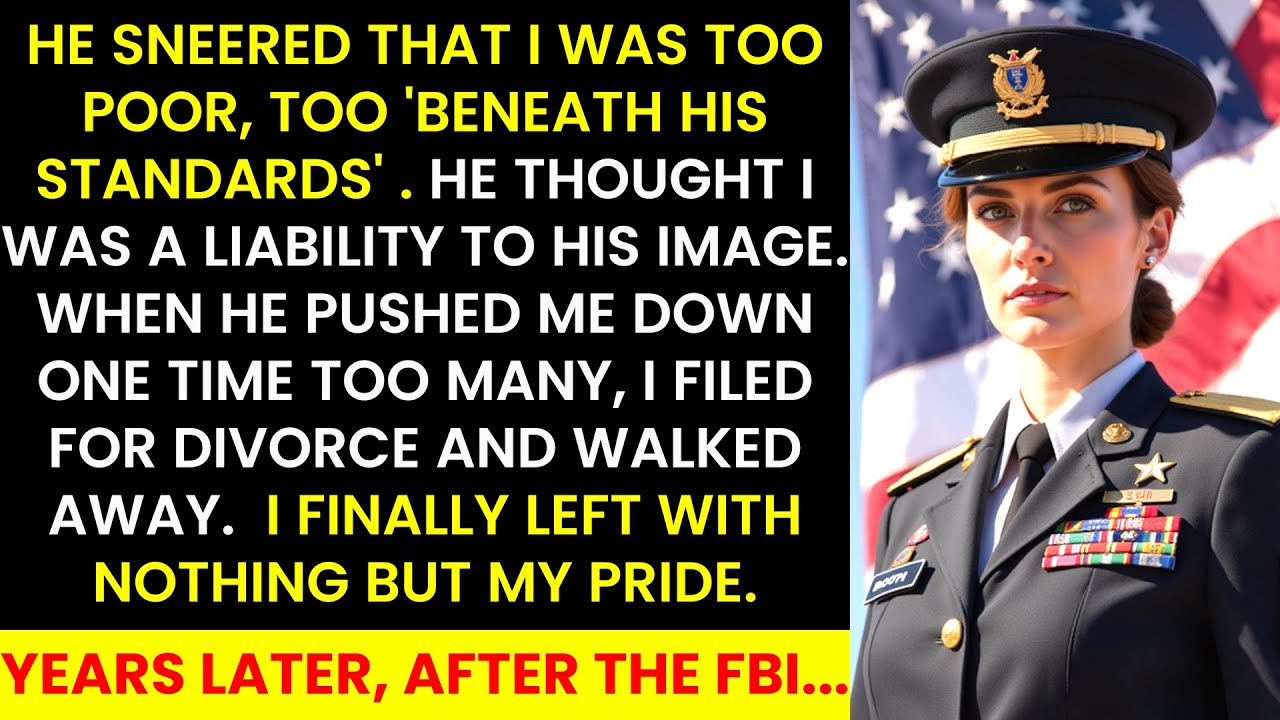
“Marrying Ellen was an investment error, Jason. She’s just a grunt with a poverty mindset. I’m looking for a way to liquidate this asset before she ruins the upper-class image I’m building. ”
I stood frozen in my socks on the cold marble floor.
He kept talking, comparing me to a guard dog, saying I was loyal and ate cheap but didn’t belong on the silk sofa. “Does honor pay for the lease on the Porsche? Does honor get us a table at Le Diplomate? ”
That scotch he was drinking came from a contract I helped him secure with a military supplier.
He was drinking my hard work while spitting on my existence. I didn’t cry. Something cold and hard snapped into place inside me, the same switch I flipped when I entered a combat zone. I walked into the living room.
He jumped, knocking over a glass of wine that soaked into the pristine white rug. “Ellen,” he stammered. “How long have you been standing there? ”
I didn’t answer.
I slipped the ring off my finger, the diamond I had treated like a holy relic, and slammed it down on the coffee table. “You’re right, Marcus. I am a soldier. And the first rule of a soldier is that we never leave a teammate behind.
But you aren’t a teammate. You’re the enemy. ”
I turned and walked out of the penthouse barefoot, carrying my muddy boots. I left everything behind, the luxury, the warmth, and the man I had loved.
I was homeless, exhausted, and alone. But I felt lighter than I had in years. I drove through the freezing Washington rain with no destination. My left hand felt strangely light, my thumb instinctively searching for a ring that wasn’t there anymore.
My mind drifted back to the beginning. At our wedding reception, I watched my mother, in her department store dress, and my father, an iron worker with permanently stained hands, greet Marcus’s mother, Catherine. She took my father’s hand like she was picking up a dead fish, and the moment he turned away, she pulled out a sanitizing wipe and scrubbed her hand. She didn’t even try to hide it.
I saw it, and I said nothing. I betrayed my own blood with my silence. I thought Marcus loved my strength when we met. He told me I was the most authentic woman he’d ever met.
But I realized too late that he wasn’t in love with me. He was just entertained by me, a blue-collar souvenir he picked up to feel rugged by association. The memory that hurt most was the day he boxed up my Bronze Star. He hid it in the basement before his boss came to dinner because the medals looked “violent” and made the place look cheap.
That medal was my soul on display. He called it clutter. From that day on, I started shrinking. I stopped telling stories about the army.
I hid my boots. I became a ghost in my own life, a shadow wearing a cocktail dress. I found a tiny studio apartment in Southeast DC, a world away from Georgetown. The walls were thin.
The air smelled of smoke and damp drywall. It was all I could afford because Marcus and his parents had moved with lightning speed, freezing our joint accounts and accusing me of financial impropriety. They wanted to starve me out. They wanted me to crawl back begging.
My first dinner as a single woman was a cold MRE eaten out of a plastic pouch on the linoleum floor. I opened my phone and saw Marcus posting a story from a high-end steakhouse, holding up a glass of cabernet with a caption about freedom and not being weighed down by people who don’t understand the grind. That dinner cost more than my rent for the entire month. He was paying for it with a bonus he earned because I introduced him to the right general three months ago.
Then the email came from Catherine Whitfield. No greeting. Just cruelty. “You should know your place by now.
We always knew this day would come. You were and will always be a bad investment. Do the smart thing. Sign the papers, walk away with what you came with, which is nothing, and disappear.
Consider this your final notice. ”
I read it three times. I wanted to cry, but instead, I pulled out the weathered Bible I carried through two deployments and read the same passage I memorized in the mountains of Kandahar. “Yea, though I walk through the valley of the shadow of death, I will fear no evil.
”
A valley isn’t a grave. It’s a pathway. You walk through it. I set my alarm for 4:30 the next morning.
I ran ten miles before sunrise. I worked double shifts. I signed up for night classes. Marcus thought he threw me into the mud to rot.
He was wrong. He planted me. Two weeks later, I stood on a stage presenting a paper on military logistics at a summit in DC. But I was terrified.
Marcus’s voice was looping in my head, telling me to be softer, to tone it down. I apologized five times in ten minutes. I qualified my expertise with “I think” and “maybe. ”
The applause was sparse and humiliating.
I ran off the stage and straight to the elevator. Just as the doors were closing, a hand shot out and blocked them. General Patricia Holbrook stepped in. Four stars.
The first woman to command the Army Materiel Command. “Why did you stand on that stage and act like a frightened mouse? ” she demanded. “You apologized five times in ten minutes.
Who taught you that competence is abrasive? ”
“My ex-husband. ”
“Your ex-husband sounds like a man who was terrified of your power, so he tried to convince you that you didn’t have any. ”
She fixed my collar and straightened my ribbons.
“Your toughness, your discipline, your ability to endure pain, those are not character flaws, Ellen. Those are assets. You are a weapon. You never, ever apologize for being sharp.
”
She gave me a card and told me she was starting a private consulting firm. She needed a director of operations, someone who didn’t know how to quit. Two years blurred into a montage of discipline. I ran ten miles every morning.
I worked at the base during the day. I earned my master’s degree at night. I did forensic bookkeeping for General Holbrook until two in the morning. Marcus texted me through his lawyer, taunting me about the heating bill.
I printed the message and pinned it above my desk. It wasn’t an insult. It was fuel. I lost friends along the way.
When my best friend got married and offered me an old dress to wear as a bridesmaid so I could watch Marcus with his new fiancée, I made an excuse. I turned off my phone and cried for exactly twenty minutes. Then I opened my textbook. On graduation day, I sat in the front row.
My parents were too frail to travel. There was no husband to cheer for me. The chairs in the VIP section were empty. Then a sound erupted from the back of the hall.
Ten soldiers from my old unit stood at attention in the back row, and in the center of them stood General Holbrook in her full dress blues. They rendered a slow, crisp hand salute. I returned it, sharp and proud. Three years after walking out of that penthouse with nothing but my boots, I walked into the Willard InterContinental Hotel as the director of Booth Solutions.
I wore a black trouser suit and no jewelry except a simple watch. I looked like I owned the building. Marcus was standing near the ice sculpture with his arm around Melissa, the interior designer he used to hire. He spotted me and sauntered over.
“Captain Ellen, still playing dress-up? ” he laughed. “You look like the help. ”
His fiancée giggled.
“Oh, honey, don’t be mean. Not everyone understands haute couture. ”
I took a slow sip of my sparkling water. “Marcus, this vision you keep talking about.
Would that happen to be Theodore’s Genesis Fund? ”
He froze. “How do you know that name? ”
“I know because the word around the Beltway is that the SEC has taken a very sudden interest in Theodore’s offshore wire transfers.
I’d be careful about the foundation of that new house you’re building. The ground is shaking. ”
Before he could respond, Senator Vance, the chairman of the Senate Armed Services Committee, walked past Marcus’s outstretched hand and took mine instead. “Ms.
Booth, General Holbrook showed me your proposal on supply chain resilience. It is exceptional work. I want to buy you lunch next week. ”
Marcus stood there with his hand still floating in the empty air.
“Enjoy the party, Marcus,” I said. “Eat the shrimp, drink the good scotch. Because I have a feeling this might be the last time you’re ever invited to a room like this. ”
Three months later, I stood in my office in Rosslyn, Virginia, looking across the Potomac at the Pentagon.
My team was made up of people Marcus would have called burdens. A military spouse who moved five times in seven years. A former sergeant who lost his leg to an IED. I called them the most disciplined, adaptable workforce on the planet.
We came up against The Genesis Fund for a massive Department of Defense contract. Marcus sat across the aisle with his flashy PowerPoint full of buzzwords. He talked about hedging financial risk. I dropped a three-inch binder on the table.
“My opponent talks about financial risk. I’m here to talk about operational risk. When a supply chain breaks in a combat zone, you don’t lose profit margins. You lose Marines.
I know the price of a late shipment, and it isn’t measured in dollars. It’s measured in flag-draped coffins. ”
We won the contract. Fifteen million dollars, base year.
Three months after that, I was watching CNN at 6 a. m. when the breaking news banner scrolled across the screen. “FBI raids Genesis Fund headquarters.
CEO Theodore Carmichael arrested in $5 billion Ponzi scheme. ”
Then the camera cut to the perp walk. Theodore first, head bowed. And right behind him, flanked by federal marshals, was Marcus.
His expensive shirt was untucked and wrinkled. His hair was a mess. He was frantically trying to shield his face from the cameras. By 8:30, the full scope had unfolded.
Marcus had leveraged everything to buy into the fund, a second mortgage on the penthouse, maxed credit lines, private loans. He believed the lie because he wanted the status that came with it. Melissa posted a black screen with white text, claiming she had no knowledge of his business dealings and ending their engagement effective immediately. She scrubbed every photo of him from her feed.
Then came the final blow. His parents issued a public statement distancing themselves from their own son to protect the family business. My staff asked if we should order champagne. I told them to turn off the TV.
“There’s no joy in watching a man drown, even if he dug the pool himself. ”
Six months later, I got a message on LinkedIn. Marcus. His profile photo was gone, replaced by a gray silhouette.
The message was short and desperate. “Ellen, please. I’m in Rosslyn, just 15 minutes. I have nobody else.
”
I replied with a location. The coffee shop in the lobby of my office building. My turf. The man sitting at the corner table was a ghost.
He had lost at least twenty pounds. His hair was thinning and streaked with gray. His wrists were bare. The confidence was gone, replaced by the skittish anxiety of a cornered animal.
“You have 15 minutes, Marcus. Talk. ”
He told me Theodore played him. He told me his parents changed the locks on the estate.
Then he switched tactics, trying to summon the ghost of his old charm. “I made a mistake letting you go. You were the only real thing in my life. You’re a soldier.
You save people. Help me get back on my feet, El. Just a small loan for the legal retainer. I can consult for your firm.
”
His hand reached across the table, shaking, desperate. I pulled mine back. “We were never a team, Marcus. You don’t miss me.
You miss the safety I provided. You miss having a guard dog to kick when you were frustrated and to hide behind when you were scared. ”
“Ellen, please. I have nothing.
”
“You have exactly what you built. ”
I stood up and placed a twenty-dollar bill on the table, weighing it down with the sugar dispenser. It was more than enough to cover both our coffees. “You once told me that marrying me was a bad investment.
You were right. I was a bad investment for you because I am long-term equity. I require patience, integrity, and genuine work to mature. You’re a day trader.
You wanted the flash without the foundation. And now the market has corrected itself. ”
“Goodbye, Marcus. ”
I turned my back and walked out into the sun.
I didn’t look back. That Saturday, I stood on the stage of my alma mater as a donor, not a student. I held three envelopes containing the first annual checks for the Booth Resilience Scholarship, a fund I established for female ROTC cadets from low-income backgrounds. Three young women walked across the stage.
Looking at them was like looking into a mirror reflecting fifteen years into the past. The valedictorian, a petite girl who looked like a strong wind might blow her over, shook my hand with a grip that surprised me. Her eyes were wet. “Thank you, ma’am.
You have no idea what this money means. My dad, he didn’t think I could make it. ”
I leaned in close. “Don’t you ever let anyone appraise you based on where you came from or what you have in your bank account.
Real value isn’t liquid. It’s right here, and right here. Protect that value with your life because it’s the only currency that never depreciates. ”
She stood a little taller as she walked away.
That evening, I drove to a scenic overlook near the Potomac River as the sun dipped below the horizon. The water turned to liquid gold. I shut off the engine and rolled down the windows. The anger was gone.
It had simply evaporated. I didn’t hate them anymore. Hate takes energy, and I had severed that tether. In a strange way, I was almost grateful.
They were the opposing force in my life’s training exercise. Without the crushing weight of their rejection, I never would have built the muscle mass necessary to carry the success I hold now. My phone buzzed. A text from General Holbrook about golf.
Another from my operations manager, sending a picture of her kids’ birthday party with a caption thanking me for the bonus. My life was full. Not with gala invitations or fake friends, but with honest laughter, hard work, and people who would pick up the phone at three in the morning if I needed them. On the passenger seat sat a bouquet of white peonies I’d bought for myself at Whole Foods an hour ago.
They smelled sweeter than any roses Marcus ever had his secretary send me as an apology. I stepped out of the car and stood at the edge of the riverbank. Across the water, the lights of the Lincoln Memorial flickered on against the night. Success is how high you bounce when you hit bottom.
I had hit the bottom, face-first into the mud, stripped of my dignity and my home. But I didn’t stay there. I bounced. And I soared higher than Marcus, with all his leverage and connections, could have ever imagined.
I am Ellen Booth. I am a soldier. I am a CEO. But most importantly, I am the victor in the war for my own soul.
Your value is never determined by someone else’s appraisal. Do not let anyone treat you like a liability in your own life. You are, and always have been, your greatest asset.