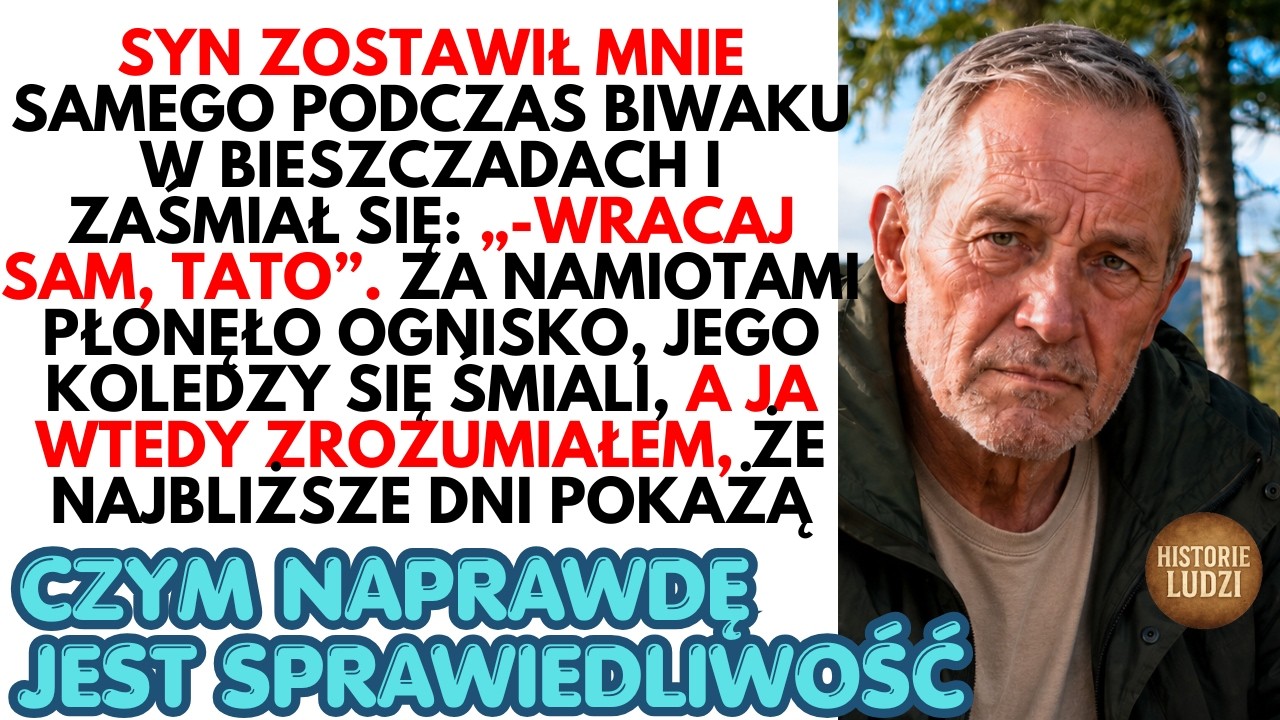
My son left me alone in the Bieszczady Mountains. Behind the tents, the campfire was burning. His friends were laughing, and I stood at the edge of the darkening forest. For the first time in my life, I understood that for years I had been making excuses for a man who had stopped acting like a son a long time ago.
Krzysztof turned back for a moment. I saw his face in that gray light, when the day was no longer day but night hadn’t yet fully crept between the trees. He was smiling. Not widely.
Not like someone amused to tears. Rather, the way an adult smiles when they’re doing something mean but hoping everyone will call it a joke. “Go back on your own, Dad. You’ll manage,” he said, then walked toward the tents.
I heard twigs snap under his boots. I heard Paweł laugh, then Jakub, a muffled, broken sound as if one of them was still trying to pretend it was all innocent. Behind the tents, the fire shot sparks, smoke drifted low between the bushes, and somewhere deeper in the forest an animal called out, not threateningly. Not enough to make a man think the worst, but enough to remind me that I was standing alone on a forest path far from home, with my own son on the other side of that silence.
I didn’t shout after him. I didn’t run. I didn’t make a scene, though someone else might have. I stood there looking at the spot where he’d vanished between the trees and waited another moment.
You know, a man carries one last stupid hope at moments like that, that the person will come back, wave a hand, say, “Okay, Dad, don’t be mad, we were just messing around. ” That the whole weight that just landed on my chest would turn out to be a mistake. He didn’t come back. And right then, there in the Bieszczady at the edge of the darkening forest, something inside me finally broke.
Something that had been cracking for years. I’d just been stubbornly pretending it was still holding. My name is Marek. I’m fifty-eight years old.
For most of my life, I considered myself a calm man. Not perfect, because those don’t exist, but decent. I worked as a warehouse manager for a construction company near Wrocław. Ordinary work, not a great career, but honest.
I got up in the morning, drank coffee in the kitchen, drove through crowded streets, came home in the afternoon with my head full of invoices, deadlines, and people who always wanted everything yesterday. Anna and I lived in a house on the outskirts of Wrocław. Small, but ours. With a little garden, an old apple tree behind the garage, and a terrace I’d been promising to renovate for years.
Anna used to laugh that the terrace was like my New Year’s resolutions. Solid in theory, but always waiting for a better moment. We’d been together for over thirty years. We’d gone through what every marriage goes through.
Bills, sick parents, queues at the clinic, a kitchen renovation that nearly drove us to divorce, and Christmases where there was always one missing chair or one missing spoon for the borscht. Krzysztof was our only child, long-awaited. After he was born, Anna said she’d received a gift from life she no longer expected. And I was proud as a fool.
I carried him around the room when he cried. I taught him to ride a bike. I stood by the pitch when he played school matches and pretended I wasn’t freezing, even though my fingers were stiff as wood. He wasn’t a bad boy.
Really, he wasn’t. Sharp, articulate, likeable, the kind who could walk into a room and instantly make things lively. His grandmother said he had a spark. Neighbors praised him.
Teachers sometimes complained, sometimes patted him on the shoulder. And Anna and I, like parents do, saw more good in him than bad. Maybe that’s where it started. Because when he was little, every one of his misdeeds seemed like a trifle.
When he didn’t apologize to a classmate, we said he’d learn. When he lied about doing his homework, Anna explained he was probably scared. When he came home too late as a teenager and answered me rudely, I clenched my jaw but then thought, “He’s young, hormones, it’ll pass. ”
Except it didn’t pass.
With age, the words changed, the clothes changed, the phone in his hand changed, but the same lack of responsibility remained. And we kept putting a soft landing under his feet so life wouldn’t hurt him too much. After university, Krzysztof came home for a while. That’s what he said then.
I remember him standing in the hallway with two bags, a laptop under his arm, and the face of a man closing one chapter while having the next almost ready. He just needed to finish a few things. “Dad, it’s at most a few months,” he said. “I’ll look around for something, save a bit, and move out.
”
I nodded. Anna immediately started preparing his room, as if he were returning from the army rather than from a rented apartment in Kraków, where he’d studied and where, as it later turned out, he’d also owed his roommates money. I didn’t want to make a big deal of it. A young man after studies, first job, uncertain world.
I’d started from zero myself once. Except I really did start from zero. Krzysztof started with a full fridge, a warm bed, access to our car, and a mother who put a meal under his nose before he could even say he was hungry. Those few months first became six, then a year, then two years.
After a while, a man stops counting, because counting itself starts to hurt. Krzysztof worked. To be fair, he didn’t sit on the couch all day. He had a job at an advertising agency in Wrocław.
Something with online campaigns. He talked a lot about projects, strategies, clients, and deadlines. Sometimes he came home late, sometimes he worked remotely, sitting in the kitchen with our espresso machine and his laptop, earning money that supposedly was never enough. He didn’t earn a fortune, but he earned enough to rent a room, then a studio, or at least try to live like an adult.
But why try, when at our house he had everything ready? He didn’t pay for electricity or water. He didn’t care about heating, internet, property tax, or the fact that in winter the bills arrived such that a man had to sit down before opening them. He ate what Anna bought.
He took cold cuts, cheese, yogurt, sometimes the last butter from the fridge. And it never occurred to him to ask if anything needed to be bought. When I made a shopping list, he’d only say, “Dad, when you’re at the store, get me those cereal flakes I like and lactose-free milk. ” Not “I’ll chip in,” not “I’ll go myself,” just “get me,” as if a teenager lived in the house, not a man past thirty.
Our garage slowly stopped being ours too. First he put a bike in there, then a second one, because the first was for the city and the second for off-road. Then boxes with stuff from university, old speakers, tires he never used, computer parts, folding chairs, a tent he’d bought on sale and never set up. When I wanted to take the ladder out of the garage, I had to move his boxes around like a warehouseman in my own home.
“Krzysiek, sort this out,” I’d say. “Sure, Dad. This weekend. ”
The weekend came and went, and the boxes stayed.
After a month, I heard the same thing. After a year, I stopped asking and just moved everything myself. And that was the worst part. Not the mess itself, not the money, not even that he lived at our expense.
The worst part was that I, step by step, was teaching him that my words didn’t matter. Our old station wagon, which Anna used to drive to the clinic and I sometimes took for work materials, became something he took for granted. “I’ll borrow it for a bit,” he’d say, then come back two days later with an almost empty tank. When I once pointed out that he could fill it up, he looked at me as if I were picking a fight for sport.
“I’ll fill it next time. ” He didn’t. The next time either. But he could leave a coffee cup, receipts, and the smell of his energy drinks in the car, which made me nauseous.
Anna tried to soften things. She always softened things. “Marek, don’t start in the morning,” she’d say quietly when she saw me looking at an empty milk carton or a dirty plate left on the counter. “He has a lot on his mind.
”
“We have a lot on our minds too,” I’d answer. “I know, but he’s our child. ”
And that’s where the conversation ended, because I never managed to win against that sentence. Our child.
Yes, ours. Only the child had long stopped being a child, and we kept acting as if the world had an obligation to handle him gently because we once carried him in our arms. Krzysztof increasingly spoke to me in a tone I hated. Impatient, condescending, as if I were a man from another era who didn’t understand how life works.
When I asked if he was looking for a place, he’d sigh: “Dad, the rental market isn’t your generation’s thing. You bought a house when everything was cheaper. ” He didn’t say it directly, but the meaning was clear. You had it easy, I have it hard, so I have the right to live off you.
And I stayed silent, sometimes from anger, sometimes from exhaustion, sometimes because I still believed a day would come when he’d sit at the table, look me in the eye, and say, “Dad, thanks. I’ll manage now. ” I waited for that day too long. Far too long.
In March, when winter was loosening its grip but the mornings were still cold enough that a man regretted not taking a thicker scarf, Krzysztof came into the kitchen one evening and leaned against the doorframe. Anna was slicing bread for supper. I was sitting at the table with a cup of tea and a gas bill I was staring at longer than necessary, as if I could shrink it by looking. “Dad,” Krzysztof began in a tone I hadn’t heard from him in a long time.
Soft, almost boyish. “I thought maybe we could go somewhere. You and me. ”
I looked up from the bill.
“Where? ”
“The Bieszczady. Camping. A few days.
Forest, campfire, tents. No phones, none of that household talk. Man to man. ”
Anna stopped slicing the bread.
The knife halted mid-loaf. She looked at me, then at him, and I saw something in her eyes I hadn’t seen in a long time. Hope. Quiet, cautious, but like someone had opened a window in a stuffy room.
I felt it too, though I didn’t want to admit it, even to myself. “You and me? ” I asked. Krzysztof nodded.
“Yeah. We haven’t been anywhere together in ages. Remember when we used to go to the lake? When you taught me to make a campfire?
”
I remembered. Of course I remembered. Little Krzysiek in an oversized hoodie with a stick in his hand, crouching by the fire and asking every minute if he could add another branch yet. I remembered his wonder when he first slept in a tent and whispered to me at midnight because every rustle seemed like an adventure.
I remembered how he hugged me in the morning with a cold nose and said it was the best holiday ever. A man should be careful with memories like that. They can disarm common sense better than any lie. “When?
” I asked. “In May. The long weekend, I can extend it. I borrowed a camper from a friend at work.
I mean, I’ve arranged it preliminarily. It’ll be more comfortable, but we’ll take tents too, for the atmosphere. ”
Anna was smiling then, as if she could already see us returning, transformed, at peace, with father and son once again on the same side of the table. “Marek, maybe this is a good idea?
” she said quietly. And instead of asking where this sudden need for closeness came from, instead of remembering all the broken promises, all the “I’ll do it this weekends,” all the empty tanks and boxes in the garage, I felt plain fatherly weakness. The kind that makes a man see in his adult son the boy with a stick by the campfire. “Alright,” I said.
“I’ll go. ”
Krzysztof smiled wider. “Great, really great, Dad. ”
For a few days, I carried that inside me like a small warm stone in my pocket.
I didn’t say much, but I started thinking about the trip. I took out an old rain jacket from the closet, checked my trekking boots. I bought a new thermos because the old one had leaked since our Mazury trip. Anna bustled around it with such emotion that it sometimes embarrassed me.
“Take warm socks! ” she said. “It can get cold in the mountains in the evening. ”
“Anna, I’m not leaving home for the first time.
”
“I know. But it’s the first time in a long while that I see you happy. ”
And she was right. I was happy.
Maybe stupidly, maybe naively, but happy. I thought we’d talk on the road, that without daily grievances, without dishes in the sink, without bills and his constant sighing, we could touch something simpler. Father and son. Coffee from the thermos at a rest stop, a long road across Poland, mountains at the end of that road.
Only a week before the trip, Krzysztof casually dropped: “Oh, Dad, Paweł and Jakub are coming too. That doesn’t bother you, right? ”
He said it by the fridge, pouring juice straight from the carton into a glass, as if informing me we needed to buy bread. I froze for a moment.
“I thought this was supposed to be a trip for two. ”
“Yeah, but you know, it’ll be more fun. Paweł handles the gear. Jakub knows the trail.
They’re cool. You like them, right? ”
I didn’t like them. I knew them.
That’s not the same thing. Paweł was loud but mostly harmless. The kind who always laughs first, even before he understands the joke. Jakub, though, had something sharp in him.
He looked at people as if measuring them, and he liked jokes that made someone feel bad. I wanted to say no. I really did. But Krzysztof was looking at me with that expectant smile of his.
Anna called from the living room asking if everything was all right, and I did what I’d done for years. I gave in. We left on Friday morning. The camper stood in front of the house.
White, a bit dented, but solid. Krzysztof packed the backpacks. Paweł joked that he’d brought so much sausage we could feed half of Sanok. Jakub was checking something on his phone and kept saying the spot would be amazing.
Anna came out in a sweater thrown over her shoulders. She handed me the thermos and sandwiches wrapped in paper. “Call when you have signal,” she said. “I will.
”
She hugged me a little longer than usual. Or maybe I only imagined it. Maybe a man later adds meaning to gestures that were ordinary at the time. We drove off.
Wrocław was behind us. Then the highway, gas stations, coffee from machines, talk about nothing. Paweł told a story from work. Jakub laughed too loudly.
Krzysztof drove with one hand on the wheel and looked pleased. I sat in the front for the first part of the road and watched him sideways. At one point he asked, “Dad, do you still remember how to tie a proper knot for the tent line? ”
“Yes,” I said.
“Then you’ll teach me? ”
And right then, the stupid old father in me thought, maybe not everything is lost. We reached the Bieszczady late in the afternoon. The road near the end got narrow and winding, the kind where a man stops joking and starts watching for a bus or tractor coming from the opposite direction.
Outside the camper windows, dark walls of forest slid by, clearings, wooden houses by the road, and those Bieszczady hills that look gentle from a distance but close up remind a man that not everything in the world is at his disposal. Jakub chose the spot. He claimed a friend who’d gone there for years had recommended it. There was a small clearing by a forest road, a stretch of flat ground for tents, a stream further on, and a path leading between the trees.
No crowds, no music blasting from other people’s speakers. Just forest, damp earth, and air smelling of smoke, resin, and something cold that doesn’t exist in the city. I admit, at first I really felt at peace. We set up two tents next to the camper.
Paweł struggled with the poles and cursed under his breath. Jakub corrected him with an expert tone, though he mixed up the lines twice himself. And Krzysztof laughed and called out, “Dad, show them how it’s done, or they’ll be sleeping under a tarp. ”
So I showed them.
I tied the line, pulled the rainfly, drove the stakes at an angle, the way my own father taught me. Krzysztof watched carefully for a moment and even said, “Yeah, the internet can’t explain that. ”
A trifle, one sentence. But for a father who’d heard mostly sighs and “leave it” for years, such a sentence can make more room in the heart than it should.
I thought then that maybe this trip wasn’t a mistake. Maybe a man just needs a change of environment, to be pulled away from his comfortable couch, fridge, and daily grievances, to remember who he is. In the evening we made a fire behind the tents. Paweł brought sausage.
Jakub opened a beer. Krzysztof added wood with the air of a man who owned the whole world. We sat on folding chairs. The fire crackled, sparks flew up and died in the darkness.
From the forest came distant animal sounds, rustles, a bird’s call, a branch snapping. Nothing scary. An ordinary night in the mountains. Except the city gets you used to the idea that darkness is never truly dark.
Paweł told stupid stories from work. Jakub made jabs. Krzysztof laughed loudly, much louder than usual. I sat with a cup of tea and watched the fire.
I didn’t drink, because I don’t like a heavy head in an unfamiliar place. Besides, someone had to think practically. That’s just how I am. Even when I try to relax, part of me checks that the thermos is closed, the flashlight is within reach, and the tent is standing properly.
After a while, Krzysztof stood up. “Come on, Dad, I’ll show you something. ”
“Now? ”
“Yeah, just a bit.
There’s a nice view between the trees. Jakub said you’ll see. ”
I looked at the forest. It was dark already, but not completely.
The sky between the branches still had a hint of navy, and the path from the fire was visible enough to walk without trouble. Paweł snorted something under his breath. Jakub looked to the side, ostensibly at the fire, but I saw him smile. I should have stayed.
But when your son says to his father, “Come,” a man doesn’t always hear the warning. Sometimes he only hears an old echo. “Dad, come with me. ”
I went.
We walked maybe fifteen minutes. The fire was left behind. At first I could still see its orange glimmers between the trees. Then I only heard Paweł and Jakub’s laughter, growing quieter, as if someone were covering it with a blanket.
Krzysztof walked ahead with a steady step, holding a flashlight. He said little. Once he asked if I was managing, but there was no concern in his voice. Something light, provocative instead.
We came to a fork in the forest path. To the left, the trees grew denser. To the right, the path curved back toward the clearing. Krzysztof stopped, turned, and looked at me.
In the flashlight’s beam, his face looked different. Harder. Foreign. “Alright,” he said.
“You can find your way from here. ”
For a moment I didn’t understand. He smiled that smile I won’t forget for the rest of my life. “Go back on your own, Dad.
You’ll manage. ”
For a second, I was sure he was joking, that he’d clap me on the shoulder and laugh, “Okay, come on, I got you. ” But he was already turning away. “Krzysiek,” I said calmly, though I felt something closing my throat.
He didn’t answer. He walked back, not fast, not running, just walked away, as if leaving his father alone at the edge of a darkening forest were an ordinary part of the evening. I stood there listening to his steps. Then I heard laughter from the clearing again.
I didn’t know if they were laughing at this or something else. It didn’t matter. In that moment, I didn’t feel fear. I felt shame so deep I went cold under my jacket.
I wasn’t helpless. I knew the direction. I had a flashlight on my phone and good boots. It wasn’t a tragedy.
And that’s exactly why it hurt even more. Because it wasn’t about danger. It was about my son treating my humiliation as entertainment. I stood a while longer at that path, and the forest darkened before me calmly, indifferently.
And then I understood. I hadn’t lost my way. I’d finally seen where the road I’d been walking for years led. I don’t know how long I stood there.
Maybe a minute, maybe three. In such moments, time becomes strange, as if someone had pulled the ordinary order out of it. The forest darkened, the fire behind the trees was just a distant patch of light, and I felt that if I went after Krzysztof now and started shouting, I’d lose something more important than one conversation with my son. So I didn’t shout.
I took a slow breath, turned on the flashlight on my phone, and walked the path toward the clearing. I walked calmly, step by step. Not because I was calm inside, because I wasn’t. Inside, there was a pressure like someone had lodged a heavy stone under my ribs.
But all my life I’d learned one thing. When a man is truly humiliated, he doesn’t have to put on a show for others. Branches brushed against my jacket sleeves. The earth gave softly under my boots.
Somewhere far off, a dog barked, or maybe an animal called. I couldn’t tell. There was nothing threatening in it, but that sound underscored the silence between me and my own son even more. Because the worst part wasn’t that I walked alone.
The worst part was that he was returning to the fire with the feeling that nothing big had happened. After about fifteen minutes, I saw a stronger glow between the trees. I heard laughter. Paweł was saying something loudly.
Jakub answered him. Krzysztof laughed briefly. I stopped for a moment before stepping out into the clearing. I didn’t want them to see on my face what was really going on inside me.
When I returned, Paweł looked my way. The smile slid off his face like a badly stuck label. “Oh, Mr. Marek’s back,” he said, but without conviction.
Jakub was poking the fire with a stick. Krzysztof sat on a folding chair with a beer in his hand. He didn’t even stand up. “So?
” he asked. “Did you find your way? ”
I looked at him for a long time, long enough that he turned his eyes away. “I did,” I said.
Nothing more. I didn’t sit with them by the fire. I went to the camper. I took out my charger, documents, wallet, and a hoodie.
I did everything slowly, carefully, as if preparing for an ordinary evening. Inside, I heard their voices, lowered now, more cautious. Maybe they understood something had shifted. Maybe not.
I didn’t care as much as I had an hour earlier. I walked a bit further out, where there was signal. One bar, then a second. Enough.
I called Anna. She answered after a few rings. “Marek, is everything okay? ”
That question almost broke me.
Not her voice, not her words, but that everyday concern, so ordinary and pure that it hurt after what I’d just seen in my own child. “Anna, listen to me,” I said calmly. “Nothing’s wrong with me. I’m whole.
I’m by the camper, but I need to tell you something, and please, don’t defend him with a single sentence right now. ”
Silence on the other end. “What happened? ”
I told her briefly, without dramatizing.
That Krzysztof had led me onto the path, that he’d left me alone, that he’d said, “Go back on your own, Dad, you’ll manage. ” That Paweł and Jakub had laughed, or at least known what was happening. I came back without trouble, but it wasn’t about the road. Anna didn’t interrupt.
I only heard her breathing. Quiet, getting heavier. “God,” she finally said. “Marek, I…
”
“Anna,” I cut in gently. “This time, don’t say he didn’t think. Don’t say his friends put him up to it. Don’t say it’s stress, or work, or a stupid joke.
I don’t have the strength anymore to carry responsibility for him. ”
She was silent. “Do you understand me? ” I asked.
“I understand,” she said after a moment. Her voice was different than usual. Quieter, but harder. “Come home.
”
“I’ll come back in the morning. I don’t want to drive at night. But when I get back, we need to make a decision. ”
“What kind?
”
I looked toward the fire. Krzysztof sat there as if nothing had happened. “The locks,” I said. “We’ll need to change the locks and talk to a lawyer about how to do everything legally.
I don’t want a fight. I don’t want revenge. I want him to move out. ”
Anna was quiet for a long time.
Then I heard something I hadn’t expected to hear so soon. “Alright. Tomorrow I’ll call the locksmith and Ewa, that legal adviser who helped us with the land case. ”
I closed my eyes.
Not from relief, but more from that strange exhaustion that comes when a man has spent years pushing a boulder uphill and suddenly stops. I spent the night in the camper. Krzysztof tried to talk to me later, but I just said I was tired. In the morning, we drove back to Wrocław earlier than planned.
The road was long and silent. Paweł pretended to sleep. Jakub stared at his phone. Krzysztof drove and never once asked what was next.
And I already knew. When we got back, Anna stood in the doorway. She wasn’t crying. She came to me, touched my face, and looked into my eyes the way you look at a man who’s returned not from a long journey, but from a long lie.
That same day, we changed the locks. The next morning, I spoke with the legal adviser. A formal notice to vacate was to be prepared according to the law. Calmly.
Without screaming. Without humiliation. Without any tricks. For the first time in years, I didn’t feel like I was doing something against my own son.
I felt like I was finally doing something for myself. Krzysztof came home the next evening. He hadn’t told us when he’d arrive. He just pulled up to the gate in his car, slammed the door as if the sound alone could announce that he was offended, and walked up to the porch.
Anna and I were sitting in the kitchen. Two teas on the table. Between us lay a piece of paper with the legal adviser’s phone number and a list of things to take care of, calmly, one by one. Anna had her hands clasped around her cup.
She wasn’t crying. She’d barely spoken all afternoon, but I saw she was going through something of her own inside. It’s harder for a mother to peel away the last layer of excuses from her child, even when that layer has long reeked of lies. We heard the key in the lock.
First once, metal scraping, but it didn’t go in as it should. Then a second time, harder. Then silence. That short, dense silence of a man who doesn’t yet understand but already feels something isn’t going his way.
Krzysztof pressed the handle, then knocked. Not hard at first. The way someone knocks when they think it’s just a minor inconvenience. After a moment, he pounded his fist on the door.
“Hey, what’s wrong with this lock? ”
I stood up. Anna looked at me but said nothing. In her eyes, I saw a plea not to let myself be provoked.
She didn’t need to ask. I was no longer in that place where my son could pull a scream out of me with one tone of voice. I opened the door. Krzysztof stood on the porch with a backpack slung over one shoulder.
His face was tired, but his eyes held mostly indignation. Not worry. Not shame. Indignation that something he considered his had suddenly stopped working.
“What happened to the lock? ” he asked. “It’s been changed. ”
“Changed?
What do you mean? ”
“Simply. The locksmith was here this afternoon. ”
He looked at me as if I were speaking a foreign language.
“Dad, but I live here. ”
“Come in. We’ll talk. ”
I let him in.
Not because he had the right to enter as before. Because I wanted this conversation to happen face to face, in the light, with Anna present, without shouting on the doorstep, without neighbors peeking from behind their curtains. He walked into the kitchen and saw his mother. Of course he turned to her first.
“Mom, what’s going on here? ”
Anna sat upright. I could see it cost her more than it cost me. “Sit down, Krzysztof,” she said.
“No, I want to know why my key doesn’t work. ”
“Because it’s not your lock,” I answered calmly. “And it’s not your house. ”
He turned to me quickly.
“Seriously? This is about yesterday? It was a joke. ”
That word hung over the table like a dirty rag.
A joke. How many things in life do people try to cover with that word? Humiliation, contempt, lack of respect, someone’s fear, someone’s pain. Just say “joke,” and suddenly the one who was hurt has an obligation to prove they’re not oversensitive.
“It wasn’t a joke,” I said. “Dad, nothing happened. You came back fine. I knew you’d manage.
”
Anna closed her eyes. Just for a second, but I noticed. “That’s exactly the point,” I said. “You knew I’d manage.
You’ve been riding on that your whole life. You knew your father would manage, would pay the bill, move your boxes in the garage, fill up the car, buy food, keep his mouth shut when his son treated him like an obstacle. You knew I’d manage, so you decided you could do anything. ”
Krzysztof snorted, but with less confidence.
“Now you’re making a big tragedy out of it. ”
“I’m not making a tragedy. I’m making order. ”
I sat down at the table and gestured to the chair across from me.
For a moment, he looked like he wanted to leave, but curiosity or fear was probably stronger. He sat heavily, backpack still on his shoulder. “What happened in the Bieszczady wasn’t the beginning,” I continued. “It was the end.
The beginning was much earlier. When you came home after university for a while and stayed for years. When you never once asked how much it costs to heat this house. When you took the car and returned it with an empty tank.
When you filled the garage with your things, and I had to ask you ten times to do something you should have done yourself. When you spoke to your mother as if her care were your right, not her kindness. ”
“I have a job,” he threw out. “You do.
And that’s why this conversation is possible. You earn money. You can rent an apartment. You can pay your own bills.
You can live like an adult. You just haven’t had to until now, because Anna and I gave you comfort without consequences. ”
He looked at his mother. “Mom, are you going to say something?
”
Anna looked at him for a long time. When she spoke, her voice was quiet but steady. “Your father came back from the forest alone yesterday. Not scared.
Not weak. Humiliated. And I’m not going to pretend I don’t see it anymore. ”
Krzysztof lowered his eyes, but only for a moment.
“So what? You’re kicking me out? ”
“You’ll receive a formal notice to vacate,” I said. “With a legal deadline.
The adviser will prepare the letter. You’ll have time to take your things, find a place, and sort out your affairs. ”
“I don’t believe this. Your own son.
”
I felt a sting. Of course I did. I’m not made of stone. But I didn’t let that sting lead the conversation.
“My own adult son,” I corrected. “And I’m not doing this to destroy you. I’m doing this because continuing to live here is destroying all of us. ”
The kitchen went very quiet.
A car passed outside. A dog barked somewhere at the neighbors’. Ordinary sounds. And I had the feeling that an era of my life was ending.
Krzysztof stood up abruptly. “Great. Really great. I’ll remember this.
”
“I hope so,” I said. “Because I will too. ”
The official notice came two days later. Not because I wanted to play paper wars with Krzysztof, but because after so many years of chaos, I needed order.
Everything had to be legal. Calm, clear, so no one could later say I’d acted out of anger. The adviser prepared the letter and explained each point, and I listened carefully, like a man who, after a long time, finally wants to learn how to close doors without slamming them. The deadline was fair.
I didn’t tell him to disappear overnight. I didn’t throw his things on the lawn. I didn’t cut off his phone or make scenes in front of the neighbors. It never even crossed my mind.
Revenge is easy only in stories. In life, it leaves behind a mess you have to clean up yourself. Krzysztof picked up the letter on Monday after work. He came to the house because, legally, he still had time to collect his things.
This time, he didn’t try to open the door with a key. He rang the bell. That sound seemed strange in our house. Foreign.
I opened the door. He stood with a tense face, but less defiant than before. He held an envelope in his hand. “You really did it?
” he said. “All because of one evening? ”
I looked at him calmly. “Not because of one evening.
Because of years. That evening just took the blindfold off my eyes. ”
He didn’t answer. He came inside and went upstairs for his clothes.
Anna was in the living room. She didn’t come to the hallway, but she didn’t hide either. She sat with a book on her lap, though I’m certain she didn’t read a single sentence. When Krzysztof came down with the first bag, he stopped at the living room door.
“Mom,” he said quietly. Anna looked up. For a moment, he looked like he wanted to say something important. Maybe apologize.
Maybe ask her to take his side once more. Maybe he didn’t know himself. In the end, he just shrugged. “I’ll come Saturday for the rest.
”
“Alright,” she said. And that was it. Sometimes that brevity hurts the most. Before, Anna would have filled that silence with care.
She’d have asked if he’d eaten, where he’d sleep, if he had clean clothes, if he needed money. This time, she didn’t ask. Not because she’d stopped loving him, but because she understood that every such question was another cushion under the fall he apparently needed. Over the following weeks, Krzysztof came several times.
He took clothes, books, computer equipment, boxes from the garage, bikes, old speakers he’d probably forgotten about himself. Paweł helped him once. He behaved politely, too politely. He avoided my eyes, and when I was alone with him for a moment by the car, he said, “Mr.
Marek, that thing in the Bieszczady was stupid. ”
I didn’t answer right away. “It was,” I said finally. “I thought Krzysiek would go after you right away.
”
I looked at him. He didn’t seem to be lying. Maybe something in him had shifted, just later. But that was no longer my business.
“Each of you had your own mind,” I said. He lowered his head and went back to carrying boxes. Jakub never showed up. Good.
There are people whose absence is the most sensible gift they can give. Krzysztof found an apartment near the end of the deadline. A studio in Wrocław, near the tram stop, supposedly small but sufficient. We found out from a short sentence he threw out in the hallway: “I have somewhere to go.
”
“Good,” I said. I wanted to add something more, that it was the first sensible step, that he’d manage, that maybe this was the point all along. But I held back, because for years I’d said too much for him and softened too much of what should have been hard. On the last day, he took the rest of his things from the garage.
When he closed the trunk, he stood for a moment in the driveway, looking at the house. The same house he’d returned to without asking, where he always had a full fridge, warm water, and a mother ready to excuse every silence of his. Now he looked at it like someone who’d just understood that a roof over your head can also be someone else’s patience. “Dad,” he said.
I waited. “I don’t know what to say yet. ”
I nodded. “Then don’t force it.
”
He got in the car and drove away. The house didn’t become empty after he left. That surprised me the most. It became calm.
The silence stopped being tension and became just silence. Anna started leaving her book on the living room table, because no one would knock it aside with papers and chargers anymore. I sorted out the garage, threw out the empty boxes, hung up the tools, found the ladder I’d been looking for for about a year. On Saturday, I planted lavender under the apple tree, because Anna once mentioned she liked its smell.
In the evenings, we sat on the terrace, the same one that had waited so many years for renovation. We drank tea. Sometimes we talked. Sometimes we sat quietly.
It wasn’t joy at someone’s failure. I didn’t feel triumph. I was a father, not a victor. Somewhere inside me, it still hurt that it had come to that path in the Bieszczady, to the laughter behind the tents, to words a son should never say to a father.
But pain isn’t always a sign that a decision was wrong. Sometimes what hurts is what is finally true. I love Krzysztof. I can’t undo that, and I don’t want to.
I love the boy who once fell asleep in a tent with a cold nose and asked if the fire would burn until morning. I also love the adult man he became, even though I can’t always like him, and I can’t always let him into my life without conditions. I understood one thing. Loving a child doesn’t mean enduring everything forever.
It doesn’t mean handing over the keys to the house, to your peace, to your marriage, to your own dignity. A boundary isn’t a punishment. A boundary says, “Here my patience ends, but my worth doesn’t. ”
That evening, Anna set a bowl of soup in front of me and sat across.
Outside the window, it was getting dark, but it wasn’t the darkness from the forest. It was ordinary domestic darkness, after which you turn on a lamp. “You did the right thing, Marek,” she said. I looked at the clean counter, at the new keys lying in a small bowl by the door, at the house breathing in our rhythm again.
“I don’t know if it was right,” I answered. “But it was honest. ”
And for the first time in a very long time, I felt that was enough.