Richard’s hand slammed into my chest with so much force that my boots skidded on the rug and I went down hard. My right shoulder, the one that took shrapnel on deployment, hit the oak floor with a sickening pop. I lay there gasping, staring at the ceiling that my hazard pay had repaired last summer. My stepsister Emily giggled, holding up her phone to capture my misery.
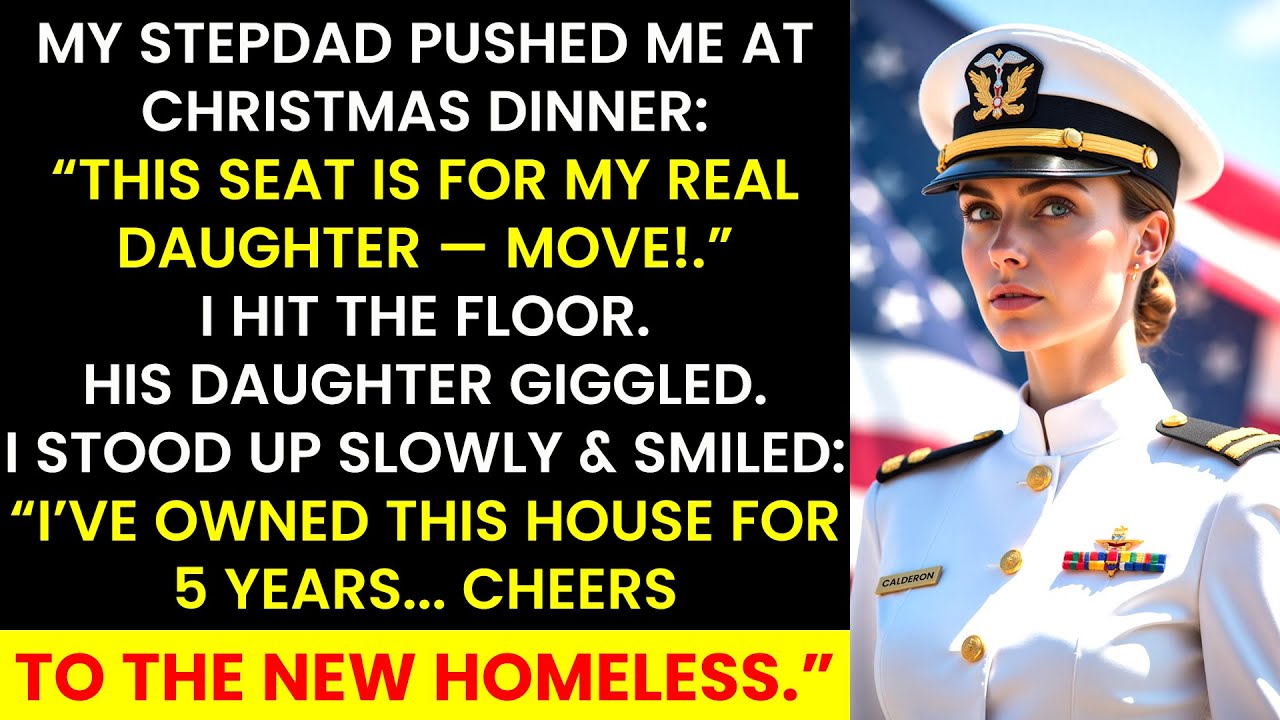
“You fell so dramatically. It’s like a B-movie stunt. ”
Richard stood over me, chest heaving, waiting for the outburst. “This spot is for my real daughter, not for a homeless border like you.
”
My mother just bowed her head and kept peeling potatoes like a ghost. They had no idea that the homeless woman they were humiliating tonight was the sole name on the deed to the house they were living in. I was a Navy Sergeant E5, twenty-eight years old, just back from a nine-month deployment. I never thought the most brutal battlefield would be my own dining room on Christmas Eve.
I had driven through blinding Ohio snow, my knuckles white on the steering wheel. In my tactical backpack sat a sixty-dollar bottle of Woodford Reserve, a peace offering for Richard. A desperate, foolish attempt to buy a ceasefire for the holidays. The moment I stepped through the front door, the warmth of the fireplace did nothing to thaw the icy hostility in the air.
The living room smelled of pine needles and stale cigarette smoke. Richard sat in his recliner with a Bud Light, his eyes glued to the football game. He didn’t even look up. Emily glanced at my service dress blues and sneered.
“Are you still wearing that costume? It’s Christmas, Livia. Nobody cares. ”
My mother fluttered around the kitchen, wiping her hands on her apron, her eyes darting everywhere except at me.
I realized it instantly. I wasn’t a daughter returning from service. I was an intruder breaching their perimeter. The dining table was set with bone china my grandmother had left behind.
Three plush red velvet chairs surrounded the turkey. In the far corner near a drafty heating vent sat a cold, rusted metal folding chair. In front of it, a flimsy white paper plate. I refused to accept it.
I walked to the head of the table and reached for the heavy wooden chair. “I will not sit in the corner,” I stated firmly. Richard moved with a speed that defied his size, launching himself from the recliner like a bear poked with a stick. “Do not give orders in my house,” he roared.
And then he struck me. I could have gotten up and broken his arm. The Navy had trained me well. I could dismantle a man of his size in under three seconds.
But Jocko Willink’s voice echoed in my mind, clearer than the pain: Discipline equals freedom. Detach. Do not let emotion dictate action. I didn’t scream.
I didn’t cry. Slowly, painfully, I pushed myself up and dusted off my uniform. I reached into my bag, pulled out the sixty-dollar bourbon, and cracked the seal. I poured a glass to the brim and looked Richard dead in the eye.
“Cheers, Richard. Merry Christmas, and congratulations to the newly homeless. ”
I downed the drink, slammed the glass down, and walked out into the blizzard. I sat in my Jeep parked a few blocks away, the engine idling, the heater blasting against my frozen hands.
The chill deep in my bones had nothing to do with the Ohio winter. My shoulder throbbed with a rhythmic ache, forcing me to reopen the cold case file of how I ended up here, shivering in a car while a tyrant feasted at my table. I was seventeen when my biological father died. He was a good man, quiet and hardworking, the kind who saved every penny in a coffee can.
He left behind a life insurance policy worth fifty thousand dollars—meant to be a safety net for my mother and me. Richard entered the picture two months after the funeral. “I will take care of you and the girl, Sarah,” he told her. Within six months, that fifty thousand dollars had evaporated.
Not into savings—into a brand new Ford F-150 with expensive rims and a sound system that shook the windows. The rest disappeared into failed sports bets and scratch-off lottery tickets. I remember the night I turned eighteen. I came home from my shift at the diner to find my mother crying at the kitchen table.
The landlord was threatening eviction. Richard was out at the bar showing off his truck. That was the moment the girl died and the soldier was born. I didn’t join the Navy because I loved war.
I joined because I needed the signing bonus to pay off their back rent. Three years later, I bought a ranch-style house in the suburbs with my VA loan. It was supposed to be my victory. But before the ink was dry, my mother grabbed my hand, her eyes rimmed with red.
“Livia, please. Do not tell Richard the house is in your name. You know how he is. If he knows he is living under his stepdaughter’s roof, it will destroy him.
He will leave us. ”
Because I loved her, and because I was young and stupid enough to believe peace could be bought with a lie, I agreed. We said we did it together. For the last five years, an automatic allotment was deducted from my military paycheck every month to cover the mortgage, property taxes, and insurance.
I paid for the new roof. I paid for the furnace repair. I paid for the very floorboards Richard had just thrown me onto. But inside those walls, Richard played lord of the manor.
He mounted a stuffed deer head on the living room wall without asking. When I came home on leave last year and tried to hang a small Navy flag in my old bedroom, he tore it down. “It ruins the aesthetic of my house,” he sneered. The neighbors told me how Richard held court at the local VFW, bragging about the empire he had built.
He accepted pats on the back, drinking beers bought with the money he saved by not paying rent. He was living a lie, and my silence was the foundation that held it up. But the violence didn’t start with that push. It started with a thousand tiny cuts over the three days leading up to the holiday.
I arrived home seventy-two hours before dinner. I opened my bedroom door expecting the smell of old books and lavender. Instead, I found neon pink, cheap hairspray, and a massive ring light on a tripod. My bed had been shoved into the corner, piled high with clothes that still had tags.
My desk was buried under an avalanche of drugstore makeup and tangled charging cables. And on the floor, my service dress blues jacket—the uniform I kept crisp and lint-free as a matter of honor—was balled up on the carpet. Emily was using it as a mat so her bare feet wouldn’t touch the cold floor while she filmed her dance video. “What are you doing?
” I asked, my voice barely a whisper. She popped her gum. “Oh, you’re back early. I just needed the lighting.
You can sleep on the sofa, right? You’re used to sleeping in the dirt or whatever. ”
I walked past her, ignoring the urge to tip over her tripod, and went to the bookshelf. The shadow box containing my Navy commendation medals and the folded triangular flag from my father’s funeral was gone.
I found them under the bed, shoved into a moldy cardboard box next to Emily’s muddy sneakers. The glass on the shadow box was cracked. “Why did you touch these? ” I growled, clutching the box to my chest.
My mother appeared in the doorway. “Now, Olivia, don’t be dramatic. Emily needed creative space. Those medals look a little violent.
They were throwing off the positive vibes of her live stream background. We just packed them away for safekeeping. ”
My sacrifice and my father’s memory were throwing off the vibes of a twenty-two-year-old’s lip-sync video. The next morning, Richard found me in the kitchen making pancakes.
He grabbed a piece of bacon off my plate and laughed. “Look at you. You’ve got arms like a bricklayer. No wonder you’re still single.
Men want a woman, Livia, not a GI Jane who looks like she can bench press a Buick. ”
He ate the breakfast I cooked while dismantling my womanhood between bites. The breaking point came on the afternoon of Christmas Eve, just hours before dinner. Richard cornered me in the garage.
“I heard the military creates big tax-free bonuses for reenlistment,” he said, his voice no longer mocking. Just greedy. “I need $5,000. The roof has a leak.
”
I froze. I had paid for a complete roof replacement last year. I had seen the brochures for the new Polaris snowmobile on the kitchen counter. “No,” I said.
“The roof is fine, Richard. I have the warranty paperwork. ”
His face transformed, the mask of the friendly stepfather slipping to reveal the predator underneath. “You think you can just come here, wave your money around, and not help the man who raised you?
You’re ungrateful. You’re stingy. ”
He gathered spit in his mouth and spat on the concrete inches from my combat boots. “Cheap,” he muttered, turning away.
That spit was a declaration of war. When he pushed me later that night, it wasn’t an accident. It was the punishment for saying no. I drove away with no destination until I saw the flickering neon sign of The Outpost, a run-down dive bar attached to the local VFW.
I took a seat at the far end, keeping my back to the wall, a habit I had never been able to break. A heavy hand landed on my left shoulder. “Livia? Is that Hawkeye from Bravo Company?
”
It was Marcus. He had traded his Kevlar vest for a flannel shirt and a blazer, but the eyes were the same—sharp, observant, the eyes of a man who had scanned rooftops for snipers in Fallujah. He was the best JAG lawyer the Marine Corps had ever produced before he retired to private practice. He didn’t smile.
“You’re listing to the right. You’re guarding that side. Your trap muscle is in a spasm. What happened?
You reinjure the old war wound? ”
My mother had lived in the same house with me for three days and hadn’t noticed a thing. Marcus looked at me for three seconds and knew exactly where I was hurt. I told him everything.
The folding chair. The bone china I wasn’t allowed to use. The demand for $5,000. The spit on the garage floor.
The shove that sent me sprawling. Marcus slammed his beer bottle down. “That old parasite dared to put his hands on you in the house you bought for him? ”
He offered to have Richard in handcuffs by midnight—assault and battery, domestic violence.
With my medical history, it was a felony charge. I shook my head. “If I have him arrested, my mother gets dragged into it. She will have to testify.
She will fall apart. ”
Marcus sighed, then a shark-like grin spread across his face. “Fine. We don’t use the police.
We use the nuclear option. I’ll pull your file, draft a formal eviction notice effective immediately based on breach of unwritten lease terms regarding tenant conduct, and print out every single bank transfer you’ve ever made. I’ll hand you a paper cannon. All you have to do is walk in there, place it on the table, and pull the trigger.
”
“You would do that on a holiday? ”
“For you? In a heartbeat. ”
I checked into a Motel 6 just off the interstate.
The room smelled of industrial-strength bleach and despair, but it was warm, and more importantly, it was mine. No one could tell me where to sit. In the harsh bathroom mirror, I saw the bruise on my shoulder—a deep, violent shade of purple and black spreading across my deltoid like a storm cloud. I snapped three photos from different angles.
I wasn’t posting them for sympathy like Emily would. I was documenting evidence. Then my phone buzzed. A text from my mother.
“Livia, please come back. Dad is not mad anymore. He says if you come in and apologize for your attitude earlier, he will let you sleep on the sofa tonight. It is Christmas.
Do not be stubborn. ”
She didn’t ask if I was hurt. She didn’t ask where I was sleeping in a blizzard. She didn’t ask if my shoulder, the one she knew was reconstructed with titanium pins, was okay.
Her only concern was managing Richard’s mood. Something soft and daughter-like inside me finally died. My mother wasn’t a hostage in that house. She was a collaborator.
I logged into my banking app and opened the recurring transfer. Mortgage payment: $1,200. Scheduled to go out in five days. It looked like extortion.
Protection money paid to a mobster who beat you up anyway. My thumb hovered over “Cancel recurring payment. ” A warning box popped up. “Are you sure you want to cancel this payment?
Late fees may apply. ”
I pressed yes with so much force I thought I might crack the screen. Autopay cancelled. I had just cut the fuel line to Richard’s ego.
I slept the deep, dreamless sleep of a soldier the night before an invasion. At seven in the morning, I stepped into a freezing cold shower and then reached for the garment bag on the back of the bathroom door. I pulled on my service dress blues, fastening the gold buttons one by one, pinning my ribbons to my chest, placing the white Dixie cup hat on my head at the regulation angle. The woman in the mirror wasn’t Livia, the stepdaughter who apologized for taking up space.
She was a sergeant in the United States Navy. Marcus was waiting for me at his office with a thick manila envelope. “This is the nuclear option, Livia. Once you put this on the table, you cannot take it back.
”
“They struck the match last night, Marcus. I am just controlling the burn. ”
I drove to the house. Richard’s massive lifted Ford F-150 was parked diagonally across the driveway, blocking the entrance completely.
His signature move. Not today. I shifted my Jeep into four-wheel drive, swerved off the pavement, tore through his pristine lawn, and pulled up inches from the front porch. The front door swung open.
Richard stepped out in a stained bathrobe, clutching a snow shovel, a cigarette dangling from his lip. He started to scream about his lawn, then saw the uniform. For a second, he looked unsure. Then his narcissism kicked back in.
“Well, look at this. The general has returned. What’s with the costume? You think playing dress-up is going to scare me into letting you back in for breakfast?
”
I looked him dead in the eye. “Step aside, Richard. ”
He smirked. “Or what?
You going to cry again? ”
“I am not here to eat,” I said, clutching the manila envelope tight. “I am here to take out the trash. ”
I brushed past him and walked into the warmth of the house I owned.
My mother and Emily were at the table picking at scrambled eggs and burnt toast. Emily didn’t even look up from her phone. “If you’re here to apologize, make it quick. I’m live right now, and I really don’t need your negative energy ruining my engagement metrics.
”
I walked past the empty folding chair in the corner and kicked it aside. It fell with a loud metallic crash. Richard stormed in, slamming his hand down so hard the coffee cups danced. “Are you deaf, girl?
I told you to get on your knees and apologize. ”
I reached up and slowly removed my white Dixie cup hat. With deliberate care, I placed it on the table next to the platter of bacon. In Navy culture, placing your cover on the table is a breach of etiquette.
Here, it was a flag planting. Then I grabbed the back of Richard’s heavy oak throne, dragged it out with a screech, and sat down. “You—you dare sit in my chair, in my house? ” He raised his hand, the same motion he had used the night before.
I didn’t flinch. I tapped the manila envelope with my index finger. “Sit down, Richard. Standing is tiring for a man of your age.
”
He froze. Bullies operate on fear. When they don’t get it, their system crashes. I slid the thick brown envelope across the polished wood.
“I have a late Christmas gift for you. I think you will appreciate this more than the bourbon I bought yesterday. ”
Greed won. He snatched the envelope and ripped it open.
A sheath of legal paper stamped with the red official seal of the county clerk fell onto the table. “Read it out loud, Richard. Let the whole family hear who actually owns the roof over their heads. ”
His hands began to shake violently.
The paper slipped from his grip and fluttered to the floor. “What? What the hell is this? ”
Emily snatched the paper up and scanned it.
“It says she owns it,” she read aloud, her voice trembling. “It says sole owner Livia Calderon. Dad, is this real? ”
The room plunged into suffocating silence.
A five-year-old lie shattering into a million pieces. My mother covered her face with her hands and let out a single sharp sob. “No, that is impossible,” Richard yelled. “This is my house.
I pay the bills. I pay the electric bill. I fixed the leaky faucet. I bought the fertilizer for the lawn.
”
I picked up the stack of bank statements and slammed them onto the table. “I pay the mortgage, Richard. That is $1,200 every thirty days for five years. I pay the property taxes.
I paid $5,000 for the new roof you bragged about to your friends. You are not the owner. You are a tenant. And you are a terrible, ungrateful, violent tenant.
”
Every number I spoke was a physical blow. I watched him shrink. For the first time in my life, I saw genuine fear in his eyes. “You assaulted the property owner.
Under Ohio state law, that is domestic violence. I can call the police right now. ”
The scream didn’t come from Richard. It came from my mother.
She threw herself out of her chair and grabbed my arm, her face wet with tears. “Don’t call the police! Livia, please do not do this to him. It will kill him.
”
I looked down at her. For years, she had stood between us to protect him from my truth. Now she was begging for mercy. I lowered the phone.
“I will not send you to jail today. But the game is over. You have exactly sixty minutes. You can go upstairs, pack your bags, and get out of my house forever.
Or you can go pick up that metal folding chair, the one you made me sit in last night, and bring it back here. If you want to stay under my roof, you will sit in that chair and listen to my conditions. ”
Richard looked at the door, then at me, then at the rusted metal chair lying on the floor. The arrogance was gone.
The king was dead. He walked slowly, shoulders slumped, picked up the folding chair, carried it back to the table, and sat down. But the sixty-minute deadline came and went. The front door never opened.
Richard spent the entire morning and afternoon sitting on that rusted metal chair, staring at the wall, motionless. By one in the morning, the house was dark except for a single lamp next to the sofa where I sat. I heard the floorboards creak. Richard emerged from the shadows, looking smaller than he had this morning.
He stopped a few feet from me, his hands fidgeting with the frayed hem of his sleeve. “Can I speak with you? ”
I nodded. He didn’t move toward his plush leather recliner.
He pulled over a small ottoman and sat down. For the first time in twenty years, he was physically looking up at me. “Why do you hate me so much, Richard? ” I asked.
“I don’t hate you, Livia,” he whispered. “I am afraid of you. ”
Tears tracked through the stubble on his cheeks. “I grew up with nothing.
My whole life I tried to be the big man. But I failed. Every business idea, every bet, every job—I messed it up. Then you came along.
You joined the Navy. You got the discipline. You got the money to buy this house when you were just a kid. You became everything I wanted to be, but never could.
Every time I looked at you, I saw my own failure staring back at me. So I had to push you down. Make you feel small. It wasn’t hate, Livia.
It was envy. ”
I looked at him for a long moment. The part of me that remembered the spit on the garage floor wanted to crush him. But the soldier in me knew you don’t execute a surrendered enemy.
I reached into my pocket and pulled out a single sheet of notebook paper. “This is the new lease agreement. You will attend AA meetings three times a week and anger management therapy. Your mother’s name goes on a joint checking account tomorrow.
No more secret spending, no more gambling. And zero tolerance: you will never raise your voice, raise your hand, or insult anyone again. If you call me a name or push anyone, that eviction notice gets filed with the sheriff the same day. ”
He signed his name with a shaking hand.
“Thank you, Livia. Thank you for not throwing a useless old man out into the snow. ”
“I didn’t do it for you, Richard. I did it for my mother, and because this house deserves peace.
”
“Good night, Livia. ”
“Good night, Dad. ”
It was the first time I had used the word without choking on it. Three months passed.
The brutal Ohio winter broke, making way for a fragile, hopeful spring. I pulled my Jeep into the driveway on Easter Sunday. The first thing I noticed was the order. Richard’s truck was parked perfectly parallel to the garage door, leaving ample space for me.
A silent admission of respect. Emily walked out of the kitchen wearing a red polo shirt and khaki pants—her uniform for her new job as a cashier at Target. “I picked up a morning shift for the holiday pay. I’m saving for my own apartment.
”
My mother was arranging tulips at the dining table. She looked younger. The deep lines of worry had softened. “He’s in the kitchen.
Go say hello. ”
Richard was wearing an apron over his church clothes, bent over the oven basting a turkey. This was part of his therapy. Acts of service to replace acts of dominance.
We gathered at the table. There was no metal folding chair. Four proper wooden chairs. Richard brought the turkey out and placed it in the center.
Then he reached into his pocket and pulled out a small rectangular box covered in blue velvet. Inside was a heavy brass plate, polished to a mirror shine with holes drilled in the corners for screws. I ran my thumb over the engraved letters. “Livia’s seat.
Commander and chief. ”
“I made it at the machine shop last week,” Richard said, his voice gruff. He walked around the table to the heavy oak chair at the head, pulled a screwdriver from his pocket, and screwed the plaque into the wood with clumsy, shaking hands. When he finished, he stepped back and gestured to the chair.
“From now on, that is your seat. Nobody else sits there. Not me. Not guests.
That is the captain’s chair. You earned it. I’m just part of the crew now. ”
I walked to the head of the table and ran my fingers over the cold, smooth brass.
“Thank you, Dad. ”
Richard’s eyes welled up, but he blinked the tears away. He raised a glass of water. “To the owner of the house.
”
A soldier knows true victory isn’t standing over a pile of rubble. That is just destruction. True victory is turning an enemy into an ally. I looked around my dining room, the sunlight streaming through the windows, illuminating the dust motes dancing in the air.
The perimeter was secure. The hostiles had been converted. The base was safe. And the greatest battle I fought wasn’t against Richard.
It was against my own belief that I had to shrink myself to be loved. I didn’t destroy my family. I saved it.