The scream filled every corner of the apartment. “Don’t touch her again. ” It wasn’t a plea. It was a command.
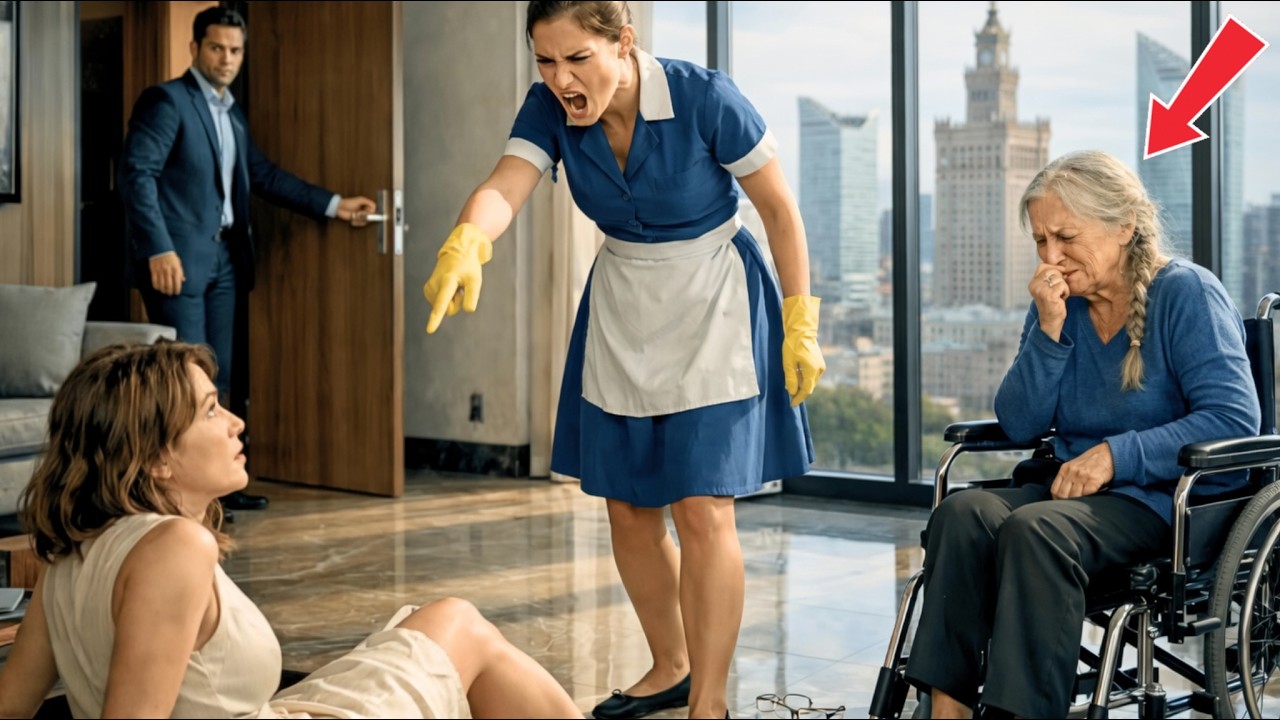
Łucja’s voice came from somewhere she didn’t know she had, as her yellow rubber gloves still dripped water from the mop she had dropped. Izabela wasn’t on the floor because Łucja pushed her. She had stepped back on her own, startled by something she hadn’t expected to see in a cleaner’s eyes. Dignity.
A look that said there was a line, and she had just crossed it. Pani Halina was crying quietly in her wheelchair by the window, clutching her hands. Robert Kowalski arrived late. He always arrived late.
He opened the door with his key, froze on the threshold, his hand still on the handle. His eyes scanned the scene in seconds: his wife on the floor, the cleaner standing over her pointing a finger, his mother weeping by the window. He said nothing. Neither did Łucja.
She didn’t lower her finger. It was Izabela who spoke first, in that voice she knew exactly how to modulate to sound wounded. “Robert, this woman attacked me. I want you to throw her out immediately.
”
Robert looked at Łucja. Łucja looked at him. There was something in that exchange that lasted too long. Not the pause between a boss and an employee.
Something older. Something Izabela couldn’t read, but which instinctively unsettled her. “What happened here? ” Robert asked.
His voice sounded tired more than angry. “Your mother,” Łucja said, her tone flatter now, calmer, but no less firm. “Your wife ripped off her medal. The one she’s worn for forty years.
The one that was your father’s. She threw it on the floor and told her to stop crying because she was ruining the atmosphere. ”
The silence that followed was different. Robert didn’t look at Izabela.
He looked at his mother. Pani Halina nodded faintly, eyes half-closed, as if saying it out loud cost her more than she could bear. Izabela got up from the floor with practiced elegance, brushing off her dress. “They’re exaggerating.
It was an accident. And either way, this employee has no right to scream at me in my own home. ”
“It’s his mother’s home,” Łucja said without moving. “Łucja,” Robert said, a soft warning in his voice.
“Yes, Mr. Kowalski. ” She picked up the mop from the floor, leaned it calmly against the wall, then bent to pick up Pani Halina’s glasses. She handed them back carefully, holding the older woman’s hands for a moment.
“I’m finished for today. If you need me, I’ll be in the kitchen. ”
She left without haste, without tears, without drama. Izabela watched her until she disappeared down the hall, and something shifted in her expression.
Not anger. Calculation. Six hours later, Łucja sat in the small room at the back of the apartment, back straight, feet on the floor, staring at the wall. She didn’t regret it.
That was what surprised her most. All her life she had learned that people like her couldn’t afford regret, that there were hierarchies, that crossing them came at a price. But this time, there was something about the image of Pani Halina, glasses on the floor, hands trembling, that had switched off every restraint she had built. Her phone buzzed.
A message from her sister Natalia in Kraków. How’s it going? All good. Łucja hesitated for a moment.
Yes, all good. Lying by text was easier. She turned off the screen and lay on the bed, staring at the ceiling. She heard footsteps in the hall, Izabela’s voice on the phone in a low tone she couldn’t make out.
Then silence. She thought about Robert, about how he had looked at her. Not the look of a man seeing his employee. The look of someone recognizing something he shouldn’t recognize.
Did he remember, or was she projecting what she wanted to see? For six months she had told herself she came to this house to work, that him living here was a coincidence, that what happened three years ago meant nothing now. But the truth was it meant everything, from the first day she crossed the threshold and saw him walking down the stairs in a tie, looking at his phone, not seeing her. She saw him.
And she stayed anyway. What she hadn’t calculated was Izabela. In the living room, Robert was left alone with his mother after Izabela went to her room with a headache. He sat across from Pani Halina and took her hands.
“Mom, don’t tell me I’m overreacting. ”
“You’re not,” she said before he could continue. He looked at her. At seventy-four, with gray hair braided over her shoulder and her glasses back on her nose, she was still the sharpest woman he had ever known.
“The medal was your father’s,” she said. “I know, Mom. ”
“I don’t care about the medal, Robert. I care that that woman looked at me like I was an old piece of furniture that was just in the way.
”
Robert didn’t answer. “Łucja stood up for me,” Pani Halina continued, quieter. “That girl has something I can’t explain. Since she came, she’s the only person in this house who talks to me like I still have something to say.
”
Robert looked down. “I need to talk to Izabela. ”
“For six months you’ve been saying you need to talk to Izabela,” his mother said gently but without mercy. “And nothing gets better.
Either it gets better, or it gets worse. Son, things don’t stay the same. ”
Robert stood, walked to the window. He looked out over the city.
“What do you know about Łucja, Mom? Did you ever ask her anything? ”
“I know she’s from Kraków. That she has a sister.
And I know that when she says your name, there’s something she’s very carefully controlling. ” She paused. “And you’re controlling the same thing, and you both believe the other doesn’t notice. ”
The silence that followed lasted a long time.
Neither of them broke it. The story began six months earlier. On that rainy morning in Warsaw, Łucja Nowak arrived at the address given by the agency with a small backpack, folded work clothes inside, and a knot in her stomach that had been with her for three days and wouldn’t dissolve. The building was one of those that needed no advertisement.
Glass facade, uniformed doorman, clean street. The kind of place where you immediately understood that unwritten rules existed, and you’d better learn them fast. She reported at reception, took the elevator, and rang the door of apartment 1402. A woman of about forty opened the door, straight dark hair, eyes that assessed quickly.
“Łucja Nowak? ”
“Yes, ma’am. ”
“I’m Izabela. The lady of the house.
Come in. ”
The apartment was large and bright, windows facing the city skyline. Everything was arranged with a precision that wasn’t cleanliness but control. Every object in its place, no trace of spontaneity.
“The rules are simple,” Izabela said, walking ahead without looking back. “Working hours from six in the morning to eight in the evening, Monday to Saturday. Sundays off unless there’s an emergency. No guests in the house.
No phone during working hours except for breaks. You don’t touch the rooms upstairs unless I tell you to. ”
Łucja nodded. “Do you have experience with elderly people in wheelchairs?
”
“Yes. I cared for my grandmother for four years. ”
Izabela stopped and looked at her for the first time with something like attention. “My husband’s mother lives here with us.
She’s independent but needs help with certain things. She likes breakfast at eight. She likes having the newspaper read to her on Tuesdays and Thursdays. Coffee without sugar.
” A pause. “She doesn’t like being treated like an invalid. ”
“Understood. ”
“Anything else you’d like to ask?
”
“Does the man of the house have any special instructions? ”
Izabela raised an eyebrow, very slightly. “My husband works a lot. Mostly he’s not here.
When he is, don’t disturb him. ” She said it with a naturalness that was almost carelessness, as if describing an object in an inventory. Pani Halina was already awake when Łucja knocked on her door for the first time. She was a small woman with a full presence, sitting by the window, an open book on her lap, glasses on the tip of her nose.
She looked up calmly. “You must be the new one. ”
“Yes, ma’am. Łucja Nowak.
”
“Very nice. Halina Kowalska. ” She offered her hand, not the back to kiss, but a full firm handshake. “Where are you from?
”
“I’m working, ma’am. ”
Pani Halina looked at her for a moment over her glasses. “I know that. I’m asking what brought you here.
”
Łucja didn’t answer right away. Not because she didn’t know, but because the true answer was too long and too complicated for a first day. “I needed a change,” she said. Pani Halina nodded slowly.
As if that was enough for now. “Do you know how to play chess? ”
“Basics? ”
“Good, I’ll teach you the rest.
Can you read aloud without being boring? ”
“I think so. ”
“We’ll test that later. ” She closed her book and put it on the table.
“Has anyone made you coffee? ”
“No, ma’am. ”
“Then go to the kitchen and bring two cups. Without sugar.
Mine, yours, however you like. And come sit here. ” She pointed to a chair across from her. “This corridor is too long to run back and forth with things that don’t matter.
”
Łucja went to the kitchen and returned with two cups. She sat across from Pani Halina, and for the first time in weeks, the knot in her stomach loosened a little. Robert Kowalski came home that evening at nine. Łucja was cleaning the kitchen when she heard the front door.
She looked out into the hall and saw him pass. Dark suit, loose tie, phone in hand, tall, with that kind of exhaustion that isn’t physical but comes from decisions. He didn’t notice her. She stood still until he went upstairs and disappeared.
She let out a breath. For six months she had prepared for this moment, telling herself that when she saw him in person everything would be different, that time erases traces, that people change. And it was true that she had changed. What she hadn’t calculated was that he was still exactly the same.
The same profile, the same shoulders leaning slightly forward when he thought, the same tendency not to notice what was right beside him because he was too busy looking ahead. Three years ago she had found that fascinating. Now it felt like a warning. The first week passed without incident.
Łucja quickly learned the house routine. She learned that Pani Halina ate breakfast alone and read the newspaper backwards, starting with culture. She learned that Izabela left at ten every morning and came back around one, sometimes with bags, sometimes without, always with the same inscrutable silence. She learned that Robert vanished before she finished serving morning coffee and returned after she had turned off the last light.
She also learned that between Izabela and Pani Halina there was a distance that wasn’t only physical. She noticed it on Wednesday. Pani Halina asked to have an old family photograph placed on her nightstand, a picture of her with her husband and a young Robert, about twelve, on a trip to the sea. When Izabela came in that afternoon to leave flowers, she glanced at the photo for a second, then said in the softest voice in the world: “Ah, those were the days when everything was simpler.
” She said it without looking at Pani Halina, without waiting for an answer, and left. Pani Halina waited until the footsteps faded, then looked at Łucja with a calm that was more expressive than any comment. “You understand why I can’t stand her? ” she said simply.
Łucja didn’t answer. But she understood. On Thursday of that first week, Robert saw her properly for the first time. It was early in the kitchen, before anyone else was awake.
Łucja was preparing Pani Halina’s breakfast when he appeared in the doorway, still in his robe, hair disheveled, looking for coffee. “Good morning,” Łucja said without turning. He stopped. “Good morning.
” A pause. “I haven’t seen you before. ”
“I’ve been here a week, sir. ”
“Ah.
” He leaned against the doorframe. “What’s your name? ”
“Łucja. ”
Another silence.
She kept cutting fruit, not turning around. He poured himself coffee in silence. “Do you like my mother? ” he asked from behind.
“Very much. She’s a wonderful lady. ”
“Yes,” he said—something in his voice that was both pride and guilt. “She is.
”
He left with his coffee, saying nothing more. Łucja didn’t turn around until she heard his footsteps fade. Then she closed her eyes for a second, just one. Because Robert Kowalski hadn’t recognized her.
And that was exactly what she had calculated she needed to stay. But the confirmation still hurt. That evening in her room, Łucja took out a folded piece of paper from the bottom of her backpack. A note he had left her three years ago.
Four lines, handwritten, no signature. She already knew it by heart. She folded it again, put it away, and told herself once more that she was here for work, only for work. That what happened before didn’t exist.
That she was new and he was different. She turned off the light and in the dark of the room, Łucja Nowak knew with absolute certainty that she was lying to herself. The discovery Izabela made wasn’t dramatic. It was worse.
It was accidental. Izabela Majewska wasn’t a woman who looked for problems where they didn’t exist. She was a woman who, when she found useful information, kept it silently and calmly decided how to use it. Three weeks after Łucja arrived, Izabela forgot her phone in the kitchen and came back for it.
Łucja wasn’t there, but her open backpack was on a chair, and from it stuck the corner of a folded piece of paper with handwriting Izabela recognized. It wasn’t Łucja’s writing. It was Robert’s. Izabela didn’t touch the paper.
She didn’t need to. Seeing the distinctive strokes was enough. She took her phone from the counter and left before Łucja returned. But she already had what she needed.
That afternoon, Izabela began to search. Not obviously. Izabela never did anything obviously. She started with simple things.
Łucja Nowak, Kraków, twenty-six. A nearly empty social media profile. She kept digging. In a private group of former university students, she found a photo from four years ago.
A small informal course ending celebration, twelve people smiling with certificates. Łucja Nowak was in the center of the photo, and next to her, hand on her shoulder, was Robert Kowalski. Izabela locked her phone screen. She sat in her car in a parking lot for twelve minutes without moving.
Robert had never mentioned this woman. Never said her name. And yet here they were, four years ago, with the kind of physical closeness you don’t have with a stranger. From that day, Izabela changed.
Not suddenly—that would have been clumsy. She did it the way she knew: gradually, precisely, so no one could point to the exact moment things went wrong. She began making demands of Łucja that couldn’t be faulted as unfair. The floor on the terrace has marks.
Clean it again. Pani Halina’s clothes smell of fabric softener; she doesn’t like it. We’re not eating here today, so you can use your free time to clean all the bathrooms upstairs. Each instruction came in a perfectly neutral voice.
No sharpness. Just work, just demands. The kind of pressure that leaves no trace but accumulates weight. Łucja obeyed without complaint.
But Pani Halina was watching. The older woman had that gift of elderly people who have lived enough: seeing what happens in the space between words. She saw Izabela give Łucja the heaviest tasks just as she sat down. She saw her ask tricky questions disguised as conversation.
On Wednesday, as Łucja read the newspaper aloud, Pani Halina interrupted. “What have you done to Izabela? ”
Łucja looked up. “Nothing, ma’am.
”
Pani Halina kept looking at her with a calm that was sharper than any interrogation. “Izabela isn’t a woman who torments for the sake of tormenting. When she hurts, it’s because she wants something or fears something. Which one is it with you?
”
Łucja didn’t answer at once. “I don’t know, Pani Halino. ”
The silence between them lasted long enough for both to understand that there was a truth neither of them was willing to speak yet. “Continue reading,” Pani Halina said finally.
Łucja continued. What Izabela hadn’t calculated was that pressure also produces reactions. Three weeks after she started making demands, she told Łucja to clean Robert’s study. A room that had been off-limits.
Łucja entered with the cleaning cart. It was a room that smelled of paper and that kind of orderly disorder that men who work a lot have. Marked books, stacks of files, a board with partly erased diagrams. She cleaned carefully, touching nothing unnecessary.
It was while cleaning the highest shelf that she saw it. Between a book on architecture and a box of documents lay an unopened envelope with no sender, her name in handwritten script on the front: Łucja Nowak. The same handwriting as the note in her backpack. Robert’s handwriting.
Łucja took down the envelope with hands that didn’t shake because she forced them not to. The paper was slightly yellowed at the edges. How long had it been there? She heard Izabela’s heels in the hallway and quickly slipped the envelope into her apron pocket.
That evening, locked in her room, she opened it. Inside was one page, written on both sides. Robert’s writing, more nervous than usual, beginning without greeting: I know you don’t have to read this. I know I have no right to write to you after what happened.
But there’s something you needed to know that I didn’t have the courage to tell you in person. Łucja read the letter twice. When she finished, she folded it carefully and put it beside the first note at the bottom of her backpack. She turned off the light and, for the first time since arriving at this house, she cried.
Three years ago, Robert Kowalski wasn’t the man he was today. He was younger in behavior, though the same age. He had come out of a four-year marriage that had fallen apart without scandal and without love, the way things that were never properly glued together fall apart. His company existed but was small, and he still had that kind of hunger that isn’t ambition but a need to prove something to himself.
The creative writing course had been a friend’s idea. Robert went with the attitude of someone handling a formality. Łucja was late that first evening. She came in while the instructor was speaking, took the only free chair, and pulled out a notebook that already had written pages.
Robert noticed because it was the most worn notebook in the room. They didn’t speak that evening. In the second week, the instructor paired them up to discuss what they had written. Robert and Łucja were paired.
She read his text—a clumsy piece about a construction site seen from inside, full of technical data disguised as metaphors. When he finished, she said: “You’re not describing a construction site. You’re describing how you feel inside one. ”
Robert looked at her, startled.
“Everything you wrote is about control—measuring, making sure everything is in its place, making sure the building doesn’t collapse. ” She closed his notebook and handed it back. “This isn’t a text about building. It’s about fear.
”
No one had said something like that to him in a long time. Maybe ever. For the next eight weeks they saw each other every Tuesday. At first they only talked about texts.
Then they started staying after class in the café downstairs. In those conversations, Robert learned who Łucja Nowak was. She came from a family without money but with books. Her mother sewed, her father was a driver.
She studied literature at a public university but had to stop after two years when her mother got sick. She found whatever work she could. The writing course she paid for in three installments—something she never told him. And there was what she carried underneath it all.
Łucja had a son. A seven-month-old baby named Szymon, who lived with her sister in Kraków while she worked in Warsaw to send money. A son whose existence no one in this house knew about. No one in Warsaw knew.
Because Łucja had learned that when a woman is alone and poor and has a child, doors close. Szymon was the secret she carried alone. His father had disappeared before she knew she was pregnant, without drama, without violence. One day he just stopped answering his phone.
Łucja decided that wouldn’t define her—Szymon would grow up knowing his mother always chose to stay. What happened with Robert wasn’t planned. It happened in the tenth week of the course, a Tuesday in November, when it was raining in Warsaw the way it only rains there. They stayed in the café longer than usual, talking about nothing in particular, the way people talk when they already know enough about each other not to need topics.
They left together under Łucja’s umbrella, because Robert didn’t have his own. At the corner where they were supposed to part, Robert looked at her in a way that needed no explanation. “I don’t think this is a good idea,” Łucja said. He didn’t agree, but neither of them moved.
What happened after was short and real. That’s what it was: one night, two people, honesty. The following week, Robert didn’t come to the course. The week after that, neither.
Łucja waited for him for two more Tuesdays. Then she stopped waiting. What she learned later, she heard from the instructor by accident. Robert had gotten the city contract.
His company had jumped. He’d moved to Mokotów. The instructor said it with admiration. Łucja nodded and asked nothing more.
What she didn’t know—what she was never told—was that Robert had tried to contact her. He’d left a note at the academy because he didn’t have her number. He’d written a letter he put away because he had no address to send it to. She learned that three years later, the evening she opened the envelope from the study.
And there was the hardest secret to carry: that Robert had looked for her, and she never knew. That things hadn’t ended by his decision, but by miscommunication. Three lost years. Szymon was now two years and ten months old.
Łucja called him every evening from her room, quietly, when the house slept. Her sister Natalia would hold the phone to his ear, and he would say mama in that voice that didn’t form sentences yet but already had definite opinions. Mama, come quickly, sweetheart, quickly. It was what she always told him, and it was always a promise that depended on things she didn’t fully control.
She had come to Warsaw for work. That was true. But she had also come because part of her wanted to know what really happened. She wanted to check if what she felt that rainy night was real, or if memory had idealized it into a lie.
And now that she knew, now that she had read the letter, she was more lost than before. Because the letter confirmed it—Robert hadn’t vanished by choice. And Robert Kowalski was now married to another woman. And that woman already knew something.
Łucja felt it in every extra instruction, every measured glance, every order that was slightly heavier than the last. Izabela knew. Not everything, but enough. Stefan Jasiński had been Robert Kowalski’s trusted lawyer for twelve years.
He had seen Robert’s rise from the inside. He arrived at the apartment on Thursday at seven with a folder under his arm and that look of a man who has something to say and is wondering how to say it. Robert received him in the study. Stefan waited until the door closed.
“Who is that woman? ” he asked. “An employee. She’s been here two months.
”
“From which agency? ”
Robert looked at him, surprised. “Why? ”
“Because Izabela called me last week asking whether it’s possible to check the employment history of a cleaner outside the normal channels.
” Stefan put the folder on the desk. “When I asked who, she gave the name Łucja Nowak. ”
The silence that followed was short but dense. “What did you tell her?
”
“That it’s not my field and it’s not a good idea. ” Stefan leaned back. “Robert, what’s going on in this house? ”
“Nothing I can’t handle.
”
“You said the same thing two years ago when you signed a marriage contract without reading the entire property clause. ”
Robert’s jaw tightened. “Stefan, I’m telling you this because this is my job. Izabela has been acting in ways I don’t understand for weeks.
She’s asked for information about accounts that isn’t normal. She’s consulted with a notary who isn’t me. And now she wants to investigate your employee. This is not a woman who’s content in her marriage.
This is a woman who’s building something. ”
“What accounts? ”
“The trust funds we set up three years ago. The ones holding the company’s pre-merger assets.
Those accounts are in my name. ”
“Yes, but in the marriage contract there’s a clause about sharing profits accumulated during the marriage, which you signed before I reviewed it. ” Stefan opened the folder. “If someone with a good lawyer decides to interpret it a certain way, there’s an argument for claiming a share of the value generated over the last eighteen months.
”
“Are you telling me Izabela is preparing an exit? ”
“I’m telling you someone is asking questions that only make sense if they’re planning an exit. I’m not telling you it’s her. I’m telling you to open your eyes.
”
Robert didn’t sleep well that night. Not because the information destroyed him, but because it fit. It fit with the small things he’d been ignoring for months because ignoring them was more convenient. At two in the morning he got up for water.
The kitchen was dark. Łucja was sitting at the table, doing nothing, arms around a cup that must have long been cold, looking out the window. Robert stopped in the doorway. “Can’t sleep?
”
Łucja looked at him in the half-light, without her uniform, hair loose, an expression she hadn’t had time to put away. She seemed younger, more real than she had ever seemed since she came. “Sometimes, no. ”
Robert poured himself water, hesitated, then sat across from her.
A long silence. They both looked out the same window. “Do you have family in Kraków? ” he asked.
“A sister. I always miss her. ”
Another silence, more comfortable than the last. “How long have you been doing this kind of work?
” Robert asked. “Since I was twenty-two, on and off. ”
“What did you study before? ”
Łucja looked at him.
It was an innocent question, asked with the naturalness of conversations at dawn. But for her, it wasn’t innocent. It was the border of a territory she couldn’t enter. “Things,” she said simply.
Robert nodded. He didn’t press. “My mother says you’re the best person who’s come into this house in years. ”
Łucja didn’t answer at once.
“Your mother is very generous. ”
“My mother isn’t generous. She’s precise. When she says something like that, it’s because she really thinks it.
”
The silence that followed had a different weight. They both felt it. They both chose not to name it. Robert stood.
“Goodnight, Łucja. ”
“Goodnight, Mr. Kowalski. ”
He was already leaving when she spoke again, almost involuntarily.
“The envelope from the study. ”
Robert stopped, back to her. “I found it while cleaning. It’s in the left drawer of your desk.
I put it there. ”
A very short pause. “I didn’t open it. ”
It was a lie.
They both knew it. Robert didn’t turn. “Thank you. ” And he walked on.
Izabela had seen them from the hallway. She hadn’t come out for water. She heard footsteps and came to see. She stood in the shadows of the corridor, far enough not to be seen, close enough to hear almost everything.
She didn’t catch the exact words, but she caught the tones, the length of the silences, the way Robert’s voice changed when he spoke to that woman. She knew that voice. It was the voice Robert no longer used with her. The next day, Izabela ordered Łucja to organize the closet in the guest room.
Pointless work in a room no one used. Łucja went without question. When she was inside, Izabela closed the door and locked it from the outside. Łucja heard the click.
She stood still, tried the handle. Locked. She knocked twice. “Mrs.
Izabela? ” Silence. “Mrs. Izabela, the door is locked.
” Nothing. Łucja sat on the edge of the bed in the empty room and waited. She knew this was a demonstration. A way of saying: I can do this to you.
I can lock you up anywhere I want. I can remind you who rules here. Forty minutes later, Pani Halina called Izabela from her room asking about Łucja. And Izabela, with all the calm in the world, went and opened the guest room door.
“How strange,” she said, looking at the lock. “These old doors sometimes jam by themselves. ”
Łucja walked out without saying anything. But that evening, before calling Natalia to talk to Szymon, she searched her phone for the number of the employment agency.
Not to resign. To have the number at hand just in case. Stefan Jasiński returned to the apartment the following Friday. This time he went to the living room, where Pani Halina was alone, drinking tea.
He sat down with her for a moment, waiting for Robert. “How are you, Pani Halino? ”
“Old and sharp,” she replied, “which is the worst possible combination, because you see everything and can’t do anything about it. ”
Stefan smiled.
“What do you see that others don’t? ”
Pani Halina looked at him over her glasses. “I see that my son married a woman who is counting how much this house is worth. ” A pause.
“And I see there is another woman in this house who is trying not to love my son, and who is doing a very bad job of it. ”
Stefan put his cup on the table. “Have you told Robert any of this? ”
“I told him that things don’t stay the same, that they get better or worse.
It looks like they’ve chosen worse before they get better. ”
“And what do you recommend, Pani Halino? ”
She thought for a moment. “That someone should ask Łucja Nowak what she came looking for in this house.
Because she didn’t come just to clean floors. I’ve known that from the first day. And I think it’s time someone else knew it too. ”
Izabela Majewska had learned from a very young age that money wasn’t an end—it was a tool.
She grew up in Wrocław, in a family that had money and lost it with the discreet elegance of those who prefer to pretend they never had it. Her mother had directed all her intelligence toward marrying well, then teaching her daughter to do the same. Izabela learned the lesson but improved it. She didn’t look for a good marriage.
She looked for a strategic one. Robert Kowalski appeared on her radar three years ago when his company was starting to truly grow. She met him at an investment meeting. He was attractive in that solid, discreet way men who built what they have are.
Izabela needed six months to develop the relationship, four more to strengthen it. When Robert proposed, she already knew the approximate value of every asset he owned. The plan was simple in structure, complex in execution: build a marriage that looked real long enough to establish legal claim over the property. The property clause in the marriage contract wasn’t Robert’s oversight.
It was Izabela’s suggestion, presented through a trusted lawyer as standard formality. Stefan Jasiński never thought it was good. Izabela knew this from the start and managed by keeping him away from important decisions. What she hadn’t calculated was that Stefan was more observant than he appeared.
On Monday after the locked-room incident, Izabela met her contact in a café in the north of the city. The man’s name was Bogdan Wiśniewski, a lawyer specializing in property law. “How are we doing? ” Izabela asked.
“The clause is solid if we interpret it according to the article we discussed. But we need to document your contribution to the consolidation of assets during the marriage. Emails, presence at decision-making, anything that shows active participation. ”
“I have enough.
I attended three board meetings in the first six months. There are minutes with my name as an observer. There are two emails where Robert consults with me about expansion decisions. ”
Bogdan nodded slowly.
“That helps. When do you want to move? ”
“There’s a complication. ”
“What kind?
”
“A domestic employee who knows more than she should. ” Izabela paused. “She has a connection to my husband from the past. I don’t know exactly how deep it was, but she’s in this house for a reason.
And that reason isn’t cleaning floors. ”
“What do you need? ”
“For her to disappear. ” Izabela said it without drama, without any trace that could connect it back to her.
What Izabela didn’t know was that Łucja had already discovered her plan. Three days earlier, she had been cleaning the terrace when she heard Izabela on the phone in the adjacent living room, door ajar. She didn’t hear everything. She heard enough.
Trust funds. Property clause. Before Robert changes his mind. Łucja stopped sweeping.
She listened two more minutes, then continued as if she had heard nothing. That evening she didn’t call Natalia. She stayed in her room, organizing information in her head the way she did when she needed to think clearly. What she heard wasn’t a partner’s conversation.
It was a conversation about strategy. Izabela was planning something, related to Robert’s money, and she had been planning it for a long time. The dilemma was as old as the world and as impossible as always. If Łucja said nothing, Robert would lose what he had built for years, without knowing, without being able to defend himself.
If she said something, she would have to explain how she knew. And explaining how she knew meant explaining why she was paying attention to what Izabela said on the phone. And Izabela had the photo. She had the course history.
She could build a narrative. And if she explained, she would also have to explain everything else: Szymon, the letter, why she really came to this house. Łucja closed her eyes. She thought of Szymon saying Mama in that voice of full certainty.
She thought of Robert’s letter saying There’s something you needed to know. She decided she would wait. Not out of fear, but because she needed to know more before she spoke. Because if she was going to open those doors, she had to open them with the whole story, not half of it.
The opportunity came on its own. The next Wednesday, Izabela left at ten as usual. Robert was at a construction site. Pani Halina was sleeping.
Łucja was cleaning the study when she saw Izabela’s open laptop on the couch in the living room, unlocked. She stopped in the doorway. She didn’t enter. From where she stood she couldn’t read the content, but she could see the email window was open, and the name in the header of the last message wasn’t one she recognized: Bogdan Wiśniewski.
Subject: Additional documentation. Stage two. She looked at the hallway. She looked at the screen.
She didn’t enter. She went back to the study and continued cleaning. But she remembered the name. That evening, from her room, she searched for Bogdan Wiśniewski online.
Lawyer, Wrocław, specialist in property disputes and asset division. Everything was clear. She didn’t need to see the email. With the name and the specialty, she understood the full map.
Stefan Jasiński arrived at the apartment that same afternoon, while Izabela still wasn’t back. He asked for Robert. Łucja told him he wasn’t there. Then, instead of leaving, he paused in the entrance.
“May I ask you something? ” He was looking at her. “Are you doing okay here? ”
It was a strange question, given where it came from.
“Yes, of course. Why do you ask? ”
Stefan watched her for a moment. “Because Pani Halina asked me to ask you.
And because I’ve known Robert Kowalski for twelve years, and something in this house isn’t right. And I’m not the only one who sees it. ”
Łucja was silent. If you ever need to talk to someone, Stefan said, leaving his card on the hall table, call me.
Not as Robert’s lawyer. As someone who wants things to go well. He left. Łucja took the card, looked at it, put it in her apron pocket beside her phone.
That evening she called Natalia. “Nati, I need to ask you to take care of Szymon a little longer. ”
“What’s going on, Lu? ”
“Nothing yet.
But I think soon everything will happen at once. ”
“Are you okay? ”
Łucja looked at Stefan’s card on the table. “I’m fine.
” A pause. “Can you put Szymon on? ” She heard her son’s voice on the other end of the line. “Mama, come.
”
“I’m coming, sweetheart,” Łucja said almost automatically. And this time, when she said it, it sounded less like a promise and more like a decision. The night everything fell apart was a Thursday. There were no earlier signals that this day would be different.
The apartment woke with the same silence: coffee at eight, the newspaper for Pani Halina, the rhythm of Izabela’s heels that Łucja knew by heart. Robert left early for a meeting. Łucja made the beds, cleaned the bathrooms, prepared lunch for Pani Halina. All with that calculated normalcy of someone who knows something is coming but doesn’t know exactly when.
What came happened at eleven in the morning. Łucja had entered Pani Halina’s room to leave her a cup of hot water when Izabela appeared in the doorway, without knocking. She stood in the middle of the room with an expression Łucja hadn’t seen on her before: something more open than usual, something that with another person would look like vulnerability, but with Izabela seemed like the first move in a game. “I need to talk to you,” Izabela said to Pani Halina.
The older woman slowly closed her book. “Then speak. ”
Izabela walked fully in. Łucja moved to leave.
Izabela stopped her with her voice. “Stay, Łucja. You should hear this too. ”
Something cold ran down Łucja’s back.
Izabela sat on a chair across from Pani Halina, crossed her legs, and spoke with a calm that was a kind of practiced stillness. “I’ve decided to file for divorce from Robert. ”
Pani Halina said nothing. “I know this affects you too.
And I wanted to tell you before I talk to him. Out of respect. ”
“Out of respect,” the older woman repeated, a statement, not a question. “This marriage isn’t working.
Robert and I have different visions of what we want. It’s better for both of us to separate now than to keep building something that has no future. ”
Pani Halina looked at her for a long moment. “And my son’s company assets?
Are you going to divide those too? ”
Izabela didn’t blink. “That’s a legal matter the lawyers will handle fairly. ”
“Your lawyers or his?
”
A short silence. “Pani Halino, I understand this is difficult, but please don’t dramatize. These things happen. ”
Łucja watched Pani Halina, her fingers clenched on the book cover, knuckles slightly white.
She watched Izabela maintaining her composure with that technical precision of hers. Then Pani Halina said something no one expected. “Do you know what pains me most about you, Izabela? ”
Izabela waited.
“That you never had the courage to really love him. ” The older woman’s voice was quiet, but each word carried its own weight. “Robert is a man who made mistakes, who was alone too long, who needed someone who would see him, not count what he was worth. And you chose the latter.
”
“I didn’t come here to be judged. ”
“No. You came here to announce that you’re taking what isn’t yours, and you wanted to do it looking me in the eye, to see if I’d break. ” Pani Halina reopened her book.
“I won’t. I already broke when my husband died. Everything that came after was easier. ”
Izabela stood.
And in that moment of standing, something broke in her too. Not her whole composure, just an edge, enough that what she said next had a different temperature. “That woman,” she said, pointing at Łucja, “is not here for work. She’s here because she has something with your son.
And if you think that’s better than what Robert has with me, you’re blinder than you seem. ”
Pani Halina looked at Łucja. Łucja didn’t lower her gaze. “They’re both here,” Izabela continued, her voice sharpened.
“Looking at each other like no one sees them, and you protect her like she’s family. She’s not. She’s a cleaner who came to look for something that isn’t hers. ”
“Izabela,” Łucja said quietly.
“Don’t talk to me. ” Izabela turned to her for the first time, her eyes no longer containing calculation but real fury. “You have no place in this conversation. You clean floors.
That’s all you are. ”
The silence lasted one second. In that second, Izabela made the mistake everything before had been leading toward. She reached out her hand toward Pani Halina’s medal—the one from her husband—and grabbed it roughly.
“This is exactly the problem,” she said. “Clinging to old objects instead of looking to the future. ” And she pulled. The thin chain resisted for a second before breaking.
Pani Halina made a short sound of pain and something deeper. Her glasses hit the armrest and fell to the floor. Łucja was already moving. She stepped between Izabela and Pani Halina, blocking her path.
When Izabela tried to step around her, Łucja raised her hand and stopped her with a firmness that wasn’t violence but left no room for negotiation. “Don’t touch her again. ”
The voice came from a place Łucja didn’t know she had. Izabela stepped back, more surprised than afraid.
Then Łucja pointed down at the floor, where the medal had fallen. “Pick it up. ”
“Don’t you dare order me in my own…”
“Pick it up. ”
Izabela looked at both of them—Łucja blocking the way, Pani Halina trembling, eyes closed.
And then the apartment door opened. Robert had come home early. He found the open door to his mother’s room, entered, and froze in the threshold. He saw Łucja standing, pointing.
He saw Izabela holding his mother’s medal. He saw his mother in the wheelchair, eyes still closed, hands clenched on her lap. He didn’t speak at once. He lowered his gaze to the floor, saw the glasses, picked them up calmly, brought them to his mother, put them on her carefully.
Pani Halina opened her eyes and looked at him. Robert straightened, turned to Izabela. She was still holding the medal. “Give it to me,” he said.
His voice was flat, no recognizable temperature. Izabela dropped it into his palm. Robert brought it to his mother, put it back around her neck, his hands shaking slightly—enough for Łucja to see, though no one else noticed. Then he turned to Izabela.
“Get out of this room. ”
“Robert, I need you to listen. ”
“Leave this room now. ”
Izabela left.
Robert looked at Łucja. She held his gaze for a second, then went to pick up the glasses from the floor, even though he had already picked them up, just to have something for her hands. “Thank you,” Robert said very quietly. Łucja nodded, saying nothing.
He went out after Izabela and closed the door. Pani Halina looked at Łucja. “Sit down,” she said. Łucja sat.
The older woman took her hand and held it. “Enough,” she said finally, very quietly. “Enough. ”
And Łucja, who had endured everything without breaking, had to look toward the window so Pani Halina wouldn’t see her eyes fill with tears.
In the living room, Robert and Izabela were alone for twenty minutes. When Izabela finally left the house, she walked past Pani Halina’s room without stopping. Before reaching the front door she paused in front of Łucja’s room. She didn’t enter.
She just stood there, looking at the closed door. “This isn’t over,” she said, loudly enough that only she could hear. Maybe, if Łucja was close, she heard it too. Stefan arrived at three.
It wasn’t Robert who called him—it was Pani Halina, who called from her room with a calm that allowed no protest. “Come now, Stefan. What was supposed to break has broken today, and now we need to repair what remains. ”
Stefan came with the folder he had been preparing for weeks.
Robert was in the study staring at the board with partially erased diagrams. Stefan closed the door. “How are you? ”
“Fine.
”
“You don’t look fine. ”
“She left. She has an apartment in Mokotów. I think she’s had it for a while.
” Robert said it without emphasis, as if he had already processed that part. “She sent me a message saying we’ll talk through her lawyer, Bogdan Wiśniewski. ”
“I know who he is and what he does. ” Stefan opened the folder.
“Robert, you need to read this today, not tomorrow. ”
The folder contained three things: a copy of the property clause in the marriage contract with handwritten notes, a summary of consultation actions Bogdan Wiśniewski had taken regarding Robert’s company over the last two months, and a letter of intent for separation dated three weeks earlier. Robert read in silence. When he finished, he closed the folder and placed it on the desk with excessive care.
“She signed this before what happened today. ”
“What happened today wasn’t spontaneous, Robert. It was an execution of something planned. And the clause—how solid is her position?
”
“She has arguments. Not perfect ones, but with the right lawyer and the right judge, she can build a case. ”
“So we need to move fast. And I need you to tell me everything you know about what she’s been doing these months.
Meetings, calls, people she saw. ”
Robert nodded and began to speak. They were in the study for an hour. When they came out, Stefan had enough to begin building a defense.
And Robert had the expression of a man who had just understood that something he considered solid had been paper from the start. Łucja heard the study door open. She was in the kitchen preparing dinner for Pani Halina. She heard Stefan say goodbye, heard his footsteps toward the exit, then Robert’s footsteps coming toward the kitchen.
She prepared herself. Robert came in, leaned against the doorframe. “How is my mother? ” he asked.
“Resting. She ate well. She’s calm. ”
“Good.
” A pause. “Łucja. ”
“Yes? ”
“I need to ask you something.
”
She put down the knife and turned. Robert was looking at her with an expression that wasn’t his boss face, nor a tired man at dawn. It was something harder to name, something he was calculating whether he could afford. “I need you to tell me the truth about something.
”
Łucja waited. “Izabela said that you and I—that something happened between us in the past. ”
The silence lasted just as long as it takes for a decision to become irreversible. “Yes,” Łucja said.
Robert didn’t move. “Yes. ”
A longer silence. “Why didn’t you tell me when you came?
”
“Because you didn’t recognize me. And because I thought it would be better that way. ”
“Better for whom? ”
“For both of us.
Mostly for me. ”
Robert moved away from the doorframe, came into the kitchen, sat at the table, and looked at his hands. “I looked for you. ”
“I know.
”
“After the course, I left a note at the academy. ”
“I know. I found the letter in your study, when I was cleaning. ”
Robert looked up.
He didn’t say anything for a moment. There was no accusation in the question, and no accusation in the answer. Just two people telling each other the truth after a long time of not doing so. “So you know what was in it?
”
“Yes. ” Łucja looked at him directly. “And there’s something else I need to tell you. Something you don’t know.
”
Robert waited. Łucja spoke without introduction, in the way she had learned to do hard things—going straight to the point. She told him about Szymon. He was almost three, living with her sister in Kraków.
He was the real reason she had come to Warsaw, because she needed money and because there was something else she needed to resolve. Robert listened without interrupting. When she finished, the silence that followed was different from all the others that evening. It was the silence of someone processing something that completely changed the map.
“His father? ” Robert asked carefully. “There is no father. There never was.
”
Robert slowly nodded. “And why are you telling me this now? ”
Łucja paused. “Because this morning Izabela broke something that wasn’t hers.
And because carrying this truth alone weighs more than I can bear. ” She paused again. “And because you have the right to know everything before I leave. ”
Robert looked at her.
“You’re leaving? ”
“I think that’s appropriate. After today, staying would complicate everything. ”
“For whom?
”
“For you. You have enough with Izabela, with lawyers. ”
“And with you? ” he said.
“I asked, for whom? ”
She didn’t answer. Robert stood, walked to the kitchen window, looked at the courtyard. “I didn’t recognize you either when you came,” he said, back to her.
“Or at least, I told myself that. But the first time I heard you talking to my mother from the hallway, I knew. ” A long pause. “I didn’t want to know.
But I knew. ”
Łucja stood very still. “Why didn’t you say anything? ”
“Because I was afraid of what it meant.
Because I was married. Because I’d made decisions I couldn’t reverse overnight. ” He turned. “All the same bad reasons people have when they decide not to see what’s in front of them.
”
They looked at each other from opposite ends of the kitchen. It wasn’t a moment of resolution—there was too much broken on the floor, too many lawyers and documents and decisions ahead. But it was the first real moment they’d had in three years. The first in which neither of them chose not to see.
Stefan called at nine. Robert answered in the study. “I have something,” Stefan said without preamble. “Bogdan Wiśniewski has an old complaint about unethical practice in Wrocław.
The case was dropped, but the file exists. And there are two previous clients of Izabela’s—from previous situations, before you, who signed confidentiality agreements after separations. The amounts aren’t public, but there’s a record. ”
“What does it mean?
”
“That this isn’t the first time she’s done this. And if we find those clients and one of them talks, we have a pattern. A pattern is much harder to defend against than a single case. ”
“How much time do you need?
”
“A week, maybe less. ”
“Good. ” Robert looked toward the hallway. “Stefan, one more thing.
Łucja Nowak. I want you to make sure she’s legally protected if Izabela tries to harm her. ”
A short silence on the other end. “Is there something I should know?
”
“Yes. But I’ll tell you in person tomorrow. ”
“Agreed. ” A pause.
“Robert, good decision calling me earlier. ”
“I didn’t call you. My mother did. ”
There was a pause, and then, for the first time in that endless evening, something almost like a smile in Stefan’s voice: “Of course.
As always. ”
Pani Halina was awake when Łucja went to bid her goodnight. The older woman was holding the medal in her hand, sliding it slowly between her fingers. “Did you talk to him?
” she asked without looking up. “Yes. ”
“Everything? ”
Łucja hesitated a second.
“Almost everything. ”
Pani Halina looked up. “Almost. There’s always the most important part.
”
“I know, Pani Halino. ”
The older woman watched her for a moment, then reached out and took her wrist gently but firmly. “What’s his name? ”
Łucja knew without asking.
“Szymon. ”
Pani Halina smiled. It was the first time Łucja had seen that smile on her—the one that came from deep. “Szymon,” she repeated, as if storing the name in a safe place.
“That’s a good name. ”
Łucja nodded, her throat tight. “Goodnight, Pani Halino. ”
“Goodnight, Łucja.
” She released her. “And sleep well, because tomorrow there is still much to solve, and there’s no point solving it with tired, closed eyes. ”
Łucja turned off the light and closed the door. In the hallway she stood for a moment, back against the wall, eyes closed.
Szymon. Robert. The letter. The medal.
Stefan. Izabela. All at once. She took a breath and went to her room to call her son.
Friday dawned gray over the Warsaw rooftops. Łucja got up before the alarm, dressed in silence, went to the kitchen, made coffee. She did everything with the same daily routine, the same gestures repeated for months. But something inside was different.
As if the knot that had been so tight for so long had loosened. She hadn’t slept much, but she had slept deeply, without the weight of what had gone unsaid. Robert appeared at seven, not in a suit, in simple clothes, as if he had decided that today wasn’t a day for presentation. He poured himself coffee in silence, sat at the table.
Łucja put Pani Halina’s breakfast on a tray and started to take it. “Łucja. ”
She stopped. “Thank you, for everything yesterday.
” It wasn’t only about the medal. They both knew. “You don’t need to thank me,” she said. “Yes, I do,” he said simply.
“Yes, I do. ”
Łucja took the tray to Pani Halina’s room. The older woman was already awake, sitting in her wheelchair by the window, the medal around her neck, a closed book on her lap. “Put the tray there,” she said, “and sit down for a moment.
” Łucja placed the breakfast and sat in the chair opposite. Pani Halina looked at her directly. “When were you planning to leave? ”
“Pani Halino…”
“Don’t tell me you hadn’t thought about leaving.
I’ve known you for six months. I know what you look like when you’re calculating an exit. ”
Łucja looked down. “I thought that after yesterday, the cleanest solution would be to leave.
So everything that happened here could resolve without me complicating things. ”
“And Szymon? ” The name in Pani Halina’s mouth still surprised her. “Szymon is doing well with my sister.
He’s been doing well all these months. ”
“That’s not what I asked,” Pani Halina said. “I’m asking about you. I want you to understand something.
The weight you’ve been carrying alone all this time—you didn’t have to carry it alone, and you don’t have to continue carrying it alone now. ”
“Pani Halino, Robert’s situation is complicated now. The last thing I need is…”
“Do you know how old my son is? ” the older woman interrupted.
Łucja paused. “Forty-two. ”
“Forty-two. A company.
A mother in a wheelchair. And he just discovered his marriage was a transaction. ” Pani Halina paused. “Do you think he needs someone to simplify his life by getting out of the way?
Or do you think he needs, for once, someone to stay even though it will be complicated? ”
Łucja didn’t answer. “There’s a difference,” she said cautiously, “between staying because you want to and staying because you feel you owe something. I don’t want Robert to feel he owes me anything.
”
“And what if it’s not debt? What if it’s choice? ”
“Łucja. I’ve seen my son in many states.
I saw him build his company from nothing. I saw him lose his first marriage. I saw him alone for years, never complaining, because he doesn’t know how to complain. ” She squeezed Łucja’s hand.
“And for six months, I have seen him look at you with an expression I haven’t seen on him in a long time. The expression of someone recognizing something he thought he had lost. ”
The silence that followed didn’t need filling. “Eat breakfast with us today,” Pani Halina said, releasing her hand.
“The three of us. It’s time. ”
Stefan arrived at eleven with news. He met Robert in the study, and this time the door stayed ajar.
Łucja didn’t hear everything, but she heard enough as she passed with her cleaning cart. Stefan had found one of the people from Izabela’s past—a woman from Kraków who had signed a confidentiality agreement four years ago after a separation that had cost her half of what she had. The woman wouldn’t speak publicly, but off the record she confirmed that the method was the same: the lawyer Bogdan Wiśniewski, the same property clause, the same sequence. “We can’t use her as a witness,” Stefan said.
“But we can use her as a pattern to build an argument of bad faith. And bad faith changes everything in the legal interpretation of the clause. ”
“How long? ”
“If we move this week, we can secure a claim on the assets before she files the formal petition.
That gives us position. ”
“Move,” Robert said. What followed was harder. Robert found Łucja on the terrace, where she was righting the potted plants Pani Halina kept, knocked over by the night wind.
“Do you have a moment? ”
“Of course. ”
They stood among the pots with the sky still gray over the city. “I want to ask you something,” Robert said.
“And I want you to think before you answer. ”
Łucja waited. “I want you to stay. ”
It was simple, direct.
Robert, for the first time in six months, used her name without the Mrs. in front of it. She noticed it at the same moment he did. “The situation with Izabela will be complicated in the coming weeks.
If I stay, she could build a narrative that harms you. ”
“Let her say what she wants. That’s not how it works. ”
“Yes, it is.
”
Robert looked at her with the expression he had when he had made a decision and was no longer questioning it. “What Izabela built wasn’t a marriage. It was a contract with an expiration date. That doesn’t change whether you’re here or not.
What changes is something else. ”
“What? ”
“If you leave, I stay without the only person in this house who told my mother the truth when no one else would. Without the only person who told me about fear when I thought I was talking about construction.
” He paused. “Without the only person I know who is raising an almost-three-year-old child alone, who doesn’t complain, doesn’t ask, doesn’t demand—and who deserves someone to tell her that she doesn’t have to do it alone. ”
Łucja looked at him. Her eyes were dry—she had learned to keep them dry in important moments—but something in her jaw, in the line of her shoulders, relaxed without her permission.
“I don’t know what will happen,” she said. “I have a son. I have a life in Kraków. I have things to resolve that won’t resolve overnight.
”
“I know. And you have a divorce, lawyers, assets to protect, and a company to run. I know that too. So what exactly are you asking?
”
Robert thought for a moment. “Not to make your decision about leaving because of me. That if you leave, it’s because you want to leave, not because you think it’s easiest for others. ”
Łucja looked at the overturned pots, straightening them one by one, thinking.
Robert didn’t rush her. When she finished with the last one, she wiped her hands on her apron and looked at him. “Give me time,” she said. “As much as you need.
”
That afternoon, Łucja called Natalia. She didn’t wait until evening. “Nati, I need to tell you something. ”
“What happened?
”
“Nothing bad. ” She took a breath. “I told Robert about Szymon. ”
The silence on the other end lasted a few seconds.
“And? ” Natalia said finally, in that voice of hers that had carried four years of supporting her sister. “And… I don’t know yet. But he knows, and he didn’t react the way I feared.
”
“How did he react? ”
Łucja paused. “Calmly. With respect.
” She paused again. “He asked me to stay. ”
Natalia was quiet for a moment. “Lu, tell me—for three years you’ve been carrying that note of his folded in your pocket.
For six months you’ve been in this house, telling yourself you’re only there for work. How much longer? Are you going to keep convincing yourself you don’t want what you want? ”
“It’s complicated, Nati.
”
“Everything is complicated. Szymon was complicated too. And here we are. ” A pause.
“Do you want me to bring him? ”
“What? ”
“Szymon. Do you want me to bring him to Warsaw?
”
Łucja closed her eyes. The image came on its own: Szymon in that big kitchen. Szymon with Pani Halina and her glasses and her book. “Not yet,” she said.
“But soon. ”
“How soon? ”
“Soon is soon, Nati. ”
Her sister exhaled.
“All right. ” Then, more gently, “Are you okay? ”
Łucja looked at the wall of her small room at the back of the apartment, where she had spent six months sleeping with a folded note at the bottom of her backpack. “I’m better than yesterday,” she said.
“That’s something. ”
Robert went to his mother’s room, sat across from her on the low chair no one used but him, and was silent for a moment, looking at the floor. Pani Halina waited. “Mom, why didn’t you tell me earlier what you saw?
About Izabela. About what was happening? ”
The older woman thought honestly. “Because I did tell you.
I told you things get better or worse, that they don’t stay the same. ” She paused. “But there are things a son has to see for himself. Robert, if I tell you everything, you won’t see it—you’ll only hear it.
And hearing isn’t the same as seeing. ”
“And Łucja? ”
Pani Halina smiled. “I saw Łucja from the first day, from the moment she came into this room with two cups of coffee and sat with me without needing to be asked twice.
”
“And you said nothing to me then either? ”
“Because that’s not something you say either. It’s something you see when you’re ready to see it. ”
Robert slowly nodded.
“You knew. ”
“I didn’t know. I suspected. There are things that have only one explanation.
And with Łucja, the explanation was always that she was carrying something she loved too much to talk about easily. ”
Robert looked at the medal his mother wore. “His name is Szymon,” he said. Pani Halina closed her eyes for a second.
“Szymon,” she repeated. “How old is he? ” A short, warm silence. “I want to meet him,” she said simply.
Robert looked up. “Mom, there are still so many things…”
“I’m seventy-four and I’m in a wheelchair, and I have as much time as God wants to give me. I don’t have time to wait for everything to be perfect to meet the people I care about. ”
Robert looked at her for a moment, then leaned forward and kissed her forehead.
“Goodnight, Mom. ”
“Goodnight, son. ”
And as he was standing up she said, “Robert. ”
“Yes?
”
“This time, don’t lose her. ”
She didn’t say it as a reproach. She said it as the last important thing a mother tells her son when she knows she doesn’t need to repeat it. Three weeks later, the sun rose over Warsaw—not the shy sun of gray days that barely warms, but a real sun, filling the apartment through the large windows.
Łucja was in the kitchen when she heard the doorbell. Natalia came in with Szymon by the hand. The boy entered the apartment with the seriousness that almost three-year-olds have in new places, looking at everything, assessing, not yet letting go of his aunt’s hand. He had his mother’s curly hair and dark eyes.
And that way of standing with firmly planted feet that Łucja recognized. “Szymon,” Łucja said, kneeling before him. The boy looked at her for a second, then released Natalia’s hand and walked straight to her. “Mama.
”
Łucja wrapped her arms around him tightly, the kind of embrace that isn’t a greeting but a recognition. Szymon pressed his face into her neck, and she closed her eyes and breathed. At noon, Robert came in from his meeting with Stefan. Things with Izabela were moving in a good direction.
The asset claim had been granted. Bogdan Wiśniewski’s file had officially come to light. There were signs that Izabela, reassessing the terrain, was beginning to consider an out-of-court settlement. Robert opened the door to the apartment and heard a voice he had never heard in this house before.
He followed the sound to the living room. There, Pani Halina sat in her wheelchair at a low table, and across from her, sitting on the floor with crossed legs and unusual seriousness, was a boy with curly hair, looking with absolute concentration at chess pieces the older woman had set out. “This,” Pani Halina said, taking a knight and placing it before the boy, “is called a knight. Can you say knight?
”
The boy took the piece with both hands. “Con,” he said almost. “Con. ”
Pani Halina smiled with a patience and warmth Robert hadn’t seen in years.
“That’s enough for today. The knight is yours. ”
Szymon pressed the piece to his chest with absolute satisfaction. Robert stood in the doorway of the living room, saying nothing.
Pani Halina looked up and saw him, and her expression held something peaceful and complete. “You’re home,” she said simply. “I’m home. Mom, Szymon—this is the knight man.
”
The boy looked up at Robert, assessing him with that direct gaze children have before they learn to hide what they think. “Mine,” Szymon said, gripping the piece tighter. Pani Halina let out a short true laugh. “Robert, too, can be yours,” Robert said.
“Keep it. ”
Szymon nodded with the satisfaction of someone who had just successfully concluded negotiations and returned to the board. Łucja found them like that when she came back from seeing Natalia off. She stopped in the doorway of the living room.
Robert was looking at her from across the room. Pani Halina with a quiet smile. Szymon on the floor, the chess knight clutched in his hands. It was an image she hadn’t planned, hadn’t calculated, that fit none of the scenarios she had constructed over all those months.
“How did it go? ” Robert asked. “Good. Stefan called when you were arriving.
The judge signed this morning. ”
“I know. I already spoke with him. ”
A short moment.
“Well, that’s normal. ”
“Yes, normal. ” So normal it almost hurt. “Mama,” Szymon said from the floor.
“I said knight. ”
“I see, sweetheart. ”
“Mine? ”
“Yours.
Yes. ”
The boy, satisfied, returned to the board. Pani Halina looked at them both with that calm expression of someone who had lived long enough to know when something was in place. “I’m going to rest for a moment,” she announced, arranging her hands on the wheelchair armrests.
“Szymon, will you escort me? ”
The boy stood from the floor, the knight still in his hand, and walked to the wheelchair without being asked twice. Pani Halina began to wheel toward the hallway, and Szymon walked beside her, grave and formal, as if escorting an elderly lady in a wheelchair was exactly what he had planned to do that afternoon. At the entrance to the hallway, the older woman stopped and looked back once.
She said nothing, just looked at them, and continued on. Robert and Łucja were alone in the living room. Afternoon sun came through the big windows. “What now?
” Łucja asked. “Now a lot of things happen,” Robert said. “The divorce will take time. The legal situation will be complicated for months.
” He paused. “Szymon needs a stable place. You need to stop living like you’re going to leave at any moment. ”
“I don’t know how to live any other way.
”
“I know. That’s why I’m asking you to learn it here. ”
Łucja looked at him. For three years she had carried a folded note in her pocket.
For six months she had told herself she was only there for work. Her whole adult life she had learned that hard things are carried alone. And now she was here, in this living room, with the sun coming in the windows, with her son learning to say the word knight in the room of an old woman who had adopted him in five minutes, with a man telling her to stay in a way that wasn’t debt, wasn’t pity, wasn’t obligation. It was choice.
“Robert,” she said. “Yes? ”
“Tell me when I stop being your employee. ”
He waited.
“We need to talk about many things. All of them. Including the difficult ones. And I don’t know how this will end.
”
“I don’t either,” he said, looking at her. “But I know I want to find out. And I know the only way to find out is if neither of us is looking at the exit door while we talk. ”
Łucja looked down for a moment, then up.
“Agreed,” she said. That evening, after Szymon had fallen asleep in the room Łucja had prepared for him, she stood at the living room window. Warsaw was lit below. Robert came in and stopped beside her.
For a moment they said nothing. “Asleep? ” he asked. “He knocked out in five minutes.
”
“He’s got your energy, in reverse. You never stop until you stop completely. ”
Robert looked at her. It was the first joke.
The first thing said without calculation. Łucja noticed it in the same moment he did. Robert smiled slowly. “Three years, and you only know me from one note and a letter.
”
“And from the way you write about construction when you’re really writing about fear. ”
He let out a breath, almost a laugh. “That was four years ago. ”
“People don’t change that much.
”
He looked at her. “No. They don’t change that much. ”
The silence that followed was one of those that don’t weigh anything, the kind you can live in without paying for it.
Outside, Warsaw continued. Cars, lights, the muted noise of the world going about its business, indifferent to the small and enormous things happening in the apartments. “Tomorrow,” Łucja said, “we need to talk about practical things. ”
“Tomorrow and the day after.
”
“And there will be hard days. ”
“Probably many. ”
“And Szymon throws magnificent tantrums when he doesn’t sleep enough. ”
Robert looked at her sideways.
“I’ll manage. ”
“You have no idea what you’re saying. ”
“Probably not. But I want to find out.
”
Łucja looked at him. She held his gaze for a long moment, without haste. “Good,” she said at last. And that one word, spoken without drama and without impossible promises, was enough.
Because sometimes the biggest things don’t fit into big sentences. Sometimes they fit exactly into that—true, well spoken, in front of a window, with a child sleeping in the next room and an old woman who knew the ending before either of them saw it. In her room, Pani Halina held the medal between her fingers in the darkness. She wasn’t praying.
She was thinking. She thought about her husband, who had once told her that families aren’t always complete from the start, that sometimes they come together slowly from pieces that don’t seem to fit, until suddenly they do. She thought about Szymon saying con with that seriousness of a child who takes everything seriously. She thought about Robert looking at Łucja with that expression she hadn’t seen in a long time.
She thought about how seventy-four years were enough to see many things that don’t work out—and also, occasionally, those that do. She closed her fingers around the medal. “Enough,” she said into the darkness, very quietly, as if speaking to someone who wasn’t in the room but whom she felt close.
And she fell asleep with the peace of those who have seen enough to know that this time, this time, things were falling into place.