My phone lit up with a number I hadn’t seen in fifteen years. I almost didn’t answer, but something made me swipe the screen. It was my mother, calling for the first time since she and my father threw me out at nineteen. She didn’t ask how I was.
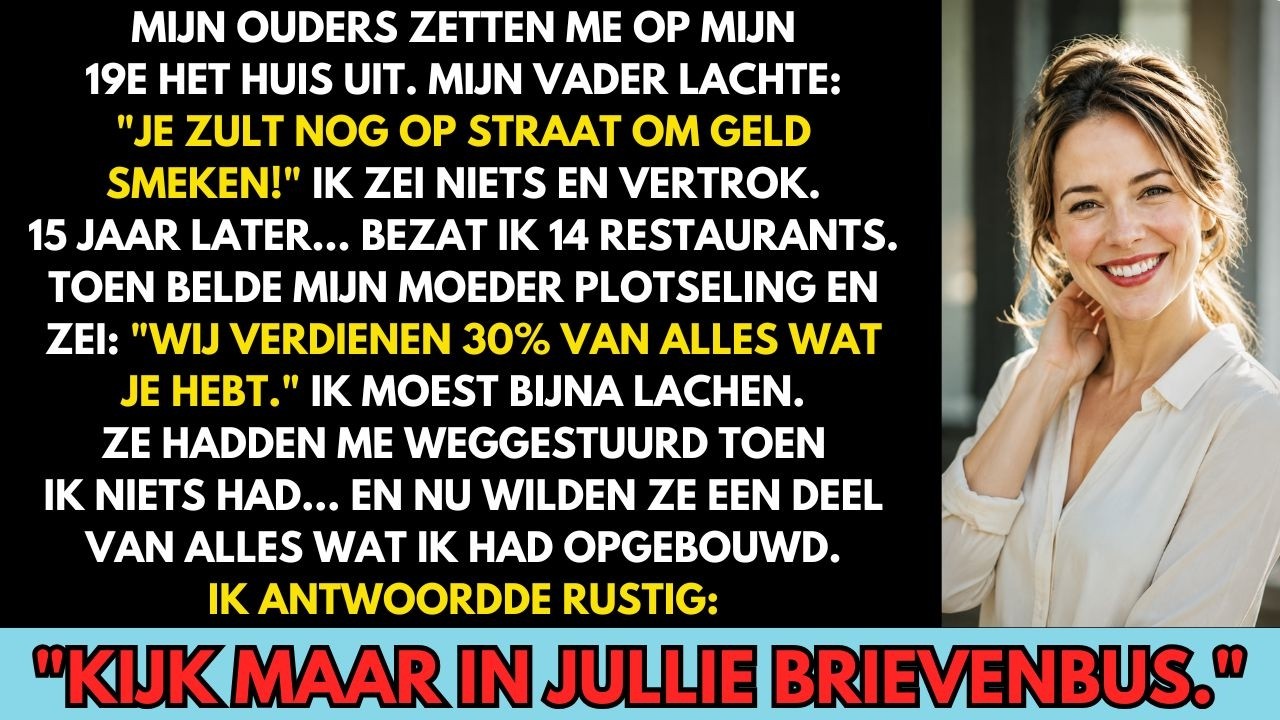
She didn’t apologize. “We’ve seen the article,” she said flatly. “We think thirty percent is a fair compensation. ”
Thirty percent of the fourteen restaurants I had built from nothing.
The restaurants I started with my grandmother’s recipes after my parents kicked me out and told me I’d be begging on the street. I held the phone away from my ear, staring at my kitchen, at my staff, at the cookies browning in an oven my grandmother never got to see. “The recipes of Oma built all those kitchens,” my mother said. “You put me out on the street with two bags,” I answered.
“We taught you independence. Look what you’ve done with it. That’s how you pay us back. ”
There it was again.
Pay back. Thirty-four years old, fourteen restaurants, and my mother still found a balance in every sentence. “Everything you are, you owe to this family,” she said, a line she had clearly rehearsed. “Mom,” I said.
“Everything I am was given to me for free by someone in this family. You were never on the good side of that. ”
I hung up. Five days later, in my own flagship restaurant, right in the middle of lunch rush, a man in a dark suit handed me a summons.
Hendrik and Ineke Dekker against Vera Dekker and the restaurant group. Unjust enrichment. Evidence exhibit A: a codicil to Oma’s will, dated November 3, 2009, in which Oma allegedly left all her recipes and notebooks to her son Hendrik. “Recently found,” the document claimed, in a box in the attic, that same month, that same autumn I had heard my mother’s voice in Oma’s living room say, “It’s just paperwork.
”
I grew up in Wezelord, a village in the Achterhoek, in a house where love was an accounting system. My mother Ineke taped grocery receipts to the refrigerator with scotch tape, divided into three columns with blue ink. My share was circled. She worked part-time as a bookkeeper for an agricultural company and brought the mentality home.
My father Hendrik ran a farm machinery parts shop at the edge of the village. By the time I was in high school, the business was losing money. We felt it every night at dinner. “Nobody eats here for free,” my father would say, and my mother would nod like it was a sacred text.
When I was fourteen, I asked for running shoes. I got them, plus a note in the ledger my mother kept in the kitchen drawer: “Shoes paid in advance against future contribution. ” From fifteen, I washed dishes at a small café on weekends, and half of every wage went to what my parents called the family fund. I’m not telling this for pity.
Many families in our village were short on money. Being short is not the same as being loveless. What made our house different was the bookkeeping itself. Every good deed had a price.
I learned to read the numbers on that refrigerator before I learned to ride a bike. In that house, I wasn’t a daughter. I was an outstanding account. But a few streets away, in the Julianastraat, there was a yellow kitchen where none of those rules existed.
That kitchen belonged to my father’s mother, my Oma Nel Dekker. She had cooked for forty years: church meals, condolence lunches, the snack table at the local drugstore before it closed. Everything she knew lived in one thick notebook with a blue cloth cover, the spine as soft as an old banknote. Cookies on Saturday mornings.
Chicken pie at the first frost. She never measured anything while I watched. She pressed my hands into the dough and said, “This is how it feels when it’s done. ”
From the age of ten, I was there every weekend.
My mother hated it. She called it “that giveaway kitchen” and said a woman who gave away what she could sell had no right to talk about money. But Oma fed everyone, from seasonal workers to the neighbor kids whose father had left. I once asked her why she never charged money.
She wiped the flour from her hands and looked at me the way you look at someone you’re leaving something to. “We feed people because they’re hungry,” she said. “Not because they can pay. ”
I was twelve.
I thought she meant pie. It took twenty-two years and a courtroom for me to understand she meant everything. Oma’s heart began to fail in the spring of 2009, when I was sixteen. By autumn she couldn’t stand at the stove for long.
So I cooked after school while she directed from a kitchen chair—a little general under a cloud of flour. The best afternoons of my life. One evening in early November, walking back from the shop, I heard my mother’s voice in Oma’s living room. She almost never came by.
I stopped in the hallway. “Mam, it’s just paperwork. Sign it and I’ll handle the rest,” she said, calm as a bank employee. Silence.
Then Oma’s voice, fragile but with an iron undertone: “I’ve already signed everything I needed to sign. ”
I was seventeen. I thought they were talking about insurance. Six weeks later, just before Christmas, Oma gave me the blue notebook wrapped in a tea towel, warm as if it had just come out of the oven.
“This is yours,” she said. “Keep it where they can’t get to it. ”
She died on February 9, 2010, a snowy morning. At the coffee table after the funeral, my mother touched my arm and said she would like to keep the notebook safe at our house.
I said it was already somewhere safe. It was the first time I ever lied to her. Sixteen months later, in June 2011, my father’s shop went bankrupt. I was nineteen, had dropped out of my studies because the money ran out, and worked full-time as a waitress along the provincial road.
One Sunday evening my parents called what my mother called a family meeting. My father slid a folder across the table: a loan application to the Rabobank for forty thousand euros to save the shop. His creditworthiness was destroyed. They needed a co-signer with a clean history and a steady income.
Nineteen years old, and I was the only one at that table the bank trusted. Then my mother opened her ledger from the kitchen drawer and turned it toward me. Nineteen years, itemized. Diapers, shoes, food, lodging.
Built up monthly, calculated back to my sixteenth. At the bottom, underlined twice: sixteen thousand euros. “We’re not asking for money,” she said in her bank voice. “We’re asking you to stand behind this family, the way this family stood behind you.
”
I knew exactly what co-signing meant. Not a rescue—a burial. And the grave had already been picked out for me. I looked at my father.
He said nothing. No, I told them. And they gave me until Saturday to decide. At the door, my mother said, “If you’re willing to contribute, you know the account number.
” Like I was a client with an outstanding balance. My father stood on the porch. The neighbor’s sprinkler ticked calmly. “You’ll be begging on the street,” he said.
Then he laughed—small, dry, sure of himself. “Give it six months. ”
I slept eleven nights in my old Golf, parked behind the supermarket. I washed my hair at a gas station sink.
I was never late for a single shift. On the twelfth morning, someone knocked on my window. Tante Jos, my father’s younger sister, a nurse in Doetinchem. The only one who had truly hugged me at Oma’s funeral.
She slid an envelope across the table at the café where I worked. “Oma gave me this in 2009,” she said. “To keep until you needed it most. I think that time is now.
”
Inside was a statement for a savings account at the Rabobank. Opened in 2009. Balance: twenty-six thousand five hundred euros. Beneficiary: Vera Dekker.
Not my father. Not my mother. Me. Next to it, half a sheet of paper in that slanted handwriting: “For flowers, rent and a new beginning.
Not for other people’s debts. ”
And I sat in that booth in my apron and cried for the first time since the porch. Oma had been dead sixteen months and was still taking care of me. She had seen that loan application coming before anyone had even opened it.
I did exactly what the note said. I claimed the account, opened my own bank account in a neighboring village, rented a room above a hardware store, and started looking at second-hand food trucks. In the spring of 2013, at an auction, I found an old delivery van for eleven thousand euros. Repairs and equipment cost another four thousand.
Permits swallowed the rest. No margin at all. I painted it butter-yellow myself and lettered the side by hand: “Nelstafel. ”
Five recipes from the blue book, adapted from Oma’s farmhouse portions to a three-burner gas style, and the lunch rush recalculated to the cent.
On opening day, I sold nineteen orders. That night I drove back to my room with sixty-one euros in a cigar box and laughed until the neighbor banged on his ceiling. I wasn’t begging on any street. I was selling cookies, and they were mine.
Above the sun visor I taped a card with Oma’s words: “We feed people because they are hungry, not because they can pay. ”
The winter of 2014 nearly broke me. The generator died during the coldest week of the year. Six hundred euros I didn’t have.
In the notebook, next to the chicken pie recipe, a note in the margin: “For cold days. Feed them first. ”
On Thursday I made forty pies and drove to the bus stop where the night shift from the meat factory waited in the dark. Gave them away free, with a card.
For six days, silence. On the seventh day, there was a line. That one gesture kept the business alive that winter, and every winter after. On a gray afternoon, a man in a work jacket came in.
Piet Overman, who had run a restaurant in Arnhem for thirty years. He offered me his building on installment, on terms no bank would ever have given a twenty-two-year-old with a food truck. I worked hours I’m not proud of the first year. In 2016, I hired Milou for waitressing—the best decision I ever made.
One evening, watching me count the till for the third time, she said softly, “You know what’s strange? We’re not even short. You run this business like you’re paying off a debt nobody else can see. ”
I laughed it off.
It would take ten years for me to understand whose bookkeeping I was still keeping. That Christmas, a card arrived from Wezelord. My mother’s handwriting, small and slanted. No letter, just a note under the printed greeting: “We hear the restaurant is doing well.
It would be nice if you remembered where you come from. Your father’s business closed because you refused to help. ”
Five years of silence. That was the message.
That evening I wrote six pages in response. Read them aloud, heard how they sounded like an invoice, and tore them up. I chose no contact. Not out of hate.
Out of arithmetic. The business grew steadily. 2016: a second location in Zutphen. 2018: four.
During the pandemic, meal boxes for families. By 2024, eight. Today—fourteen Nelstafel restaurants across the Achterhoek and the Liemers, over three hundred forty employees, and at every register a small sign: “Buy a meal for a stranger. We’ll note it.
Anyone who needs it can take it. No questions. ” Headquarters would call it brand identity. It’s just a rule about pie.
In 2023, I paid off Piet’s building completely, three years early, and sent him a photo of the deed with a pie. He sent back a napkin: “Proud of you, girl. ” It’s still framed in my office. In March 2026, a business magazine from Gelderland called for a profile.
Fourteen restaurants. A grandmother’s notebook. I said, “Yes, partly to do honor to Oma’s name. ” The photographer had me pose at the takeout window with the blue book open in my hands.
A regional broadcaster picked it up. The clip spread through village groups and local news pages until it reached Wezelord. Then, the phone call. And before I could even process my mother’s demand, the notebook had one more thing to tell me.
All that filming had been hard on the old spine of the book. Two signatures came loose. I brought it to a book restorer, a precise woman named Ruth. Four days later she called with a strange, worried voice.
“Ms. Dekker, did you know there’s something inside the back cover? Under the cloth, sewn flat against the cardboard. ”
A manila envelope.
On the front, in that familiar handwriting: “For the day they come for it. ”
I opened it in Ruth’s shop. One page dated October 2009. The same autumn I had heard my mother say, “It’s just paperwork.
”
The letter was short. Oma’s handwriting, unmistakable, for anyone who ever doubted it. And at the bottom, three lines I now know by heart:
“Ineke asked me to sign papers about my recipes. I never signed.
If any document ever says I did, it is a lie. ”
Five days later, my phone lit up with a word I had deleted years ago: “Mom. ”
“Ineke last autumn found a box of his mother’s things in the attic, with the codicil in it. He recognized the signature of his mother the way you recognize a voice.
“—that was my father’s story, told softly, because he believed it himself. The forensic handwriting expert, Edith Boas, compared the codicil to twenty years of authentic signatures. Three weeks later, she laid two images side by side on a screen. “No two genuine signatures are identical,” she said.
“These two, six years apart, are identical, point for point. That doesn’t happen in nature, Ms. Dekker. That happens on a light table with patience.
”
Under magnification, pencil traces under the ink. The skeleton of a tracing. The Christmas card from 2003, which had sat in my parents’ photo album for twenty years, was the source. My mother hadn’t found Oma’s signature.
She had copied it. Dana, my lawyer, put the crux of the whole war on the table: “There’s one more problem. Your father will testify under oath that the codicil is genuine. Before we use this, we need to know what he actually knows.
”
We deposed my father in July. Fifteen years since I’d last seen him like this. Smaller, grayer. He told the story softly because he believed it himself—Ineke, last autumn, found a box of his mother’s things in the attic with the codicil inside.
He recognized his mother’s signature the way you recognize a voice. Then something came into his face I hadn’t expected. Pride. Finally, proof that his mother—who cooked for the whole village but rarely for his ambitions—had chosen him after all.
He didn’t know. And that meant the truth wouldn’t just win my case. It would walk into his house and, in a single afternoon, take away both his wife and his mother. That same evening, an email arrived from my parents’ lawyer.
Subject: Settlement offer. They would drop the entire case in exchange for two hundred thousand euros and a non-disclosure agreement, “so the family can finally heal. ” My mother had added: “Your parents are old, Vera. This is your chance to make things right.
”
I sat at my kitchen table until two in the morning, and I was close to paying. Peace. A signature. A mother who might finally say something kind.
Then I read Oma’s last lines again: “I never signed. If any document says I did, it is a lie. ”
She hadn’t asked me to win. She had asked me not to let the lie stand.
In the morning, I called Dana. “File the report. ”
I knew what that meant. It would never leave the public record.
My father would read it or hear about it on his own porch. Whatever was left of forty-two years of marriage was on the road, and I had just let the truck go. The hearing with my mother was the last Tuesday of July. She walked in with fresh lipstick and the confidence of a woman who thought she still controlled the accounts.
In front of her lay two transparencies. The signature on the 2003 Christmas card and the one on the codicil. Identical to the pen stroke. “Can you explain, Ms.
Dekker, how your mother-in-law wrote her name identically twice, six years apart? ”
A silence colder than a freezer. My mother didn’t look at the evidence. She looked at me, past Dana, with a gaze that held no guilt and no fear—pure, bewildered rage of a bookkeeper whose numbers no longer obeyed.
My father, who had sat silently by the window all morning, took the transparency with both hands. Gently, the way you hold a photo of the dead. “Where did you get the Christmas card of my mother? ” he asked softly.
No one answered. My parents’ lawyer arrived within the hour with a new proposal: the case withdrawn immediately, all costs covered, in exchange for withdrawing the forensic report and full confidentiality. Everything I had ever wanted lay on a bench in the hallway. I just had to bury Oma’s signature one more time.
Through the glass, I saw my father sitting alone at the table, the transparency still in his hands, as if he were trying to translate his own life. Sixty-five years. His whole life hungry for one sentence from his mother, and now proof in his hands that the only version he ever had was false. I heard Oma again: “We feed people because they are hungry.
” The truth was the only thing I could still serve him, and it would taste like ash. But it was still food. “No confidentiality,” I told Dana. “The report stays in the file.
Withdraw with prejudice. They pay the costs, and we’re done. ”
Then I added: “No criminal charges. I’m not sending my mother to prison.
I’m done collecting. ”
That was exactly the point. Someone in this family had to be the first to stop keeping accounts. They accepted the offer because there was nothing left to take.
Before the papers were even signed, my father did something no one had asked. He took a pen and stepped back, as if pulled by iron. His hand shook so badly the court clerk looked away out of respect. My mother hissed his name.
He didn’t turn around. At the door, he stopped in front of me. He smelled of machine oil and peppermint, like he used to. “I said you’d have to beg,” he said, his voice like gravel.
“I know,” I said. He looked at the floor, then forced himself to meet my eyes. “You never did. ”
No apology.
Men like my father didn’t have words for that. But it was the first time he looked at me like a person, not a balance. The court dismissed the case in August, with costs against my parents. The regional paper put the forensic report on the front page.
Three weeks later, my mother called again. “Your father moved out,” she said without greeting. “He’s staying with Jos. He filed for divorce.
Forty-two years. I hope you’re satisfied, Vera. This lawsuit destroyed our family. The least you can do is acknowledge we still deserve something.
We raised you. ”
I felt no anger. I felt something finished. The specific, blunt calm of a long shift finally over.
“Mom,” I said. “Check your mailbox. ”
And I hung up. In that mailbox there was no check, no shares, no lawyer’s letter.
Three things. First, the full forensic report, every page, because the truth was the only debt I truly owed her. Second, a copy of Oma’s sewn-in letter, with the lines that will outlive us all. And third, on top of the pile, a recipe card in my own handwriting: Chicken Pie, complete, nothing withheld.
Because once, long ago, my mother had sat at Oma’s yellow kitchen table, eaten a piece of that pie, and said, without any account attached, “That’s delicious. ” The only free compliment I ever heard her give Oma. At the bottom of the card I wrote: “No bill. It was never for sale.
It was always free. That’s the part you never understood. ”
My mother hasn’t called since. But Tante Jos told me the refrigerator in Wezelord is now empty.
No more receipts, no blue ink. Only, exactly in the middle, held by a magnet, the chicken pie card. My father lives with Jos now. Once a month he comes to the flagship restaurant, sits at the bar like any other customer, and orders the chicken pie.
He always pays, even when I say it’s free. He puts the money under the plate anyway. I don’t fight it anymore. It’s the only language he has, and he uses it to say something he can’t say out loud.
On the first Sunday of every month, in all fourteen restaurants, we hold Nel’s Sunday. One long table. No register, no tickets. Whoever is hungry sits down.
Factory workers, pensioners, single mothers, and one very neat old farmer who always wears a necktie. What I’ve learned is this: love that keeps a running tab ends, sooner or later, in a courtroom, in silence, or in a village full of gossip. But love given freely keeps feeding people long after you’re gone. If you’ve ever felt like you were more of a debt than a daughter or a son in your own family, remember this: the only thing you truly owe anyone is the truth.
Not your silence, not your forgiveness on command. Setting boundaries with your own parents might be the hardest thing a person can do. But sometimes that step—refusing to keep paying for love that was never free—is what finally clears the path to something more honest. Not always reconciliation.
Sometimes just peace. And after years of keeping accounts, peace might be the most beautiful gift you can give yourself.