“Can I sit here with you for a moment? ”
The words came out as barely more than a whisper, carried by the sound of the waves. Michal, the richest man in the country, turned his head slowly and looked down at the small girl standing a few meters away from his deck chair. She was seven, maybe eight years old, with bare feet buried in the sand and a faded floral dress that had clearly seen many summers.
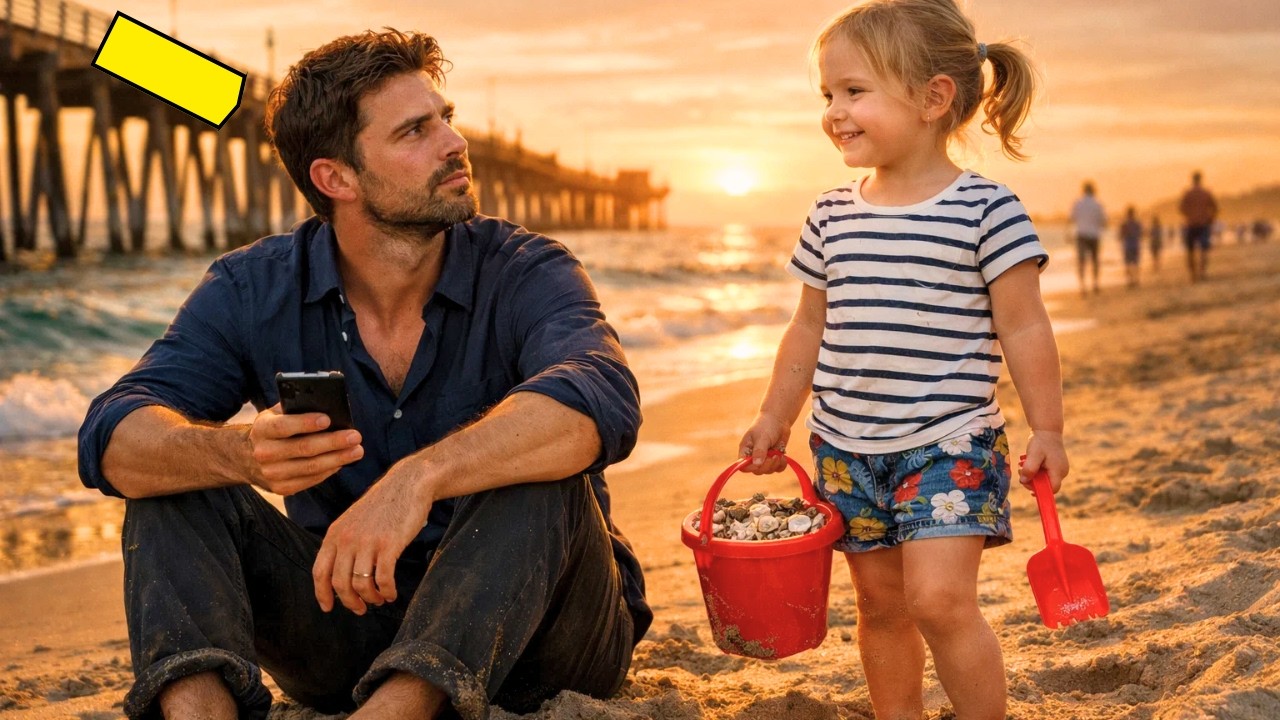
In her hand, she clutched a small red shovel. He was used to people approaching him with requests. Money, favors, connections, time. He was used to the careful, calculating eyes of adults who saw him as an opportunity.
But this child didn’t look at him like that. She just stood there, shifting her weight from one foot to the other, waiting. “Because I am alone,” she said, her voice as simple as the sea air. “And so are you.
”
Michal felt something tighten in his throat. He hadn’t thought about his loneliness in terms so raw, so direct. He had surrounded himself with people who admired him, feared him, or wanted something from him. But no one was ever just with him.
He looked at her dirty feet and her sunburned cheeks dotted with freckles. There was no cleverness in her face, no pretending. Just pure, childlike truth. “Sit down,” he said finally, gesturing to the sand beside his deck chair.
She smiled, and her whole face seemed to light up like the sunrise. She settled cross-legged in the sand and laid her little shovel beside her. For a few moments, they both looked at the sea, the silence heavier than the one Michal usually prized. “What’s your name?
” he asked, just to break it. “Zuzanna,” she said. “And you? ”
“Michal.
”
She nodded, as if accepting this information without any need to question it. She didn’t know that his name was on the cover of business magazines and whispered in boardrooms across the country. To her, he was simply Michal, the lonely man on the beach. “My mama says the sea falls asleep when the sun goes down,” she told him, pointing at the horizon.
“Your mama is right,” he said, surprised by his own gentle tone. A few minutes passed. Zuzanna picked up a small white seashell, perfect and smooth, examined it against the fading light, and then held it out to him. “This is for you,” she said.
“For good luck. ”
Michal took the shell. It was cool and smooth in his palm. He had received diamonds, medals, trophies, all symbols of his success.
But this simple shell from a child held something none of those things ever had. It had a heart. As the sun sank lower and the sky turned orange and violet, Zuzanna began to dig in the sand with her little shovel, building a small mound. She was content, no longer alone.
And Michal, holding the shell, felt the weight he carried on his shoulders become just a little lighter. “Does your daddy like the sea too? ” she asked later, looking at him with curious eyes. “Yes,” he said, a note of melancholy creeping into his voice.
“When I was a boy, we used to build the biggest sandcastle on the whole beach. He had time for things like that back then. ”
“And now he doesn’t? ”
“My father is gone, Zuzanna.
He died many years ago. ”
“Oh,” she whispered. She looked at him for a moment, and then, without a word, she reached out and took his hand in her small one, squeezing it gently. It was such a simple, spontaneous gesture.
Michal felt his throat tighten. No one had comforted him like that since his parents passed, so freely, without expecting anything in return. “Do you have children? ” she asked.
“No, Zuzanna, I don’t. ”
“That’s a shame,” she said plainly. “Kids are fun. You can build sandcastles with them.
”
Michal smiled. “Maybe you’re right. ”
“I know I’m right,” she said with childish certainty. Then she asked him, “Is your work fun?
”
He paused. Was it? Once it had been. In the beginning, when he was building his empire from nothing, there had been a thrill to it, a challenge.
But now it was just a burden. “Once it was,” he said. “But then my castle got so big that it started to weigh me down. It stopped being fun.
”
“Then you should make it smaller,” Zuzanna said, as if it were the most obvious thing in the world. “Or build a new, smaller castle that you enjoy. ”
Her words hit him with surprising force. Reduce his empire.
Build something new. It was so radical, so childlike. And yet, there was a logic in it that his complicated adult world had lost. Suddenly, his phone rang.
It was Patrycja, his assistant. The pristine silence of their little world shattered. Michal ignored the phone at first, but the ringing was insistent. He finally looked at Zuzanna, whose smile had faded.
“I have to take this,” he said. She nodded, understanding more than she should. After he hung up, Zuzanna looked at him with wide eyes. “You’re the president, aren’t you?
The one who has to work so much? ”
“Yes, Zuzanna,” he admitted, though it felt strange to say it out loud. “I am. ”
She shrugged.
“My dad says presidents are people too. They just have more work. ”
Michal laughed, a real, genuine laugh that surprised even himself. “Your father is a wise man, Zuzanna.
”
As she got up to leave, she looked at him and asked, “Maybe tomorrow you will come to the beach as Michal, not Mr. President? ”
“Yes, Zuzanna,” he said, his voice soft. “Tomorrow I will come as Michal.
”
She waved and ran off toward the dunes, her small figure disappearing into the dusk. Michal was alone again, but this time the loneliness felt different. It was filled with the memory of a little girl, her simple questions, her honest smile, and the shell he could still feel in his palm. That night, in his luxury villa, Michal didn’t think about mergers or the board of directors.
He thought about the sea, about sandcastles, about work that had to be enjoyable, and about what it meant to simply be Michal. The next day, he woke without an alarm. He came to the beach earlier, choosing the same spot. He waited for her.
And when she came running over the dunes, a smile broke across his face. “Hello, Michal,” she said, sitting down beside him as if they were old friends. “Did you wait for me? ”
“Yes, Zuzanna,” he said.
“I did. ”
They built a sandcastle that day, the biggest one yet. Zuzanna directed, and Michal followed her commands, his hands dirty with wet sand for the first time in years. He forgot about the phone, about his assistant, about the merger in Berlin.
He was simply there, in the moment, building a kingdom out of sand with a seven-year-old girl. She found two smooth pebbles and placed them on the highest tower. “This is the king and the queen,” she declared. Michal looked at the castle they had created.
It was a thing of beauty, simple and honest. It was theirs. The days that followed turned the beach into their kingdom. They built sandcastles, collected shells, and talked about everything and nothing.
Michal learned to see the world through a child’s eyes, with simplicity and curiosity. And Zuzanna learned that even powerful adults could laugh and play and just be human. One afternoon, sitting beside each other, Zuzanna turned to him. “Michal, are you happy now?
”
The question took his breath away. Happy? For years, he had thought happiness was success, money, power. But here, sitting in the sand with dirty hands beside this little girl, he felt something that came closer to happiness than anything he’d experienced in his adult life.
“Yes, Zuzanna,” he said, his voice full of emotion. “I am happy. ”
It was then that a woman’s figure appeared at the edge of the dunes. It was Anna, Zuzanna’s mother.
She approached, her face polite but a shadow of worry in her eyes. “Zuzanna, it’s time to go home,” she said, then turned to Michal. “Thank you for spending time with my daughter. But I’d like to speak with you, if you have a moment.
”
Michal nodded and watched Zuzanna leave with her mother. Then Anna returned, standing before him. “Mr. Michal, Zuzanna has grown very fond of you.
And I can see you’ve grown fond of her too. But you’re a public figure, with respect, from a completely different world. I don’t want Zuzanna to be disappointed. Or worse, for someone to use this situation.
”
Her voice wasn’t accusing. It was protective. “Anna,” Michal said, looking out at the sea. “I understand your concerns.
Zuzanna has brought me something I couldn’t buy with all my money. Peace and joy. I promise you, I have no bad intentions. And I promise I won’t promise her anything I can’t fulfill.
”
Anna looked into his eyes and saw the sincerity there. She saw the exhaustion, but also something new. Hope. “I believe you,” she said, her voice softening.
“Just be careful, please. And thank you for being not just the president, but Michal. ”
As she walked away, Michal knew he had to prove he could be more than just the rich man from the private beach. He had to show he could be the person Zuzanna believed him to be.
That night, for the first time in years, he made a decision that wasn’t about business. He called his assistant. “Patrycja, cancel all my meetings for the next few days. All of them.
And don’t forward me any calls. I need to clear my head. ”
“Mr. President, but the merger in Berlin…
”
“That’s not up for discussion, Patrycja. Handle it. I’ll return when I’m ready. ”
For the first time in years, he felt he was making a decision as Michal, not as the CEO.
He sighed with relief. The next day, he came to the beach with a small red shovel of his own. Zuzanna saw it and squealed with joy. “You have the same one as me!
That means you’re a real sandcastle builder! ”
Michal laughed. “I guess I am. And today, let’s build a castle that even the biggest wave can’t wash away.
”
And they did. Over the weeks that followed, the private beach in Jurata became their sanctuary. Michal learned to slow down, to listen, to see through a child’s eyes. Zuzanna gained an extraordinary friend who could build the most beautiful castles and listen to her stories about the sea.
Their story became a legend in little Jurata. The billionaire and the little girl who found in each other exactly what they were looking for. What began with a simple question, “Can I sit here with you? ” changed everything.
It proved that simple, childlike truth could tear down the walls we build around ourselves for a lifetime. And in the end, Michal understood that the greatest treasures are never made of gold. They are made of human connection and simple moments.