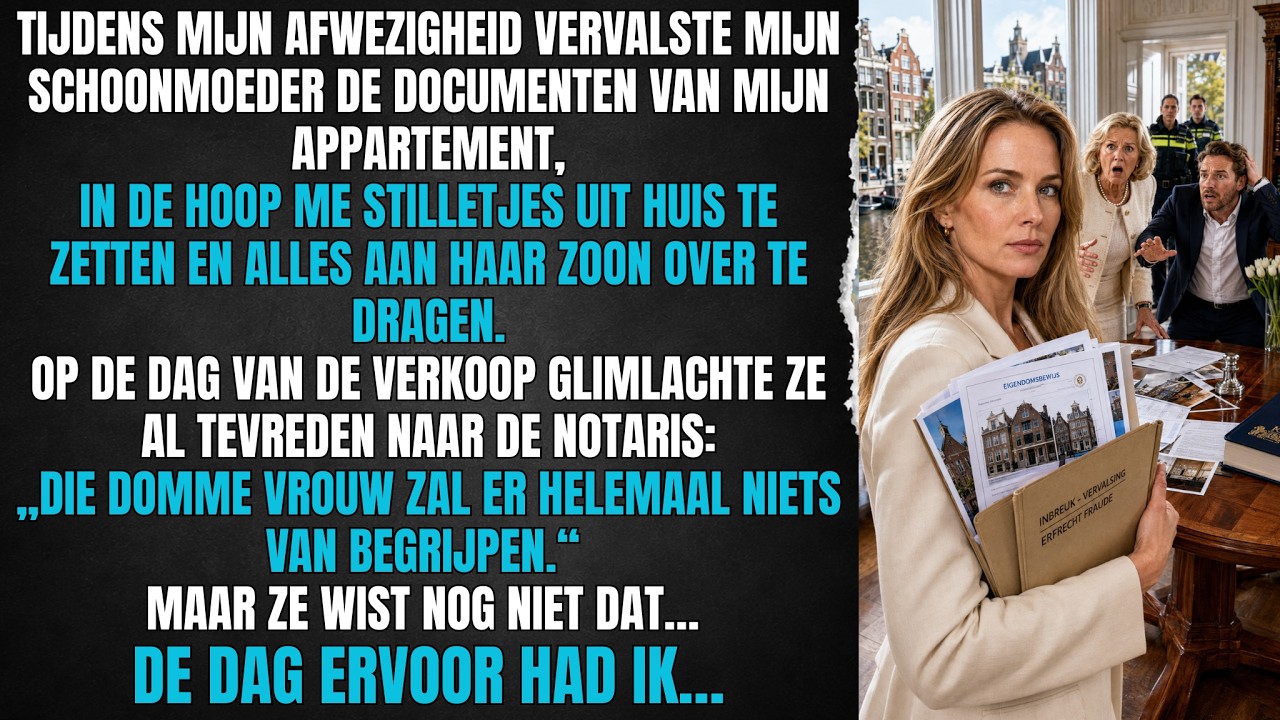
Marieke de Vries sat in the notary’s office meeting room, her hands pressed flat against the table. It was precisely 10 a. m. on November 23, and Ingrid van Dalen, her mother-in-law, was in the next room, preparing to sign the documents that would transfer Marieke’s Amsterdam apartment—her own home—to a stranger’s name for a fraction of its value.
Three months earlier, Marieke had left for a prestigious project in Frankfurt. She’d been hesitant, but her husband Jeroen had insisted she take the opportunity. He’d lost his job and their finances were strained, so the money was essential. His mother, Ingrid, had offered to help around the house.
Marieke had tried not to think about the ways that could go wrong. At first, everything seemed calm. Jeroen sent photos of meals his mother had cooked. He grumbled occasionally about her interference, but he sounded fine.
Then, in mid-October, he started dodging her calls. One afternoon, he said he was busy and never called back. His phone was off. The next day, a brief text: “Sorry, I was busy.
Everything is fine. ”
It wasn’t. Marieke asked her friend Sofie to check on the apartment. Sofie returned a call that evening, her voice uneasy.
Ingrid had answered the door, overly cheerful, claiming Jeroen was at an appointment. But there was a folder on the table, and when Sofie walked in, Ingrid shoved it under a magazine. “She panicked, like I wasn’t supposed to see whatever that was. ”
Marieke’s instincts kicked in.
The apartment was solely in her name. She’d bought it before her marriage, with her own savings and her grandmother’s inheritance. Ingrid had always resented that detail, making pointed comments about how, in a proper marriage, everything should be shared. But Marieke had never trusted Jeroen’s mother to have that kind of control.
She contacted the land registry office and asked if anyone had recently requested documents relating to her property. The woman on the phone went quiet for a moment. “Yes, a notary’s office requested extensive ownership information about your apartment three weeks ago. A week later, a file was created that seems connected to a planned transfer.
”
“A transfer? I’m not selling anything. ”
“Then someone may be claiming to act on your behalf. I strongly recommend you investigate.
”
Marieke hired a private investigator, Thomas Vermeer. Two days later, his report made her sick. Ingrid had forged a power of attorney, using samples of Marieke’s signature to create a false notarial document that supposedly authorized Ingrid to dispose of the apartment. She had even found a notary, Saskia Meijer, who appeared willing to support the scheme.
The transfer was scheduled for November 23. Marieke could have called the police immediately, but she wanted more than just to stop it. She wanted Ingrid caught. With her lawyer, Laura de Boer, she filed a formal complaint for attempted property fraud and forgery.
They coordinated with the police and the prosecutor’s office to let the transfer proceed under surveillance, with investigators watching until the decisive moment. Thomas kept Marieke informed. Ingrid had found a buyer—a distant relative named Pieter van Leeuwen—who was willing to purchase the apartment for a striking low price. The money was supposed to flow through an account in Jeroen’s name.
That detail cut deep. Did her husband know? Was he part of this? Thomas’s observations suggested Jeroen seemed confused and depressed, often under pressure.
But he couldn’t be sure. Two days before the transfer, Marieke returned to the Netherlands quietly, meeting Laura and Thomas at a hotel to go over the plan one last time. “Ingrid thinks you’re still in Germany,” Laura said. “She’ll be full of confidence.
That’s what we’re counting on. ”
The next morning, Marieke sat in the car with Laura, watching the notary’s office. At exactly 10 a. m.
, a taxi stopped. Ingrid stepped out, wrapped in a new wool coat, smiling. Marieke remembered giving her that coat for Christmas the year before. The irony was sharp enough to make her chest hurt.
Through the security video feed, Marieke watched Ingrid hand over the forged documents to Saskia Meijer. The notary leafed through them, her face revealing nothing at first. Then Ingrid laughed. “That stupid woman,” she said pleasantly.
“She’s sitting in Germany counting her foreign-allowance money while we finally set things right here. That apartment belongs to my son, not to her. ”
Marieke felt something freeze inside her. It wasn’t the insult.
It was the clarity. For five years, this woman had played the concerned mother-in-law while waiting for exactly this moment. “Very well, sign here,” Saskia said. Ingrid picked up the pen.
Pieter was ready. That was when they moved. Detective Daan Bakker flashed his badge at the secretary. “Police.
Let us in. ”
When they entered the room, Ingrid had just finished her signature. She looked up, first in confusion, then with dawning horror as she saw Marieke standing there. “Marieke.
You were supposed to be in Germany. ”
“I came back specially for this memorable occasion,” Marieke replied, surprised by the calm in her own voice. “It’s a misunderstanding. I wanted to surprise you.
”
“A surprise. ” Marieke stepped closer. “Forging documents, committing real estate fraud, and taking away the only home I own—you call that a surprise? ”
Laura took over.
“Mrs. Meijer, I’m the attorney for the property owner, who has just watched you attempt to transfer her apartment without her consent. These documents are now evidence. ”
Saskia Meijer went pale.
“I was told everything was in order. ”
“Don’t make it worse,” Daan said. “We have a recording of you discussing how to bypass controls. I advise you to stop lying.
”
Ingrid suddenly screamed, “Jeroen knew nothing about this! It was all my idea! ”
Marieke’s chest tightened. She didn’t know if that was true, and at that moment, it was the only comfort she had.
Ingrid was taken into custody. As she was led away, she shouted, “You ruined my family! You stole my son’s future! ” Then she collapsed into tears.
Marieke couldn’t tell if they were real or fake. The days that followed were empty and surreal. Jeroen called constantly, leaving long, desperate messages. “I didn’t know.
Mom said she was only helping us financially. I thought you had agreed to sell. ” Marieke read them without any feeling. Four days later, Laura gave her an update.
“The forgery is confirmed. The signature is definitely not yours. And we found something else. ” She paused.
“At the search, they found practice sheets. Your mother-in-law practiced your signature. Pages and pages of her trying to copy your name. ”
Marieke felt her throat tighten, imagining Ingrid at a table, carefully tracing her name over and over, smiling at her face that whole time.
Laura continued, “Saskia Meijer is cooperating now, claiming Ingrid blackmailed her. It’s likely not true. Pieter van Leeuwen is talking too. He says Ingrid told him you needed to sell quickly.
He paid her an €8,000 deposit for an apartment worth over €700,000 for €180,000. And he’s not the only one. The prosecutor found that Ingrid had also promised him a second apartment, owned by someone else, at a similarly ridiculous price. ”
“My apartment wasn’t the only target?
”
“It doesn’t appear so. ”
That night, Marieke finally answered a call from Jeroen. “Don’t explain anything,” she said. “Just answer this: Can you change?
”
There was a long silence. “I want to. I just don’t know if I can. ”
“Do you see?
” Marieke’s voice grew heavy. “You can’t even promise me you’ll change, because you don’t believe you can. I love you, I used to. But love isn’t enough.
You need trust and respect, and the ability to protect the person you love. We don’t have any of that. ”
She hung up before he could answer and cried, but with the tears came a strange release. The decision had been building in her for days, and now it was finally made.
Thomas called a few days later and asked to meet him. “I have information,” he said in a small café, placing photos on the table. “Ingrid has been in contact with a real network for the past three years. They target owners who are absent or isolated, forge power of attorney, and sell the properties through straw buyers.
Your apartment was the first in a series of at least five planned transactions. ”
Marieke stared at the faces in the photos. “So she was part of a criminal group. ”
“Yes.
One of the organizers is a man named Willem de Groot, a disbarred lawyer. And we suspect Ingrid received about €60,000 from previous transactions. Some of it may have gone to Jeroen. ”
Marieke’s voice cracked.
“What do you mean? ”
“Jeroen received €12,000 from her in September. He’s made purchases that don’t match his income—a computer, a watch. And he met Willem de Groot nine times over the past three months.
The prosecutor is requesting a full financial reconstruction. ”
That hit her harder than anything. Her husband wasn’t just weak. He might be complicit.
At the prosecutor’s office, the evidence came together. “Your husband wrote this on August 15,” the prosecutor said, sliding a printed message across the table. “‘Mom is handling everything. We just have to wait.
Marieke will never find out. She trusts me too much. ’”
Marieke closed her eyes. Three weeks before she left for Germany.
He had kissed her goodbye. He had told her he would miss her. The prosecutor continued, “We also found a draft rental agreement. After the fraudulent sale, Willem de Groot planned to rent out the apartment for three years and split the income with the group.
Your husband’s share was set at 30%, about €40,000. ”
That was the price of their marriage. Forty thousand euros. Jeroen was brought in for questioning.
Marieke watched through a one-way mirror with Laura. He looked exhausted. When the evidence was laid out, all color drained from his face. “I didn’t know about the forged documents.
I swear it. ”
“But you knew something was being prepared for your wife’s apartment. ”
A long silence. “Mom said Marieke had agreed to sell.
She said they had arranged everything together. That it was a surprise for me. ”
“Then why didn’t you ask your wife, directly, if that was true? ”
“I was frightened to ruin the surprise.
”
“That’s not a believable explanation,” the prosecutor said. “Here’s what the evidence suggests: your mother promised you a share of the money. And you, a man with a university degree and years of IT experience, chose to believe a story that made no sense because the payoff was attractive. ”
There was more.
The prosecutor pulled out another file. “Your browser history shows you searched thirty-two times over the past six months for information on asset division in divorce cases, and specifically whether a property owned by one spouse before marriage could still be considered shared marital property. Did your mother ask you to do that, too? ”
Marieke watched Jeroen’s face collapse into despair.
He hadn’t just known. He was planning to take the apartment from her, even in a divorce. Jeroen’s voice broke. “I want a lawyer.
”
After that, Marieke stood up. “I don’t want to see any more,” she told Laura. That evening, she called her attorney. “We’re getting a divorce,” she said.
“And I want to join the criminal proceedings as a damaged party. I don’t want Jeroen to be cast as the naive husband manipulated by his mother. His role should be judged on the evidence. ”
“Honestly,” Laura said, “that’s exactly what I hoped you would decide.
”
At the trial, Marieke sat in a dark gray suit. Ingrid stared at her with flat, aged eyes. Jeroen avoided looking at her entirely. The list of charges was read aloud—forging the power of attorney, organizing and participating in property fraud, attempted transfer of someone else’s property, using straw men, falsifying statements.
When the message “She trusts me too much” was read, Jeroen shriveled in his chair. Ingrid’s defense collapsed when the other property cases were presented. “It’s a lie! ” she shouted, pointing at Marieke.
“That woman has always wanted to destroy my son. She broke our family apart. ”
“Your honor,” Marieke said, standing calmly, “let’s call things by their real names. The family you claim I destroyed ceased to exist the moment you started calculating how to sell my apartment.
It did not exist while my signature was being forged. It did not exist when the man I gave my life to wrote to someone else that I would never find out because I trusted him too much. At that point, there was no family. There was only calculation.
”
A silence filled the courtroom. “One of you acted out of arrogance,” she continued. “The other out of cowardice. I’m not asking for revenge.
I’m just asking that everything be called correctly. This was not a misunderstanding. It was treason that was also a crime. ”
Two weeks later, the verdict was announced.
Ingrid van Dalen received six years in prison. Notary Saskia Meijer received a lighter sentence and was permanently barred from her profession. Pieter van Leeuwen also received a reduced sentence for cooperating. Jeroen was convicted of knowingly participating in part of the scheme and received a two-year suspended sentence, a substantial financial penalty, and restitution.
Marieke felt no joy. Only a deep, quiet breath, as if she had been holding something for months and could finally release it. Afterward, Jeroen caught up to her on the courthouse steps. “I know I have no right to ask anything,” he said.
“But I understand now. Too late, I know. I just want to say—you were the best thing that ever happened to me. ”
Marieke looked at him for a long moment.
“Yes, you did ruin it. ”
“Can you ever forgive me? ”
“Forgiving you doesn’t mean I let you back into my life, and it doesn’t mean I take the weight of your conscience off your shoulders. Maybe someday I won’t be angry anymore, but that will be for myself, not for you.
I want you to understand one thing: the court didn’t ruin your life. Your choices did. ”
She turned and walked down the stairs without looking back. The divorce was quick and clean.
Marieke had new locks installed, repainted every wall, threw out the couch she’d never liked because Jeroen had, and bought new curtains. She went to Florence alone that spring—a trip she’d dreamed of for years. She stood in a museum before an old mirror and saw a face that was calm, a little tired, but alive. She realized she no longer felt like a victim.
Back at work, the German project brought her a promotion. Her director simply said, “You can handle pressure. People who stay clear-headed under it go far. ” For the first time, she accepted the compliment without downplaying it.
Sofie stood with her in her newly painted living room that autumn, alongside Marieke’s final touch—nothing left from the old life. “You know,” Sofie said, “back then, I was afraid this whole story would break you. ”
Marieke looked at the light wall and her reflection in the frame of a new painting. “It did break me,” she replied.
“It just didn’t leave me broken. ”
Sofie frowned. “What do you mean? ”
“It broke everything that was only held together by lies.
”
That evening, alone in her warm, quiet apartment, Marieke stood at the window. A year ago, she had almost lost this place. But alongside it, she had almost lost something more important: the right to consider her life truly her own. She had that right back.
The price had been high. But behind her now lay the betrayal, the fear, the court cases. Ahead of her was something she hadn’t had in years: a space in which no one else would ever make decisions for her again. Maybe that was justice.
Not the tears of her mother-in-law, not the court sentence, not the shame of her ex-husband. Just this—a woman who everyone had wanted to make into a victim, emerging clearer, stronger, and older than the people who had tried to take everything from her. The apartment was not all that had remained hers.
Her life was hers.