Peter Aggerholm stood outside his own mansion, suitcase in hand, frozen by a sound he hadn’t heard in years. Music. Real music, with volume and life, streaming from the living room window. And beneath it, laughter.
His mother’s laughter. He had returned from a business trip to Copenhagen that Tuesday morning, his head full of contracts and a new luxury property project in the Nordhavn area. The usual worry about his mother pulsed in the background of his chest, a warning he didn’t know how to answer. The chauffeur had dropped him at the side gate, as was his habit when arriving earlier than expected.
He liked to enter unannounced, to see the house in its natural state, without the tidying that happened when they knew he was coming. But this morning, the music stopped him before he even opened the garden door. He moved slowly to the living room window before going in. It wasn’t his habit to spy, but his feet carried him there on their own, as if they knew something required caution before being interrupted.
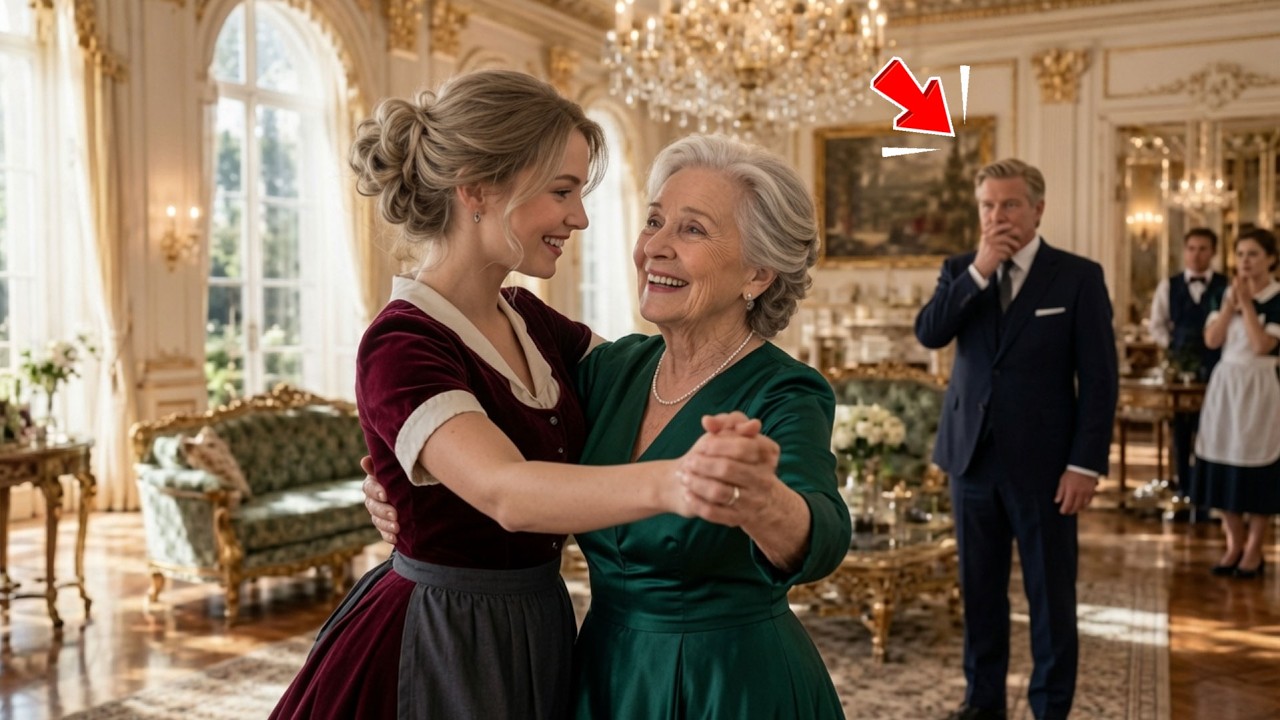
What he saw burned itself into him for the rest of his life. His mother, Fru Ranghild, seventy years old, stood in the middle of the living room. The woman he had found sitting silently for four years straight was dancing. Her arms were lifted, her hips moving, her eyes closed, a smile on her lips that Peter hadn’t seen since he was a small boy.
And beside her, hand in hand, guiding her with an ease and absolute genuine joy, stood a woman Peter had never seen before. Sigrid Dahl was around thirty, with her hair pinned up, brown skin, and a smile that arrived before her eyes. She had a presence about her, the kind of person who steps into a room and changes its temperature without anyone being able to point to exactly how. She had arrived that morning, punctual, with a simple bag over her shoulder and a printed CV that Fru Møller, Peter’s personal assistant, had selected from the thirty-seven applications received after the latest advert.
Sigrid had experience in elderly care, a specialisation in gerontology she had taken in the evenings while working during the day, and a reference letter from a family in Silkeborg describing her as the most present person to ever enter their home. The other caregivers had arrived, greeted formally, asked about medication routines, asked to see the room, taken notes. Sigrid had arrived, looked around the living room, and said, “Fru Ranghild, what a beautiful room. Is this gramophone original?
”
It stood in the corner between the bookshelf and the window, an old gramophone Peter had rescued from his mother’s childhood home when she moved into the mansion. Ranghild had insisted on bringing it. It was the only object in the room that didn’t fit the rest. Dark wood, slightly worn, completely out of step with the marble, glass, and steel surroundings.
Peter had once suggested it might be stored more carefully in the bedroom. Ranghild had looked at him in a way that definitively ended the conversation. “Yes, it is,” Ranghild replied, and there was a spark in her voice. “It was my husband’s.
He loved music, my Rasmus. He bought this gramophone when we didn’t even have a refrigerator at home. And it still works. ”
“It works, but it’s been a long time since I played anything.
”
“Why? ”
Ranghild paused, her eyes on the gramophone. “I don’t know. I don’t think I’ve had the desire to hear it alone.
”
Sigrid looked at her for a moment, then said, “Do you have records here? ”
“Yes, in the box underneath. ”
“Then tell me what Rasmus’s favourite record was while I put it on. ”
What happened in the next forty minutes could not have been predicted.
Sigrid put on an old dance record. Instrumental music, a kind of old ballroom dance. The kind of music that carries an entire era, an entire life, an entire world that existed before. Ranghild closed her eyes as the first chords came from the needle, and Peter saw his mother’s face do something he didn’t know human faces did.
It relaxed in a way that suggested she had dropped a weight she had been holding for years. “My God,” she said quietly. “This was his favourite record. ”
“How did you meet?
” Sigrid asked, sitting on the edge of the sofa, not conducting a job interview, not performing a care routine, simply asking with the kind of curiosity that carried no hidden agenda. And Ranghild talked. She talked about the dance in June, fifty years ago, in a small town near Silkeborg. Rasmus was the handsomest at the party, and she was the shyest, and he was the one who asked her to dance, and she nearly refused out of embarrassment, but her friend gave her a push in the back, and she went.
She told how he was an amazing dancer, how he held her waist with a delicate firmness she would never forget. “Can you dance? ” Sigrid asked. “I used to.
It’s been so long. The body doesn’t forget, and with my knee, we don’t need to jump,” Ranghild replied. Sigrid stood, reached out her hand, and said simply, “I promise, if it hurts, we stop. ”
So, without drama, without ceremony, without the solemn weight of a therapeutic victory, just two women in the middle of a living room, hand in hand, swaying to the rhythm of an old dance tune from an old gramophone that had been silent for far too long.
And Fru Ranghild smiled. Not the polite smile. The other smile. The one Peter recognised from old photographs, from childhood memories, from birthday parties when he was small and his mother was young.
Peter Aggerholm, director of the Aggerholm Group, a man accustomed to making decisions worth millions of kroner with calculated composure, stood still outside his own house with his eyes full of tears he didn’t try to hold back. He waited until the music stopped. Then he walked in slowly, as if sound could break something. Sigrid saw him first.
And unlike what he would have expected from someone surprised by her employer on her first day, she showed no signs of shock or embarrassment. She looked at him, then at Ranghild, then at him again, and said simply, “Good morning, you must be Peter. Your mother has just taught me that ballroom dancing is different from old-fashioned folk dancing. ”
“I learned that from Rasmus,” Ranghild interjected, and there was a blush in her cheeks that made Peter feel a pleasant warmth in his chest.
“Good morning,” he replied, his voice lower than he intended. He put down his suitcase, extended his hand. “Peter. Sigrid Dahl, candidate for the position of caregiver.
”
She gripped his hand firmly, and her smile carried a light that didn’t dim when she added, “Although your mother seems entirely capable of taking care of me, if that ever became necessary. ”
Ranghild let out a small laugh, one Peter hadn’t heard in years. He looked at his mother, looked at Sigrid, looked at the gramophone with the record still turning, the needle resting in the silent groove after the music. “Sigrid,” he said.
“You’re hired. ”
Peter had no way of knowing that morning that hiring Sigrid was like opening a window in a room that had been closed for too long. Sigrid had a philosophy of care she had never written down anywhere because it wasn’t the kind of thing that fit on a CV. For her, caring for an elderly person meant honouring what that person had been and still was.
Not reducing a life to medication lists and appointment calendars. She arrived on time. She gave the medication on schedule, followed the physiotherapy exercises the doctor had prescribed, checked blood pressure, noted everything in a small notebook she had bought herself because she found the clinic’s digital system too cold. But she did other things too.
She read aloud to Ranghild in the afternoons, stories the old woman chose herself. She put a record on the gramophone every morning before breakfast. She asked about Rasmus with genuine curiosity, unlocking stories Ranghild thought she would never tell anyone. She took Ranghild into the garden after lunch, not to sit in a rocking chair, but to walk slowly between the plants, identifying names of flowers, discussing what was growing and what needed attention.
“Did you know something about plants? ” Sigrid asked one afternoon, two days after she started. “My husband and I in Silkeborg had a vegetable garden, an orchard, a flower garden. I planted all kinds of things.
”
“And here? ”
Ranghild looked at the mansion’s garden. Professional landscaping. Ornamental plants chosen by an architect.
Everything beautiful, without a single leaf out of place. “Here there’s a gardener,” she said, in a tone Sigrid understood perfectly. The following week, Sigrid arrived with two pots of basil and a rosemary from the local market. She asked permission to plant them in a pot that stood on the balcony of Ranghild’s room.
“You don’t have to ask me for permission,” Ranghild said. “Yes, I do. It’s your room. ”
Ranghild paused.
“You’re the first person in four years who has said that to me,” she said slowly. Sigrid didn’t respond. She planted the cuttings while Ranghild held the pot. And the two of them stood there for a while, hands in the soil, without needing to say anything.
Peter observed all this with an attention he took a few days to recognise as being something more than a concerned son’s interest. From his office window, he could see his mother’s balcony. He began to notice that in the breaks between video conferences about property projects and discussions about investment portfolios, his eyes automatically wandered to that balcony. He saw Ranghild and Sigrid side by side.
His mother talking. Sigrid listening with seemingly bottomless attention. And then there was the other thing. The image of Sigrid laughing, head thrown back with a spontaneity that seemed unconcerned with who might be watching.
It began to stir something in Peter, something that took him a few more days to name. It wasn’t discomfort. It was the opposite. A warmth rising in his chest whenever he saw that scene.
A desire to be in the garden instead of the office. A curiosity about what the two women talked about, which he knew wasn’t a boss’s curiosity. He ignored the feeling with the efficiency of someone who had spent forty-three years being very good at ignoring feelings. But the feeling didn’t care.
It was a Friday, three weeks after Sigrid’s arrival, that things changed course for the first time. Peter came down late for dinner after a meeting that ran over. The table was set. The food was in the oven.
But the gramophone was playing in the living room. He found Sigrid sitting on the sofa with her shoes in her hand, still wearing her socks, a glass of water on the table, her gaze fixed on a distant point in the garden. “You’re still here,” he said, unable to hide his surprise. She turned her head, and there was a second of something—surprise, discomfort—before the smile appeared.
“Good evening. I stayed later to talk with Fru Ranghild, and there were no more buses for my line. I was waiting for the next one. ”
Peter glanced at his watch.
It was twenty past nine. “You take the bus every day? How long does it take? ”
“Depends on traffic.
About two hours. ”
Four hours a day on public transport, back and forth to a house in the other end of the city. He had never asked, and she had never mentioned it. “Why didn’t you ask me to send the driver?
”
“It’s not the company driver’s job to take me home. It’s every employee’s job to have adequate transport. ” She shrugged with a naturalness that wasn’t indifference. Just the absence of drama.
“I’m used to it, Peter. Bus transport. It gets me where I need to go. ”
It was the first time she used only his first name, without “herr” or “director,” with the same ease she would say anything else, as if there were no implicit hierarchy between them.
“Have you eaten? ”
“I ate in the kitchen with Bente before she went home. ”
“Then sit here. ” He went into the kitchen and came back with two plates, two glasses, and the food that had been waiting for him in the oven.
He set it all on the coffee table, sat in the other sofa, and said, “Tell me how my mother’s day was. ”
Sigrid looked at him for a moment, as if weighing something. “She told me about when Rasmus bought your first family home,” she said finally, taking her plate. “She spent an hour describing every room, what colour the kitchen wall was, the texture of the bathroom floor, how the light came through the bedroom window in the morning.
”
Peter was quiet. “She’s never told me that,” he said after a moment. “Sometimes people save stories to tell those who ask,” Sigrid said, without judgement, just an observation. “The lady wants to talk.
She just needs someone who will listen without rushing. ”
“You ask her things so naturally. ”
“I have genuine curiosity. It’s not a technique.
”
“It’s an important difference. ”
“It’s the difference that makes it work. ”
He looked at her. The gramophone finished its record, and the needle began gently scratching the empty groove.
Neither of them rose to lift it. “Why did you choose this field? ” Peter asked. Sigrid put her fork on the plate, looked at him.
“My grandmother was alone in the last years of her life. Far away. I was still a child, I couldn’t follow her. She had someone to care for her in the technical sense—doctor, medicine, caregiver.
But the caregiver didn’t ask about her life, treated her like someone to be managed, not as company. When I visited her three months before she died, she said she missed talking. Not people—there were people around—but real conversations. That never left my mind, Peter.
”
“How long have you been waiting here? ” he asked finally. “About two hours. ”
“Two hours sitting here alone.
”
“Not entirely alone,” she said, nodding toward the gramophone with a slight tilt of her head. “Your mother has excellent taste in music. ”
He laughed. It wasn’t a calculated laugh or social laughter.
It was genuine. And he was himself surprised by the sound of it in his own living room. “I’ll have someone install a company transport app on your phone tomorrow,” he said when the laughter had settled. “Use it whenever you need.
No bureaucracy. ”
Sigrid opened her mouth as if to decline. “It’s not a favour,” he said quickly. “It’s the least any employee should have.
I’ve been neglectful not arranging it sooner. ”
She closed her mouth and then said, “Alright. ”
The bus came. Sigrid took her bag, said goodbye with a naturalness that Peter spent a few minutes trying to decipher after she had gone, and disappeared into the Friday night as if she hadn’t just changed something in that house.
The next month passed with a speed Peter hadn’t expected. Part of it was work. The Aggerholm Group was in the middle of one of the largest operations in its history, a luxury residential complex in its launch phase with full home automation and solar panels. But the other part, the part he admitted when he was honest with himself, was that the days passed quickly because something in them made them lighter.
Something that started quietly with the sound of the gramophone rising from below. That revealed itself at dinner when his mother, with lively eyes, told a story Sigrid had unlocked that day. That was present in the messages Sigrid sent at the end of her workday with a brief account of the day. Not out of obligation, but because she had simply started doing it, and he had started looking forward to them.
“Today, Fru Ranghild taught me to make drømmekage the right way. Apparently I was wrong about the dough. She was absolutely right. ”
“The lady identified today that one of the orchids in the garden has root problems.
The gardener confirmed it. She was very pleased. ”
“New record today. Frank Sinatra in Danish.
Fru Ranghild knows all the lyrics. I learned two. ”
Peter always replied. First with a word or two, then with more, then with questions that led to answers that led to more questions.
Before he knew it, he was having the longest conversations he’d had with another person in years through text messages. He knew he was on ground that required caution. She was his employee. There was an asymmetry there that he respected too much to ignore.
And there was something else, something it took him longer to admit because it involved a vulnerability that Peter Aggerholm wasn’t used to accessing. He was afraid of failing. Not a business failure, not a professional misjudgement. Those he absorbed, corrected, moved on.
This was a different kind of fear. The fear of someone who had built an entire life on solidity and efficiency and had begun to realise that solidity without warmth isn’t so different from the mansion his mother inhabited alone. It was a Saturday afternoon that Ranghild decided the situation had lasted long enough. She and Sigrid were in the garden when Peter came down in shorts and a t-shirt, unusual in itself.
Normally on weekends he worked longer, and when he came down, it was already for dinner. “Are you going out to shop? ” Ranghild asked, innocently. “No, Mother, I came down to get some sun.
”
“How lovely. ” She patted the stone bench beside her. “Come and sit with me. ”
She had positioned herself strategically in the corner, leaving room right next to where Sigrid sat, tending the basil cuttings.
Peter sat. Sigrid stood, brushed the soil from her hands, and looked at him. “Good afternoon. ”
“Good afternoon.
”
Ranghild looked from one to the other and said, “Sigrid, did you bring the secret to that recipe you promised me? ”
“Yes, I did. ”
“Then fetch it from your bag. I’d like to write it down.
”
Sigrid went inside, and Ranghild waited until she heard the door close before turning to her son. “Peter, my boy, you’ve been watching that girl since the first day with a face that doesn’t know what to do with what it feels. ”
Peter opened his mouth. “Don’t open your mouth to deny it,” she said with a calm firmness that was exactly the same she had used when he was twelve and trying to lie about his school grades.
“I may be seventy years old, and I’ve seen a lot in my life. I know the difference between a man looking at an employee and a man looking at someone who matters to him. ”
“Mother, she works here. There’s a question of respect.
”
“I know. I raised you. I know you want to treat her with respect. That’s not what I’m saying.
” Ranghild placed her hand on his arm. “I’m saying life is short, my son, shorter than you think when you’re in the middle of it. Your father and I wasted time being shy with each other in the beginning. And then we realised that time is the most expensive thing there is.
”
Peter looked out at the garden. “She’s an extraordinary person, Mother. ”
“Yes, and I know you know that, because I see you noticing everything she does. ” She squeezed his arm.
“What you want to do about it is your business. You just shouldn’t stand still and wait for time to sort it out. Time doesn’t sort anything, my son. Time passes.
”
The door opened, and Sigrid came back with a piece of paper in her hand. “The recipe,” she said, handing it to Ranghild. Then she looked between the two of them, reading the silence with the attention of someone who reads people professionally, and said, “Am I interrupting something? ”
“No,” Peter said.
“Nothing important. ”
Ranghild confirmed with a smile that knew exactly what it was doing. The conversation that changed everything happened on a Thursday evening, three days later. Peter came home late from a meeting about the property launch.
It had been hours of discussing sales strategy, investment plans, pricing, health insurance for contractor employees. When he arrived, it was almost ten. Sigrid was in the kitchen, not because she had to be. Her working hours ended at six, but there had been an issue with the stove that Bente had reported before leaving, and Ranghild had asked for tea before bed, so Sigrid had stayed to fix the problem and prepare it.
“You didn’t need to stay,” Peter said when he found her there. “Fru Ranghild wanted it. And the new induction hob wasn’t set correctly. I’ve fixed it.
There’s also hot water, if you want some. ”
“Stay,” he said. “Please. ”
She stayed.
They sat in the kitchen with two cups of tea while the house slept around them, and Peter did something he almost never did with anyone. He spoke honestly. He told her about his father, who had left when Peter was twelve, without explanation, and how he had decided he would build something so solid he would never again be dependent on anyone’s presence or absence to keep himself upright. He told her about the Aggerholm Group’s first years, when he was twenty-six, a project on credit and a debt that woke him at three in the morning with his heart in his throat.
He told her about the decisions that worked and the ones that didn’t, and how he learned the difference between them was rarely a matter of intelligence. It was a matter of courage. “You have courage in surplus for business,” Sigrid said. “Only for business.
”
She lifted her eyes to him. “Are you asking me or telling me? ”
Peter paused. “Telling you.
I don’t have the same courage for other things. ”
Sigrid lifted her cup, took a sip, set it back on the table. “You know what’s funny? ” she said.
“Your mother asked me the other day what I wanted out of life. Not the career—life. And I realised it had been years since anyone asked me that. Not even myself.
”
“And what did you answer? ”
“That I want to wake up every day with the feeling that what I do actually matters. ” She paused. “That I want someone by my side who looks at me the way I look at her when she dances.
You know, with that thing. ” She gestured in the air, searching for the right word. “Delight. As if you’ve never seen it before and can’t believe you’ve been given the privilege of seeing it now.
”
Peter looked at her. “That’s exactly how I look at you. ”
The silence that followed was different from all the other silences they had shared. It was the kind that doesn’t need to be filled because it’s already full.
Sigrid looked at him, then at her cup, then at him again. “Peter,” she said. “You’re my employer. ”
“I know.
”
“It complicates things. I know that too. ”
“So what do you do? ”
He thought for a moment, then said, “I’m being honest.
This is something I should have done before, and I was waiting for the right moment, which my mother reminded me doesn’t exist. ”
Sigrid was silent, then exhaled through her lips, not quite a sigh, but a kind of gentle surrender. “Your mother,” she said, “is dangerous. ”
“She’s the wisest woman I know.
”
“Did she arrange this with you? ”
“She gave me a small push. That’s all. ”
Sigrid looked at him for a long moment.
“I need to think about it,” she said finally. “That’s fine. It truly is. ”
She stood, took her bag, turned to leave through the kitchen door, stopped.
“That drømmekage I learned to bake from her,” she said. “I’ll bake it on Saturday. I’ll be here on Saturday. ”
“I know,” he said.
And this time she left without stopping. The Saturday that followed was the first in a series that Peter began to store in his memory with almost superstitious care. Ranghild woke early, more animated than usual, with the energy that sometimes came over her without warning, days when her body obeyed better, her mood was light, and the world seemed clearer. Sigrid had prepared in advance.
She had bought the ingredients, organised everything on the kitchen counter. When Ranghild came down and saw it, she stood still for a moment in the doorway with a look Peter, who had come down behind his mother with coffee in hand, would never forget. It was the look of someone who had just been reminded of herself. “Shall we bake the cake?
” Sigrid said, already wearing an apron, holding one out to Ranghild. And they did. The three of them, actually, because Peter stayed without anyone needing to invite him. First he pretended he was just passing through.
Then he admitted he was staying, and then he let himself be directed by Ranghild, who instructed him on how to stir the dough with absolute, non-negotiable authority. “Not like that, Peter. Like this. Slowly, from the bottom up.
”
“Mother, I’m forty-three years old and I’ve never baked a real cake in my life. ”
“Hold the spatula. Sigrid. ”
Sigrid held the spatula and looked at Peter with a smile that clearly said she wouldn’t defend him in this situation.
The kitchen smelled of cake baking. They ate lunch together, the three of them, at a small corner table instead of the large one seating sixteen, with the simple food Bente had prepared before her day off. And the drømmekage in the middle, as if it were the most important thing on the table, which in a way it was. Ranghild talked about Rasmus, about how much he had loved drømmekage, how she baked it every Sunday when the children were small, how the smell filled the entire little house in Silkeborg and reached the street.
She talked with shining eyes, and Peter heard stories he didn’t know, details from a life that had happened before he had enough memory to remember. “You know,” Ranghild said at one point, alternately looking at Sigrid and her son with a tenderness they both noticed, “your father once said to me that a home isn’t the house. It’s the smell of good food and the sound of the people you love. ”
Neither of them said anything.
Ranghild took the cake knife, cut a piece, and said with the calm of one who has finished a chapter: “This cake turned out perfectly, Sigrid. ”
“The recipe is yours, Fru Ranghild. ”
“And so was the company,” she said, with a smile that wasn’t aimed at either of them in particular, but at both of them at the same time. “And that makes all the difference.
”
The following months wove a tapestry of days that none of them could precisely describe afterwards. The most important things rarely have a clear chronology. They are built of accumulation, of layers, of one moment on top of another, until one day you look back and realize the world that exists now is completely different from the one that existed before. Peter began coming home earlier.
Not because he had agreed to it with anyone or consciously decided it. It simply started happening, and he let it. Meetings that previously stretched past six deliberately gained a stricter end time. Trips to Copenhagen that used to last the whole week were compressed to two or three days.
Sigrid said nothing about it for weeks. Then one afternoon, when the two of them were in the garden while Ranghild rested, she said, “You come home earlier now. ”
“Yes, I do. ”
“Why?
”
He looked at her. “Because I built the company to have freedom, and I let the company use up the freedom I should have had. ” He paused. “And because I’ve started to understand what my mother means about time.
”
Sigrid was quiet for a moment. “She told me about time. She said it was more expensive than I thought. ”
“Yes, I think that’s it.
”
She considered the question with the seriousness she gave things that deserved seriousness. “I think I’ve spent many years treating my life as a secondary project. Working too much, resting too little, postponing the important things until later, because there was always something urgent. ”
She looked at the garden.
“Caring for people has taught me that later isn’t guaranteed for anyone. ”
“You take good care of everyone,” Peter said. “Who takes care of you? ”
She turned her head toward him.
“Is that a question or a proposal? ”
“It could be both. ”
She looked at him for a long moment. Then she said, “It could.
”
Ranghild was the first to use the word the two of them hadn’t yet used. It was a Sunday evening, the three of them in the living room. Peter and Sigrid on the sofa with a distance between them that Ranghild had observed shrinking week by week, until it reached a point where there was almost none. Ranghild sat in the armchair with her crossword in her lap and her glasses on the tip of her nose.
“Are you staying for dinner, Sigrid? ” she asked, without looking up. “If it’s not an inconvenience. ”
“You’re never an inconvenience, my girl.
”
Sigrid was quiet, then said with a slightly lower voice, “Fru Ranghild, did you just call me ‘my girl’? ”
“Yes, I did. ” Ranghild finally looked up, and there was a tenderness in her eyes that needed no explanation. “I’m old enough to call people what they are to me.
And that’s what you are. ”
The silence that followed filled their chests. Peter looked at Sigrid. Sigrid had eyes that shone with the restraint of one who has been surprised by a feeling she didn’t expect.
“Fru Ranghild,” she said finally, “you’re going to make me cry in front of your son. ”
“My son has already cried at the window watching you dance with me that first day. It wouldn’t make any difference. ”
Peter closed his eyes.
“Mother, what? ”
“It’s true. You weren’t meant to know. I’m old, but not blind.
”
She returned to her crossword with absolute dignity. “Now, fetch the dinner that’s in the oven. I want to eat. ”
That Sunday dinner was different from all the others.
Not because there was anything special about the food, or because anyone had planned for it to be special. It was different because the three of them shared the silent awareness that this table, this room, this combination of people, was what it was supposed to be. There was Ranghild’s knee, which sometimes made her set down her fork with a small sigh. There was Peter’s stress from the week, lingering in a certain tension in his shoulders even as he relaxed.
There was Sigrid’s shadow of worry for her own mother in Silkeborg. But nothing erased what mattered, and what mattered was simple. Three people around a table, eating good food, while the gramophone played quietly in the corner, and the Sunday evening outside was, for once, the kind one saves. Sigrid said, at one point between two mouthfuls, “You told me your mother isn’t well.
”
“Yes, her blood pressure is unstable. I’m trying to get her health insurance upgraded to better coverage, but the paperwork takes time. ”
Peter looked up. “Peter can help with that.
” He looked at Sigrid. “I can help with that. ”
Ranghild looked at Sigrid. “Let him help.
It’s not a favour. It’s what family does. ”
Sigrid looked at the table for a moment. When she lifted her eyes, there was an expression in them Peter found the most beautiful and most vulnerable he had ever seen on a human face.
“Family,” she said quietly, as one testing the weight of a word. “Family,” Ranghild confirmed, with the calm of someone who no longer has time to be imprecise about what matters. Sigrid’s mother, Fru Gerda, moved to Aarhus two months later. Not to the mansion.
Sigrid had been very clear that she wanted to maintain her independence, that things between her and Peter needed room to grow at the right pace, without pressure. Peter helped find and furnish an apartment fifteen minutes from the mansion, a condominium complex with good infrastructure and security. And behind the scenes, he ensured Fru Gerda’s health insurance was updated to appropriate coverage. Sigrid had never asked for any of this directly.
But there was a difference between asking and accepting with grace. And she had, in those months, learned to accept help with grace when it was offered with love. The day Fru Gerda and Fru Ranghild met was a Friday afternoon with coffee on the mansion’s balcony and a conversation between two women who had similar stories without ever having met before. They talked for three hours.
Peter and Sigrid observed from a distance, shoulders pressed together in silence. “I’m afraid,” Sigrid said at one point, quietly. “Of what? ”
“That this is too real.
That I’ll wake up and it’s all been a dream. ”
He turned his head toward her. “It’s not a dream. ”
“You can’t know that.
”
“I can. ” He took her hand slowly, with the same delicate firmness Ranghild had described from Rasmus at the dance all those years ago. “For a dream to be real, someone has to wake up. And I have no intention of waking up.
”
Sigrid looked at his hand in hers for a moment. Then she said, “Peter Aggerholm, did your mother say she gets all this from her first day? ”
“She’s already said that. Last week.
”
“What did she say? ”
“She said she knew the moment she saw you through the window that first day that you were the kind of person who changes an entire house simply by stepping into it. ”
Sigrid was quiet. “Did she say it with exactly those words?
”
“Yes. And she asked me not to tell you, because the surprise would be better. ” He squeezed her hand gently. “And I told you, because you deserve to know what people think of you.
Especially when it’s true. ”
At the end of that year, the Aggerholm Group launched the largest project in its history. A residential complex with 380 units, communal areas with home automation, solar energy production, and a collaborative business management model featured in three industry publications. Peter gave an interview to a business magazine.
The journalist asked what had been the biggest lesson of the year. He thought for a moment. “Building big things from the outside in isn’t enough,” he said. “The things that are most valuable are the ones you build from the inside out.
And sometimes you need someone who arrives in your home on their first day of work, puts a record on the gramophone, and reminds you that there are things in your own life you’ve stopped listening to. ”
The journalist noted it down. He thought it was a leadership metaphor. It wasn’t.
Ranghild danced again on Christmas Eve that year. It wasn’t a big party. It was the opposite. A small dinner made by many hands.
Fru Gerda on one side, Sigrid on the other, Peter at the head of the table, and the gramophone in the corner playing a record that had belonged to Rasmus and now belonged to them all. When the music started, Ranghild rose slowly, carefully, and reached her hand out first to Sigrid. “You were the first,” she said. Sigrid rose, took her hand, and they danced a full verse while Peter and Fru Gerda watched in silence.
Then Ranghild turned to her son. “Are you coming too? ”
“Mother, I can’t dance. ”
“Learn it.
” She held out her hand. “Everyone learns it, once they have the right person to dance with. ”
Peter rose. And the four of them danced in the middle of the living room, without choreography, without practice, without the perfection that no real thing has.
Feet sometimes stepping in the wrong rhythm. Laughter from those who lost the count. The room filled with a warmth that didn’t come from the climate control but from something that has no technical specification in any interior design project in the world. Ranghild closed her eyes at one point and danced as she had danced fifty years ago at a country dance with someone who held her waist with a delicate firmness she never forgot.
And the smile that appeared on her face—not the polite smile, the other smile—was the most valuable thing that existed in that mansion with its two lounges, its imported marble, its gold. Peter Aggerholm, who had built buildings and companies and investment portfolios, watched his dancing mother and understood with the clarity that only comes when you stop building and start living, that the greatest wealth a person can have has no deed, no official registration, no market value. It has only the sound of an old gramophone and the laughter of the ones you love.
And that, he discovered that evening, is more than enough.