I used to think I was a great cat owner. I’d scoop him up whenever I felt like it, wave a toy in front of his face, and talk to him in my normal voice. Then I found out that almost everything I was doing was pushing him away instead of bringing him closer. The first mistake most of us make is the way we talk to our cats.
I used to feel embarrassed about the soft, high-pitched baby voice I’d slip into when I spoke to him. But science says that’s exactly what they need. A 2022 study from the University of Paris found that cats can tell the difference between their owner’s voice and a stranger’s voice, but only when the owner uses that gentle, exaggerated tone. When owners spoke in their normal adult voice, the cats barely reacted.
The moment they switched to the sweet tone, the cats perked up, turned their heads, and moved closer. Your cat doesn’t just hear noise—they recognize you. And it only clicks when you speak to them the way you’d speak to someone you truly adore. So now, every time I walk past him or catch him staring at me from across the room, I talk to him.
The words don’t matter. The tone does. Soft, warm, gentle. That voice tells them, “You’re safe with me,” in a way nothing else can.
The second thing is something that takes three seconds. I used to see my cat slowly blink at me and just think he was sleepy. He wasn’t. That slow blink is one of the most intentional things a cat can do, and it’s directed straight at you.
Researchers at the University of Sussex tested this in 2020. When owners slow blinked at their cats, the cats were much more likely to slow blink back and even approach them. That tiny gesture literally changed how the cat felt about the person in front of them. No treat, no toy.
Just three seconds of eye contact followed by a slow, deliberate blink, and your cat reads it as “I’m not a threat. I love you. ” Here’s the part that hit me hard. Most of us stare at our cats without realizing that in cat language, direct eye contact with no blink is a challenge.
It’s confrontational. So every time I locked eyes with my cat and didn’t blink slowly, I was sending the exact opposite message of what I felt. Now I make it part of my routine. Every morning and every evening, whenever he meets my eyes, I let my eyelids drop gently and hold for just a second.
When he blinks back, that’s him saying, “I trust you with my life. ”
The third mistake was the way I played with him. I used to dangle a toy in front of his face and he’d just stare at me like I was embarrassing myself. I thought he was lazy.
He wasn’t. He was bored out of his mind. Cats are hardwired hunters. Their brains are built to stalk, chase, pounce, and catch.
That sequence is everything to them. But when you wave a toy back and forth in the same spot with the same speed, you’re skipping every single step that makes play feel real. The trick is to make the toy act like actual prey. Drag it away from your cat, not toward them.
Let it hide behind a corner. Make it freeze, then dart. Move it in unpredictable bursts. When your cat crouches low and their pupils go wide, you’ve activated something primal.
And here’s the part nobody talks about. A cat who gets a real hunt every day doesn’t just stay physically healthy. They become calmer, more affectionate, and more bonded to the person who gives them that experience. You become the source of their deepest instinct being fulfilled.
Five to ten minutes a day is all it takes, but those minutes have to feel real. The fourth lesson was the hardest for me because it taught me to do nothing. Most owners think bonding means petting, playing, or giving treats. So when I sat on the couch and my cat was across the room, I felt like nothing was happening.
But something huge was happening. My cat was watching. And the fact that I was nearby without demanding anything from him was speaking louder than any treat ever could. In the wild, cats only rest near cats they fully trust.
They don’t cuddle to show affection the way dogs do. They share space. That’s it. That quiet act of just existing together is one of the strongest bonds cats form with each other.
When you sit near your cat without reaching for them, without calling their name, without trying to make something happen, you’re telling them, “I don’t need anything from you. I just want to be here. ” And for a cat, that’s everything. At first, my cat kept his distance.
But over time, that distance got smaller. He moved to the same room, then the same couch, then right next to me. Not because I asked, but because he chose me. In the world of cats, being chosen is the highest form of love there is.
The fifth thing changed how I even touch my cat. I used to walk into a room and just reach down and start petting him. I didn’t realize I was skipping a step he’d been waiting for me to learn our entire life together. Cats don’t process the world through sight first.
They process it through scent. When two bonded cats greet each other, they don’t just walk up and start grooming. They touch noses first. That tiny exchange of scent is basically a cat handshake.
It says, “I know you. You’re safe. ” When you skip that and go straight for the head scratch, it’s like someone you barely recognize walking up and hugging you with no warning. It’s not painful, but it’s jarring.
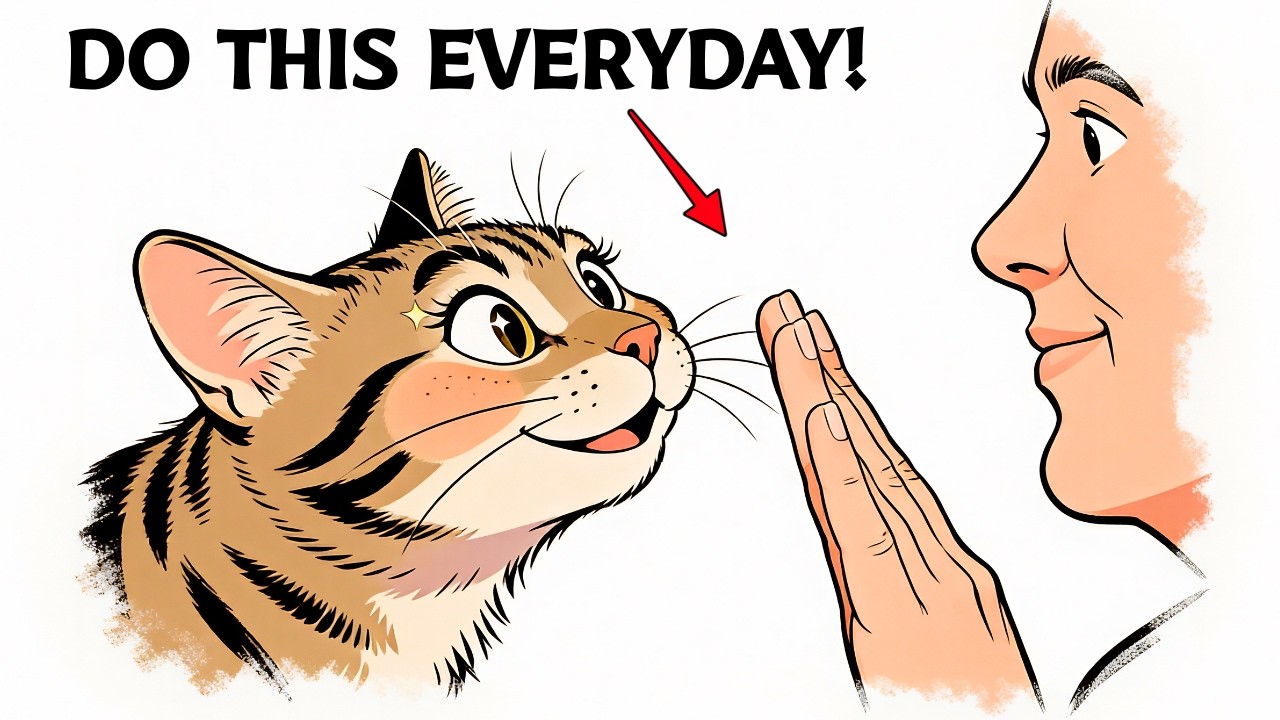
Over time, it teaches your cat to flinch instead of lean in. The habit is simple. Every single time you’re about to pet your cat, extend one finger first. Hold it a few inches from their nose and let them come to it.
Let them sniff. Let them process you. When they push their face into your hand or rub their cheek against your finger, that’s your green light. That’s them saying, “Okay, I’m ready.
” It takes two seconds, but those two seconds completely change how your cat experiences your touch. You go from being someone who pets them to someone who asks first. And cats never forget the people who ask first. The sixth one was the most painful to admit.
I used to scoop up my sleeping cat just because he looked too cute to resist. They curl up in that perfect little ball, peaceful, and something in your brain says, “I need to hold that right now. ” But what feels like love to you feels like something completely different to your cat. Cats spend twelve to sixteen hours a day sleeping.
It’s not because they’re lazy. It’s because sleep is how their body recovers, processes stress, and regulates their entire nervous system. Deep sleep is when your cat feels the most vulnerable. Their guard is completely down.
They chose that spot because they felt safe enough to disappear from the world for a while. Now imagine what happens when you interrupt that. Your cat is in their most defenseless state, and suddenly they’re being lifted into the air with no warning. Their heart rate spikes.
Their claws come out. Even if they settle into your arms a few seconds later, something was registered. That spot isn’t as safe as they thought. Do this enough times and you’ll notice something subtle.
Your cat starts sleeping in harder to reach places. Under the bed, on top of shelves, behind furniture. They’re not being antisocial. They’re protecting their sleep from the one person who keeps interrupting it.
The daily habit here is the simplest one. When your cat is asleep, walk past them. And finally, number seven. The spot that unlocks everything.
I mentioned earlier that there’s one spot on your cat’s body that triggers something deeper than your voice ever could. When deeply bonded cats groom each other—alo grooming—they don’t lick just anywhere. They focus almost exclusively on one area. The base of the head, right between and behind the ears.
That’s the spot a cat can never reach on their own. The only way they ever get groomed there is by someone they trust completely. That’s why this spot is different from every other place you pet. The belly is vulnerable.
The chin feels good. But the area between the ears and down the back of the head is reserved. It’s family only. When another cat grooms this spot, it releases oxytocin in both cats, not just the one being groomed.
Both of them. It’s a chemical bond that says, “We belong to each other. ” And you can trigger this same response. Every single day, take a few seconds to gently stroke that spot between your cat’s ears with your fingertips.
Don’t scratch. Don’t rub hard. Gentle, slow, repetitive strokes. The same rhythm another cat’s tongue would use.
Watch what happens. Your cat’s eyes will close slowly. Their body will soften. Their purr will shift into something deeper than what you hear during a normal pet.
That’s not just comfort. That’s your cat’s brain releasing the exact same chemical it would release with a bonded family member. I started doing these seven things one by one, and the change didn’t come overnight. But it came.
The cat who used to sit across the room now follows me from kitchen to couch. The cat who used to flinch now presses his forehead into my hand. The cat who used to sleep in hard-to-reach places now curls up beside me, eyes closed, purring that deep, trusting purr. It didn’t take treats or expensive toys.
It took the right tone of voice, the right kind of look, the right way to play, the patience to do nothing, the respect to ask first, the discipline to leave him alone when he sleeps, and the knowledge of one sacred spot on his head. In a matter of weeks, the cat who merely tolerated me became a cat who genuinely loves me back.