Everything is perfect. Your cat is nestled against you, purring contentedly, eyes half-closed as you stroke their fur. You may feel like this is the pinnacle of your bond, a moment of pure connection. But suddenly, without warning, your cat bites you—not a scratch or a swat, but their teeth clamping down gently around your hand. It’s confusing. Just a second ago, everything felt right. You might find yourself thinking you did something wrong—perhaps you pulled away too fast or petted too hard, inadvertently ruining the moment. However, here’s a crucial insight that many cat owners overlook: that bite could be the most honest communication your cat has ever offered you. By the end of this exploration, you’ll understand the tell-tale signal that precedes that bite—an indicator nearly every owner fails to recognize.
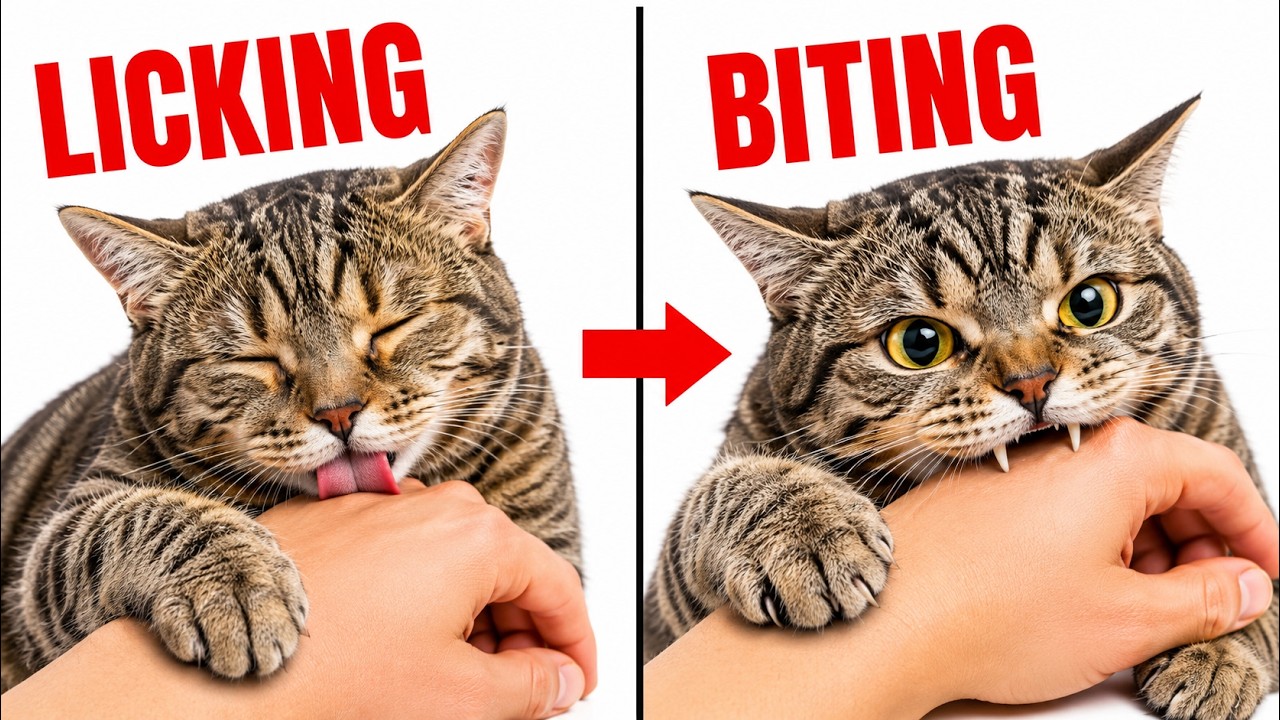
You’ve no doubt felt that little sting of rejection. Confusion washes over you as you process what just happened—in the midst of a lovely cuddle, your cat has suddenly turned on you. Perhaps you even apologized to your feline friend for something you did not actually do.
It’s essential to understand that your cat’s actions aren’t a dismissal of you or your affection. Instead, their body is reacting in a way that may be difficult for us to comprehend.

Point one: your cat’s skin is speaking a language you cannot hear. When your cat leans into you and goes quiet, it seems like you’ve reached the finish line—the ultimate expression of feline affection. Many cat owners mistakenly believe that more petting translates to more love and connection, a simple equation in their minds. However, your cat’s skin is keeping track in a way you can’t perceive. Each stroke sends a tiny electrical signal through their nerves, and with every touch, that sensation builds until it reaches a limit they can’t control. This physiological response is significant; the bite doesn’t stem from a change in your behavior but rather from the accumulation of earlier petting sessions.
Researchers specializing in feline touch receptors have established that what feels wonderful in one moment can become overwhelming as time progresses. The same gentle strokes that provide comfort can turn alien and prickle like static as seconds wear on. This underscores a critical point: the bite signifies not your inadequacy, but rather an overstimulation—a body that has reached its threshold for affection. Many owners don’t connect the dots between the bite and the extensive affectionate time that led to it. They notice the bite, yet they overlook the delightful cuddling that made it inevitable.
Point two: the warning signal that often goes unnoticed. Prior to that bite, your cat’s body goes through a change—a transition that might seem subtle to you but is glaringly apparent to another cat. Perhaps their tail flicks slightly. Maybe their ears rotate back. You might even catch a rippling along their spine. For your cat, these signals are anything but subtle. They’re communicating in their unique language, which other felines can interpret with ease. Researchers observing petting-induced overstimulation in cats have meticulously documented this sequence: tail flick, ear rotation, skin twitch—usually in that order—almost always just before a bite occurs.
Fascinatingly, one of the researchers noted that they were surprised by how many cat owners failed to recognize this signaling, even in video playback or slow motion, despite having witnessed it multiple times. It’s not that you were disregarding their signals; rather, you may not have been listening closely enough. Once you learn to recognize these three signals, a shift occurs in your interactions with your cat. Suddenly, the bites no longer catch you off guard. You begin to receive a precious half second of warning before the sudden bite, and that half second is often enough for you to slow down. You can shift your hand to a calmer location to let your cat reset before they reach a tipping point.

Point three focuses on what your cat’s mother taught them about love. You may wonder, why would a cat that trusts you engage in such behavior? To understand this, we need to travel back to the early stages of your cat’s life, long before they found their way onto your lap. You might think of affection and aggression as opposites, separated by an impenetrable barrier, but that is not the case for cats. As kittens, even before they could open their eyes, their mother engaged in two simultaneous actions: licking and gently nipping. The licking served to clean and soothe them, while the nipping guided and corrected their behavior, keeping them close. This combination—that pairing of lick and bite—constituted the very first language of love your cat ever learned.
Developmental studies reveal that this licking and nipping behavior is one of the earliest bonding rituals to which a cat is 𝓮𝔁𝓹𝓸𝓼𝓮𝓭, happening before many other milestones like vision or walking. For cats, what might appear as contradictory to us is simply part of their communication. They experienced love as an intertwined mixture of calmness and correction.
When your adult cat licks you and then gently nips your hand, they are likely reverting to the most ancient program of affection they possess. That bite doesn’t signal an end to affection; instead, it is a continuation of their expression, a subtle punctuation mark in a sentence that encapsulates the comfort they find in being close to you.
Point four emphasizes how two bites can look identical but convey entirely different messages. You might misinterpret each bite as a signal to stop, to withdraw, or to back off. In some cases, that interpretation may be correct. But other times, particularly after an extended cuddle session, the bite is not a demand for distance. It might instead signify a deliberate closure, a gentle way of concluding a positive experience. Research into allogrooming—mutual grooming behavior exhibited by bonded cats—has found that these sessions frequently end with one cat gently biting the other, which leads to both simply parting ways, relaxed and content.
In your home, this behavior likely plays out each night during those quiet moments you may have stopped noticing. Your cat is not indicating that the interaction has failed; they are simply letting you know it is complete, and that they felt it was good enough to conclude purposefully rather than allow the moment to fade away. Consider how rare it is for two beings who trust each other to end a moment on such terms—an ending chosen, not forced. This isn’t a failure; it’s punctuation—a gentle period at the end of a beautifully written sentence.
Point five introduces a crucial understanding about feline behavior that most people miss until they notice it in hindsight. Recall the earlier mention of your cat’s body reaching its limit. What is that one signal almost everyone misses? Some cats may tense up right before biting—shoulders tightening, bodies coiling as though readying to leap. However, for cats that are wholly bonded to you, the opposite occurs. They go completely soft, almost weightless, as if every muscle has released all tension—heavy and relaxed.

Studies on bonded cats describe this phenomena as a brief full-body release just ahead of an overstimulation bite. For a fleeting instant, your cat sinks, relinquishing all control as if they are letting go of everything. In that brief moment, which usually lasts less than a second, your cat could be at their most vulnerable.
Imagine this—an animal whose every instinct is designed for survival, deliberately allowing itself to feel entirely relaxed in your presence. When your cat surrenders that level of protection, they are bestowing upon you their utmost trust. At that moment, they are choosing you, not the safety of the couch or the comfort of the floor. It’s a profound act of vulnerability.
It might be tempting to maintain your hold on them, to keep them there just a little longer, as it feels so good, both for you and them. But it’s critical to recognize that if you push past that soft heaviness, the bite often becomes more assertive—not due to anger or distress but because your cat is left with no other means to communicate their need for space.
When you sense that softness, that stillness in their body, consider it a cue—a request, not a loss. Loosen your hold first. Allow them the option to choose to stay or leave on their own terms. If you give them the chance to depart gently, they may return to you even softer next time.
Ultimately, that bite never signaled an error on your part. It was simply your cat’s way of articulating a truth their heart cannot verbalize. It reflects the same honest affection their mother conveyed using the same language long before they understood there might be another way to express themselves. Cats reveal this truth with stark clarity, honest and without pretense, even when they wish they could linger a moment longer. Have you ever recognized that soft vulnerability in your cat right before they bit you? Did you know then, as you do now, that it was a manifestation of their deep trust in you?