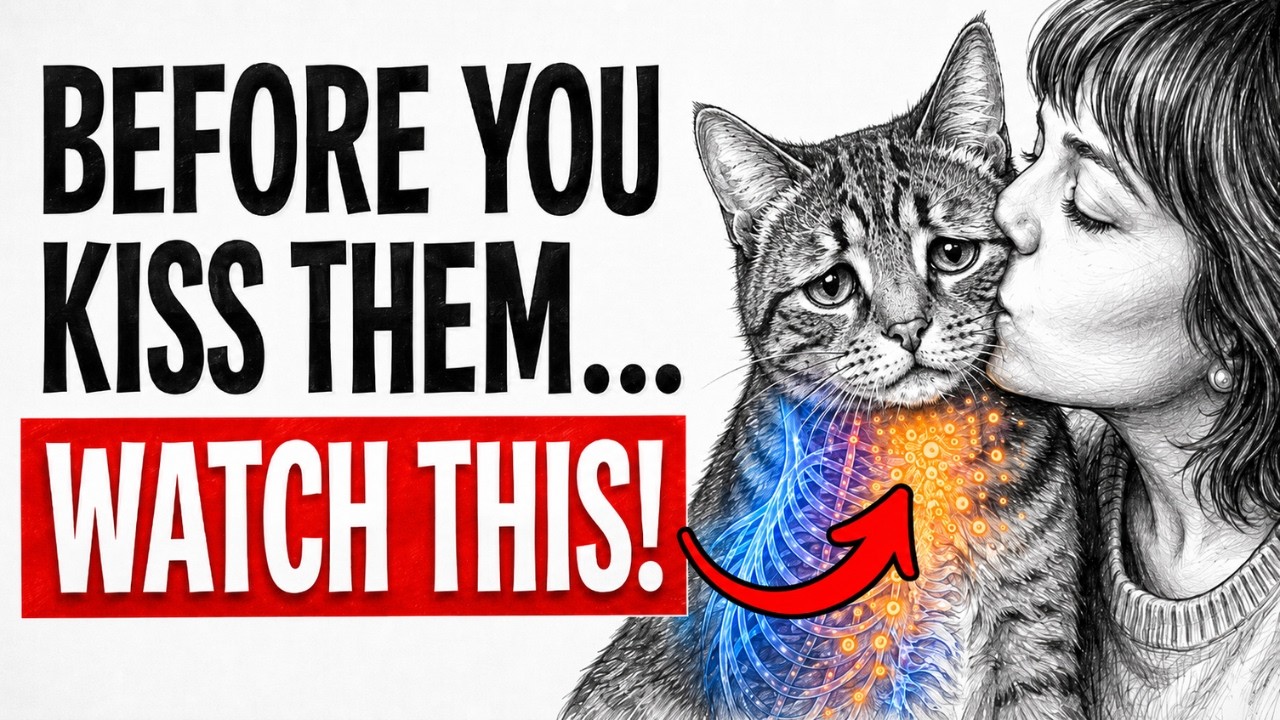
It starts with one quiet little moment. You find your cat curled up on the couch, sunlight warming their fur, and you lean down slowly, almost reverently, and place a gentle kiss on the top of their soft little head. To us, it feels incredibly tender, loving, and almost instinctive. It is our purest human expression of devotion.
But to your cat, that moment is not being interpreted as a kiss the way humans understand it at all. While your heart is overflowing with affection, your cat’s brain is entering a completely different sensory experience. It is an experience built around scent, territory, vibration, and survival instincts that are tens of thousands of years old.
And here is the part that may genuinely surprise you. Your cat may actually be processing far more information about you in those few quiet seconds than you could ever imagine. Because when your face gets that close to theirs, your cat is not just feeling physical affection. They are actively studying you. They are reading your breath, your scent, your body temperature, your emotional state, and even whether you are someone they can safely trust in that exact moment.
By the end of this journey, you will finally understand why some cats melt into your kisses with slow blinking eyes and rumbling purrs, while others flinch, flatten their ears, or vanish under the bed after only one second of contact. The reason has almost nothing to do with whether or not they love you. And once you understand what this very human gesture truly means in the feline world, you may never look at your beloved companion the same way again. Let us decode the hidden language of the cat.
Number one, the scent signature exchange. To understand what truly happens when you kiss your cat, we first have to understand one fundamental truth about how cats experience the world around them. Humans live primarily through sight and sound. We are visual, verbal creatures. Cats are something else entirely. A cat’s universe is built around scent, territory, and silent observation. Their world is shaped by invisible chemical maps, layered scent signatures, and tiny shifts in their environment that human beings would never even notice.
So, when you lean close enough to kiss your cat’s tiny forehead or the soft spot between their ears, you are entering one of the most scent-sensitive zones on their entire body. In that exact moment, your breath, your skin, and your hair all become part of an immediate chemical analysis. To us, our scent is invisible background noise. To a cat, your scent is detailed biological information.
Cats possess scent glands scattered throughout their face, particularly along their cheeks, chin, forehead, and the base of their ears. These glands release pheromones that cats use to mark territory, identify family members, and signal emotional safety. And hidden inside the roof of their mouth, cats also possess a sensory structure called the vomeronasal organ, sometimes called the Jacobson’s organ. This remarkable biological tool allows them to detect chemical signals and pheromones in ways that go far beyond ordinary smell.
So, every single time your face comes close to theirs, your cat is silently and thoroughly examining you. The scent of your breath, your skin, and even the shampoo lingering in your hair can reveal your emotional state, your stress level, your fatigue, and any unfamiliar places you may have visited that day. This is exactly why so many cats will pause and slowly sniff your face, your lips, or your hair right after you kiss them. Most owners think the cat is just being curious or affectionate. But in reality, your cat is performing a scent verification. They are confirming that you, the trusted human in their territory, still smell familiar, safe, and emotionally consistent to them.
And when your scent matches their internal memory of you, your cat’s nervous system relaxes. That is exactly why so many cats softly head-butt you, rub their cheek against your face, or close their eyes after a close moment with you. Because to them, your scent identity has just been confirmed. But scent is only the surface of this connection. What happens beneath the skin runs much deeper.
Number two, the vibrational language. Something profoundly subtle happens during those quiet seconds of physical closeness. Something almost invisible to humans, yet completely real to cats. Because cats do not only communicate through scent and body language. They communicate through vibration.
A cat’s nervous system is exquisitely tuned to subtle physical sensations. Their bodies are designed to detect the faintest tremors in the floor, the soft hum of a refrigerator, the distant footsteps of a human walking three rooms away. Their whiskers, their paw pads, and even the delicate skin beneath their fur are sensitive to vibrations that humans cannot consciously feel.
And this is exactly where your physical presence becomes surprisingly powerful. When you lean in close, when your voice softens to a whisper, when your chest rises and falls slowly against their body, your entire being begins broadcasting a low, steady vibrational rhythm that your cat can feel through their skin. But here is the truly fascinating part. Cats are also broadcasting back.
The purr itself is a vibration that operates within a frequency range scientists believe may have healing and self-soothing properties for the cat. When your cat purrs against your face during a kiss, they are not only expressing contentment. They are participating in a quiet exchange of vibrations between two living beings who trust each other deeply.
Researchers who study feline behavior have observed something fascinating about cats and their bonded humans. When a cat is comfortable enough to remain still and purring during close physical contact, their entire nervous system shifts into a parasympathetic state, the biological rest and recovery mode. Their heart rate slows, their breathing deepens, their pupils relax. In simple terms, your calm, warm presence becomes a vibrational anchor for your cat’s normally hyper-alert system. Your steady breathing, your soft voice, and your gentle stillness combine to create a rhythmic frequency your cat can settle into.
This explains a beautiful reality that many cat owners completely miss. Your cat is not always just tolerating your affection out of patience. Very often they are actively choosing to share their vibrational space with you. You become the steady frequency in a noisy, unpredictable world. But this peaceful vibrational connection also has very strict feline limits. And if you cross them, your cat’s reaction might confuse you deeply unless you understand the science behind it.
Number three, sensory thresholds and feline boundaries. Almost every loving cat owner has experienced this slightly confusing moment. You lean in. The first kiss is perfect. Your cat seems relaxed, maybe even pushing their head into your face. Then suddenly, without warning, they flick their tail sharply, twitch their ears backward, gently bite your nose, or leap off your lap entirely. Emotionally to a human, this can feel almost insulting. It looks exactly like rejection.
But you must understand this. Most of the time, it has absolutely nothing to do with rejection. It has everything to do with sensory thresholds and feline boundaries. To truly understand this, we need to talk about their whiskers and their hyper-tuned nervous system. A cat’s face is essentially a high-resolution sensory map. Their whiskers, scientifically known as vibrissae, are not just decorative hairs. They are deeply rooted sensory instruments attached to highly sensitive nerve clusters that feed continuous spatial information into their brain. They detect air currents, the proximity of objects, the temperature of nearby surfaces, and even tiny shifts in pressure within a room.
Now, put yourself in their paws and imagine what happens during a human kiss. A massive warm object, your face, suddenly fills the most information-rich area of their entire body. Your breath dramatically alters the air flow around their muzzle. Your scent overwhelms their already powerful nose. Your movement dominates their visual field. Your skin radiates intense heat against their delicate fur. For a few brief seconds, this contact can feel deeply pleasant. But if the stimulation continues for too long, your cat’s nervous system can quickly reach what is known as petting-induced overstimulation. And once that threshold is reached, your cat must create distance. Not because their love for you disappeared, but because their highly tuned nervous system simply needs a recovery moment from too much sensory input at once.
That sudden ear flick, that tail twitch, or that gentle warning nibble are not signs of aggression. In feline psychology, these are recognized as polite communication signals. It is your cat saying, in the only language they have, “I trust you, but please pause.” And interestingly enough, the cats who feel most secure with us are often the most clear about communicating these limits because they have learned through experience that we will respect them.
When your cat moves away and you calmly let them go, their nervous system learns something monumentally important about you. They learn that you are safe, you are predictable, you are gentle, and you are not a threat. You are someone who listens to them. And to a cat, that respect may matter far more than constant physical affection ever could. Because real, lasting trust in the feline world is never built through force. It is built entirely through respected boundaries. But when they do allow you to stay close, what are they truly trusting? What does placing your face against theirs really signify?
Number four, the ultimate display of vulnerability. This brings us to a profoundly powerful truth hidden inside this little human gesture. What does your kiss actually represent to your cat? Not romantically and not emotionally in the complex human sense, but purely biologically. The answer is genuinely extraordinary.
In the wild, the face, the neck, and the belly are among the most vulnerable regions of any creature’s body. These zones contain vital sensory organs, major arteries, and the foundational systems necessary for survival. Therefore, almost all animals instinctively guard these areas from any approaching creature, especially something larger than themselves. So when you lean down, close your eyes, and place your face directly next to your cat’s teeth and claws, you are performing a physical act that completely contradicts predator behavior. You are deliberately exposing your own vulnerable areas to them.
And cats understand the concept of vulnerability far better than they will ever understand the human concept of a kiss. That is the real hidden meaning your cat recognizes in that moment. They do not see human romance. They see absolute trust without defense. You are showing them that you arrive in their territory with no threat, no aggression, and no hidden intent. You offer only quiet closeness.
Over time, your cat begins associating your face with safety itself. That is exactly why some cats will slowly close their eyes when you lean in, offering what behaviorists call a slow blink. It is why some cats will press their forehead softly against yours, a gesture known as bunting. Those are not random behaviors. They are profound biological signs that your cat has accepted your presence inside their most heavily guarded sensory world. For a creature built on solitary instinct, careful observation, and self-preservation, granting you that level of intimate access is a gift of trust that is almost immeasurable. But this incredible vulnerability is deeply tied to something else you are doing in that exact moment. Something that completely transforms the dynamic.
Number five, the power of the slow blink. When your face is mere inches from your cat’s whiskers, what exactly are your eyes doing? In the wild feline world, a hard, direct, unblinking stare is a universal challenge. It signifies dominance, a threat, or the focused intent of a predator preparing to strike. If a feral cat were to stare wide-eyed into another cat’s face from close range, a confrontation would almost certainly follow.
But domestic cats have done something extraordinary. Over thousands of years of living alongside humanity, cats have developed a unique communication channel specifically tuned to us. They have learned to read the subtle expressions of human eyes. And even more remarkably, they have taught us how to read theirs. When you lean down to kiss your cat’s head, you naturally soften your facial muscles. Your eyelids lower, your brow relaxes, and you look at them with warmth. Your cat reads this expression beautifully. They recognize it instantly as non-𝓉𝒽𝓇𝑒𝒶𝓉𝑒𝓃𝒾𝓃𝑔, maternal, and safe. It overrides their hardwired instinct to retreat from a face encroaching on their personal space.
And then comes the most magical exchange of all, the slow blink. Behavioral studies have shown that when humans slowly blink at their cats, the cats are significantly more likely to slow blink back. This gentle, lingering closing of the eyes is widely considered the feline equivalent of a quiet expression of trust. It is the cat saying, in the most ancient language they have, “I feel safe enough with you to close my eyes for a moment.” By softening your eyes as you bring your face close, you are speaking a refined interspecies language. You are telling their ancient brain, “I am family, not a predator.” This soft gaze combined with the warmth of your kiss does not only make them feel psychologically safe, it actively shifts their internal chemistry, leading to the most beautiful biological response of all.
Number six, the oxytocin and serotonin bond. This is where the magic of the human-cat bond transcends emotion and becomes something measurable. When you gently kiss your cat’s head, the soft physical pressure, the familiar scent, and the warmth all trigger a powerful neurological response. In that quiet moment, both your brain and your cat’s brain release a surge of oxytocin, the bonding hormone, often called the cuddle chemical. Oxytocin is the same biological compound responsible for the bond between a mother and her newborn. It is the chemical foundation of trust, attachment, and emotional safety.
Research has shown that cats, despite their independent reputation, also experience measurable oxytocin elevation during positive interactions with their trusted humans. As the oxytocin flows through your cat’s system, it suppresses cortisol, the primary stress hormone. Their tension melts. Their heart rate stabilizes. Their muscles soften beneath your hands. At the same time, the soothing rhythm of being gently touched also encourages serotonin release, the neurotransmitter associated with contentment and emotional balance. This is part of the reason your cat may begin to purr, knead their paws softly against your arm, or drift toward sleep when you hold them close.
What is truly beautiful about this chemical exchange is that it is mutual. As their oxytocin rises and they relax into your touch, your own oxytocin rises in response, lowering your human blood pressure and easing your own stress. Your simple kiss is quietly changing their brain chemistry in real time, just as their quiet trust is healing yours. You are sharing a chemical bond that science continues to discover is far stronger than humans once believed possible between our two very different species.
So, the very next time you find yourself leaning down to softly kiss your cat’s tiny head, pause and remember this truth. Your cat does not possess the human language to think, “My human is kissing me because they love me.” What they understand is something so much older and so much deeper. They understand that this giant, powerful human feels safe enough to become vulnerable beside them. They understand that your scent is familiar, your breath is steady, your eyes are soft, and your presence is calm. And in the quiet, ancient, beautiful language of cats, allowing you that close, that gently, and that often may just be the greatest and most profound form of love that exists in the natural world.
Number seven, the territorial kiss and scent marking. There is something happening during your kiss that almost no cat owner fully understands. Something deeply rooted in the ancient feline need to define territory and belonging. Because when your face touches your cat’s head, you are not only giving affection. You are participating in one of the oldest rituals in the feline world: scent exchange.
To a cat, scent is identity. It is family. It is home. Cats live in a world where every surface, every doorway, every piece of furniture carries layered chemical messages that tell them exactly who belongs in their space and who does not. They use scent the way humans use names and faces, as the primary identifier of safety and familiarity. And here is the part that may genuinely move you. When you kiss your cat, you are leaving your scent on them and they are leaving their scent on you. It is a quiet biological exchange that creates what behaviorists call a shared group scent.
In the wild, cats living in stable colonies engage in this exact behavior. They rub against each other, sleep curled together, and gently touch noses to combine their individual scents into one unified family signature. This shared scent is how they instantly recognize each other as part of the same trusted group. So, when your cat rubs their cheek against your lips after you kiss them, or when they press their forehead firmly against your chin, they are not simply being affectionate. They are deliberately marking you. They are claiming you as part of their inner circle, their family, their territory. You are being labeled as one of their own.
This is why so many cats become noticeably uncomfortable when you come home smelling like another animal, a strange perfume, or an unfamiliar environment. Your scent signature has been altered, and their internal map of you no longer matches. That is exactly why they may sniff you intensely, refuse to settle near you for a few minutes, or immediately begin rubbing against you to restore the proper scent balance. Your kiss, in their mind, is part of an ongoing biological agreement. You belong to them and they belong to you, and the scent on your skin is the contract that proves it. But this territorial bond is also deeply connected to something even more fascinating, something hidden inside the timing and frequency of your closeness.
Number eight, the memory imprint of safe touch. Here is a truth about cats that science is only beginning to fully appreciate. Cats possess remarkable associative memory, especially when it comes to touch, scent, and emotional safety. Every time you gently kiss your cat without forcing the moment, without restraining them, and without overwhelming them, you are quietly building a long-term emotional imprint inside their brain.
To understand why this matters so much, we need to look at how cats process trust over time. Unlike many animals that bond quickly and openly, cats build attachment in slow, deliberate layers. Each positive experience is filed away inside their nervous system as a tiny piece of evidence that you are safe. Each calm interaction adds another layer to a deep internal blueprint that shapes how they respond to you for the rest of their life.
Kittens who are gently held, softly spoken to, and lovingly kissed during their early socialization window, typically between two and seven weeks of age, often grow into adult cats who actively seek human closeness. Their brains have been imprinted with the understanding that human faces, human breath, and human warmth are sources of comfort rather than danger. But here is the truly extraordinary part. Even adult cats and rescued cats with difficult histories can slowly rewrite this internal blueprint through consistent gentle contact. Their brains possess what scientists call neuroplasticity, the ability to form new emotional associations even after years of fear or trauma.
So every quiet kiss you give your cat, every soft moment of forehead contact, every patient pause when they pull away, is being recorded inside their long-term emotional memory. Over months and years, these tiny imprints accumulate into something profound. Your cat begins to recognize the very rhythm of your approach, the specific sound of your breathing, and the familiar scent of your lips against their fur as guaranteed signals of safety.
This is exactly why long-bonded cats often run toward their humans when they come home, leap onto the bed in the morning to press their face against yours, or follow you from room to room simply to maintain physical closeness. They are not being needy. They are returning to the source of their most deeply imprinted emotional safety. You have become a living anchor inside their memory, a constant in a world they cannot fully control.
And perhaps most beautifully of all, this imprint outlasts almost everything else in their lives. Cats who have lost their owners often grieve for weeks or months, refusing food, searching the house, and crying at familiar doorways. The reason is not sentimentality. It is biology. The emotional imprint of safe touch runs that deep. So every time you lean down and softly kiss your cat, remember that you are not just sharing a passing moment of affection. You are writing yourself permanently into the emotional architecture of a creature who will carry that memory inside them for the rest of their life.
I would love to hear about the unique bond you share with your feline best friend. When you gently kiss your cat, how do they normally react? Do they slow blink back at you, purr softly, headbutt your chin, or give you a gentle little love bite in return? Please drop down into the comments below. Tell us your beautiful cat’s name and share your story with us.