I knew the gavel would fall before the judge even opened his mouth. That was fine. I hadn’t come here to win a case. I had come here to end a war.
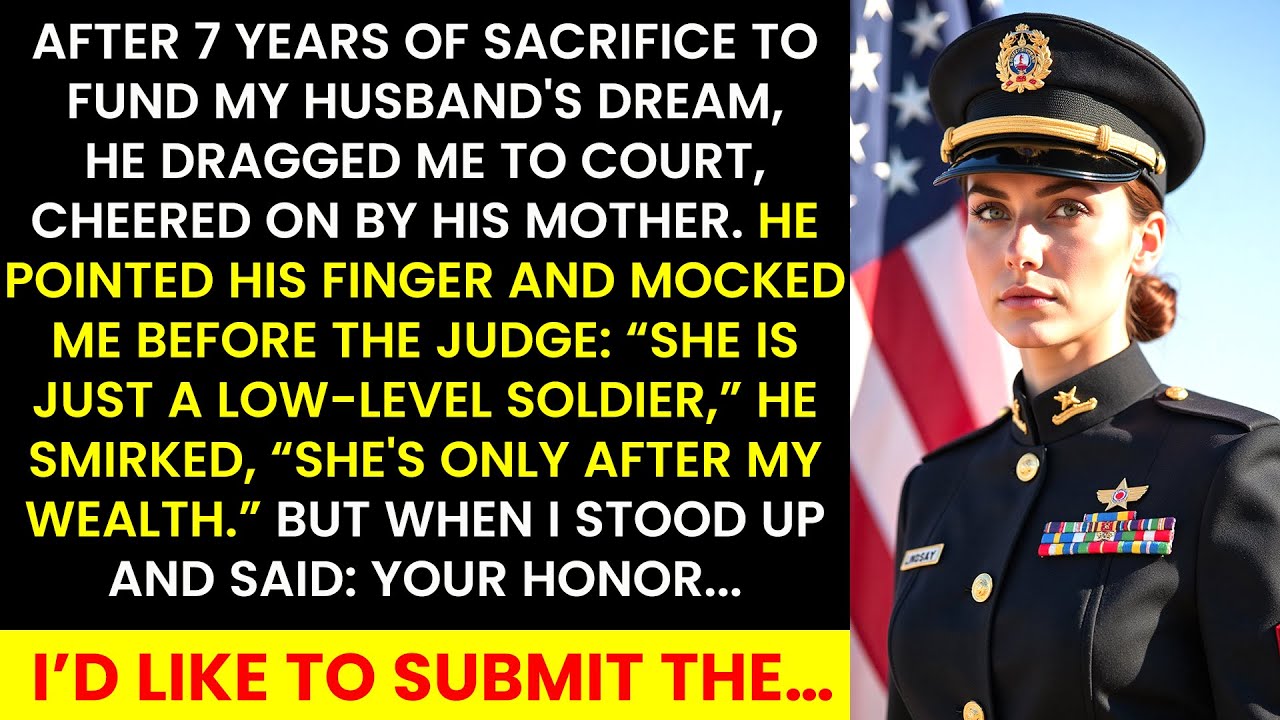
A good officer never walks into battle without a contingency plan. And the thing I pulled from the breast pocket of my suit jacket wasn’t a handkerchief to dry my eyes. It was a death sentence for his entire empire. I bought this suit at Target three days ago.
Forty dollars. It was all I could afford. And I knew exactly how much it cost because I was the one who signed the check for it two years ago, back when Corbin said he needed to look the part to woo investors. He looked the part now, all right.
Wearing a tailored Italian suit that cost more than my car, his hair perfectly styled, his jaw tight with practiced anger as he sat next to his lawyer. The courtroom was silent except for the whisper of the HVAC system above. The judge adjusted his glasses and looked at the papers in front of him. “Mr.
Reynolds’s counsel has characterized the marriage as one where the plaintiff was the sole architect of the family’s success, while the defendant contributed nothing beyond domestic upkeep. He refers to the defendant as, and I quote, ‘a woman whose only rank was supportive wife and whose only mission was to keep a man-child happy. ‘”
I heard a few quiet gasps from the handful of people in the gallery. Not that there were many.
It was a private hearing, the kind where discovery had been brutal and depositions had been designed to crush me. Corbin had paid for the best. He had years of practice making me feel small, and now he had brought in professionals to do it in a court of law. “Do you have anything to say before we proceed to the division of assets, or do you accept the plaintiff’s characterization?
” the judge asked. The Target suit pulled tight across my shoulders as I stood. My spine was straight, the way it had been trained to be. In the military, you learn that posture is everything.
You can be drowning inside, but if your back is straight and your chin is up, no one will ever know. “I do not accept the plaintiff’s characterization, Your Honor,” I said, my voice steady. Corbin snorted. A tiny, mocking sound.
His lawyer, a woman with razor-sharp cheekbones and a smile that never reached her eyes, put a hand on his arm to silence him. “Mr. Reynolds claims that I was merely background noise,” I continued. “That while he was building the future, I was just existing in the other room.
He said I wouldn’t understand the complexity of his algorithms. That my calloused hands were only fit for carrying his shoes, not wearing his ring. ”
I paused. I let the silence stretch.
In the military, you learn how to use silence. It’s a weapon, just like anything else. “But I have evidence, Your Honor. Evidence that the plaintiff has failed to disclose.
”
The judge’s eyebrow raised. The energy in the room shifted. Corbin sat up straighter in his chair. In the seat beside me, my lawyer, a woman I had only been able to afford because she worked on retainer out of sheer boredom with high-society divorce cases, looked at me with something like genuine surprise.
I hadn’t told her about my evidence. I hadn’t told her everything. I reached into the inside pocket of my blazer. The paper inside was worn, folded carefully, and I had been carrying it close to my heart for two years.
No. That wasn’t true. I had been carrying it in a lockbox. But the motion I made was the same.
I pulled it out and held it up between two fingers. “Your Honor, this is a signed document from a date two years before our separation. It was signed willingly and in good faith by Mr. Reynolds.
”
The judge gestured for the bailiff to retrieve it. The bailiff walked over, took the paper, and handed it to the judge. Corbin was watching me now. His eyes were hard, trying to read me.
But I wasn’t looking at him. I was looking at the window, at the gray morning light coming through the blinds. The judge read the document. Then he read it again.
He looked up at Corbin over the rim of his glasses. “Mr. Reynolds, this document states that in recognition of foundational technical contributions and financial investment, Caitlin Lindsay is entitled to forty-nine percent of all equity in Restock Solutions, fully vested immediately upon any filing of divorce. ”
The color drained from Corbin’s face.
The lawyer next to him snatched the paper from the judge’s hand, reading it herself, her eyes widening. “That’s a forgery,” Corbin sputtered. “She made me sign that. It was a mistake.
I was drunk. She tricked me. ”
“I don’t sign my equity away when I’m drunk, Corbin,” I said quietly. “You forget.
I was the one who handled the paperwork. You were the one who never looked at what you were signing. You just needed it to be done so you could go back to your coding. ”
The judge held up a hand.
“Silence, Mr. Reynolds. Mrs. Lindsay, is this the extent of your evidence?
”
“No, Your Honor. It’s not. I have documentation of substantial financial transfers from the joint account to a private account in the Cayman Islands. I have receipts for three luxury vehicles, a rental property, and a boat that I never received.
All purchased with marital funds after the date of separation. ”
All eyes were fixed on me. The clerk who had been quietly typing turned around to stare. I could feel Corbin’s gaze burning into the side of my head.
“And I have a ledger,” I said. “A handwritten ledger from the very beginning. Before Restock Solutions was ever anything but a dream. I documented everything, Your Honor.
Every idea, every meeting, every call. I was the one who built the foundation. He was the one who stood on top of it and called himself a king. ”
I reached into my bag and pulled out a worn spiral notebook.
The pages were yellowed, the ink faded on some of them, but I had kept it safe. “I invested my severance from the military in this company. I paid for the first three months of server costs with my own money. I created the financial model that got us our first round of funding.
And when his code crashed, which it did repeatedly because he never once properly tested a single release, I was the one who stayed up late with him, walking him through the bugs, calming him down, keeping him from giving up. ”
“Objection,” the lawyer said, but her voice was weak. There was no energy behind it. “No,” the judge said, his eyes still on the notebook I had placed on the table.
“I think you have done enough, Mrs. Lindsay. ”
I sat down. My hands were shaking, but I clasped them together to hide it.
The judge looked at the equity agreement again. Then he looked at Corbin. “Mr. Reynolds, you are aware that this document is legally binding, are you not?
It is stamped, it is notarized, and it was signed in the presence of two witnesses, one of whom is your own mother. ”
Corbin’s face went white. “My mother? She never…”
“Your mother,” the judge repeated.
“It appears she witnessed the signing. She just didn’t read the document she was signing. She thought it was a tax waiver. ”
I had learned that from her.
The mother-in-law who never missed a chance to comment on my lotion or my job. She had signed without looking. They all believed that I was just a woman who would never pick up a pen. “Mrs.
Lindsay,” the judge said, turning to me. “Is it true that you offered to settle this matter privately? That you would have accepted a modest spousal support arrangement to avoid the public discovery of these facts? ”
“Yes, Your Honor,” I said.
“I didn’t want to be here. I didn’t want to hurt the company. I believed in Restock Solutions. I still do.
But my husband treated my presence as an inconvenience, and my contributions as a burden. He told me that I was just existing. That he couldn’t build the future with a woman whose only rank was supportive wife. So, yes, Your Honor.
I offered him a way out. ”
“And he refused? ”
“He refused,” I said. “He wanted to humiliate me.
So I decided, for the first time in our marriage, to give him exactly what he wanted: a fight. ”
Corbin was crying. Not because he was sorry, but because he had lost. His empire, his future, his vision of himself as the brilliant mastermind.
All of it crumbling because of a piece of paper he had signed when he was too busy being in love with himself to read the terms of his own betrayal. I had cried for the first hundred miles after my husband had told me he needed space. I had cried in the car, my chest heaving, my knuckles white on the steering wheel, alone on the highway to nowhere, trying to understand how the man I had given my life to could look at me and see nothing. Then I stopped crying.
And I started planning. The judge ruled in my favor on all counts. Forty-nine percent of the entire company. Not just future revenue.
All of it, current and future. The Carribean accounts would be unfrozen and transferred into escrow. The rental property was mine, along with a judgment for attorney fees. Corbin’s lawyer tried to argue a motion for a new trial, but the judge denied it before she could even finish her opening sentence.
“She was also part of the ‘supportive wife,'” the judge said, looking at Corbin’s lawyer with a flicker of disgust. “The court finds that the plaintiff’s characterization is not only false but deliberately misleading. The defendant, Caitlin Lindsay, is a founding partner of Restock Solutions. Her name is on the original incorporation documents.
Her hands, as she mentioned, were not only fit to carry shoes. They built the company that your client has been so eager to take all the credit for. ”
Corbin was escorted from the courtroom by his lawyer. I watched him go.
He didn’t look back. He never did. The gallery emptied. People in suits walked past me without meeting my eyes.
The clerk at the front desk gave me a small nod. She was a woman who had watched the whole thing, and she had seen the truth. I stayed in my seat until the room was empty. Then, I stood up.
I wasn’t the same woman who had walked in that morning. I wasn’t the wife who had folded his socks and packed his lunch. I was someone else now. I walked out of the courthouse and into the cold morning air.
The sun was starting to break through the clouds. I walked to my beat-up sedan, the one I had bought used the year before we were married, and got in. Inside the glovebox, taped to the inside of the lid, was a piece of paper. It had been there for years.
I pulled it out and read it. It was a quote from Theodore Roosevelt. The one about the man in the arena. The one who strives valiantly, who errs, who comes up short again and again.
The man whose place shall never be with those cold and timid souls who know neither victory nor defeat. I had told myself, all those years, that one day Corbin would read it and understand. That he would see the strength I carried. That he would finally look at me and see someone worthy of respect.
He never looked. He never read it. He only saw the checkbook. I started the engine and pulled out of the parking lot.
I didn’t know where I was going. I had a forty-nine percent share of the company, but I was still figuring out who Caitlin Lindsay was without a man to take care of. My phone buzzed. I checked it at the stoplight.
It was a text from him. Did you really think you could destroy me? You’ll regret this. You made a mistake, Caitlin.
I smiled and put the phone back in my pocket. I didn’t need to respond. I didn’t need to explain the fact that I had spent six years protecting his dreams, his ego, his fragile sense of self. That I had handled the paperwork, the callbacks, the breakdowns.
That I had seen him at his worst and still chose to stay. And the moment I needed him to be strong for me, the moment he saw my own success, he made me the problem. Mission comes first. That was the lesson I had learned in the Army.
But I had learned it the wrong way. I had decided that his mission was my mission. That his success was my sacrifice. And the cost of that mistake had been my dignity.
But I was taking it back now. I had thrown away his flowers. The ones that arrived at my office the next morning, the same day the settlement was public. I knew who they were from before I even saw the handwriting.
The card said what it always said: “I still love you. Let’s talk. ”
I dropped the vase. The sound of it hitting the inside of the trash bin was heavy and final.
Then I went back to my desk. The desk covered in post-it notes that had turned yellow and forgotten. My calluses were fading. But the strength was still there.
I pulled out the documents one more time. Not a legal brief, not a letter to a traitor. It was a letter to myself. The most expensive lesson I learned was never about the money.
It was that you can’t pour from an empty cup. You can’t save someone else when you’re drowning yourself. And you can never, never apologize for the things that make you strong. I didn’t want his apologies.
I didn’t want his regret. I just wanted my name back. I looked out the window of my small rented office. The street below was full of people going about their days.
And for the first time in a long time, I didn’t have to fight to be seen. Because I knew who I was. Not because I was someone’s wife. Not because I was someone’s partner.
But because I had walked through the fire and come out the other side carrying a forty-nine percent ownership stake in my own future. I wasn’t the same woman who had agreed to quit her job and become a supportive wife. I was a founder. I was a veteran.
I was someone who had finally learned to put her own oxygen mask on first. And when the next time my phone rang, and the caller ID showed a number I didn’t recognize, I picked it up. “Hello? ” I said.
“Hi,” the voice on the other end said. “Is this Caitlin Lindsay? My name is David. I’m a recruiter with a small firm over in Cleveland.
I know this is a long shot, but we have a client looking for a COO, and I saw your name in the news. Would you be open to a conversation? ”
Twenty minutes later, I had an interview Friday. They flew me out.
Their building was in a tech park just outside the city. It was filled with people who looked like they had never touched a warehouse floor in their lives, but they looked at me with respect in their eyes. The woman across from me was in her early sixties, silver hair, sharp eyes, and a handshake that told me she had built this place from nothing. “I read your story,” she said.
“You took what was yours. That takes more courage than most people realize. ”
“It was just a legal process,” I said, suddenly feeling shy. “It wasn’t just a legal process,” she said.
“It was a life lesson. I’ve been where you are. My ex-husband was a brilliant man. He built things.
He made money. But he forgot that he didn’t build them alone. It took me years to learn what you’ve already figured out. ”
I tried to apologize, tried to tell her that I didn’t mean to make a spectacle, but she just waved her hand.
“It’s a lesson half of America needs to learn. Never shrink yourself to make someone else comfortable. You don’t have to be a man to be a founder. You don’t have to be a brute to be a soldier.
And you definitely don’t have to be a doormat to be a wife. ”
I got the job. And when I walked out of that office building, I felt a new light on my face. I wasn’t a soldier anymore.
I was a leader. I wasn’t a forgotten wife. I was a survivor. And as the sun set over the city, I didn’t walk to an elevator.
I walked down the stairs. It took longer. But I was done with shortcuts. When I got to my car, I didn’t stop to look at my reflection in the window.
I already knew what I looked like. A woman who had been told she couldn’t, who was told her hands were too calloused, her smile too tired, her worth too small. But they were wrong. Every last one of them.
I was unbreakable. I had always been unbreakable. It just took me a while to remember it. I opened my car door and drove home, the sky bleeding into shades of gold and violet over the rooftops.
I didn’t know what the future held. But for the first time in my life, I knew that whatever came, I would handle it. Not as someone’s shadow.
But as the sun.