The morning started before the great hall clock had even struck. Astrid Jensen was arranging the flowers on the central table, a task Bodil, the oldest servant in the house, had given her the evening before. That was when she heard Ingrid’s footsteps on the stairs. They were not ordinary footsteps.
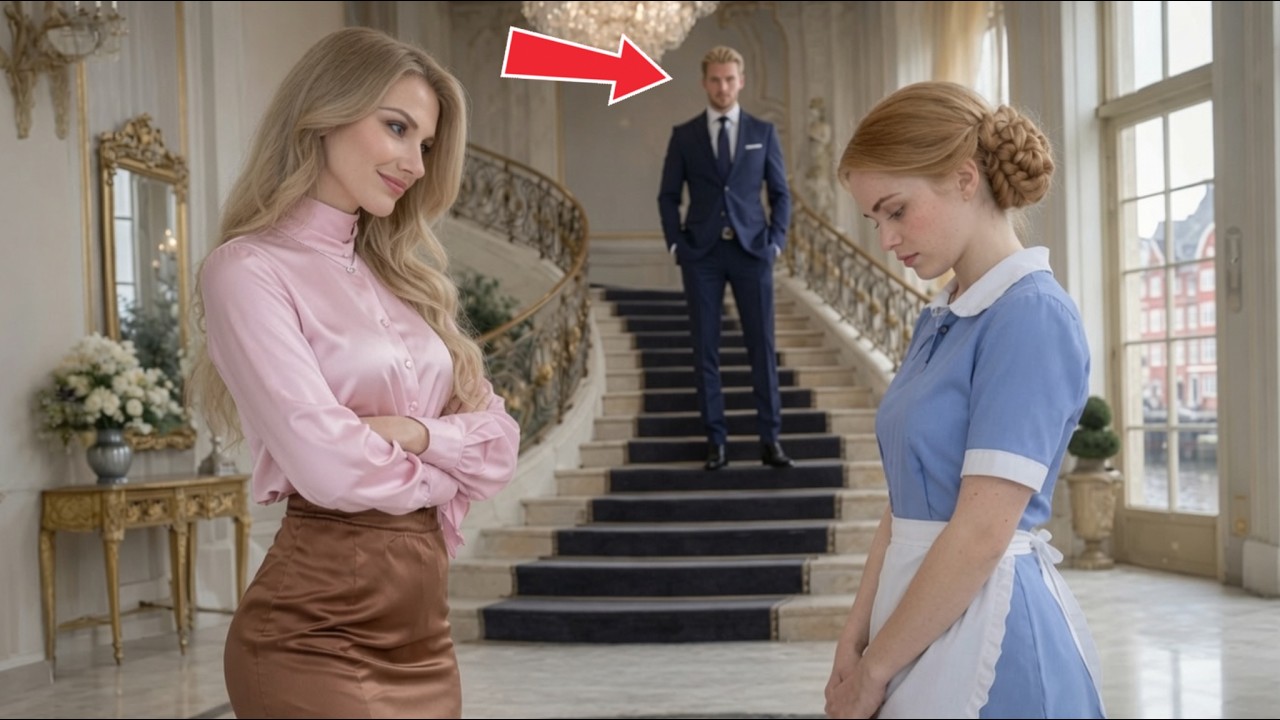
They carried intention. They were searching for something, or someone. They found her. Ingrid stopped at the bottom step, her eyes cold.
“Come here. ”
Astrid set down the flowers and approached, keeping her eyes fixed on Ingrid’s face. Her mother had taught her that lowering your gaze was the first thing the guilty did, and she had nothing to feel guilty about. “Good morning, Mrs.
Møller. ”
Ingrid did not return the greeting. She pointed toward the display cabinet at the back of the hall, where the house’s most expensive ornaments were kept. “The crystal eagle on the second shelf,” she said.
“Where is it? ”
Astrid looked at the cabinet. There was an empty space on the second shelf, one that had not been there yesterday. She frowned, genuinely confused.
“Mrs. Møller, I don’t know. Yesterday, when I cleaned the cabinet, everything was in its place. ”
“Everything was in its place,” Ingrid repeated, her tone shifting in a way that put Astrid on alert.
“Are you sure? ”
“Yes, Mrs. Møller. Completely sure.
”
Ingrid crossed her arms, tilting her head. Something in her expression turned from question to judgment. “How convenient. That piece came from Venice.
It has a value you probably can’t even imagine. And it disappears on the exact evening you were alone in this hall to clean. ”
“Mrs. Møller, I took nothing,” Astrid answered, her voice steady even as her hands began to tremble along her sides.
“You can check my bag. You can check my room. You can check whatever you want. ”
“I don’t need to check anything,” Ingrid said, raising her voice with calculated clarity.
“Objects don’t disappear on their own. And in this house, the only person in this hall last night was you. ”
That was when Kirsten, the kitchen maid, appeared from the kitchen door with an uncomfortable expression. Behind her stood Bodil, who had heard the voices from the first-floor landing and come down without a sound.
Neither woman moved to intervene, because when Mrs. Ingrid spoke in that tone, no one in the house dared interrupt her. No one except Astrid. “Mrs.
Møller,” Astrid said, with a calm that cost her everything she had. “I understand the piece is important to you. I understand the circumstances seem to point at me. But I didn’t take it.
And if you accuse me without proof, with all the respect I owe you, that isn’t fair. ”
The silence that followed lasted exactly three seconds. Then Ingrid stepped forward, and when she spoke again, her voice carried an absolute coldness. “Fair.
You talk to me about fairness in my own house. ”
Ingrid’s voice exploded through the hall, forcing Kirsten to step back and Bodil to close her eyes for a moment. “I did not bring a thief into this house so she could lecture me about what is fair. You’re fired.
Do you hear me? Fired. You are nothing in this house. You never were.
You don’t even deserve the air you breathe in here. ”
The words hit like physical blows. Astrid did not cry. She wanted to, because something inside her had broken, but she held her back straight and her eyes clear, meeting Ingrid’s gaze for what felt like an eternity.
Bodil stepped forward. “Mrs. Møller,” she said carefully. “Maybe we should check before—”
“Don’t you dare interfere,” Ingrid cut her off without looking at her.
“This does not concern you. ”
It was Kirsten who spoke next, from the kitchen doorway, her voice low but clear. “Mrs. Møller, the eagle.
I think I saw it yesterday on the small dining table. You placed it there before dinner, and I don’t believe it was put back in the cabinet. ”
The silence that followed was heavier, sharper. Ingrid turned slowly toward Kirsten, and in her expression was something worse than shame, the discomfort of having made a mistake in front of witnesses.
She walked into the small dining room and returned twenty seconds later holding the crystal eagle. Everyone waited. Astrid waited for an apology, for the grace and elegance Ingrid displayed to the world to find the right words. But Ingrid simply placed the eagle on the central table.
“You can finish your shift,” she said without looking at her. “But I want this week to be your last. ” Then she walked up the stairs without looking back. Astrid stood still for several seconds.
Bodil approached and placed a hand on her shoulder, saying nothing, because there were no words for what had just happened. Kirsten watched from the kitchen door with wet eyes. “Thank you,” Astrid whispered to Kirsten. She nodded and lowered her head.
Astrid picked up her cleaning cloth, folded it carefully, and continued working, because she had bills to pay. Her mother, in a small room in an old building across the city, depended on medicine that only this salary could cover. Giving up was not something she could afford. What Astrid did not know, what none of the women in that hall knew, was that they had not been alone.
Søren Møller had arrived at the mansion before dawn, a day earlier than expected. He had come in through the main door in silence, left his briefcase in his study, and gone down toward the hall for coffee when he heard his wife’s voice rise. He stopped at the threshold of the side door, hidden in the corridor’s shadow, and heard everything. He watched Astrid hold his wife’s gaze.
He heard the words thief, nothing, fired, come out of his wife’s mouth with a ease that turned his stomach. He watched Kirsten reveal the truth, and how Ingrid walked away without a single word of apology. Søren Møller had built his company from nothing on a principle he repeated to himself in hard times: a person’s character is seen not in how they treat their equals, but in how they treat those who cannot defend themselves. What he had witnessed shook him in a way he had not expected.
Søren found Ingrid in her dressing room, phone in hand. She looked up, and her first expression was not guilt but surprise. “Søren. I didn’t know you were back.
”
“I came early,” he said, closing the door. “I heard what happened in the hall. ”
“Oh, did you? ”
“Yes.
” Ingrid turned to the mirror and began arranging her hair with a casualness Søren found more revealing than any argument. “It was an important piece,” she said. “The circumstances pointed to her. Anyone would have drawn the same conclusion.
”
“Anyone who didn’t take ten seconds to check before accusing,” Søren replied, his voice low but heavy. “You were wrong. ”
Ingrid looked at him through the mirror. “I don’t intend to apologize to a servant for a misunderstanding.
That sets the wrong precedent. I’ve already made my decision. This week is her last. ”
Søren studied his wife’s face for several seconds, reading her with the same careful attention he used on contracts and partners.
What he saw did not surprise him, but saddened him deeply. “Fine,” he said finally, and left the dressing room. That afternoon, Søren called his personal lawyer, Lars Christensen. “I need you to come to the mansion tomorrow,” Søren said without preamble.
“It’s not related to the company. ”
“Is something wrong? ” Lars asked. “Not yet,” Søren answered.
“But I want to be prepared. ” He hung up before Lars could ask another question. Astrid knew nothing of that conversation. She spent the rest of the morning doing her work with the same care as always, moving through the corridors like someone who knew every step might be her last, because it was.
During the lunch hour, when the house fell into its partial silence, Astrid sat on the small bench in the back garden, the only place on the estate where she felt even slightly at home. Bodil joined her with two cups of tea. “How are you? ” Bodil asked.
“Good,” Astrid said, then, because Bodil was one of those people it made no sense to lie to, added, “No. I’m not good. ”
Bodil nodded. “What happened this morning was not right.
It’s not the first time she’s done something like this. But I want you to know Kirsten and I know the truth, and that matters. ”
Astrid looked out at the garden. There was a large tree with branches reaching toward the fence.
In one of them was a small nest she had noticed over the past days. “Bodil,” Astrid said quietly. “How long have you been here? ”
“Many years,” Bodil said with a tired smile.
“Enough to know this house has more layers than you see from the outside. ”
“And Mr. Møller, what is he like? ”
Bodil glanced at her.
“Why do you ask? ”
Astrid hesitated. “When Mrs. Møller spoke to me in the hall, I had the feeling someone else was in the side corridor.
I didn’t see anyone, but I felt it. ”
Bodil took another sip of tea. “Mr. Søren arrived this morning,” she said finally.
“Earlier than everyone expected. ”
Astrid waited. Bodil looked at her with an expression that was not confirmation, but not denial either. “What I’ll tell you, some things in this house that seem finished, sometimes they really aren’t.
”
That afternoon, as Astrid put away her cleaning supplies, her phone rang. It was Håbets Clinic. Doctor Lund spoke with the careful kindness of someone who had learned to deliver bad news gently. “The treatment we started weeks ago has had a partial response.
That’s positive. But this week’s tests show we need to adjust the protocol. The new medication the specialist recommends is not covered by your mother’s basic insurance. ”
Astrid closed her eyes.
“How much does it cost? ”
The doctor gave her a number. Astrid had to lean against the wall. It was more than double what she earned in a month, and this month would be her last working in the Møller mansion.
“How long do we have? ” she asked. “The specialist says we should ideally start the new protocol within the next few weeks. Your mother is stable for now, but if we wait too long—”
“I understand,” Astrid cut in.
“I’ll get the money. ” She hung up and stood in the dark corridor, phone pressed to her chest. Her mother had worked her whole life with her hands, raised Astrid alone after her father disappeared, never complained, because she said complaining was a luxury the humble could not afford. Now Astrid had to find money she did not have, in a week she would lose her job.
She took a deep breath, dried her eyes, and went back to finish her work. In the study on the first floor, Søren sat opposite Lars, a document in his hand. “I want to know my options,” Søren said. “Regarding this house.
Regarding the decisions made in it when I’m not here. Regarding the people who work here and depend on an environment that is at least fair. ”
Lars studied him. “Does this have to do with this morning?
”
“It has to do with this morning, and with everything this morning represents. I’ve looked the other way for a long time, Lars. In this house, things happen that I can no longer ignore. ”
That evening, Emil found Astrid in the kitchen, washing the last of the utensils.
He stopped at the entrance, hesitating. “What happened this morning wasn’t right,” he said, without preamble. “I’m the son of the house’s owners, and I’ll say it plainly. It wasn’t right.
”
Astrid looked at him. “Thank you. ”
“Are you leaving? ” he asked.
“Your mother said this week would be my last. ”
Emil nodded slowly. “My father heard everything. ” Astrid said nothing, but something in her chest shifted.
“I just wanted you to know,” Emil said, and left the kitchen, leaving behind a silence that, for the first time that day, did not hurt. The next morning, Astrid found Bodil in the kitchen before anyone else. She closed the door behind her. “Bodil.
”
Bodil turned. Something in the single word told her this was not an ordinary conversation. She turned off the stove and sat down. “Sit.
”
Astrid sat. “What I’m about to tell you, I haven’t told anyone. Not my mother. Not anyone I know.
I’ve carried it alone since before I came to this house. ”
Bodil nodded without rushing. “A long time ago,” Astrid began, choosing each word carefully, “when I worked in another house in this city, I met a person. An important person.
I didn’t know that then. Or maybe I did, and I chose to ignore it because it was easier. That person spoke to me in a way no one ever had before. He treated me as if I had value, as if my words mattered.
And I made the mistake of believing him. ”
Bodil frowned slightly but did not interrupt. “When that person disappeared from my life,” Astrid continued, “I was already carrying something I hadn’t planned to carry. Something that changed everything I thought I knew about my future.
” Her eyes grew moist, but she did not cry. “I made decisions I didn’t consult anyone about, because I had no one to consult. I learned to live with the consequences in silence. ”
Bodil reached across the table and placed her hand on Astrid’s.
“That person,” Bodil said, her voice barely a whisper, “has something to do with this house. ”
The silence that followed was the most articulate answer Astrid could have given. Upstairs, Søren had been awake since before dawn, rereading his notes from his conversation with Lars. Lars had asked him something almost in passing: “Are you sure you know everything that goes on in this house, Søren?
Because in my experience, when someone calls their lawyer to talk about options, it’s usually because there’s something they haven’t fully seen. ”
Søren had said yes, he was sure. But that morning he began to question whether that answer had been honest. He dressed and went down to the kitchen before the house woke.
What he found when he pushed open the kitchen door made him stop. Astrid and Bodil sat at the table, Bodil’s hands on Astrid’s, Astrid’s eyes carrying the particular shine of someone who had just put down the heaviest burden they had ever carried. Søren instinctively stepped back, but before he could retreat, Astrid looked up. Their eyes met.
In that single second, several things happened at once. Astrid saw in the man’s eyes something she did not expect: not the cold distance of an employer, but genuine attention. And Søren saw in her face something he did not expect either: not shame at being found vulnerable, but a strange calm, as if part of her had been waiting for this moment without knowing it. “Good morning,” Søren said, walking in as if he had seen nothing.
“Good morning, Mr. Møller,” Bodil replied, rising immediately. Astrid rose more slowly, meeting his eyes directly. “Good morning,” she said, without the title, without the tone of a servant addressing her employer.
Søren noticed. He served himself coffee and stood by the window. In the reflection, he could see Astrid gathering her things to start her shift. “Astrid,” he said without turning.
She stopped. “Yes, Mr. Møller? ”
“I want to apologize,” Søren said, turning to face her.
“For what happened in the hall yesterday. ”
The silence that followed had a different texture than any that had come before. Bodil, moving toward the pantry, stopped without turning around. “You don’t owe me an apology, Mr.
Møller,” Astrid said finally. “You didn’t say any of those things. ”
“Exactly,” Søren replied. “And that was also a mistake.
”
Astrid processed the words slowly, like someone who did not want to misunderstand something that could mean too much. “Thank you,” she said. And this time it was a different thank you than the one she had given Kirsten. This one had weight.
Søren nodded, finished his coffee, and left without saying more. Later, Lars arrived and spent over an hour in the study with Søren. Emil noticed, paused at the closed door, then went down to the kitchen, where Astrid was finishing up after lunch. “My father is meeting with his lawyer,” Emil said.
“They’ve been in there for over an hour. That’s not normal. My father only calls Lars for company things. Never for house things.
”
Emil paused, then asked, “Why did you come specifically to work in this house? There are many houses in this city. Why this one? ”
The question landed like a stone in still water.
Astrid folded her cloth carefully. “One day,” she said, “I’ll answer that question. ” “Why not now? ” “Because the time isn’t right yet.
And because some truths need the right moment so they don’t hurt anyone. ”
Emil looked at her, and something in his expression shifted subtly. He walked to the door, then stopped. “Whatever the reason you came here, I’m glad you came.
” He left. That afternoon, Ingrid received two friends, Helle and Anne, for lunch. Astrid served them efficiently and retreated to the kitchen, but the corridor carried voices with a clarity no one had considered when the house was built. It was not Astrid’s intention to listen.
It just happened. “So you had to fire her,” Helle said. “She stays until Friday. A misunderstanding, already resolved.
”
“A misunderstanding? I heard you accused her of theft in front of the entire staff. ”
A brief silence. “Things aren’t always as people tell them,” Ingrid said.
“Ingrid,” Anne said gently, “you’ve done this for years. Remember that girl a long time ago who also left your house crying because of something that turned out not to be true? ”
“That was different. ”
“How was it different?
”
Another silence, longer this time. “Helle,” Ingrid said, changing her tone, “tell me about the renovation project. ”
In the kitchen, Astrid stopped moving. In that exchange was confirmation that what happened to her was not an isolated incident.
It was a pattern. And somewhere in that pattern were other women who had experienced the same and walked away in silence. It saddened her in a way her own humiliation had not. Her own humiliation hurt.
But knowing this pain had history, that there were others before her, gave it a new dimension. And it gave her a resolve she had not felt clearly before. Later, Bodil found Astrid in the garden, sitting on the bench under the large tree. “This morning,” Bodil said, “I spoke with Søren.
I told him you’re not the first. In the years I’ve been in this house, I’ve seen five employees leave under similar circumstances. They all left believing they had done something wrong when they had done nothing. And I told him that if he wanted to know what kind of place his own house was when he wasn’t here, it was time for him to open his eyes.
”
“What did he say? ” Astrid asked. “He didn’t answer with words,” Bodil said. “He stood looking out the window for a moment, then told me, ‘Thank you, Bodil.
I know what I need to do. ‘”
The garden was quiet except for the wind in the leaves of the large tree. The birds had returned to the nest. “Bodil,” Astrid said low.
“Remember what I told you this morning? That isn’t all. There’s a part I haven’t told you yet, a part that changes everything else. ”
Bodil waited with the patience that was her way of saying, I’m here.
Take the time you need. “The person I spoke about,” Astrid said, her voice falling to nearly a whisper, “who disappeared from my life and changed everything, wasn’t a stranger in this city. He was a person with a known name. A name I didn’t fully understand then, because I was young, and because he never spoke to me about his life clearly.
”
Bodil frowned slightly. “What name? ” she asked. “Before I tell you the name,” Astrid said, “I need you to understand something.
I didn’t come to this house to cause harm. I didn’t come to demand anything. I came because I needed to see him with my own eyes. I needed to understand whether the picture I had of him was real, or whether it was a story I had invented to survive.
”
“And? ” Bodil said, barely audible. “And it’s worse than I thought,” Astrid said. “Because he’s better than I remembered.
”
Bodil processed the words slowly, turned them over, examined them. When she finally understood what Astrid was saying without quite saying it, she put her hand to her mouth. “Astrid,” she said, “are you talking about—”
“I can’t say the name yet,” Astrid interrupted gently but firmly. “Not yet.
But soon. When I’m brave enough, and when I know the moment won’t destroy someone who doesn’t deserve it. ”
The two women sat in silence under the large tree, watching the light fade over the garden, while the mansion turned on its lights one by one, as if it too were waking to something that had slept for too long. That evening, Søren did not come to dinner.
In his study, he had two things before him: his notes from the meeting with Lars, and an old photograph he had found that afternoon in the bottom drawer of his desk. It showed a younger, more carefree man with a smile Søren remembered having but had not seen in the mirror for a long time. He held it for a long time. Then he called Lars.
“I need to speed everything up,” he said. “It can’t wait until next week. It has to be tomorrow. ”
In the servants’ quarters, Astrid lay with open eyes, counting the days she had left in the house, and wondering whether she would have the courage to do what she had come to do before time ran out.
The next morning broke with deceptive calm. Astrid arrived earlier than usual. She had not slept well, and she had spent the last hours of the night making a decision. She knew she could no longer postpone it.
She had searched for a way to tell the truth without hurting someone who did not deserve it, but there was no such way. Some truths have no painless way to enter the world. They simply come out. Søren went down to his study at eight sharp.
Lars would arrive at ten. Everything was prepared. What was not prepared was what he found on his desk. It was a white envelope without a sender, his name written by hand, in a script he did not recognize at first, but which had something familiar about it he could not place.
He opened it. Inside was a single sheet folded in three, written in the same careful hand. He read it, reread it, and sat down. The letter said, among other things, that there was a period in his life he remembered with convenient vagueness.
A youthful period before the company, before the mansion, before everything that now defined him. A period when he had simply been a young man with fewer certainties and more lightness, who had met a woman under circumstances he had never fully considered, because life had then moved forward at a speed that left no time to look back. The letter said that something had remained from that time. Someone.
And that this someone carried his mother’s surname but had his father’s eyes. Søren read the letter three times. The first time with disbelief. The second, searching for the crack where doubt could enter, because it was easier to doubt than to accept what the lines said.
The third time slowly, each word taking its exact place, fitting together with things he had seen, feelings he had had, moments where something unexplainable had seemed strangely familiar without him knowing why. He thought of Ingrid. He thought of Emil. He thought of Lars, arriving in less than two hours with documents that suddenly carried a different meaning than when he had ordered them.
And he thought of the young woman who had been in his house for weeks, cleaning surfaces that were already clean, answering “Yes, Mrs. Møller” with a straight back and dry eyes, carrying a truth she could have thrown at him at any moment as a weapon, and which she had instead kept hidden with a delicacy that undid him. He left the study. Astrid was in the corridor on the second floor when she heard him coming.
She recognized his footsteps before she saw him. She stopped. She turned. Søren stopped a few meters away.
They looked at each other in a moment that held too much to be filled with ordinary words. Søren had the letter in his hand. “I need to speak with you,” he said. “I know,” Astrid answered.
“Not here,” he said. “In the study. Now. ”
They walked down the stairs without speaking and entered the study.
Søren closed the door. For the first time since Astrid had crossed the mansion’s service door, they were alone in a closed room, face to face, without the screen of the roles they had used until then. Søren placed the letter on the desk, looked at it for a second, then at her. “Is this true?
” he asked. “It’s true,” Astrid said. “All of it. ”
Søren sat on the edge of the desk, running a hand through his face.
“Why didn’t you tell me before? Why a letter? Why not just—”
“Because I didn’t know who you were,” Astrid interrupted, with a calm that was harder to maintain than it looked. “When I met you a long time ago, I didn’t know your full name.
I didn’t know what you had, what you were, what you would become. And when I found out much later, it was already too late for many things. ”
“Why did you come to this house? ”
“To see you,” Astrid said.
“Not to demand anything. Not to cause harm. Just to see if the person I remembered was real, or whether it was something I had invented to survive the hardest moments. ”
Søren looked at her for a long time.
“You’re more than I remembered,” he said. “And that makes everything both more complicated and simpler at the same time. ”
There was a silence that was not empty but full of everything that still needed to be said. “Is there anything else you need to know?
” Astrid asked. “Something I didn’t write in the letter, because I needed to see your face when I told you? ”
Søren waited. “I didn’t come to this city alone,” Astrid said, and her voice cracked for the first time in the entire conversation.
“I came with someone. Someone who doesn’t know I’m here, who doesn’t know anything about all this, who grew up believing a version of the story I built to protect him, because it was the only thing I could do at the time. ”
Søren remained completely still. “How old is—” he began, his voice barely audible.
“Old enough to understand the truth,” Astrid said, “if someone tells him carefully and with love. ”
At that moment, someone knocked on the study door. It was Emil. He stepped in with his usual naturalness, then stopped on the threshold when he saw them both.
His father stood by the desk with a sheet of paper in his hand and something in his eyes Emil had never seen before. And Astrid stood before him with the calm that the boy already knew was not an absence of feeling but the opposite. It was her way of holding in what could not be contained in the body. Emil looked from one to the other and understood without a word that he had walked into something far larger than anything he had imagined.
“Sorry,” he said, stepping back. “Stay,” Søren said. Emil stopped. Søren placed the letter on the desk, ran a hand through his face, and when he looked at his son again, there was a mixture of things in his expression: surprise, wonder, and beneath it, something that looked like the beginning of self-forgiveness.
“There’s something I need to tell you,” Søren said. “You deserve to know, because you’ve seen more clearly than any adult in this house for days. ”
What Søren told his son in the following minutes was not everything. It was too much for a single moment.
But it was enough. It was the essential part, the part Emil needed to understand why Astrid had come to this house, why she had looked at him in that specific way from the first day, why there was something about her that had from the beginning seemed inexplicably familiar. When Søren finished, Emil said nothing for a moment that seemed very long. Then he looked at Astrid.
“How old is he? ”
“Younger than you,” Astrid answered, with a gentleness that was also a form of care. “He’s still small. He doesn’t understand everything yet.
But he’s curious and brave and asks questions that don’t always have easy answers. ”
Emil nodded slowly. “What’s his name? ”
Astrid looked at him for a second, and something in her expression opened in a way it had not throughout the entire week.
“Elias,” she said, and her voice, when she said that name, carried a different texture than any previous word. Emil repeated the name silently, moving only his lips. Then he did something neither adult expected. He turned to Astrid and said, with a direct and unpolished voice, “Thank you for not leaving without telling him.
”
Søren called Lars before the agreed time. “Speed everything up,” he said. “And add something to what we already had. Full health coverage for two people outside this house.
An adult and a minor, effective immediately. ”
“Astrid Jensen,” Søren said. “And Elias. I’ll confirm the full surname within the hour.
”
He hung up and stood looking at the phone for a moment. Then he opened the bottom drawer of the desk and took out the photograph he had looked at the evening before. He held it up to the morning light with a different attention than before. It was a photograph from years back, from a time he had tucked away too quickly.
In it, there was a young man, seemingly carefree, in a moment he had thought closed forever. Holding the photograph now, with the years on top of it, Søren Møller understood something no success, no contract, no mansion had been able to teach him. Consequences ignored do not disappear. They only wait.
Bodil found Astrid in the garden shortly before noon. “How did it go? ” Bodil asked. “He knows,” Astrid said.
“Emil too. ”
“And Elias? ”
“Not yet. He’s with a neighbor who watches him when I work.
He knows nothing. The time isn’t right yet. ”
“When will the time be right? ”
Astrid looked at the nest in the large tree.
The birds had finished building it. They no longer flew in and out with materials. They simply stayed inside the space they had created with so much work over so long. “When I know that what I’m going to tell him won’t take anything away from him,” Astrid answered, “but will give him something he’s never had.
”
Bodil nodded. Then she changed her tone. “There’s something you should know. This morning, before you came down, I heard Mrs.
Ingrid on the phone. She called the employment agency. She asked them to send a new maid starting Monday. She said she’d had a problem with a difficult employee.
That was her word. Difficult. ”
The silence that followed had a sharpness. Astrid processed the words slowly.
In the domestic work industry, a negative reference was not simply an inconvenience. It was a closed door. It was a chain of closed doors in a moment when she most needed one to open. Before she could say anything, her phone vibrated.
It was a message from Håbets Clinic. It said: Miss Jensen, we inform you that the costs of your mother’s new treatment have been covered in full by an anonymous donor. The protocol will begin tomorrow. Your mother is doing well.
Astrid lost her breath. Bodil put a hand on her arm. “What happened? ”
“My mother’s treatment,” Astrid said, her voice breaking.
“Someone paid it. Someone paid for all of it. ”
Bodil looked at her with no surprise. “I didn’t know,” she said.
“But I’m also not surprised. ”
Later that afternoon, in a small park across the city, Astrid sat on a bench with Elias at her side. He was an attentive boy with quick questions he had unconsciously inherited from someone he did not yet know well but was learning to know. Søren arrived punctually and sat on the bench across from them.
He looked at Elias for a moment with an attention boys notice and return without discomfort. “Hi,” Elias said. “Hi,” Søren answered, and in that single word lay an entire lifetime of things still needing to be said, which would find their right moment with the patience they deserved. It was not a cinematic meeting.
There was no music, no immediate embrace, no declarations that solved everything in an instant. It was something more real. It was a conversation between a man and a child learning to know each other with honesty, question by question, without haste, building something that did not yet have a name. Fru Karen received her first dose of the new treatment the next morning, which she afterward described as the morning when she felt someone gave her the future back.
She called Astrid that afternoon. “My daughter,” she said, in a voice that had been weaker for weeks but now carried something different. “I don’t know who paid for this. I don’t know how it happened.
But I want you to know I raised the right person. This doesn’t happen to just anyone. This happens to someone who walked with dignity even when no one was watching. ”
Astrid could not answer at first.
“Mom,” she said finally, her voice broken in the right way. “You taught me to walk that way. ”
Emil and Elias met one Saturday afternoon, which Astrid had prepared as carefully as any important thing in her life. She let them be alone in the mansion’s garden for a while, watching from the window with Bodil at her side.
Emil showed Elias the nest in the large tree. Elias looked at it with the specific concentration children have for what adults have learned to ignore. “How did they get here? ” Elias asked.
“They came on their own,” Emil said. “They found the right place and built their home. ”
“How did they know this was the right place? ”
Emil looked at him and smiled with something new for him.
“I think,” he said, “they just followed it. ”
Astrid left the Møller mansion for the last time as an employee on a morning that smelled of flowers and something that had no name. She carried her usual worn bag and the same shoes as the first day, but she walked differently. Not because the world had suddenly changed or because all problems had disappeared, because they had not.
There were still bills. There were still hard days. But there was something she was no longer carrying. And that something had given her back what no one should ever lose: the certainty that existing with dignity is not a privilege.
It is a right. And defending it, even when it hurts, even when no one is watching, is the bravest act a person can perform. She stopped at the door for a moment and looked back once. The great hall shone with morning light that made it look exactly as it had on her first day, but it was no longer the same.
Nothing was. And that, Astrid thought, was exactly as it should be. Because the stories that change a life rarely arrive announced. Sometimes they come disguised as an ordinary Monday, as a temporary job, as an unjust accusation in a marble hall.
And the only thing that determines whether that story destroys you or builds you up is what you decide to do when no one is watching.