Rasmus Møller pushed open the front door of his mansion with the weight of a man carrying the entire world on his shoulders. It had been an endless day at the offices of the Golden Tinder hotel group, and the only thing he wanted was to reach his room, take off his shoes, and disappear from the world for a few hours. But he had barely taken three steps into his own home before his legs stopped obeying him. From the main living room came a sound that froze his entire body, as if his feet had been nailed to the marble floor.
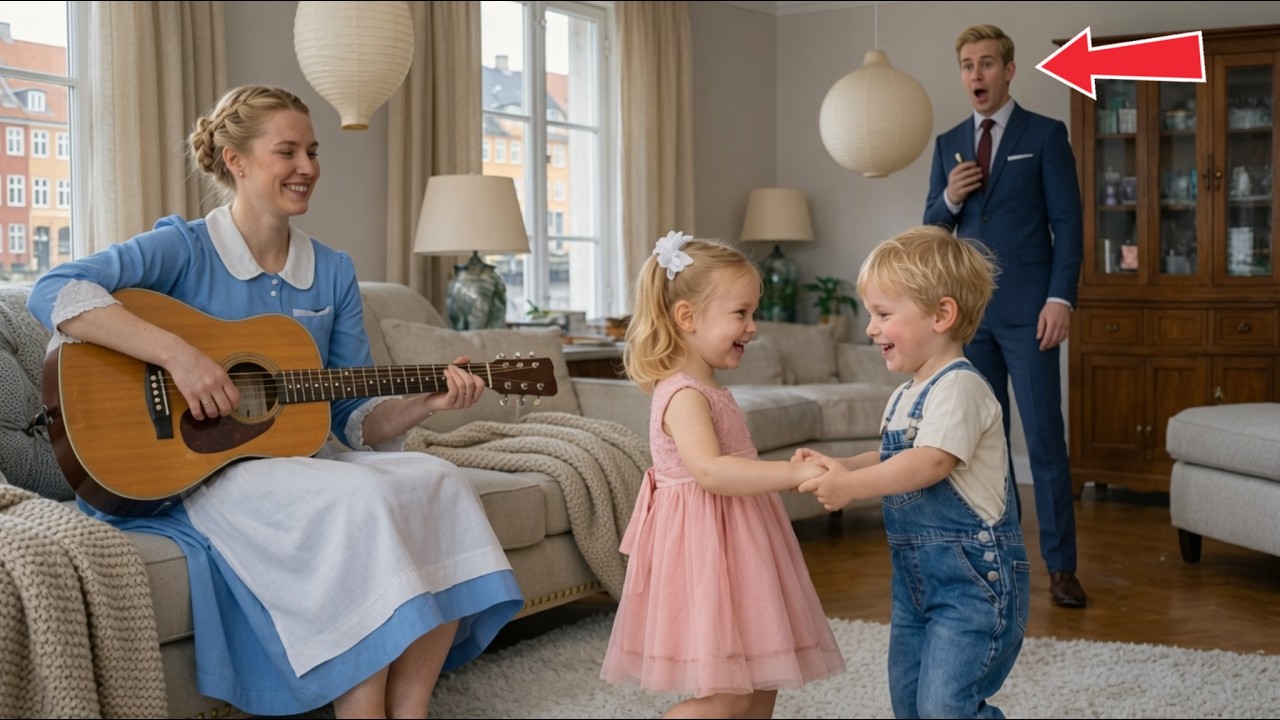
It was laughter. A childlike, crystal-clear, free laughter. A laughter Rasmus had not heard in so long that he had almost forgotten what it sounded like. It was his daughter Isabella’s laughter.
He approached slowly, holding his breath, as if afraid that any sound could shatter this impossible moment. And when he finally looked into the room, he went numb, breathless, incapable of processing what his own eyes were showing him. In the middle of the mansion’s most elegant living room, sitting on the floor with an old guitar resting on her knees, was Victoria Hansen, the housekeeper his mother had hired only a few weeks earlier. Her fingers moved over the strings with a mastery that did not fit a woman who scrubbed floors for a living.
The melody flowing from the guitar was gentle, enveloping, like an invisible caress filling every corner of the room. What shattered his heart was seeing Isabella, his little Isabella, dance. His daughter, the girl who had only spoken in monosyllables since her mother’s death, was holding hands with a boy Rasmus had never seen. The two of them spun clumsily around the way only children can, with that imperfect grace that is more beautiful than any professional choreography.
Isabella’s mouth was open, her eyes shining, her whole body vibrating with a joy that seemed to have been locked inside for centuries, waiting for the precise moment to explode. Rasmus had to support himself on the doorframe because he was shaking. His vision blurred, and he felt something warm running down his cheeks. He was crying.
A man who ran a hotel empire, who negotiated billion-dollar deals without blinking, stood weeping quietly at the entrance to his own living room because his daughter had done something as simple as laugh. The boy dancing with Isabella was only a little older than she was. He moved with the overflowing energy of childhood, guiding Isabella with a surprising tenderness, letting her spin carefully around as if he instinctively knew she was fragile and needed to be treated with delicacy. Victoria smiled and began playing a new melody, somewhat faster this time, and the two children burst into laughter as they tried to follow the rhythm with their small feet.
Then the boy noticed Rasmus standing in the doorway. He stopped immediately, his expression shifting from joy to fear in the blink of an eye. He released Isabella’s hands and stepped back several paces, lowering his gaze to the floor as if he had done something terrible. Mom, the boy whispered with a trembling voice, tugging at Victoria’s sleeve.
Victoria looked up, and her eyes met Rasmus. The guitar stopped abruptly, as if someone had suddenly cut the power. On Victoria’s face appeared an expression of absolute terror, the kind that only arises when you know everything you have built is about to fall apart. Mr.
Møller, said Victoria, rising so quickly the guitar almost slipped from her. I can explain. I know I should not have brought my son. It’s just that the person watching him had an emergency, and I had no one else.
And I swear this will never happen again. Who is that boy? interrupted Rasmus. But his voice did not sound the way he expected.
It did not sound like an angry boss’s voice. It sounded like the voice of a man who had just witnessed a miracle and needed someone to confirm he had not dreamed it. That is my son, Mr. Møller.
His name is Thomas. I beg your forgiveness a thousand times. It will never happen again. Please do not fire me.
This job is the only thing I have. Isabella laughed. The sentence came from Rasmus’s mouth like a sacred whisper, and Victoria fell silent, unsure how to interpret those two words. My daughter laughed, repeated Rasmus, and this time his voice broke.
Even little Thomas lifted his gaze from the floor to look at the tall man crying openly at the door of his own living room. Daddy, said Isabella, approaching Rasmus with the naturalness only children possess, tugging at his hand to pull him toward the middle of the room. Thomas is my friend, and Victoria plays guitar so beautifully. Will you dance with us?
Rasmus knelt before his daughter and took her shoulders with trembling hands. He looked into her eyes and saw what he had stopped searching for. Life. There was life in those eyes that had been empty for so long, dark like windows in an abandoned house.
And that life had returned. Not because of expensive therapists, not because of imported toys, not because of trips to international amusement parks. It had returned because of an old guitar, a housekeeper, and a boy who had taught her to dance. When did this start?
How long have they been doing this? asked Rasmus, addressing Victoria while wiping his tears with the back of his hand. Victoria swallowed visibly, terrified that her answer might cost her the job. It was not planned, Mr.
Møller. The first time I brought Thomas because I had no one to watch him, Isabella was sitting alone on the stairs. My son went over and offered to play. She did not answer, but he insisted.
And when I began playing the guitar while I cleaned, Isabella simply stood up and started moving to the music. Before Rasmus could process all the information, a sharp voice sliced the air from the hallway like a knife cutting through silk. And what is this scandal? Mrs.
Grethe Møller appeared at the living room entrance with the erect posture and unyielding gaze she had perfected through years of running this house as if it were her own kingdom. Her eyes scanned the scene with lightning speed: the housekeeper with a guitar, an unknown boy in her living room, her granddaughter holding hands with that boy, and her son kneeling on the floor with tears in his eyes. Rasmus, can you explain to me why there is a strange child in my house playing with Isabella? asked Mrs.
Grethe with a calm that was more threatening than any scream. Grandmother, said Isabella with a firmness that surprised everyone in the room, including Rasmus. He is my friend. Mrs.
Grethe looked at her granddaughter as if the girl had spoken a forbidden word. Then she turned her gaze to Victoria, and what reflected in her eyes made Thomas instinctively hide behind his mother. Mrs. Hansen, said Mrs.
Grethe with the tone she used to remind every person in the house of their exact place in the hierarchy. You were hired to clean, not to arrange children’s parties in the main living room, and certainly not to bring your children into a house that does not belong to them. Mother, interrupted Rasmus, rising slowly. Isabella laughed.
Do you understand what that means? I understand that my granddaughter needs appropriate company. Not the company of—
Mrs. Grethe stopped before completing the sentence, but the damage was already done.
Everyone in the room understood perfectly what she was about to say. Little Thomas, from behind his mother’s back, lifted his gaze and said something that left the entire room in ringing silence. Ma’am, I just want to play with Isa because she is always so sad. My mother says that when someone is sad, you give them your hand and do not let go until they smile again.
Mrs. Grethe opened her mouth to respond, but no words came out. For the first time in a long time, someone had left her without arguments, and that someone was a child who barely reached her waist. This conversation is not over, said Mrs.
Grethe finally, addressing Victoria specifically with a look that was a silent verdict. Tomorrow morning we will discuss the terms of your employment in this house. And she withdrew, leaving behind a heavy silence no one dared break. That evening, after Victoria had retreated with Thomas, Rasmus did something he had not done in a long time.
He sat at Isabella’s bedside to tuck her in, and for the first time in what seemed like an eternity, his daughter looked at him with a smile before closing her eyes. Daddy, whispered Isabella, already half asleep. Can Thomas come tomorrow too? We will see, my darling.
He told me his father is also in heaven, like Mommy, murmured Isabella, and with that devastating sentence she fell into deep sleep. Rasmus remained motionless at his daughter’s bedside for several minutes, processing those words. Thomas had also lost his father. Two children broken by the same wound had met in the living room of a mansion.
And without therapists, without diagnoses, without medication, they had healed each other with something as primitive and powerful as holding hands and dancing. The next morning, Rasmus woke with a strange feeling in his chest. It was not anxiety. It was not worry.
It was curiosity. A deep curiosity gnawing inside him. Who was Victoria Hansen really? A woman who scrubbed floors did not play guitar the way she did.
Victoria’s fingers had moved over the strings with a fluency that belonged to someone who had devoted years, perhaps decades, to mastering the instrument. There was something in her story that did not fit, a missing piece of the puzzle. And Rasmus Møller was a man who could not live with unfinished puzzles. He asked his personal assistant, a discreet and efficient man named Kasper Jensen, to research Victoria Hansen’s background.
He did not want an invasive investigation. He just wanted to understand her story. Meanwhile, in the service kitchen, Victoria prepared the cleaning supplies with trembling hands. She had not slept all night.
Mrs. Grethe’s words kept circling in her head like a tornado threatening to destroy everything she had managed to build. This job was her only livelihood, the only barrier between her and the street, between Thomas and hunger. Mom, are you okay?
asked Thomas, sitting in a corner of the kitchen with an old notebook. I am okay, my darling, lied Victoria with that ability mothers develop to hide fear behind smiles. I am just a little tired. Is the lady from yesterday angry because I played with Isa?
asked Thomas without lifting his gaze from his drawing, with that brutal perception children have who have learned to read the mood in order to survive. Victoria knelt beside her son and stroked his head. You do not need to worry about that, Thomas. You did nothing wrong.
Playing with someone who is sad is one of the best things a person can do. My father told me that, replied Thomas naturally, as one mentions the weather. He said that music and friendship heal everything. Before Victoria could respond, the kitchen door opened, and Rasmus Møller stood in the doorway, a place he had probably not set foot in for years.
Victoria, can we talk for a moment? asked Rasmus. In the library, Victoria and Thomas followed Rasmus through the mansion’s corridors. An enormous room filled with shelves reaching to the ceiling, smelling of old wood and forgotten pages, contained the conversation that would change everything.
Victoria, began Rasmus, sitting across from her with an ebony table between them. I need to ask you a question, and I need you to answer honestly. Where did you learn to play the guitar like that? Victoria’s face shifted as if someone had opened a door she had spent years trying to keep locked.
It was in another life, Mr. Møller, she answered in a low voice. A life that no longer exists. I want to know that life, insisted Rasmus.
Not as your boss, but as the father of a girl who smiled last night because of you. Victoria was silent for a long moment. Finally, she took a deep breath and began to speak. I studied music from a very young age.
My father was a carpenter, but he loved the guitar more than anything in the world. He taught me my first chords before I could read. When I grew up, I won a scholarship to study at the Royal Danish Conservatory. I was the first in my family to set foot in a university.
During my years at the conservatory, they told me I had something special. Not just technique, but something that cannot be taught. I was selected to represent the country at an international classical music festival in Vienna. What happened?
asked Rasmus. I met Søren, said Victoria, and when she spoke the name, her voice transformed into something softer, more vulnerable, as if the name itself was an old melody. He was an instrument maker, building handmade instruments. We met because he was building the guitar I was to play at the festival.
We fell in love before the guitar was finished. Thomas lifted his gaze. My father, he whispered with a sad smile. We married shortly after the festival.
I continued playing. He continued building guitars. We were happy. We did not have much money, but we had music, and for us that was enough.
That guitar they played last night was the last guitar Søren built, said Victoria, and her voice finally broke. He finished it weeks before the accident. That day he left early for the workshop like any other day. I never imagined it would be the last time I saw him alive.
When I was called and told the roof had collapsed, I felt the world break apart. Søren did not make it out in time, and with him everything disappeared. I could not play again for months. Every time I picked up the guitar, I felt his presence so strongly I could not breathe.
I dropped out of the conservatory, dropped the music, dropped everything. I had only Thomas left, and the promise I made to Søren that our son would never go hungry. No one hires a guitarist to pay the bills, Mr. Møller.
But every house needs someone to clean. So I put Søren’s guitar in its case and learned to use a broom. Rasmus had to look away because his eyes were filled with tears he did not want to show. Victoria’s story had opened a wound he also carried.
The wound of a man who had lost the woman he loved and did not know how to move forward. Every day after school he can come here and play with Isabella. You will play the guitar the way you did last night. Every day.
Mr. Møller, your mother—
My mother I will take care of. Later that morning, when Rasmus finally found Victoria to protect her from his mother’s planned confrontation, it was already too late. Mrs.
Grethe stood facing Victoria in the main hall, holding a folded paper. I will explain this only once, Mrs. Hansen, said Mrs. Grethe with the voice that seemed made of polished ice.
This house has rules that existed long before you came and will continue to exist long after you are gone. Employees do not mix their private lives with their work. Employees’ children do not play with the masters’ children. And no one, absolutely no one, plays musical instruments in the main living room as if this were a cafeteria.
Mrs. Møller, I assure you it will not happen again—
I am not finished, interrupted Mrs. Grethe. What you did last night was not merely bringing your son without permission.
What you did was exploit my granddaughter’s vulnerability. Isabella is a fragile girl under professional treatment, and you decided, without preparation or right, to play therapist with a guitar. Rasmus clenched his fists at his sides. Every word from his mother burned inside him, but he knew that interrupting Mrs.
Grethe mid-speech would only make things worse. These are the new conditions, continued Mrs. Grethe, taking the folded paper from her jacket pocket. First, your son does not set foot in this house again under any circumstances.
Second, you confine yourself exclusively to your cleaning duties without interacting with Isabella beyond what is strictly necessary. Third, that guitar disappears from this property today. Victoria lifted her gaze for the first time since the conversation began, and Rasmus could see something in her eyes that crushed him. It was not fear.
It was not submission. It was the pain of someone being asked to give up the last thing she had left of the person she loved. Mrs. Møller, said Victoria with a voice that trembled but refused to break completely.
I can accept not bringing my son. I can accept confining myself to my duties. But that guitar is the only thing I have left of my husband. It is the only thing my son has of his father.
I cannot—
Enough! Rasmus’s voice tore through the room like lightning splitting an old tree. Everyone turned to him. Mother, this is a conversation about my daughter, not about house administration.
Isabella is my daughter, not an administrative project. And what Victoria and Thomas achieved in one afternoon is more than any professional has achieved in years. So there will be no new conditions, there will be no termination, and that guitar does not leave this house. The silence that followed was so heavy it seemed to have physical form.
Mrs. Grethe looked at her son with an expression Rasmus knew all too well: a woman not used to losing battles and not intending to start now. You are making a mistake, son, said Mrs. Grethe, her voice almost a whisper.
And when the consequences come, I hope you remember this moment. Mrs. Grethe withdrew, and the hall fell silent. Victoria was trembling visibly.
Thank you, Mr. Møller, she whispered. Do not thank me. What you did for Isabella, I am the one who should thank you on my knees.
Before he could say anything more, the mansion’s doorbell rang. It was Kasper Jensen, punctual as always, with a folder under his arm and an expression confirming that what he brought was not simple. In his private office, with the door locked, Kasper opened the folder and placed a dossier on the desk with the care of someone handling explosive material. Mr.
Møller, I conducted a thorough search as you requested. Public records, digital archives, press releases. What I found was unexpected. Victoria Hansen was considered one of the most talented guitarists of her generation.
She won three national prizes before finishing her education. She was selected to represent the country at the international music festival in Vienna. The press called her the Voice of the Strings. And what happened?
asked Rasmus. This is where things get complicated, said Kasper, turning to the next section. Victoria’s husband, Søren Hansen, was an instrument maker working in a workshop that operated in an industrial building. That building was owned by a business conglomerate that for years ignored warnings about structural problems and safety conditions.
One day a section of the workshop roof collapsed. Søren was the only worker who did not make it out in time. Victoria tried to sue the company that owned the building. She hired a lawyer with the little savings she had, but the company had a powerful legal team that crushed the case before it reached a court.
Not only did she receive no compensation, but the legal costs left her in total ruin. Rasmus felt each revelation hit his chest with greater force than the previous one. But what Kasper said next made the ground disappear beneath his feet. I investigated which company owned that industrial building.
The conglomerate that ignored the safety warnings, that let Søren Hansen die, and that then legally destroyed his widow for not paying a single cent in compensation. Kasper paused for a moment that seemed to last an eternity. The building belonged to Møller Real Estate Investments. The company your father founded, and which your mother managed during the years you devoted yourself exclusively to the hotel business.
Rasmus stood completely motionless. His brain tried to process the information, but it was as if Kasper’s words had suddenly been written in a language he could not understand. Are you telling me that my family, my father’s company, is responsible for Victoria’s husband’s death? I am telling you that Møller Real Estate Investments owned the building where Søren Hansen died, and that the legal team that crushed Victoria’s case was hired and led by only one person.
Who? Grethe Møller. Your mother. The world stopped spinning for Rasmus in that moment.
His mother had hired Victoria weeks ago. His mother, who now so desperately wanted to fire her. His mother, who had destroyed that woman’s life earlier without anyone knowing. But there was more.
Kasper took out the last page of the folder. It was a copy of a hospital record. Your wife, Mrs. Caroline Møller, before her death was hospitalized at Hope’s Clinic.
In her last weeks, she regularly received visits from a volunteer who kept her company and played the guitar to ease her pain. That volunteer signed the visitor register with her full name. Rasmus took the paper with trembling hands and read the name written on the visitor line: Victoria Hansen. The paper slipped from his fingers and fell to the floor while Rasmus collapsed into his chair, incapable of bearing the weight of a truth that had just split his life into two irreconcilable halves.
The woman who cleaned his house had comforted his dying wife. The woman whose life his mother had destroyed had spent the last weeks playing guitar at Caroline’s bedside so she would not die alone. And neither of them had ever known who the other was. Rasmus did not sleep that night.
Every time he closed his eyes, Kasper’s revelations repeated in his mind like a horror film he could not turn off. His mother had destroyed Victoria’s life. His wife Caroline had been comforted by Victoria in her final days, and now the same woman was cleaning the floors of the Møller mansion without knowing she was sleeping under the same roof as the people responsible for her tragedy. The next morning, Rasmus made a decision that filled him with fear but that he knew was necessary.
He would talk to Victoria and tell her everything he had discovered. But before he could find her, something happened that completely changed the course of the day. Isabella woke humming. Rasmus stood in the hallway, listening to the melody coming from his daughter’s room.
He stopped with his hand on his heart, paralyzed for the second time in a few days by a sound he thought was impossible. He approached the half-open door and saw Isabella sitting in her bed, moving her bare feet while humming the song Victoria had played on the guitar that first evening. Daddy, said Isabella when she noticed him in the doorway. Thomas is coming today.
Rasmus knelt at his daughter’s bedside and stroked her hair. Yes, my darling. Thomas is coming today. I want him to teach me to dance better.
He can spin many times without falling. Rasmus smiled with moist eyes. His daughter was planning activities, expressing desires, projecting herself into the future. Things the best specialists had tried for years to achieve without result.
He decided he needed a professional opinion before speaking to Victoria. He called Dr. Erik Sørensen, the child therapist who had treated Isabella since Caroline’s loss. What you describe is extraordinary, Mr.
Møller, said Dr. Sørensen after hearing everything. Isabella had built an emotional wall as a defense mechanism against the loss of her mother. No conventional therapeutic technique had managed to penetrate it because that wall was made of the most resistant material that exists: a child’s pain who lost the person she loved most.
And how is it possible that a child and a guitar could achieve what years of therapy could not? Because children do not analyze pain, Mr. Møller. Children simply feel it.
When Isabella found another child carrying the same wound, something happened that we in psychology call emotional recognition. Thomas did not try to heal Isabella. He simply let her know she was not alone, and that was enough for her to decide, for the first time, that it was worth feeling again. Doctor, I need you to come to the mansion.
I need you to assess Isabella and tell me exactly what we must do not to destroy this progress. I will be there this afternoon. But while Rasmus arranged the therapist’s visit, in another corner of the mansion something far less noble was brewing. Line Frederiksen had spent the entire night studying a letter she had intercepted from the Royal Danish Conservatory.
The letter informed Victoria that the conservatory had launched a special reinstatement program for talented former students who had interrupted their studies under extraordinary circumstances. The program included a full scholarship, access to international teachers, and the possibility of resuming her musical career exactly where she had left it. Line understood the power of that information immediately. If Victoria received the letter, she would have the chance to rebuild her life far from the Møller mansion.
She would leave, take Thomas with her, and Isabella would lose the only connection that had made her smile again. But Line did not merely want Victoria to disappear. She wanted her to disappear humiliated, branded as someone who could never be trusted. That same morning, Line presented a plan to Mrs.
Grethe while they drank tea in the back garden. The letter is a weapon, explained Line with the precision of someone who had studied every detail. We will not give it to her. We will make it look as if Victoria used her position in this house for personal gain, that she deliberately approached Isabella to win Rasmus’s trust and obtain contacts that would allow her to return to the world of music.
Mrs. Grethe listened attentively, and in her eyes flickered something Line interpreted as approval. But the truth was that far more complex and darker calculations were operating in Mrs. Grethe’s mind.
She did not merely want to protect her house from a housekeeper who had overstepped boundaries. She needed Victoria to disappear before anyone discovered the connection between Møller Real Estate Investments and Søren Hansen’s death. Because if Rasmus discovered that truth, he would not only lose his mother forever, but the entire family empire would collapse under the weight of a scandal no lawyer could hold back. Do it, said Mrs.
Grethe with the coldness characteristic of someone signing a death sentence. But it must be clean. I want no scandals. That afternoon, while Dr.
Sørensen assessed Isabella in the library, Line executed the first phase of her plan. She waited until Victoria was cleaning the mansion’s west wing, then slipped quietly into the small room the housekeeper used to store her personal belongings during the workday. There she found what she was looking for: Søren’s guitar. Line opened the case carefully and placed inside it an object that would bring Victoria’s world crashing down.
A diamond bracelet belonging to Mrs. Grethe, an old, well-known, priceless piece of jewelry. Then she closed the case, left it exactly as she had found it, and departed with the same discretion with which she had entered. The bracelet would be reported missing that evening.
The search would inevitably lead to Victoria’s belongings, and when they opened the case in front of Rasmus, there would be no possible explanation that could save the guitar player. Meanwhile, in the library, Dr. Sørensen completed his assessment of Isabella with results that left Rasmus speechless. Your daughter has experienced an emotional breakthrough that I would call extraordinary, said the doctor.
She has not only recovered the ability to express positive emotions, but she is developing new affective bonds. Something that weeks ago seemed completely impossible. And what do you recommend, Doctor? That you absolutely change nothing.
Isabella’s connection to this child and to Victoria’s music is therapeutic at a level science is only beginning to understand. To sever this bond now would be like tearing up a plant that has just sprouted after years of drought. That evening, after Victoria had finished her workday and was preparing to leave with Thomas, Mrs. Grethe’s voice rang through the entire ground floor of the mansion like an alarm that freezes the blood.
My bracelet! My mother’s bracelet is gone! Within minutes the entire mansion was in motion. Rooms were searched, every corner, every personal possession was inspected.
Line led the search with suspicious efficiency, discreetly steering the staff toward the wing where Victoria kept her belongings. Rasmus watched the scene with a bad feeling twisting in his gut. Something did not fit. His mother had worn that bracelet hundreds of times and never lost it.
Why now? Then one of the staff members approached Line with an uncomfortable expression. Mrs. Frederiksen.
We found something in Mrs. Hansen’s room. The silence that fell over the mansion was deafening. All eyes turned to Victoria, standing at the front door with Thomas in hand, ready to go home.
Her face reflected total confusion. Line went to Victoria’s room and returned with the guitar case open. Inside, gleaming under the hall lights like a silent accusation, lay Mrs. Grethe’s diamond bracelet.
No, whispered Victoria, shaking her head, stepping back. That is not possible. I never—
The evidence speaks for itself, judged Mrs. Grethe with a coldness that could have frozen the sun.
Rasmus watched the scene, feeling his brain process a thousand possibilities per second. The bracelet had been placed inside Søren’s guitar. Not in a bag, not in a drawer, but in the most sacred object Victoria owned. That was precisely what made no sense.
No one hiding stolen goods hides them in the one place they protect with their lives. Someone had put that bracelet there. Someone who knew exactly what that guitar meant to Victoria and had deliberately chosen that hiding place so the accusation would be more devastating, more personal, more impossible to refute. And while Rasmus reached that conclusion, little Thomas released his mother’s hand, took a step forward, and with a trembling but firm voice, said something that made everyone present freeze.
My mother would never put anything inside that guitar. That guitar is my father’s. It is the most important thing we have. If someone put it there, it was someone who wants to hurt my mother, and I know there are people in this house who do not want us here.
Thomas’s eyes, without pointing at anyone specifically, scanned the hall with a clarity that shook even Mrs. Grethe. And Line felt, for the first time since she had devised her perfect plan, something she had not anticipated. Fear.
How touching, said Mrs. Grethe with the icy smile she used when she felt cornered but would never admit it. A child defending his mother. That is natural.
That is understandable. But feelings do not erase evidence. The bracelet was among your belongings, Mrs. Hansen.
That is a fact. A fact that someone fabricated, answered Rasmus, stepping forward and placing himself between his mother and Victoria like a human shield. Are you accusing someone in this house of planting false evidence? asked Mrs.
Grethe, raising an eyebrow with perfectly feigned disbelief. Who exactly? I am saying that Victoria did not put that bracelet there. And how can you be so sure?
You have known her for how long? Weeks. I have lived in this house for decades. I have cared for every object, every memory, every piece of this family.
And you prefer to believe a stranger over your own mother. Mrs. Grethe’s words were designed to strike precisely where it hurt most: family loyalty. And Rasmus could feel the years hitting their target.
For despite everything he knew, despite Kasper’s revelations, she was still his mother, the woman who had raised him, who had held this family together when his father died. Mr. Møller, said Victoria with a voice that had found an unexpected calm amid the chaos. You do not need to argue with your mother on my account.
I know what I did and what I did not do. My conscience is clear. She bent down, took the guitar case with the bracelet still inside, and placed it carefully on the hall table. Then she took Søren’s guitar out, the only possession that truly mattered to her in the world, and held it against her chest like someone embracing a living person.
You can keep the bracelet. You can search every corner of my life if you want. You will find nothing, because there is nothing to find. The only thing I take from this house is what I came with: my guitar and my son.
Victoria, wait, said Rasmus desperately, but she was already walking toward the door. Mom, are we not coming back? asked Thomas softly, taking her hand as they left. Victoria did not answer.
She could not, because if she opened her mouth in that moment, she would break completely in front of the same people who had orchestrated her humiliation. The following days were the darkest the Møller mansion had experienced since Caroline’s death. Isabella stopped humming. Stopped asking for anyone to play with her.
Stopped going down to the living room where she had once danced with Thomas. She locked herself in her room with the silent determination children have when they decide the world has already hurt them too much and the only way to protect themselves is to disappear inside. Dr. Sørensen visited the mansion several times, and each visit ended with the same devastating diagnosis.
Isabella is regressing, Mr. Møller, and she is doing it faster than she came forward. If we do not restore the stimulus that caused her emotional opening, I fear she will close permanently. Permanently?
What does that mean exactly? Dr. Sørensen’s silence before answering was the most terrifying answer Rasmus had ever received. It means we could lose her, Mr.
Møller. Not physically, but emotionally. There is a point in the process of emotional shutdown in children from which there is no return. If Isabella crosses that threshold, no therapy, no stimulus, no intervention will bring her back.
Rasmus left the doctor’s office shaking. He had to find Victoria. Not tomorrow, not next week. Now.
Every hour that passed was an hour closer to losing his daughter forever. But the city was enormous, and Victoria did not want to be found. Rasmus hired investigators, searched records, contacted the schools where Thomas might be enrolled, visited shelters, asked in the churches where people went when they had nowhere to go. Nothing.
Victoria Hansen had disappeared with the efficiency of someone who already knew what it was to lose everything and start from zero. While Rasmus was consumed by his search, something began to change inside the mansion. The mood became heavy, as if the walls themselves knew an injustice had been committed under their roof and demanded reparation. The service staff murmured in the corridors.
Mrs. Mette, the cook, stopped making Mrs. Grethe’s favorite dishes without explanation. The gardeners avoided crossing Line’s path, as if her presence evoked something they could not express in words.
It was Mrs. Mette who one day approached Rasmus with the caution of someone knowing that what she was about to say could have enormous consequences. Rasmus, forgive me for interfering where I do not belong, said the cook in a low voice. But my conscience will not let me sleep.
The night the bracelet disappeared, I was in the kitchen baking bread for the next day. From the kitchen you can see the corridor leading to the room where Mrs. Hansen kept her things. Rasmus stopped breathing.
That evening, long before the scandal broke out, I saw Mrs. Frederiksen enter that room. She was in there for several minutes and came out empty-handed. At the time I did not think anything of it, but after what happened here, Rasmus, I am telling you with a woman’s certainty who has seen honesty and lies pass through this kitchen for many years: that girl is innocent.
Mrs. Mette’s testimony fell over Rasmus like the last piece of a puzzle he already knew but needed someone else to confirm. Line had planted the bracelet. His mother had approved it, and between the two of them they had thrown out of the house the only person who had managed to give Isabella her life back.
Rasmus went directly to his mother’s office. He did not knock. He opened the door wide and found Mrs. Grethe sitting at her desk reviewing documents as if the world were not falling apart around her.
We need to talk, Mother. And this time you will tell me the truth. Rasmus, I do not know what you—
Line planted the bracelet in Victoria’s things. I have a witness.
And before you try to discredit it, you should know something else. I know about Møller Real Estate Investments. I know about the building that collapsed. I know what you did to Victoria Hansen years before she set foot in this house.
Mrs. Grethe’s face changed as if someone had torn off a mask she had worn for years. There was no immediate denial, no manufactured indignation. There was something far more disturbing: silence.
A silence that admitted everything without saying a single word. And there is something else you do not know, Mother. Something that crushes my soul and that I should tell you. What?
Victoria was the person who accompanied Caroline in her final days. While you were arranging funerals and I was drowning in my grief, an unknown woman sat at my wife’s side and played the guitar so she would not feel fear at disappearing. That woman was Victoria. The same woman whose husband died because of our company’s negligence.
The same woman you just threw out of our lives as if she were garbage. Mrs. Grethe placed her hand on her chest. For the first time in Rasmus’s life, he saw something in his mother’s eyes he never thought possible: remorse.
A remorse so deep and so old it seemed to have been buried under tons of pride, waiting for this exact moment to surface and claim its due. Rasmus, whispered Mrs. Grethe, but her son had already left the office. Rasmus Møller no longer had time for explanations or apologies.
His daughter was fading away. Victoria had disappeared, and every second that passed was a second he could not get back. That same evening, as he reviewed the investigators’ reports for the last time without finding anything, his phone rang. It was an unknown number.
Mr. Møller, said a female voice he did not recognize. My name is Rikke Olsen. I am the director of the Open Hearts Shelter.
A woman arrived here a few days ago with her little son. She will not give her real name, but the boy tells everyone that his father lives inside a guitar. I found your number on a card the boy had in his pocket. I believe they are the person this child is looking for.
Rasmus grabbed his car keys before the woman finished speaking. Rasmus drove through the city streets like a man possessed. Traffic lights blurred past the windshield as he repeated Rikke Olsen’s words in his mind. A boy who says his father lives inside a guitar.
Only one child in the entire world said that sentence. Only one. The Open Hearts Shelter was located in an area of the city Rasmus had never set foot in. The streets narrowed the farther he drove, the buildings grew lower, the facades more cracked.
When he finally parked in front of the shelter, he had to sit in the car for a few seconds to try to control his shaking hands before getting out. A sign by the door read: Open Hearts Shelter, for no one should face the night alone. Rikke Olsen was waiting for him at the entrance. A woman with a steady gaze and years of social work behind her.
Mr. Møller, before you go in, I need to explain something to you. When the woman and child arrived here, she was in a very fragile emotional state. She would not give her real name, registered as Marie.
But children cannot lie when something hurts them. Thomas told everyone who would listen that his mother played the most beautiful guitar in the world and that he missed a girl named Isa. The name of his daughter on the boy’s lips made Rasmus feel a direct blow to the middle of his chest. I found her crying one evening in the shelter’s courtyard, continued Rikke.
She was sitting on the ground embracing her guitar, rocking it as if the guitar were a baby. I did not pry. I just sat next to her. After a long time she said only one sentence: They took the only good thing I had left, and it was not even my fault.
Can I see her? asked Rasmus with a choked voice. You can. But I warn you of something.
That woman has a wounded pride, and the wounds of pride are the ones that take the longest to heal. It will not be easy. Rikke guided him through a narrow corridor to an inner courtyard where several children were playing under the light of some soft lamps. And there, sitting on a wooden bench against the farthest wall with Søren’s guitar resting at her side like a silent companion, sat Victoria Hansen.
Rasmus stopped several meters away. Victoria’s gaze was empty, fixed on a point on the floor, her hands folded over her knees. She looked thinner than the last time, with shadows under her eyes that told of sleepless nights and days without enough food. But even under those conditions, there was something in her posture that refused to collapse.
A dignity made of a material no humiliation could bend. Thomas was the first to see him. The boy was playing with other children in the shelter yard when his eyes met Rasmus. He stood motionless for a second, as if his brain needed to confirm the image was real, not another of the dreams he had every night where he returned to the mansion and danced with Isabella.
Then, without a word, he ran to his mother and tugged at her sleeve. Mom, whispered Thomas. Mom, look. Victoria lifted her gaze, and her eyes met Rasmus Møller’s, standing in the middle of the shelter courtyard with a rumpled suit, red eyes, and an expression that was half relief, half shame.
Her face transformed in the blink of an eye. First surprise, then confusion, and finally something Rasmus recognized with painful clarity: mistrust. The mistrust of someone who has been betrayed too many times to believe anyone comes with good intentions. What are you doing here?
asked Victoria, rising with the same upright posture she had had that evening she left the mansion. I came to find you. What do you need me for? To accuse me of something else?
Now that a necklace is missing, a ring—will you search my guitar again to see if I have hidden a diamond crown in it? Each word came from Victoria’s mouth filled with a pain that had festered through days of uncertainty, nights spent at a shelter, mornings when she had to explain to her son why they could no longer return to the house where he had a friend. Victoria, the bracelet was planted. Line Frederiksen put the bracelet inside your guitar.
I have a witness who saw her enter your room that evening. It was all a trap orchestrated to get you out of the house. And why should I believe you? answered Victoria with a calm more devastating than any scream.
Your mother humiliated me in front of the whole house. She treated me like a criminal in front of my son. And you, Mr. Møller, you stood there doubting.
I saw how your mother’s words made you doubt. I saw that moment in your eyes. And that moment, that one second of doubt, hurt more than everything else combined. Rasmus received these words like blows.
He knew he deserved them. Victoria was right. He had doubted for a fraction of a second. He had allowed his mother’s voice to weigh more than what his own eyes had seen, what his own heart knew was true.
You are right, said Rasmus without trying to defend himself. I doubted, and I hate myself for it. But I am here now, and I did not come only to tell you that you are innocent. I came because I have to tell you something I discovered, something you deserve to know, even if it destroys me to say it.
Victoria looked at him with narrowed eyes, like someone assessing whether it was worth opening a door that could hide a new betrayal behind it. What? Rasmus took a deep breath. Your husband, Søren.
The workshop where he worked. The building that collapsed. That building belonged to one of my family’s companies, Møller Real Estate Investments. My mother managed that company in those years.
It was she who ordered the legal team to block your case after Søren’s death. The silence that followed was not a normal silence. It had weight, texture, temperature. Victoria stepped back a step, as if Rasmus’s words were a physical force pushing her.
Her eyes filled with tears that refused to fall, held back by a will that had learned not to break in public. Her mouth opened, but no sound came out. Are you telling me, began Victoria with a voice barely audible, that Søren died because of your family? That I lost everything, my career, my home, my entire life, because your mother decided it was cheaper to leave me in ruins than to take responsibility?
And that after all that, I ended up cleaning the house of the same people who destroyed my world? Yes. Did you know when you hired me? No.
I discovered it afterward. My mother was the one who hired you, and now I understand that she did it precisely because she did not want anyone from outside to remind her of the case. By having you close, she controlled the situation. Victoria closed her eyes.
The tears finally found their way down her cheeks, quiet, constant, like a river breaking a dam that had held back too much for years. There is more, said Rasmus, and his own voice broke as he spoke the next words. My wife, Caroline, before she passed away, spent her last weeks at Hope’s Clinic. A volunteer visited her every day and played the guitar to ease her pain.
That volunteer was you, Victoria. You accompanied my wife in her final days, and neither of you ever knew who the other was. Victoria opened her eyes with a shock. Her expression shifted from pain to disbelief, from disbelief to something that had no name in any language.
Caroline, she whispered. The woman in the room at the end. The one who asked me to play that lullaby every afternoon because she said it reminded her of her daughter. Rasmus could not answer.
The tears overcame him, and he sank onto the bench where Victoria had been sitting moments earlier, covering his face with his hands while his body shook with sobs that came from a place so deep it seemed to tear pieces from his soul. I sang for Isabella, continued Victoria, now crying freely. Caroline told me about her daughter every day. She said she was the sweetest girl in the world.
That she had a laugh that could light up any room. She asked me that if life ever brought me before a sad child, I should play that song for them. The song you played for Isabella that evening in the living room, murmured Rasmus, lifting his gaze. It was Caroline’s song.
Thomas looked at his mother without fully understanding what was happening, but knowing with the sacred intuition of childhood that something very great was breaking apart and being rebuilt at the same time in that shelter courtyard. Mr. Møller, said Victoria, wiping her tears with the back of her hand. I did not know who you were when I accepted the job.
I never connected the surname. When I saw Isabella sitting alone on the stairs, I only saw a sad girl. I did not see the daughter of the man whose family destroyed mine. I saw a girl who needed exactly the same thing as my son: someone to remind her that life could still be beautiful.
And now that you know everything, asked Rasmus with genuine fear in his voice. Now that you know who we are, what we did, what my mother did to you, can you forgive us? Victoria looked at her son, who was still holding her fingers with his small hands, hands that did not understand surnames, companies, or lawsuits. Then she looked at Søren’s guitar leaning against the wall, waiting in silence as it always did.
Søren taught me something I never forgot, said Victoria with a firm voice despite the tears. He said that music exists to transform pain into something beautiful. That if you remain trapped in what was taken from you, you end up dying. But if you turn that pain into a melody, the person you lost never really disappears.
They live inside every note you play. Victoria, I need to ask you something, said Rasmus, rising. And I need you to know I am not asking for my sake. I am asking for Isabella.
My daughter is fading again. The doctor says if she does not reconnect with Thomas, we could lose her emotionally forever. Isabella needs Thomas, and she needs your music. The music Caroline left her without knowing it.
Victoria looked at Thomas. The boy, hearing Isabella’s name, lifted his gaze with eyes that lit up like two stars igniting in the middle of the darkest night. Mom, said Thomas with that voice that could disarm anyone. Isa needs me.
And with those three words, a child decided the fate of two families. The road back to the mansion was the most silent Rasmus had ever experienced. Victoria sat in the back seat with Thomas sleeping in her lap, exhausted by the emotions of an evening that had been too big for his small body. Søren’s guitar occupied the passenger seat, as if it were another passenger, as if it had the right to be there.
Victoria had not said she forgave. She had not said she was returning forever. She had only said: I am coming for Isabella’s sake. And Rasmus understood that for now, that was enough.
It was more than he deserved. When the car stopped in front of the mansion, it was almost two in the morning. The lights on the ground floor were on, which was unusual at that hour. Rasmus got out first and opened the front door, expecting to find the house asleep.
But the house was not asleep. In the hall, sitting on a chair with an erect back and hands crossed over her knees, sat Mrs. Grethe Møller. Beside her, standing against the wall with a nervous expression, stood Line Frederiksen.
And before them both, with a tablet in hand and a face that would prefer to be anywhere else in the world, stood Kasper Jensen. Mr. Møller, said Kasper as he saw Rasmus enter. Your mother asked to speak with you tonight.
She insisted on waiting for you. Rasmus looked cautiously at his mother, but something had changed in Mrs. Grethe. She was not the ice queen giving orders and expecting blind obedience.
Something Rasmus had not seen since he was a very small child, when his mother could still cry. I am sorry, said Mrs. Grethe as Victoria entered behind Rasmus with Thomas sleeping in her arms and the guitar slung over her shoulder. The two women looked at each other for a moment that contained years compressed into a single exchange of glances.
Mrs. Hansen, please sit down. The word please came from Mrs. Grethe’s mouth as if she had had to tear each letter from some deep and rusty place inside herself, a place where the word had been stored for decades without use.
After my son left this evening, began Mrs. Grethe in a low voice, I sat alone in my office, and for the first time in a long time, I looked at myself in the mirror. I could not recognize what I saw. When my husband died and left me responsible for his businesses, I was a woman who knew nothing about the business world.
I learned quickly because I had no other option. But what I learned was to protect what was ours at any cost. Every decision I made was to keep this family afloat, so Rasmus could have a future, so the Møller name would continue to mean something. And in that process, I became someone who stopped seeing people and began only seeing threats.
Mrs. Grethe paused. Her eyes were moist. When the Møller Real Estate building collapsed and your husband died, Mrs.
Hansen, a report with your name came to my desk. You were a line in a legal document. A problem to be solved. A risk to be neutralized.
I never stopped to think that behind that name there was a woman with a child, with shattered dreams, with a guitar that was the only thing she had left of the person she loved. I erased you from my papers and continued as if nothing had happened. And when I hired you to work here, I did it because your name appeared on an applicant list, and something inside me, something I did not want to examine, told me that by keeping you close, I could ensure the past remained buried. It was a mistake disguised as control.
Mrs. Grethe rose slowly, with a difficulty that was not physical but emotional, as if the weight of her own words bent her back. I will not ask for your forgiveness, because I know there are things that cannot be forgiven with words. But I will do something I should have done long ago.
She turned to Line, who had turned as pale as the hall’s marble. Line, you were the one who placed the bracelet among Mrs. Hansen’s belongings. I saw you enter the room that evening.
And you were the one who intercepted a letter from the Royal Danish Conservatory addressed to Victoria. A letter she never received because you decided she did not deserve it. Line opened her mouth to defend herself, but Mrs. Grethe raised her hand with an authority that this time was not aimed at suppressing but at correcting.
I do not need explanations. I need you to hand over the letter immediately, and tomorrow morning you will pack your belongings. Your time in this house is over. With trembling hands, Line took a crumpled envelope from her jacket and placed it on the hall table.
Then, without a word, she walked to the door and disappeared into the night. No one stopped her. Her departure was as silent as all her manipulations had been. Mrs.
Grethe took the envelope and handed it to Victoria. This belongs to you. Victoria took the letter with trembling fingers, opened it slowly, read the contents, and what formed on her face was something no one in that room would ever forget: hope. Pure, unexpected hope, as fragile and powerful as the first note from a guitar that had been silent for years.
It is a scholarship, whispered Victoria. The conservatory wants me back. And you shall go, said Mrs. Grethe with a firmness that surprised everyone.
Møller Real Estate will finance all expenses the scholarship does not cover. Housing for you and your son, materials, transportation, everything. Not as charity, but as the debt this family owes you and that has gone unpaid for too long. Victoria held the letter against her chest as if it were a treasure found at the bottom of the sea.
But before she could answer, a sound made everyone in the hall turn their heads toward the stairs. Small bare feet walking down step by step with the caution children have when they wake in the middle of the night and follow an instinct they cannot explain. Isabella appeared at the end of the stairs with disheveled hair and sleep-narrowed eyes. But those eyes opened completely when she saw what was in the hall, or more precisely, who was in the hall.
Thomas, whispered Isabella. Isa! Thomas climbed down from Victoria’s arms and ran toward Isabella. The girl ran down the last steps and ran toward him with a speed that contradicted the emotional lethargy that had consumed her for days.
They met in the middle of the hall and embraced each other with the disproportionate strength children’s hugs have when they reunite with someone they thought was lost. You left, said Isabella with a broken voice, and that two-word sentence contained all the abandonment that girl had accumulated, first with the loss of her mother and then with the disappearance of her only friend. But I am back now, answered Thomas with the monumental simplicity that was his gift. And I brought my father’s guitar, so your mother in heaven can hear us dance again.
The song Caroline had taught Victoria filled every corner of the Møller mansion like a wave washing away everything old and broken, leaving only what was worth preserving. Isabella and Thomas danced hand in hand in the middle of the hall, exactly as they had done that first evening, but this time with witnesses who wept and smiled at the same time. Rasmus knelt beside his daughter, and she pulled him in to dance with them. Mrs.
Grethe, standing supported by that same melody, swayed gently in time with a song that healed everything it touched. Later, Victoria returned to the Royal Danish Conservatory. Her comeback was news in the country’s music circles, and her old professor, when he heard her play Søren’s guitar in the first lesson, said something that would become a saying: Technique can be learned, but what Victoria has inside cannot be taught. It is suffered, lived, and transformed into music.
Thomas was enrolled in the same school as Isabella. The two became inseparable, children who earlier than most adults had learned that shared pain heals faster than hidden pain. Mrs. Grethe later established a foundation in Søren Hansen’s name, dedicated to guaranteeing safe working conditions for craftsmen and independent workers.
She did not announce it in the press. She sought no recognition. She did it in silence, the same way she had caused the damage. But this time she left a trail of repair instead of destruction behind every action.
And Rasmus, one ordinary afternoon, came home from work and found the same scene that had changed his life forever. Victoria played the guitar in the living room while Isabella and Thomas danced barefoot on the carpet. But this time he was not paralyzed in the doorway. This time he walked in, sat down beside Victoria, and listened to the song his wife had given to the world without knowing that melody would end up uniting the two families who most needed to meet.
That evening, before falling asleep, Isabella asked her father: Daddy, do you think Mama and Thomas’s father know each other in heaven? Rasmus smiled with moist eyes. I am sure of it, my darling. And I am sure they are dancing.
Isabella closed her eyes with a smile that lit up more than all the lights in the mansion combined. And somewhere in the universe, a lullaby continued to sound, played by a guitar that carried the soul of a man who kept his promise. As long as those strings vibrated, he would never completely disappear. There are instruments made of wood and strings, but there are others, the most valuable ones, made of love, of loss, of the unshakable decision to transform pain into the most beautiful melody the world has ever heard.
And that guitar, Søren Hansen’s last guitar, never stopped playing.