The phone buzzed against the cold stainless steel table of the coffee shop. I had just finished a grueling 24-hour duty shift and was staring at a photograph of my grandmother, Madeline—the woman I trusted my parents to care for, believing family was the safest harbor. My mother, Cora, had texted an hour ago: “Grandma is sleeping, honey. We are having a lovely dinner,” accompanied by a photo of expensive red wine.
But now an unknown number flashed on the screen. The panicked voice of a man on the other end said, “Are you the relative of the elderly lady in the beige sweater? I found her shivering alone on a stone bench at the abandoned park off Highway 17. She said her son left her here.
”
My heart felt pierced by a tactical blade. Had my parents discarded their own mother on this freezing winter night just to free their hands for a party? I sat there, 28 years old, a veteran of high-stakes military logistics. Nothing in my training had prepared me for a breach of honor this profound.
Two weeks ago, I had wired 70% of my monthly paycheck home. I thought that money was for the supplements Madeline needed, the heating bills, and the comfort she deserved after 76 years of selfless sacrifice. I believed my father, Douglas, and my mother, Cora, still held onto the core tenets of decency. I was wrong.
“Highway 17,” I whispered into the phone. The man confirmed the location—a desolate stretch, miles from any residential area, known only for rusted warehouses and long shadows. “She’s freezing, Captain. I’m a veteran myself.
I recognize the look in her eyes. It’s the look of someone left behind in the trenches. ”
The bustling noise of the cafe faded into deafening silence. My grandmother, the woman who raised me on the scent of fresh apple pies and the unwavering laws of honor, was being treated like a bag of refuse.
My vision narrowed into a tunnel of cold fury. I hit end and dialed Douglas. The line rang three times before his smooth baritone picked up. “Livia, why are you calling so late, sweetheart?
I’m in the middle of a fitting for my new tuxedo. We have that gala at the yacht club tomorrow night, you know. ”
“Where is Madeline, Dad? ” I asked.
No greeting. The voice I reserved for insubordinate subordinates. A microsecond of hesitation, a glitch in his polished armor. Then the lie slid out with the grease of a used car salesman.
“She’s sleeping, Livia. Honestly, the sedatives the doctor prescribed have made her a bit difficult lately. Cora said it was best to just let her rest and not disturb her. Why the sudden interrogation?
”
He was standing in a room full of designer labels and high society aspirations, while his own mother was huddled on a rusted bench. It wasn’t just a lie—it was a desecration. “Don’t disturb her,” I repeated, my voice a flat, dangerous line. “I understand perfectly.
”
I didn’t scream. An officer doesn’t scream when the mission parameters shift to a rescue operation. I hung up, my knuckles white around the phone. Every holiday, every “We love you” text, every dollar sent home—it was all part of a grand theater of greed.
I stood up, leaving my coffee to grow cold, grabbed my keys, and climbed into my Ford F-150. The engine roared to life with a primal growl that matched the storm inside me. The world I knew had crumbled into dust. My objective was singular: retrieve the only teammate I had left in this world, then burn my parents’ house of cards to the ground.
The tires screamed as I swung the truck onto Highway 17, the roar of the V8 engine the only thing keeping my spinning thoughts at bay. From my parents’ house to this specific abandoned park, it was exactly 24 minutes. They had bypassed several well-lit rest stops, occupied gas stations, and 24-hour diners to reach this desolate patch of rusted swing sets and cracked asphalt. This wasn’t a mistake.
It was a calculated, cold-blooded disposal. I pulled into the gravel lot. My high beams cut through the gloom, settling on a single, flickering street lamp that groaned in the freezing wind. And there she was.
Madeline was a small, shivering silhouette hunched over on a rusted iron bench. Beside her stood a man in an old field jacket who moved with the disciplined posture of a veteran, shielding her from the wind with his own body. As I killed the engine and vaulted out, my boots hit the pavement with sharp, echoing strikes. I flicked on my tactical flashlight—the beam landed on her face.
What I saw was a total collapse of a human spirit. Her beige sweater was soaked through with freezing mist. Her eyes, once bright with wisdom, were clouded and glazed. Tears had practically frozen against her wrinkled cheeks.
Beside her sat a single canvas bag stuffed haphazardly with old journals and trinkets. Her entire life discarded in a single trip. “Livia? ” she whispered, her voice a fragile thread barely carrying through the wind.
I knelt before her, my knees hitting the cold, damp earth without regard for my uniform. “I’m here, Grandma. I’m right here,” I said, struggling to keep the military steel in my voice from cracking. “They said…
they said I was a parasite, Livia,” she rasped, the words tumbling out in a broken sob. “Cora told me that your soldier’s salary wasn’t enough to pay for the burden of having me in the house. She said she couldn’t stand the smell of an old woman’s medicated oil in her designer hallways anymore. She said I was rotting the air of her perfect life.
”
The words hit me like a physical blow. A parasite. A burden. They had stripped her of her dignity, weaponized my sacrifice against her, and then tossed her out into the dark because she no longer had any utilitarian value to their brand.
I stood up slowly, the fury inside me transitioning from a wild, uncontrolled fire to a focused, freezing laser. I reached into the backseat of my truck and pulled out my dress blues—the heavy dark blue wool of my formal uniform, a symbol of the oath I took to protect. Without a word, I draped the jacket over her shivering shoulders. The gold buttons and sharp military stripes stood in stark, defiant contrast to her tattered beige sweater and the rusted iron bench.
“Don’t say another word, Grandma,” I said, my voice as cold and heavy as steel. “Their mission is over. They have deserted their post. My mission begins now.
”
I lifted her into my arms, feeling the terrifying skeletal lightness of her frame. As I settled her into the warm cab of the Ford, the veteran who had watched over her gave me a sharp, silent nod—a recognition of duty and shared code. I climbed into the driver’s seat and locked the doors, the clicking sound echoing like the chambering of a round. My parents thought they were free of their burden.
They thought they could go back to their yacht club parties without consequence. They were wrong. I wasn’t taking her back to that house of lies. The war had just moved to a new front, and I was bringing the full weight of my honor to their doorstep.
The silence in my small apartment in Portsmouth was thick enough to choke on, broken only by the rhythmic, fragile wheezing of my grandmother as she slept in the guest room. I stood by the window, watching the sunrise over the Virginia coastline, but I felt no warmth. My laptop was open on the kitchen counter, glowing with the sickly blue light of a reality that didn’t exist. On the screen, my mother’s Facebook profile was a masterpiece of manufactured bliss.
Cora had posted a photograph of a sun-drenched patio featuring a silver tray with a full English breakfast, golden croissants, and two delicate porcelain cups. Her caption read, “A peaceful morning knowing Grandma has been moved to the best resort for her golden years. Family is everything. ”
The best resort she spoke of was a rusted iron bench on Highway 17.
For 10 years, I’d been the silent financier of this theater. Every deployment, every extra shift, and 70% of my officer’s salary had gone into maintaining this fortress of lies. I had believed I was protecting my family’s dignity, only to find out I was paying for the shovels they used to bury my grandmother’s soul. I took a deep breath.
It was time to initiate a signals intelligence operation. I pulled out my phone, set it to speaker, and hit record. I needed their lies documented in high fidelity. The line rang twice before Douglas picked up.
His voice was smooth, draped in arrogant comfort. “Livia, darling, you’re up early. Did you sleep well? ”
“I’m fine, Dad,” I replied, my voice a flat, calculated mask of calm.
“I was just thinking about Grandma. I wanted to send some extra funds for her checkup. I want to make sure she’s getting the best care. ”
He chuckled, a condescending affection that made my skin crawl.
“Livia, you are truly thoughtful to a fault. But there’s no need, sweetheart. I’ve already taken care of everything. Madeline is currently at a high-end private clinic in the suburbs.
Very exclusive, very quiet. In fact, they have a strict no-phone policy for the patients to ensure absolute tranquility. She’s probably having a massage right now. ”
He lied with the professional ease of a man who had forgotten what the truth sounded like.
He sat there, likely sipping expensive coffee, describing a fictional paradise while his mother lay in my guest room with frostbitten fingers. “A high-end clinic,” I repeated, my voice tight. “That sounds expensive. Can I have the address?
I’d like to send her some flowers. ”
Before Douglas could answer, the phone was snatched away. Cora’s voice, shrill and dripping with venom, pierced the air. “Listen to me, Captain.
Don’t you dare bring that interrogation habit you use on your subordinates into this house. We are your parents, not your suspects. ”
“I just want to know where she is, Mom. ”
“You are just a low-level soldier, Livia,” Cora hissed.
“You spend your days covered in mud and motor oil, playing hero in the dirt. You have no idea what it takes to maintain an elite lifestyle or the burden of managing a senile old woman in high society. Madeline being with us was an act of charity, a sacrifice we made for your sake. If you continue to interfere with our decisions, don’t be surprised when we cut off all communication.
You’ll never see her face again. We will make sure you are legally barred from her life. Do you understand? ”
The threat was clear.
They were weaponizing her life against me, using my love for her as a leash. I didn’t argue. I didn’t beg. I simply hung up.
They thought they were in a position of power, sheltered behind their yacht club memberships and designer labels. But they had forgotten one fundamental rule of engagement: never underestimate a soldier who has nothing left to lose. I sat down at my desk and opened a new folder on my drive. I labeled it “target profile.
” They had spent years building their fortress of lies, but every fortress has a structural weakness. I began scrolling through my contacts, looking for the names of those who lived in the shadows of their elite neighborhood—the people they ignored, the neighbors they looked down upon. I was going to find the cracks in their perfect world. The reconnaissance phase was over.
It was time for the ambush. The air inside the Sunset Diner was thick with the heavy scent of old grease and coffee that had been reheated too many times. I sat across from Rose, a woman who had lived next door to my parents for over 20 years. She looked smaller than I remembered, her frail hands trembling as she clutched a heavy silver fork, her eyes darting everywhere except toward my face.
“Rose, I’m not here to make small talk,” I said, my voice low and vibrating with controlled authority. “I know you were on your porch that night. I know you saw my father’s Ford Expedition pull out of the driveway at 11:00 p. m.
on Tuesday. You saw who was in the backseat. ”
Silence followed, punctuated only by the distant sizzle of the grill. Rose stared down at her half-eaten plate of hash browns.
“Livia, please,” she whispered, her voice cracking like dry parchment. “Douglas, your father, he told us all at the last neighborhood watch meeting that anyone who meddled in the Shields’ private family business would be facing a massive defamation lawsuit. He’s got friends on the council. He’s got lawyers on speed dial.
I’m a widow on a fixed income. I can’t afford to be a liability to my own estate. ”
“And what did Cora tell you? ” I pressed, leaning forward just enough to invade her personal space.
Rose swallowed hard. “She said… she said Madeline had finally lost it. Cora told everyone at the garden club that your grandmother was suffering from severe dementia, that she was hallucinating and had started hurting herself just to get attention.
She told us we shouldn’t listen to anything Madeline said because she was demented and dangerous to herself. ”
The sheer cold-bloodedness of the betrayal was a knife to my gut. They weren’t just discarding her body—they were systematically erasing her mind and her character from the memories of everyone who knew her. By branding her as insane, they had ensured that even if she did find her way back, no one would believe her story.
I reached into my pocket and pulled out a photograph—a raw, unedited shot of Madeline sitting in the military hospital bed two nights ago. Her eyes were red-rimmed, staring into a void of pure heartbreak. Her hands clutching the beige sweater I’d found her in. I slid the photo across the Formica table.
“She’s been your friend for 20 years, Rose. You two used to exchange apple pie recipes every autumn. You went to the same church, and you let them throw her into the darkness of a desolate park like she was a bag of industrial refuse? ”
Rose looked at the photo, and I saw the exact moment her conscience finally snapped.
A shudder that started in her shoulders and ended with a sharp, choked sob. The fork clattered against the porcelain plate, echoing through the diner like a gunshot. “She was crying, Livia,” Rose gasped, the words spilling out in a rush of agonizing guilt. “Madeline was begging Cora to let her stay.
She was clutching the car door handle so hard her knuckles were white. Cora just shoved her hand away and told Douglas to drive before the neighbors saw. I saw it all from behind my curtains. I wanted to run out there, I swear I did.
But I was so scared of what Douglas would do to me. ”
I had my witness. “There’s more, isn’t there? ”
“The town hall meeting,” she whispered.
“This Saturday. Douglas is the keynote speaker. He’s giving a presentation on sustainable American families to secure his seat as the council president. He’s using your grandmother’s successful transition to a luxury resort as his primary case study for family values.
”
The irony was sickening. I reached across the table and gripped Rose’s hand. “You don’t have to do anything right now, Rose. But when I call your name in that meeting, I need you to stand up and tell the truth.
For Madeline. ”
Saturday. The town hall. Douglas and Cora were about to find out that a soldier’s honor is a lot harder to silence than a neighborhood’s fear.
The silence of my parents’ suburban home was deafening. I stood in the darkened hallway, my shadow stretching across the polished hardwood floors. I had used the spare key hidden beneath the ceramic planter on the porch, a secret I had kept since I was 17. I wasn’t here as a daughter tonight.
I was a tactical operator on a reconnaissance mission. I walked past the mahogany console table, heading straight for Douglas’s home office. The room smelled of leather and expensive cigars. With the proficiency of an officer trained in signal intelligence, I bypassed the simple password—his own birth date—and began the deep dive into his personal correspondence.
I found something far more valuable and infinitely more disgusting. A series of encrypted email threads with a boutique law firm in downtown Portsmouth. The subject lines were clinical and cold: “Financial incapacity assessment” and “asset liquidation strategy. ” Douglas and Cora had spent months meticulously documenting incidents of Madeline’s supposed mental decline.
They were building a legal cage to prove she had lost her capacity to manage her own affairs. Their goal was to seize control of her social security, her modest savings, and her veteran’s widow pension. It was systematic, legalized theft. I saw my own name mentioned in a memorandum: “Livia’s contributions are to be diverted to the house maintenance fund immediately upon the filing of the incapacity papers.
”
For 10 years, I had poured my heart and 70% of my salary into this house, thinking I was securing a future for my grandmother. In reality, I was funding the very lawyers who were drafting the papers to erase her autonomy. I was the unwitting financier of my own grandmother’s imprisonment. I moved to the security system interface next.
The ring camera data was stored in a cloud folder labeled “property maintenance. ” I navigated to the timestamp of that freezing Tuesday night. The footage flickered to life in eerie shades of gray. I saw the front door swing open.
Douglas appeared, his hands gripped tightly around Madeline’s upper arms as he hauled her toward the SUV. She looked so small, so fragile, her feet shuffling to keep up with his angry, impatient strides. Then Cora stepped into the frame. She wasn’t crying.
She was adjusting her silk scarf, her face a mask of bored annoyance. I increased the volume, the audio picking up her sharp, piercing rasp over the wind. “Just get her in the car, Douglas. If the neighbors see her like this, it’s social suicide.
Go to the park off 17. Nobody goes there this time of year. ”
Madeline was trembling, her hands reaching out to grab the car door, her mouth moving in a silent plea. Cora just stood there with her arms crossed.
“Just go, you senile old woman. You’re ruining our reputation with that smell and your constant rambling. You’re lucky we aren’t leaving you at a shelter. ”
The final piece of the puzzle lay in a hidden directory labeled “project haven.
” It wasn’t a clinic or a resort. It was a real estate development plan. My grandmother owned a significant tract of coastal land on the outskirts of the city, land that had been in the Chamberlain family for generations. Douglas and Cora had discovered that the city had quietly rezoned the area for a multi-million dollar luxury resort.
They weren’t just discarding her for convenience—they were clearing her out of the way so they could sell her birthright to the highest bidder. I leaned back, my eyes burning. My parents were no longer human beings to me. They were monsters draped in designer labels.
I copied every email, every video, and every legal document to an encrypted USB drive. I erased my digital footprint and stepped back into the hallway. I looked at the family portrait on the wall one last time. They wanted to maintain their reputation?
Fine. I was going to give them a reputation that would follow them to their graves. The Portsmouth town hall was a grand, echo-filled sanctuary of white marble and polished mahogany. Tonight, the air was heavy with the scent of expensive perfume, buzzing with the low hum of 400 influential citizens.
At the front of the room, behind a podium draped in a banner that read “Sustainable American Families,” stood Douglas Shields. He looked every bit the successful patriarch in his charcoal gray Italian suit, his voice booming with practiced hollow sincerity. “Integrity is the bedrock of our neighborhood,” he proclaimed. “Responsibility to our elders is not just a duty, it is the soul of the American home.
”
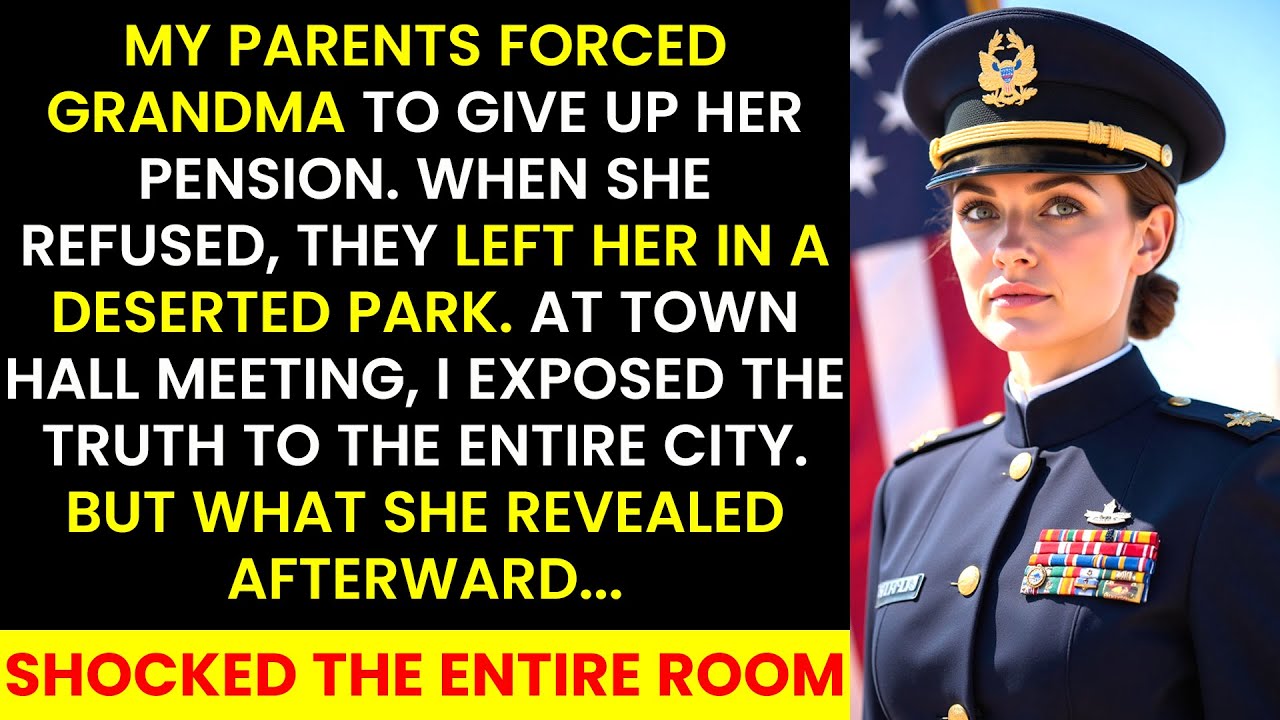
The irony was a bitter poison in my throat. I stood at the very back of the hall, wearing my dress blues, the dark blue wool pressed to a razor’s edge, my silver bars and service ribbons catching the harsh overhead lights. Every step I took toward the stage was a rhythmic metallic strike, the sharp click-clack of my polished heels hitting the hardwood floor like the beat of a war drum. Beside me, Madeline stood tall, her hand resting lightly on my forearm.
She wasn’t the demented old woman my parents had described. She was a silent monument of dignity. The hall fell into a vacuum of silence. Douglas froze mid-sentence, his hand suspended in the air as if he had been turned to stone.
Cora, sitting in the front row, let out a soft audible gasp. I marched up the center aisle, the eyes of Portsmouth burning into my back. I reached the stage, stepped up to the AV technician’s desk, and thrust my USB drive into the system. “Ladies and gentlemen,” I said, my voice projecting with the flat dangerous clarity of a field commander.
“I am Captain Olivia Shields. I am not here to talk about abstract integrity. I am here to show you the reality behind the designer suits and the yacht club memberships. ”
I hit play.
The giant projector screens behind Douglas flickered to life. The first thing that hit the room was the sound—the sharp, piercing rasp of Cora’s voice. “Just get her in the car, Douglas. If the neighbors see her like this, it’s social suicide.
Go to the park off 17. ”
The audio from the ring camera echoed through the vaulted ceiling, every word a hammer blow to my father’s reputation. Then the video played. The 400 people in the room watched in stunned horror as Douglas roughly hauled my grandmother toward the SUV.
They saw her small frail hands clutching the door handle in a desperate plea for mercy. They saw Cora standing with her arms crossed, her face a mask of cold elitist indifference. “Go to the park,” my father’s recorded voice echoed through the hall, sounding like a death sentence. “Stay there until you clear your head, you old burden.
”
A collective gasp rippled through the audience, followed by a low, dark growl of indignation. Cora snapped. She bolted from her seat, her face distorted with wild animalistic fury. She stormed onto the stage, her high-pitched scream echoing through the speakers.
“You are a demon, Olivia. You are a traitor to your own blood. You are destroying your parents for the sake of a senile, useless old woman who has been a parasite on our lives. ”
I didn’t flinch.
I looked directly into her bloodshot eyes, my voice as cold as a Virginia winter. “She is not a parasite, Cora. She is the mother who gave life to the man you married. She is the woman who raised me while you were busy chasing status at parties.
You didn’t just abandon her—you tried to erase her. ”
Douglas stood behind the podium, his empire of lies crumbling into ash before his eyes. Then a voice rose from the third row. It was Rose.
She stood up, her hand shaking, but her voice strong. “It’s true,” she cried out. “I saw them. I saw it all from my window, and I was too afraid to speak.
Douglas threatened to sue me into the streets. They are monsters. ”
One by one, more neighbors stood up. The room erupted into a symphony of condemnation.
“Shame,” a man shouted from the balcony. “Shame on you, Douglas. ” The word began to chant, growing louder and more rhythmic until the walls seemed to shake. “Shame.
Shame. Shame. ”
My parents looked smaller than I had ever seen them. Two terrified, hollow people caught in the glare of a truth they could no longer outrun.
The ambush was a total success. But as I looked at the wreckage of my family, I felt no joy. Only a profound hollow sadness for the honor they had traded for a few pieces of silver. I took Madeline’s hand, and together we walked back through the doors, leaving the echoes of the town’s judgment behind us.
The drive back was conducted in a heavy pressurized silence. When we reached my apartment, I closed the door, the click of the deadbolt sounding like a gunshot. Madeline slowly lowered herself into the armchair by the window. Outside, thin crystalline flakes of snow began to drift past the glass.
I took off my cover and placed it on the kitchen table. My shoulders, held at rigid tension for 48 hours, finally slumped. I had achieved the mission. Yet I didn’t feel like a victor.
I felt a hollow aching void in the center of my chest—a vast abyss where a family used to be. By 10:00 that night, the digital world had finished what I started at the podium. The news of the scandal had ripped through Portsmouth faster than a munitions fire. On social media, the destruction was absolute.
The perfect family aesthetic Cora had spent 10 years maintaining was being systematically dismantled by a thousand angry comments. Douglas and Cora had become social pariahs in the very town they had fought so hard to dominate. I stepped out onto the small balcony, the biting Virginia air hitting my face like a physical wake-up call. I looked up at the stars, obscured by swirling white flakes, and remembered a different winter.
Being 5 years old, hoisted onto Douglas’s broad shoulders at the Christmas market. The way Cora used to hum a soft southern lullaby until I fell asleep. I searched those memories for the monsters I had seen at the town hall, trying to find the moment when money and status had started to rot their souls. I walked back inside.
I wasn’t going to let their cruelty define the rest of our lives. I made a choice right then, standing in the quiet of that Portsmouth midnight. We weren’t going to hide, but we weren’t going to stay in the shadow of their shame, either. It was time for a tactical move to a new front—a place where the air was clean and the truth didn’t taste like ash.
I began to pack a small bag, my movements precise and determined. I was closing the door on the house of lies forever. The next morning, I found Madeline sitting in the breakfast nook, her eyes fixed on a battered wooden box. It was made of dark cedar, worn smooth by decades of touch, smelling of old memories and earth.
As I sat down, she slid the box toward me, her thin fingers trembling with a quiet, steady purpose. “Livia,” she whispered, her voice carrying a resonance I hadn’t heard since before the storm at the park. “Your father and Cora saw me as a liability, an expense they didn’t want to pay. But your grandfather, Harold, was a man of the soil.
He knew the real value of a life is often buried where the shallow-minded refuse to look. ”
I opened the box to find a stack of legal documents. Land deeds and a comprehensive urban development report. Years ago, Harold had quietly purchased 50 acres of scrub land on the outskirts.
Others dismissed it as worthless, but Portsmouth had recently finalized a massive rezoning plan. That scrub land was now the center of a new residential and commercial hub. According to the valuation summary from last month, the property was worth $3 million. I sat there, stunned, the paper feeling heavier than my service weapon.
All the humiliation and insults Cora had hurled at me became absurdly pathetic in an instant. My parents had discarded a literal gold mine because they were too blinded by their own petty greed to notice what was right in front of them. By the next afternoon, as the legal filings moved through the county system, my phone became a battlefield. Douglas and Cora, who had spent the week hiding in shame, were suddenly desperate to reconnect.
The messages were filled with manufactured tears and frantic apologies. “Livia, we were just so stressed,” Douglas wrote. “We want to bring Grandma home and give her five-star care. ”
It was sickening.
Their repentance didn’t sprout from a change of heart—it sprouted the second they caught the scent of $3 million. The climax of their desperation arrived two hours later with a frantic pounding on my door. Looking through the peephole, I saw Cora. Her hair was a mess, her face blotchy from crying.
When I refused to open the door, she sank to her knees in the hallway, her sobs echoing through the wood. “Livia, please, we’re your parents. Just let us talk to Madeline. ”
I stood on the other side, my heart as cold and unyielding as the steel of my rank.
They had deserted this family the moment they left a 78-year-old woman on a park bench in the rain. I walked back to the living room, where Madeline was watching me with quiet wisdom. She took my hand. “Don’t let the hatred consume you, Livia,” she said, her voice a gentle anchor.
“It’s a heavy pack, and you’ve already marched far enough. Forgiveness isn’t about letting them back in. It’s about setting yourself free from the burden they created. ”
I looked into her eyes and realized she was right.
Forgiveness was the ultimate weapon. It was the power to move forward without being tethered to their rot. The finality came in a glass-walled lawyer’s office downtown. Madeline sat across from an attorney, her back straight and her dignity reclaimed.
She signed the trust documents, officially transferring every acre into my name. “My son and his wife lost their right to this legacy long ago,” she said, her voice echoing with the authority of a queen. “This property belongs to the one who knows the meaning of honor. ”
Douglas stood in the lobby, watching us through the glass partition.
His face was a mask of distorted regret—not for the mother he almost killed, but for the fortune he would never touch. They were left with nothing: no reputation, no family, no millions. Their punishment was the life they had built—a hollow, impoverished existence in a town that would never forget their names for all the wrong reasons. As we walked out, I felt a new strength rising within me, a legacy of honor worth more than any medal or any amount of gold.
I took Madeline’s hand and didn’t look back. Six months passed. The golden sunlight of a Virginia autumn spilled across the wide, wrap-around porch of our new home, a far cry from the shadowed rooms of the Portsmouth apartment. The air here tasted of salt, cedar, and an absolute sense of freedom.
Madeline looked 10 years younger. The deep lines of fear that once etched her face had softened into a radiant peace. Her laughter was no longer a fragile, guarded thing—it was a warm melody that signaled our survival and our complete rebirth in a house built on truth. With the capital from the strategic sale of one small portion of the coastal land, I had officially launched Shields and Chamberlain, a private security and military consulting firm.
It was built on the foundation my grandfather would have respected: absolute loyalty, surgical precision, and unyielding integrity. I made it my primary mission to hire fellow veterans, men and women who carried their own scars but still held fast to a sacred code of honor. Our office was a sanctuary for those who had served and were looking for a new front to fight on. A few weeks ago, I ran into Cora at a discount grocery store on the outskirts of Portsmouth.
The woman who once spent thousands of dollars on silk scarves was now pushing a rickety trolley filled with generic brand canned goods. She looked gray and exhausted, her clothes slightly frayed at the cuffs. When she saw me walking toward my new SUV, she didn’t scream. She simply ducked her head and hurried away into the shadows of the store, unable to meet my eyes.
Douglas was working 12-hour night shifts as a low-level security guard, struggling to pay off the mountain of debt they had accrued. As I watched Cora scurry away, I didn’t feel rage. I only felt deep, heavy pity for two souls who had traded their mother’s love for a pile of silver that had finally turned to ash. As the evening sun dipped behind the tree line, I sat on the porch with Madeline, a stack of old Polaroid photos of Harold resting on our laps.
“Livia,” she said, her hand reaching out to squeeze mine, surprisingly steady and warm. “Your greatest victory was not the $3 million from the land or the professional success of this company. It was that you found your own soul in the middle of that hurricane. ”
I nodded, feeling a lightness in my chest that no metal could provide.
We walked inside together to prepare a simple dinner: meatloaf, mashed potatoes, and green beans. The kind of meal that tasted like freedom and home. My scars were still there, hidden beneath my skin, but they were no longer wounds of betrayal. They were badges of honor, proof that I had fought for the truth and won.
The community center in our small Virginia town was transformed today, filled with the delicate, honeyed scent of thousands of white roses—my grandmother Madeline’s favorite flower. I stood backstage, adjusted the lapel of my blazer, and took a deep breath. The room beyond the curtain was humming with the quiet, respectful chatter of hundreds of people: veterans in faded caps, elderly neighbors with weathered faces, local leaders who had come to witness the birth of a legacy built on the ruins of a betrayal. Today marked the official launch of the Harold Chamberlain Memorial Fund.
We had dedicated a massive portion of the $3 million from the land and the profits from my new firm to create a lifeline for the forgotten—a safety net for lonely seniors and aging veterans who had been pushed into the shadows of society, much like my grandmother had been on that freezing night in the park. I looked through the gap in the curtain and saw Madeline sitting in the very front row. She was wearing a soft lavender dress, her silver hair perfectly coiffed, and she was smiling with a radiant, quiet pride that was the greatest promotion I had ever received. I walked onto the stage, the rhythmic click of my heels echoing against the polished wooden floorboards.
As I reached the podium, the room fell into a sudden, expectant silence. “I once believed that the only duty of a soldier was to fight on distant battlefields,” I said, my voice projecting with steady military clarity. “I thought honor was something earned under fire in foreign lands. But I have realized that the most brutal battlefields are sometimes located right inside our own living rooms.
Those front lines don’t have artillery fire or mortar shells, but the weapons used there—lies, greed, and the cold steel of betrayal—can kill a human soul faster than any bullet ever could. ”
I paused. I saw several older men in the third row wipe their eyes, a few women nod in somber agreement. They recognized the silent war I was describing because many of them had been casualties of it themselves.
“We are here today to declare that no one gets left behind,” I continued, my voice growing stronger. “We are here to ensure that the people who built this country and raised our families are never treated as burdens or discarded like yesterday’s news. This fund is not just about money. It is about restoring the dignity that was stolen from them.
”
As I spoke, I felt the final fragments of my own pain begin to dissolve. I was no longer the victim of a greedy father or a social-climbing mother. I was an architect of the future, using the very stones that had been thrown at me to build a cathedral of hope for others. Toward the end of my speech, my eyes drifted to the heavy oak doors at the back of the hall.
Two figures stood there, lingering in the shadows of the foyer, looking in with expressions of desperate, starving longing. It was Douglas and Cora. They were dressed in their best remaining clothes, trying to look like they still belonged in this world of influence and grace. They watched the standing ovation, the cameras flashing, and the local dignitaries shaking my hand, but they did not dare to step inside.
They were ghosts at their own feast. They were the past that I had finally, fully forgiven, but a past that I would never forget. Forgiving them was the key that unlocked my own prison, but remembering them was the shield that would protect my integrity forever. When the ceremony concluded, I stepped down from the stage and took Madeline’s hand.
We walked out of the center and into the crisp afternoon air, strolling beneath the towering, whispering pine trees of Virginia. We didn’t talk about the freezing rain of the park or the bitter words of the months prior. Instead, we talked about our new plans to partner with local orphanages and how the fund could provide a bridge between the wisdom of the elderly and the energy of the youth. I looked at the rhythmic swaying of the pines and realized that the scar in my heart had finally stopped aching.
It had become a mark of strength, a permanent reminder that I had survived the storm. My story was not ending with a cold act of revenge, but with a warm act of continuation. I looked at my grandmother, saw the peace in her eyes, and knew that my mission was officially complete. We had held the line.
We had guarded the truth. And most importantly, we had left no one behind.