Richard Calea stepped out of his black Mercedes into the rain, his assistant Nolan already holding a tablet with the evening’s program. The screen showed Richard’s name above the title of his keynote speech, “Leadership in Uncertain Times. ” He adjusted one cufflink, then the other. A small ritual before he became the person everyone expected him to be.
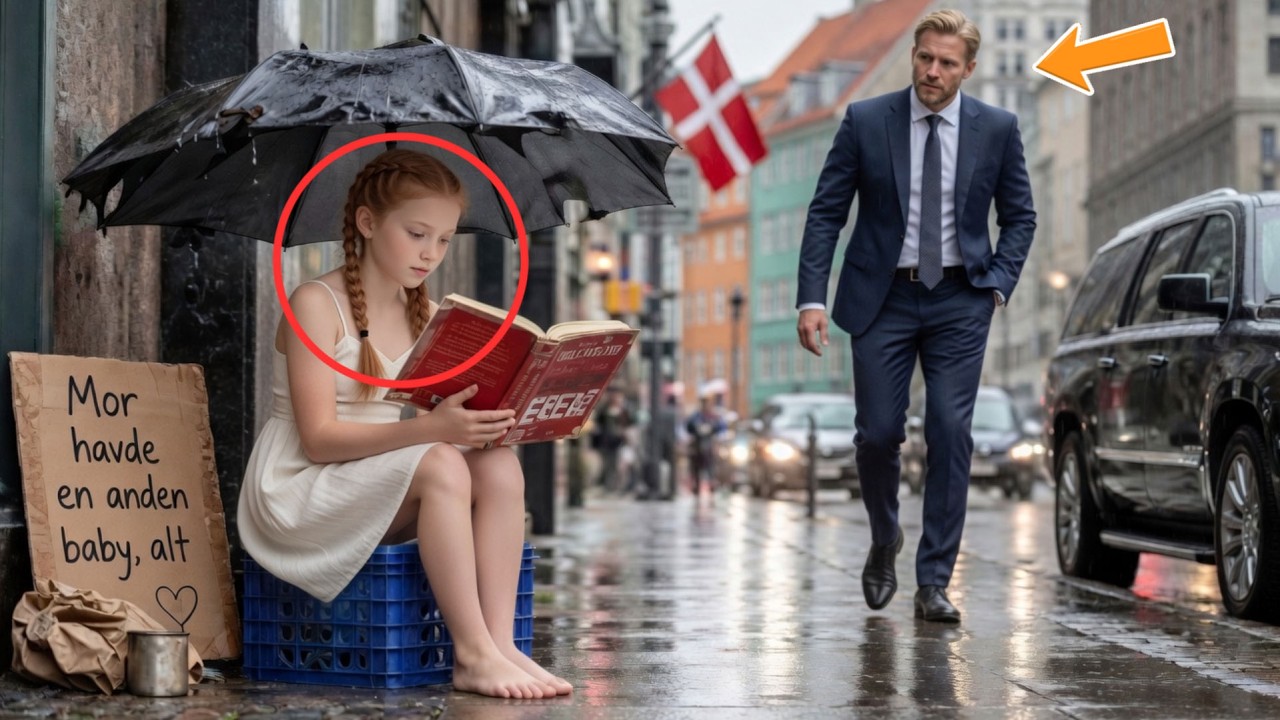
On the other side of the street, a girl sat by a boarded-up shopfront under a flickering security light. She was maybe nine years old, her shoes soaked dark, her hair plastered to her face. But what stopped Richard was the thing on her lap: a swollen, rain-warped paperback. She was bent over it in total concentration, one hand holding the spine, the other shifting a broken umbrella so that the driest angle covered the book instead of her head.
Her lips moved silently as she read. a bus hit a puddle, spraying her with dirty water. She barely flinched, just lifted the umbrella a little higher over the book. That was the detail that unsettled him.
His assistant Nolan said quietly, “They’re already seating the donors. Richard didn’t answer. He crossed the street. The rain hit differently there—colder, harsher.
When he reached the boarded-up doorway, his expensive coat was already soaked. He didn’t care. The girl finally looked up. Her face was thin and tired in a way that made him uneasy—a child who’d had to be careful too early.
She didn’t smile or seem grateful that a well-dressed stranger had crossed the street to talk to her. She scanned him once, from his shiny shoes to his rain-spotted face, with a practiced cautionthat belonged to someone much older. “That’s ambitious reading,” he said, nodding atthe book. “Maybe,” she said, “especially out here.
” He gestured vaguely atthe cover. “I found it in a trash bin in the rain,” she said, tilting her chin toward an office towerin the distance. “It was already ruined. ” Her voice was plain, matter-of-fact.
No performance, no softening. He bent slightly, not invading her space. Up close, he could see how swollen the paperback was,how the corners were peeling. Pencil lines ran along some passages—someone else’s underlinings, or hers.
“Why did you keep it? ” he asked. She shrugged, but não um empty shrug. It said she was tired of explaining herself to people who hadn’t earned it.
“It says that some things don’t become great by accident. ” He looked at her more carefully. The rain ran down the bent edge ofthe umbrella, dripping near her knee. Her hair was soaked, her ears pink with cold—and still,the book lay under the driest part ofthe umbrella, protected like something alive.
“And that matters to you. ” Now she studied him seriously—not his face, but him. It was a look adults give when deciding whether someone is stupid, dangerous, useful, or a waste of time. That look didn’t belong to a girl.
It meant life had put it there. Finally she said, “I’m not trying to end up where life left me. ” No self-pity. No small speech.
Just the truth, laid between them in the rain. Behind him, muffled applause drifted through the hotel doors. He could picture the room—white tablecloths, stage lights, crystal glasses, people talking about markets and mission. That polished language he’d lived in for years.
Resilience, innovation, service, character. He’d said it all so well, maybe too well. And yet this girl, on a milk crate under a broken umbrella, had just said something about discipline and survival with more weight than he’d heard all quarter from people paid to advise him. “What’s your name?
” he asked. A second passed—she seemed to consider whether names were a form of surrender. “Emma. ” Then, after another second, “Emma Brocks.
” “I’m Richard. ” One corner of her mouth moved, but not into a smile. Her eyes slid past him to the poster near the hotel entrance—his face, elegantly printed in black and white. “I know.
” It hit him harder than he would have liked. Of course she knew. The city was papered with men like him, every time they wanted to be mistaken for leaders and philanthropists at the same time. He straightened a little and looked back atthe hotel.
Through the glass, warm light spilled across the lobby floor. Someone inside was probably already managing the room, wondering if Richard Calea was stuck in traffic. He looked back at Emma—the soaked shoes, the plastic bag wrapped around her backpack. The way she’d tucked her knees inward to hold the book steady.
“Have you eaten? ” he asked. The question changed her face—not exactly to fear, but to calculation. Her hand tightened on the book.
Her shoulders straightened a centimeter. She glanced once at the street, once at the hotel, then back at him. He recognized that look: this was a girl who knew that anything offered for free stayed owed for a long time, unless the terms were clear. He heard himself ask, from outside his own body, having spent so many years famous enough to be recognized, now standing before a nine-year-old girl soaked after dark, asking if she was hungry.
The shame of that image cut through him before she even answered. “It depends,” she said. “On what? ” Her gaze didn’t leave his.
“On what you want from me. ” The sentence was clean, without accusation. That made it worse. Behind him, the hotel doors opened wider, releasing another burst of golden light and violin music and people who would never remember the weather once they got home.
Richard stayed a second longer than made sense, looking at Emma Brocks, understanding that she wasn’t asking a child’s question. She was asking for terms. “I want you to come inside,” he said finally, keeping his voice steady. “I just don’t think you should be sitting out here in this.
” Her eyes stayed on him—not soft, not scared. Assessing. He gestured toward the end of the block. “There’s a café still open half a block away.
Warm booth, hot food. You can say no. If you do, I’ll leave you alone. ” That seemed more important to her than the offer itself.
She closed the book carefully, as if it were worth more than everything else she owned. She tucked it into the plastic bag beside her backpack. She stood without a word—but she didn’t walk toward him. She started walking first, keeping several steps of distance between them, forcing the gap to remain hers.
He followed at her pace. The café sat on the corner under a red-and-blue neon sign that buzzed and seemed older than both of them combined. Its windows were fogged from inside. A faded sign advertising lemon tart hung crookedly off the door.
When she opened it, a bell gave a tired clink. Warmth hit them first, then smell: coffee that had sat a while, grilled onions, fryer oil, wet wool, dish soap. The smell of a hundred long nights of making ends meet. A waitress in her late fifties looked up from the counter.
She had reading glasses on a beaded chain and a face like someone who’d spent years learning the difference between tired and worn out. Emma scanned the room before she took three steps in: front door, back hallway, bathroom sign, counter angle, big front window. She chose a booth against the wall where she could see both the entrance and the street. She slid into the inner seat and pushed her backpack against her leg with one arm over the frame.
Richard took the other side without commenting on any of it. Water dripped from his coat onto the cracked linoleum. His keynote costume suddenly felt too stiff for a place where the sugar dispenser had one pink packet, three yellow, and a bent straw someone had forgotten. The waitress came over with two laminated menus.
“Kitchen’s still on,” she said. “What can I get you? ” Richard looked at Emma. Emma didn’t open the menu.
“How much is the tomato soup? ” The waitress paused a beat. “Thirty-nine fifty. ” Emma nodded slightly, as if that fit into her mental math.
“Okay. ” Richard started to say, she’ll have—then stopped. “What do you want? ” “Soup and a hot drink.
” She glanced at the menu again, though she clearly wasn’t reading it anymore. “Hot chocolate. ” Richard looked atthe waitress. “Tomato soup, and a hot chocolate.
” Emma’s eyes lifted sharply. “I didn’t say sandwich. ” “You didn’t,” Richard replied. “But if you don’t want it now, they can wrap it up.
” Emma held his gaze, deciding whether that counted as pressure. Finally she said, “Wrapped. ” The waitress gave Richard a very brief look—not impressed, not charmed, just assessing. Then she wrote it down and went to the kitchen.
For a moment neither of them spoke. Rain slid down the window by Emma’s shoulder. Outside, cars moved through the blurred, wet light. Central Copenhagen looked half-washed and half-electric.
Emma put both hands on the table. “Are you police? ” “No. ” “Social services?
” “No. ” “Church group? ” “No. ” “Journalist.
” That caught her. “No. ” “Then what are you? ” Richard leaned back slightly.
He was used to being asked what he did, not what he was. He looked at his wet sleeve, then back at Emma. “A man who saw a girl sit in the rain with a book and didn’t feel right walking in to eat dinner. ” Emma kept looking.
It wasn’t enough. He could see that. He tried again, this time with less polish. “I honestly don’t know the right way to do this.
I’m just trying not to walk past something that shouldn’t be walked past. ” That landed better—not because it was well worded, because it wasn’t. Her shoulders gave maybe half a centimeter. Not trust, just less immediate resistance.
“That doesn’t mean I trust you,” she said. “I wouldn’t expect you to. ” The waitress returned with the hot chocolate first—a simple cup and two sugar packets. Emma waited until the woman had gone before she touched it.
And even then she wrapped her hands around the cup before taking a sip, letting the warmth reach her fingers first. The soup came next, steam curling up in soft red swirls. Then the sandwich, cut diagonally, with a pickle anda small pile of chips nobody had ordered. Emma took the spoon and ate slowly.
Not the way a girl eats when she feels comforted, but the way someone eats who has trained herself not to rush, not to waste, not to trust the feeling of being full before she needs something again. Richard noticed that Emma never let go of the backpack frame. After a while, he gestured toward the book wrapped in plastic. “It’s good.
” “Partly,” she said, honestly. Emma took another spoonful. “Partly sounds like old men complimenting each other. ” Richard nearly laughed, against his will.
“That’s also honest. ” Emma’s mouth twitched briefly, then flattened back. “Which part do you like? ” “The part about discipline.
” Emma smoothed a corner of the bag, where water had tightened the plastic. “And the part that says excuses don’t build much. ” Richard looked at her a second. “Do you understand all of it?
” “Not all of it. ” Emma split a sandwich triangle intotwo. Enough for what? He almost asked.
He stopped. He was beginning to understand that Emma answered the question under the question—if she decided to. And if not, not. Instead he said, “Where did you learn to read like that?
” Emma shrugged into her soup. “Library, around. ” Not defensive—just closed. He let it go.
Then, quietly, “So, do you live near here? ” Emma looked up immediately—not angry. Just a boundary. She wasn’t going to let him cross it.
“I’m not dumb enough to say that the first night. ” “Fair enough,” he replied. The waitress returned with a grilled cheese sandwich on a white plate—made by mistake, she said, setting it near Emma. “No sense throwing it out.
” Emma looked at the sandwich, then atthe waitress. She knew perfectly well that kitchens in Denmark don’t accidentally make cheese sandwiches at that time of night—unless someone had ordered kindness without mentioning it. “Thank you,” Emma said quietly. The waitress shrugged inthe smallest possible way.
“Refills are free. ” When Emma finished her soup, she wrapped half of the turkey sandwich in napkins with neat, deliberate folds and tucked it into her backpack beside the book. She left the pickle and put the chips in a folded paper napkin. Richard noticed she packed like someone who had learned to think three hours ahead.
Richard paid atthe register. When he came back, he had the receipt in one hand and a ballpoint pen in the other. He turned the receipt over and wrote only two things: Richard, and the café’s phone number. No last name, no title, no embossed corporate card that would have made the moment feel bought.
He slid it across the table. “If you ever come in here and want Denise to call me, she can. ” Emma picked up the receipt and read it twice. “That doesn’t mean I will.
” “I know. ” Outside, the rain had softened into a steadier drizzle, still cold enough to slip into collars and stay. Emma opened her umbrella again, though one side hung rather badly. She adjusted her backpack on her shoulders, then Richard saw it: a white van parked further along the curb with its lights off.
Engine running. He could feel the low vibration in the wet air. The windshield reflected streetlight, so the driver was mostly silhouette and shadow. But the vehicle had the stillness of something waiting, not resting.
Richard’s body tensed before his mind processed it. Emma noticed. Of course she did. “You don’t have to walk with me,” she said.
“I’ve managed fine. ” It wasn’t defensive—it was a fact, or maybe a habit. Richard kept his eyes on the van a second too long. Then forced himself to look normal.
“I’m just going that direction. ” Emma answered with a short nod and began walking. The umbrella tilted over her backpack more than her head. A second later, the van’s headlights blinked once and went off again, as if whoever was inside had changed their mind about being seen.
Richard stood on the sidewalk with rain hitting his neck, watching until Emma was several meters away, small and straight-backed, under a broken umbrella, carrying a ruined book as if it still had something to teach him. On the other side of the street, the gala still shone, but it no longer felt like the center of the night. Richard didn’t sleep much. Every time he closed his eyes, the same details came back in pieces: the broken umbrella, the rain-soaked book, Emma’s face when she asked what he wanted from her—and behind it all, that white van sitting too still on the curb, as if it had unfinished business there.
In the morning, the gala already felt like something polished and unreal. The applause, the donors, the speech he never gave—all of it had begun to flatten out in his mind. What remained was a nine-year-old girl protecting a ruined paperback with more care than most adults protected anything that mattered. On his way into the city, Nolan asked if he wanted to go straight to the office.
Richard looked out the window atthe wet streets. Delivery vans, corner kiosks, people hurrying toward Tuesday morning as if it were something to survive rather than enjoy. “No,” Richard said. “Drive me back to the café.
” Nolan turned slightly in his seat, but didn’t ask why. The neon sign was still buzzing in the window when Richard walked in. The morning rush was over. Two utility workers in reflective jackets sat at the counter with heavy hands around their cups.
A nurse picked at a piece of toast, staring intothe middle distance. The smell was coffee, bacon, grease, chlorine, and yesterday’s fryer oil. Honest smells. Working smells.
Denise looked up from the register and recognized him without reacting. “Morning,” she said. “Morning. ” Denise poured coffee before Richard sat down.
He took the booth closest to the pastry case. “Has Emma been in? ” Denise wiped the counter with a cloth that had seen better days. “Not today.
” Richard nodded once, then waited. He’d learned enough in one night to know that people like Denise didn’t just hand over information because a man had a good coat and a familiar face. After a moment, Denise said, “Some mornings she comes in for hot water. Uses the bathroom sink to wash up.
Fixes her hair. Makes herself presentable. ” The phrase caught him. Makes herself presentable.
As if the girl had a job to show up for. “She doesn’t steal,” Denise added. “Not cream, not pastry, not sugar packets. Last week she found four kroner under booth four and brought them straight to me.
I told her to keep them. She wouldn’t. ” Richard held his cup between both hands. “Does she come here alone generally?
Does anyone bother her? ” Denise gave him a look over her glasses. “Everyone gets bothered here, Calea. She’s just learned to spot it faster than most.
” Richard accepted that. “She’s usually at the library branch off Klonti, if the weather’s bad,” Denise continued, “or in the church basement on Vesterbrogade for breakfast. She knows which places are warm and which ones don’t ask too many questions. ” Richard left cash under the saucer, though he’d barely touched his coffee.
When he stood, Denise said, “Don’t go over there and act like you have answers. ” He looked at her. “I don’t plan to. ” “Good,” Denise said.
“She’s already had enough adults with plans. ” The library branch was already active when Richard arrived. Coats dripping by the entrance. Flyers hung crooked on a bulletin board.
Old men at a long table read newspapers under flickering lights. A young mother steered a stroller with one hand while returning books with the other. The place smelled of wet carpet, dust, printer toner, and paper that had passed through a thousand different hands. He found Emma at a public computer in the back.
She had a dictionary page open on screen anda small spiral notebook by the keyboard. With a golf pencil worn almost down to the metal, she was copying words from the dictionary one by one in neat, careful script. Not browsing, not drifting—working. Her backpack sat by her shoes with the strap looped once around her ankle.
Richard slowed before he reached her. “Emma. ” Emma went still before she looked up. “I didn’t ask you to come here.
” “No,” Richard said. “You didn’t. ” Her eyes hardened, sharper than the night before, now that the warm booth was gone and daylight had brought them both back to where they belonged. “Then why are you here?
” He could have said concern, curiosity, responsibility. None of it would have sounded true coming from him. “I wanted to make sure you were okay. ” “Is that different from wanting something?
” The question was so direct it almost shamed him. He glanced at the screen, then at the notebook. “I’m sorry I just showed up. ” Emma didn’t say anything, but she didn’t turn back to the computer either.
The notebook was half open. Dictionary page on one side. On the other, a narrow handwritten list. Socks, gloves, instant oatmeal, AA batteries.
The figures beside them had been added up and crossed out twice. Richard looked at the page, then away—careful not to stare like a social worker or a thief. “Do you have a budget? ” “I keep track,” Emma said.
“That’s smart. ” “No,” Emma said flatly. “It’s necessary. ” It landed where it was supposed to.
Richard pulled out the chair beside Emma. She stayed standing. “May I say something? ” Emma hesitated long enough that the permission meant something, then nodded briefly.
Richard sat. Up close, he could see how the edge of Good to Great was dried into a permanent wave. The book was partly tucked under her backpack, protected even here. “Do you come here often?
” Richard asked. “When it’s open, and when it’s not. ” Emma tapped the pencil once against the notebook, deciding how much to say. “Depends if the church serves breakfast, or if Ali’s workshop is open, or if anyone’s in the mood to bend rules.
” “Ali? ” “The mechanic. ” Emma finally looked at him again. “Sometimes he lets me sit in the waiting room if it’s cold.
Not at night, only during the day. ” Richard nodded slowly. “My mom doesn’t like it,” Emma added quickly, as if correcting therecord before Richard misunderstood. “She doesn’t like me being around men I don’t know.
” But her mouth tightened. “But what we don’t like doesn’t solve where we are. ” There it was—the true center of it all. “Where is your mom?
” Richard asked quietly. Emma turned her gaze back to the screen. For a moment he thought she might not answer. “Sometimes she’s in Nørrebro, at a women’s shelter.
” She swallowed once. “Sometimes she’s not. ” “And then? ” Richard asked.
“And then I am. ” Emma didn’t elaborate. Her pencil rolled under her fingers. “She got addicted to painkillers after my grandmother died.
Then everything fell apart. ” She said it without drama, as if stating a fact she’d had to learn to carry. “She tries. That’s what people don’t understand.
They act like when someone falls apart, it means they never cared. That’s not true. ” “I didn’t say it was. ” When I spoke, my voice came out low.
“That’s why I’m still talking to you. ” He let it sit. Around them, library life moved on. A copier jammed somewhere ahead.
Someone coughed. A librarian wheeled a returns cart past the reference desk. Ordinary sounds, safe sounds—but Emma’s body never fully relaxed. One foot still hooked around her backpack strap.
One shoulder stayed slightly raised. “Do you stay close to her? ” Richard asked. “I stay where I can have control.
” She rubbed the pencil’s worn eraser against her thumb. “The library, the church. Sometimes near the shelter, sometimes at the workshop. I don’t just wander.
” “I know. ” Emma looked at him, searching for pity. When she didn’t find any, a small part of her face unclenched. Her problem wasn’t just money.
He could see it now. It was instability—adults who entered programs, adults who made promises, adults who filled out forms and disappeared behind them. No wonder help sounded dangerous to her. Help usually came with hands already reaching.
Richard’s phone vibrated in his coat pocket. He glanced at it sideways: Jason, I need your approval on the guest list for the foundation brunch. Another message followed, from Vanessa: The impact presentation still needs your notes. Richard pushed the phone away without opening it.
He thought about the house in Hellerup—the polished table, Jason using the foundation as a family crest, Vanessa saying impact the way other people said amen. As if the work itself proved something. And he—he had spent years writing checks large enough to feel virtuous without ever getting close enough to make his own life uncomfortable. Emma copied another word into her notebook.
“Why did you really come back? ” she asked. Richard told the truth, because anything else would have sounded rehearsed. “Because I saw the van.
” Emma’s pencil stopped. “You saw it. ” “Yes. ” “It shows up sometimes,” Emma said.
“Same dent above the rear wheel. Same driver acting like he doesn’t see me. I don’t like it. ” Her eyes returned to the page, but he had her full attention now.
After a long moment, Emma said, “You can’t help my mom unless you’re ready to be disappointed. ” The sentence came calmly—not dramatic, not twisted—protective, except that it came from a girl. Richard didn’t rush to reassure her. He had the sudden sense that false comfort would offend her more than indifference.
“Can I handle disappointment? ” he said. Emma waited. “What I’m not interested in,” Richard added, “is disappearing the moment someone becomes difficult.
” Emma held his gaze for the first time since Richard had crossed H. C. Andersens Boulevard. She didn’t look ready to run.
Then Emma closed her notebook, slid it into her backpack beside the ruined book, and stood. “You can’t fix everything,” she said. “I know. ” She pulled the strap over her shoulder.
“Then start with what’s real. ” A pause. “My mom. ” Emma nodded faintly.
Richard stayed a second after she walked toward the stacks. He watched her go—small, watchful, carrying everything she owned, including the burden of having to manage the adults who were supposed to be managing her. Only then did he understand what Emma was protecting so fiercely. Not just the book.
Not just her mother. The right to keep her dignity in a life that was constantly trying to bargain it away. Richard didn’t try to fix Carla Brocks with money. He didn’t call any of the hospital directors he knew.
He didn’t ask his accountant to send gift cards through some respectable intermediary. He didn’t ask Nolan to arrange a driver, a hotel room, a polished solution he could feel generous about for three hours and then quietly hand off to someone else. The following Saturday, Richard drove into the city himself. The library annex sat a couple of blocks from the main branch, squeezed between a narrow parking lot and a row of brick houses with low steps and iron railings slick with old rain.
The door stuck before it gave. Inside, the place felt functional in the way low-budget public spaces do: burned coffee, disinfectant, wet coats, a soda machine buzzing inthe corner, folding tables, stacked plastic chairs, a corkboard full of flyers about English classes, CV help, eviction-prevention clinics, and a food distribution calendar written in blue marker already drying out. None of it was charming. That was part of why it mattered.
A woman running the annex with a lanyard and reading glasses stood at the sign-in sheet, sorting brochures into uneven piles. She recognized Richard—but not the way people at the gala recognized him. Without lighting up, without playing a role. “Here for the reading grant?
” she asked. “Exactly,” Richard said. Not exactly a lie. He had read the proposal twice.
He also knew that if he’d shown up and said he was there for a specific girl, Emma might never come again. A retired nurse in white sneakers was transferring supermarket biscuits from a butter tub to a paper plate. Two old veterans sat near the window reading newspapers under flickering light, occasionally commenting on FC Copenhagen as if time itself moved slowerin rooms like that. At another table, a boy hacek school uniform filling out a job application while his grandmother whispered answers from memory.
Someone had dumped a jigsaw puzzle out on a card table, and it was already obvious at least a dozen pieces were missing. Richard signed his name and chose a folding chair near the back wall—no assistant, no driver waiting on the curb, no cameras. Only a legal pad he barely looked atthe whole time, and a cup of instant coffee that tasted like burnt patience. Emma arrived ten minutes later.
Richard knew it before he turned around. The room shifted slightly every time Emma walked in. Not because she demanded attention, but because Emma entered like someone used to having to plan exits. Emma stopped just inside the doorway when she saw him.
Her backpack hung high on one shoulder. The warped copy of Good to Great poked out of the side pocket. Her eyes scanned the room once—door, hallway, bathroom sign, side exit, window—then returned to him. “You’re early,” she said.
“So are you. ” Emma didn’t smile, but she came in. She chose the chair facing the main entrance. Richard noticed and said nothing.
That meant more than any comment. Emma set her backpack by her foot, slipped one shoe through the strap, and took out her spiral notebook and the battered book, whose pages had dried stiff and curled like old leaves. They sat across from each other with the folding table between them—not like family, not like benefactor and grateful girl. More like two people checking whether the routine could be trusted.
“Are you going to keep coming? ” Emma asked. “For today,” Richard said. “That wasn’t my question.
” Richard looked at her a second, then nodded. “Yes. That’s the plan. ” Emma opened the book, but didn’t start reading right away.
“People say that. ” “I know. ” Emma studied his face, as if expecting the sales pitch behind the sentence. When none came, she lowered her gaze to the page.
Around her, the room continued doing what it did. The annex coordinator helped a man print a bus schedule. Someone at the puzzle table discovered a piece that belonged to an entirely different box. The retired nurse refilled mismatched coffee cups, calling everyone “dear” without sounding false.
It was an ordinary room full of ordinary people, which made it rarer than most places built to impress. Richard gestured toward the book. “Still working through it? ” Emma looked at his wrist.
“Still working through that watch? ” Richard glanced down at the steel watch he’d worn for fifteen years. Expensive enough to be noticed. Simple enough to pretend otherwise.
“Fair enough,” he said. That produced the smallest change in Emma’s mouth—not a smile, but close enough to count. Emma pushed the book a few centimeters toward him. “This part here.
” Richard leaned in. Emma’s pencil had underlined a sentence with such force that the line almost disappeared into the paper. “The words are fine,” Emma said. “It’s the meaning that gets slippery.
” Richard read the passage. Then he looked up. “Which part? ” “The part where discipline isn’t punishment, but direction.
” Emma tapped the page once. “Direction toward what? ” It wasn’t the kind of question that wanted a conference-answer. Richard knew that perfectly well.
He leaned back and looked at the room instead of at Emma. The veterans, the nurse, the boy with the application, the chipped coffee pot, the coordinator hand-feeding printer paper because there was no one else to do it. “Maybe this,” Richard said. Emma frowned slightly.
“This. ” “A place that keeps the lights on. ” Richard gestured gently, careful not to turn the room into a lesson. “The coffee is bad.
The chairs don’t match. Half the puzzle pieces are missing. But people know it opens when it says it opens. They know someone will be here.
” Emma followed his gaze around the room. “That’s not greatness,” she said. “No,” Richard said. “But maybe it’s how you get there.
” Emma let that settle between them. For the next hour, they worked in small portions. Richard translated some of the book’s corporate language into everyday Danish. Emma stopped him every time he unconsciously slipped into jargon.
Once he used the phrase “resource-scarce environment,” and Emma looked at him so coldly that Richard corrected himself mid-sentence. “You mean the neighborhoods you used to just drive through? ” she said. Richard accepted it.
“Yes,” he said. “That’s what I mean. ” That answer mattered to Emma. He could feel it—not because it impressed her, but because Richard had stopped protecting himself from sounding wrong.
So they circled each other for weeks. Richard came on Saturdays—not every day. Not with flowers or grand plans. Only on Saturdays at first.
He read the literacy grant proposal all the way through and made notes nobody had to ask him to do twice. He brought nothing flashy. Once he accidentally brought nice pens to the annex, and the coordinator handed them straight back, saying the cheap ones disappeared slower. Richard learned.
Emma noticed the consistency the way some people notice weather. She noticed that Richard came when he said he would, that he never asked where she’d slept before if she didn’t mention it, that he didn’t try to fix things behind her back, that he asked before he sat down, that when Emma went quiet, Richard didn’t rush to fill the silence and call it connection. They began sharing the same folding table so often that it started to feel like something. Richard learned things because he listened, not because Emma taught them to him in order.
Emma had a thing for artificial banana flavor, especially in cheap candy and children’s syrup. She preferred hardcover books over spirals because the spiral got crushed in backpacks and loosened pages. She always chose the chair that let her see the door. Once, when the annex coordinator put out vanilla-flavored coffee creamer, Emma wrinkled her nose and said black coffee smelled more honest.
Richard laughed before he could stop himself. “You’re nine,” Richard said. “And you’re slow,” Emma replied, turning a page. The contrast with home began to grate.
One Saturday evening in Hellerup, the dining table gleamed under the chandelier’s dimmed light. Salmon, asparagus, linen napkins so heavy they seemed inherited. Vanessa skated her phone between bites, barely looking up except to perform when she thought it might be useful later. Jason talked about the foundation’s metrics in the cautious, bored tone of a man who wanted to be associated with virtue rather than do the work that produced it.
Richard had laid Emma’s book on the sideboard earlier that day after taking it home to dry another corner near a fan. Vanessa had seen it. Vanessa set her water glass down and said, almost casually, “Dad, we’re really leaning into the resilience theme. ” Richard looked at her.
“What does that mean? ” Vanessa waved a hand—the grant, the book, the whole aesthetic, humility, literacy, genuine urban struggle. “It’s a lot, this season for you. ” Jason smiled without lifting his head.
“Maybe he’s workshopping a softer relaunch for the foundation. ” The words were light. That was what made them ugly. Richard set his fork down.
“It’s a girl’s book. ” Jason finally looked up. “No, Dad, it’s Jim Collins. It’s a classic, if you use it right.
” Richard looked at his son a second too long, then at Vanessa, who didn’t seem exactly cruel, just insulated past decency. Richard didn’t argue. Not then. He was still learning something new and uncomfortable.
The emptiness in his home hadn’t come by accident. He had funded it, furnished it, and called it success. That night, Richard stood up. Vanessa looked up.
“Leaving? ” “No,” Richard said. “I’m just done here. ” He drove alone into the city and parked before the dark annex.
The building was closed. The soda machine inside glowed blue against the empty room. Richard sat behind the wheel a long time, listening to the engine tick as it cooled, thinking about how Emma had never once asked him for money. What Emma had asked for, without using words, was stability.
Richard came back the following Saturday, and the one after that. One morning, Emma pushed the book toward him with enough force that it nearly slid off the table edge. “Read that part again,” she said. “I already read it.
” “Not like someone selling it. ” Richard looked down. In the margin next to the passage was one of Emma’s small pencil notes: This takes time. Richard read the passage slower.
“Why did you underline this? ” he asked. Emma shrugged, but not carelessly. “Because people always think talking counts most.
” Richard looked at her. Emma looked back. No lesson in it. No accusation.
Just a girl giving him a sentence and waiting to see if he was honest enough to hear himself in it. On the fourth Saturday, the room had begun to wait for them. The nurse put biscuits attheir table. One of the veterans started saving the newspaper’s Copenhagen section for Richard without mentioning it.
The annex coordinator stopped asking whether Richard was really there for the grant. Emma still didn’t behave as if Richard belonged to her life, but she had stopped behaving as if she had to apologize for the moment. Richard crossed the door. Then one Saturday, Emma didn’t come.
At ten, Richard looked up when the door opened. It wasn’t Emma. At ten-fifteen, he checked the hallway. Then he sat back down and told himself not to be silly.
At ten-forty, he gave up pretending to read. The empty chair across from him did something strange to the room. It made it feel less safe, more temporary. At ten-fifty, his phone buzzed.
It was Denise. Richard answered on the first ring. “Have you seen her? ” Denise said.
Her voice was tight in a way Richard had never heard before. “The white van was outside my place again before dawn. Same one, parked too long. ” Richard’s hand tightened on the phone.
He looked atthe empty chair on the other side of the table. Empty except for a cheap pencil Emma had left the week before and never come back to collect. On the table in front of Richard, Good to Great lay open to one of the pages Emma had underlined. For the first time since the night on H.
C. Andersens Boulevard, fear cut through him. Raw and cold. Not public concern.
Not charitable discomfort. Something personal. Richard found Emma that evening in the church basement on Vesterbrogade. The room looked as it always did after supper: tables pushed against walls, a mop bucket by the utility sink, fluorescent lights buzzing as if tired of their own sound.
A volunteer was stacking plastic cups into a tower that wobbled slightly. Someone had left a tray of dry buns on the counter as an afterthought. Emma sat alone on a metal folding chair near the back wall. Her backpack stood at her feet.
The battered copy of Good to Great lay closed on her lap,her palms pressed flat against the cover as if holding something back. Emma didn’t look up when Richard came in. “I was worried,” Richard said. “You shouldn’t be,” Emma replied.
The words were clean and flat. No comfort in them. A door. Richard stopped several feet away.
He didn’t reach for her shoulder. He didn’t bend down. The room wasn’t theirs the way the annex table had begun to be. It was Emma’s territory, and Emma was making that clear.
Richard tried again. Quietly. “Denise said you were here. ” Emma’s jaw moved once, as if chewing on something hard.
She kept her eyes on the floor. “What happened? ” Richard asked. For a moment, he thought Emma might make him ask again, make him guess.
Instead, Emma reached into her backpack and took out a folded glossy piece of paper. She didn’t hand it to him. She threw it on the table beside them, as if it were dirty. Richard unfolded it.
At the top, in bold white letters on black, it read: TRUE RESILIENCE, TRUE IMPACT. Below the headline was a photograph taken from across the street of the library annex. Emma at the folding table, head bent, pencil in hand. The swollen paperback visible beside her.
Her face was clear enough that anyone who had seen her once would recognize her twice. A caption ran beneath the photo in smooth, confident prose: “From the Streets to Transcendence: One Story of Resilience, Supported by the Calea Foundation. ” Richard looked at it until his eyes burned. Not from tears—from disbelief.
“Where did you get this? ” he asked. Emma finally looked up. Not hurt.
Not begging. Her expression had the stillness of someone who had already survived the shaming part alone. “Someone showed me on their phone,” Emma said. “Then they printed it out like it was a flyer.
” “Is it—” Richard started, even though he already knew. Emma nodded once. Richard’s chest tightened. The typography.
The wording. The design. It had the Calea Foundation’s fingerprints all over it. The kind of campaign his team could produce in an afternoon.
The kind of story donors love to applaud because it doesn’t ask anything of them except applause. “I didn’t approve this,” Richard said. Emma’s mouth barely moved. “That doesn’t help.
” The simplicity of that answer hit harder than anger would have. Richard held the flyer with both hands, careful not to crumple it ina fit of rage. “Emma, I didn’t know. I swear.
” Emma looked at him the way she had looked at him that first night on H. C. Andersens Boulevard. Only now, the question wasn’t whether Richard was safe.
The question was whether safety had ever been possible with someone like him. “You are the Calea Foundation,” Emma said. “Your name is on the building. Your name is on everything.
You can’t be surprised when it acts like you. ” The volunteer by the sink paused a second, glanced at them, then went back to stacking cups, as if he had long since learned not to get involved in private storms. Richard lowered his voice. “I would never use you like that.
But it happened. ” Emma tapped the flyer with one finger. “And I told you. I told you what people do.
” Her eyes slid to the line on the page—“From the Streets to Transcendence”—and something tight passed over her face. “You can’t decide I’m inspiring,” Emma said. “I didn’t sign up to be anyone’s lesson. ” “I know,” Richard said quickly.
“Do you? ” Emma’s gaze sharpened. “Really? ” Richard stopped talking.
Let the silence do its work. Emma picked up the flyer and tore it across the middle. The sound was loud in the basement—the sound of something breaking, and it wasn’t paper. Emma tore the halves again, then again, until the bold letters had become strips.
“They’re all the same,” Emma said, her voice almost steady—just slower, softer, better dressed. Then Emma reached into her coat pocket and took out the receipt from the café—the one with his name and Denise’s number written on the back. The tiny piece of paper looked absurd next to the glossy marketing paper. Emma set it on the table in front of Richard, perfectly flat.
“I don’t need this,” she said. Richard looked at the little receipt—the first bridge he’d built, and how quickly it could burn. “Em,” he began. “No.
” Emma stood and swung her backpack over one shoulder, holding the book against her side. “You can’t explain your way out of this. Explanations are for people who can still feel safe. ” Richard followed her toward the stairs.
She kept walking. He didn’t grab her arm. He didn’t call after her like a father. He wasn’t that.
Not yet. No, never. Maybe. He was just a man who had let his world touch Emma’s, and his world had left fingerprints.
When Richard reached the door, Emma was already halfway up the stairs, disappearing into the wet night. The next morning, Richard walked into the foundation’s office without calling ahead. The lobby smelled of citrus cleaner and new carpet. Framed photos covered the walls—ribbon cuttings, smiling grant recipients, galas, his own face next to mayors and directors.
The place was designed to give the impression that goodness had a budget. Jason was in the conference room with two marketing staff, a laptop open, slides on screen. Vanessa sat near the window with coffee, scrolling her phone as if nothing in the world could genuinely touch her. Jason looked up and smiled.
“Dad, you saw the rollout. It’s already generating buzz. ” Richard placed the printed flyer on the table without drama, without speech—only the paper as evidence. Jason barely glanced at it.
“It’s a strong hook. Did you get her permission? ” Richard asked. Jason shrugged.
“She’s nine, Dad. Permission isn’t how these stories work. ” Vanessa finally looked up. “We didn’t put her last name on.
No problem. This is standard impact narrative. ” Richard felt his stomach twist. “She’s a child,” Richard said.
“And you put her face in an ad. ” “It’s not an ad,” Jason said, leaning back in his chair, now irritated. “It’s a story. People respond to real resilience.
” “Real resilience,” Richard repeated quietly. Jason’s tone sharpened. “Look, donors want something they can feel. We’re relaunching the gala.
We needed a human angle. ” “A human angle. ” Richard looked at the marketing staff. They looked at their screens, waiting forthe storm to pass over them.
Vanessa stirred her coffee as if this were a brand meeting that had gotten emotional. “Take it down,” Richard said. Jason blinked, genuinely surprised. “What?
” “Take the post down. Cancel the relaunch campaign. ” Vanessa’s head snapped up. “Dad, you can’t just—there are donors scheduled.
There are commitments. ” “I don’t care,” Richard said, and his voice was calm enough to scare even himself. Jason stood. “You’re overreacting.
This is how the Foundation works. ” “Then we’ve been doing it wrong. ” Jason scoffed. “For a street kid.
” The words hung in the air—ugly, careless. Richard’s hand hit the table hard enough that water glasses jumped. He hadn’t intended to do it. That was the truth.
His control slipped, and for once the room saw what lived under his polished surface. “She is not a prop,” Richard said, quietly. “Not for you. Not for me.
Not for anyone. ” The marketing staff finally looked up, eyes wide. Vanessa sat completely still. Jason’s face tightened.
“Are you shaming this family in public? ” “No,” Richard said. “I’m shaming us because we deserve it. ” Vanessa shook her head, silent but sharp.
“This is emotional. ” “Yes,” Richard said. “It is. ” He looked at his children and saw a gap he hadn’t wanted to admit.
They knew the language of compassion, but not its price. “Compassion used for branding is still exploitation,” Richard said. “Take it down. ” Jason grabbed his laptop like a shield.
“You’ll regret this. ” “Maybe,” Richard said. “But I’ll regret the alternative more. ” Jason left.
Vanessa stayed, looking at the torn pieces of the flyer that Richard had kept in his pocket and laid beside the intact one—as if the tearing had followed him into the room. By midweek, the post was gone. The relaunch was paused pending review. Donors were called with careful, polite apologies.
Richard felt no relief. He felt it was too late. He drove back to the annex. Emma wasn’t there.
He checked the café. Denise hadn’t seen her. He went back to the church basement. The volunteer shook his head without speaking.
Every place that had begun to feel stable now felt suddenly temporary, as if someone had pulled a chair out from under a table. That night, Richard drove the routes. Emma used to walk, telling himself he had done the right thing,that he had finally chosen decency over comfort. But decency doesn’t guarantee safety.
It didn’t bring her back. Richard drove the same blocks until the dashboard clock became accusatory. He stopped twice to ask a street vendor anda night-shift cashier if they’d seen a girl with a broken umbrella. Nothing.
Both times, as the city’s lights blurred intototal darkness, Richard understood that the center had shifted forever. It was no longer about whether Emma could trust him. It was about whether Richard could absorb the cost of protecting Emma’s dignity—even if it tore his own home apart. And somewhere in Copenhagen, nine-year-old Emma Brocks had decided that the safest trick was to disappear.
Richard didn’t sleep much that week. He kept replaying the sound of paper tearing in the church basement. The way Emma had laid a café receipt on the table like a verdict. The way Jason had said “street kid” with his mouth full, without flinching.
Saturday morning, Richard drove to the annex anyway. The room was the same as always. Fluorescent lights, burned coffee, folding table, a jigsaw puzzle missing half its sky. The retired nurse was there in her white sneakers, making biscuits as if it were a small act of defiance against the world.
One of the veterans nodded to Richard without questions. The chair across from him was empty. Richard sat at his usual table, waiting—not with a plan, not with a speech, only with the steadiness of someone who had finally learned that showing up was a choice. He had brought a manila envelope, no logo, no foundation stamp, no letterhead.
Inside was a single page, his handwriting uneven in places where his hand had tightened. At ten-thirty, the annex coordinator walked past with a stack of flyers and gave him a look—not cruel, just direct. “You made a mess. Don’t expect the room to clean it up for you.
” Richard kept waiting. Around eleven, the door opened and Denise came in, wiping rain off her cheeks with a paper napkin. The smell of the café came in with her—coffee and fryer oil, honest and late-night truth. Denise saw him and walked straight over.
“You look terrible,” Denise said. “I feel worse,” Richard said. Denise pulled out the chair and sat without asking permission. “She’s not coming here right now.
” “I figured. ” “She’s been staying with her aunt in Valby. ” Denise lowered her voice. “After what went online, she pulled back a lot.
” Richard swallowed. “Are you sure? ” Denise’s eyes didn’t blink. “As sure as I’m ever.
” It wasn’t comfort. It was a fact. Richard nodded once, as if he’d been struck and had no right to look surprised. “She was told the post was taken down,” Denise added.
“But that’s not the point, is it? ” “No,” Richard said. “And you know that. ” “Yes.
” Denise studied him for a second—taking stock, as she always did. “You’re not used to being told no. ” Richard made a small dismissive motion with his head. “Not by anyone who matters.
” Right then, Denise said, “That’s your problem and your opportunity. ” Richard didn’t argue. “Don’t go over there and act like you’re the solution,” Denise warned. “She doesn’t need to be fixed.
She needs to know you’re not another adult who makes a mess and then disappears. ” Richard slid the envelope a couple of centimeters across the table—not offering it as a gift, only showing her it existed. Denise tapped the corner of the envelope. “It better be simple.
” “It is. ” “And true. ” “It is. ” Denise stood.
“Valby. A narrow brick house. A small front step. Don’t park right out front like you’re important.
” Richard almost smiled. It didn’t reach his eyes. “Yes, ma’am. ” “Go,” Denise said, keeping her hands down by her sides.
Valby was quieter than Nørrebro, but it wasn’t soft. Rows of houses shoulder to shoulder, small front yards with chipped steps, Danish flags hung next to eagle pennants. FC København stickers. A corner shop with faded signage anda bell that sounded tired when the door opened.
A street where people knew whose child was whose—and who didn’t belong there at all. Richard parked half a block away, as told. He walked the rest without a suit jacket, without a watch—a dark sweater and old boots he hadn’t worn in years. He felt exposed without the costume he usually hid in, which was probably the point.
Emma was sitting on the front step of a narrow brick house, elbows on her knees. The battered copy of Good to Great lay open in her lap, but she wasn’t reading. Her eyes kept lifting toward the street, watching for something she didn’t want to name. Emma saw him before Richard reached the path.
Her posture changed instantly—backpack tighter, shoulders stiffer. The same vigilance that had protected her inthe rain, atthe café, atthe library. Richard stopped several meters away. “I’m not here to argue,” Richard said.
Emma didn’t answer. Richard lifted the envelope. “This is for you. You can throw it away.
You canburn it. I won’t fight you about it. ” Emma’s eyes narrowed slightly—not because she doubted the envelope, but because she doubted the man holding it. “Set it down,” she said.
And he did. Richard placed it on the step between them and pulled his hands back. Empty palms, as if he had learned how to approach a skittish animal. Emma looked at him a long moment before she picked it up.
She opened it slowly. One page. No logo. No typed paragraphs hidden behind professional language.
Just his handwriting. Emma, I failed you. Not because I wanted to, but because I didn’t protect you the way I should have. I let a system built for visibility touch something that required privacy.
That’s on me. If you never want to see me again, I’ll respect that. If you ever do, I’ll show up quietly. No cameras.
No speeches. No impact. Just a chair across from yours. Richard.
Emma read it twice, then looked up. “You wrote this yourself? ” “Yes. ” “No assistant?
” “No assistant. ” A long silence fell between them, broken only by a car passing and the distant creak of a garden gate. Emma folded the page once, carefully, as if she didn’t trust it not to bite her. “You can’t undo it,” Emma said.
“I know. ” “You can’t promise it won’t happen again. ” Richard nodded. “I can’t promise the world won’t try.
I can promise I won’t pretend it’s normal, and that I’ll fight it if it comes near you again. ” Emma regarded him as if searching for softness, trust, any sign that the apology was buying something. Richard gave her none. Richard looked tired—not the tired people perform at charity events.
Not the tired that can be fixed with a weekend away. The tired that comes from being forced to see yourself. Emma’s voice lowered. “They laughed.
” Richard’s throat tightened. “Who? ” “Kids. A lady in the corner shop.
One said I should be grateful because I’m famous now. ” Her mouth twisted around the word. “They don’t know me. ” “Do they think they do?
” “I’m sorry,” Richard said. Emma flinched atthe words—not from pain, but exhaustion. “I don’t need you to save me,” Emma said, and she meant it. “I know.
” “I don’t need scholarships or speeches. ” “I know. ” Emma tapped the book on her lap. “This is mine.
” “I know. ” Richard waited. He let Emma lead. After a moment, Emma asked quietly, “What do you need?
” Her eyes slid from Richard to the street, then back. She didn’t answer quickly, because Emma didn’t speak carelessly. “Consistency,” Emma said finally. “And respect.
” Richard nodded once. “That’s fair. ” Emma studied him again. “Jason put it out there.
” “Yes. ” “And you took it down. ” “Yes. ” “They’re angry at you.
” “Yes. ” Emma held thenvelope with both hands. “Why did you do it? ” Richard didn’t search for a clever sentence.
He didn’t polish it. He told her the plainest truth he had. “Because you’re not a lesson,” Richard said. “You’re a person.
” The words didn’t sound rehearsed, because Richard didn’t have the energy to rehearse. Emma’s gaze stayed on him a moment longer than Emma usually allowed. Then Emma stood and swung her backpack on. “For now,” Emma said, “you can walk with me to the annex.
” Richard didn’t smile. He didn’t sigh with relief. He didn’t treat it like a victory. He just nodded.
“Okay. ” They walked the narrow streets side by side. Emma kept herself half a step ahead, as if she needed to feel that the direction belonged to her. Richard didn’t try to close the gap.
When they reached the annex, Emma stopped before the door and turned. “No pictures,” Emma said. “Never,” Richard said. “No speeches.
” “Never. ” “And if I say stop, you stop. ” “Yes,” Richard said, every time. Emma opened the door first.
Inside, the room lifted its gaze from its routines. The retired nurse waved. The veterans nodded as if they had been holding seats in place. The annex coordinator didn’t smile, but she stepped aside.
Emma walked straight to her usual table. Richard followed and took the chair across from her, hands open, waiting. Emma set the battered copy of Good to Great between them—a boundary anda invitation at once. Emma opened to a page she had underlined and tapped it once with her pencil.
“Read this part again,” Emma said. Richard leaned in. Outside, Copenhagen kept moving the way it always did. Buses, corners, people hurrying off, rain threatening without fully arriving.
Inside, two chairs waited across from each other. The way back wasn’t dramatic. It was slow. It cost something, and it wasn’t finished.
They didn’t find Carla Brocks quickly. That was the first lesson Emma made Richard experience instead of just accept. The search didn’t work like a movie sequence. It worked like interrupted calls that led nowhere.
Addresses crumpled on the backs of old flyers, long stretches in traffic where neither of them spoke. Because speaking would turn hope into something crushable. Richard started where Emma would actually respect: with the people who already knew her name. He went to the annex and asked the coordinator which channels were real, and which were just paperwork dressed up as help.
He went to the church kitchen on Vesterbrogade and asked the volunteers who checked on women when they stopped showing up. He went to the library desk and waited his turn, like everyone else. He drove to Ali’s workshop. Ali stood at the door until the older mechanic wiped his hands off and nodded.
No welcome, no hostility—just presence. Richard showed no one his business card, didn’t use his last name as a key. He asked questions, listened to answers, and wrote down what he was told the way people do when information matters. In the mornings, Emma still came to the table atthe annex when she could, but she didn’t move in with Richard.
Not even after thenvelope, not even after the cancelled relaunch. The annex coordinator had arranged a temporary supervised youth placement through the library’s network. A simple room staffed by adults who understood boundaries and didn’t confuse authority with ownership. Emma accepted it for two reasons she didn’t need to say aloud.
It was safe, and it kept control in her hands. Richard didn’t argue with Emma about it. He drove her the first evening and didn’t get out of the car until Emma said he could. When Emma went in, Richard didn’t follow.
He sat behind the wheel and waited until the door closed. Then he waited another minute, as if the extra time proved something. The next morning, Richard showed up with a small plastic bag and set it on the annex table without comment. Inside were two pairs of dry socks, plain black, nothing fancy, and a travel-size pack of tissues.
Emma looked at the bag. “Do you think I’m crying now? ” she asked. “No,” Richard said.
“I think your feet are wet. ” Emma looked away, but she didn’t push the bag back. That was how belonging grew—in small increments, not speeches, but noticing what a girl had endured and refusing to make a spectacle of it. The search for Carla moved forward through ordinary, exhausting channels: hospital admission lists, outreach workers with tired eyes and sharp memories, shelter coordinators who could tell you exactly which women would likely return to certain street corners when shame hit—and which ones disappeared entirely.
Transit stations where people slept in places not meant for sleeping, because at least there was light. They followed false leads. One outreach worker said Carla might have been seen near a stop in Nørrebro. They drove out and waited in the cold, watching buses stop and go, watching faces pass under the shelter of the roof without being the face Emma needed.
Another time, someone at a church breakfast said Carla had asked for a phone a week earlier, then vanished when the volunteer went to fetch one. Emma listened to that detail with pressed lips, as if trying not to turn it into anger. At night, they ate dinner before vending machines in bright, dreary waiting rooms—peanut butter crackers, chips, a granola bar that tasted like dust. Leaving the building felt like surrendering to the possibility that Carla could walk intothe next ten minutes.
Richard’s phone lay face down. He didn’t check emails, didn’t let meetings catch him. He learned to be quiet without treating silence as failure. Emma noticed.
She also noticed what Richard didn’t do. He never asked for her file. He never requested case notes. When a worker at the youth placement offered to print something, Richard shook his head.
“Ask her first,” Richard said. Emma’s eyes flicked to Richard—quick as a lit match—then back to the hallway. One afternoon at a hospital reception desk, a staff member talked about Emma as if Emma weren’t there. “We need her to sign.
” Richard didn’t raise his voice. He didn’t take a stance. He just leaned forward and cut the sentence off with a quiet correction. “Ask her,” Richard said.
“She’s the one you should be listening to. ” The staff member blinked, irritated at first, then uncertain. Emma didn’t smile, but her shoulders lowered half a centimeter, as if the room had turned one degree closer to justice. That moment did more than any grand gesture could have.
Carla wasn’t found because Richard made the right decision or knew the right person. Carla was found the way people get found in real life—through a tired nurse who recognized a name, through a social worker who didn’t treat Emma as a problem, through a system that only sometimes worked because the individuals inside refused to give up. It was a detox unit. Not dramatic, not cinematic—just fluorescent lights, scuffed tiles, and the constant hum of machines doing their work.
Carla lay in a narrow bed, smaller than Richard had expected. Hair pulled back in a careless ponytail. She wasn’t unconscious, but she looked like days she didn’t remember clearly had worn her raw. Her eyes opened when Emma walked into the room.
For a moment, Carla looked at her daughter as if she might be a trick of exhaustion. Then Carla’s face collapsed. “Baby,” Carla whispered. Emma didn’t run to her.
Emma stood with her backpack on both shoulders, feet planted the way Emma stood when she needed to control her own body. Carla tried to sit up and winced. Tears ran down her face without sound. “I’m sorry,” Carla said.
The words fell as if they had been waiting in her throat for years. “I’m so sorry. ” Emma’s mouth tightened. Emma didn’t reject the apology.
Emma rejected the idea that an apology could replace what Emma had needed. “I needed you to stay,” Emma said. That was it. Not a speech.
Not a punishment. A fact. Carla covered her mouth with her hand and sniffed once, hard, as if the truth had landed somewhere deep and heavy. Richard stayed in the corner, having let himself be present without taking center stage.
He didn’t step forward until Emma’s head turned slightly toward him—a small nod that said, you can come closer. Richard took one step. Not to comfort Carla. Not to play savior.
To stand beside a girl who was doing something no nine-year-old should have to do—holding the line between love and survival. Carla’s eyes found Richard then, confused and ashamed. “You’re—” she started. “Richard,” Richard said quietly.
“I’m just here. ” Carla swallowed, exhausted. “I’m not—I’m not good at—” “I know,” Emma said, sharper than she meant, then softer. “You just have to not disappear.
” The silence that followed wasn’t peaceful, but it was honest. When they came out of the hospital, it was late. The city had taken on the color of rain, even though the sky was clear. Emma didn’t ask to go home with Richard.
She didn’t ask to go anywhere. She just walked beside him to the car, staring out the window as if trying to learn what afterward looks like. The week after, the annex held a modest community meal. It wasn’t a fundraiser.
No banners. No microphone. The folding tables were covered with cheap plastic tablecloths. Someone had made a tray of baked lasagna.
Denise brought bread in a paper bag, as if she had stolen it from her own café kitchen and dared anyone to judge her for it. The librarian put out donated fruit cups. Ali showed up in his work clothes and stayed in the background, as if crowds made him uncomfortable. A retired school principal greeted Emma by name.
Not “sweetheart. ” Not “my girl. ” Her name. Richard carried trays and cleared tables when coffee spilled.
He followed instructions from women who didn’t care who Richard used to impress. He moved chairs without announcing it. He stacked napkins, listened. Emma sat among people who knew her.
And for the first time in a long time, Emma didn’t sit half-turned toward the exit. That was when trust changed—not into comfort, but into something real. After the plates were cleared and the room emptied, Emma stayed near the folding table where she and Richard always sat. The battered copy of Good to Great sat under her arm.
Emma looked up at Richard, almost casually, as if she didn’t want the question to sound as important as it was. “Do you still have it? ” Emma asked. Richard didn’t pretend not to understand.
The ruined book. Emma nodded. “Yes,” Richard said. “I kept it.
” Emma’s eyes held his for a second—steady, strangely intense. “Good,” Emma said. “I think it belongs somewhere people can touch it. ” Spring didn’t come to Copenhagen with trumpets.
It came in small installments. The air stopped biting at ears. The rain fell softer. The sun appeared more often, even if it didn’t stay.
The annex still stuck sometimes, but not always. And people stopped pulling at it as if angry at it. Months had passed since the night on H. C.
Andersens Boulevard. The Calea Foundation’s former gala was still absent from the calendar like a missing tooth. In its place, something smaller had grown up inside the annex. Quietly funded, locally run,and held together with the same ordinary stability that Emma trusted more than speeches.
They called it the reading room, but really it was a collection of promises. The fresh paint still smelled strong along one wall. The folding chairs didn’t match. A donated rug curled at the corners.
The coffee was still terrible, but now there were shelves. A children’s corner with cushions that had been mended twice. A job-search table with a printer that jammed if you looked at it sideways. A side table with folders of family resources, food lists, housing lists, legal aid schedules, prepared by people who knew what the brochures forgot to mention.
It wasn’t a miracle center. That was why it worked. Richard came early on opening morning, as he did now. Not to be seen, but to make sure the lights were on,and the chairs didn’t block the aisles,and the paper cups weren’t running out.
He carried boxes from a volunteer’s trunk. He straightened a crooked sign. He listened when the annex coordinator corrected him about where the drop-off bin should go. No one introduced him.
No one applauded. Denise came in with two paper bags from her café—rolls, still warm,anda tub of butter she pretended to have grabbed at the last second. “You’re getting soft,” Denise said to Richard, not unkindly. “I’m trying,” Richard said.
Denise glanced toward the entrance. “Is she nervous? ” Richard didn’t ask who. He already knew.
Emma came in ten minutes later with her backpack high on her shoulders. She stopped, as she always did, scanning the exits. Her shoulders were slightly raised, as if the room could change its mind about Emma at any moment. Then Emma saw the children’s corner—the low shelves.
The table covered with pencils and hardcover notebooks. The familiar faces—the veterans by the window. The retired nurse in her white sneakers. Ali, hovering in the background as if crowds still made him uneasy.
Emma’s posture didn’t fully relax, but it loosened enough that Richard felt it like a change in temperature. Emma didn’t walk to Richard first. That mattered too. She walked to the clear glass display case near the entrance.
The annex coordinator had placed it there at Emma’s request,and then stepped aside, as if overseeing what it meant to let a girl own her own story. Richard stood several feet away with empty hands, waiting for what Emma had decided. Emma reached into her backpack and took out the rain-warped copy of Good to Great. The cover was swollen, the corners frayed.
Pencil underlinings filled the margins like a private language. The spine looked as if it had survived more than weather—as if it had survived being treated like something once, then had chosen not to disappear. Emma held it with both hands for a moment. Then she placed it inside the case—not like a trophy, but like a witness.
Beneath the book, Emma slid a handwritten card. The letters were careful in the way Emma’s always were when she wanted the meaning to be clear. Richard leaned in just enough to read it: “Found in a trash bin. Kept in the rain.
Saved because someone thought broken things still had value. ” For a moment, Richard couldn’t breathe properly. He turned his head slightly, as if checking the room. It was the only way to keep his face from giving too much away.
Behind him, people came in. Not donors—neighbors, parents, some teenagers looking for a warm, free place. A librarian carrying a stack of books. A man in work clothes quietly asking about job openings.
A woman with tired eyes hovering near the resource table as if she didn’t want to be seen needing it. The room filled the way good rooms fill—without a show. Carla Brocks arrived later, accompanied by a worker from her women’s shelter. She looked healthier than on the detox unit, but her eyes still carried the wary tenderness of a woman learning to live without lying to herself.
Her visits with Emma were still supervised, still tentative, still uncertain, still without guarantees. Nothing about Carla had become perfect. Carla showed up—which was the beginning of anything true. But Richard didn’t mistake beginnings for endings.
Emma saw her mother, and something complicated passed over Emma’s face. Emma didn’t run to Carla. She didn’t punish her either. She just held the moment.
Carla’s hand went to her chest when she saw the book in the case. Carla didn’t speak—just nodded to Emma the way people nod when words would be too heavy. Emma nodded back. Richard watched from a respectful distance.
He had learned that closeness isn’t always love. Sometimes love is restraint. Jason wasn’t there. Jason had made noise in the press for a short time, suggesting his father was making reckless decisions and putting the legacy at risk.
Then he had drifted into his own lane once the scandal stopped yielding returns. Vanessa hadn’t apologized in a clean, public way that could function as absolution, but Vanessa had shown up—not with her phone, not with a photographer. She came in ordinary clothes and asked the annex coordinator where she could help. She spent the first hour wiping tables and refilling a biscuit tin.
She avoided Richard’s eyes, as if she still didn’t dare speak honestly. Richard didn’t scold her. He didn’t punish her either. He noticed, and let time do what it was meant to do.
When the opening-day crowd thinned out and the last group of children headed toward the reading corner, Emma approached Richard as if deciding something. “Come,” Emma said. Not a request. An instruction.
Richard followed her to the shelves. A light spring rain had started again, tapping softly against the windows. Nothing like the hard silver rain that had introduced them. This rain sounded gentler, as if it weren’t trying to prove anything.
Emma picked up a stack of picture books and handed Richard a label machine. “You’re putting the categories in the wrong order,” Emma said. Richard looked at the shelf markers and frowned. “I thought it was—.
” “No. ” Emma reached for a strip of labels with small, precise fingers. “Like this. ” Richard handed over the label machine.
“Then show me. ” Emma paused, as if still not used to adults asking her to lead without calling it cute. Then she took the label machine and showed him, patient and firm, as if the shelves mattered because this place mattered. They worked for a while without talking much.
Only the small sounds of books sliding into place, plastic labels clicking, rain tapping the glass. Somewhere in the room, the retired nurse laughed softly at a children’s joke—the kind of laughter that means someone feels safe enough to be human. Richard glanced once at the glass case near the entrance. The ruined book lay behind the clear glass, now protected by the kind of light that isn’t paid for with applause.
Emma followed his eyes. “It’s strange,” Emma said softly. “What? ” “People think big things have to be shiny.
” Richard looked at her and waited. Emma shrugged—the smallest shrug, but real. “That book was trash. And you kept it.
” “The book kept me,” Emma corrected. Richard didn’t argue. He understood. When they finished the last shelf, Emma leaned back and inspected their work as if Emma were responsible for keeping the room true.
Then she looked at Richard, almost casually again, as if she needed the question to sound smaller than it was. “Next Saturday too? ” Emma asked. Richard didn’t hesitate.
“I’ll be here,” Richard said. Emma stared at him a moment, as if searching for a trace of performance. When she found none, she nodded once. Satisfied.
Not grateful-satisfied. That was another kind of trust. Outside, Copenhagen kept moving. Horns in the distance, cars passing, billboards selling other people’s greatness.
Inside the annex, no one applauded. A man of fifty-one anda girl of nine kept putting books on shelves in a room that smelled of fresh paint and burned coffee. The spectacle was gone. The work remained.
And for the first time in a long time, that was enough.