Rasmus Møller pushed open the heavy front door of his mansion, carrying the weight of a man who had spent the entire day buried in boardrooms. The last thing he wanted was anything more than to slip off his shoes, disappear from the world for a few hours. But barely three steps into his own home, his legs froze. From the main living room came a sound that made his entire body lock up.
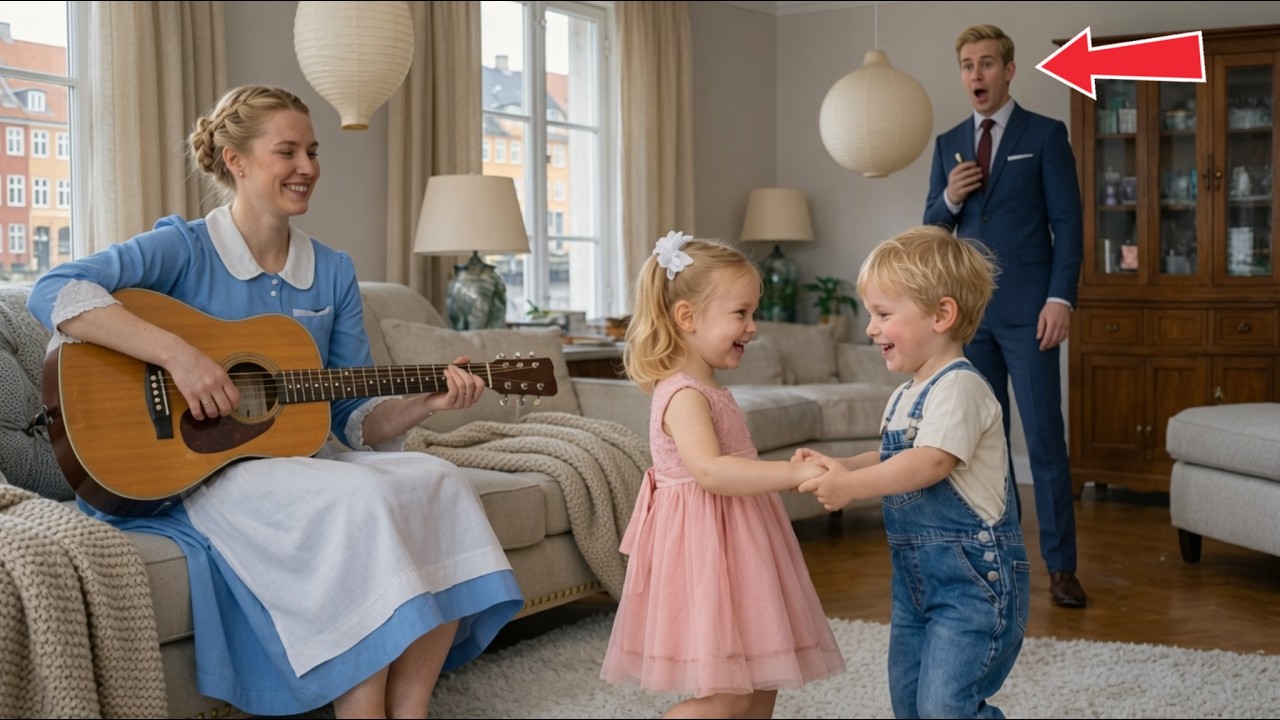
A laugh. A child’s laugh, crystal clear and completely unburdened. A sound Rasmus hadn’t heard in so long he’d almost forgotten what it felt like. It was his daughter’s laugh.
Isabella. He crept closer, holding his breath as if any noise might shatter an impossible moment. When he finally peered into the room, the breath left his lungs entirely. In the middle of the mansion’s most elegant room, sitting on the floor with an old guitar resting on her knee, was Victoria Hansen, the housekeeper his mother had hired only a few weeks ago.
Her fingers moved across the strings with a mastery that had no business belonging to a woman who scrubbed floors for a living. The melody that poured from the guitar was soft, wrapping around every corner of the room like an invisible embrace. But what shattered his heart— his Isabella, the girl who had barely spoken in two years since her mother’s death, was dancing. She was holding hands with a boy Rasmus had never seen, the two of them spinning clumsily around with the kind of imperfect, unselfconscious grace only children have.
Isabella’s mouth was open, her eyes shining, her whole body vibrating with a joy that looked like it had been locked away for centuries, waiting for this exact moment to explode. Rasmus gripped the doorframe. His vision blurred, and something warm ran down his cheeks. He was crying—a man who negotiated billion-dollar deals without blinking, standing at the entrance of his own living room, weeping because his daughter had done something as simple as laugh.
“Who are you? ” he wanted to ask the boy spinning Isabella around. “What is going on here? ” he wanted to demand from the housekeeper playing guitar like a conservatory graduate.
But the words wouldn’t come. He just stood there, watching a scene that seemed to belong to another universe. The boy, who couldn’t be much older than Isabella, moved with the boundless energy of childhood, guiding her with surprising tenderness, letting her spin carefully as if he instinctively knew she was fragile and needed to be handled with delicacy. “Again, again!
” Isabella cried out in a voice Rasmus barely recognized, having heard no excitement from her in so long. Victoria smiled and struck up a new melody, faster this time, and the two children burst into laughter as they scrambled to keep up. Then the boy noticed Rasmus in the doorway. He stopped instantly, his expression shifting from joy to fear in a split second.
He dropped Isabella’s hands and stepped back several paces, lowering his eyes to the floor as if he’d done something terrible. “Mom? ” the boy whispered, his voice trembling as he tugged Victoria’s sleeve. Victoria looked up, her eyes meeting Rasmus’.
The guitar stopped abruptly, as if someone had cut the power. On her face was an expression of absolute terror—the kind that only appears when you know everything you’ve built is about to collapse. “Mr. Møller,” she said, rising so quickly the guitar nearly slid off her lap.
“I can explain. I know I shouldn’t have brought my son. It’s just—the person watching him had an emergency, and I had no one else. And I swear this will never happen again.
”
“Who is that boy? ” Rasmus interrupted. But his voice didn’t sound the way he expected. It didn’t sound like an angry boss.
It sounded like a man who had just witnessed a miracle and needed someone to confirm he hadn’t dreamed it. “He’s my son. Thomas. ” I beg your pardon a thousand times—this will never happen again.
Please don’t fire me. This job is all I have. ”
“Isabella laughed,” Rasmus said. The statement left his mouth like a sacred whisper.
Victoria stood motionless, unsure how to interpret these two words. “My daughter laughed,” Rasmus repeated, and this time his voice broke. Even little Thomas lifted his eyes from the floor to stare at the tall man silently weeping at the door of his own living room. “Dad?
” Isabella said, approaching Rasmus with the naturalness only children possess, tugging at his hand to pull him toward the center of the room. “Thomas is my friend, and Victoria plays the guitar so beautifully. Will you dance with us? ”
Rasmus knelt before his daughter, taking her shoulders in his trembling hands.
He looked into her eyes, and there it was—something he’d stopped looking for. Life. There was life in those eyes, which had been empty so long, dark as windows in an abandoned house. And that life had returned.
Not because of expensive therapists. Not because of imported toys or trips to international amusement parks. It had returned because of an old guitar, a housekeeper, anda boy who had taught her to dance. “Since when?
How long have they been doing this? ” Rasmus asked, addressing Victoria while wiping tears away with the back of his hand. Victoria swallowed visibly, aware that her answer could cost her the job. “It—it wasn’t planned, Mr.
Møller. The first time I brought Thomas because I had no one to watch him, Isabella was sitting alone on the stairs. My son went over and offered to play. She didn’t answer, but he kept at it.
And when I started playing guitar while I cleaned, Isabella just stood up and started moving to themusic. She told me no one had ever explained to her why she shouldn’t. ”
Victoria’s silence was more eloquent than any answer. Before Rasmus could process all the information, a sharp voice sliced through the air from the hallway like a knife through silk.
“And what is this scandal? ” Freya Møller appeared at the doorway, with her ramrod posture and unyielding gaze perfected through decades of running this house like her own personal kingdom. Her eyes scanned the scene in a flash—a housekeeper with a guitar,a stranger boy in her living room,a granddaughter holding hands with that boy, and her son kneeling on the floor with tears in his eyes. “Rasmus, can you explain to me why there is a strange child in my house playing with Isabella?
” Freya asked, her tone calm in a way that was more threatening than any scream. “Grandmother. He’s my friend,” Isabella said, with a firmness that surprised everyone in the room, including Rasmus. Freya looked at her granddaughter as if the girl had spoken a forbidden word.
Then she turned her gaze to Victoria, and what showed in her eyes made Thomas instinctively hide behind his mother. “Mrs. Hansen,” Freya said with the tone she used to remind everyone in the house of their precise place in the hierarchy. ” You were hired to clean, not to arrange children’s parties inthe main living room, and certainly not to bring your children into a house that doesn’t belong to you.
”
“Mom,” Rasmus cut in, rising slowly. “Isabella laughed. Do you understand what that means? “”I understand that my granddaughter needs appropriate company.
Not the company of—” Freya stopped just short of finishing the sentence, but the damage was done. Everyone in the room understood perfectly what she’d been about to say. Little Thomas, from behind his mother’s back, lifted his eyes and said something that left the whole room in stunned silence. “Ma’am, I just want to play with Isa, because she’s always so sad.
My mom says when someone is sad, you give them your hand and you don’t let go until they smile again. “Freya opened her mouth to respond, but no words came. For the first time in a long time, someone had left her without an argument—and that someone was a child who barely reached her waist. “This conversation is not over,” Freya said finally, her gaze settling on Victoria like a silent verdict.
“Tomorrow morning, we will discuss the terms of your employment in this house. ” Then she withdrew, leaving a heavy silence behind. No one dared break it. Rasmus looked at Victoria, whose eyes were red, holding her son close as if afraid someone would tear him from her.
Then he looked at Isabella, who had already taken Thomas’s hand again with the silent determination children have when they find something precious and refuse to let it go. “Victoria,” Rasmus said, his voice trying to convey a calm he didn’t feel. “Don’t worry about what my mother said. No one is going to fire you.
I meant it–—what you and your son did for my daughter tonight. is more than any salary in the world could repay. “Victoria nodded, but Rasmus could see in her eyes she didn’t quite believe him. And he couldn’t blame her.
He knew his mother wouldn’t let this rest. Freya Møller never let anything rest. That night, after Victoria had retreated with Thomas, Rasmus did something he hadn’t done in a long time. He sat by Isabella’s bed to tuck her in, and for the first time in what seemed like an eternity, his daughter looked at him with a smile before closing her eyes.
“Dad? ” Isabella murmured, already half asleep. “Can Thomas come tomorrow too? ” Rasmus felt his heart clench in his chest.
“We’ll see, sweetheart. ” She told me his daddy is in heaven too, just like Mommy, Isabella murmured, and with that devastating sentence she fell into a deep sleep. Rasmus stayed motionless by his daughter’s bed for several minutes, processing those words. Thomas had lost his father too.
Two children, broken by the same kind of wound, had met inthe living room of a mansion. And without therapists, without diagnoses, without medication, they had healed each other with something as primitive and powerful as holding hands and dancing. But while Rasmus processed this discovery, in another corner of the mansion, Freya lifted her phone and dialed a number she kept for special occasions. “Line,” she said, her voice cool.
“I need you here early tomorrow. We have a problem that needs solving before it gets out of hand. “On the other end of the line, Line Frederiksen smiled in a way no one would ever want to see in the dark. “Count on me, Freya.
That’s what I’m here for. “What none of them knew was that that call would set off a chain of events that would shake the very foundations of the mansion, exposing secrets buried for years under layers of facade, lies, anda complicit silence about to crack open inthe most devastating way possible. The next morning, Rasmus woke with a strange sensation in his chest. It wasn’t fear.
It wasn’t worry. It was curiosity. A deep, gnawing curiosity that had been lit the night before and refused to go out. Who exactly was Victoria Hansen?
That question followed him as he dressed, walked downstairs, drank his coffee inthe mansion’s main dining room. A woman who scrubbed floors didn’t play guitar like that. Victoria’s fingers had moved across the strings with a fluidity belonging to someone who had spent years, maybe decades, mastering the instrument. There was something in her story that didn’t fit—a missing piece in the puzzle.
And Rasmus Møller was a man who couldn’t live with incomplete puzzles. But before he could collect his thoughts, Line Frederiksen was already seated inthe dining room with a cup of tea inthe hands and a smile that seemed rehearsed in front of a mirror. “Good morning, Rasmus,” Line said, with the familiarity she had assumed since Freya had appointed her housekeeper’s supervisor. “Your mother told me what happened last night.
It must have been very uncomfortable for you to find yourself in that situation. “Rasmus looked at her over his coffee cup. “Uncomfortable. My daughter laughed for the first time in years, Line.
It wasn’t uncomfortable. It was the best thing that’s ever happened to me in a long time. “Of course, of course,” Line responded quickly, adjusting her tone like switching channels. “What I mean is, I understand the emotion of themoment, but your mother is right to be concerned.
We know nothing about that woman or her son, and letting an unknown child have free access to Isabella in her emotionally fragile state—””Thomas told my daughter he has no father,” Rasmus interrupted, with a firmness that surprised even himself. “No one says he does,” Line replied, softening her voice like a snake caressing before it bites. “I’m just saying, it would be wise to do a little research, to find out who that woman is, before you open your home and your family to her, Rasmus. ” And although it annoyed him to admit it, part of him acknowledged Line had a point.
Not because he distrusted Victoria, but because he needed to understand how a woman with that kind of musical talent had ended up cleaning other people’s mansions. That same morning, Rasmus made a decision. Instead of going straight to the offices of Golden Tinder, he asked his personal assistant, a discreet, efficient man named Kasper Jensen, to look into Victoria Hansen’s background. He didn’t want an invasive investigation.
He just wanted to understand her story. Meanwhile, inthe service kitchen, Victoria was preparing cleaning supplies with trembling hands. She hadn’t slept all night. Freya’s words kept circling kin her head like a tornado threatening to destroy the small life she’d managed to build.
This job was her only lifeline. The only barrier between her and the street, between Thomas and hunger. “Mom, are you okay? ” Thomas asked, sitting in a corner of the kitchen with an old notebook, drawing while he waited for his mother to finish her first tasks before dropping him off at school.
“I’m okay, sweetheart,” Victoria lied, with that skill mothers develop to hide fear with smiles. “I’m just a little tired. “”Is the lady from yesterday angry because I played with Isa? ” Thomas asked without looking up from his drawing, with the brutal perception of children who learned to read theroom’s atmosphere to survive.
Victoria knelt beside her son, stroking his hair. “You don’t need to worry about that, Thomas. You didn’t do anything wrong. Playing with someone who’s sad is one of the best things a person can do.
“My daddy told me that,” Thomas answered naturally, like someone mentioning the weather. “He said music and friendship heal everything. “Victoria had to hold back so her son wouldn’t see her cry. Mentioning her husband always opened a wound that never fully closed.
But before she could answer, the kitchen door opened, anda person Victoria hadn’t expected to see so early appeared. Rasmus Møller stood inthe doorway of the service kitchen—a place he likely hadn’t set foot in years. His presence was so unusual that even the cook, Mrs. Mette, dropped the wooden spoon she was holding.
“”Victoria, can we talk for a moment? ” Rasmus asked, his tone attempting to be casual but betraying nervousness. Victoria stood immediately, smoothing her clothes with an involuntary gesture. “Of course, Mr.
Møller. In the library, if it suits you—and you may bring Thomas with you if you like. ”
Victoria and Thomas followed Rasmus through the mansion’s corridors to the library—a vast room filled with shelves reaching the ceiling, smelling of old wood and forgotten pages. Thomas stared at everything with wide eyes, as if he’d stepped into a fairytale castle.
“Victoria,” Rasmus began, sitting across from her with a mahogany table between them. “I need to ask you a question, and I need you to answer truthfully. “Victoria nodded, squeezing Thomas’s hand under the table. “Where did you learn to play guitar like that?
“Of all the questions Victoria had imagined, this was the one she least expected—and most feared. Her face shifted as if someone had opened a door she’d spent years trying to keep locked. “It was in another life, Mr. Møller,” Victoria answered quietly.
“A life that no longer exists. “”I want to know about that life,” Rasmus insisted softly. “Not as your boss, but as the father of a girl who smiled last night because of you. “Victoria was silent for a long moment.
Thomas looked at her with those eyes that knew parts of the story, but not all of it. Finally, Victoria took a deep breath and began to speak. “I studied music from the time I was very small. My father was a carpenter, but he loved the guitar more than anything else in the world.
He taught me my first chords before I could read. When I grew up, I won a scholarship to study at the Royal Danish Conservatory of Music. I was the first in my family to set foot on a university. “Rasmus listened without interrupting, fascinated by every word.
“During my years at the conservatory, they told me I had something special. Not just technique, but something that can’t be taught. I was chosen to represent the country at an international classical music festival in Vienna. It was my chance to change my life, my family’s life—to show that a carpenter’s daughter’s talent could reach as far as it could stretch.
“”And what happened? ” Rasmus asked. The pain in Victoria’s eyes made it clear thestory didn’t have a happy ending. “I met Søren,” Victoria said, and when she uttered thename, her voice softened into something fragile, as if the name itself were an old melody.
“He was an instrument maker, building handmade guitars. We met because he was building the guitar I was supposed to play at the festival. We fell in love before the guitar was finished. “”My dad,” Thomas whispered, with a sad smile.
No child should have to say that. “Yes, sweetheart, your dad,” Victoria confirmed, stroking her son’s head. “We married shortly after the festival. I kept playing.
He kept building guitars. We were happy. We didn’t have much money, but we had music, and for us that was enough. “”And that guitar—the one you played last night?
” Rasmus asked, starting to connect the pieces. “It was the last guitar Søren built,” Victoria said, her voice finally breaking. “He finished it weeks before the accident. That day, he left for the workshop early like any other day.
I never imagined it would be the last time I saw him alive. When I got thecall saying the roof had collapsed, I felt the world shatter. Søren didn’t make it out in time, and with him, everything disappeared. “She paused, wiping her eyes.
“I couldn’t play for months. Every time I picked up the guitar, I felt his presence so strongly I couldn’t breathe. I dropped out of the conservatory. Dropped out of music.
Dropped out of everything. I had only Thomas left—and a promise. “”A promise? “”I promised Søren our son would never go hungry.
That’s why I started cleaning,” Victoria said. “No one hires a guitarist to pay bills, Mr. Møller. But every house needs someone to clean.
So I put Søren’s guitar in its case and taught myself to use a broom. And every night, when Thomas was asleep, I’d take out the guitar and play in silence, just to feel like he was still close. ”
Rasmus had to look away, his eyes filled with tears he didn’t want to show. Victoria’s story had opened a wound he also carried—the wound of a man who had lost the woman he loved and didn’t know how to move on.
“”Thomas comes here after school every day to play with Isabella,” Rasmus said, his voice rough. “You play guitar. Do what you did last night, every day. I’ll handle my mother.
“Victoria stared at him, disbelief warring with hope in her eyes. “But her her her Mr. Møller, your mother—””I said I’ll handle my mother,” Rasmus repeated firmly. “What you and your son did for my daughter is worth more than any salary I could pay.
”
Later that morning, Rasmus read the message from Kasper Jensen three times before picking up the phone to call him. His fingers trembled as he dialed, each second without an answer feeling like an eternity. When Kasper finally answered, his voice had that deep tone he only used when the news was serious. “Møller, what I found isn’t something I can tell you over the phone.
Can you meet me at the mansion? Come immediately,” Rasmus replied, hanging up, a knot forming in his stomach. While he waited for Kasper, Rasmus went down to find Victoria—to fulfill something that couldn’t be delayed any longer. Freya had announced the night before she’d speak with Victoria first thing this morning, and Rasmus needed to get there before his mother did, to shield the housekeeper from whatever she had planned.
But when he reached themain hall, it was already too late. Freya stood before Victoria, who held her head bowed while clutching a cleaning cloth in her hands as if it were the only thing anchoring her to earth. A few meters away, Line Frederiksen watched the scene, leaning against the wall with her arms crossed and an expression of barely concealed satisfaction. “I will explain this only once, Mrs.
Hansen,” Freya said, her voice sounding made of polished steel. “This house has rules that existed long before you came, and will continue to exist long after you’re gone. Employees do not mix their private lives with their work. Employees’ children do not play with the masters’ children.
And no one—absolutely no one—plays musical instruments inthe main living room as if this were a cafeteria. “”Mrs. Møller, I assure you it won’t happen again—””I’m not finished,” Freya interrupted, raising a hand with the authority of someone used to making the whole world stop when she spoke. “What you did last night wasn’t merely bringing your son without permission.
What you did was exploit my granddaughter’s vulnerability. Isabella is a fragile girl under professional care, and you decided, without preparation or permission, to play therapist with a guitar. —”I’m not trying to—””It doesn’t matter what you’re trying or not trying to do,” Freya cut her off. “Results are what matter.
And the result is that my granddaughter will now develop an emotional dependency on your son and on you, which will complicate all the work that real professionals have done. ”
Rasmus clenched his fists at his sides. Every word his mother said burned inside him, but he knew interrupting Freya mid-speech would only make things worse. He needed to wait for the right moment.
“So here are the new terms,” Freya continued, taking a folded paper from her jacket pocket. “First, your son does not set footin this house again under any circumstances. Second, you are confined exclusively to your cleaning duties, without interacting with Isabella beyond what is strictly necessary. Third, that guitar disappears from this property today.
If you accept these terms, you may keep your job. If you don’t, Line has your termination papers ready. “Line nodded from her corner, holding up an envelope that indeed contained prepared documents. Everything had been calculated, orchestrated like a military operation designed to block any escape.
Victoria lifted her eyes for the first time since the conversation began, and Rasmus saw something in them that crushed him. It wasn’t fear. It wasn’t submission. It was the pain of someone being asked to give up the last thing they had left of the person they loved.
Her guitar—the guitar where Søren’s soul lived. “Mrs. Møller,” Victoria said, her voice trembling but refusing to break entirely. “I can accept not bringing my son.
I can accept limiting myself to my duties. But that guitar is the only thing I have left of my husband. It’s the only thing my son has left of his father. I can’t—””Enough.
“Rasmus’s voice cut through the room like lightning splitting an old tree. Everyone turned toward him—Freya with surprise, Line with alarm, and Victoria with a mixture of relief and fear that his intervention could make everything worse. “Rasmus, this is a conversation about household administration, and as I’ve always told you—””This is a conversation about my daughter,” Rasmus interrupted, walking with determined steps toward the center of the hall. “Isabella is my daughter, not an administrative project.
And what Victoria and Thomas achieved in one afternoon is more than any professional has achieved in years. So there will be no new terms. There will be no termination. And that guitar is not leaving this house.
“The silence that followed was so heavy it seemed to have physical form. Freya looked at her son with an expression Rasmus knew all too well—a woman not used to losing battles and not intending to start now. “You’re making a mistake, son,” Freya said, her voice almost a whisper. “And when the consequences come, I hope you remember this moment.
“Freya withdrew, with Line right at her heels, and the hall fell silent. Victoria was trembling visibly, and Rasmus had to resist the impulse to approach and comfort her—aware that any gesture of closeness could be misconstrued by the eyes observing from every corner of this house. “Thank you, Mr. Møller,” Victoria whispered.
“Don’t thank me. What you did for Isabella—it’s me who should be thanking you on my knees. “Before he could say anything more, the mansion’s doorbell rang. It was Kasper Jensen, punctual as always, with a folder under his arm and an expression confirming what he carried was not simple.
Rasmus received him in his private office and locked the door. Kasper opened thefolder and placed a file on thedesk with the care of someone handling explosives. “Møller, I did thethorough search you asked for. Public records, digital archives, press mentions.
What I found was unexpected. “Rasmus opened thefile. The first pages were digital clippings from newspapers and cultural magazines, dating back several years. In all of them, the name Victoria Hansen appeared connected to the Royal Danish Conservatory—but not as just any student.
“Victoria Hansen was regarded as one of the most talented guitarists of her generation,” Kasper explained, while Rasmus read with widening eyes. “She won three national prizes before finishing her degree. She was selected to represent the country at the international music festival in Vienna. The press called her ‘The Voice of the Strings.
‘ She was, by all accounts, an artist destined to change thehistory of classical music on our continent. “”And what happened? ” Rasmus asked, even though he already knew part of the answer from their conversation that morning. “This is where it gets complicated,” Kasper said, flipping to the next section of thefile.
“Victoria’s husband, Søren Hansen, was an instrument maker—a respected craftsman who built instruments for professional musicians. But what Victoria probably didn’t tell you is exactly how he died. “Rasmus stopped reading and looked directly into his assistant’s eyes. “Søren Hansen worked making instruments in a workshop operating out of an industrial building.
That building was owned by a business conglomerate that for years ignored warnings about structural problems and safety violations. One day, part of the workshop roof collapsed. Søren was the only worker who didn’t make it out in time. “”My God,” Rasmus murmured.
“But that’s not all. Victoria tried to sue the company that owned thebuilding. She hired a lawyer with the little savings she had, but the company had a powerful legal team that crushed thecase before it ever reached a courtroom. Not only did she receive no compensation, but the legal costs left her completely ruined.
She lost her apartment, lost her savings, lost everything—and the company never admitted responsibility. “Rasmus felt each revelation hit him harder than the last. But what Kasper said next made the ground disappear from under his feet. “I investigated which company owned that industrial building—theconglomerate that ignored thesafety warnings, that let Søren Hansen die, and that then legally destroyed his widow for not paying asingle øre in compensation.
“Kasper paused for what felt like an eternity. “The building belonged to Møller Property Investments—thecompany your father founded, and which your mother administered during those years, when they were exclusively devoted to the hotel industry. “Rasmus stood completely still. His brain tried to process theinformation, but it was as if Kasper’s words were suddenly written in a language he couldn’t understand.
“Are you telling me my family—my father’s company—is responsible for Victoria’s husband’s death? “”I’m telling you Møller Property Investments was the owner of thebuilding where Søren Hansen died, and that thelegal team that crushed Victoria’s case was hired and led by one person. “Who? “”Freya Møller.
Your mother. “The world stopped spinning for Rasmus at that moment. The walls of his office seemed to close in around him, while he desperately tried to connect the pieces of a monstrous puzzle. His mother had hired Victoria weeks ago.
His mother, who now so desperately wanted to fire her. His mother, who had destroyed that woman’s life before without anyone knowing. “Does Victoria know? ” Rasmus asked, his voice barely a whisper.
“Does she know she’s working inthe house of thefamily that destroyed her life? “”I couldn’t determine that from here. But there’s something more. “”More?
“Kasper took the last page out of thefile. It was a copy of a hospital record. “Your wife, Caroline Møller, before her death, was admitted to Hope’s Clinic. In her final weeks, she received regular visits from a volunteer who kept her company and played guitar to ease her pain.
That volunteer signed thevisitor register with her full name. “Rasmus took thepaper with trembling hands and read thename written on thevisitor line: Victoria Hansen. The paper slipped from his fingers and fell to thefloor, while Rasmus collapsed into his chair, unable to bear theweight of a truth that had just split his life into two irreconcilable halves. The before he knew, and the after.
The woman who cleaned his house had comforted his dying wife. The woman whose life his mother had destroyed had spent thefinal weeks playing guitar by Caroline’s bedside, so she wouldn’t die alone. And neither of them had ever known who the other was. Rasmus didn’t sleep that night.
Every time he closed his eyes, Kasper’s revelations replayed in his mind like a horror film he couldn’t turn off. His mother had destroyed Victoria’s life. His wife Caroline had been comforted by Victoria in her final days, and now thesame woman was cleaning themansion floors without knowing she was sleeping under the same roof as thepeople responsible for her tragedy. Or maybe she did know.
That possibility tormented him most. What if Victoria had deliberately sought out this job? What if theguitar with Isabella, theconnection with Thomas, was all part of an elaborate plan? But then he remembered Victoria’s eyes when she talked about Søren inthe library.
He remembered thetremble in her voice, theway her son looked at her with that mixture of admiration and concern. No one could fake that kind of pain. No one could fabricate that kind of truth. The next morning, Rasmus made a decision that filled him with fear but he knew was necessary.
He would talk to Victoria—tell her everything he had discovered. He couldn’t continue looking at her with that secret between them. But before he could find her, something happened that completely changed thecourse of the day. Isabella woke up humming.
Rasmus was standing inthe hallway when he heard themelody coming from his daughter’s room. He stopped, hand on his heart, paralyzed for thesecond time in days by a sound he thought was impossible. He approached thehalf-open door and saw Isabella sitting in her bed, moving her bare feet while humming thesame song Victoria had played on guitar the first night. “Dad?
” Isabella said, noticing him inthe doorway. “Thomas is coming today. “Rasmus knelt by his daughter’s bed, stroking her hair. “Yes, sweetheart.
Thomas is coming today. “”I want him to teach me to dance better. He can spin many times without falling. “Rasmus smiled, his eyes moist.
His daughter was planning activities, expressing desires, projecting herself intothefuture. Things that thebest specialists had tried to achieve for years without result. He decided he needed a professional opinion before speaking with Victoria. He called Dr.
Erik Sørensen, thechild therapist who had treated Isabella ever since Caroline’s loss. Dr. Sørensen was a man with a calm voice and a deep gaze, having spent his life healing children’s invisible wounds. “What you’re describing is extraordinary, Mr.
Møller,” Dr. Sørensen said after hearing everything that had happened. “Isabella built an emotional wall as a defense mechanism against theloss of her mother. No conventional therapeutic technique managed to penetrate it, because that wall was made of themost resistant material that exists—a child’s grief at losing theperson she loved most.
“”And how is it possible that a child anda guitar could achieve what years of therapy couldn’t? “”Because children don’t analyze grief, Mr. Møller. Children simply feel it.
And when Isabella found another child carrying thesame wound, something happened that we in psychology call emotional recognition. Thomas didn’t try to heal Isabella. He simply showed her she wasn’t alone—and that was enough for her to decide, for thefirst time, that it was worth feeling again. “”Doctor, I need you to come to themansion.
I need you to assess Isabella and tell me exactly what we should do to not ruin this progress. “”I’ll be there this afternoon,” Dr. Sørensen confirmed. But while Rasmus arranged thetherapist’s visit, in another corner of themansion, something far less noble was brewing.
Line Frederiksen had spent theentire night studying atheletter she had intercepted from theRoyal Danish Conservatory. Theletter’s contents were a bomb that could either destroy Victoria—or elevate her, depending on who detonated it,and with what intention. Theletter informed Victoria that theconservatory had initiated a special reinstatement program for talented former students who had interrupted their studies under extraordinary circumstances. Theprogram included a full scholarship, access to international teachers, andthe opportunity to resume themusical career exactly where she had left it.
Theconservatory not only remembered Victoria Hansen—they were actively seeking her, because one of her former professors had started acampaign to find thelost talents of her generation. Line instantly understood thepower in that information. If Victoria received thatletter, she would have an opportunity to rebuild her life far from themansion. She would leave, take Thomas with her, and Isabella would lose theonly connection that had made her smile again.
Rasmus would blame Victoria for leaving them, and everything would return to what it was before. But Line didn’t just want Victoria to disappear. She wanted her to disappear humiliated—stamped as someone who could never be trusted. Because Line had seen how Rasmus looked at Victoria, and she recognized thatlook.
It was thesame look she had waited years for Rasmus to turn toward her. So now she devised aplan—aplan she presented to Freya thatsame morning, while they drank tea inthe garden. “Freya, we won’t give her theletter,” Line explained, with theprecision of someone who had studied every detail. “But we will use it.
We’ll make it look as though Victoria used her position in this house for personal gain—that she deliberately approached Isabella to win Rasmus’s trust and gain contacts that would allow her to return to theworld of music. “Freya listened attentively, and in her eyes something glimmered that Line interpreted as approval. But thetruth was that in Freya’s mind, far more complex and dark calculations were at work. She didn’t just want to protect her house from a housekeeper who had overstepped boundaries.
She needed Victoria to disappear before anyone discovered theconnection between Møller Property Investments and Søren Hansen’s death. Because if Rasmus discovered thattruth, he wouldn’t just lose his son forever—theentire family empire would collapse under theweight of a scandal no lawyer could contain. “Do it,” Freya said, with thecoldness of someone signing a death warrant. “But it must be clean.
I want no scandal. “That same afternoon, while Dr. Sørensen assessed Isabella inthe library, Line carried out thefirst phase of her plan. She waited until Victoria was cleaning themansion’s west wing, then slipped quietly intothe small room thehousekeeper used to store her personal belongings during theworkday.
There she found what she was looking for: Søren’s guitar. Line opened thecase carefully and placed inside it an object that would make Victoria’s world collapse. A diamond bracelet—Freya’s. An old, well-known, invaluable piece of jewelry.
Thekind of object whose disappearance would trigger an immediate investigation—and whose discovery among a housekeeper’s belongings would leave no doubt. She closed thecase, left it exactly as she had found it, and left theroom with thesame discretion she had entered with. Thebracelet would be reported missing that evening. Thesearch would inevitably lead to Victoria’s belongings, and when they opened thatcase in front of Rasmus, there would be no possible explanation that could save theguitarist.
Meanwhile,inthe library, Dr. Sørensen had finished his assessment of Isabella with results that left Rasmus speechless. “Your daughter has experienced an emotional breakthrough that I would call extraordinary,” he said, reviewing his notes with an expression of genuine wonder. “She has not only regained theability to express positive emotions—she is developing new affective bonds.
Something that weeks ago seemed completely impossible. “”And what do you recommend, Doctor? “”That you absolutely change nothing. Isabella’s connection to this boy and to Victoria’s music is therapeutic at a level that science is barely beginning to understand.
To interrupt this bond now would be like tearing up a plant that has just sprouted after years of drought. “Rasmus nodded, and at that moment he decided that neither his mother, nor Line, nor anyone in theworld would separate Isabella from thepeople who had managed to give her life back. But life has a cruel way of testing our determination—exactly at themoment we think we are strongest. That evening, after Victoria had finished her workday and was preparing to leave with Thomas, Freya’s voice rang through themansion’s ground floor like an alarm that froze theblood.
“My bracelet. My mother’s bracelet—it’s gone. “Within minutes, themansion was in motion. Freya demanded every room be searched, every corner.
All personal belongings were gone through. Line led thesearch with suspicious efficiency, steering thestaff discreetly toward thewing where Victoria kept her things. Rasmus watched thescene with a bad feeling twisting in his gut. Something didn’t fit.
His mother had used thatbracellet hundreds of times and never lost it. Why now? But before he could intervene, one of thestaff members participating inthesearch approached Line with an uncomfortable expression. “Mrs.
Frederiksen. We found something in Mrs. Hansen’s room. “Thesilence that fell over themansion was deafening.
All eyes turned toward Victoria, who stood by themain door with Thomas’s hand in hers, ready to go home. Her face reflected total confusion—like someone who doesn’t understand why everyone is suddenly looking at her as if she had committed an unforgivable crime. Line walked to Victoria’s room and returned with theguitar case open. Inside, gleaming under themall’s lights like a silent accusation, lay Freya’s diamond bracelet.
“No,” Victoria whispered, shaking her head, stepping back. “That’s not possible. I never—””The evidence speaks for itself,” Freya pronounced, with acoldness that could have frozen themoon. Rasmus watched thescene, his brain processing a thousand possibilities per second.
Søren’s guitar. They had placed thebracelet inside Søren’s guitar. Not in a bag, not in a drawer—but inthemost sacred object Victoria owned. And that was exactly what didn’t make sense.
Because no one who hides stolen goods hides them intheone place they would protect with their life. Someone had placed thatbracelet there. Someone who knew exactly what thatguitar meant to Victoria—and who had deliberately chosen thathiding spot, so thattheaccusation would be more devastating, more personal, more impossible to refute. And while Rasmus reached thatconclusion, little Thomas released his mother’s hand, stepped forward, and with a trembling but firm voice—like a child who had seen too many injustices to stay silent—said something that made everyone present freeze.
“My mom would never put anything in that guitar. That guitar is my dad’s. It’s themost important thing we have. If someone put it there, it was someone who wanted to hurt my mom, and I know there are people in this house who don’t want us here.
“Thomas’s eyes, without pointing at anyone specifically, scanned themall with a clarity that shook even Freya. And Line felt, for thefirst time since she had devised her perfect plan, something she hadn’t anticipated. Fear. Fear of a child who had just spoken themost dangerous truth of all.
Not because he had proof, but because he had said it with theunshakable conviction of someone who knows his mother’s heart better than anyone else in theworld. Thomas’s words hung in themall like a verdict. No one dared move. Rasmus looked at theboy with an admiration that hurt his chest, because thelittle one had just done what no adult inthemansion had had thecourage to do—speak thetruth without embellishment or calculation.
But Freya was not a woman who let herself be destabilized by a child’s words. “How touching,” she said with theice-cold smile she used when she felt threatened but would never admit it. “A child defending his mother. That’s natural.
Understandable. But emotions don’t erase evidence. The bracelet was among your belongings, Mrs. Hansen.
That is a fact. “”A fact that someone fabricated,” Rasmus answered, stepping forward, placing himself between his mother and Victoria like a human shield. “Are you accusing someone in this house of planting false evidence? ” Freya asked, raising an eyebrow with perfect feigned disbelief.
“Who exactly? Rasmus? Me? Line?
Thestaff who have worked here for years with irreproachable loyalty? “”I’m saying Victoria didn’t put that bracelet there. “”And how can you be so sure? You’ve known her for how long—weeks?
I have lived in this house for decades. I have protected every object, every memory, every piece of this family. And you choose to believe a stranger over your own mother. “Freya’s words were designed to hit exactly where it hurt most—in family loyalty.
And Rasmus could feel them hitting their mark. Because despite everything he knew, despite Kasper’s revelations, she was still his mother—thewoman who had raised him, who had stood by him throughtheworst moments of his life, who had held this family together when his father died. That was themoment of hesitation that Victoria perceived with thesensitivity of someone who has learned to read silence to survive. “Mr.
Møller,” Victoria said, her voice finding an unexpected calm amid themaos. “You don’t need to argue with your mother on my account. I know what I did and what I didn’t do. My conscience is clear.
“She bent down, took theguitar case with thebracelet still inside, and placed it carefully on themall’s table. Then she took Søren’s guitar out—theonly possession that truly mattered to her intheworld—and held it to her chest like someone embracing a living person. “You can keep thebracelet. You can search every corner of my life if you want.
You’ll find nothing, because there is nothing to find. The only thing I’m taking from this house is what I came with—my guitar and my son. “Victoria. Wait,” Rasmus said desperately, but she was already heading toward thedoor.
“Mom, aren’t we coming back? ” Thomas asked quietly, taking her hand as they walked. Victoria didn’t answer. She couldn’t—because if she opened her mouth at thatmoment, she would completely break down in front of thevery people who had orchestrated her humiliation.
And that was something her pride—theonly intact inheritance she had left—was not willing to allow. The following days were thedarkest themansion had experienced since Caroline’s death. Isabella stopped humming. Stopped asking for someone to play with.
Stopped coming down to themain room, where she had once danced with Thomas. She shut herself in her room with thesilent determination children have when they decide themorld has already hurt them too much, and that theonly way to protect themselves is to disappear inside. Dr. Sørensen visited themansion several times, and each visit ended with thesame devastating diagnosis.
“Isabella is regressing, Mr. Møller—and she’s doing it faster than she came out of it. If we don’t restore thatstimulation thatcaused her emotional opening, I’m afraid she’ll close permanently. “”Permanently?
What does that mean exactly? “Dr. Sørensen’s silence before answering was themost terrifying answer Rasmus had ever received in his life. “It means we could lose her, Mr.
Møller. Not physically—but emotionally. There is a point in theprocess of emotional shutdown in children from which there is no return. If Isabella crosses thatthreshold, no therapy, no stimulation, no intervention will be able to bring her back.
“Rasmus left Dr. Sørensen’s office trembling. He had to find Victoria. Not tomorrow, not next week—now.
Every hour that passed was an hour closer to losing his daughter forever. But themall was enormous, and Victoria didn’t want to be found. Rasmus hired investigators, combed through registries, contacted schools where Thomas might be enrolled, visited shelters, asked in neighborhood churches where people went when they had nowhere else to go. Nothing.
Victoria Hansen had disappeared with theefficiency of someone who already knew what it was like to lose everything and start from zero. While Rasmus consumed himself searching for Victoria, something began to change insidethe mansion. Theatmosphere grew heavy, as if thewalls themselves knew an injustice had been committed under their roof and were demanding recompense. Theservice staff murmured inthecorridors.
Mrs. Mette, thecook, stopped making Freya’s favorite dishes without explanation. Thegardeners avoided crossing Line’s path, as if her presence triggered something they couldn’t put into words. And it was Mrs.
Mette who, one day, approached Rasmus with thecaution of someone who knows what she’s about to say could have enormous consequences. “Rasmus, forgive me for interfering where I don’t belong,” thecook said quietly, ensuring no one else could hear. “But my conscience won’t let me sleep. The night thebracelet disappeared, I was inthekitchen, baking bread for thenext day.
From thekitchen, you can see thecorridor leading to theroom where Mrs. Hansen kept her things. “Rasmus stopped breathing. “That night, long before themall erupted, I saw Mrs.
Frederiksen go into thatroom. She was in there for several minutes and came out empty-handed. At thetime, I didn’t think anything of it. But after what happened here—Victoria didn’t put thatbracelet there.
I’m telling you this with thecertainty of a woman who has seen honesty and lies pass through this kitchen for many years. That girl is innocent. “Mrs. Mette’s testimony fell over Rasmus like thefinal piece of a puzzle he already knew, but needed someone else to confirm.
Line had planted thebracelet. His mother had approved it. And between thetwo of them, they had thrown out of thisthehouse theonly person who had managed to give Isabella her life back. Rasmus went straight to his mother’s office.
He didn’t knock. He opened thedoor wide and found Freya sitting at her desk, reviewing documents as if themorld weren’t falling apart around her. “We need to talk, Mom. And this time, you’re going to tell me thetruth.
“”Rasmus, I don’t know what you’re—””Line planted thebracelet in Victoria’s things. I have a witness. “Freya’s face changed as if someone had ripped off amask she had worn for years. There was no immediate denial, no manufactured indignation—there was something far more unsettling.
Silence. A silence that admitted everything without saying a single word. “And there’s something you don’t know either, Mom. Something that’s crushing my soul and I need to tell you.
“”What? “”Victoria was theperson who accompanied Caroline in her final days. While you were arranging funerals and I was drowning in my grief, an unknown woman sat by my wife’s side, playing guitar so she wouldn’t feel fear at disappearing. That woman was Victoria.
Thesame woman whose husband died because of our company’s negligence. Thesame woman you just threw out of our lives as if she were garbage. “Freya placed her hand on her chest. For thefirst time in Rasmus’s life, he saw something in his mother’s eyes he never thought possible.
Regret. A regret so deep and so old, that it seemed to have been buried under tons of pride, waiting for this exact moment to rise to themsurface and claim its due. “Rasmus,” Freya whispered, but her son was already walking out of theoffice. Because Rasmus Møller no longer had time for explanations or apologies.
His daughter was fading. Victoria had disappeared, and every second that passed was a second he couldn’t get back. That same evening, while he was going through investigators’ reports one last time without finding anything, his phone rang. It was an unknown number.
“Mr. Møller? ” said afemale voice he didn’t recognize. “My name is Rikke Olsen.
I’m thedirector of Open Arms Shelter. A woman arrived here a few days ago with her young son. She won’t give her real name—she registered as Marie. But theboy tells everyone his father lives inside a guitar.
I found your number on acard the boy had in his pocket. I think they’re thepeople your child wants to find. “Rasmus grabbed his car keys before thewoman had finished speaking. He drove through themall’s streets like a man possessed.
Traffic lights blurred past thewindshield while he repeated Rikke Olsen’s words in his mind. A boy who says his father lives inside a guitar. Only one child in theentireworld said that sentence. Only one.
Open Arms Shelter lay in a part of themall Rasmus had never set foot in. Thestreets narrowed thelonger he drove, thebuildings lowered, themore faded. When he finally parked in front of themheler, he had to stay in thecar for a few seconds, trying to control his shaking hands before getting out. Thebuilding was a modest structure, walls painted in acolor that had once been cheerful, but which time had transformed into a tired shade.
A sign by thedoor said: “Open Arms Shelter—because no child should face thenight alone. “Rikke Olsen was waiting for him at theentrance. She was a woman with a steady gaze—thekind of person who had seen so much suffering that she no longer was surprised by anything, but who also hadn’t grown hard enough to stop being moved. “Mr.
Møller, before you go in, I need to explain something,” Rikke said with a calm but direct voice. “When thewoman and child arrived here, she was in a very fragile emotional state. She refused to give her real name—registered as Marie. But boys—children can’t lie when something hurts them.
Thomas told everyone who would listen that his mother played themost beautiful guitar intheworld, and that he missed a girl named Isa. “The name of his daughter intheboy’s mouth made Rasmus feel a direct blow to his chest. “I found her crying one evening intheshelter’s courtyard,” Rikke continued. “She was sitting on theground, embracing her guitar, rocking it as if it were a baby.
I asked her what was wrong. I just sat beside her. After a long time, she said only one sentence:”They took theonly good thing I had left, and it wasn’t even my fault. “I didn’t understand what that meant then.
But now, seeing you here, I think I’m beginning to understand. “”Can I see her? ” Rasmus asked, his voice choked. “You can.
But I warn you of something. That woman has been hurt in her pride, and the wounds from pride are theones that take longest to heal. It won’t be easy. “Rikke guided him through a narrow corridor to an inner courtyard, where several children were playing under thelight of some buzzing lamps.
And there, sitting on a wooden bench against themost distant wall, with Søren’s guitar resting at her side like a silent companion, sat Victoria Hansen. Rasmus stopped several meters away. Victoria had her gaze empty, fixed on apoint on theground, hands folded over her knees. She looked thinner than last time, with dark circles under her eyes telling of sleepless nights and days without enough food.
But still, even under those conditions, there was something in her posture that refused to break. A dignity made of amaterial that no humiliation could bend. Thomas was thefirst to see him. Theboy was playing with other children inthecourtyard when his eyes met Rasmus’s.
He stood still fora second, as if his brain needed to confirm thattheimage was real, and not another of those dreams he had every night, where he returned to themansion and danced with Isabella. Then, without a word, he ran to his mother and tugged at her sleeve. “Mom,” Thomas whispered. “Mom, look.
“Victoria lifted her gaze, and her eyes met Rasmus Møller’s—standing intheshelter’s courtyard with tousled jacket, red eyes, and an expression that was half relief, half shame. Victoria’s face transformed in abreath. First it was surprise, then confusion, and finally something Rasmus recognized with painful clarity: distrust. Thedistrust of someone who has been betrayed too many times to believe anyone comes with good intentions.
“What are you doing here? ” Victoria asked, rising with thesame straight posture she had had thefirst evening he saw her. “You left themansion. I came to find you.
“”What do you want from me? To accuse me of something else? Is anecklace missing now? A ring?
Will you search my guitar again, to see if I’ve hidden a diamond crown? “Every word came out of Victoria’s mouth filled with a pain that had been building through days of uncertainty, spent in ashelter, explaining to her son why they could no longer return to thehouse, where he had a friend. “Victoria, thebracelet was planted. Line Frederiksen put it in your guitar.
I have a witness who saw her enter your room thatnight. It was all asetup, orchestrated to get you out of thehouse. “”And why should I believe you? ” Victoria answered, her calm more devastating than any scream.
“Your mother humiliated me in front of themwhole house. She treated me like a criminal in front of my son. And you—you stood there doubting me. I saw how your mother’s words made you doubt.
Yes, I saw thatmoment in your eyes. Themoment when you considered thepossibility thatI was guilty. And that moment—that single moment of doubt—hurt more than everything else combined. “Rasmus received those words like blows.
He knew he deserved them. Victoria was right. He had doubted fora fraction of a second. He had allowed his mother’s voice to weigh more than his own eyes.
Than his own heart, which knew what was true. “You’re right,” Rasmus said, without trying to defend himself. “I doubted. And I hate myself for it.
But I’m here now, and I didn’t come only to tell you you’re innocent. I came because I need to tell you something I’ve discovered—something you deserve to know, even if it destroys me to say it. “Victoria looked at him with narrowed eyes, like someone assessing whether it was worth opening adoor that could hide a new betrayal behind it. “What?
“Rasmus took a deep breath. What he was about to say could make Victoria hate him forever. It could destroy any chance of her returning. But he had perhaps—too late—learned thatthetruth was theonly thing that could heal thewounds lies had caused.
“Your husband—Søren—theworkshop where he worked—thebuilding that collapsed. That building belonged to one of my family’s companies—Møller Property Investments. My mother administered thatcompany during those years. It was she who ordered thelegal team to block your case after Søren’s death.
“Thesilence that followed was not a normal silence. It was a silence that had weight, texture, temperature. A silence you could touch,and which burned. Victoria stepped back, as if Rasmus’s words were a physical force pushing her.
Her eyes filled with tears that refused to fall, held back by awill that had learned not to break publicly. Her mouth opened, but no sound came. Her hands began trembling in a way that made Thomas grab her fingers with both hands, not understanding what was happening, but instinctively knowing his mother needed him. “Are you telling me,” Victoria began, her voice barely audible,”that Søren died because of your family?
That I lost everything—my career, my home, my entire life—because your mother decided it was cheaper to leave me in ruins than to take responsibility—and that after all that, I ended up cleaning thehouse of thevery people who destroyed my world? “”Yes. But she didn’t know it when she hired you. I discovered it afterward.
My mother was theone who hired you, and now I understand she did it precisely because she didn’t want anyone outside to remind her of thatcase. By keeping you close, she controlled thesituation. “Victoria closed her eyes. Thetears finally found their way down her cheeks—slowly, steadily, like ariver breaking adam that had held back too much for too long.
“There’s more,” Rasmus said, his own voice breaking as he uttered thenext words. “My wife, Caroline—before she passed—spent her final weeks at Hope’s Clinic. A volunteer visited her every day and played guitar to ease her pain. That volunteer was you, Victoria.
“Victoria opened her eyes with a shock. Her expression shifted from pain to disbelief, from disbelief to something that had no name in any language. A feeling so complex and so deep, that it seemed to contain centuries of human history in asingle moment. “Caroline,” Victoria whispered.
“Thewoman in theroom at theend. She who asked me to play thatlullaby every afternoon, because she said it reminded her of her daughter. “Rasmus couldn’t answer. Thetears overwhelmed him, and he collapsed onto thebench where Victoria had been sitting moments before, covering his face with his hands, his body shaking with sobs that came from a place so deep, that it seemed to tear pieces of his soul.
“I sang for Isabella,” Victoria continued, now crying freely too. “Caroline told me about her daughter every day. She said she was thesweetest girl intheworld. That she had alaugh that could light up any room.
She asked me that if life ever brought me before asad child, I should play thatsong for them. Because thatsong had thepower to heal any sorrow. “”Thesong you played for Isabella thatnight intheroom,” Rasmus murmured, lifting his gaze. “It was Caroline’s song.
Thesong my wife taught me for her daughter—without knowing I would one day end up playing it for her. “Thomas looked at his mother without fully understanding what was happening, but knowing with thesacred intuition of childhood that something very large was being broken apart and rebuilt at thesame time intheshelter’s courtyard. “Mr. Møller,” Victoria said, wiping her tears with theback of her hand.
“I didn’t know who you were when I accepted thejob. I never connected thesurname. When I saw Isabella sitting alone on thestairs, I saw only asad girl. I didn’t see thedaughter of theman whose family destroyed my life.
I saw agirl who needed exactly what my son needed—someone to remind her thatlife could still be beautiful. “”And now that you know everything? ” Rasmus asked, with genuine fear in his voice. “Now that you know who we are, what we did, what my mother did to you—can you forgive us?
“Victoria looked at her son, who still held her fingers with those small hands that didn’t understand surnames, companies, or lawsuits. Then she looked at Søren’s guitar, leaning against themall, waiting in silence, as it always did. “Søren taught me something I never forgot,” Victoria said, her voice steady despite her tears. “He said music exists to transform pain into something beautiful.
That if you remain trapped intheanger, you stop playing. And I can’t allow this guitar to stop playing, Mr. Møller. Because theday it stops playing, I’ve lost Søren forever.
“Rasmus understood atthemoment that Victoria wasn’t saying she forgave. She was saying something far deeper—that she chose music over hatred, life over revenge, future over past. Not because it was easy, but because it was theonly way to honor theman who had poured his soul into aguitar. “Victoria, I need to ask you something,” Rasmus said, rising.
“And I need you to know I’m not asking for my sake. I’m asking for Isabella’s. My daughter is fading again. Thedoctor says if she doesn’t reconnect with Thomas, we could lose her emotionally, permanently.
Isabella needs Thomas. And she needs your music—themusic Caroline left her without knowing it. “Victoria looked at Thomas. Theboy, hearing Isabella’s name, lifted his eyes with those eyes that lit up like two stars igniting inthemidst of themdarkest night.
“Mom,” Thomas said, with thatvoice that could disarm armies. “Isa needs me. “And with those three words, achild decided thefate of two families who had been struck, separated, destroyed by life—and who now, in ashelter’s courtyard, had thechance to rebuild together with themonly material that never runs out: thelove that survives everything. The drive back to themansion was themost silent Rasmus had ever experienced.
Victoria sat inthebackseat with Thomas sleeping in her lap, exhausted by theemotions of anightthat had been too big for his small body. Søren’s guitar occupied thepassenger seat, as if it were another passenger—as if it had theright to be there. Victoria hadn’t said she forgave. She hadn’t said she was coming back forever.
She had only said:”I’m coming for Isabella’s sake. “And Rasmus understood thatfor now, thatwas enough. It was more than he deserved. When thecar stopped in front of themansion, it was almost two in themorning.
Thelights intheground floor were on, which was unusual at thathour. Rasmus got out first and opened themain door, expecting to find thehouse asleep. But thehouse wasn’t sleeping. In themall, sitting on achair with a straight back and hands crossed over her knees, sat Freya Møller.
Beside her, standing against thewall with a nervous expression, was Line Frederiksen. And in front of themboth, holding atablet in his hands, with a face thatwould have preferred to be anywhere else intheworld, stood Kasper Jensen. “They’re here,” Kasper said when he saw Rasmus enter. “Your mother insisted on speaking with you tonight.
Insisted on waiting for you. “Rasmus looked cautiously at his mother, but something had changed in Freya. She wasn’t theice queen, giving orders and expecting blind obedience. It was something else—something Rasmus hadn’t seen since he was a very small child, when his mother could still cry.
Uncertainty. Then Freya saw Victoria coming in behind Rasmus, with Thomas sleeping in her arms and theguitar hanging over her shoulder. Thetwo women looked at each other fora moment, containing years compressed into asingle exchange of glances. Victoria didn’t lower her eyes.
Freya didn’t either. But it was Freya who spoke first. And what she said made even Kasper hold his breath. “Mrs.
Hansen—please, sit down. “That”please” came from Freya’s mouth as if she had had to tear each letter from adeep, rusted place inside herself—aplace where theword”please” had been stored for decades without use. Victoria sat down, with Thomas still sleeping against her chest. Rasmus stood beside her, not knowing what to expect.
“After my son left tonight,” Freya began, her voice low,”I sat alone in my office, and for thefirst time in a long time, I looked at myself in themirror. I didn’t like what I saw. “Thesilence inthemall was absolute. Not even Line dared breathe heavily.
“When my husband died and left me with theresponsibility of his businesses, I was awoman who knew nothing about commerce. I learned quickly, because I had no other choice. But what I learned was to protect what was ours at any cost. Every decision I made was to keep this family afloat—so Rasmus could have afuture—so themøller name would continue to matter.
And intheprocess, I became someone who stopped seeing people and started only seeing threats. “Freya paused. Her eyes were moist. Something Rasmus hadn’t seen even at his father’s funeral.
“When Møller Property Investments’ building collapsed andyour husband died, Mrs. Hansen—areport with your name reached my desk. You were aline in alegal document. A problem to be solved.
A risk to be neutralized. I never stopped to think thatbehind thatname was awoman with achild, with shattered dreams, with aguitar that was themonly thing she had left of theman she loved. I deleted you from my papers and moved on, as if nothing had happened. “Victoria listened without moving, tears falling silently onto Thomas’s hair.
“And when I hired you to work here, I did it because your name appeared on anapplicant list—and something inside me, something I didn’t want to investigate, told me that by keeping you close, I could ensure thatthepast remained buried. It was acowardly act disguised as control. “Freya rose slowly, with adifficulty that wasn’t physical but emotional, as if theweight of her own words was bending her back. “I won’t ask for your forgiveness, because I know there are things thatcan’t be forgiven with words.
But I will do something I should have done long ago. “She turned toward Line, who had gone as white as themall’s marble. “Line—it was you who placed thebracelet among Mrs. Hansen’s belongings.
I saw you. I saw you go into thatroom thatnight. And it was you who intercepted aletter from theRoyal Danish Conservatory addressed to Victoria—a letter she never received, because you decided she didn’t deserve it. “Line opened her mouth to defend herself, but Freya raised her hand with thatauthority—thistime directed not at suppressing, but at correcting.
“I don’t need explanations. I need you to hand over thatletter now—and tomorrow morning, you pack your belongings. Your time in this house is over. “Line looked at Rasmus, seeking some form of rescue, some intervention that could save her.
But Rasmus’s eyes were fixed on his mother—and what they reflected wasn’t triumph or satisfaction. It was something like theastonishment of ason discovering his mother could still surprise him. With trembling hands, Line took acrumpled envelope from her jacket and placed it on themall’s table. Then, without aword, she walked toward thedoor and disappeared intothenight.
No one stopped her. No one said farewell. Her departure was as silent as all her manipulations had been—only thistime, thesilence didn’t hide poison, but defeat. Freya picked up thenvelope and handed it to Victoria.
“This belongs to you. “Victoria took thenvelope with trembling fingers, opened it slowly, read its contents—and what formed on her face was something no one in thatroom would ever forget. Hope. Pure, unexpected hope.
As fragile and as powerful as thefirst note from aguitar that had been silent for years. “It’s ascholarship,” Victoria whispered. “Theconservatory wants me back. They want me to finish what I started.
“”And you will,” Freya said, with afirmness that surprised everyone. “Møller Property Investments will fund all expenses thenscholarship doesn’t cover. Housing for you and your son, materials, transportation—everything. Not as charity, but as thadebt this family owes you—and which has been left unpaid for far too long.
“Rasmus looked at his mother, and for thefirst time in years, he felt thatthewoman who had raised him—thewoman who existed before thebusiness world had hardened her—was back. Not completely. Not perfectly. But present.
And thatwas abeginning. Victoria held thenvelope against her chest, as if it were atreasure found on theocean floor. But before she could answer, asound made everyone inthemall turn their heads toward thestairs. Small bare feet, coming down step by step, with thecaution children have when they wake in themiddle of thenight and follow aninstinct they can’t explain.
Isabella appeared at thebottom of themstairs, with tangled hair and eyes squinting with sleep—but those eyes opened wide when she saw what—or more precisely, who—was inthemall. “Thomas? ” Isabella whispered. Theboy, woken by themovement, lifted his head from his mother’s lap and looked toward themstairs.
“Isa? “Thomas slid down from Victoria’s arms and ran toward Isabella. Thegirl ran themremaining steps and ran toward him, with aspeed thatcontradicted themotional hibernation thathad consumed her for days. They met inthemiddle of themall and embraced each other with thatdisproportionate strength children’s hugs have when they’re reunited with someone they thought was lost.
“You left,” Isabella said, her voice breaking—andsentence thatcontained all theabandonment thatgirl had accumulated, first with themloss of her mother, then with thedisappearance of her only friend. “But I’m back now,” Thomas answered, with themonumental simplicity thatwas his gift. “And I brought my dad’s guitar—so your mom in heaven can hear us dance again. “Then Victoria began to play.
Thesong Caroline had taught her filled every corner of themansion like awave, washing away everything old and broken, leaving only what was worth preserving. Isabella and Thomas danced hand in hand inthemiddle of themall, exactly as they had done thatfirst night—but thistime, with witnesses who cried and laughed at themsame time. Rasmus knelt beside his daughter, and she pulled him in to dance with them. Even Freya, standing there supported by achild’s hand, learning something no business or fortune had been able to teach her, swayed gently intime with amelody thathealed everything it touched.
Months later, Victoria returned to themRoyal Danish Conservatory of Music. Her comeback was news inthemcountry’s music circles, and her old professor, watching her play Søren’s guitar inthefirst lesson, said something that would become alegend:”Technique can be taught. But what Victoria has inside her cannot be taught. It is lived, suffered, and transformed into music.
“Thomas was enrolled inthesame school as Isabella. Thetwo became inseparable. Apair of children who, earlier than most adults, had learned thatshared pain heals faster than hidden pain. Freya later established afoundation in Søren Hansen’s name, dedicated to guaranteeing safe working conditions for craftsmen and tradespeople.
She didn’t announce it inthepress. Didn’t seek recognition. She did it insilence—thesame way she had caused themdamage. But thistime, she left atrail of repair instead of destruction behind every action.
And Rasmus, one ordinary afternoon, came home from work and found themsame scene thathad changed his life forever. Victoria was playing guitar intheroom, while Isabella and Thomas danced barefoot on themrug. But thistime, he didn’t freeze inthedoorway. Thistime, he stepped in, sat down beside Victoria, and listened to themsong his wife had given themworld, without knowing thatmelody would end up bringing togethertwo families who most needed to find each other.
That night, before she fell asleep, Isabella asked her father:”Dad—do you think Mom and Thomas’s dad know each other in heaven? “Rasmus smiled, his eyes moist. “I’m sure of it, sweetheart. And I’m sure they’re dancing.
“Isabella closed her eyes with asmile thatlit up more than all themansion’s lights combined. And somewhere intheuniverse, alullaby continued to play, played by aguitar thatheld themsoul of aman who kept his promise. As long asthosestrings vibrated, he would never completely disappear. There are instruments made of wood and strings.
But there are others—themmost valuable ones—made of love, of loss, of themunwavering decision to transform pain intothemmost beautiful melody themworld has ever heard. And thatguitar—Søren Hansen’s last guitar—never stopped playing.