The heel of my military boot struck the hardwood floor with a sharp, steel-like clack. I was 32 years old, Captain Heidi Green of the United States Army Judge Advocate General’s Corps, and the uniform I was wearing today wasn’t for a parade. It was for family court. My father, Robert Green, sat on the other side of the aisle in a custom-tailored Italian suit.
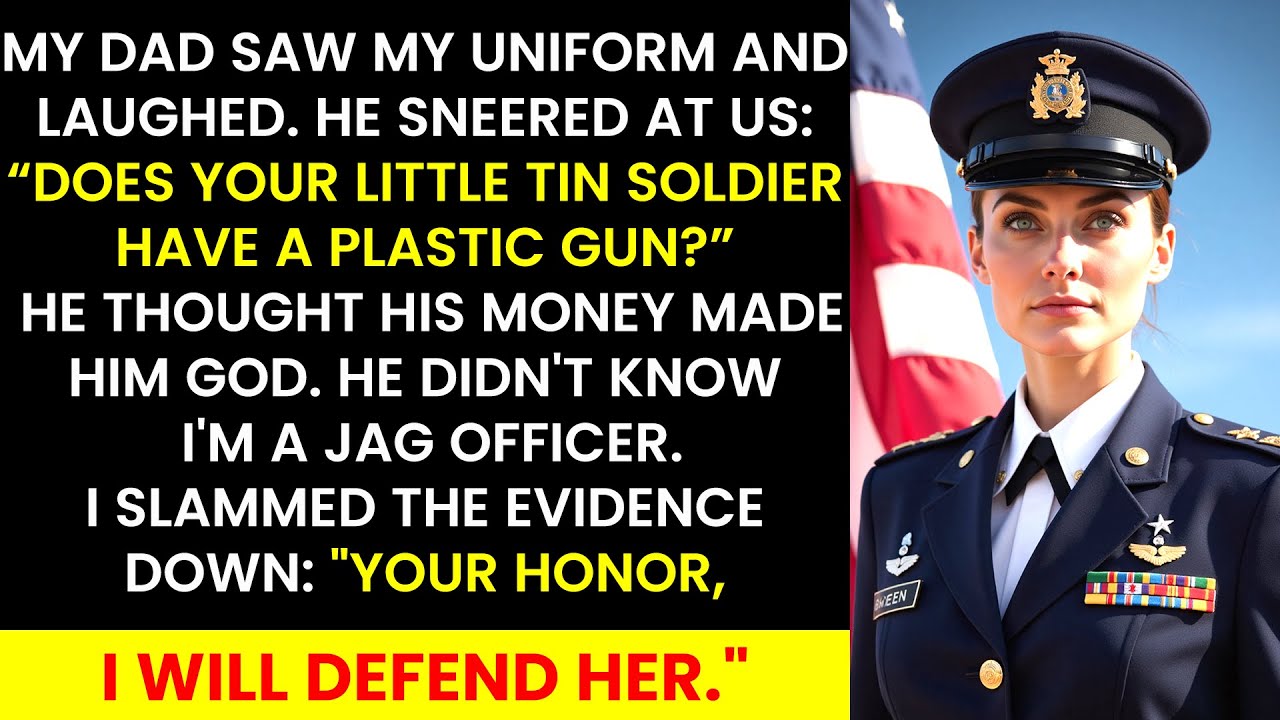
When he saw my mother sitting alone, curled up without a lawyer, he turned to his young mistress and smirked, confident his money had finally crushed her. That smile vanished the moment I snapped to attention and looked the judge dead in the eye. “Your Honor, I, Captain Heidi Green, will be representing her. ”
The parking lot of the county court in Ohio was gray and freezing that morning, matching my mother’s mood.
She sat huddled inside her 2010 Ford Taurus, her thin hands clasped together so tightly her knuckles were white. She wore a fraying brown wool coat she’d bought on clearance at Walmart five years ago. Across the lot, a sleek black Porsche Cayenne pulled into the reserved spot. My father stepped out looking like a million dollars.
“Heidi,” Mom whispered, her voice trembling. “He has an entire team of lawyers. He told me he would crush me into dust if I dared to ask for a division of assets. Maybe we should just go home.
”
I reached over and took her freezing hand. Her skin felt rough against my palm, covered in calluses—the physical receipts of thirty years of hard labor building my father’s career. “We aren’t going anywhere, Mom,” I said firmly. Inside the courthouse, my father stood laughing with his entourage.
Next to him was Tiffany, twenty-six, scrolling through Instagram with her mouth open, chewing gum. She represented everything my mother wasn’t: flashy, expensive, and hollow. When Bob saw us, he raised his voice so everyone could hear. “Well, look at that.
Who did Martha bring along? Does her little tin soldier plan to use a plastic gun to scare the judge? ”
His lawyer and Tiffany burst into laughter. Mom shrank into her coat, trying to disappear.
I kept my face frozen, a stone mask, a skill I learned through thousands of hours of interrogation training. You never let the enemy see you bleed. As my father passed our table, he leaned down and whispered, his voice dripping with condescension. “Heidi, wake up.
This is the real world, not your little army barracks. In here, money talks. Honor is garbage for losers. Tell your mother to sign the waiver.
If she’s good, I might toss her a few bucks to survive the winter. ”
Beside me, Mom bowed her head, tears dropping silently onto her battered handbag. He wasn’t just betraying her. He was trying to strip away the last shred of her dignity.
The bailiff’s voice boomed. “All rise. ”
Judge Harrison entered, an older man with silver hair and a no-nonsense attitude. He opened the case file and frowned.
“Defendant Martha Green,” he said. “I do not see a record of legal representation. Do you intend to represent yourself today? ”
From the other table, I heard a stifled giggle.
My father and Tiffany leaned in, eager to watch the show. But the moment didn’t come. I stood, snapping to attention. My military-issued dress shoes struck together with a singular, sharp clack that cut through the courtroom murmuring.
I adjusted the rack of ribbons on my chest and locked eyes with the judge. “Your Honor,” I said, my voice clear and steady, “I, Captain Heidi Green of the United States Army Judge Advocate General’s Corps, will be representing her. ”
The silence that followed was absolute. The smile on my father’s face vanished completely.
He thought he was fighting a helpless old woman. He had no idea he had just declared war on the United States Army. As the judge reviewed the power of attorney documents I’d slapped onto his bench, my eyes locked on my mother’s hands resting on the polished oak table. They were shaking uncontrollably—rough hands, paper-thin skin, knuckles swollen from arthritis.
The hands of a woman who had worked herself to the bone. Looking at them, I was transported back to our cramped, humid kitchen in the mid-nineties. Back then, my father was just a guy with a pickup truck and a dream, drowning in debt. To keep the lights on, Mom worked double shifts at Denny’s Diner, on her feet for twelve hours a day serving pancakes and refilling coffee for truckers.
Dinner was almost always the same: cheap mac and cheese from a blue box. Mom would serve my father first, then me. When she finally sat down, her plate contained nothing but the burnt, crunchy scraps stuck to the pan. “I’m full, sweetie,” she’d say with a tired smile when she caught me staring.
“I ate a big lunch at the diner. Your father needs the energy. He’s building something big for us. ”
She was lying.
She was starving, feeding his ambition with her own sustenance, pouring her life force into him, believing they were a team. The success did come. Green Construction landed lucrative contracts. The rusty pickup was traded for a brand new model.
But instead of relief, a new tension entered our home. Dad traveled more. When he was home, he was critical. I remember him getting dressed for a Chamber of Commerce dinner.
Mom came out wearing her best floral dress, bought on sale. She looked beautiful to me. Dad just sighed. “Martha, look at you,” he grumbled, not making eye contact.
“You look tired. Look at the other wives. They smell like expensive perfume. They look polished.
You always smell like grease and dish soap. Honestly, it’s embarrassing. You’re making me look bad. ”
He didn’t hit her.
He didn’t have to. Words like that leave bruises that never heal. The ultimate betrayal happened on Christmas Eve when I was eighteen, fresh out of boot camp. I walked through the front door expecting roast turkey and carols.
Instead, I heard my mother sobbing in the master bedroom. Dad was packing a suitcase, looking calm, almost bored. “We just aren’t compatible anymore, Martha,” he said. “I’ve outgrown this life.
I need someone who can stand beside me at galas. ”
He didn’t just leave. He handed her a divorce settlement he’d drawn up himself, bypassing lawyers to save money. “Sign this,” he told her.
“It’s a fair deal. I’ll take care of you, Martha. Don’t get the courts involved. ”
And my mother, the woman who ate burnt scraps so he could be full, she signed it.
She believed him. I blinked, bringing myself back to the courtroom. Across the aisle, Tiffany was whispering in my father’s ear, giggling. On her finger sat a diamond ring the size of a grape—at least $50,000, worth more than the entire apartment my mother was renting.
It was bought with the money Mom saved by clipping coupons, paid for by double shifts at Denny’s. It was polished with the sweat of a woman now being discarded like old furniture. Starter wife syndrome. The woman supports the man through the struggle, builds him up, manages the home.
Then once he reaches the summit, he pushes her off the edge and pulls up a younger woman to enjoy the view. The courtroom recess was announced. My father strutted out into the hallway, flanked by his legal team. He didn’t look back at me.
To him, I was invisible. Or worse, an embarrassment. My father had always wanted a son. He needed a Robert Jr.
to inherit the hard hat and the empire. Instead, he got me. When I was born a girl, his disappointment was quiet but palpable. When I grew up and told him I wanted to study law and join the army, that disappointment turned into open contempt.
I remember the day I received my acceptance letter to law school. I was twenty-two, beaming with pride. He didn’t even put down his newspaper. “I’m not paying a single red cent for that,” he declared.
“Lawyers are parasites, Heidi. And the army? That’s for people who aren’t smart enough to make it in the real business world. You want to be a little tin soldier?
Fine. Go play dress up. But you’re on your own. ”
So I did.
I joined ROTC to pay for my education. While the children of his business partners drove BMWs bought with daddy’s money, I was up at 4 a. m. , low-crawling through freezing mud pits and eating MREs that tasted like cardboard.
I never asked him for a dime. Every time I came home in my uniform, expecting a nod of approval, I only saw a sneer. I walked into the courthouse hallway, shaking off the memory. I fished quarters from my pocket and bought a black coffee from a vending machine.
It tasted burnt and watery, but the caffeine hit my system with familiar efficiency. It reminded me of JAG School in Charlottesville, where I learned that the law is the only thing standing between civilization and chaos. I spent a tour in Afghanistan drafting legal briefs while mortar sirens wailed. I learned that a single overlooked detail can cost lives or save them.
“Enjoying that swill? ”
I turned. Bob was leaning against the wall, holding a venti Starbucks latte with perfect whipped cream. “I heard what a captain makes these days,” he said, smiling that fake friendly smile.
“It’s barely enough to buy a decent suit. Look at you. No makeup, hair in a tight bun. You look so severe.
”
“I earn every dollar I make, Bob. Can you say the same? ”
He laughed. “Always so self-righteous.
I’m feeling generous today. You’re out of your depth. This isn’t a court-martial. So here’s an offer: after this is over, come work for me.
I need a new executive secretary. The pay is double what Uncle Sam gives you. Maybe get a makeover. Start looking like a woman instead of… whatever this is.
”
The insult landed with precision. He was telling me my value lay solely in my appearance and subservience to men like him. I took a slow, deliberate sip of my bitter coffee, letting the silence stretch. Five seconds.
A tactical pause. “Thank you for the offer, Mr. Green,” I said, my voice low and terrifyingly polite. I saw him flinch at the use of his last name.
“But the United States Army pays me enough to understand a very simple concept. Honor is not something you can purchase with a platinum credit card. ”
I took a step forward. He stepped back, hitting the wall.
“You should be less worried about my lipstick and more worried about your CEO chair,” I whispered. “Because you made a mistake, Bob. You judged me by your standards. You thought I was weak because I don’t worship money.
But when I am done with you in that courtroom, you are going to wish you had never woken up this tin soldier. ”
I finished my coffee, crushed the cup, and dropped it in the trash can next to him. “I’ll see you inside. ”
That night, the war took place in my mother’s cramped dining nook.
While she slept fitfully, I transformed her wobbly table into a command post. I laid out my laptop, highlighters, and three cardboard boxes of garbage Mom had saved from the house before she was kicked out. My father had laughed at those boxes, told his lawyers they were old receipts and junk mail. But in the intelligence community, we have a saying: one man’s trash is another man’s conviction.
I taped a large sheet of butcher paper to the wall and drew a timeline of the marriage with a black Sharpie. I scanned for anomalies, for breaks in the pattern. Hour after hour, I sifted through thirty years of debris: utility bills, credit card statements, grocery receipts. By 3 a.
m. , my eyes felt like sand. I picked up an old issue of Field and Stream from the bottom of the second box. My father didn’t hunt or fish.
Why did he have this? I shook it. A small slip of paper fluttered out—a carbon copy of a FedEx waybill. Sender: Robert Green.
Recipient: Blue Ocean Holdings, Ltd. Location: Georgetown, Cayman Islands. My heart skipped a beat. A construction company in rural Ohio had no business sending urgent documents to a tax haven in the Caribbean.
I checked the date against his travel calendar: May 14th, marked as “SE Region Builder Conference, Miami. ” I checked the next year. Another trip to Miami. Another FedEx receipt for a P.
O. box in the Caymans. The pattern emerged like a flare in the night sky. Miami wasn’t the destination.
Miami was the gateway. He was funneling money offshore right under Mom’s nose. I didn’t sleep. At sunrise, I drafted a federal subpoena.
Instead of targeting the Cayman accounts directly, I targeted the intermediary bank in Miami listed on the wire transfer codes. My father’s lawyers were lazy and arrogant. They hadn’t scrubbed the metadata because they didn’t respect their opponent. When I clicked send, I felt a cold thrill.
Not a warning shot. The coordinates for a precision air strike. Two days later, the encrypted file arrived. Mom sat across from me drinking herbal tea, her eyes swollen.
“Did you find anything, Heidi? ” she asked softly. “Maybe we should just take the settlement offer. He said he’d give me $20,000.
”
“Don’t take the settlement, Mom. ”
As I scrolled through the transaction history, the blood drained from my face. It was worse than I thought. First, tax evasion.
Millions funneled into shell companies registered to Tiffany Miller. Then the 401k—the retirement fund Mom and Dad contributed to for thirty years—had been drained. He had forged her signature on a withdrawal form three years ago, claiming financial hardship. But the final document made me physically nauseous.
I found a credit report. Not my father’s. My mother’s. He had used her social security number without her knowledge to open five high-interest credit cards, maxed them out on gambling debts and luxury gifts for Tiffany, then deliberately defaulted.
My mother’s credit score was in the low 400s. He hadn’t just stolen the money. He had salted the earth. No landlord would rent to her.
No bank would touch her. He wanted to make sure she had no choice but to crawl back to him or live on the street. “Is it bad? ” she whispered.
I closed the laptop slowly, my hands shaking from a rage so cold it felt like ice in my veins. “It’s not bad, Mom,” I said, my voice eerily calm. “It’s criminal. ”
I stood and walked to the window, speaking to my reflection.
“Bob Green wanted to play dirty. He wanted to use paper and ink to destroy a life. Fine. He wants a war?
I’m going to give him total annihilation. ”
I dialed my father’s lawyer. “This is Captain Green. Tell your client we accept his invitation for lunch tomorrow.
And tell him to bring his checkbook. We have some numbers to discuss. ”
The invitation for a “settlement conference” came by email. The venue wasn’t a law office.
It was The Capital Grille, where the city’s power players go to eat. “I don’t want to go, Heidi,” Mom said, clutching her purse. “I don’t fit in there. Look at my shoes.
They’re scuffed. ”
“We aren’t going there to eat, Mom. We are going there so you can see exactly who he has become. ”
When we walked in, the air was thick with leather and expensive red wine.
My father and Tiffany were already seated, a $200 bottle of Silver Oak Cabernet half empty. Tiffany wore a low-cut dress, her neck dripping in gold. My father didn’t stand. He didn’t offer a greeting.
He just jerked his chin toward the empty chairs. “Sit,” he grunted. He was eating a bone-in ribeye, sawing into the rare meat. He scraped his knife across the plate, staring at Mom with open contempt.
“Let’s cut the crap,” he said. “I don’t have time to play games with your little toy soldier daughter. Here is the final offer. ”
He pulled a personal check from his breast pocket and slapped it on the table, sliding it across with his finger like he was tipping a waitress.
I looked at the number. $20,000. That was his price for thirty-two years of marriage. “Take that money,” he said, pointing at the check with his knife.
“Buy yourself some new clothes. Go take a cruise. Then get the hell out of my life. You’re old, Martha.
Don’t fight for things you didn’t earn. ”
Mom stared at the paper, her lips parted. Then Tiffany decided to speak. “Honestly, Martha,” she drawled, “you should really just take it.
Bob is being way too generous. Look at you. You’re past your prime. You haven’t contributed a dime to his success in years.
What do you even need more money for? At your age, are you saving up for a coffin? Because frankly, that check is enough to bury you comfortably. ”
Bob chuckled, proud of her cruelty.
Mom let out a ragged sob and covered her face. I stood up so fast my chair toppled backward, crashing onto the floor. Every head in the restaurant turned. I grabbed the glass of ice water in front of me and threw the contents straight into Tiffany’s face.
Water splashed across her expensive blowout, her mascara running into a smeared black mess. She shrieked and knocked over the $200 bottle of wine. “You crazy bitch! ” she screamed.
“Shut your mouth! ” I roared, my voice commanding absolute silence. I leaned across the table, placing my hands flat on the white tablecloth, inches away from my father’s nose. “$20,000?
” I hissed. “You think my mother is that cheap? ”
“Now, Heidi,” he stammered. “Calm down.
”
“You listen to me, Bob,” I cut him off. “You are going to pay for every single tear she shed today. And you aren’t going to pay with money. You’re going to pay with everything.
Your reputation. Your company. Your freedom. I promised you a war, but you just signed a suicide note.
”
I picked up the check and ripped it in half, then in quarters. I dropped the pieces onto his half-eaten steak. “Enjoy your lunch. And save your appetite, because I’ll see you in hell.
”
I turned to Mom. “Come on. This place stinks of trash. ”
We walked out with our heads held high, leaving Tiffany screaming for a towel and my father staring in stunned silence.
I felt a surge of adrenaline, but I didn’t know the stress of that lunch had already done irreversible damage. The war I had just declared was about to take a casualty before the sun went down. The drive home was silent. We got back to the apartment around 8 p.
m. Mom said she felt tired, complaining of a dull ache in her left arm and a tightness in her jaw. “I just need to sleep, Heidi. That lunch took everything out of me.
”
Ten minutes later, I heard a crash. Mom was on the floor, clutching her chest, gasping for air. Her skin had turned a terrifying shade of gray. “Chest… elephant sitting on…” she wheezed.
I didn’t panic. Panic gets people killed. I dialed 911 and started CPR, pushing hard and fast, counting out loud, ignoring the sickening crunch of cartilage. “Come on, Mom.
Stay with me. Don’t you dare leave me. ”
The paramedics loaded her onto a gurney and rushed her out. I jumped into the ambulance, holding her ice-cold hand.
At County General, they wheeled her behind the trauma unit doors. I was stopped at the registration desk. The administrator typed my mother’s name into the system. She frowned.
She typed something else and frowned deeper. “Ms. Green, I’m sorry to tell you this, but the system is flagging her insurance as inactive. ”
“That’s impossible,” I said.
“She’s covered under my father’s policy. Blue Cross Blue Shield. It’s a platinum plan. ”
“I see the policy number, but it shows a status change.
The primary policy holder, Robert Green, removed her as a dependent effective today. ”
My blood ran cold. “What time? ”
“The time stamp on the cancellation is 5:02 p.
m. ”
My knees almost gave out. That was exactly twenty minutes after we walked out of the restaurant. He hadn’t just gotten angry.
He had pulled out his phone and executed a kill order. He knew Mom had a history of high blood pressure. He knew the stress could trigger a health crisis. He deliberately cut her lifeline while she was fighting for her actual life.
My phone buzzed. The name on the notification read Bob Green. I opened the message. “See Heidi, this is the real world.
Without me, your mother is a zero. I heard the ambulance. Good luck with the hospital bills. If you withdraw the lawsuit by tomorrow morning, I might consider reinstating her coverage.
This is a lesson about real power. ”
He was holding my mother’s beating heart hostage to save his bank account. I looked through the glass partition. Doctors were intubating her, forcing a tube down her throat to breathe for her.
She looked so small, so fragile. I gripped my phone until my knuckles turned white. The fear I felt in the ambulance evaporated, replaced by a cold, dark fire in my chest. It was the same feeling I had before a combat patrol.
Focus. Clarity. Lethality. I thought about the Soldier’s Creed: *I will never accept defeat.
I will never quite. I will never leave a fallen comrade. *
My mother was my fallen comrade. She had taken bullets for me her whole life.
Now she lay on that table because of enemy fire. “Okay, Bob,” I whispered. “You want to play God? You want to decide who lives and dies based on a signature?
”
I looked at his text message one last time and took a screenshot. I didn’t reply. You don’t negotiate with terrorists. You eliminate them.
The sun hadn’t fully risen when I pulled my Jeep Wrangler into the used car dealership. That Jeep was my symbol of independence, the first thing I bought with my own paychecks after Officer Candidate School. But right now, it was just a liquidity event. The salesman circled the car, kicking the tires.
“Best I can do is twelve thousand. ”
It was a lowball. The Jeep was worth at least eighteen. But I didn’t have time to haggle.
Mom was lying in a hospital bed with a billing department demanding a deposit. “Do it,” I said. “Cut the check. ”
I signed the title over without a tremor.
As I watched my Jeep drive away, I felt a sharp ache in my chest. But I pushed it down. Assets can be replaced. Mothers cannot.
I took the bus back to the hospital, clutching the cashier’s check. I opened Facebook, looking for pain or fuel. There it was—a new post from Robert Green, timestamped two hours ago. A photo of him standing on a manicured green lawn, a golf club in hand, palm trees and ocean behind him.
Checked in at The Breakers, Palm Beach, Florida. Caption: “Living the good life. Staying away from negative energy and toxic people. Blessed.
”
He was playing golf while his ex-wife lay in a cardiac ward because he cut her insurance. “Enjoy the sunshine, Bob,” I whispered. “Because a storm is coming. ”
I activated my network.
First, I called Gary, a former Army intelligence officer turned private investigator. “Gary, it’s Heidi. I’m cashing in the favor. ”
“Name it, Cap.
”
“I need eyes on the Caymans. I have a paper trail leading to Blue Ocean Holdings. I need to know who the signatories are. I need proof linking the money to a person, not just a shell company.
”
“Consider it done. I got your six, Heidi. ”
The real nuclear weapon arrived an hour later. A phone call from an unknown number.
“Is this Heidi Green? This is Barbara Wilson. I used to be the head bookkeeper for your father’s company. He fired me two years ago because I refused to cook the books.
But Heidi, I kept a backup. I have the shadow ledgers. The real ones. ”
For the next forty-eight hours, Room 304 of County General became my war room.
Mrs. Wilson arrived with a tote bag of hard drives and binders. We taped spreadsheets to the hospital walls, cross-referencing bank transfer data with her internal ledgers. The picture that emerged was staggering.
Federal tax evasion on a massive scale. Laundering money through phantom real estate projects. Embezzling company funds for Tiffany’s lifestyle, classifying diamond necklaces as office supplies. Every page was another nail in his legal coffin.
I stopped looking at him as my father. He was a target. On the night before the final hearing, Mom stirred in her bed. “Heidi, you don’t have to do this.
I’m scared. He’s powerful. He knows people. I don’t want him to ruin your career.
”
I took her hand. “Mom, he doesn’t have power. He has money. There is a difference.
Tomorrow, you aren’t going to bow your head to him ever again. We are going to take back everything. Not just the money. We are taking back your honor.
”
She squeezed my hand weakly and closed her eyes. I put on my Class A uniform slowly, deliberately. Every button fastened. My rack of ribbons pinned to my chest.
I stepped in front of the mirror. The woman looking back wasn’t the useless tin soldier my father mocked. She was Lady Justice. “Time to go hunting,” I whispered to my reflection.
“Court is now in session. The Honorable Judge Harrison presiding. ”
I watched my father walk to the witness stand. He didn’t walk like a man facing judgment.
He strolled like he was boarding a yacht, shooting a confident wink at Tiffany in the front row. His lawyer had just finished a forty-minute sob story about market volatility, claiming Bob was barely scraping by with zero liquid assets. “Your witness, Captain Green,” the judge said. I brought a single thin sheet of yellow legal pad paper to the podium.
“Mr. Green,” I began, my voice deceptively soft. “You have just sworn under oath to tell the truth. Is that correct?
”
“I did. ”
“And you have stated to this court, under penalty of perjury, that the financial affidavit you submitted, listing your total assets at less than $100,000, is accurate and complete? ”
Bob smiled. “That is correct.
The economy has been tough, sweetheart. I’m a law-abiding citizen. ”
The trap was set. He had just committed perjury on public record.
“I see,” I said, stepping away from the podium. “Then how do you explain your travel schedule? According to your company credit card statements, you have visited Miami, Florida twelve times in the last eighteen months. ”
“I have business partners in Miami.
Networking. ”
“And while you were networking, are you aware that your wife was using coupons to buy expired bread because you limited her allowance to $50 a week? ”
Bob rolled his eyes theatrically. “That’s business, Heidi.
You’ve been in the army too long. You don’t understand how the corporate world works. ”
“You’re right, Mr. Green,” I said, my voice hardening.
“I might not understand business the way you do. ”
I walked back to my table, lifted a heavy black binder, and slammed it down onto the witness stand railing. The sound echoed like a gunshot. “But I do understand financial crimes!
Your Honor, I would like to submit Exhibit A. ”
I pulled out a stack of enlarged documents. “This is a bank statement from the Cayman National Bank in Georgetown, Grand Cayman, for a shell corporation named Blue Ocean Holdings. And this is the incorporation document.
Mr. Green, do you recognize the signature at the bottom? ”
His face went from flushed to chalk white. “The signature is dated May 14th, exactly two days before Mr.
Green filed for divorce. On the same day, a wire transfer of $2. 5 million was made into this account. ”
The courtroom erupted.
Reporters started typing furiously. “Objection! ” Mr. Sterling jumped up.
“This is an ambush! ”
“Sit down, counselor,” Judge Harrison barked. “Overruled. Continue, Captain.
”
“Where did that $2. 5 million come from, Bob? Did it come from networking, or did it come from the joint 401(k) retirement fund you liquidated without your wife’s consent by forging her signature? ”
Bob started to sweat.
He looked at Tiffany, but she was slowly backing away, her hand over her mouth. “That’s… it’s a misunderstanding,” he stammered. “I was moving funds for tax optimization. ”
“You intended to steal,” I cut him off.
“You didn’t just hide money, Bob. You committed federal tax evasion. Wire fraud. And perjury, five minutes ago, when you sat in that chair and lied to this court.
”
I took a step closer, looming over him. “And the worst part—the part that makes you a monster, not just a criminal—yesterday at 5:02 p. m. , you canceled my mother’s health insurance while she was in cardiac arrest.
You tried to kill her with a spreadsheet because she dared to ask for her fair share. ”
“I… I didn’t—” Bob was shaking now, looking small and pathetic. “Is that true? ” Judge Harrison asked, his voice quiet but carrying the weight of doom.
He looked at Bob over his glasses. “Did you cancel the defendant’s medical coverage during a medical emergency? ”
Bob opened his mouth, but no words came out. “I have the termination notice right here as Exhibit B,” I said, placing the paper gently on the judge’s bench, along with the text message mocking us for it.
Judge Harrison read it. His face turned crimson. He slowly closed the file. “I have heard enough.
This court finds there is probable cause to believe the plaintiff has committed multiple felonies, including perjury and dissipation of marital assets. I am also referring this matter to the district attorney for investigation into insurance fraud and tax evasion. ”
He banged his gavel. “Mr.
Green, your bail is revoked. You are remanded into custody immediately. Marshals, take him. ”
Two US marshals in tactical vests stepped forward.
They grabbed Bob by the arms and hauled him up. “Heidi, please,” he begged. “I’m your father. ”
I stood at attention, my face a mask of stone.
“You’re not my father,” I said. “You’re the defendant. ”
Click. Click.
The sound of the handcuffs locking around his wrists was the most beautiful sound I had ever heard. It was the sound of the spell breaking. The sound of justice. “No, you can’t do this!
I built this town! ” he screamed as they dragged him toward the holding cells. I turned to the gallery. Tiffany was gone—she had bolted out the back door the moment the handcuffs came out.
But not before stopping to scream at the lawyer about the townhouse in her name. Everything was frozen. The house, the cars, the accounts. The ATM had just been unplugged.
She stormed over to where the marshals held Bob. “You useless old fool! ” she shrieked. “You told me you had it handled!
You told me you were untouchable! ”
“Tiffany, baby, please. I can fix this. ”
“You can’t fix anything!
I wasted two years of my prime on you! ”
She yanked the massive diamond ring off her finger and threw it at him. It bounced off his lapel and skittered across the floor. Without a backward glance, she ran, her high heels echoing until they faded out the rear doors.
My mother sat crying, but these were tears of release. The tension that had held her rigid for decades was finally leaving her muscles. The marshals led my father past our table. He stopped, planting his feet.
For the first time in my life, I didn’t see the giant who built skyscrapers. I saw a small, graying man in a wrinkled suit, hands bound behind his back. “Heidi,” he whispered, his voice trembling. “I didn’t think you could do it.
I didn’t think you had it in you. ”
“That was your mistake,” I said calmly. “You underestimated the women of the Green family. You thought we were weak because we were kind.
You forgot that kindness isn’t a lack of spine. ”
“I can make this right. Heidi, tell them I’m your dad. ”
“My father died a long time ago,” I said, “the day he chose money over his family.
You’re just a defendant now. Goodbye, Robert. ”
The marshals dragged him away. I watched until the heavy metal door clicked shut behind him.
We stepped out onto the courthouse steps. The afternoon sun hit us, warm and bright. The air smelled of rain on hot asphalt, the scent of a summer storm that had finally passed. Mom closed her eyes and took a deep, shuddering breath.
“It’s over. ”
She turned and hugged me—a desperate, bone-crushing embrace. “Thank you, Heidi. You saved my life.
”
I stroked her hair. “I’ve got you, Mom. I’ve always got you. ”
We had won.
Mom would get half of the true assets. She would be secure. But I felt a hollow ache in my chest. There is no joy in sending your own father to prison.
Justice is a bitter medicine. It tastes like blood and regret. It was necessary. But it left a scar.
“Captain Green! ”
It was Mr. Sterling, jogging toward us, sweating, tie loosened. “My client is willing to talk.
Maybe we can cut a deal before the DA gets involved. If you drop the fraud charges, he can sign over the Florida property immediately. It’s family. ”
“Family?
” I repeated, my voice ice cold. “Yesterday you watched him throw a check at my mother like she was a beggar. Save your strategy for criminal court, counselor. You aren’t negotiating with a daughter anymore.
You’re negotiating with the federal government. My evidence is already with the DA. There are no deals. There is only the law.
”
I turned away and waved down a taxi. I opened the door for Mom. “Where do we go from here? ” she asked.
I smiled, the first genuine smile I’d felt in days. “First, we’re going to a nice steakhouse. We’re going to order the biggest steaks on the menu, and we’re paying full price. No coupons.
No sharing. And then we’re going to find you a new house. A place with a garden, a place that smells like flowers, not grease. ”
Six months have passed since the gavel fell.
I drove my rental car down a winding gravel road on the outskirts of town. I wasn’t driving toward a courthouse or a hospital today. I was driving toward peace. I pulled into the driveway of a small white clapboard cottage.
It had a wide, welcoming front porch and a garden exploding with color. Pink and yellow roses climbed the trellis. Hydrangeas bowed their blue heads along the walkway. For twenty years, my father had forbidden Mom from planting a garden like this.
He called it cluttered. Now the air smelled like sweet nectar and damp earth. It smelled like freedom. The screen door squeaked open and my mother stepped out.
I blinked. The woman on the porch didn’t look like the terrified, gray-faced victim I had defended. She looked ten years younger, wearing a bright yellow floral dress, her hair loose and soft around her shoulders. “Heidi!
” she called out, waving a gardening towel. She hugged me, smelling of sunscreen and lavender soap. “Look at you, Mom. You’re glowing.
”
“The garden club ladies are coming over tomorrow. And Thursday, I’m going ballroom dancing at the community center. My feet still remember the steps. ”
She had found the Martha she used to be before the money and misery buried her.
We sat on the front porch in wicker rocking chairs, drinking iced tea. The wind chimes tinkled softly. “Have you heard any news? ” I asked.
Mom reached into her pocket and pulled out a plain white envelope stamped with the prison’s inspection seal. “He wrote to me,” she said softly. I took the letter. The handwriting was shaky, stripped of its arrogant flourish.
“Martha, I have a lot of time to think in here. I realize now that I was chasing a ghost. I thought money made me a man. Sitting in this cell, I realize I’m the poorest man on earth.
I lost the only two people who ever actually loved me. I’m so sorry. ”
I folded the letter and handed it back. “How does that make you feel?
”
Mom looked out at her rose bushes. She took a sip of tea. “It makes me feel sad for him,” she said. “But I forgive him, Heidi.
”
I looked at her, surprised. “I’m not forgiving him because he deserves it,” she said, turning to look at me with clear, strong eyes. “I’m forgiving him because I deserve peace. Holding on to hate is like drinking poison and expecting the other person to die.
I’m done drinking poison. I have a life to live. ”
I stared at her in awe. I had spent years learning how to destroy enemies.
But my mother, with her soft hands and floral dress, had mastered the hardest battle—the battle for her own soul. “I leave tomorrow at 0600,” I said. “My orders for Germany came through. I’ll be stationed in Stuttgart for three years.
”
“I’m going to miss you, but you have a job to do. ”
I walked over to my uniform hanging on a hanger. “Dad always told me our legacy was the business—buildings, concrete, bank accounts. He thought that because I didn’t want that, I was a failure.
He was wrong. He left a legacy of rubble and shame. But you—you started with nothing. You worked double shifts.
You sacrificed. And you raised a daughter who knows right from wrong. ”
I choked up, my throat tight. “I used to be ashamed that we were poor.
But today, I am prouder to be the daughter of a waitress than the daughter of a millionaire. Your resilience is my inheritance, Mom. That’s the real legacy. ”
The sun dipped below the horizon, painting the sky in shades of violet and gold.
It was time to go. Mom cupped my face in her hands. “You be safe over there, Heidi. You make them respect you.
”
“I will. And you keep dancing. ”
I walked to the car, but before I got in, I turned around. Mom was standing on the porch, framed by the climbing roses, bathed in golden light.
She wasn’t a victim. She wasn’t a starter wife. She was a survivor. The queen of her own castle.
I stood tall, brought my heels together, and raised my right hand to the brim of my hat in a slow, crisp, ceremonial salute. It wasn’t a salute for a superior officer. It was a salute for the bravest warrior I had ever known. Mom smiled, tears streaming down her face, and waved.
I got in the car and started the engine. As I drove away, watching her figure grow smaller in the rearview mirror until she disappeared around the bend, I didn’t feel heavy anymore. The war was over. The home front was secure.
My father’s biggest mistake wasn’t the fraud. It was his definition of wealth. He believed power came from controlling others and hoarding assets. But watching my mother bloom in her sixties taught me the real truth.
True power is the courage to walk away from what hurts you. No matter how scary the unknown seems, it is never too late to rewrite your story. You are not defined by the scars of your past or the balance in your bank account. You are defined by your resilience.
If you are holding on to a painful past, let this be your sign. You are strong enough to let go and plant your own garden.