Ingrid Møller’s voice cut through the marble hall like a blade. “You’re fired. You are nothing in front of everyone. ” She didn’t realize her own husband was watching every second from the shadows.
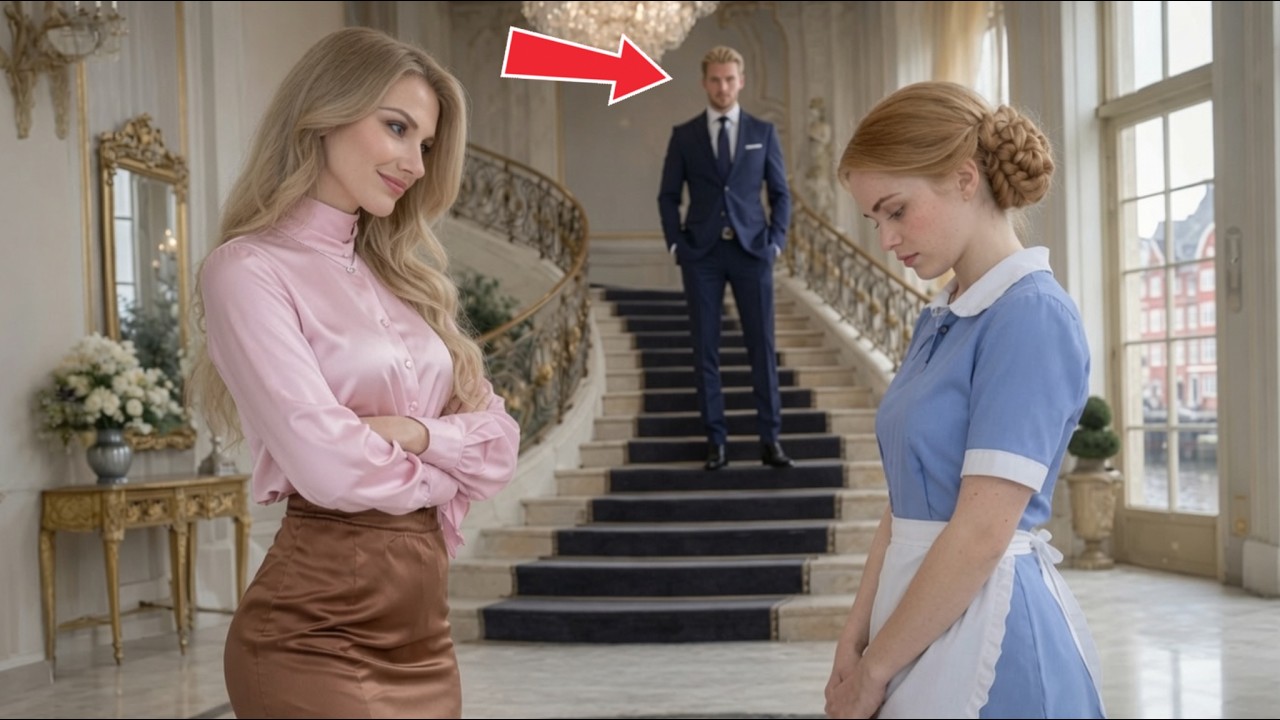
What he did afterward shattered the person you least expected. The Møller mansion was the kind of place that made people lower their voices without being asked. White marble corridors, high ceilings with gold trim, curving staircases that led down to the great hall like a film set. Everything in the house communicated one thing with absolute clarity: the people who live here don’t have to explain themselves to anyone.
Astrid Jensen knew that from the first day she stepped through the service door with her worn-out bag over her shoulder. She knew it when she walked along the walls to stay out of the way. She knew it when she answered “Yes, Mrs. Møller” and immediately after “Yes, madam,” the way you say Mrs.
Møller, even though something inside her chest squeezed with a force she found hard to ignore. She had worked there for weeks and learned one rule above all others. When Mrs. Ingrid Møller had narrowed eyes and tight lips, it was best to become invisible.
That morning, Astrid didn’t succeed. It all started before the great hall clock struck eight. Astrid was putting the finishing touches on the flower arrangement at the center table, a task that Bodil, the oldest employee in the house, had given her the evening before. Then she heard Ingrid’s footsteps on the stairs.
They weren’t normal footsteps. They were footsteps with purpose. Footsteps looking for something or someone. They found her.
“Come here. ”
Astrid put down the flowers. She came closer. She kept her eyes on Ingrid’s face without lowering them.
Her mother had taught her from childhood that the one who avoids your gaze is the first to be guilty, and she had nothing to feel guilty about. “Good morning, Mrs. Møller. ”
Ingrid didn’t return the greeting.
She extended her arm and pointed toward the display cabinet at the back of the hall, where the house’s most expensive decorations were stored. The crystal eagle on the second shelf, she said. Where is it? Astrid looked toward the cabinet.
The second shelf had an empty space that hadn’t been there yesterday. She frowned, genuinely confused. “Mrs. Møller, I don’t know.
Yesterday, when I cleaned the cabinet, everything was in its place. ”
“Everything was in its place,” repeated Ingrid, and her voice shifted tone in a way that set off alarms in Astrid. “Are you sure about that? ”
“Yes, Mrs.
Møller. Completely sure. ”
Ingrid crossed her arms, tilted her head, and at that moment something in her expression stopped being a question and became a verdict. “How convenient.
That piece came from Venice. It’s worth more than you can probably imagine. And it disappears precisely on the evening you were alone in this hall cleaning. ”
“Mrs.
Møller, I didn’t take anything,” Astrid answered, her voice firm even though her hands had begun to tremble slightly. “Check my bag. Check my room. Check whatever you want.
”
“I don’t need to check anything,” Ingrid said, raising her voice with calculated clarity, loud enough to echo through the entire hall. “Objects don’t just disappear, and in this house, you were the only person in this hall last night. ”
It was then that Kirsten, the kitchen maid, appeared from the kitchen door with an uncomfortable expression. And behind her, Bodil, who had heard the voices from the first-floor hallway and come down without a sound.
The two women stood motionless, not intervening, because when Mrs. Ingrid spoke in that tone, no one in the house dared interrupt her. No one except Astrid. “Mrs.
Møller,” Astrid said with a calm that cost her everything she had. “I understand the piece is important to you. I understand the circumstances seem to point to me. But I didn’t take it.
And if you accuse me without evidence, with all due respect, that’s not fair. ”
The silence that followed lasted exactly three seconds. Then Ingrid Møller took a step forward, and when she spoke again, her voice held such absolute cold that Astrid felt the temperature in the hall drop several degrees. “Fair.
You talk to me about fairness in my own house. I’m asking you to be quiet. ” Ingrid’s voice exploded through the hall with a force that made Kirsten step back and Bodil close her eyes for a moment. “I did not bring a thief into this house so she could teach me what is fair or not.
You are fired. Do you hear me? Fired. You are nothing in this house.
You never were. You don’t even deserve the air you breathe in here. ”
The words hit like physical blows. Astrid didn’t cry.
She wanted to cry, because inside her something broke with painful clarity, but she didn’t. She stood with a straight back and burning eyes, holding Ingrid’s gaze for a second that seemed endless. Bodil stepped forward. “Mrs.
Møller,” she said carefully. “Maybe we should check before—”
“Don’t interfere,” Ingrid said without even looking at her. “This doesn’t concern you. ”
It was Kirsten who spoke next, from the kitchen door with a low but clear voice.
“Mrs. Møller, the eagle. I think I saw it yesterday on the small dining table. The lady put it there before dinner, and I don’t think it was put back in the cabinet.
”
The silence that followed was a different kind than the one before. Denser, heavier, with an edge that cut in two directions. Ingrid slowly walked toward Kirsten, looked at her, and in her expression there was something that wasn’t shame, but something much harder to bear. The certainty of having made a mistake in front of witnesses.
She went toward the small dining room, disappeared behind the door, and came back twenty seconds later with the crystal eagle in her hand. Everyone in the hall waited. Astrid waited for an apology. She waited for Ingrid Møller, with all the polish and elegance she showed the world, to find the right words.
I was wrong. I’m sorry. I was mistaken. Just three words.
Ingrid placed the eagle on the central table. “You can finish your shift,” she said without looking at her. “But I want this week to be your last. ” And she went up the stairs without looking back.
Astrid didn’t move for several seconds. Bodil approached and put a hand on her shoulder without saying anything, because there were no words for what had just happened. Kirsten looked at her from the kitchen door with damp eyes and an expression that mixed guilt and relief. “Thank you,” Astrid said to Kirsten with a barely audible voice.
Kirsten nodded, lowered her head. Astrid picked up the cleaning cloth she had left on the table, folded it carefully, and continued working, because she had bills to pay, because her mother in a small room in an old building on the other side of the city depended on medication that only that salary could cover, and because giving up, even though it hurt in places she didn’t know existed, was something she couldn’t afford. What Astrid didn’t know, what none of the women in that hall knew, was that they had never been alone. Søren Møller had arrived at the mansion before dawn, returned from a business trip a day earlier than expected.
He had come in through the front door silently, placed his briefcase in the study on the first floor, and gone down toward the hall to find a cup of coffee. When he heard his wife’s voice rise with that sharp clarity he knew all too well, he stopped at the threshold of the side door, partly hidden by the corridor’s shadow, and heard everything. He had seen Astrid hold Ingrid’s gaze without shaking. He had heard the words thief, you are nothing, fired come out of his wife’s mouth with an ease that turned his stomach.
He had seen Kirsten reveal the truth, and how Ingrid picked up the eagle and left without a single apologetic word. Søren Møller had built a company from scratch with a principle he repeated to himself in hard times: a person’s character is seen not in how they treat their equals, but in how they treat those who cannot defend themselves. What he had just witnessed shook him in a way he hadn’t expected. But he didn’t yet know what would change absolutely everything in the coming days: Astrid Jensen was not just an employee with dignity and a sick mother.
Astrid carried a secret she had tried to bury for weeks, and when it came to light, it would not only shake the mansion’s foundations, but reveal a truth that connected her life to the Møller family in a way none of them could have imagined. Søren Møller was not a man who made impulsive decisions. He had learned from a young age that immediate reactions were almost always the wrong ones, that well-considered silence was worth more than a thousand words thrown out in the heat of the moment. He had built his business, Møller Group, on that philosophy: first observe, then understand, then act with precision, never the other way around.
But that morning, standing in the doorway of the great hall’s side door with the echo of Ingrid’s words still thundering between the marble walls, Søren felt something in that principle straining to its limit. He waited until the hall was empty. He waited until Bodil went up the stairs, until Kirsten returned to the kitchen, until Astrid disappeared down the corridor with her cleaning cart. Only then did he come out of the shadows, cross the hall in silence, and stop in front of the cabinet where the crystal eagle had returned to its place as if nothing had happened.
He looked at it for a moment. A beautiful, cold, perfect object, exactly like the accusation his wife had built around it. He went up the stairs. Ingrid was in her dressing room when Søren opened the door.
She had the phone in her hand and an expression that mixed morning energy with something that in another person might have been called discomfort. But Ingrid Møller had spent her whole life perfecting the art of not showing what she felt. When she looked up and saw her husband in the doorway, the first thing that crossed her face was not guilt, but surprise. “Søren, I didn’t know you were back.
”
“I came early,” he said, closing the door calmly. “I got to hear what happened in the hall. ”
A short pause. Ingrid put the phone down on the vanity.
“Oh. Did you? ”
“Yes. ”
Ingrid turned toward the mirror and began to fix her hair with a naturalness Søren found more revealing than any argument she could have made.
“It was an important piece,” she said. “The circumstances pointed to her. Anyone would have reached the same conclusion. ”
“Anyone who hadn’t taken ten seconds to check before accusing,” Søren replied, his voice low, without sharpness, but with a weight that filled every corner of the dressing room.
“It turned out you were wrong. ”
“Don’t—” she began. “You called her a thief in front of the entire staff,” Søren continued. “You said she was nothing.
You fired her without a single piece of evidence. And when Kirsten showed you were wrong, you left without saying a word. ”
“I will not apologize to an employee for a misunderstanding,” Ingrid said, and in her voice there was a firmness that left no room for negotiation. “That’s not how it’s done, Søren.
It sets the wrong precedent with the staff. ”
Søren looked at her for a long moment. “What kind of precedent does it set to accuse someone without evidence? ”
Ingrid didn’t answer.
“I want you to talk to her,” Søren said. “Absolutely not, Søren. I’ve already made a decision. This is her last week.
I will not reverse a decision in front of the staff. It undermines the authority of this house, and you know that as well as I do. ”
Søren was silent for several seconds. He studied his wife’s face in the mirror with the same careful attention that for years had served him to read contracts, partners, and opponents.
What he saw didn’t surprise him, but saddened him in a quiet, deep way. “Fine,” he said finally, and left the dressing room. Lars Christensen had been Søren’s personal lawyer for years, and in all that time he had learned to distinguish routine calls from those that weren’t. When his phone rang that afternoon and he saw Søren’s name on the screen, something in his instinct told him this was one of the latter.
“I need you to come to the mansion tomorrow,” Søren said without preamble. “It’s something I want to go through with you. Not related to the company. ”
“No.
To the house. ”
Lars paused briefly. “Has something happened? ”
“Not yet,” Søren replied.
“But I want to be prepared, just in case. ” He hung up before Lars could ask another question. Astrid knew nothing about that conversation. She knew nothing about what Søren had seen or what he had talked about with Ingrid.
She spent the rest of the morning doing her work with the same care as always. Cleaning surfaces that were already clean, arranging things that were already in place. Moving through the mansion’s corridors with the caution of someone who knows every step could be her last, because it was. This week would be her last.
During lunch, when the house fell into that partial silence that settled every day between one and three, Astrid sat on the small bench in the back garden that Bodil had shown her in those first weeks. It was the only place on the entire property where she felt, if not comfortable, then at least a little at ease. Bodil sat down beside her with two cups of tea. “How are you?
” she asked in that direct way Astrid had learned to appreciate. “Fine,” Astrid answered, and then, because Bodil was one of those people it made no sense to lie to, she added: “No. I’m not fine. ”
Bodil nodded as if that was the only honest answer possible.
“What happened this morning was not right,” she said. “And it’s not the first time she’s done something like this. But I want you to know that Kirsten and I know the truth, and that means something. ”
Astrid held the cup between her hands and looked out into the garden.
There was a large tree at the back with branches reaching toward the fence. In one of the branches was a small nest she had noticed for days. Two birds flew in and out without rest, building something that at first seemed fragile and which every day became a little more solid. “Bodil,” Astrid said quietly.
“How many years have you been here? ”
“Many,” Bodil answered with a tired smile. “Enough to know that this house has more layers than you see from the outside. And listen—Møller.
What is he like? ”
Bodil looked at her sideways. “Why do you ask? ”
Astrid hesitated.
There was something she had been holding on to since that morning. Something she didn’t know whether to mention, but the question was already in the air. “When Mrs. Møller was speaking to me in the hall,” she said slowly, “I had the feeling there was someone else in the side hallway.
I didn’t see anyone, but I felt it. ”
Bodil didn’t answer immediately. She took another sip and looked out at the garden. “Mr.
Søren arrived this morning,” she finally said. “Earlier than anyone expected. ”
Astrid turned toward her. “He was there.
”
Bodil looked at her with an expression that was neither confirmation nor denial. “What I tell you,” she said with the practical wisdom of someone who has lived enough to know when words are unnecessary, “is that in this house, things that seem finished are sometimes not. Sometimes they’re just beginning. ”
Astrid processed the words in silence.
She didn’t know what to do with them. She stored them away inside, along with everything else she didn’t know how to handle, and finished her tea while watching the nest in the large tree. That afternoon, while Astrid was putting away her cleaning supplies in the staff room, her phone rang. It was a number she hadn’t saved, but she recognized it immediately because she had called it dozens of times in recent weeks.
Hope Clinic. “Miss Jensen,” said the voice on the other end. It was Dr. Lund, who always spoke with the careful kindness of someone who has learned to deliver bad news delicately.
“I need to talk to you about your mother’s condition. ”
Astrid stepped out into the corridor. She moved away from the staff room to the quietest part of the hallway. “Tell me.
”
“The treatment we started weeks ago has had a partial response. That’s positive. But this week’s tests show we need to adjust the protocol, and the new medication the specialist recommends is not covered by the basic insurance you have on file. ”
Astrid closed her eyes.
“How much does it cost? ”
Dr. Lund gave her a figure. Astrid had to lean against the wall.
It was more than double what she earned in a month. And this month would, besides, be the last she worked in the Møller mansion. “Miss Jensen, are you there? ”
“Yes,” Astrid said, though it wasn’t true.
“Doctor, how long do we have to raise the money? ”
“The specialist says we should ideally start the new protocol within the next few weeks. Your mother is stable for now, but if we wait too long—”
“I understand,” Astrid interrupted, because she couldn’t hear the end of that sentence. “I’ll get it.
I’ll get it somehow. ”
She hung up. She stood in the dark corridor with the phone pressed to her chest and her eyes fixed on the wall in front of her, which was white and smooth and told her absolutely nothing. Her mother had been in treatment for months at the small clinic on the other side of the city.
A woman who had worked all her life with her hands, who had raised Astrid alone after her father disappeared without leaving an address, who had never complained about anything because she said complaint was a luxury the humble couldn’t afford. Now she lay in a hospital, enduring in the only way she knew. And the only thing Astrid could do for her was to raise the money. Money she didn’t have, in a week when she was about to lose her job.
Astrid took a deep breath. Once. Twice. Three times.
Then she put the phone away, wiped her eyes with the back of her hand, and went back to the staff room to finish her things. Giving up was not an option. It never had been. What Astrid didn’t know was that at that same moment, in the study on the first floor of the same mansion, Søren Møller was sitting at his desk with a document in his hand and an expression that Lars, sitting across from him, had never seen in all their years together.
“I want to understand exactly what you’re asking me to do,” Lars said, choosing his words carefully. “It’s simple,” Søren replied. “I want to know what options I have. ”
“Options regarding what, precisely?
”
Søren put the document on the desk, leaned back in his chair, and looked at his lawyer with that gaze that wasn’t distance, but concentration. “Regarding this house,” he said. “Regarding the decisions that are made in it when I’m not here. Regarding the people who work here and who depend on an environment that is at least fair.
”
Lars studied him a moment. “Does this have to do with what happened this morning? ”
“It has to do with this morning and everything this morning represents,” Søren answered. “I’ve been looking the other way for a long time, Lars.
Looking toward the company, the contracts, the numbers. Meanwhile, in this house—” He stopped, looked toward the window where the evening garden spread in orange tones. “In this house, things are happening that I can’t keep ignoring. ”
Lars opened his briefcase and took out a notepad.
“Fine,” he said. “Then tell me everything from the beginning. ”
That evening, Emil found Astrid in the large kitchen where she was washing the last utensils before ending her shift. He stopped at the entrance as if considering whether to come in.
Astrid saw his reflection in the window and turned toward him. “Good evening,” Emil said, and in his voice there was something that wasn’t the usual tone of a teenager speaking to an employee. Something more direct, more genuine. “Good evening,” Astrid replied.
Emil came in and sat on the bench by the island without being invited, with the naturalness of someone who considers the kitchen neutral territory. “What happened this morning was not right,” he said without preamble. Astrid looked at him. “I’m the son of the owners of this house,” Emil continued.
“And I’m saying it plainly. It wasn’t right. ”
Astrid put down the utensil she was holding. She looked at him for a moment.
This boy, who still had something childish in his features but who spoke with an honesty many adults had lost along the way, reminded her of someone. She didn’t quite know who. “Thank you,” she said simply. “Are you leaving?
” Emil asked. Astrid hesitated. “Your mother said this week would be my last. ”
Emil nodded slowly with the expression of someone who already knew that but had hoped to hear a different answer.
“My father heard everything,” he said. Astrid didn’t answer, but something in her chest moved in a way she didn’t know how to interpret. “I just wanted you to know,” Emil said and stood up. “Normally here, not for everyone.
” And he left the kitchen, leaving behind a silence that for the first time in that draining day didn’t hurt. Astrid was alone, washed the last utensils, turned off the kitchen light, and walked toward the service door with a heart of many layers. The morning shock, the fear from the doctor’s call, the strange warmth from the boy’s words. And under it all, locked in the deepest part of her being, the secret she had carried alone for weeks.
The secret that, if it came to light, would change absolutely everything. There was a certain hour in the morning when the Møller mansion became completely still, when Astrid allowed herself to be honest with herself. Not the Astrid who pushed the cleaning cart with a straight back and dry eyes. Not the Astrid who answered “Yes, Mrs.
Møller” and then “Yes, madam,” hiding every blow in a place no one could see. But the real Astrid, the one who was afraid, the one who was exhausted, the one who carried so much weight that sometimes she felt the gravity around her was different from everyone else’s. That evening, sitting on the edge of the narrow bed in the staff room, with the phone turned off on the pillow and hands folded in her lap, Astrid made a decision. It was time to tell the truth to someone.
But not just anyone. The next morning arrived with a cold clarity that contrasted with the weight Astrid carried inside. She found Bodil in the kitchen before anyone else, preparing breakfast with the silent efficiency she had to everything. Kirsten hadn’t arrived yet.
The mansion breathed that special stillness of the first hours, when even the clocks seemed to still be sleeping. “Bodil,” Astrid said, closing the kitchen door behind her. Bodil looked at her. Something in the tone of that single word told her this wasn’t an ordinary conversation.
She turned off the stove, dried her hands on her apron, and turned fully toward her. “Sit down,” she said. Astrid sat, folded her hands on the table, and for a moment that seemed longer than it was, she was silent, as if the words, now that they finally had permission to come out, didn’t know where to begin. “What I’m about to tell you,” she said finally, “I’ve told no one.
Not my mother. Not anyone I know. I’ve been carrying it alone since before I came to this house. ”
Bodil nodded without saying anything, without rushing, with the patience of someone who knows that some stories need their own time to be told.
“A long time ago,” Astrid began, choosing each word carefully, “when I worked in another house in this city, I met someone. An important person. I didn’t know it then. Or maybe I did know, and I decided to ignore it, because it was easier.
” She paused. “That person spoke to me in a way no one had ever spoken to me before. He treated me as if I had value, as if my words mattered, and I made the mistake of believing him. ”
Bodil frowned slightly but didn’t interrupt.
“When that person disappeared from my life,” Astrid continued, “I was already carrying something I hadn’t planned to carry. Something that changed everything I thought I knew about my future. ” Her eyes grew moist, but she didn’t cry. “I made decisions I didn’t consult anyone about, because I had no one to consult with, and I learned to live with the consequences of those decisions in silence.
”
Bodil reached her hand across the table and placed it on Astrid’s hands without pressing, just being there. “That person,” Bodil said with a voice so low it was almost a whisper. “Does it have something to do with this house? ”
The silence that followed was the most eloquent answer Astrid could have given.
Upstairs, Søren Møller had been awake since before dawn. He had the notes from his conversation with Lars the day before lying on his desk, and he had read and reread them with the specific concentration he reserved for problems without an obvious solution. Lars had explained his options with the direct clarity Søren paid him for, and none of those options were either simple or painless. But there was something Lars had said almost at the end of the conversation, almost as a minor detail, that he couldn’t get rid of.
“Before you make any decision,” Lars had said, closing his briefcase, “let me ask you something, and I need you to think seriously about it. Are you sure you know everything that goes on in this house, Søren? Because in my experience, when someone calls their lawyer to talk about options, it’s usually because there’s something they haven’t fully seen yet. ”
Søren had answered yes, he was sure.
But that morning, alone with his notes, he began to ask himself whether that answer had been honest. There were things he had ignored for too long. Not out of malice or indifference, but because of the silent trap that very busy people fall into. The trap of assuming that what they don’t see doesn’t exist.
He had built a company that employed hundreds of people, and he was proud of treating them fairly. Meanwhile, in his own house, an employee had been accused of theft without evidence and fired without an apology, and he had witnessed all of it. And until that moment, he had done absolutely nothing. It wasn’t ignorance.
It was cowardice. He got up, dressed, and went down to the kitchen before the house woke. What he found when he pushed open the kitchen door made him stop short. Astrid and Bodil were sitting at the table.
Bodil’s hands on Astrid’s. Astrid’s eyes with that particular gleam of someone who has just released the greatest burden they have carried in their life. Neither of them had heard him come in. Søren stepped back instinctively without making a sound, but before he could retreat, Astrid looked up.
Their eyes met. It was a second, maybe less, but in that second several things happened at once. Astrid saw in the man’s eyes something she hadn’t expected to see, something that wasn’t the boss’s cold distance, but genuine attention, almost uncomfortable in its honesty. And Søren saw on the girl’s face what he also hadn’t expected.
Not shame at being found in a vulnerable moment, but a strange calm, as if part of her had been waiting for this moment without knowing it. “Good morning,” Søren said, stepping into the kitchen as if he had seen nothing. “Good morning, Mr. Møller,” Bodil answered, rising immediately.
Astrid didn’t move at once. She took a second longer than normal, and when she stood, she looked at him in a direct way Søren hadn’t expected from someone in her position. “Good morning,” Astrid said, without “Mr. Møller,” without the tone of an employee speaking to the boss.
Søren noticed it, said nothing, poured himself a cup of coffee, and stood by the window. In the window’s reflection he could see Astrid gathering her things to start her shift, moving around the kitchen with the calm efficiency he had observed from the shadows yesterday. “Astrid,” he said without turning around. She stopped.
“Mr. Møller,” she said now, with the title again, as if she had recalibrated something internally in that moment. “I want to apologize,” Søren said, turning toward her. “For what happened in the hall yesterday.
”
The silence that followed had a different texture than all previous silences in this story. Bodil, who had started moving toward the pantry, stopped without turning around. Astrid looked at Søren for a moment that stretched longer than comfortable. “You owe me no apology, Mr.
Møller,” she said finally. “You didn’t say any of the things that were said. ”
“Exactly,” Søren replied. “And that was also a mistake.
”
Another pause. Astrid processed the words with a careful slowness, like someone who doesn’t want to misunderstand something that could mean too much. “Thank you,” she said. And this time it was a different thank-you from the one she had given Kirsten the day before.
This one had weight. It had history. Søren nodded, finished his coffee, and left the kitchen without saying more, because he had long since learned that gestures explained too much lose all their value. What happened after that morning was something no one in the mansion saw coming.
Lars arrived before noon with his briefcase under his arm and the experienced lawyer’s expression that reveals nothing until he’s ready to reveal everything. Søren received him in the study, closed the door, and for more than an hour no sound came from the room. It was Emil who passed by in the hallway, stopped in front of the closed study door with that special antenna teenagers have for detecting when something important is happening around them. He didn’t press his ear to the door.
He simply stood for a moment, processed, and then continued, but went down to the kitchen where Astrid was finishing the last details after lunch and sat on the usual bench with an expression she had learned to read in the few days she had been in the house. “What happened? ” Astrid asked without stopping cleaning. “My father is having a meeting with his lawyer,” Emil said.
“They’ve been in there for over an hour. ”
Astrid didn’t answer. “That’s not normal,” Emil continued. “My father calls Lars for business things.
Never for house things. ”
“Maybe it is something with the company,” Astrid said. “Maybe,” Emil said. But his tone clearly indicated he didn’t believe it.
There was a silence between them that wasn’t uncomfortable, but thoughtful. Outside, the garden shone under a midday sun that made everything seem calmer than it was. “Astrid,” Emil said suddenly with that directness that was most characteristic of him. “You’re leaving at the end of the week.
”
Astrid put the cloth on the counter. She looked at him. “Your mother said so. ”
“I know what my mother said,” Emil answered.
“I’m asking you. ”
Astrid considered the question seriously, because the boy deserved it. “I have reasons to stay,” she said finally. “Reasons that go beyond this job.
But it doesn’t depend on me. ”
Emil nodded slowly. “May I ask you something? ”
“You’ve been asking me things for days,” Astrid answered, and there was something faintly resembling a smile in her voice.
“Why did you specifically come to work in this house? ” he asked. “There are many houses in this city. Why this one?
”
The question fell into the middle of the kitchen like a stone into still water. The ripples reached Astrid and moved her in a way Emil couldn’t see, but which was absolutely real. Astrid took the cloth from the counter, folded it carefully, and when she lifted her gaze to Emil, there was something in her eyes that the boy couldn’t name at that moment, but that he would remember long after. “One day,” Astrid said in answer to the question.
“I’ll tell you. ”
Emil looked at her for a second. “Why not now? ”
“Because the time isn’t right yet,” Astrid said.
“And because some truths need the right moment so they don’t hurt anyone. ”
Emil didn’t answer, but something in his expression changed subtly, as if a piece he didn’t know he was missing had found its place, without him yet fully understanding the complete picture. He stood, walked toward the door, stopped. “Astrid,” he said without turning around.
“Whatever reason you came here for, I’m glad you came. ” And he walked out. Astrid stood motionless for a long time in that kitchen that smelled of fresh lunch and something that wasn’t exactly hope, but resembled it more than anything she had felt in a long time. Outside the study, the meeting between Søren and Lars was coming to an end, and what they had decided within those four walls was something that, when set in motion, would turn the week Ingrid had announced as Astrid’s last in the house into something entirely different.
No one knew it yet, but the right moment Astrid had just told Emil about was closer than anyone in the mansion could imagine. Lars Christensen had seen many things in his career. He had placed people on opposite sides of a table and watched them sign documents that changed their lives forever. He had heard confessions that never reached a courtroom.
He had kept secrets that weighed more than any file in his archive. But when Søren Møller told him what he wanted to do, Lars was silent for several seconds, which was absolutely unusual for him. “Are you sure? ” he asked finally.
“Completely,” Søren answered. “This will have consequences,” Lars said. “Not only in this house. In everything.
I know. ”
Lars studied him a moment. Then he opened his briefcase, took out his pen, and began to write. What Søren had asked him for wasn’t a simple contract adjustment or a household reorganization.
It was a move that required precision, documentation, and above all, the exact moment of execution. Lars had explained each step with the clarity that characterized him, and Søren had listened without interrupting, nodding with the concentration he used when something really mattered. But there was an element Lars didn’t know about. An element Søren didn’t fully know either.
And that element was, at that moment, washing windows on the second floor of the same mansion, completely unaware of everything that had been decided a few meters away. Ingrid Møller came down the stairs that afternoon with the specific determination of someone who has decided that the world will work on her terms or not at all. She had prepared herself carefully, as she always did when expecting guests. That afternoon, two friends from her closest circle were coming, Helle and Anne, women from the same world with whom she shared long lunches, coats, and conversations that seemed light but had invisible edges.
Astrid served them efficiently and discreetly, brought tea, arranged the snacks on the glass table, and disappeared into the kitchen as instructed. But the kitchen had a small window facing the corner corridor, and the corridor transmitted the sound of voices with a clarity no one had considered when the mansion was built. It wasn’t Astrid’s intention to listen. It just happened.
“And the new employee,” Helle asked with the casual curiosity that in reality wasn’t casual. “The one you had to fire. ”
“She’s staying until Friday,” Ingrid answered. “A misunderstanding that’s already been resolved.
”
“A misunderstanding? ” Helle raised an eyebrow. “I heard you accused her of theft in front of the entire staff. ”
A short silence.
“Things are not always as people tell them,” Ingrid said. “Ingrid,” Anne said with that gentle directness that was her way of saying difficult things. “You’ve been doing this for years. Do you remember that girl a long time ago who also left your house crying over something that turned out not to be true?
”
“That was different. ”
“How was it different? ”
Another silence. This time longer.
“Helle,” Ingrid said, changing the tone. “Tell me what you wanted to say about the renovation project. ”
Astrid, in the kitchen, stopped moving her hands on the counter. She became completely still, because in that exchange there was something that had struck her in a way she hadn’t expected.
Confirmation that what had happened to her wasn’t an isolated incident. It was a pattern. And somewhere in that pattern were other women who had experienced the same thing and walked away in silence. It saddened her in a different way than her own humiliation had.
Her own humiliation hurt. But knowing that this pain had history, that there were others before her, gave that pain an entirely new dimension. It gave her a resolve she hadn’t clearly felt before that moment. It was Bodil who found Astrid in the back garden late in the afternoon, sitting on the bench under the large tree, looking at the nest the birds had built over the days.
Bodil sat down beside her. It took a moment before she spoke. “This morning,” she said, “I was out talking to Søren. ”
Astrid turned toward her.
“Why? ”
“Because there were things he needed to know,” Bodil said simply. “Things I’ve seen in this house for years and have kept to myself because it wasn’t my place to say them. But the crystal eagle thing yesterday was the last straw.
”
Astrid couldn’t speak for a moment. “Bodil,” she said, and in her voice was a mixture of gratitude and alarm. “What exactly did you tell him? ”
“I told him you’re not the first,” Bodil answered.
“I said, in all the years I’ve been in this house, I’ve seen five employees leave under similar circumstances. That they all left because they thought they had done something wrong, when in reality they had done nothing. And I told him that if he wanted to know what kind of place his own house was when he wasn’t here, it was time for him to open his eyes. ”
Astrid looked at her for a long time.
“And what did he say? ”
Bodil paused with the specific weight of important things. “He didn’t answer with words,” she said. “He stood looking out the window for a moment, and then he said to me: Thank you, Bodil.
I know what I need to do. ”
The garden was quiet except for the sound of wind between the leaves of the large tree. The birds had returned to the nest. Astrid watched them for a moment.
She thought about her mother, who that afternoon had called from the clinic with a weaker voice than the week before, but with that quiet determination that was her way of saying: I’m fine, don’t worry. Even though they both knew the second part wasn’t entirely true. “Bodil,” Astrid said quietly. “Do you remember what I told you this morning?
”
“Every word. ”
“I need you to know that what I told you isn’t everything,” Astrid said. “There’s a part I haven’t told you yet. A part that changes everything else.
”
Bodil looked at her with the patience that was her way of saying: I’m here. Take the time you need. “The person I was talking about,” Astrid said, her voice falling to almost a whisper. “The person who disappeared from my life and changed everything.
It wasn’t a stranger in this city. It was a person with a well-known name. A name I didn’t fully understand then, because I was young, and because he never spoke to me about his life with clarity. ”
Bodil frowned slightly.
“What name? ” she asked, even though something in her expression suggested part of her was beginning to put things together. Astrid opened her mouth, closed it, breathed. “Before I tell you the name,” she said, “I need you to understand something.
I didn’t come to this house to cause harm. I didn’t come to demand anything. I came because I needed to see him with my own eyes. I needed to understand if the image I had of him was real, or if it was a story I had invented to survive.
”
“And? ” Bodil said with a barely audible voice. “And it’s worse than I thought,” Astrid said, “because it turns out he’s better than I remembered. ”
Bodil processed the words slowly, turned them over, examined them, and when she finally understood what Astrid was saying without completely saying it, she put her hand to her mouth.
“Astrid,” she said. “Are you talking about—”
“I can’t say the name yet,” Astrid interrupted with a gentle but absolute firmness. “Not yet. But soon.
When I’m brave enough, and when I know the moment won’t destroy anyone who doesn’t deserve it. ”
The two women sat in silence under the large tree while the sun set over the garden, and the mansion turned on its lights one by one, as if it too was waking up to something that had been sleeping for too long. That evening, Søren didn’t eat dinner. Ingrid noticed, but said nothing.
Emil looked at the empty place at the table and then at his mother with a question in his eyes that he didn’t voice aloud. In the study upstairs, Søren had two things in front of him. The notes from his meeting with Lars, and an old photograph he had found that afternoon in the bottom drawer of his desk, hidden under documents he hadn’t opened in years. The photograph showed a younger, more carefree man with a smile Søren remembered having, but which he hadn’t seen in the mirror in a long time.
He held it for a long time. Then he placed it face down on the desk and called Lars. “I need to speed everything up,” he said when his lawyer answered. “It can’t wait until next week.
It has to be tomorrow. ”
A pause on the other end. “Søren,” Lars said with the professional caution that knew when to use it. “Did something else happen?
”
“Not yet,” Søren answered. “But it will. And when it does, I want to be prepared. ” He hung up.
In the garden, the bird’s nest swayed gently in the night wind. Inside the staff room, Astrid lay with her eyes open, staring at the ceiling, counting the days she had left in the house, and wondering whether she would have the courage to do what she had come to do before time ran out. The right moment was approaching, and when it came, nothing in that mansion would be the same again. The day broke with a deceptive calm.
Sun streamed through the tall windows of the great hall with the generosity that characterizes mornings that don’t know what is about to happen. The crystal chandeliers reflected small rainbows on the white marble. The flowers in the central arrangement had opened fully during the night, filling the air with something soft that stood in almost cruel contrast to the tension that had been building in the mansion’s walls for days. Astrid arrived early, earlier than usual.
She hadn’t slept well. She had spent the last hours of the night making a decision. She knew she could no longer postpone it. She had turned it over from every possible angle, looking for a way so it wouldn’t hurt anyone who didn’t deserve to be hurt.
But there was no such way. Some truths have no painless way of entering the world. They simply come out. And the harm they cause depends less on how they are told and more on how long they have been hidden.
The time had come. She had promised Emil. She had promised Bodil. And even though she had never said it aloud, she had also promised her mother, who had been lying in a sickbed for months without knowing that the reason her daughter had chosen this particular house among all the houses in the city was a reason that changed absolutely everything.
Søren went down to the study at eight sharp with a clarity in his eyes he hadn’t had the day before. He had slept little, but he had slept with a decision made, and that made a difference his body recognized better than his mind. Lars would arrive at ten. Everything was prepared.
What wasn’t prepared was what he found on his desk. It was a white envelope without a sender, with his name written by hand, in writing he didn’t recognize at first but which had something familiar about it that he couldn’t place in that first moment. He picked it up, held it for a second, and opened it. Inside was a single sheet folded in three, with a few lines written in the same careful hand as on the envelope.
He read them, reread them, sat down. In the kitchen, Bodil was making breakfast when Astrid came in and closed the door behind her with a gentleness that in itself was a statement. “I did it,” Astrid said. Bodil turned, looked at her, and in the girl’s eyes she saw something she immediately recognized, because she had seen it before in people who had just released the greatest burden they had carried in their lives.
A blend of trepidation and relief that doesn’t know which of the two will win. “Did you write to him? ” Bodil asked. “I left a letter,” Astrid said, “on his desk.
This morning, before he came down. ”
Bodil put the spoon on the counter. “What does the letter say? ”
Astrid sat on her usual chair, folded her hands, and for a moment she seemed much younger than she was, as if the decision she had just made had briefly sent her back to an earlier version of herself that didn’t yet know how hard life could be.
“I told him who I am,” she answered. “Not just my name. I told him where I come from. I told him why I’m here.
I told him what happened a long time ago and what came out of that time. ” She paused, and said: “And I didn’t ask him for anything. I came to this house because I needed to know if the person I remembered really existed, and now that I know, I’m willing to leave Friday without saying anything to anyone, if he prefers it that way. ”
Bodil processed each word with the careful slowness that was her way of respecting important things.
“And if he doesn’t prefer it that way,” she said. Astrid looked at her. “Then everything changes,” she said simply. Søren read the letter three times.
The first time with the disbelief of someone receiving information his mind couldn’t yet place. The second time looking for gaps, for the crack where doubt could enter, because it was easier to doubt than to accept what the lines said. The third time slowly, with each word taking its precise place, fitting together with things he had seen, feelings he had had, moments where something inexplicable had seemed vaguely familiar without him knowing why. The letter said, among other things, that there was a period in his life he remembered with convenient vagueness.
A youth period before the company, before the mansion, before everything that defined him now. A period when he had simply been a young man with fewer certainties and more lightness, who had met a woman under circumstances he had never fully examined, because life afterward had rushed forward with a speed that left no time to look back. The letter said that something had remained from that time. Someone.
And that this someone had his mother’s surname, but his father’s eyes, as Mrs. Karen had told her in one of her clearest moments, when she no longer had the strength to keep more secrets. Søren stood, walked to the window, looked out at the garden without really seeing it. He had a son or a daughter.
The letter didn’t specify with the concrete word, because Astrid, precise in everything she did, had preferred to leave that space for the conversation that would come later. But what it said was sufficient for Søren to understand that what he had believed he knew about his own history had a dimension he had never been aware of. He thought of Ingrid. He thought of Emil.
He thought of Lars, who would arrive in less than two hours with documents that suddenly had a completely different meaning than they had when he had ordered them. And he thought of the young woman who had for days been in his house, cleaning surfaces that were already clean, answering “Yes, Mrs. Møller,” with a straight back and dry eyes, carrying a truth she could have thrown at him at any moment like a weapon, and which she had instead kept with a delicacy that undid him. He left the study.
Astrid was in the corridor on the second floor when she heard him coming up the stairs. She recognized his footsteps before she saw him, because she had been learning the house’s sounds for days without realizing she was doing it. She stopped. She turned around.
Søren stopped a few meters away. The two looked at each other for a moment that didn’t have the discomfort that characterizes ordinary encounters, but the specific density that characterizes silences which contain too much to be filled with ordinary words. Søren had the letter in his hand. “I need to talk to you,” he said.
“I know,” Astrid answered. “Not here,” he said, glancing briefly down the corridor. “In the study. Can you come now?
”
“I can. ”
They went down the stairs without speaking, entered the study. Søren closed the door, and for the first time since Astrid had crossed the mansion’s service door, they were alone in a closed room, face to face, without the shield of the roles they had been using until then. Søren placed the letter on the desk, looked at it for a second, then at her.
“Is it true? ” he asked. And his voice had something Astrid hadn’t heard from him before. A vulnerability that wasn’t weakness, but the honesty of someone who has decided to stop protecting himself.
“It’s true,” Astrid said. “All of it. ”
Søren sat on the edge of the desk, ran a hand through his face with the gesture of someone trying to organize thoughts that won’t be organized. “Why didn’t you tell me before?
” he asked. “Why the letter? Why not just—”
“Because I didn’t know who you were,” Astrid interrupted with a calm that was harder to maintain than it looked. “When I met you a long time ago, I didn’t know your full surname.
I didn’t know what you had, what you were, what you would become. And when I found out much later, it was already too late for many things. ”
“Why did you come to this house? ”
“To see you,” Astrid said.
“Not to demand anything. Not to cause harm. Just to see if the person I remembered was real, or if it was something I had invented to survive the most difficult moments. ”
Søren looked at her for a long time and said the same word Bodil had said to her in the garden.
“And? ”
“You are more than I remembered,” he said, “and that makes it both more complicated and simpler at the same time. ”
There was a silence that wasn’t empty but full of everything that still needed to be said. “Is there anything more you need to know,” Astrid said, “something I didn’t write in the letter, because I needed to see your face when I told you?
”
Søren waited. “I didn’t come to this city alone,” Astrid said, and her voice cracked for the first time in that entire conversation, lightly, at the edges, like a surface that has carried too much weight for too long. “I came with someone. Someone who doesn’t know I’m here, who doesn’t know anything about all this, who grew up believing a version of the story I built to protect him, because that was the only thing I could do at the time.
”
Søren remained completely still. “How old is he? ” he asked, his voice barely audible. Astrid opened her mouth, closed it, and when she spoke again, the words came out with the gentle inevitability of things that have waited too long to be said.
“Old enough to understand the truth,” she said, “if someone tells him carefully and with love. ”
The entire room seemed to contract and expand at the same time. Outside, in the corridor, Ingrid’s footsteps were heard coming down the stairs with a clarity that made them both turn toward the door simultaneously. Søren looked at Astrid.
“Not yet,” she said before he could speak. “The time isn’t right yet. I need you to give me until tomorrow. ”
Søren looked at her for a second that contained an entire conversation.
“Until tomorrow,” he said. And at that precise moment, someone knocked on the study door. The one who knocked was Emil. He stepped in with his usual naturalness that didn’t ask permission but also didn’t force itself, and he stopped on the threshold when he saw them both: his father standing at the desk with a sheet of paper in his hand and something in his eyes that Emil had never seen him wear before, and Astrid standing in front of him with that calm the boy already knew wasn’t the absence of feelings but quite the opposite.
It was her way of holding in what couldn’t be contained in the body. Emil looked at one, looked at the other, and without saying a single word, he understood that he had stepped into the middle of something much larger than anything he had imagined. “Sorry,” he said, stepping back. “Stay,” Søren said.
Emil stopped. He looked at him with a question in his eyes that he didn’t voice aloud, because something told him the answer would soon come by itself. Søren put the letter on the desk, ran a hand through his face, and when he looked at his son again, there was in his expression a mixture of things that Emil took a moment to identify. Guilt.
Wonder. And beneath them, something that greatly resembled the beginning of self-forgiveness. “There’s something I need to tell you,” Søren said. “You too, because you deserve it.
Because you’ve been seeing more clearly than any adult in this house for days, and that can’t be ignored. ”
Emil stepped fully in and closed the door behind him. What Søren told his son in the following minutes wasn’t everything. It was too much for a single moment, too much to be processed standing in a study with morning light streaming through the window as if nothing unusual was happening.
But it was enough. It was the essential part, the part Emil needed to understand why Astrid had come to this house, why she had looked at him in that specific way from the first day, why there was something about her that from the beginning had inexplicably seemed familiar. When Søren finished speaking, Emil said nothing for a moment that seemed very long. Then he looked at Astrid.
“How old is he? ” he asked. “Younger than you,” Astrid answered with a gentleness that was also a form of care. “He’s still small.
He doesn’t understand everything yet. But he’s curious and brave and asks questions that don’t always have easy answers. ”
Emil nodded slowly, processing, placing each piece in its right place with that orderly intelligence that was his most silent and most powerful trait. “What’s his name?
” he asked. Astrid looked at him for a second, and something in her expression opened in a way it hadn’t at any other point that entire week. “Elias,” she said, and her voice, when she said that name, had a different texture than all previous words. It was the name she had chosen alone in a small room in the most difficult and most extraordinary moment of her life.
It was the name she had whispered thousands of times. The name that was everything. Emil repeated the name in silence, without sound, only with his lips. And then he did something neither of the two adults expected.
He turned toward Astrid and said with a direct and unvarnished voice: “Thank you for not leaving without telling him. ”
Søren called Lars before the agreed time. “Speed up everything you can,” he said. “And add something to what we already had.
I need you to include full health coverage for two people outside this house. An adult and a minor, with immediate effect. ”
On the other end of the phone, Lars took exactly two seconds. “The names of the people,” he asked with the professionalism that was his way of saying understood.
“I won’t ask anything more. ”
“Astrid Jensen,” Søren said, “and Elias. The full surname I’ll confirm in an hour. ” He hung up.
He stood looking at the phone for a moment. Then he opened the bottom drawer of the desk and took out the photograph he had looked at the evening before. He held it in the morning light with a different attention than earlier. It was a photograph from years ago, from a time he had stored away too quickly.
In it was a young, seemingly carefree man in a city that was no longer his, in a moment he had believed concluded forever. Beside him was a figure that back then he hadn’t been able to see clearly, because he was younger and more careless and had the habit of those who haven’t yet lost anything: looking forward without turning back. Now, holding that photograph with the years on top of it, Søren Møller understood something no success, no contract, and no mansion had been able to teach him. Consequences don’t disappear because you don’t look at them.
They just wait. He put the photograph away. This time, not face down. Bodil found Astrid in the back garden shortly before noon.
Astrid was sitting on the usual bench, but something about her was different. It wasn’t exactly relief, nor was it peace, because the situation still had too many open fronts for anything so complete as peace. It was rather that specific feeling you get when you set down a weight you’ve carried so long that you no longer felt it as a weight but as part of your body. And suddenly the body doesn’t know quite what to do with its new lightness.
“How did it go? ” Bodil asked, sitting beside her. “He knows,” Astrid said. “Emil too.
”
Bodil closed her eyes for a moment. When she opened them, there was in her gaze something that mixed relief with an older, deeper emotion. One of those that only exist in people who have seen enough of life to recognize when something important finally finds its place. “And Elias?
” Bodil asked. “Not yet,” Astrid said. “He’s with a neighbor who looks after him when I work. He knows nothing.
The time isn’t right yet. ”
“When will the time be right? ”
Astrid looked at the nest in the large tree. The birds had finished building it.
They were no longer flying in and out with materials. They were simply there, inside the space they had created with so much work over such a long time. “When I know that what I have to tell him won’t take anything from him,” Astrid answered, “but will give him something he has never had. ”
Bodil nodded.
“There’s something you need to know,” she said then, shifting the tone with the gentleness she used for news that required care. “This morning, before you came down, I heard Mrs. Ingrid talking on the phone. ”
Astrid looked at her.
“She called the employment agency,” Bodil continued. “She asked them to send a new housemaid starting Monday. That confirms your departure for Friday. ”
“I already knew that.
”
“There’s more,” Bodil said. “I heard her say to someone—I don’t know who—that she had had a problem with a troublesome employee. Those were her words. Troublesome.
And that she needed references from someone more reliable. ”
The silence that followed had sharpness. Astrid processed the words slowly. Troublesome.
A small word with enormous damage. In the domestic service industry, a negative reference wasn’t just an inconvenience. It was a closed door. A chain of closed doors, at a moment when she most needed one to open.
She thought of Elias. She thought of Mrs. Karen. She thought of the medicine that cost more than she had, and which Dr.
Lund needed to start within the next few weeks, or the treatment would lose its effectiveness. She clasped her hands in her lap, but before she could say anything, her phone vibrated. It was a message from a number she immediately recognized: Hope Clinic. But it wasn’t a call.
It was a text message that said something Astrid read three times to be sure her eyes weren’t deceiving her. “Miss Jensen, we inform you that the costs of your mother’s new treatment have been fully covered by an anonymous donor. The protocol will begin tomorrow. Your mother is doing well.
Have a nice day. ”
Astrid lost her breath. Bodil, who had seen the color change in her face while she read, placed a hand on her arm. “What happened?
”
Astrid lifted her gaze from the phone, and for the first time in that entire week, in all those days of straight backs and dry eyes and “Yes, Mrs. Møller” and “Understood, Mrs. Møller,” the tears came without asking permission from anyone. They weren’t tears of pain.
They were the other kind, the ones that hurt in a different way, because they come from a place that had been dry for too long. “My mother’s treatment,” she said with a broken voice. “Someone paid for it. Someone paid for all of it.
”
Bodil looked at her, and in her expression there was no surprise. “Did you know? ” Astrid asked. “I didn’t know,” Bodil said, “but I’m not surprised either.
”
The two women sat in silence under the large tree with the midday sun falling over the garden and the finished nest swaying gently in the breeze, while something inside the mansion that had been broken for too long began, very slowly, to find its way to being repaired. Lars arrived at one o’clock with his briefcase and three additional documents that weren’t in the original version of the plan. He spread them out on Søren’s desk with the orderly efficiency that was his signature. He pointed at each relevant point with the precision of someone who knows that details are what determine whether something works or breaks down, and waited.
Søren read everything and signed where relevant. “One more thing,” Lars said, putting the documents away. “When this is executed—and it will be executed tomorrow, if you decide to—there’s a person in this house who will react in a way that won’t be calm. ”
“I know,” Søren said.
“Are you prepared for that? ”
Søren looked out the window. Outside, the garden was quiet, but somewhere that afternoon, already beginning to lean toward evening, in some corridor or some room of this enormous mansion, each person who lived or worked within these walls was processing something. Ingrid, who didn’t yet know what was waiting.
Emil, who knew and had been quieter and more serious than usual for hours. Bodil, who had kept years of silence and finally had spoken. Kirsten, who with a single honest gesture at the right moment had changed the entire course without knowing she had done it. And Astrid, who had come to this house carrying a secret that weighed more than anything else in it, and who now, for the first time, walked through those corridors without that burden.
“I haven’t been prepared for the important things in a long time,” Søren said. “I think it’s time to change that. ”
Lars nodded, closed his briefcase. “Tomorrow, then.
”
“Tomorrow,” Søren confirmed. And as he spoke that word in the study of the same mansion, Ingrid Møller put down the phone after a conversation she had just had with Anne, her friend, who had told her something that had left her with an expression that wasn’t exactly fear, but also not her usual calm. Something was changing in that house. Ingrid didn’t yet know what, but she felt it.
Dawn arrived with a false calm. It wasn’t the kind of morning that signaled a storm, nor the kind that promised stillness. It was something in between. Something that, in the language of people who have lived enough, is recognized immediately.
The morning before the things that change everything forever. Astrid got up before the mansion woke. She dressed carefully. She looked at herself in the small mirror in the staff room for a moment that wasn’t vanity, but a silent acknowledgment, like saying goodbye to a version of herself that had served its purpose and no longer needed to exist.
Today was Friday. The day Ingrid had marked as her last. What Ingrid didn’t know was that she was right. Just not in the way she imagined.
Søren came down to the great hall at eight sharp. Lars was already there, sitting in the chair by the window with his briefcase on his lap and the expression of an experienced lawyer who reveals nothing but is ready for anything. On the central table, next to the flower arrangement Astrid had prepared that morning with almost ceremonial precision, lay three envelopes, each with a handwritten name. Bodil came in from the kitchen with a tray of coffee.
She looked at the envelopes, looked at Søren, and without saying a word put down the tray and withdrew with the discretion of someone who understands that there are moments that don’t belong to her, but which still matter. Kirsten arrived minutes later as every morning and stopped at the kitchen entrance when she saw the tension in the air. In that hall, something told her the same thing it had told Ingrid the evening before: something was about to happen. She stood in silence, because sometimes the best way to be present is simply not to leave.
Ingrid came down the stairs at eight thirty. She carried her usual confidence, the invisible armor that years of practice had made so natural she no longer knew she was wearing it. She reached the bottom of the stairs, saw Lars, saw the envelopes on the table, and stopped. She looked at Søren.
“What is this? ” she asked. “A conversation we should have had a long time ago,” he answered. Astrid was in the garden when Emil found her.
The boy approached without haste, sat on the bench beside her, and the two watched the nest in the large tree for a moment without speaking. “Are you nervous? ” Emil asked. “Very,” Astrid admitted, and there was something liberating in that simple, unvarnished honesty.
“Me too,” Emil said. Astrid looked at him. “Why you? ”
Emil thought for a moment before answering.
“Because today I’m going to learn something new about my family,” he said. “And I don’t know exactly how I’m going to feel about it. But I know I’ll feel it anyway. ”
Astrid looked at him for a long time.
This boy who from the first day had treated her as a person, who had said it wasn’t right when everyone else was silent, who had asked “Why did you come specifically to this house? ” with an intuition that reached far beyond his age. “Emil,” Astrid said. “I want you to know something before it all begins.
”
“Tell me. ”
“Elias isn’t coming to take anything from you,” she said. “He’s not coming to take a place that is already yours. He’s coming to find something he was missing.
And you, if you ever want to, can be part of that. But no one will force you to do anything. ”
Emil looked at her with that direct way that was his way of saying important things. “I’m already part of it,” he said.
“Since I saw you hold my mother’s gaze without lowering your eyes in front of everyone. ”
The conversation between Søren and Ingrid took the turn Lars had predicted and for which he had prepared every document with surgical precision. Ingrid listened first with the controlled calm that was her first line of defense. Then with a stiffness that revealed what the calm was trying to hide.
And finally, when Søren had finished telling her everything, with a silence that was different from all the silences she had inhabited in this house. “How long have you known? ” she asked. “Since before yesterday,” Søren answered.
“And you waited until today? ”
“I needed to be sure of every step,” he said. “I needed everything to be in order before I spoke. This conversation deserves order.
”
Ingrid stood, walked to the window, looked out at the garden where Astrid and Emil were still sitting on the bench under the tree, talking with a calm that from inside seemed almost unreal. “I can’t believe,” Ingrid said, her voice with a tremor she couldn’t control, “that you had her in this house—”
“Ingrid. ” Søren interrupted her with a firmness that wasn’t cruelty, but clarity. “What happened in the past I can’t change.
But what I can change is what we do now. And what I witnessed this week, what I heard in this house, tells me there are things we also need to change. ”
Ingrid turned toward him. “What things?
”
Søren looked at her for a moment, carrying the weight of many years built from good things and things that had been ignored for too long because it was more comfortable to ignore them. “The way you treat the people who work here,” he said. “The way I’ve been looking the other way while it happened. Both need to change.
”
“And Lars has the documents that formalize exactly that. ”
Lars opened his briefcase. What it contained wasn’t a verdict, nor a separation, nor anything that resembled a war. It was something harder to handle than any of those things, because it required not drama, but responsibility.
There was a formal restructuring of working conditions for all the staff in the mansion. A letter of acknowledgment to Astrid, formally confirming that the accusation had been groundless. Permanent health coverage for Mrs. Karen.
And a formal document bearing Elias’s name, which Søren had instructed Lars to create the day before, not as a gesture of obligation, but as an act of fatherhood that came late but came with real intent. Ingrid read each page in silence. When she finished, she placed the documents on the table with a gentleness they hadn’t expected. “Will you give me a moment?
” she asked. “All the time you need,” Søren said. Ingrid walked toward the stairs, went up slowly, and disappeared into the corridor on the second floor, leaving behind a silence that wasn’t defeat, but the specific sound of a person confronting something they can no longer avoid. Lars looked at Søren.
“It went better than I expected,” he said. “We’re not done yet,” Søren answered. Astrid was in the kitchen when Bodil came in with an expression that was both nervous and determined. “The lady wants to speak with you,” she said.
Astrid put down what she had in her hands. “Where? ”
“In the morning room. ”
Astrid nodded.
She dried her hands, walked down the corridor with the steady gait she had learned in the weeks she had walked around the house knowing every step could be observed and judged, and pushed open the door to the morning room. Ingrid was sitting there without the phone, without her usual posture, with her hands folded on the table and something in her expression that Astrid hadn’t seen before and took a moment to identify, because it was so unexpected. It was effort. The specific effort of someone doing something that doesn’t come naturally but has decided to do it anyway.
“Sit down, please,” Ingrid said. “Thank you. ”
Astrid sat. There was a short silence that Ingrid didn’t try to fill in a hurry.
“What happened that first day,” she said finally, choosing each word with a consideration that was new to her. “The accusation. The words I used. The way I walked out without acknowledging my mistake.
That was wrong. ” She paused. “It was wrong, and I know it. And even though I don’t usually say this, and even though I know it’s late to say it now, I have to say it anyway.
I’m sorry. ”
The morning room was completely quiet. Astrid looked at Ingrid for a moment. She looked in that apology for the crack where condescension or calculation could slip through, because she had learned to look for it, but she didn’t find it.
What she found was imperfect and came late and didn’t erase what had happened, but it was real. “I accept it,” Astrid said. Ingrid nodded, and in her expression there was something that resembled relief mixed with something harder to carry, which wasn’t shame, but the beginning of something she hadn’t practiced in years. Honesty with herself.
“Is there anything else? ” Ingrid said, her voice lowering slightly. “Anne called yesterday. She told me things I didn’t want to hear about a pattern she has observed for years and that I have ignored because it was easier to ignore it than to change it.
” She looked at her hands. “I am not the person I think I am sometimes. And that’s something I need to fix, not the people who work in this house. ”
Astrid didn’t answer immediately, because there are truths that don’t require answers but only space to exist.
“Thank you for telling me,” she said finally. The two women looked at each other for a moment that was neither friendship nor oblivion, but something neither of them had expected to find. A mutual understanding that didn’t need more words to be valid. Later, in a small park on the other side of the city, Astrid sat on a bench with Elias at her side.
He was an attentive boy with quick questions that he had unknowingly inherited from someone he didn’t yet know well but was learning to know. Søren arrived punctually, as he always did, with his habit of respecting other people’s time. He sat on the bench in front of them. He looked at Elias for a moment with an attention that boys notice and return without shyness, because that was how he was: open and direct.
“Hi,” Elias said. “Hi,” Søren answered, and in that single word lay an entire lifetime of things still waiting to be said, which would find their right moment with the patience they deserved. It wasn’t a movie meeting. There was no music, no immediate hug, no declarations that solved everything in a moment.
It was something more real than all that. It was a conversation between a man and a child learning to know each other with honesty, question by question, without haste, building something that didn’t yet have a name but which they both, each in his own way, could already feel. Astrid watched them from her place with her hands folded in her lap and something in her chest too complex to simply be called happiness, but which resembled it more than anything else she had felt in a long time. Mrs.
Karen received her first dose of the new treatment at Hope Clinic the next morning, which she later described as “the morning I felt someone give me my future back. ” Dr. Lund explained the protocol with her usual kindness. She said the prognosis was encouraging and squeezed her hand before leaving the room.
Mrs. Karen called Astrid that afternoon. “My daughter,” she said with that voice that had been weaker for weeks, and which that day had something different, something Astrid recognized before her mother said another word. “I don’t know who paid for this.
I don’t know how it happened. But I want you to know that I raised the right person, because this doesn’t happen to just anyone. This happens to the one who has walked with dignity even when no one was watching. ”
Astrid couldn’t answer immediately.
“Mom,” she said finally, her voice breaking in the right way. “You taught me to walk that way. ”
Bodil stayed in the Møller mansion as she had for years, but with something different that wasn’t a change of place but a change of weight. The staff’s conditions had changed with the documents Lars had formalized.
And although paper doesn’t transform people from one day to the next, it creates a space where transformation can happen. Kirsten, who with one honest gesture at the right moment had changed the entire course without knowing she had done it, continued to come every morning with the quiet punctuality that was her way of being in the world. She never knew exactly what her voice had set in motion that day with the crystal eagle, but Astrid knew. And on the last morning they shared in that kitchen, before Astrid ended her formal work at the mansion, she said simply: “Thank you for speaking when it was easier to stay silent.
”
Kirsten looked at her and smiled in that specific way of good people who don’t seek recognition but receive it with grace when it comes. Emil and Elias met one Saturday afternoon, which Astrid had prepared as carefully as she had prepared every other important thing in her life. She let them be alone in the mansion’s garden for a while and watched them from the window with Bodil at her side. Emil showed Elias the nest in the large tree.
Elias looked at it with the specific concentration of children who still find extraordinary what adults have learned to ignore. “How did they get here? ” Elias asked. “They came by themselves,” Emil said.
“They found the right place and built their home. ”
Elias processed that for a moment. “How did they know this was the right place? ”
Emil looked at him and smiled with something that was new to him.
A warmth he was learning to use. “I think,” he said, “they just followed it. ”
Astrid left the Møller mansion for the last time as an employee on a morning that smelled of flowers and something that had no name but filled her chest in a way that made it hard to breathe and easy to continue at the same time. She carried her usual worn-out bag, the same shoes as the first day, but she walked differently.
Not because the world had suddenly changed, or because all problems had disappeared. That wasn’t the case. There were still bills. There were still hard days.
There were still moments when life weighed more than it seemed fair. But there was something she was no longer carrying alone. And that something, even though it didn’t have a precise name, had given her back something no one should ever lose. The certainty that existing with dignity is not a privilege.
It’s a right. And that defending it, even when it hurts, even when it costs, even when no one is watching, is the most courageous act a person can perform. She stopped for a moment at the door. She looked back once.
The great hall shone with the morning light that made it look exactly as it had on the first day. But it was no longer the same. Nothing was. And that, Astrid thought as she crossed the door out to the street, was exactly as it should be.
Stories that change a life rarely come announced. Sometimes they come disguised as an ordinary Monday, as a temporary job, as an unjust accusation in a marble hall. And the only thing that determines whether that story destroys you or builds you up is what you decide to do when no one is watching. Astrid Jensen had always known that.
She had just needed the world to discover it too.