The call came at the worst possible moment. Søren Jensen’s entire team was in the glass-walled meeting room, all of them frozen, watching the phone ring on the table. They had prepared for weeks for this call from the German company. The contract was worth millions.
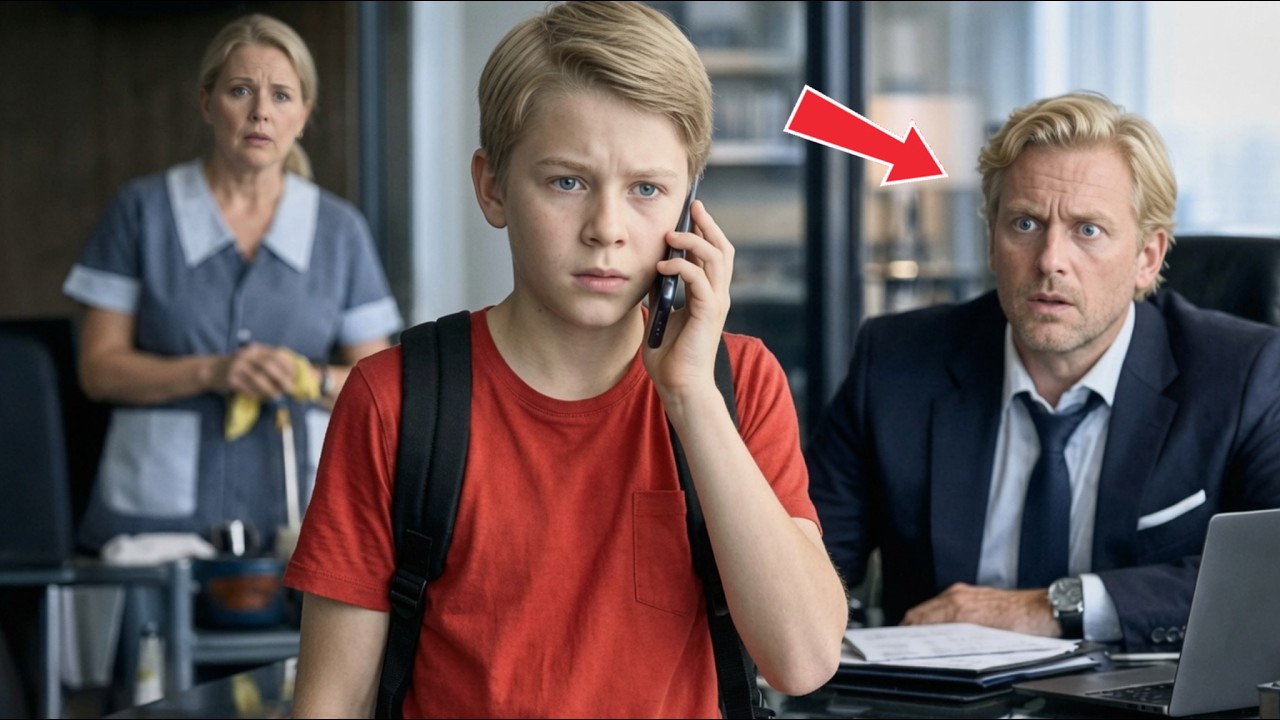
And now, with the line open, no one in the room could speak the only language that mattered. None of them understood German. On the other side of the glass, in the corridor, Mette was wiping down the floor with her cleaning cart. She was a temp, called in for extra day work because the regular cleaner was out.
She had been told to keep her head down. She had brought her twelve-year-old son, Emil, because the school was closed and she had no one else to watch him. She had told him to sit quietly in the corner and not talk to anyone. Emil was used to this.
He was a quiet boy, too quiet for his age. He sat on the small chair with his worn backpack on his lap. Inside was a notebook, old and unremarkable, the kind no one would ever look at twice. That was exactly how he wanted it.
The notebook was filled with German words, short phrases, and sentences he had written over the years. His grandmother, Ingrid, had moved from Germany to Denmark as a young woman. She had never felt at home, but she had never stopped speaking her language either. She would say, if I stop speaking German, I will disappear.
So she taught Emil. Every evening, while his mother worked, he sat in his grandmother’s small kitchen, surrounded by pots and memories, learning words the way other children learned songs. She had died two years ago. Emil still carried that notebook everywhere.
In the meeting room, the tension was suffocating. The German company had already postponed twice. Today was the final confirmation. The interpreter was contracted, expected to be available.
But he wasn’t answering his phone. The head of the legal department whispered to Søren that they had tried everything. No one in the building spoke German well enough to handle a contract negotiation. Someone suggested speaking English.
The German client had made it clear: he wanted clarity, and he wanted it in German. The phone rang again. A woman from the legal team, pale-faced, answered it. Her expression turned to panic.
They are speaking German, she said, covering the mouthpiece. They are already talking. The room fell silent. She looked around helplessly.
Does anyone here understand this? One man raised his hand hesitantly. I know a few words, but I can’t respond. Another voice whispered, hang up.
Søren slammed his hand on the table. No. If we hang up, it’s over. He looked around the room at his diplomas, his seven-figure salaries, his experienced staff.
No one could solve this. No one even tried. In the corridor, Mette pushed her cart toward the support area, trying to be as quiet as possible. A woman in high heels had just scolded her for cleaning at the wrong time.
Mette had apologized and lowered her head. She knew how easily this job could disappear. She made no eye contact with anyone. But Emil had stopped walking.
The voice from the phone in the meeting room was now amplified, accidentally switched to the speaker as the legal assistant tried to change a setting. The German man on the other end was speaking fast, impatiently. Emil understood a full sentence, then another. His heart started pounding.
Mom, he called out softly. Mette turned, startled. Not now, Emil. But Emil wasn’t looking at his mother.
He was looking into the meeting room. He says he’s going to hang up, he blurted out, louder than he intended. Mette felt the floor disappear beneath her. Emil, be quiet, she whispered, almost in a panic.
But someone inside the room had heard him. One of the executives opened the glass door. Who said that? Emil swallowed as every pair of eyes in the room turned to him.
A man frowned. The cleaning woman’s son. Mette reached for him. I’m sorry, she said quickly.
He doesn’t know what he’s saying. Yes, I do, Emil replied, his voice thin. He said he’s going to hang up. The silence that followed was different from all the others that day.
It was not tension. It was confusion. Søren approached the door and looked at the boy as if he had never seen him before. You understand German?
He asked directly. Emil hesitated, glancing at his mother. Mette wasn’t just pale. She was ash-colored.
A little, Emil said. I learned it from my grandmother. This is not a game, said one of the executives. This is a million-kroner contract.
I know, Emil said, looking down. That’s why I said something. The phone was still open. The voice on the other end repeated itself with growing impatience.
The legal assistant held the device with both hands, unsure what to do. Answer it, Søren said suddenly. It wasn’t a friendly request. It was a tired order.
The assistant held the phone toward Søren, but Søren didn’t take it. He kept looking at Emil. You said you understand. What is he saying now?
Emil took a deep breath. He’s asking if anyone here speaks German. If not, he’s hanging up. A low, nervous laugh escaped one of the executives.
This is absurd. Søren didn’t laugh. The phone clicked from the other end. The call was about to drop.
Emil took a step forward without realizing it. Can I answer? No, someone said immediately. This is an adult conversation.
He’s a child, said another. This is insane. Mette felt her legs shaking. Emil, come here, she begged, almost crying.
The phone beeped again. A short warning. Last chance, the voice from the other end said, now audible even to those who didn’t understand German. Emil recognized the tired tone.
He looked at Søren. He’s hanging up now, he said. Søren stared at the boy for two seconds too long. Then he looked around the room.
He saw a meeting full of prepared, well-paid adults, unable to respond. Let him speak, Søren ordered. If it goes wrong, the responsibility is mine. The assistant handed the phone to Emil with trembling hands.
Emil closed his eyes for a second. He remembered his grandmother, telling him to speak slowly, to repeat back what he didn’t understand. He opened his eyes. Guten Tag, he said in German.
Almost perfect, in a voice too steady for a twelve-year-old boy. The room froze. But the silence wasn’t fear anymore. It was shock.
The voice on the other end stopped. The German man was not aggressive anymore. He was careful, guarded. He asked for confirmation on two points: a deadline and a liability clause.
Emil translated, pausing to organize the technical words in his head. The meeting room rushed to life. The legal team scrambled to draft a formal written guarantee within minutes. Emil relayed the information.
When he had to, he stopped mid-sentence. Wait, he said, covering the microphone. If I say it that way, it sounds like a vague promise. We need to say that the document is already in final review and that the sending is planned.
Not that we will try. Søren looked at him with a calculating stare. That makes sense. Emil returned to the phone, choosing his words carefully.
The German man asked who he was speaking to. My name is Emil, he said. There was a pause. The man asked if this child was responsible for the negotiations.
Søren stepped closer. Tell him you are assisting the responsible team. Emil relayed the message. When he did not understand a word, he asked politely.
Can you repeat that, please? A little slower. The entire room held its breath. The repetition came, clearer.
The conversation continued for several minutes, exact and professional. At one point, Emil nearly confused a legal term. He stopped, covered the phone, and turned to the room. This needs to be confirmed for me.
A lawyer rushed over, looked at the document, and nodded. It’s correct. Emil nodded and continued. When the German man said he would wait for the email and would continue the process if he received it that day, Emil delivered the final sentence calmly: We confirm in writing within a few minutes.
We thank you for your patience. He took the phone from his ear. The dry click of the hung-up call echoed louder than it should have. For a few seconds, no one said anything.
No applause. No celebration. Only people staring at each other, trying to understand what had just happened. Emil handed the phone carefully back to the assistant.
Can I go now? he asked softly. Mette stepped forward immediately. We’re leaving now, she said, her voice shaking.
Søren raised his hand. One moment. Mette froze. Søren looked at Emil again.
There was no calculation in his eyes now, just something harder to define. You said you learned this from your grandmother, he commented. Emil nodded. Yes.
I want to understand that better, Søren said. Then he turned away. That afternoon, the building was quieter. Mette finished her last round with a neutral, beaten-down calm.
Emil sat in the support area, hugging his backpack to his chest. Two hours passed. They were not told to leave. They were not told what would happen next.
They just waited. Then an assistant appeared. Mr. Jensen asks you to wait, he said neutrally.
He will call for you shortly. Mette sat down next to her son and smoothed his hair. God be with us, she muttered. An hour later, the assistant returned.
You can come in now. Søren’s office was smaller than Emil had imagined. It was functional, cold, but not hostile. A window overlooked the city.
Søren sat in rolled-up shirtsleeves, looking more tired than powerful. Have a seat, he said, gesturing to the two chairs. Mette sat down as if she were taking up space that didn’t belong to her. Emil sat beside her, hands clenched on his backpack.
Søren broke the silence first. What your son did today was not ordinary. But it wasn’t a miracle either. It was a consequence.
A consequence of listening, of attention, of something that’s rare in environments like this. Emil looked down at the table. The room was still. I said I wanted to understand it better, Søren continued.
And I do. Not to blame you, but to truly understand. He told them about his new program, a scholarship for Emil at a school with strong language instruction, German included, with materials, transport, and pedagogical support. Emil’s eyes went wide.
I didn’t ask for this, he said quickly. I know, Søren replied. That’s exactly why I’m offering it. Then he turned to Mette.
Her current contract, he knew, was unfair. Night shifts, no stability. Are you offering me a better position? She asked, trying to understand.
Søren slid a second document across the desk. Shift adjustments, permanent employment in a regular team, basic benefits. Nothing extravagant beyond what was realistic. I’m not offering money in exchange for what happened, he said.
I’m offering dignity, so you don’t have to choose between working and protecting your son. Mette’s hands were shaking. I don’t know if I can accept. I’ve never received anything like this.
Accepting it isn’t a favor, Søren replied. It’s recognizing that someone saw value where there was only a function before. Emil looked at his mother, then back at Søren. My grandmother, he began hesitantly.
She would have liked this. Søren smiled faintly. I expect she would. You have time to think about it, Søren added, his tone businesslike but not unkind.
Talk it over. Come back when you’re ready. Mette nodded, standing. Thank you for seeing us, she said, uncertain whether this was good or bad.
Søren opened the door for them. Sometimes, he said quietly, you only realize what you have when you’ve almost lost it. The next day, Mette went to work as usual. But things had changed.
A staff member nodded to her in the corridor. A man stepped aside to let her pass without complaint. No one said anything outright. The change was in the air.
Later that week, at a school assembly, Emil wrote in his notebook in Danish, his thoughts on what had happened. He wrote about his grandmother, how she had unknowingly given him not just a language, but the ability to listen without fear. Then he stopped writing, closed the notebook, and put it in his backpack. Tomorrow would be the beginning of something new.
The first week at his new school was harder than Emil had expected. The halls were wider, the classrooms brighter, the desks didn’t squeak. He arrived the first day with his same worn backpack. A boy next to him looked at him with curiosity but said nothing.
During recess, he stayed in the classroom. He didn’t want to socialize. He just wanted the day to end. A girl hesitated before leaving.
Aren’t you coming out? She asked. Emil shook his head. I’m fine here.
The girl shrugged. Suit yourself. I’m Sofia, by the way. Emil told her his name, though she already knew it.
He went home that day with a hollow expression that his mother saw through immediately. She gave him time. When he came home from school, he wrote one sentence in his notebook: I don’t know if I belong here. Days passed like this, weeks of quiet attendance, of him never raising his hand, even when he knew the answers.
One evening at dinner, Mette put her hand over his. Talk to me, she said. Emil finally looked up. No one sees me, Mom.
They see the poor boy who got lucky. Mette took his face in her hands. You’re not less than anyone because of what we don’t have. You earned your place.
Show them who you are. Don’t hide. The next day, in German class, the teacher asked for volunteers to read a text aloud. No one raised a hand.
Emil remembered his mother’s words. He remembered his grandmother’s voice. He remembered the day in the building. He raised his hand.
His pronunciation was perfect, fluid, natural. The classroom went silent. When he finished, the teacher applauded. Outstanding, Emil.
Where did you learn to do that? In the schoolyard, Sofia came up to him. Can you teach me? I’m failing that class.
Emil hesitated. Others were listening too. Okay, he said. I can help.
He didn’t eat lunch alone that day. Over the following weeks, he began to participate in all classes. His teachers noticed his intelligence and dedication. He helped his classmates with German.
He gave a presentation on German immigration to Denmark that impressed the whole room. Slowly, he stopped being the new boy and became just Emil. But not every day was easy. After a particularly difficult exam, he came home quiet.
His mother sat beside him. It’s hard, Mom, he admitted. I feel like I have to be perfect. Every mistake will prove I don’t deserve to be here.
Mette looked at him steadily. You don’t need to be perfect. No one is. You just need to do your best, and you already are.
At the end of the first month, the school held a cultural presentation. Emil stood in front of the class and recited a German poem his grandmother used to say to him. His voice broke a little in places, but he finished. The silence that followed was deep, then broke into applause.
Sofia approached him afterwards. It was beautiful, she said. Your grandmother would be proud. He smiled.
I hope so. On the way home, he took out his notebook and crossed out the sentence about not belonging. Underneath, he wrote a new one: I am still finding my place, but I will find it. At Mette’s work, the shift from night to day had been more significant than she had anticipated.
For the first time in years, she could walk through the building in the light. She could see the faces of the people she shared the building with. She was no longer a shadow. She was given a permanent access card.
Her name was on a locker. She had medical evaluation forms, paid leave, and a team. Her supervisor, a kind-eyed veteran, introduced her to the day staff. She drank coffee in the morning with her new coworkers, talked about weekend plans and families.
One day, one of her coworkers said, you’ve been working like no one else. The simple recognition made her eyes sting. Not everything was smooth. She overheard whispers sometimes, the ones saying she only got the job because of her son.
The words stung. From then on, she held her head higher. When the janitorial supervisor pulled her aside at the end of the quarter and handed her an evaluation with excellent marks in every category, she saw the comment at the end: I recommend considering growth opportunities for this employee. Her permanent position came with responsibilities.
She treated her own subordinates with the respect she had always craved. One morning, a young executive approached her, her voice kind. Are you the mother of the boy who speaks German? Mette straightened.
Yes. The woman smiled. He gave a presentation at my little brother’s school. He told me about it.
He said it was inspiring. Mette’s heart swelled. He’s a good kid. The months passed.
Emil adjusted. Mette found her rhythm. And the months turned into a year. On the day of the school’s annual close-of-semester event, Emil was chosen to give a speech on behalf of the new students.
His first reaction was panic. I can’t do this, he told his mother. You already spoke in front of executives when you saved a multi-million-kroner contract, she said. This is different, he protested.
That was on the phone. This is in public. Mette looked at him. Remember what I told you.
It’s not about being perfect. It’s about being real. The auditorium was filled with parents and students. Mette sat in the middle rows, wearing her best clothes.
When they called Emil’s name, she saw him hesitate at the podium. Then he took a deep breath. My name is Emil, he began, his voice quavering at first. And six months ago, I didn’t know if I belonged here.
He spoke about his mother, who worked as a cleaner. He spoke about his worn-down apartment building. He spoke about a school with torn books and windows that didn’t shut properly in winter. He spoke about coming to this school and feeling like he had to hide his background.
Then he spoke about his grandmother. I learned German not in an expensive school with certified teachers. I learned it in a small kitchen, between pots and memories. She taught me that the most valuable things aren’t always wrapped in luxury.
And because a language program on compassion existed, I was able to help. But it wasn’t the language that mattered, he said. It was the opportunity. And having people who refused to look away.
He looked directly at the audience. Some of you have more than I do. Don’t look down on those who have less. My mother cleans offices, but she gave me values that money can’t buy.
Dignity doesn’t come with a job title. It comes from how we treat each other. To the students like me, don’t be ashamed. Use your story as a strength.
Work twice as hard if you need to, but never accept that you deserve less. He paused, then finished. We won’t be remembered for how much we had, but for how much we shared. The audience rose to their feet.
Below the stage, Mette was openly weeping. Søren stayed until he spoke to them at the parking lot, in casual clothes. He had watched from the back, unseen. That’s a fine speech, young man, he said.
You spoke truths many adults are afraid to say. Emil looked at the ground. Then Søren told them something else: the company was creating a scholarship fund for employees’ children with academic talent. Emil was the inspiration for it.
That same year, Mette was promoted to shift leader. She had her own small office and her own team. And in her new position, she made sure no one under her supervision ever felt invisible. One evening, over dinner at home, Mette asked her son what he wanted to be when he grew up.
Emil put down his fork. I want to create language programs for communities that can’t access them, he said. So that children like me can learn, not because their parents can pay, but because they want to. Your grandmother would be proud, Mette said.
Two years later, Emil graduated from high school with honors. In his graduation speech, he said, We all have a call to answer. Not necessarily in German. Not necessarily in an office.
But we all have the moment where we can choose between staying silent or speaking up. I chose to speak. And it changed my life. A year after that, Emil founded a language program for underserved communities.
Mette became an operations manager. Søren expanded the company’s opportunity programs to other businesses. But the most important thing wasn’t the position or the program, it was the quiet change that rippled through so many lives. Men and women who had been invisible were now seen.
Talents once ignored were now recognized. Doors that were closed were now opening. Because sometimes, the greatest things begin with the smallest gestures. A grandmother who teaches her grandson her words.
A mother who works in silence. A boy who answers a phone. And someone who decides to truly look. That’s all it takes to change a life.
Or maybe, to change the world.