The laughter stopped him cold. Frederik Jacobsen didn’t cry. He never cried. He’d signed contracts worth hundreds of millions without a tremor, buried his wife without shedding a single tear in front of anyone, and built a business empire from nothing with the cold calculation of a man who’d learned early that feeling was a luxury winners couldn’t afford.
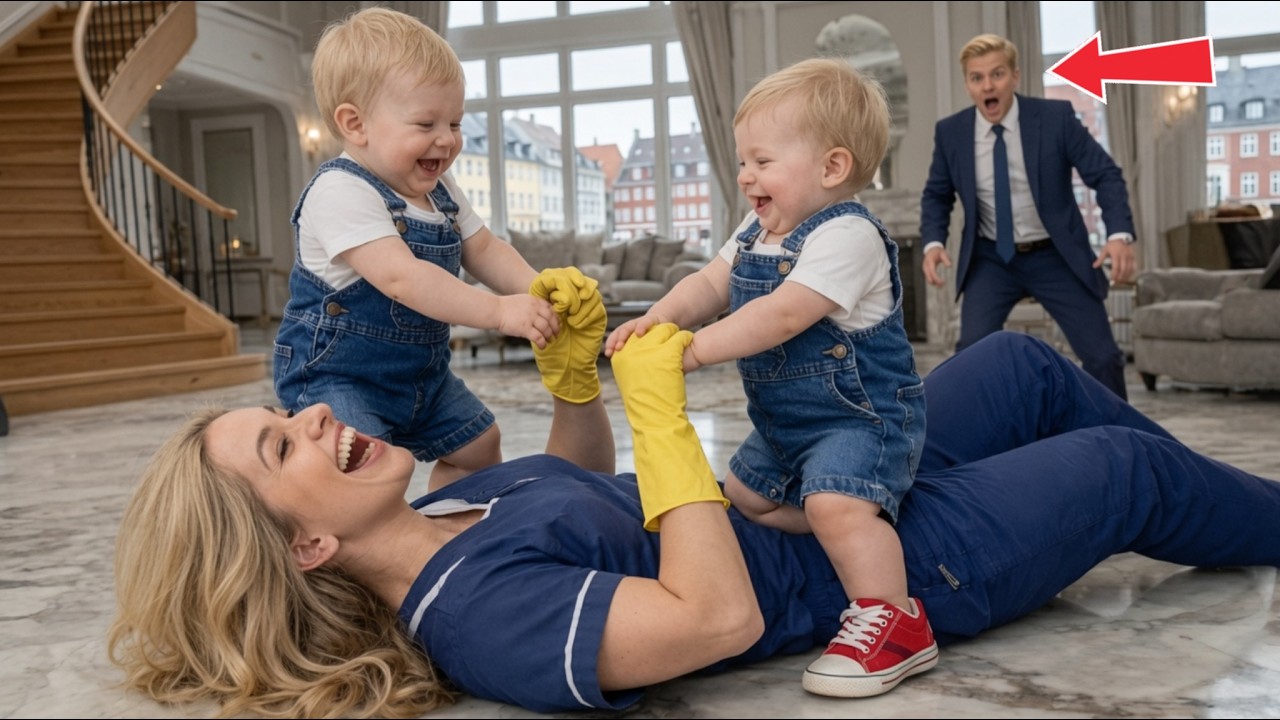
But that morning, standing in the doorway of his own kitchen, he heard his children laugh. It wasn’t the first time he’d heard them laugh. But there was something different about these bursts of joy—something deeply genuine and free, as if his two small sons had found the purest version of happiness in that moment. What stopped him dead, what made him grip the doorframe as if the ground had shifted beneath his feet, was that the laughter wasn’t coming from the playroom or the garden.
It was coming from the living room. His living room, with the imported Italian furniture, the marble floor from Turkey, and the crystal chandeliers that had belonged to his late wife. The room where no one—absolutely no one—went without his express permission. Frederik walked slowly down the hallway.
What his eyes found when he rounded the corner was an image that would be burned into his chest forever. Ida Jensen, his housekeeper, who had only worked in the villa for four weeks, lay sprawled on the marble floor, completely surrendered to laughter with her yellow cleaning gloves in the air, while Emil and Lukas, his twin sons, pulled at them with wild and pleading determination. The three of them lay together as if they were the only family in the world. As if this fifteen-room villa was simply the best playground in the universe.
Frederik said nothing. He couldn’t. Because in that moment, with his hand still clinging to the doorframe, he understood something that struck him with silent, devastating force. It had been over a year since he’d last heard that laughter.
Since the twins learned to walk, since the house was emptied of the only person who knew how to fill it, Emil and Lukas had been surrounded by professional educators, certified nannies, and personalized staff who performed their functions efficiently but without soul. And within weeks, this woman, this housekeeper who arrived with a single suitcase and handwritten references, had achieved what none of them had managed. She had brought laughter back into his home. The day Ida Jensen rang the doorbell of the Jacobsen villa, she didn’t arrive with high expectations.
Sofie, her former colleague, had told her that the master of the house was complicated—that polite word people use when they mean something much harder. She told her that the last three employees had quit in less than two months, that the atmosphere was as cold as the marble floors, and that the babies, though adorable, cried often without anyone really knowing why. “They’re babies,” Ida said simply. “Babies cry when they need something.
It’s not always hunger or sleep. Sometimes they just need someone to truly see them. ”
Sofie looked at her as if she’d said something either very profound or very naive. She still didn’t know which of the two it was.
Mr. Knudsen, the butler, opened the door that morning with the neutral expression of a man who had seen many people come and go through that entrance and no longer placed bets on anyone. He assessed her silently, took her documents, made her wait in a reception room where the sofas were so elegant one was afraid to sit on them, and disappeared upstairs. Ida waited.
She looked at the portrait hanging over the fireplace. A woman with a calm smile and light eyes, holding a baby in each arm. There was no name, no date. Only that image, filling the room with a presence that Ida immediately felt.
The presence of someone who was no longer there. That’s their mother, she murmured to herself without addressing anyone. “Yes,” a voice answered, and she turned. Frederik Jacobsen stood in the doorway in a dark suit with the gaze of a man who had slept poorly for too long.
He was younger than Ida had imagined, but his eyes had the heavy depth of someone who had experienced too much in too short a time. “I’m sorry,” Ida said. And she meant it, without protocol, without form. She said it the way only someone who knows what it means to lose says it.
Frederik looked at her a second longer than necessary. Then he opened the folder with her documents and began the interview. It was brief. Frederik Jacobsen was not a man who beat around the bush.
“My children need a constant person. Not someone who leaves when things get complicated. ” He paused. “Things here get complicated.
”
“I understand,” Ida replied. “Do you have experience with twins? ”
“I have experience with love,” she said, with a calm that wasn’t arrogance but pure conviction. “The rest you learn.
”
Mr. Knudsen, observing from the side, lowered his gaze to hide a smile. Frederik didn’t smile, but he didn’t dismiss the answer either. “You start Monday.
”
In the first weeks, Ida learned the rhythms of the Jacobsen villa with the same dedication she learned everything else. She observed. She listened. She understood before she acted.
She learned that Frederik left before dawn and returned when dinner was already cold. She learned that Mr. Knudsen had arthritis in his right hand but never mentioned it. She learned that the twins had personalities as different as their laughter—Emil was curious and adventurous, Lukas was observant and deep, as if he were trying to understand the world before moving through it.
And above all, she learned that this villa was an unusually beautiful and unusually lonely place. No one spoke more than necessary. No one stopped. No one asked how the other was doing.
The rooms were spotless. The food was perfect. The schedules were precise. And yet something fundamental was missing between those walls.
Something Ida recognized from the first day but took time to name: human warmth. It was Lukas who chose her first. One morning, while Ida was tidying up the playroom, the little boy crawled to her feet, looked up at her with his big serious eyes, and stretched his arms toward her with a determination that didn’t allow for no. Ida lifted him without hesitation, and Lukas laid his little head against her shoulder and breathed out, as if he had been waiting for weeks for exactly that moment.
Something moved in her chest. Something that had to do with all the things she herself had lost, with all the arms that hadn’t been able to hold her when she needed to be held. She gently hugged the little boy and closed her eyes for a moment. “I’m here now,” she said softly.
“I’m here now. ”
Emil, observing them from the other end of the room with a toy in his hand, dropped it and came running too. From that day, something changed in the Jacobsen villa. Not suddenly, not loudly.
It changed the way true things change—slowly, from within, without asking permission. Frederik noticed it without wanting to. First he ignored it with the same discipline he ignored everything that threatened to disturb him. But the signs accumulated relentlessly.
The twins looked better, ate better, cried less. Mr. Knudsen walked around with a different, lighter expression, as if something in the house’s atmosphere had removed a burden he had carried for too long. And the mornings, which before were silent to the point of seeming empty, now carried new sounds from the kitchen or the living room—half-mumbled songs, small bursts of laughter, the particular sound of someone genuinely happy with what they were doing.
Frederik didn’t know how to react to it. He had no protocol for it. What he knew was that he had a business trip coming up that would keep him out of the country for a while. A strategic meeting he had postponed twice and could no longer postpone.
His legal team was waiting. His international partners had blocked the calendar, and the contracts on the table were worth more than anything else in his professional life. Or at least, that’s what Frederik Jacobsen kept telling himself that afternoon as he reviewed documents in his study and heard voices in the hallway. He recognized Louise, his sister-in-law, who had come without notice as always.
“But darling, how long have you been here? ” he heard Louise say with that soft, sharp tone she used when extracting information. “And is Frederik satisfied with your work? ”
“Mr.
Jacobsen is satisfied,” came Knudsen’s calm voice. “Fine, fine. ” Louise paused, calculating. “It’s just, I’m worried.
You know how Frederik is. He attaches himself without realizing it. And afterwards, well, we saw what happened last time. ”
Frederik squeezed the pen in his hand until his knuckles went white.
Last time. Always last time. Louise never missed an opportunity to remind him that trusting people was a mistake he’d already made before. That the world was full of people who approached those with money, with intentions that weren’t what they seemed.
That with his position and fortune, he was a permanent target. And the worst part was that a part of Frederik, the part built on the ashes of too many disappointments, believed her. The night before his scheduled departure, Frederik walked past the twins’ room and stopped without really knowing why. The door was ajar.
From inside came Ida’s voice, soft as water over stones, telling a story she was inventing in the moment. He could tell by the way the words appeared unhurriedly, building a small bright world, precisely crafted for two children falling asleep while listening. Frederik leaned against the hallway wall, closed his eyes, and for the first time in a long time, he didn’t think about numbers or contracts or what he would lose if he made a mistake. He thought about the woman in the portrait over the fireplace.
He thought about what she would have said if she saw him standing there in the dark, spying on his own children’s happiness from the outside, as if he had no right to enter. He thought that maybe Louise wasn’t always right. But the next day, when his assistant confirmed the plane was ready and the contracts were waiting, Frederik Jacobsen took his suitcase, said a brief goodbye to the twins that didn’t quite become a hug, and walked out through the front door of his villa. What no one knew—neither Mr.
Knudsen, nor Louise, nor Ida herself—was that Frederik never got on that plane. Because something in that chest that supposedly felt nothing told him that if he left at that moment, he would lose something no contract in the world could give back. And for the first time in years, Frederik Jacobsen chose to listen. Frederik Jacobsen had never spied on anyone in his life.
He was a direct man with a direct gaze and conversations that went straight to the point. In the business world, that quality had earned him as much respect as enemies. But that morning, hidden behind the staircase panel in his own villa, with his briefcase still in hand and the taxi that was supposed to take him to the airport waiting outside, Frederik Jacobsen did exactly that. He spied.
And what he observed from the shadows was nothing like what Louise had hinted at. There was nothing suspicious, nothing calculated, nothing that justified the mistrust his sister-in-law had planted in his chest like a bitter seed. What was there was something far harder for a man like him to process. Life.
Ida was in the kitchen with the twins, and the scene was so simple and so powerful at the same time that Frederik couldn’t look away. Emil was trying to reach a spoon that was out of his reach, making that sound of frustration small children make when the world doesn’t cooperate with their intentions. Ida, without stopping her tidying, reached out, handed him the spoon, and then said something low that made the boy burst into such genuine laughter that it echoed through the entire hallway. Frederik felt something strange in his chest.
It wasn’t emotion. It couldn’t be emotion. It was simply an objective observation from a man stating a fact. His children were doing well.
Better than well. They were exactly as they should be, and that was what mattered. He repeated that three times to himself. Then he stayed for another twenty minutes behind the panel without moving.
It was Mr. Knudsen who discovered him. The butler appeared from the side hallway with the silent punctuality that characterized him. When he found Frederik pressed against the wall as if he were part of the furniture, he said nothing for a moment that stretched long enough to be significant.
“The taxi is still waiting,” he said finally, with a neutrality so perfect it was almost an art form. “I know,” Frederik replied without moving. A new silence. “Should I cancel it?
”
Frederik looked at the butler. Mr. Knudsen held his gaze. In his years of service, the old man had witnessed a person’s most contradictory moments and had learned not to judge any of them.
“Cancel it,” Frederik said finally. “And tell no one I’m still here. ”
Mr. Knudsen nodded briefly.
Before he left, he allowed himself an almost imperceptible pause. “She is a good woman, Mr. Jacobsen. ”
He didn’t wait for an answer.
He didn’t need one. Frederik spent the morning in his study with the door ajar and documents open on the desk without his eyes really reading anything. From that position, he could unintentionally hear the sounds traveling through the villa like something entirely new. Small clumsy steps on the marble.
A song Ida hummed while working—something soft without lyrics, more feeling than melody. Lukas’s voice asking about something that wasn’t quite a word yet but already had full intention of becoming one. And Ida’s response—patient and clear, as if every babble from that child deserved the same attention as an important question. In the middle of the morning, something happened that Frederik hadn’t expected.
He heard Emil cry. Not the cry of hunger or tiredness. He’d been a father long enough—even an absent one—to distinguish those sounds. This was the sudden, surprised cry of someone who has hurt themselves, of someone who has just discovered that the world can cause pain.
Frederik rose instinctively with the primitive reflex that no cold man can completely extinguish when it comes to his children. But before he could move, he heard Ida’s voice. She didn’t come running. She didn’t come with the exaggerated panic many adults unconsciously infect children with.
She came with quick but certain steps, and her voice was the first thing to appear, before her arms, before any gesture. “I’m here, I’m here. Now, show me. ”
Emil, between sniffles, pointed at his knee.
“Ow. That really hurts,” Ida said with an honesty Frederik hadn’t expected. “Of course it hurts. You have every right to cry.
”
The boy looked at her in surprise, as if no one had ever given him permission to feel what he felt. “But look,” she continued, her voice dropping to almost a secret. “The brave ones aren’t those who don’t cry. They’re the ones who cry, wipe their tears, and keep going.
Do you want to be one of them? ”
There was a short pause. Then Emil’s crying became a sniffle, the sniffle became a sigh, and the sigh became a small but determined, “Yes. ”
Frederik stood in the middle of his study with his hand still on the chair back, not having moved.
He sat down slowly, and for the first time in longer than he wanted to remember, he felt his eyes burn. Dinner brought a visit Frederik had neither asked for nor wanted. Louise appeared at the garden side door, entering as if the villa were also her home, carrying a bag from an expensive bakery and a smile that always came one step ahead of her true intentions. “I came to see my nephews,” she announced when she met Mr.
Knudsen in the hallway, “and to see how everything is while Frederik is away traveling. ”
“Mr. Jacobsen is not traveling,” Mr. Knudsen replied.
Louise blinked. “What? ”
“Mr. Jacobsen is in his study.
Would you like me to announce your arrival? ”
There was a brief silence in which Louise collected her expression with the practiced speed of someone caught off guard but perfectly capable of pretending she wasn’t. “Not necessary. I wouldn’t want to disturb him.
”
But instead of retreating, she continued toward the living room, where Ida was with the twins. Frederik, who had heard everything from the adjacent hallway, didn’t go in. He waited. “Oh, how sweet you are,” Louise said with the selective tenderness she used when someone was watching.
“And you’re the new housekeeper. Ida Jensen, right? ”
“Yes,” Ida answered simply. “How lovely.
” Louise looked slowly around the room. “Small children are so vulnerable, aren’t they. They need stability, not attachment to people who might be gone tomorrow. ”
The remark hung in the air the way Louise’s remarks always did—wrapped in enough politeness not to be directly attackable, but with a sharpness in the center that no one could ignore.
Ida paused, arranging a toy Lukas had handed her. She gave it back to the boy with a genuine smile, then looked at Louise with a calm that wasn’t coldness but something harder to destabilize. “You’re right,” she said. “Children need stability.
That’s why I’m very careful not to make promises I can’t keep, and to keep everything I promise. ”
Louise smiled—the smile of someone storing away an answer for later use. “How admirable,” she said. And she said goodbye with the same lightness with which she had come.
When Louise had gone, Frederik finally emerged from the hallway. He didn’t go into the living room. He went to the kitchen. He poured himself a glass of water he didn’t need and stood at the window, looking out at the garden without really seeing anything.
Mr. Knudsen came in minutes later with his usual discretion. “Mrs. Louise asked about the housekeeper’s employment documents,” he said directly, but without emphasis.
“She wanted to verify her references. ”
Frederik turned slowly. “She asked for them? ”
“She hinted at it.
I told her the documents are confidential. ”
Frederik set the glass down on the counter with a calm that cost more than it appeared. “No one touches those documents without my permission. Understood?
”
“Perfectly, sir. ”
Mr. Knudsen moved to withdraw, but Frederik spoke again. “Knudsen.
A question. How long have you worked for me? ”
The butler considered the question with the seriousness it deserved. “Since before they were born, sir.
I worked for their father first. ”
Frederik nodded slowly. “Then you know me well enough. Do you think I’m wrong to be cautious, Knudsen?
”
Mr. Knudsen took a moment—the silence of a man who has a clear opinion and is deciding whether the time is right to share it. “I believe, sir,” he said finally, “that there is a difference between being careful and missing what is right in front of you. And I also believe that your wife, if she could share her opinion, would know exactly what to say at this moment.
”
Frederik didn’t respond, but he didn’t stop the butler when he withdrew. That afternoon, from the first-floor gallery, Frederik watched unseen as Ida took the twins out into the garden. It wasn’t part of her formal duties. No one had asked her to do it.
She simply did it because the children needed it and she knew. Emil chased a butterfly with the absolute concentration only small children have when something captivates them. Lukas, on the other hand, sat in the grass looking up at the sky with the expression he had of processing something too large for his size. Ida was between the two worlds, ready for either.
At one point, Lukas stretched his arm upward without looking at Ida, as if pointing at something in the clouds. And Ida sat down beside him, followed his finger with her eyes, and nodded slowly, as if she perfectly understood what the child was seeing—even though he hadn’t said a single word. Frederik gripped the gallery railing. There was something in that small gesture.
Something that didn’t need words, that understood without needing explanations, that felt deeply familiar to him. It took him a moment to understand why: it was exactly what his wife used to do with him. That realization came without warning and settled in the middle of his chest with the weight of true things. It wasn’t a comparison.
It wasn’t a replacement. It was simply an acknowledgment that love, when genuine, has universal gestures—and his heart, locked up for so long, had just recognized one. That evening, long after the twins had fallen asleep and the villa had regained its usual stillness, Frederik found himself doing something he hadn’t done in a long time. He walked to the portrait over the fireplace and stood looking at it.
His wife’s smile was exactly as he remembered it—calm, without pretense. The kind of smile that doesn’t need a grand reason to exist. “I don’t know what I’m doing,” he murmured low, as if she could hear him. “I don’t even know why I didn’t leave.
”
The silence didn’t answer, but it didn’t contradict him either. What did come floating from a corner of the ground floor was the soft sound of a song. The same one Ida hummed in the morning—without words, only melody, only feeling. Frederik listened to it to the end.
When it stopped, he walked up to his room with something he couldn’t quite name but that, for the first time in a long time, didn’t weigh him down. It weighed just enough to be significant. Because the next day, Louise would make a phone call that would change everything. Louise Jacobsen never did anything without a purpose.
Every visit, every smile, every seemingly innocent question had a precise direction, like an arrow that already knows its destination before being released. Frederik had always known this. Ever since he was a child and his older brother brought that woman into the family. Louise had known how to win that place with patience and intelligence.
No one could deny her that. But that morning, when Mr. Knudsen informed Frederik that Louise had made some phone calls from the living room before she left yesterday, something tightened in Frederik’s stomach with the precision of someone who knows certain patterns all too well. “Do you know who she called?
” Frederik asked without looking up from his desk. “No. But the call lasted a long time, and when it ended, Mrs. Louise was different.
More satisfied. ”
Frederik closed the folder in front of him. “Thank you, Knudsen. ”
The butler nodded and withdrew, leaving Frederik alone with that information and everything it might mean.
What Frederik didn’t know was that at the same time, in a small apartment on the other side of the city, Sofie Nielsen—the woman who had recommended Ida for the position—was looking at her phone with an expression that mixed guilt with something she hadn’t yet decided what to call. Louise had been clear, direct, and generous in her phone call. Too generous for it to be a casual gesture. She had asked about Ida with the studied delicacy that feigns concern while actually extracting information.
And Sofie, who wasn’t a bad person but also wasn’t brave, had talked more than she should have. She hadn’t lied. That was the problem. She had told truths.
Truths that, out of context, in the wrong hands, could transform into something entirely different from what they were. Sofie put the phone down on the table and looked up at the ceiling. “My God,” she murmured. “What have I done?
”
Ida knew nothing about any of this. That morning had begun like the previous ones—with the twins waking before the sun had fully made up its mind, with Lukas demanding attention with the seriousness that made one laugh, with Emil already standing in his crib, bouncing with an energy that seemed to have accumulated all night. But there was something different about that day. Something Ida noticed without being able to pinpoint exactly what it was.
Like when the weather shifts and the body feels it before the clouds appear. Mr. Knudsen was quieter than usual, which said a lot for a man already formal by nature. “Are you well, Mr.
Knudsen? ” Ida asked as she prepared the children’s breakfast. The butler looked at her for a moment with the expression he had when processing things before giving them back. “I am well, Miss Ida.
” He paused briefly. “And you? Is this a simple question, or is there more behind it? ”
Ida smiled—a smile that had more history than joy.
“I’m well. Though sometimes I miss… people. ”
“Whom?
”
Ida’s smile turned softer. “My mother. She always said that a house feels different when there’s love inside it. That the walls absorb it and keep it.
” She glanced around the living room. “This house has had it once. You can feel it. ”
Mr.
Knudsen took a moment that was itself an answer. “That is true,” he said finally. “And those who let it fade here don’t deserve to lose it. ”
Frederik listened to that conversation from the hallway.
He hadn’t planned to listen. He was walking down to find some documents he needed to review. And Ida’s voice stopped him before his feet had fully decided where to go. He stood motionless, and the woman’s words reached him with the same clarity as the things that reach a person when they need to hear them, even if they don’t know it.
This house has had it once. You can feel it. Frederik leaned against the wall, just like the evening before in front of the twins’ room. His wife’s name was Isabella Holm Jacobsen.
And she had filled the villa with exactly what Ida described—not with grand gestures or elaborate words, but with the constant and bright presence of someone who knows how to be present, who knows that love isn’t an event but a decision made every morning. When Isabella died, Frederik had hidden all of that away. Not because he forgot it, but because he didn’t know how to keep it close without it hurting so much that it became unbearable. And now this woman, this housekeeper who didn’t know him at all, had named exactly that with the simplicity of someone who doesn’t know she’s just touched something sacred.
The revelation came that afternoon, and it didn’t come from where Frederik expected. Louise showed up again, this time with visible intent from the moment she crossed the door—without the bakery bag and without the polite smile. She came with information. People like Louise, when they have information, know how to store it for a long time.
They store it long enough to use it at the moment it suits them best. Frederik received her in his study and closed the door. “I know some things about your housekeeper,” Louise said as she sat down with the elegance she never abandoned, even in the most uncomfortable moments. “What kind of things?
”
“The kind of things that you, as a father, have a right to know for my nephews’ sake. ” She folded her hands in her lap. “Ida Jensen worked for years in the Larsen family’s house. You know them—business people, good family.
The thing is, they let her go suddenly without an official letter of recommendation. Only handwritten personal references that anyone can fabricate. ”
Frederik looked at her without blinking. “And no one knows exactly why they fired her.
There are versions. ” Louise paused, the pause she always took before releasing what she really wanted to say. “They say she attached herself too much to the family’s children. That she began making decisions that weren’t hers to make.
That the children preferred her to their own parents, and it created conflicts. ”
The silence that followed was the kind every person fills with their own fears. Louise knew this. That’s why she let it linger.
“I’m just saying,” she continued with a softness that was her way of adding the final touch, “that someone who has already created a certain kind of situation in another family can do it again. And your children are very small, Frederik. Very vulnerable. They attach easily.
” She paused. “Just like you. ”
Frederik didn’t respond immediately. He looked out the window toward the garden, where Ida at that moment was walking with the twins, one child in each hand, letting their clumsy steps set the pace.
“Thank you for your visit, Louise,” he said finally. His sister-in-law looked at him, trying to read something in the expression he had learned to make impenetrable. “Is that all you’ll say for now? ”
“Yes.
”
When Louise had gone, Frederik stood for a long time at the window. The information she had brought wasn’t a lie. That was the most complicated part. It wasn’t an invention or an obvious exaggeration.
It was something that could be true—or it could be the edited version of an entirely different truth. And Frederik Jacobsen, who had built his career on the ability to distinguish between facts and convenient narratives, knew very well that those two things don’t always look alike. Attaching herself too much to the children. Making decisions that weren’t hers to make.
The children preferring her. Was that a flaw? Or was it exactly what his children had needed? He sat with that question for the rest of the afternoon.
It was Mr. Knudsen who, without intending to, gave him the first real piece of the puzzle. That evening, while Frederik ate dinner alone in the dining room as always, the butler came in with the coffee and allowed himself one of those pauses Frederik had already learned to read as a prelude to something important. “Mr.
Jacobsen, this may not be my place,” he began. “Tell me. ”
“Years ago, before you hired the previous nannies, I conducted some background checks on candidates. It’s something I do—a habit, not a lack of trust.
” A new pause. “When Miss Sofie recommended Ida, I checked too. I found nothing that gave cause for concern. I found something else.
”
Frederik set the cup down. “What did you find? ”
“That when Ida left the Larsens, the children refused to eat properly or sleep peacefully for weeks. That Mrs.
Larsen privately admitted she had made a mistake in letting her go. That the real reason Ida was dismissed wasn’t Ida herself. ”
Mr. Knudsen held his final pause, the longest one.
“It was Mr. Larsen, who couldn’t bear that his own children ran into the housekeeper’s arms before his. And instead of asking himself why, he decided to remove the comparison. ”
The silence that followed was entirely different from the one Louise had left hours earlier.
It wasn’t filled with fear. It was filled with recognition. Frederik looked at the butler for a long moment. “Why didn’t you tell me this before?
”
Mr. Knudsen answered with a simplicity that was itself the most honest response he could have given: “Because before, sir, you weren’t ready to hear it. ”
That evening, Frederik went up to the twins’ room before Ida had finished putting them to bed. He stood in the doorway, as he had done other times, but this time he didn’t hide.
Ida saw him and didn’t look surprised. She simply made space—a small, natural gesture, like someone opening a door she already knew someone would eventually want to cross. Frederik walked in slowly and sat on the edge of Lukas’s bed. The boy looked at him with those big serious eyes he had, and then, with the overwhelming logic small children possess, placed his little hand on his father’s hand.
Frederik didn’t move, but something in his expression changed in a way Ida clearly saw. Not because she had known him her whole life, but because there are certain moments in people that don’t require explanation. They’re universal. They’re the exact moment when someone who has resisted for too long finally stops.
Emil, from his bed, stretched his arms out toward his father. And Frederik Jacobsen, for the first time since these children were born, lifted them both at once, held them against his chest, and closed his eyes. Ida left the room in silence. In the hallway, she leaned against the wall with her heart pressed by a feeling that didn’t yet have a clear name.
She understood that she had just witnessed something that didn’t belong to her, but that in some way was also hers, because she unknowingly had laid the first stone for that moment. And what would come after would prove that this stone was more important than anyone could have imagined. Because Sofie was about to appear, and what she brought with her would change everything. Sofie Nielsen was not a woman who made quick decisions.
She was the type to think twice, then three times, then once more for good measure. The type who preferred uncomfortable silence to direct confrontation. The type who carried others’ guilt along with her own without complaining too much. That’s how she had been her whole life, and that trait had saved her many conflicts and cost her many opportunities.
But that morning, looking out the window of her small apartment with the cold coffee in her hand and Louise’s conversation echoing in a guilty corner of her head, Sofie understood that this time, silence would cost her something she wasn’t willing to pay. It would cost Ida. And Ida didn’t deserve that. She stood up, grabbed her bag, and walked out before her habit of thinking too much could stop her.
She arrived at the Jacobsen villa without notice—with the honest clumsiness of someone who hasn’t fully planned what she wants to say but knows with certainty that she must say it. Mr. Knudsen received her at the door with his usual calm, and when Sofie asked for Ida, the butler observed her for a moment with his ability to read intentions, then said simply, “Follow me. ”
He led her to the small room in the left wing used for informal visits and went to fetch Ida.
But before he left, he stopped in the doorway and looked at Sofie with a look that carried the weight of a gentle warning. “Whatever you came to say, say it fully. Half-truths have already done enough damage in this house. ”
Sofie blinked.
“Yes, sir,” she replied with the voice of someone who had just received exactly the instruction she needed. When Ida entered the room and saw Sofie, her expression wasn’t surprise but something more complex. It was the expression of someone who senses that an unexpected visit rarely brings neutral news. She sat down across from her friend, folded her hands in her lap, and waited.
“I spoke with a woman named Louise,” Sofie said without preamble. “She called a few days ago and asked about you. And I talked more than I should have. ”
Ida didn’t respond immediately.
She looked at her friend with the calm she had that wasn’t indifference but control—the kind of control people develop who have learned that hasty reactions don’t always lead to good places. “What did you tell her? ”
“I told her about the Larsen family. ” Sofie lowered her gaze.
“I told her that they let you go suddenly, that there was no official letter. I said it as information, not as an accusation, but I know how that kind of thing sounds when it reaches the wrong ears. ”
Ida breathed out slowly. “Sofie.
I know. And I’m truly sorry. I shouldn’t have spoken without asking you first. I want to make it right, and to do that, I need you to let me tell Mr.
Jacobsen the whole story. The complete story, not the version Louise has already given him. ”
There was a silence that lasted long enough to have its own weight. “Has he already heard something?
” Ida asked. “If Louise has spoken to him… yes. And if she has, I can assure you she didn’t tell him the truth.
”
What had happened in the Larsen family was, like almost all complicated stories, much simpler than it looked from the outside. Ida had worked there for years, caring for two small children with the same dedication she did everything else. The children loved her. She loved them.
And that bond was visible and real. The problem was never the bond. The problem was Mr. Larsen, a successful and busy man who spent more time outside the house than in it.
One day he returned earlier than expected and found his children running toward Ida with open arms without noticing he had walked through the door. There were no shouts, no scenes. Mr. Larsen was too proud for scenes.
He simply called his wife that evening and told her it was time to do without Ida’s services. Mrs. Larsen, who inwardly knew it was a mistake, didn’t have the courage to contradict him. And Ida, to whom no one honestly explained anything, received a brief letter about restructuring the household staff and a dismissal that answered none of the questions she never got to ask aloud.
She left without fighting, without protesting, because Ida had learned early that some battles aren’t won with arguments, and that dignity sometimes means withdrawing without bowing your back. But what she took with her, what she carried silently for a long time afterward, was the image of the two children looking out the window as the taxi drove away—their small hands pressed against the glass, not understanding why the person who truly loved them was leaving without the goodbye they deserved. That image was what Ida had never told anyone. Not even Sofie.
Frederik listened to all this from the hallway. He hadn’t planned to listen. He had come downstairs because Mr. Knudsen had informed him, with the discretion that was really an invitation, that there was a visitor for Ida in the small room.
And Frederik, who for days had been navigating between doubt and something he still wouldn’t name, had walked toward the room with the intention of passing by. He didn’t pass by. He stood motionless as Sofie’s words painted an entirely different picture from the one Louise had installed in his head. And when Ida began to speak—when she described those children with their small hands on the window, with a voice trying to be calm but trembling just slightly at the edges—Frederik felt something break inside him with the surgical precision of truths that come late.
He had doubted her. He had listened to Louise. He had let mistrust install itself again, as it always did. And he had spent days watching Ida with the careful distance he called shrewdness but which was really fear disguised as intelligence—all while she unknowingly carried a story of loss that was almost identical in its emotional texture to his own.
Two people who knew what it meant to lose something they loved. Two people who had learned to keep going without making too much noise. Frederik withdrew from the hallway before they discovered him. He went up to his study and sat at his desk with his hands folded, his gaze fixed on a point that was neither a document nor a window.
It was the past. And for the first time in a long time, he looked at it not with fear but with something dangerously close to understanding. That afternoon, Frederik did something he hadn’t done in his entire professional life. He cancelled an important call.
His assistant on the other end of the line took a moment that said everything discretion prevented him from expressing verbally. “Reschedule it for tomorrow, Mr. Jacobsen. For next week,” Frederik said.
“I have something I need to take care of here. ”
He hung up before more questions could come. He went down to the garden, where Ida was with the twins under the shade of the large trees at the back. Sofie had already left.
Mr. Knudsen observed from the gallery with the expression of someone watching something they had waited a long time to see. Frederik approached slowly. Ida heard him coming and looked up.
And in her gaze, he read something clear. She didn’t know he had listened, but she knew something had changed. People like Ida, who observe more than they speak, always know when something shifts—even if they don’t know exactly what or how. “May I?
” Frederik said, gesturing to the grass beside her. Ida looked at him for a moment—the brief but genuine moment when a person decides whether to open a door or not. “Of course,” she said. Frederik sat down in the grass, suit and all, with shoes that cost more than many people earned in a month.
He sat down in the grass in the garden of his own villa as if it were the most natural thing in the world. And Emil, who understood nothing of protocols or hierarchies, immediately crawled onto his lap with a toy in his hand. Frederik received him without stiffness. They sat in silence for a long time.
It wasn’t an uncomfortable silence. It was the kind that arises between people who don’t need to fill the space with words to feel they’re communicating something. It was Frederik who spoke first, and he did so without looking at her, his gaze fixed on Lukas, who was examining a small stone with a scientist’s concentration. “Isabella, my wife, used to say that the garden was the only place in this house where you could think honestly.
” He paused. “I never believed her. I never went out into the garden. ”
Ida didn’t respond immediately.
She let the words find their place. “And now? ” she asked gently. Frederik looked around—at the trees, the afternoon light, his two children in the grass, the woman sitting beside him with the simplicity of someone who doesn’t need to prove anything.
“Now I think she was right about many things I didn’t pay enough attention to. ”
It was the smallest confession in the world. And at the same time, it was enormous. Ida nodded slowly without making the moment bigger than it already was.
“The people who truly love us are often right about the things that are hardest for us to hear,” she said. “The problem isn’t that we don’t listen to them. It’s that sometimes we listen too late. ”
Frederik looked at her, and Ida held his gaze with the same calm she held everything else—without avoiding it, without forcing it, letting it be exactly what it was.
A recognition between two people who had lost something enormous and, without having planned it, were now sitting in the same garden trying to remember how to live without that burden. That evening, while Frederik reviewed his documents with a concentration more real than in previous days, Mr. Knudsen came in with the coffee and found something he hadn’t expected. On the desk, next to the contracts and reports, was a photograph of Isabella that normally lay hidden in the top drawer.
The butler set down the coffee without saying anything. But when he walked out into the hallway, he allowed himself a brief, silent smile. The first in a long time. Because what no one knew yet was that Louise wasn’t finished.
And the move she was preparing had the potential to destroy everything those days had begun to build. In a single moment. Louise Jacobsen knew timing very well. She knew when to push and when to wait.
She knew that people who act impulsively rarely win, and that those who plan with patience almost always find the exact moment when the ground is soft enough for a single word, said in the right way, to do more damage than a thousand arguments. It was a skill she had cultivated for years. And she cultivated it with the same care other people cultivate virtues. What Louise was preparing wasn’t a lie.
It was something far more dangerous than a lie. It was an incomplete truth, presented at the precise moment, to the precise person, with the purpose that the listener would draw the wrong conclusion without anyone being able to accuse her of having said anything false. And that precise moment had come. Frederik was at a meeting at his company’s headquarters when he received a message from Louise.
It wasn’t a long message. Louise never used too many words—fewer words had greater effect. “I need you to see something before you make decisions you can’t undo. It’s about the housekeeper.
It’s important. It’s not a rumor. ”
Frederik read the message twice, then put it in his pocket and finished his meeting with the same concentration as always—because he had learned at an early age that problems don’t resolve faster by panicking, and that people who want to destabilize you always count on haste to cloud your judgment. But when the meeting was over and the last partner had left the room, Frederik stood alone at the window overlooking the city.
And something in his chest tightened with a familiar feeling he didn’t like to recognize. It was the same tension as always. The one from before. The one from the time when the world hadn’t yet taught him that trust was possible without ending empty-handed.
He called Louise. “What do you have? ”
What Louise had was a document. It wasn’t fake.
That was the problem Frederik would face hours later when he had it in front of him. The document was completely genuine, issued by a real institution with a verifiable date and signature. It was a record of a minor court case Ida had been involved in years earlier. A misunderstanding with a landlord who had accused her of not paying several months’ rent.
A dispute that had briefly gone to court before being fully settled in Ida’s favor. Settled. Closed. Filed.
But in Louise’s hands, presented without context, without the ruling—only showing the initial part of the process and not its conclusion—that document transformed into something entirely different from what it was. It became a shadow. “She has a mark on her record,” Louise said, sitting across from Frederik in the villa’s study with the document on the table between them. “I know it’s a long time ago.
I know there may be explanations. But you have two small children in this house, Frederik. And the least your role as father requires is that you verify who you’re leaving them with. ”
Frederik looked at the document without touching it.
“Where did you get this? ”
“That doesn’t matter. What matters is that it exists. ”
“Everything matters, Louise.
Where information comes from determines exactly how much it’s worth. ”
His sister-in-law held his gaze with the composure she never abandoned. “I got it through completely legal means. There are services that verify backgrounds.
Any responsible family uses them before hiring household staff. ” She paused, calculated. “The question isn’t where this came from. The question is why you didn’t know about it.
”
The silence that followed was exactly the kind of silence Louise had been seeking. Frederik didn’t answer. Mr. Knudsen found Frederik that afternoon in the study with the document on the desk and an expression the butler immediately recognized, because he had seen it before—years earlier, in the moment when the world had given that man a reason to close himself off.
It was the expression of someone about to make a wrong decision for the right reasons. “Sir,” Mr. Knudsen said carefully. “Did you know about this?
” Frederik asked, turning the document toward him. The butler read it slowly. His expression didn’t change, but his eyes stopped for a moment at the date, then at the case’s final status. “This case was settled,” he said.
“It says here it was closed in the lady’s favor. ”
“It says there was a court case. ”
“It says there was a court case that she won because she was right. ” Mr.
Knudsen laid the document back on the desk with the same calm he did everything in his life. “There is an important difference between these two readings. ”
Frederik stood and walked to the window. “I have two children, Knudsen.
”
“I know, sir. ”
“If I’m wrong in this, the consequences aren’t only mine. ”
“I know that too, sir. ” The butler paused.
“But if you’re wrong in the opposite direction, the consequences won’t only be yours either. They’ll be for the two children who, for the first time in a long time, sleep without crying at night. ”
Frederik didn’t respond. Mr.
Knudsen picked up the document, folded it precisely, and placed it on the edge of the desk. “Before you make any decision here, I would ask you to speak directly with her. Not with Mrs. Louise.
Not with me. With her. ”
Ida was in the laundry room when Frederik appeared in the doorway. It was a small room on the ground floor—functional, without pretense, completely different from the rest of the villa.
Ida was singing softly while folding the children’s small clothes, their ridiculously short socks that always ended up loose. When she looked up and saw Frederik, she stopped—not because she was startled, but because the man’s expression was different from all the previous ones. And Ida had read silence long enough to know it contained something that weighed heavily. “Miss Jensen, I need to ask you something,” Frederik said, direct without preamble, because it was the only way he knew.
“And I need you to answer me with the same honesty. ”
Ida placed the clothes on the table and looked directly at him. “Always. ”
Frederik took the document from his pocket and set it on the table between them—without drama, without accusation in the gesture.
Only the visible fact, waiting for an explanation. Ida looked at it, and something in her face passed through several emotions in a few seconds. Recognition of something that had cost her much, and then a serenity that came from the things that are already processed and no longer have the power to hurt in the same way. “I knew the landlord from before,” she said without removing her gaze from the document.
“When I lost my previous job, I had difficulty paying the rent for a few months. I explained the situation, asked for time, thought we had an agreement. ” She paused. “He filed the case anyway, without informing me, without giving me the chance he had personally told me I would have.
And I won the case. I had the transfer receipts, the messages where he accepted the deadlines. The judge closed the case in my favor. ”
She lifted her gaze to Frederik.
“You can verify this. I’m not asking you to believe me blindly. I’m telling you that the full truth is available if you seek it. ”
Frederik looked at her for a moment longer than most.
“Why didn’t you mention it when you were hired? ”
Ida answered without hesitation, because it was closed and settled, because it wasn’t relevant, and because—she paused, brief and honest—”I learned that there are things that, if you mention them before someone knows you, define how they see you forever. Even though they’re not what you truly are. ”
No one in the world could have argued that this answer wasn’t entirely reasonable.
Frederik picked up the document, folded it, and put it in his pocket. “Thank you,” he said simply, and left the laundry room without saying more. What happened next no one saw coming—neither Mr. Knudsen, nor Ida, nor even Louise, who thought she controlled every move on the board.
Frederik called his legal team that same afternoon and requested a complete and independent verification of Ida Jensen’s background. Not because he doubted what she had told him, but because he was a man who made decisions based on evidence, and because the decision he had to make this time deserved to be built on a foundation no one could shake. The report arrived within hours. Everything Ida had said was accurate.
The court case was closed, settled in her favor, with no outstanding issues of any kind. Her previous references, verified directly with primary sources rather than intermediaries, were consistent and positive. There wasn’t a single shadow in any document. But what the legal team found, almost as a marginal note, was something Frederik hadn’t asked for but which changed the entire temperature of the situation.
The background check service Louise had used to obtain the document was the same one that, months earlier, had been hired by a direct competitor of Frederik’s to investigate his key employees. A firm whose management had known connections to people in Louise’s immediate social circle. It wasn’t an accusation. It was a connection.
But it was a connection Frederik couldn’t ignore. That evening, Frederik walked alone into the twins’ room, without anyone calling him, without anyone leading him there. He walked in because he wanted to, because in recent days he had learned that wanting to be present was reason enough. The children were sleeping.
The room had that special calm that rooms have where children sleep—a peace that can’t be manufactured, that simply arises when the little ones feel safe and well. Frederik stood between the two beds for a long moment. He looked at Emil, who slept with the same wildness he did everything else—completely surrendered, one arm out from under the duvet. He looked at Lukas, who slept with the composed expression he had, serious even in sleep, as if processing something important.
He knelt between the two and spoke very softly—so softly that the words were almost only lip movements. “I’m going to ask something difficult of you,” he said. “I’m going to ask you to be patient with me while I learn to do this right. Because your mother knew how to do it, and I lost my teacher far too early.
But I’m learning. ” He paused. “I promise. ”
No one answered, of course.
But Lukas, without waking, without moving, breathed out in a way that under other circumstances would have gone unnoticed. In this one, it didn’t. Ida found him in the hallway when he came out. It wasn’t a sought-after meeting.
Frederik turned the corner, and she was standing there with a small blanket in her arms that she was bringing for Emil, who always kicked off his covers. They looked at each other in the hallway’s half-darkness with that particular—and slightly uncomfortable—feeling of the moment when two people know they share something that doesn’t yet have a name. “Are they alright? ” Ida asked softly.
“Yes,” Frederik answered. And then, because he was a man who, when he decided to say something, said it fully: “Thank you for what you do here. For how you treat them. For staying, when everything indicated this wasn’t an easy place to stay.
”
Ida looked at him for a moment with the direct honesty that characterized her. “This is exactly the kind of place worth staying,” she said. “It’s a place worth learning from. ”
Frederik nodded slowly.
Ida went into the room to lay the blanket over Emil, and Frederik walked toward his own room with something he hadn’t felt at the end of a day in a long time. Something that resembled peace. But that peace would be short-lived. Because the next morning, Louise appeared at the villa with reinforcements.
She didn’t come alone. She came with a woman Frederik didn’t recognize at first—but whose name, when Louise pronounced it with a smile that was almost a challenge, made the ground under his feet suddenly feel less solid. “May I present Mrs. Larsen,” Louise said with the calm that was her most elegant way of declaring war.
“I believe she has some things to tell you about the person you’re entrusting your children to. ”
And Mrs. Larsen—a woman with a tense expression and a gaze that avoided the center of the matter—stepped into the Jacobsen villa with a version of the story Frederik already knew partially. But only partially.
For what this woman brought with her was the missing fragment—the one Sofie hadn’t mentioned, the one Mr. Knudsen hadn’t been able to find, the one Ida had never told because keeping it hidden was her way of protecting herself. And that fragment, when it came to light, would change the way everyone in that house saw everything else. Mrs.
Larsen was not a bad woman. That was the first thing Frederik thought when he saw her up close, sitting in the living room with her hands folded in her lap and an expression that was neither triumph nor malice. It was something more complicated. It was the expression of someone bearing a guilt she had tried to place in many different ways and still hadn’t found the right way to put down.
Louise sat beside her with the posture of someone who had organized a situation and was waiting to see it unfold according to plan. Mr. Knudsen stood near the door with his usual neutrality, although Frederik had known him long enough to read something that resembled a silent warning in that neutrality. “Thank you for coming,” Frederik said, addressing Mrs.
Larsen with a politeness that was genuine. “I’m listening. ”
The woman looked at Louise for a moment, as if seeking confirmation of something. Then she looked at Frederik, and something in the man’s directness seemed to make her decide.
“I came because I believe you deserve to know the full story,” she said. “Not the version that circulates. The real one. ”
Louise’s mouth opened slightly.
She hadn’t expected this. Mrs. Larsen spoke for several minutes without interruption. And what she said built, in the middle of the living room, a picture entirely different from the one Louise had brought with her.
Yes, Ida had been enormously loved by her children. Yes, the children often preferred her. Yes, it had created tensions with her husband. All of that was true and had been mentioned before.
But the missing fragment was another. “What no one knows,” Mrs. Larsen said, with the voice of someone finally releasing something she had carried for too long, “is that on the day my husband decided to let Ida go, I tried to defend her. I said it was a mistake, that our children needed her.
That the reason they preferred her wasn’t her fault, but ours—mine and my husband’s—for not being present in the way they needed us to be. ”
She paused for a long moment. “My husband wouldn’t listen. And I didn’t have the strength to insist enough.
”
Her voice broke slightly at the next words. “Ida left without me explaining anything to her. Without me telling her it wasn’t her fault. Without me telling her that I knew perfectly well she was exactly the right person for my children, and that we lost her for reasons that had nothing to do with her.
”
She paused again. “I’ve carried that with me the whole time. And when this woman called me and said there was an opportunity to speak, I thought I would come and say what she wanted me to say. But I can’t do that.
”
Louise was completely motionless. “What I came to say,” Mrs. Larsen concluded, looking directly at Frederik, “is that if you have Ida Jensen in this house caring for your children, you are the luckiest man I know. And if you let her go for any reason that isn’t the truth, you will make the same mistake we made.
And that mistake, I assure you, is not one you forget. ”
The silence that followed wasn’t uncomfortable. It was confirming. It let things take the space they deserved.
Frederik looked at Louise. His sister-in-law held his gaze with the composure she never lost, but there was something different about her. A small but visible crack in the perfect armor she always wore. “Louise,” Frederik said with a calm more convincing than any raised voice.
“I need to ask you something, and I need you to answer me honestly. Not as my sister-in-law. As a person. ”
He waited.
“The firm you used to obtain Ida’s documents has connections to people close to the Lindberg group,” he said, letting the name settle. “The same people who, for months, have been trying to gain access to confidential information from my company. Is that a coincidence? ”
The name Lindberg Group was, in the business world they both moved in, a reference that needed no explanation.
They were Frederik’s direct competitors, known for methods bordering on the ethically questionable. And their connection to Louise was something Frederik had preferred not to investigate too closely for years—for reasons that had more to do with family loyalty than logic. It was also the last thing Louise had mentioned briefly a year earlier without elaborating. A year ago, confidential information about an important negotiation had reached the Lindberg Group in a way that had never been fully proven but had cost Frederik a significant contract.
The trail was never conclusive, but it was always there—uncomfortable and unresolved. Until now. Louise lowered her gaze for the first time in the entire conversation. “Frederik, I only wanted to protect you.
”
“From whom? ”
“From yourself. ”
And when she said it, something in her voice sounded genuine for the first time—which made the situation more complex, not simpler. “You always close yourself off.
You always retreat. Since Isabella died, you’ve become someone who lives in a fortress and calls it caution. And I’ve watched that fortress cost you more than it’s protected you. ”
“That still wasn’t your decision to make,” Frederik replied.
“I know. ” She repeated it: “I know. ”
And this time, in those two words, there was something that hadn’t been present in any of their previous interactions. Genuine regret.
Frederik asked Mr. Knudsen to escort Mrs. Larsen out with the courtesy owed to someone who had had the courage to speak the truth when no one required it of her. Then he was alone with Louise in the living room.
What followed wasn’t a confrontation. It was an honest conversation. And honest conversations are always harder than confrontations because they have no winners or losers—only people finally looking each other in the eye. Louise spoke about her real fear: losing her place in that family since Isabella died.
Becoming irrelevant. Watching someone she didn’t control take a place she felt belonged to her in a way she had never been able to articulate. It wasn’t reasons that justified what she had done, but they were human reasons. And Frederik, who in recent days had learned to listen before concluding, listened to all of it.
“I can’t promise you this won’t change things between us,” he said when she was finished. “Because it will. But I also won’t ask you to leave my children’s lives. You’re their aunt.
No one erases that. ”
Louise nodded, her eyes glistening. “What I ask of you,” Frederik continued, “is that the next time you have a fear, you tell me about it. Don’t turn it into a campaign.
”
It was the most honest conversation they had had in years. Perhaps in their entire relationship. Ida knew nothing about all of this that morning. It was Frederik who told her.
Sitting across from her in the kitchen with the twins napping and the house in that special calm of the hours when children rest, he told her about Mrs. Larsen’s visit. He told her what that woman had said. He told her about the conversation with Louise.
Ida listened to everything without interrupting—with her ability to receive things without reacting too soon. When Frederik was finished, she took a moment and then looked out the window with an expression that mixed something old with something new. “Mrs. Larsen had no obligation to do that,” she said softly.
“No,” Frederik confirmed. “That’s why she did it. ”
Ida nodded slowly. “Sometimes people do the right thing late,” she said.
“But late doesn’t mean never. And never doesn’t mean it wasn’t worth it. ”
Frederik looked at her with the attention he had unconsciously developed—the attention of someone who has learned to listen not only to words but to what lives beneath them. “How do you learn to see things that way?
” he asked. Ida smiled—the smile of someone who has reached certain places by roads she didn’t choose but would no longer change. “My mother always said that anger is a burden you choose to carry or put down. The weight doesn’t change.
What changes is who carries it. ” She paused. “I learned to put it down. Not always quickly, but always.
”
The evening came, and for the first time, Frederik sat at the small kitchen table where Ida usually ate alone after putting the twins to bed. A simple meal, without protocol, without calculated distances. Mr. Knudsen, when he discovered them, paused for a moment in the doorway, smiled, and withdrew without saying anything—because there are things that don’t need comments, that only need space to exist.
But what no one knew yet was that the most important chapter of this story hadn’t yet happened. That what would come the next day would test not what they had built in those weeks, but who they truly were—each of them. And whether what they had begun to feel was real enough to survive the biggest truth Ida had kept hidden from the very first day. There was a box.
Ida kept it under her bed from the first day she arrived at the villa. It wasn’t large or showy. It was a simple cardboard box reinforced with tape at the corners—the kind that follows people who move often because they’ve learned that the most important things don’t take up much space. No one had seen it.
No one had asked about it. And Ida, who was careful with things that belonged to silence, had never found the time or reason to take it out before that morning. She woke before everyone else as always, but instead of getting straight up, she first went into the twins’ room. She watched them sleep from the doorway with that quiet tenderness that doesn’t need gestures to exist.
Emil had one foot out from under the duvet and his arm stretched out into nothing, as if in his dream he were reaching for something. Lukas lay perfectly still with the seriousness he had, which even sleep couldn’t fully dissolve. Ida smiled. Then she returned to her room, sat on the edge of the bed, and took out the box.
Frederik found her in the kitchen an hour later with a cup of tea in her hands and an expression different from all the previous ones. It was neither sadness nor joy. It was something in between—more honest than either extreme. The expression of someone who has made a decision and already feels both the weight and the lightness of that decision at the same time.
“Good morning,” Frederik said with the new naturalness he had gradually acquired, which was still slightly too big for him, like clothes that would soon fit perfectly. “Good morning,” Ida replied. Frederik made himself a coffee and sat down across from her. Instead of the first awkwardness, there was now the comfortable silence of people who no longer need to fill every space to feel accompanied.
It was Ida who spoke first. “I want to tell you something,” she said. “Something I should have mentioned before. Not because it changes anything that has happened here, but because you deserve to know it.
And because the things we carry in silence end up costing more than the things themselves. ”
Frederik set his cup down and gave her what she needed—his full attention. What Ida told him began long before the Jacobsen villa, long before the Larsen family, long before any job or any city. It began with a girl who grew up watching her mother work in other people’s houses with a dignity so great it never quite fit into the small spaces the world gave her.
A woman who cleaned marble that would never be her own, cooked meals at tables where she would never sit, and came home every evening with tired hands and an intact heart—because she had decided early that work doesn’t define a person. How you treat people while you work defines you. Ida had learned everything she knew from that woman. Her mother died when Ida was still young—not from a long illness or something that allowed time to prepare.
She died suddenly, the way the world sometimes chooses for good people, as if they didn’t deserve more time. And Ida, who suddenly found herself alone with an inheritance that wasn’t money or property but a way of being in the world, made the only decision that made sense to her. She continued to work. Continued to care.
Continued to pour the same love into every borrowed home that her mother had poured into her own. But what she had never told anyone, what lay in that box under her bed, was that her mother had worked in this city. In this exact neighborhood. In this exact area.
Outside the Jacobsen villa was the Jacobsen villa. Her mother had worked for the previous owners of the property. A family that no longer existed as a family. And she had spoken about this place with a special affection that Ida had never fully understood—until she came here, until she walked through these hallways and felt something she couldn’t name that first day but that became clearer with each passing week.
Recognition. Not the recognition of having been here before, but of having been shaped by someone who was here before. Frederik listened to everything without interrupting. When Ida was finished, she opened the box with the delicacy one uses with things that truly matter and took out a photograph.
It was old, with the yellowed edges of time. It showed a woman with a simple smile and large hands. The hands of someone who works. Standing in front of a door Frederik immediately recognized.
It was the front door of his villa, taken decades earlier—when the facade was different, but the structure was unmistakably the same. Frederik looked at the photograph for a long time. “Why didn’t you say this from the start? ” he asked, without harshness—only the genuine curiosity of someone who wants to understand.
Ida answered with an honesty that was already her most natural way of existing: “Because I didn’t want it to seem like a suspicious reason. That someone would think I came here looking for something. ”
She paused. “I came because Sofie recommended me, and I needed work.
But when I came and felt what I felt, I knew there was more. I couldn’t explain it. I just knew I had to stay and do it well. ”
“And the box?
”
“Letters from my mother. Some photos. A notebook where she wrote things. ” Ida’s gaze softened toward the box with a tenderness that was also a form of vulnerability.
“I always carry it with me. It’s the closest I get to feeling that she’s still here. ”
Frederik looked at the photograph once more, then at Ida, and said something she hadn’t expected. “My wife Isabella once knew a woman like that.
She told me about a housekeeper from the previous owners of this property who, according to her, had left something good impregnated in these walls. Isabella was one of those people who believed in that kind of thing. ”
A short pause. “I laughed at her for it.
And now… ” Frederik looked around the kitchen—the same cold, silent kitchen it had been for over a year, now transformed into the most alive place in the house. “Now I think Isabella was right about almost everything. ”
And for the first time in the entire story, Frederik Jacobsen truly smiled.
Not the controlled smile from meetings or the polite grimace from visits. A real smile, coming from within, completely transforming his face. Ida saw it, and something in her own chest answered with a warmth that required no further analysis. Mr.
Knudsen found them like that when he came into the kitchen minutes later—sitting face to face with an old box between them and a conversation that had made the air in that room entirely different. He paused in the doorway for a moment. Then he entered with his usual discretion, placed some documents on the counter that no one had asked for and that were clearly a pretext, and said without looking at either of them in particular: “The twins are waking up, Miss Ida. ”
It was his way of saying: They need you.
And somehow, his way of saying: What’s happening here is exactly what this house needed. Ida carefully stored the photograph, closed the box, and stood. But before she left, she turned to Frederik with a question she hadn’t known for weeks whether she had the right to ask. “Are you alright?
” she asked him. Not as an employee to an employer. As one person to another. Frederik looked at her for a moment with the new expression he was still learning to use.
“I think so,” he answered—for the first time in a long time. “I think so. ”
Weeks later, the Jacobsen villa was recognizable but transformed. Not in its structure—the Italian furniture was still in place, the Turkish marble still gleamed, Isabella’s crystal chandeliers still hung with the same elegance as always.
What had changed was invisible to those who didn’t know how to see it, and absolutely obvious to those who did. The doors were open. Not just the physical ones—the ones that were closed before because protocol demanded it, or because no one had thought to open them. The other ones.
The ones that separate people from people when fear disguises itself as caution. Frederik came home earlier. Not always early, but earlier. And when he came home, he didn’t go straight to the study.
He went first to the twins’ room, or the garden, or the kitchen—depending on where the noise was. And the noise, which before was an absence, was now the most reliable sign that something in that place was working as it should. Emil had learned to say approximate versions of several names. Lukas had begun pointing at things and waiting for someone to name them—trees, clouds, birds—with the methodical approach of someone building a vocabulary he would need for saying important things.
Frederik had begun sitting with him in the garden in the afternoons, naming the world together—slowly, without hurry. It was the closest to happiness Frederik could remember feeling. Louise returned to the villa a few weeks later. She came without an agenda, without information, without the bakery bag or the prepared smile.
She came with empty hands and an expression that was new for her—the expression of someone who has spent time alone with her own reasons and reached conclusions that weren’t comfortable but that she decided to honor anyway. Frederik received her in the garden, where he was with the twins. Louise greeted the children, who looked at her with the direct and impartial assessment only the youngest have. Then she looked at Frederik with something that was an apology without needing to be spoken as one.
“How are you all? ” she asked. And this time, the question wasn’t strategic. It was genuine.
“Good,” Frederik replied. “We’re good. ”
Louise nodded. She looked toward the villa, toward the open windows from which Ida’s voice carried some soft tune.
And in her expression, there was something Frederik hadn’t expected to see—relief. The genuine relief of someone who feared she had destroyed something important and discovers that it survived. Not despite what happened, but in some strange way, because of it. Because the truth, even when it comes by crooked paths, always comes.
And when it comes completely, it builds more than it destroys. “Frederik,” Louise said quietly. “About the Lindberg Group. You should know that I didn’t directly give them information.
But I talked too much at a moment when I shouldn’t have. Without the intention of hurting you, but without the care you deserved. ”
“I know,” Frederik said. “I know already.
” And there was something in his calm that was also a form of forgiveness—without needing to make that forgiveness an event. “Take care with what you say from now on. That’s enough for me. ”
Louise didn’t answer, but her eyes said what words didn’t reach.
That afternoon, while the twins napped and the house breathed in the golden calm of slow hours, Frederik found Ida in the garden. She was sitting in the grass with her mother’s notebook open in her lap. She wasn’t reading it. She simply had it there—as company, as presence.
Frederik sat down beside her without asking. She wasn’t surprised. They sat in a moment that was round and complete, without needing anything more. “I have a question,” Frederik said finally.
“Ask. ”
“What did your mother write in that notebook? ”
Ida looked down at the pages with a smile that was the kind of smile that hurts a little and comforts a lot at the same time. “Simple things.
What she saw. What she felt. ” She turned a page carefully. “She wrote once that happiness isn’t a place you arrive at, but a way of walking.
That people who expect to be happy when they get somewhere almost never arrive, because they can’t recognize the road when they’re on it. ”
Frederik listened with the attention of someone recognizing in another’s words something he had long been seeking in his own. “Your mother was very wise. ”
“She was very honest,” Ida corrected gently.
“Which is sometimes the same thing, but not always. ”
Frederik looked out at the garden—at the trees, the light, the space that had been Isabella’s and was now also his children’s and this woman’s, and everything this woman had brought without knowing she was bringing it. “Ida,” he said, and in his voice there was something that had never been there before. Not uncertainty—Frederik Jacobsen didn’t radiate uncertainty—but vulnerability.
The thing that’s different and braver. “I want to ask you to stay. Not as an employee. As part of this family.
With everything that means, and everything it could mean with time, if you want it. ”
Ida looked at him. And in that gaze was a universe of things. The girl who grew up watching her mother work with dignity.
The woman who had lost and continued. The children at the Larsens’ window. The weeks in this villa where they had built something neither of them had planned to build. All of that was in that gaze, along with something newer—more fragile and more steadfast at the same time.
“I’m already staying,” she said simply. And those two words were the most complete answer Frederik had ever received in his life. Mr. Knudsen, walking through the inner hallway with a discretion that was already almost supernatural, stopped for a moment at the window facing the garden.
He saw the two of them sitting in the grass, talking, with the notebook between them and the afternoon light falling over everything with the generosity it has when it decides to be beautiful. He thought of Isabella. He thought of how she always said this house held more love than anyone could see—that it only needed the right people to remember how to let it loose. Mr.
Knudsen continued on his way. And in the garden, without anyone orchestrating it or planning it, something happened that summarized everything those weeks had built. Emil and Lukas woke earlier than expected. They escaped their room with the unstoppable determination of the small who know exactly where they want to go, and appeared in the garden, running toward the two adults sitting in the grass with outstretched arms and absolute certainty in every step.
Frederik received them. Ida received them. And for a moment that didn’t need to be any longer to be eternal, the four of them were together in that garden where Isabella had always known one could think honestly. And the house—that villa that had been beautiful and silent for far too long—became again what it had always should have been.
A home. Because in the end, life isn’t about the walls we build to protect ourselves. It’s about the moment we decide to open a door to the right people.
And that decision—even when it comes late, even when it comes with fear, even when it comes without guarantees—is always, always the beginning of everything that matters.