Ryszard Kowalski landed in Poland on a Tuesday morning, a dark gray suit hiding a heart that had grown cold, a watch on his wrist worth more than his family’s old house, and a suitcase lighter than his conscience. Beside him, his wife Waleria stared out the taxi window with pursed lips. She had never liked Poland. She never would.
But Ryszard needed to close a construction deal with his old partner Henryk, and Waleria was not the type to stay alone in Frankfurt. They rented a spacious house on the outskirts of Wrocław, with air conditioning, mosaic floors, and a garden that sloped toward the hills. Ryszard chose it because it was functional, not because it was beautiful. He did not look for beauty.
He looked for control. The first thing he did was hire someone to clean and cook. Henryk gave him the contact. “Her name is Krystyna,” he said over the phone.
“She’s quiet, reliable, and she doesn’t cause trouble. Exactly what you need. ”
Krystyna arrived the next morning at seven. She knocked with her fist, not the doorbell.
Her hair was pulled back, her apron clean, her eyes downcast. Ryszard opened the door, gave her instructions without looking at her face, and returned to his computer. He didn’t ask where she was from. He didn’t ask if she had a family.
For Ryszard, Krystyna was another household function, like the air conditioning or the stove. Waleria was worse. From the first day, she spoke to Krystyna in a tone that wasn’t a shout but cut just as deep. “Krystyna, the glasses go on the other side.
” “Krystyna, this shirt is creased. ” “Krystyna, if you can’t handle it, tell me now. ” Krystyna never answered. She just nodded and kept working.
One moment during the third day slipped past Ryszard, but fate didn’t forget it. Krystyna was cleaning the living room when a framed photograph slipped off the shelf. She caught it before it hit the floor. She held it for a moment, looking at it.
It was an old photo Ryszard had carried around for years without knowing exactly why: an eighteen-year-old boy with a backpack, smiling in front of a wooden hut. Ryszard snatched it from her hands with a dry gesture. “Don’t touch what isn’t yours. ” Krystyna lowered her eyes and went back to her cloth without a word.
That same photograph would appear again, in a place Ryszard never would have imagined. The first week passed without surprises. Krystyna came early, cleaned, cooked, served, and left before dark. Ryszard barely saw her.
He was busy with plans, contracts, calls with Henryk. Waleria complained about the heat, the food, the dust. “I don’t know how people live here,” she said every evening, as if expecting someone to carry her away. But at the start of the second week, Ryszard noticed something.
Almost by accident. He was in the kitchen looking for a glass of water when he saw Krystyna by the stove wrapping something in aluminum foil. It wasn’t her food. It was leftovers from dinner: half a portion of chicken stew, some buckwheat, three or four flatbreads that had remained from lunch.
Krystyna carefully placed them into a plastic bag, as if packing something precious. Then she hid the bag in her purse, took off her apron, and moved toward the door. Ryszard said nothing, but he started wondering. The next day was the same.
And the day after. Always at the end of the day, always with the same bag, always with the discreet haste of someone for whom someone, somewhere, was waiting. Waleria said it first. “That woman is taking our food, Ryszard.
She’s robbing us right in front of our eyes. ” She said it with her arms crossed and a look that allowed no reply. “Fire her. ”
Ryszard thought for a moment.
Any other employer would have done it. But Ryszard wasn’t just any employer. He was a man who had to know. Not out of pity, not out of empathy, but out of control.
If someone was stealing from him, he wanted to know exactly how much, how, and where the stolen things ended up. “Not yet,” he told Waleria. “First I want to know what she’s doing. ” Waleria looked at him with weariness.
“Why? She’s just a cleaner. She takes food. That’s it.
” “Because no one is going to fool me,” Ryszard answered. “And if she’s taking, I want to know where. ”
From that day, Ryszard began watching Krystyna more closely. He noticed she always carried the same plastic bag.
Sometimes with an old container, sometimes just bread wrapped in a cloth. He noticed that when she left through the door, Krystyna walked faster than when she arrived, as if something was pulling her. And one afternoon, when Krystyna left with her bag and crossed the street without looking back, Ryszard grabbed his car keys. He wasn’t going to ask her.
He wasn’t going to confront her. He was going to follow her. Because Ryszard Kowalski didn’t ask questions. Ryszard Kowalski checked.
He followed her at a distance, two streets behind, neither speeding up nor getting too close. Krystyna walked to the main avenue and stopped at a bus stop. Ryszard parked across the street, engine running, and waited. The bus came a few minutes later, one of those old ones with painted numbers and open windows because the air conditioning had stopped working.
Krystyna got on without looking back. Ryszard waited for the bus to move and followed it. They crossed Wrocław from east to west, passing districts Ryszard didn’t know, streets that grew narrower, dustier, with fewer sidewalks and more stray dogs. The bus let people off at every corner.
Krystyna didn’t get off until the bus reached an intersection where the asphalt ended and a dirt path began, disappearing among the hills. Krystyna got off. Ryszard watched her from his car about a hundred meters away. She didn’t look back.
She just started walking. Ryszard hesitated, but something pushed him, something deeper than curiosity, something that didn’t yet have a name. He parked the car and got out. The sun hit his face like a slap.
Ryszard loosened his tie and started walking the same dirt path as Krystyna. He could see her in the distance, a small figure with a plastic bag, walking without hurry but without stopping, like someone who travels this road every day, like someone who no longer has to think to reach their destination. After twenty minutes, a small settlement appeared. It wasn’t a village.
It was a handful of houses scattered across the plain, as if someone had thrown them from the sky without looking where they’d land. Mud walls, rusted tin roofs. No shop, no church, nothing that suggested anyone lived there. But Krystyna walked straight ahead, without hesitation, as if this place had always been her destination.
Ryszard hid behind a crumbling wall. From there, he watched Krystyna approach the last house in the settlement. A wooden hut with an open door, a tar-paper roof patched with cardboard, a dirt floor that blended with the ground outside. Krystyna stopped in front of the door, pulled the plastic bag from her purse, and then Ryszard heard something that made him hold his breath.
An old, hoarse voice, broken by years, coming from inside the house. Then another, softer, more distant, as if speaking from a place that was no longer entirely of this world. Ryszard pressed himself against the wall. His heart was beating in his throat.
He didn’t know why. He didn’t know why this place made him feel like he was about to open a door he shouldn’t open. But he didn’t leave. He looked in.
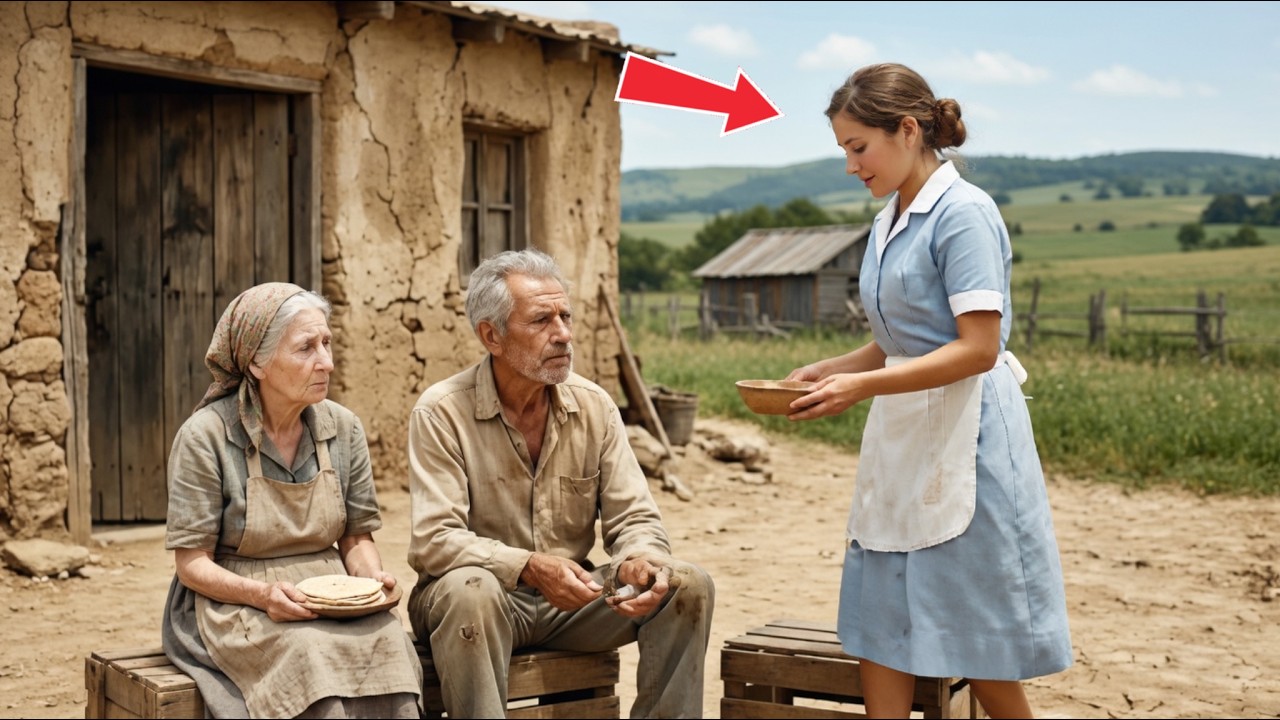
The first thing he saw were the crates. Two wooden crates, the kind used to transport fruit at markets, placed in front of the house like chairs. And on each crate sat a person. A very old man with hunched shoulders and hands resting on his knees.
His skin was dried by the sun, the color of the earth around him, and he wore a worn linen shirt that was threadbare at the elbows. His left eye was clouded, almost white, but his right eye stared ahead with an intensity that wasn’t calm. It was resistance. A man who had decided not to die yet, though he didn’t know exactly why.
Next to him, on the other crate, sat a smaller, frailer woman with a gray shawl over her shoulders despite the heat. Her hands rested on her knees, motionless, like birds that no longer fly. Her eyes were lost somewhere on the horizon, as if she saw something others couldn’t. From time to time she moved her lips, murmuring something, a song, or maybe a name.
Krystyna stood before them, her back to Ryszard, unaware that he was less than fifteen meters away, pressed against that wall with a racing heart. “I’m here, Mr. Antoni,” Krystyna said in a voice Ryszard had never heard from her. A quiet, tender voice of someone who cares.
“How are you feeling, Mrs. Cecylia? ”
The old woman looked up and smiled. A slow smile, like a child recognizing something familiar without knowing exactly what it is.
The old man didn’t answer. He only nodded once, barely, as if grudgingly admitting that someone had come. Krystyna opened the bag, taking out a container of stew, flatbreads wrapped in a cloth, a piece of sweet bread Ryszard didn’t know where she’d gotten it. She served the old man first, carefully placing the plate in his hands, as if handing something sacred to someone who no longer expected anything.
The old man looked at the plate, didn’t thank her, but began eating slowly, with the dignity of someone who eats little but doesn’t accept pity. Then Krystyna approached the old woman. She gently removed her shawl, wiped her face with a damp cloth she had in her bag, tucked her hair behind her ears. The old woman let her work gently, as if this ritual were the only thing giving shape to her days.
Krystyna tore the flatbread into small pieces and patiently fed her, with a patience that isn’t learned. You’re born with it, or you don’t have it at all. Ryszard watched from behind the wall, and something happened to him that he couldn’t explain with the cold logic that ruled every decision in his life. The old man’s hands, those large, dark hands with wide knuckles and thick fingers.
Ryszard had seen those hands before, somewhere, sometime. And the woman, the way she tilted her head when she smiled, that constant murmuring. Ryszard felt that if he closed his eyes, he might hear the same melody in some corner of his memory. But every time he tried to catch the memory, it slipped away like water between his fingers.
He left silently, walked back to his car on weak legs, started the engine, and drove home without turning on the radio, without calling anyone, thinking of nothing but those two faces sitting on their crates in front of the crumbling wooden hut. That night, lying beside Waleria, who slept with her mouth open and the air conditioning on maximum, Ryszard couldn’t close his eyes. Every time he tried, he saw the same thing. The old man’s hands.
The old woman’s smile. And a feeling that drove into his chest like a rusted nail. He knew these people. He didn’t know from where, he didn’t know why, but he knew them.
And something inside him, something that had been sleeping for twenty years, began to stir. Ryszard didn’t go to the office the next day. He told Henryk he had a meeting with a supplier. He told Waleria he was going to check on a site.
He didn’t tell anyone the truth, because he didn’t know what he was doing. He drove to the intersection where the asphalt ended, parked in the same spot as the previous afternoon, and walked the dirt path while the sun barely rose over the hills. He reached the settlement before seven. No one was on the street, not even a dog, just the wind lifting dust between the houses.
Krystyna wouldn’t come until afternoon. Ryszard knew that. That’s why he was there at that hour. He wanted to see without being seen.
He approached the wooden hut from the side. The window was a hole in the wall with broken glass patched with a piece of cardboard. Ryszard peered in. The old man was sleeping on an iron cot with a mattress so thin the springs showed through.
He wore a blanket despite the heat, as if the cold he felt came from inside, not outside. His large hands rested on his chest. He breathed slowly, with a faint wheeze that betrayed his age. The old woman sat on a plastic chair beside the cot.
She wasn’t sleeping. Her eyes were open, fixed on some point on the wall, and she moved her lips slowly, singing something wordlessly, a lullaby or a prayer, or a mix of both. Then it happened. The old man shifted on the cot, turned his body to the side, and something slipped out from under the pillow.
Something small and flat that fell to the ground without a sound. An old photograph, folded in half, with yellowed edges and a damp stain in one corner. Ryszard moved closer to the broken glass, squinting. In the photo was a young man, eighteen, maybe nineteen, dark-haired, thin, with tousled hair and a smile that didn’t yet know the weight of the world.
He had a backpack on his shoulder and stood in front of a wooden hut with a bare hill in the background and a clear sky stretching as far as the eye could see. Ryszard held his breath. He knew this photo. He knew this backpack.
He knew this smile. He’d seen it a thousand times. He had it in his own living room, framed, on a shelf. The same photo Krystyna had picked up from the floor three days earlier, the one he’d snatched from her hands.
It was him at eighteen. The day he left Cisze. The air lodged in his chest. He looked up from the photo to the sleeping face of the old man.
Large hands. Wide knuckles. A scar on his chin. The one they always said he’d gotten from barbed wire when he was twenty.
And he recognized him. Mr. Antoni. Antoni Kowalski.
His father. Ryszard stepped back. He looked at the old woman, the one who sang wordlessly, who tilted her head when she smiled, who murmured names no one else could hear. Mrs.
Cecylia. His mother. The two old people his cleaner cared for every afternoon with leftovers from their own kitchen were his parents. The parents he’d left in Cisze twenty-three years ago.
The parents he’d promised to return for. The parents he’d stopped calling, stopped searching for, stopped remembering, until they became an old photograph on a shelf no one looked at anymore. And now they were here, in this wooden house, without electricity, without water, without anything, sitting on crates, eating leftovers brought by the woman he paid minimum wage. Ryszard leaned against the outside wall of the house.
His legs refused to obey him. The sun was already beating on his face, but he couldn’t feel it. He felt nothing, or he felt everything at once, which is worse. He stayed there, leaning against the mud wall of his parents’ house, in a silence heavier than any word.
The loudest silence of his life. Cisze, Poland. Twenty-three years ago, the Kowalski house was wooden, with a beam roof and a dirt yard where Mrs. Cecylia hung laundry and Mr.
Antoni kept his tools. It wasn’t big. It wasn’t pretty. But it was theirs.
And in that yard, Ryszard learned to walk, to count, to look at the sky, and to want to leave far away, because in Cisze there was nothing. No work. No hospital. No future.
Only the sun, the earth, and the certainty that if you stayed, you would die like everyone else. Poor, quiet, and forgotten. Ryszard knew this by the time he was fifteen. Mr.
Antoni knew it even earlier. Because Mr. Antoni had already paid the price of staying. He had paid with Rose.
Rose was the first daughter. Born three years before Ryszard. A little girl with an easy laugh who chased the chickens and fell asleep in Mrs. Cecylia’s arms as she sang to her.
At three years old, she got a fever that wouldn’t break. Mrs. Cecylia put wet cloths on her. Mr.
Antoni walked to the village for medicine, but there was no doctor in the village. The nearest doctor was in town, and Mr. Antoni couldn’t afford the ticket. Rose died on a Tuesday evening.
Mrs. Cecylia was never the same, and Mr. Antoni carried that death on his shoulders like a stone he never put down. When Ryszard turned twenty-two and said he wanted to leave for the West, Mr.
Antoni didn’t stop him. He couldn’t. Because every time he looked at his son, he saw Rose’s shadow and thought, this village won’t kill this one too. “Go,” he said one morning, his back turned, pretending to sharpen a scythe.
His hands were shaking. “Go and don’t look back. There’s nothing for you here. Here your sister died because I couldn’t even afford a doctor.
I don’t want you to live what I lived. ”
Ryszard left that same day, a backpack on his shoulder, and a promise he made to his mother in the doorway of the house. “I’ll come back for you. I’ll give you the life you deserve.
” Mrs. Cecylia hugged him so hard Ryszard felt his mother’s bones against his own. Mr. Antoni didn’t come close.
He stood with his back turned, looking at the hill. But as Ryszard walked down the dirt path, Mr. Antoni turned and watched him go until he disappeared in the distance. No one saw it, but it happened.
The first months in Frankfurt were hard. Ryszard worked wherever he could. Construction, painting, hauling materials on building sites. He slept in a room shared with four men who spoke languages he didn’t understand.
But every Friday, without exception, he went to the corner shop and sent money to Cisze. And every Sunday, he called. Mr. Antoni never answered the phone.
He said those devices were the devil’s work. But Mrs. Cecylia did. And every Sunday she told him the same things: the hens were still laying, the roof no longer leaked since he’d sent money for repairs, his father was doing well even though he’d never say it.
Then came the first big contract. A construction company hired him as a foreman, then as a manager. Then Ryszard realized he could do the same thing on his own, and he started his own business. Money started pouring in seriously.
And along with the money came Waleria. Waleria was the daughter of Poles who had emigrated from Lesser Poland thirty years earlier and never returned. She grew up in Germany, not speaking Polish, not knowing her parents’ village, not missing what she never had. For her, Poland was an alien memory.
When Ryszard talked about Cisze, the wooden hut, the dirt yard, she looked at him the way you look at an old piece of furniture. With respect, perhaps, but with no intention of keeping it. The calls became rarer. First every two weeks, then once a month, then only at Christmas.
And one day, Ryszard couldn’t say exactly when, he stopped calling. There was no single moment, no single decision. Just a silence that grew like weeds, slowly, until it covered everything. When he realized, five years had passed.
Five years without calling. Five years without sending money. Five years without asking if his parents were still alive. And the shame, small at first, grew so large it no longer fit in a single phone call, a single message, a single return flight.
Ryszard convinced himself they were fine, that someone was taking care of them, that they didn’t need him. He convinced himself because he had to. Because the alternative, admitting he’d abandoned them, was a mirror he couldn’t look into. And so passed not five years, but twenty-three.
Twenty-three years of silence. Twenty-three years of a photograph on a shelf no one looked at anymore. Twenty-three years of a promise made in the doorway of a wooden hut, carried away by the wind. Until now.
Until this morning, leaning against the mud wall of a house he didn’t know, with the sun on his face and the weight of twenty-three years crashing down on him like a collapsing roof. Ryszard Kowalski had found his parents. But the question burning in his chest wasn’t where they had been. It was where he had been.
Ryszard returned home like a ghost. He sat on the edge of the bed without taking off his shoes, without loosening his tie, motionless. Waleria found him like that when she came out of the bath. “What’s wrong with you?
” Ryszard didn’t answer for a long time. When he did, his voice came out hoarse, as if the words were scraping his throat on the way out. “I found my parents. ”
Waleria froze with a towel in her hands.
“What? ” “My parents, Waleria, are here, in a village forty minutes away. They live in a wooden hut without electricity, without water. Krystyna brings them food every day.
Leftovers from our kitchen. ”
Silence. Waleria processed the information with the same expression she had when a supplier gave her wrong numbers. Cold.
Calculating. “So what? ” she said. “That’s not your problem anymore, Ryszard.
You left them twenty years ago. If it mattered that much, you would have come back sooner. ” She sat in front of the mirror and started brushing her hair, as if the conversation were over. “They’re my parents.
”
“And mine are still in Lesser Poland,” Waleria said without turning around. “In a village just as poor as yours. And you know what? I didn’t go back either.
Neither did my parents go back for theirs. That’s life. When you move forward, Ryszard, you leave behind what you have to leave behind. ”
The sentence fell like a stone into still water.
Ryszard looked at her, and for the first time in fifteen years of marriage, he saw Waleria clearly. She wasn’t evil. She wasn’t cruel. She was a mirror.
She’d grown up in a house where abandoning family was the norm, where cutting roots was the price of progress, where looking back was for the weak. And Ryszard had married her precisely because of that. Because Waleria would never ask him to go back. She would never remind him of what he’d left.
She would never ask about Mr. Antoni and Mrs. Cecylia. He had chosen her because she was convenient.
And now that convenience filled him with disgust. “I’m not leaving this like that,” Ryszard said. Waleria put down the brush and looked at him in the mirror. “Do what you want.
But don’t involve me. ”
Ryszard left the room, knowing, though he didn’t yet want to admit it, that he was alone in this. That the road back to that wooden hut was a road he would have to travel without anyone at his side. The next day, he waited for Krystyna in the kitchen.
She came at seven, as always, with her apron and downcast eyes. But this time Ryszard spoke to her differently. He didn’t give instructions. He offered her a chair.
Krystyna looked at him with distrust. In her experience, when an employer offers a chair, what follows isn’t good. “Please sit down, Krystyna. I need to ask you something.
” She sat on the edge of the chair, hands on her knees, ready to get up at any moment. “The old people,” Ryszard said. “The ones you visit every afternoon. Who are they?
”
Krystyna didn’t answer right away. She looked at him carefully, searching for a trap. “You followed me? ”
“Yes.
”
More silence. Krystyna lowered her eyes. When she raised them, her eyes were no longer those of a cleaner in front of her boss. They were the eyes of a woman protecting something.
“I found them years ago,” she said. “At the market in Cisze. A lady asked me to bring food to old people who were left alone in the countryside. ‘No one visits them,’ she said.
‘No one cares about them. ’ I went, thinking I’d leave the food and come back. But when I got there…” She paused, looking at her hands. “The house was falling apart.
No electricity, no water. They were eating dry bread with salt. The man saw me come and said he didn’t need anyone’s pity, that I should go. But the woman… she grabbed my hand and didn’t let go.
She looked at me with eyes I knew. The eyes of someone who had waited a long time for someone to come. ”
Ryszard listened with his hands clenched under the table. “From that day, I’ve gone every day with what I could.
Sometimes leftovers, sometimes beans from my own pot. The man never thanked me, but he stopped telling me to go. Sometimes I bring Ania with me. A woman named Teresa lives a few houses away.
She watches her while I’m with the old people. ”
Then Krystyna said something Ryszard didn’t expect. “There was a time I almost stopped going,” she said quietly, as if ashamed. “A few months ago, I was short on money.
Ania needed shoes for school, and I was spending on two households. I thought, I can’t do this anymore. It’s not my responsibility. I have a daughter to feed.
And for a week I didn’t go. Not once. Not twice. On the third day, I went only to tell them I couldn’t come anymore.
” She raised her face. Her eyes were wet, but she didn’t cry. “But when I came, Mrs. Cecylia saw me from the door and said, ‘Rose, I thought you weren’t coming anymore.
’ She grabbed both my hands and started crying. I don’t know who Rose is, but she looked at me like I was the only thing she had left in the world. ” She paused. “I couldn’t leave.
How could I leave? ”
Ryszard didn’t move. He couldn’t. Every word from Krystyna was a hammer striking the wall he’d built for twenty-three years.
The woman he paid minimum wage was doing what he hadn’t done, with less money, less time, and more reasons not to. “Do you know anything about their son? ” Ryszard asked in the steadiest voice he could manage. Krystyna shook her head.
“The man doesn’t let anyone talk about him. Once I asked Mrs. Cecylia if they had any family, and she started to say a name, but he interrupted her. He said, ‘That man doesn’t exist anymore.
’ And he didn’t return to the subject. ”
That man doesn’t exist anymore. Ryszard nodded slowly, stood up, thanked Krystyna, and left the kitchen without telling her who he was. Without telling her that the man who no longer existed was standing in front of her in a suit worth more than everything Krystyna earned in a year, and that he hadn’t done even half of what she did every afternoon with a plastic bag and an old container.
He didn’t tell her because saying it out loud would be an admission. And Ryszard wasn’t ready for that yet. But the wall already had cracks. And cracks, once started, don’t stop.
Ryszard went to the wooden hut the next day. This time he didn’t hide. This time he walked straight to the door with a tight chest and sweaty hands, like a fifteen-year-old about to do something irreversible. The door was open.
In a place where there’s nothing to steal, doors don’t get closed. Inside, Mrs. Cecylia sat on a plastic chair, husking corn with slow hands. The kernels fell into a chipped tin plate.
She didn’t look up when she heard footsteps. She kept husking, as if the whole world could walk through that door and she wouldn’t notice. Ryszard stopped two meters from her. He looked at her.
Truly looked at her, not through a window. Up close, his mother was a different person. Smaller. Frailer.
White, thinning hair. Hands covered with dark spots. Eyes that looked without focus, as if searching for something lost long ago. “Mom,” Ryszard said.
The word came out of him broken. Mrs. Cecylia looked up, looked at him, and smiled. A sweet smile.
The smile of someone who sees a kind face but doesn’t know whom it belongs to. “Is that you, Rose? ” she said in a quiet, almost childish voice. “How good that you came, my daughter.
Sit down. I’ll make you some tea. ”
Ryszard felt the ground open beneath him. His own mother was looking into his face without recognizing him.
“Mom, it’s me. It’s Ryszard. Your son. ”
Mrs.
Cecylia tilted her head. The smile disappeared. In its place came pure confusion, without pain, like someone searching for a word that slipped away. “No, Ryszard left a long time ago.
He doesn’t come anymore. But Rose, yes. Rose always comes. ” She looked at him a moment longer, then lowered her eyes to the corn and kept husking as if nothing had happened.
Ryszard stood breathless, voiceless, not knowing what to do with his hands, with his body, with the twenty-three years pressing down on him like a concrete slab. Then he heard footsteps. Mr. Antoni appeared from the other room, walking with difficulty, one hand braced against the wall.
His left eye was clouded, but his right eye was alive, burning, with a light that wasn’t joy. It was recognition. He didn’t need two seconds. He knew right away.
He stopped in the doorway, straightened as much as his body allowed, and his voice, when it came out, didn’t tremble with weakness. It trembled with rage. “Now you come? ”
Ryszard opened his mouth.
Nothing came out. “After you stopped calling,” Mr. Antoni said, taking a step forward, “stopped sending, stopped asking if we were still alive, now you come in your suit and clean shoes to stand in my house? ”
“Dad, I…”
“Nothing here belongs to you.
” His voice cracked, but he held it. “Nothing is yours here. Not this house. Not this chair.
Not that woman, who doesn’t even know who you are. You left, Ryszard. You left, and you didn’t come back. And now don’t come looking for what you threw away.
”
Mr. Antoni’s eyes were red. Not from crying. From something older than crying.
Then he turned and disappeared where he came from. The creak of a bed as he sat down, and then nothing. Mrs. Cecylia kept husking the corn.
She hummed something. She registered nothing of what had just happened. Ryszard left the house, took three steps, leaned against the mud wall, and slid to the ground. He didn’t cry.
No, he didn’t cry. But something worse than crying filled his body. An emptiness so vast it couldn’t fit inside him. His mother didn’t recognize him.
His father recognized him and rejected him. And he sat on the ground in a three-thousand-dollar suit stained with dust, in front of a collapsing house. And he knew that no amount of money in the world could fix what he’d broken. The next days were sleeplessness and questions without answers.
Ryszard went to the office, signed papers, took calls, but his head was somewhere else. He had to understand not just the pain, he already understood that. He had to understand how they got there. The last time he’d sent money, over fifteen years ago, his parents were still in Cisze, in the wooden house with the dirt yard.
One morning he drove to Cisze. He drove to the village where he was born, looking for the wooden house where he grew up. But when he reached the street he remembered, the house was gone. In its place stood a new fence and a sign: Private Property.
Ryszard got out of the car and asked a neighbor sweeping the sidewalk. “What happened to the Kowalskis? ”
The woman looked at him the way one looks at a ghost. “The Kowalskis were thrown out years ago, sir.
They couldn’t pay the taxes, and they took everything from them. ”
The house in Cisze. The house where he was born. The house where Rose was buried in the backyard.
It no longer belonged to the Kowalskis. They’d lost it eight years ago. But that wasn’t what froze his blood. It was the realization of who knew.
Henryk. His partner. His childhood friend. The one who never left Cisze.
The one who saw everything from the front row. He’d watched Mr. Antoni and Mrs. Cecylia lose their house.
He’d watched them being pushed into that settlement in the middle of nowhere. He’d watched them shrink, age, disappear from the world as if they’d never existed. And when Ryszard returned to Poland, when he sought him out for business, when they sat in a restaurant in Wrocław raising a toast of vodka to their new partnership, Henryk smiled at him, hugged him, and said not a word. Not one.
Not half. “Listen, Ryszard, you know your parents don’t live in Cisze anymore? ” He didn’t say that. “Your mother isn’t doing well.
” He didn’t say that. He had Ryszard’s number. He’d had it for twenty years. One phone call.
Five minutes. “Ryszard, your parents aren’t doing well. ” That’s all it would have taken. And he chose not to make it.
Ryszard stared at the empty desk in his office. Outside, Wrocław kept moving as if nothing had happened. Inside, something Ryszard thought was solid, his friendship with Henryk, the blind trust he’d placed in him, was crumbling in silence. But the worst part wasn’t Henryk’s betrayal.
The worst part was the question that followed it, the one Ryszard couldn’t avoid no matter how much he wanted to. Was Henryk guilty, or was he guilty, the one who also didn’t call, didn’t ask, who also chose silence? Because in the end, they had both done the same thing. Both knew, and both stayed silent.
Only one did it from a distance, and the other while looking him in the eye. Ryszard walked into Henryk’s office without knocking and closed the door behind him. Henryk was on the phone, laughing at something. When he saw Ryszard’s face, he hung up.
“What happened? ”
Ryszard didn’t sit. He stood in front of the desk, hands in his pockets so Henryk wouldn’t see them shaking. “Did you know my parents lived in a wooden hut without electricity?
”
Henryk didn’t blink, but the second of silence before his answer betrayed him. “I knew things weren’t going well,” he said slowly. “But it wasn’t my business, Ryszard. ”
“Not your business.
” Ryszard took his hands out of his pockets. “You live in Cisze. You saw them lose their house. You saw them move to the countryside.
You saw them disappear. And it wasn’t your business? ”
Henryk leaned back in his chair, crossed his arms, and then he did what cowards do when cornered. He attacked.
“And what would you have done, Ryszard? The same thing you did for the last twenty years? Nothing. I had your number.
Yes, but you had theirs too. How many times did you call? How many times did you ask how they were? ”
Ryszard clenched his jaw.
“No. I called you because you didn’t want to know,” Henryk continued. “And we both know it. Don’t make me the villain in your story.
The villain is you. I just stayed silent like you did. The difference is I saw them up close, and you forgot them from a distance. But the silence was the same.
”
Ryszard wanted to answer. Wanted to shout. Wanted to say it wasn’t the same, that he was far away, that life had consumed him. But he couldn’t.
Because every word Henryk said was the truth Ryszard had told himself during those sleepless nights. It just hurt more hearing it from someone else’s mouth. “We’re not partners anymore,” Ryszard said. Henryk shrugged.
“As you wish. ”
Ryszard left without closing the door, knowing he’d just lost the last ally he had left in Poland. No wife to support him. No parents to accept him.
No friend. No one. That same evening, for reasons he couldn’t fully name, he drove to the settlement. He didn’t go in.
He parked his car far away and walked to the hut in the dark. The moon was high, and the village looked silver, as if someone had sprinkled the world with ash. He approached the window. Inside, a candle was burning.
Mr. Antoni sat on the cot. Mrs. Cecylia lay with her eyes closed.
The old man was talking to her. “That boy came,” Mr. Antoni said, his voice different at night. Not the hard voice of the man who chased him away.
Lower. More tired. The voice of a man talking to the only person he has left. “He came in his suit and his city shoes.
But it’s too late. Too late already. ”
Mrs. Cecylia murmured something incomprehensible.
Maybe a name. Maybe nothing. “Too late already,” Mr. Antoni repeated, looking at the candle as if talking to the flame.
Ryszard, on the other side of the wall, closed his eyes. The sentence went into his ears and drove into his chest like wire. Too late already. His own father, the man who pushed him out, who told him to go and not look back, was now saying it was too late.
That there was no time left. That what was broken was broken. He left the window silently, returned to his car, got in, and sat there with the engine off, staring into nothing. A village at night is an honest place.
Nothing masks it. No noise to drown out the silence. No light to hide the darkness. It is what it is.
And that night, sitting in his car with his hands on the wheel and his eyes fixed on the dirt path, Ryszard was what he was, too. A man who had destroyed the most important thing in his life and didn’t know if he could rebuild it. He thought about Frankfurt. His office with a view of the city center.
His contracts, clients, bank account. All of it was still there. He could go back. He could drive to the airport, board the first flight, and in four hours be in his leather chair with a whiskey in his hand and the air conditioning set to twenty-one degrees.
He could forget again. He’d done it before. Twenty-three years of practice. It would be easier.
Much easier. He was about to start the engine when someone knocked on the window. Ryszard jumped and turned. A round face was looking at him with curiosity on the other side of the glass.
Ania, Krystyna’s daughter, stood there in a nightgown, oversized slippers, and tousled hair. Ryszard rolled down the window. “What are you doing out here? ”
“I came out to throw away the trash,” Ania said, pointing to the house a few meters away.
“And what are you doing here in your car? ”
“I’m thinking about something. ” Ryszard paused. “Whether I should go or stay.
”
Ania thought for a moment, serious, as if the question deserved all her attention. “My mom is sad sometimes too,” she said. “When she doesn’t have enough money, or when she remembers my dad. But she says that taking care of someone is the only way not to be alone.
”
She said it so simply, without knowing that those words hit a forty-five-year-old man harder than any contract, any shout, any rejection. “Goodnight, sir,” Ania said, and walked back to the house in her oversized slippers, humming something. Ryszard sat motionless, hands still on the wheel, eyes fixed on the dirt path disappearing into the darkness. Taking care of someone is the only way not to be alone.
He started the engine, turned on the lights, and instead of turning toward the road, toward the airport, toward Frankfurt, toward the comfortable life waiting for him with open arms, he turned the wheel toward the dirt path. He didn’t know if it was too late. He didn’t know if his father was right. But he knew that leaving again would be dying alive.
And he had already been dead for twenty-three years. He found her the next day at 4:10 PM, leaving the house with her bag and plastic sack. The same routine, the same road. But this time Ryszard was waiting for her at the door.
“Krystyna. ” She stopped and looked at him with the caution that had become her habit whenever he spoke outside the normal routine. “I need to tell you something, and I need you to listen before you say anything. ”
Krystyna nodded.
She didn’t sit. She stood with the bag hanging from her hand, ready to leave at any moment. Ryszard took a deep breath. “Those two old people you care for every afternoon.
They’re my parents. ”
The silence that followed wasn’t ordinary silence. It was one of those silences that have weight, that take up space, that sit on your chest. Krystyna didn’t move.
She stared at him, wide-eyed, processing every word as if spoken in a foreign language. “What did you say? ” “Mr. Antoni and Mrs.
Cecylia. They’re my parents. I’m the son who left. The one who no longer exists.
”
Krystyna dropped her bag. It fell at her feet, and she didn’t pick it up. Ryszard watched her face change from surprise to something darker, something he knew well because he saw it in the mirror every morning since he’d discovered the truth. Anger.
“You left them like that? ” Krystyna’s voice was no longer gentle. It was sharp. “You’re the son Mr.
Antoni won’t even hear about. The one who left them without money, without a house, without a phone call for twenty years. ”
Ryszard didn’t answer. There was nothing to answer.
“I found them eating bread with salt,” Krystyna continued. “Bread with salt. Two people over seventy. And you were in Frankfurt in your suit, your car, and with your wife who doesn’t even know where Cisze is.
” Her voice broke with fury. Tears filled her eyes, but she didn’t cry. She stood there, trembling, fists clenched, looking at him the way you look at someone who failed the people you love most in the world. Then slowly, the anger shifted into something else.
Not forgiveness. Something more complicated. “Mrs. Cecylia calls me Rose,” Krystyna said in a quiet voice.
“Every time I come, she says, ‘Rose, how good that you came. ’ I never understood why. ” She paused. “Now I understand.
”
Another silence, longer, sadder. “And what do you want to do now? ” Krystyna asked. “I want to try.
I want to be there. ”
Krystyna looked at him for a long time, measuring him, not his money, not his position. Measuring what was left of him. “I’ll help you,” she said at last.
“But on one condition. ” Ryszard looked at her. “Don’t promise them anything you won’t keep. They’ve had enough of that.
If you enter that house, it’s to stay. Not to visit. Not to feel better about yourself and then leave again. To stay.
Do you understand? ” Ryszard nodded. “Because if you let them down again,” Krystyna said, picking up her bag from the ground, “this time it won’t be Mrs. Cecylia who doesn’t recognize you.
It will be me who doesn’t open the door for you. ” She turned and walked toward the road. Ryszard watched her walk away, knowing he had just made a pact more serious than any contract he’d ever signed. He didn’t come with flowers.
He didn’t come with speeches. He didn’t come with money. He came with a hammer, a bag of nails, and three planks of wood he’d bought at a roadside hardware store. It was early.
Krystyna hadn’t come yet. Ryszard walked to the hut, put his things on the ground, and looked at the roof. There were holes everywhere. Pieces of cardboard someone had placed to cover leaks.
Rusty sheets moving in the wind. He took off his watch, rolled up his sleeves, and started working. Mr. Antoni came out hearing the hammer blows.
He stood in the doorway with his arms crossed, watching his son climb a patched ladder, driving planks into the roof. He said nothing. Not good morning, not what are you doing here, not go away. He sat on his crate and watched.
Ryszard didn’t talk to him. He understood, or Krystyna had made him understand, that words were no longer enough. Promises had been used up. The only thing he could do was be there with his hands.
That day he fixed the roof. The next day he came back with more material and fixed the door that hadn’t closed properly for years. The third day he brought water containers and food that wasn’t leftovers: fresh beans, chicken, fruit, bread. The fourth day he cleaned the yard, pulled up the dry weeds, straightened the crates, set up a tarp for shade.
Mr. Antoni didn’t speak to him on any of those days. But he stopped telling him to go away. And one afternoon, when Ryszard was carrying water containers from his car, the old man stood up from his crate and held the door open for him.
Without looking at him. Without saying anything. Just held the door. And that gesture, so small anyone would ignore it, was bigger for Ryszard than any embrace.
On the fifth day, Ryszard tried to cook. He put a pot on the wood stove, threw in beans, poured water, salt, a piece of onion. The beans stuck. The flatbreads came out thick and misshapen.
He burned one. Krystyna came in mid-afternoon and found him standing at the stove with glassy eyes, not from emotion but from smoke, trying to peel a flatbread off the pan with his fingers. “That’s not how you do it,” Krystyna said, taking the spatula from him. But she smiled.
For the first time since she’d learned who he was, she smiled. Mr. Antoni ate the stuck beans without complaining. He didn’t say they were good, but he ate the whole plate.
That was enough. On the seventh day, it happened. Ryszard was in the house, sealing a crack in the wall with a mixture of clay and straw that Krystyna had taught him to prepare. His hands were covered in mud, his shirt soaked with sweat, his hair disheveled.
He didn’t look like a businessman. He didn’t look like a boss. He looked like a son. Mrs.
Cecylia had sat on her chair all morning, watching him work with that expression she always had, present and absent at the same time, like someone watching a movie without sound. But suddenly she stood up slowly, leaning on the wall. She walked over to Ryszard. He didn’t see her.
Mrs. Cecylia placed both her hands on his face. Cold, wrinkled hands with trembling fingers. Ryszard froze.
His mother was looking at him from very close, with eyes that for the first time in days weren’t lost. They were here. Completely here. “You have your father’s hands,” Mrs.
Cecylia said softly, as if it were a secret between them. “You always did, my son. ”
My son. She said “my son” to him.
Ryszard broke. His knees gave way. He bent down, and his mother pulled his head to her chest, stroking his hair with those hands that had once rocked him, that now could barely hold themselves up. And Ryszard cried.
For the first time in twenty-three years, he cried. Not like strong men cry, wiping quickly and looking away. He cried like sons who come home late cry. With his whole body, his whole breath, everything he’d stored inside for years that no longer fit.
Mr. Antoni, from his crate, saw everything. He didn’t get up. He didn’t approach.
But he turned his head to the wall so no one would see his face, and with his free hand, he wiped something from his eye. Quickly, as if nothing had happened. But something had happened. The phone rang on Thursday evening.
Ryszard was in the hut, sitting on the floor, sanding a plank he was going to use to reinforce the window. His hands were rough. His nails were black with mud. The shirt that used to be white now had the color of earth.
When he saw the name on the screen, he knew what was coming. “Ryszard. ” Waleria’s voice was firm, very firm. The voice of someone who has already made a decision and is only calling to inform.
“This is your last chance. Are we going, or am I going alone? ”
Ryszard didn’t answer right away. He stood up and walked to the door.
Outside, the sun was setting behind the hills, and the sky had that orange color that exists only in a Polish countryside, as if someone had set the horizon on fire. Krystyna was walking down the dirt path with Ania by the hand. The girl was carrying a drawing she’d made in school and waving it in the air to dry it. Mr.
Antoni was sitting on his crate as always, looking at the plain with his good eye. Mrs. Cecylia sat beside him, her shawl on her shoulders, humming that song only she knew. “I didn’t stay in this country to end up in a village without asphalt,” Waleria said.
“I have a life in Frankfurt, Ryszard. A life we built together. If you want to throw it away because of guilt you should have dealt with twenty years ago, that’s your problem. But I’m not staying to watch.
”
Ryszard closed his eyes, breathed in the dry air, and answered. “Go, Waleria. I left once. I won’t do it again.
”
Silence on the other end. Long, heavy. Then Waleria’s voice, lower. “That’s it, then.
” She hung up. There were no shouts. No slamming doors. Ryszard Kowalski’s marriage ended with a click and three seconds of digital silence.
Fifteen years of shared life, dinners, trips, a house in a Frankfurt suburb with always-mowed grass. All ended in a two-minute conversation. Ryszard took off his wedding ring. He looked at it for a moment, not with anger, but with pure sadness, like someone letting go of something that no longer belonged to him.
He put it in his pants pocket. Maybe he’d throw it away later. Maybe not. It didn’t matter.
The company in Frankfurt still operated. Ryszard managed it by phone, delegating what he could, letting go of what he couldn’t. He no longer cared about controlling every nut and bolt. He had enough money to live on and to fix that wooden house.
The rest could wait. What mattered was that for the first time in twenty-three years, Ryszard Kowalski was exactly where he should be. And he wasn’t going to move. Weeks passed.
Not months, because this isn’t a story where everything heals with time. It’s a story where everything starts with a decision, and then you have to sustain it every day, every morning, every time life asks if you’re sure. Ryszard arranged for electricity to be connected to the house. A long cable running from the nearest pole three hundred meters away.
Probably not legal, but it worked. He brought a water tank that he filled every third day with his car. He bought a new mattress for Mr. Antoni’s cot and another for Mrs.
Cecylia, who up until then had slept on a pallet on the ground. Mr. Antoni didn’t thank him. Didn’t hug him.
Didn’t call him son. But he stopped telling him to go away. And one morning, when Ryszard arrived carrying materials to build an extra room, the old man stood up from his crate, walked to the car, and started unloading the planks without waiting to be asked. They didn’t say a word to each other.
They worked together all morning in silence, side by side. And that silence was more eloquent than any forgiveness spoken in words. Mrs. Cecylia had better days and worse days.
On worse days, she called him “sir” and asked if he was from the municipal office. On better days, she looked at him with those clear eyes, the eyes from years ago, and said, “My son,” as if he had never left. Ryszard learned to live with both. He learned that a mother’s love with lost memory is still love, just that it comes in fragments, when you least expect it.
And you have to be there to receive it. Krystyna still came every afternoon, but no longer alone with her bag of leftovers. Now she came with Ania, who ran around the yard chasing lizards, and with food she and Ryszard cooked together on the wood stove. Ryszard never learned to make decent flatbreads, but he learned to make rice that didn’t stick, which according to Krystyna was already a miracle.
One afternoon, without any plan, everyone sat down to eat together. Ryszard laid planks across two crates in front of the house. It wasn’t a table. It was an idea of a table.
Krystyna brought the plates. Ania arranged the napkins, pieces of butcher paper she folded as if they were cloth. Mr. Antoni sat down without being invited.
Mrs. Cecylia sat beside him, shawl on her shoulders despite the heat, murmuring something that could have been a prayer or a lullaby. Beans. Rice.
Flatbreads, the ones from Krystyna, not Ryszard’s. Water with lemon in plastic cups. The sun was setting, and the sky burned orange and red, as if the village were saying goodbye to the day with everything it had. Ania said that at school they’d asked her what she wanted to be when she grew up, and she said a doctor, “to heal old people,” she explained with her mouth full of beans.
Krystyna scolded her for talking with her mouth full. Mr. Antoni said nothing, but the corner of his mouth moved. Barely.
Almost nothing. Something that in another man would be a smile, and in Mr. Antoni Kowalski was a revolution. Mrs.
Cecylia looked at everyone with shining eyes. It wasn’t clear whether she knew exactly who each of them was, but she was smiling. Smiling with the calm of someone surrounded by voices, and that was enough for her. When they finished eating, Ryszard started clearing the plates.
Mr. Antoni remained seated, looking at the horizon as always. But when Ryszard passed by him, the old man raised his hand and touched his shoulder. Just that.
A brief, awkward touch, as if his hand didn’t know how to do it after so many years. Ryszard stopped. Mr. Antoni didn’t look at him.
He kept looking at the horizon, but he didn’t let go of the shoulder. He held it for two, three seconds, then let go and said, in the quietest voice Ryszard had ever heard from him, “Tomorrow we need to fix the fence. ”
Tomorrow. He said tomorrow.
He didn’t say “too late. ” He said “tomorrow. ” And that word in Mr. Antoni Kowalski’s mouth was worth more than any forgiveness.
And Ryszard, sitting on a fruit crate with a plate of beans in his hands, looked at that improvised table in the middle of nowhere and understood something that twenty years of deals, contracts, and bank accounts hadn’t taught him. That the most important table in your life isn’t the one with the tablecloth. It’s the one where the right people are sitting. It wasn’t a perfect ending.
Mr. Antoni didn’t hug him. Maybe he never would. Mrs.
Cecylia didn’t always know who he was. Maybe she never would, fully. But no one at that table was alone. And after twenty-three years of silence, that was enough.
Sometimes life doesn’t give you a second chance whole. It gives you a piece. A fragment. A plank table in the middle of the dust with beans and lemon water.
And it’s up to you whether you take it or let it go. Ryszard took it late. Imperfectly.
But he took it.