For thirty years, Helena had woken before the sun. Her body no longer needed an alarm clock; it rose at the same hour out of habit, as if her exhaustion were part of her internal wiring. She would slip out of bed in silence so as not to wake Grzegorz, pull on the same worn apron, and start her day with the chickens. She collected the eggs with a careful tenderness, as if they were made of glass.
Then she milked the goats with hands that had long since forgotten what dawn’s cold felt like. From that milk, she made fresh cheese, wrapped it in cloth, and left it to drain on the wooden table Grzegorz had built when he was still a different man. Then came the best part: the kitchen. Helena made rustic bread from the finest grains she could find, pierogi filled with potato and cheese, thick homemade potato pancakes, and gołąbki—cabbage rolls stuffed with meat and buckwheat, which she wrapped with a precision no one had taught her.
She had learned on her own, as she had learned everything else in life. By seven in the morning, everything was ready. She would cover the baskets with clean cloths, load them onto the old cart Marek had given her before he left, and walk forty minutes down the dirt road to the village market. The market in Brzozów was nothing grand.
A few wooden stalls, canvas tied down with string, women selling the same things as always. But for Helena, Friday was her day—the only day of the week when someone saw her, when someone said, “Good morning, Mrs. Helena,” when someone tasted what her hands had made and said, “This is delicious. ” Those words carried her through the entire week.
She set up in her usual spot by the streetlamp, laid a cloth over the borrowed table, and arranged her goods with a neatness that looked like a display. Rustic bread at the front, gołąbki in the center, fresh cheese on the side, covered with a cabbage leaf. She had no sign; there was no need. Everyone knew it was her stall.
And every Friday, without fail, a thin, barefoot boy with dusty feet and messy hair would appear. He couldn’t have been more than eight or nine years old. He came at the same time, when the market was full, and stood in front of Helena’s stall without saying a word. He just watched.
He looked at the rustic bread with eyes she knew well—the eyes of someone who is hungry but has no way to pay. She never asked his name, never asked where he came from. She simply cut a piece of bread, wrapped it in a napkin, and handed it to him. “Eat, little one, you’re very thin.
” The boy took it with both hands, as if it were a treasure, and ran off without a word. Helena watched him disappear between the stalls and smiled—a small, barely visible smile. The smile of someone who gives what she has, because she knows what it means to have nothing. That boy came every Friday for almost three years.
Then, one day, he stopped coming. Helena didn’t forget him, but she didn’t ask either. She had too much on her mind to go looking for a boy who had probably left the village, as everyone left. She had no way of knowing that this boy had truly left, but he had not forgotten her, nor her bread, nor those six words.
Many years later, he would return—not as a boy, but as a man, a landowner—and he would find her at the worst moment of her life, alone by the side of the road, with no one looking for her. Grzegorz woke before Helena. That had to be said, because it was important. By five in the morning he was already outside in his boots, hunched over, his hands in the soil.
He planted grain, tended the pepper bushes, watered the pumpkins, checked the fence of the pen, and if a post was loose, he fixed it before anyone had to ask. Then he took the goats to pasture and came back before the sun grew too hot. In those moments, and only in those moments, Helena could still see the man she had married. A quiet man, yes.
A man who never learned to say “I love you,” or “thank you,” or “you look lovely today. ” But a man who acted—who built this house with his own hands, who once a year, on Helena’s birthday, went out to the road early, picked wildflowers from the field, those yellow ones that grow between the stones, and left them in a glass vase on the kitchen table, saying nothing, expecting nothing. Helena would find them when she came down to make coffee, and for a second—just a second—she would feel that all her sacrifice had been worth it. That Grzegorz existed.
But he wasn’t the only one. There was another Grzegorz—the night one, the vodka one. It always started the same way. After dinner, when Helena was washing the dishes and he sat on the porch, he would pull out a bottle.
Sometimes three or four calm nights would pass, but once he started, he wouldn’t stop. One sip, two, five. And somewhere between the fifth and the seventh, Grzegorz stopped being Grzegorz. First, his voice changed—slow, drawn out, with a sharpness Helena recognized before he even said his first word.
Then came the red, sunken eyes, looking at her as if she were to blame for everything he hadn’t achieved. “If it weren’t for you, I wouldn’t be stuck here,” he’d say. Helena would stay silent, her hands wet with soap, staring at the floor. “I’ve put up with you for thirty years.
Thirty years in this filthy village. My children left because even they can’t stand you. ” Helena never answered. She had learned that answering only made it worse, that every word she said was fuel for a fire already burning.
So she stood still, breathing slowly, waiting for the vodka to do its work and for Grzegorz to fall asleep in his chair. Sometimes he threw things—a glass, a plate. Once, he threw a whole chair against the wall. Helena cleaned it all up the next day in silence, as if nothing had happened.
And the next day, Grzegorz woke at five, put on his boots, and went out to the fields as if the night before had never existed. He never asked for forgiveness, never mentioned what he’d said. And neither did Helena. Because in her mind, in that logic that guilt builds when no one tells you otherwise, she wondered if Grzegorz might be right.
Maybe it was her fault. Maybe if she’d been a better wife, he wouldn’t drink. Maybe if she’d been prettier, smarter, more of something, he would have treated her differently. It was a trap.
And Helena had been trapped in it for years, not realizing that Grzegorz didn’t drink because of her. He drank because his children had left, because the world had moved on and he had been left behind, because every truck that passed on the road to the city reminded him that he had never had the courage to climb aboard. And instead of accepting that, he grabbed the bottle and blamed the only person who had stayed. She was the one who made his coffee every morning, washed his clothes, cooked his food, held the house together by sheer will.
And in his drunkenness, he told her she was the problem. So Helena lived—for years, many years—rising before the sun, tending to everything, selling at the market, coming home to silence or something worse. And she never complained. Not to the neighbors, not to her children, not even to herself.
Because complaining would mean accepting that something was wrong, and Helena wasn’t ready for that. Not yet. But something was about to break. And when it broke, Helena would understand that the house she had held up had never held her up.
Marek left first. He was eighteen, with a backpack of clothes for three days and a promise he made to Helena at the door. “I’ll work hard, Mom, and when I save up some money, I’ll send it so you can renovate the kitchen. ” Helena hugged him for so long that Grzegorz had to tell her to let him go.
She put a bag of rustic bread wrapped in a napkin, some fresh cheese, and a folded note into his backpack, on which she had written in her clumsy handwriting: “God keep you, my boy. Your mother loves you very much. ” Marek got on the bus without looking back, because if he had looked back, he wouldn’t have gone. For the first few weeks, he called on Sundays.
Helena sat on the porch chair with the phone to her ear, asking about everything. Was he eating well? Was he cold? Did he need anything?
Grzegorz listened from inside without saying a word. Sometimes Helena handed him the phone. He’d say, “How are you, son? ” And after thirty seconds, he’d hand it back.
He never knew how to talk to his son. He never did. Marek sent money the first three times. Then he stopped.
Not because he didn’t have it—his construction job in Warsaw paid well—but because every transfer was a reminder of where he came from. Sundays turned into every two weeks, which turned into every month, and Marek was busy building a life where that village didn’t exist. Helena endured that first silence. It hurt, but she endured it, because she still had Magda.
Seven years later, she left too. Magda promised nothing. She was twenty-one, had a personality that didn’t resemble Helena’s, and a suitcase bigger than her brother’s. At the door, Helena gave her the same bag of food, the same cheese, the same note.
Magda gave her a quick, almost formal hug and said, “It’ll be fine, Mom, don’t worry. ” And she left. The cycle was faster with Magda, as if she already knew the path her brother had paved. She called for the first few weeks, then every two weeks, then once a month, then not at all.
There was no exact moment, no argument, no farewell. There was something worse. There was just silence—a phone that stopped ringing, a name that stopped appearing, a daughter slowly fading away. So slowly that by the time Helena noticed, there was nothing left.
Now she was alone. Both had left. Both had stopped calling. And instead of being angry, Helena asked herself what she had done wrong.
Did I give them too little? Are they ashamed of me? Was this house, this village, this life not enough? It wasn’t her fault, but no one had told her that, and she had no one to ask.
One day, Helena decided to find them. She didn’t warn them. She saved money from three Fridays at the market—almost everything she had—and bought a bus ticket to Warsaw. She woke at four in the morning, put on her best dress, a flowered one that was ten years old but which she ironed as if it were new, and packed a bag with everything she knew how to make.
Rustic bread, pierogi, fresh cheese, meat gołąbki. The bag was heavy, but Helena had always carried heavy things. The journey took six hours. Six hours of watching the fields turn into a city.
Brick houses became apartment blocks. The dirt road became a highway. And Helena sat in her seat with the bag on her lap, feeling that with every kilometer she was moving away from what she knew and towards a world where she didn’t know if she’d find herself. She arrived in Warsaw at noon.
She called Marek from a phone booth. He answered, surprised. “Mom? Are you in Warsaw?
” “Yes, my boy. I wanted to surprise you. ” Silence. A silence Helena felt like cold water.
“Ah, okay. Listen, I’m at work right now. Give me the address where you are, and I’ll come pick you up in a little while. ” Marek arrived two hours later, in a car Helena didn’t know, wearing a shirt she hadn’t bought him, with a haste he didn’t try to hide.
He hugged her quickly, opened the car door, and when Helena took out the bag of food and said, “I brought your favorites, my boy,” he looked at her with an embarrassment she had never seen in him. “Thanks, Mom. I’ll put it away later. ” He took her to his apartment—small but neat, with furniture Helena didn’t know existed, and photos on the wall of Marek smiling with people she didn’t know.
There wasn’t a single photo from Brzozów, not one with her. Helena wanted to stay two days. Marek suggested she leave the next day. “You know, I have a lot of work, Mom.
Next time, let me know ahead, and I’ll organize myself better. ” He didn’t introduce her to anyone. When the phone rang and someone asked who he was with, Marek said, “An aunt who came to visit. An aunt.
” Helena heard it from the kitchen, where she was preparing dinner no one had asked her to make. She said nothing. She kept chopping onions, and if she cried, she could blame it on the onions. The next day, she boarded the return bus.
The bag of food was just as heavy as when she’d arrived. Marek hadn’t opened a single gołąbek. He hadn’t tried the cheese or touched the bread. Six hours back, staring out the window.
But now Helena didn’t see the landscape. She saw her reflection in the glass. A woman in an old dress with rough hands, who had traveled six hours so that her son could call her an aunt. She cried in silence so no one would see her, as always.
But that night in Warsaw, something happened. Marek was alone in his apartment. It was eleven at night. He couldn’t sleep.
He got up, went to the kitchen, and opened the cupboard where he had hidden his mother’s bag. He opened it slowly, took out a piece of the rustic bread, smelled it first, then bit into it. And in that moment, with that taste in his mouth, Marek was no longer in Warsaw. He was in his mother’s kitchen.
He was seven years old, and Helena was wiping his face with her apron, saying, “Eat it all, my boy, you’re growing. ” He ate the whole loaf himself, standing in the kitchen at eleven at night so no one would see him. Because Marek truly loved his mother, but he only had the courage to love her in secret. And that, though no one says it, is the worst form of abandonment.
That Friday, Helena came back from the market later than usual. She’d sold little. The heat had kept people away, and she had leftover gołąbki, bread, and half a kilo of cheese no one bought. She walked the forty minutes back with a nearly full basket, thinking she’d have to use the gołąbki for dinner and the cheese for Saturday breakfast, thinking how to stretch what she had, as always, thinking about everything except what was waiting for her.
When she reached the house, the door was ajar. Helena noticed immediately. She always locked it before leaving. Always.
She pushed the door slowly, and the first thing that hit her was the smell. Spilled vodka, cigarettes, and something else. Perfume that wasn’t hers. The basket fell from her hands.
Grzegorz was lying in the bed—her bed, the bed Helena had slept in for thirty years, where she’d given birth to her two children, where she’d cried so many nights in silence, staring at the ceiling. And there he was, drunk, with a woman Helena didn’t know. A younger woman with loose hair and a blouse that wasn’t from the village. Helena stood in the doorway.
She didn’t scream, didn’t cry, didn’t throw anything. She stood there with empty hands, watching the scene as if from outside her own body, as if this couldn’t be real. As if thirty years of rising before the sun, of washing, cooking, enduring, staying silent, forgiving, holding on—thirty years of all that—couldn’t end like this. But it did.
Grzegorz saw her and, instead of looking away, instead of asking forgiveness, instead of feeling the most basic shame a man can feel, he got angry. “What are you doing here? Weren’t you at the market? ” Helena didn’t answer.
She couldn’t. Her voice had fled to a place she couldn’t find it. “I’m talking to you, Helena! ” Grzegorz got up from the bed, swaying.
The other woman pulled the sheet over herself and looked away, as if she had nothing to do with what was happening. “You know what? That’s enough. Enough of you, your gloomy face, your complaining.
Get out. Get out of my house. ” *His* house. As if Helena hadn’t built every brick of this life with her own hands.
As if the walls didn’t stand because of her. As if the kitchen, the animals, the market, the children, the sleepless nights, the swallowed humiliations—none of it counted. Helena looked into his eyes, and for the first time in thirty years, she didn’t see the man who left wildflowers on the table. She saw a stranger.
She didn’t argue, didn’t beg, didn’t ask him to come to his senses. She went to the wardrobe, took out an old bag—the same one she had brought to this house when she got married. She packed a few clothes, a sweater, a shawl. She walked through the kitchen and took a piece of rustic bread left from the market.
She wrapped it in a napkin and put it in her bag. She didn’t know why she did it. Maybe because it was the only thing that truly belonged to her. She walked to the door.
Grzegorz didn’t stop her. The other woman said nothing. Helena stepped out into the night. The door closed behind her, and with that dry, final, irreversible sound, thirty years of a life that no longer existed came to an end.
The road was dark. No moon, no one. Helena clutched the bag and started walking. At first came the cold.
No one prepares you to sleep outside when you’ve slept under a roof your whole life. The night air of the dirt roads was a different animal—dry, icy, silent—seeping into the sleeves of her sweater, into her collar, into her bones. Helena walked quickly at first, not because she knew where she was going, but because walking was the only thing she could do. Stopping meant thinking, and thinking at that moment was dangerous.
The road was a straight line in the middle of nowhere, without streetlights, without houses, without anything to tell Helena the world still existed beyond her own footsteps. After twenty minutes, she heard an engine in the distance—a truck. Headlights appeared behind her, two yellow dots that slowly grew. Helena stepped to the side and raised her hand.
The truck approached. The driver saw her. She knew because the lights illuminated her completely—a woman alone at night with a bag by the side of a road in the middle of the fields. He saw her, and he drove on.
The taillights shrank until they disappeared. Helena lowered her hand. She didn’t cry. She had no tears left.
She just kept walking. But something in her broke then. It was one thing for a husband to throw you out, another for children to forget you, but to have a stranger see you lying by the road at night, alone, and decide you weren’t worth stopping for—that was something else. That told you that you were invisible, that you didn’t matter, that the world could easily go on without you.
By dawn, the cold had become unbearable. Helena found a large stone at the side of the road. She huddled behind it with her shawl wrapped around her body. She closed her eyes.
She didn’t sleep. No one sleeps like that. But she closed her eyes and let the memories come, because she no longer had the strength to push them away. She saw little Marek, four years old, burning with fever.
Helena sat by his bed all night, pressing a cool cloth to his forehead, singing softly so he wouldn’t be afraid. She had stayed awake that night too, but that time out of love. Now she stayed awake because she had nowhere to go. That same Marek—the one who now didn’t answer his phone.
She saw Magda, five years old, laughing on her lap, while Helena braided her hair on the porch. “Mom, will you push me on the swing? ” “Wait, sweetheart, I’m almost done. ” And Magda laughed, a loud, clean laugh with nothing in it but joy.
The same Magda who later said, “Mom chose that life. ” Helena opened her eyes. The sky was beginning to lighten. A grey shade turned orange, then red, then white, and with the light came warmth.
First slowly, then mercilessly. She stood up. Her whole body ached—her legs, her back, her knees. Her lips were dry, her mouth parched.
She hadn’t eaten since the previous noon. The piece of rustic bread was still in her bag, but she didn’t touch it. She wasn’t hungry. She felt something worse than hunger.
She felt emptiness. She walked for another two hours under the sun. The road shimmered before her—that heat mirage that looks like water but is nothing. Helena felt her legs weigh double, the sun burning her head through her shawl, each step costing more than the last.
By eleven in the morning, she couldn’t go on. She sat at the edge of the road, put her bag beside her, looked at the flat, empty, endless horizon, and asked herself a question she had wanted to ask for years but never dared: *Would anyone even notice if I disappeared? * Grzegorz wouldn’t look for her—she knew that. Her children—her children hadn’t noticed she existed in years.
Would they notice if she stopped existing? No one knew she was here. No one was looking for her. No one would come.
Helena closed her eyes and let the sun burn her face. She had no strength left for anything. Not for walking, not for crying, not for praying. She just sat there, alone in the middle of nothing.
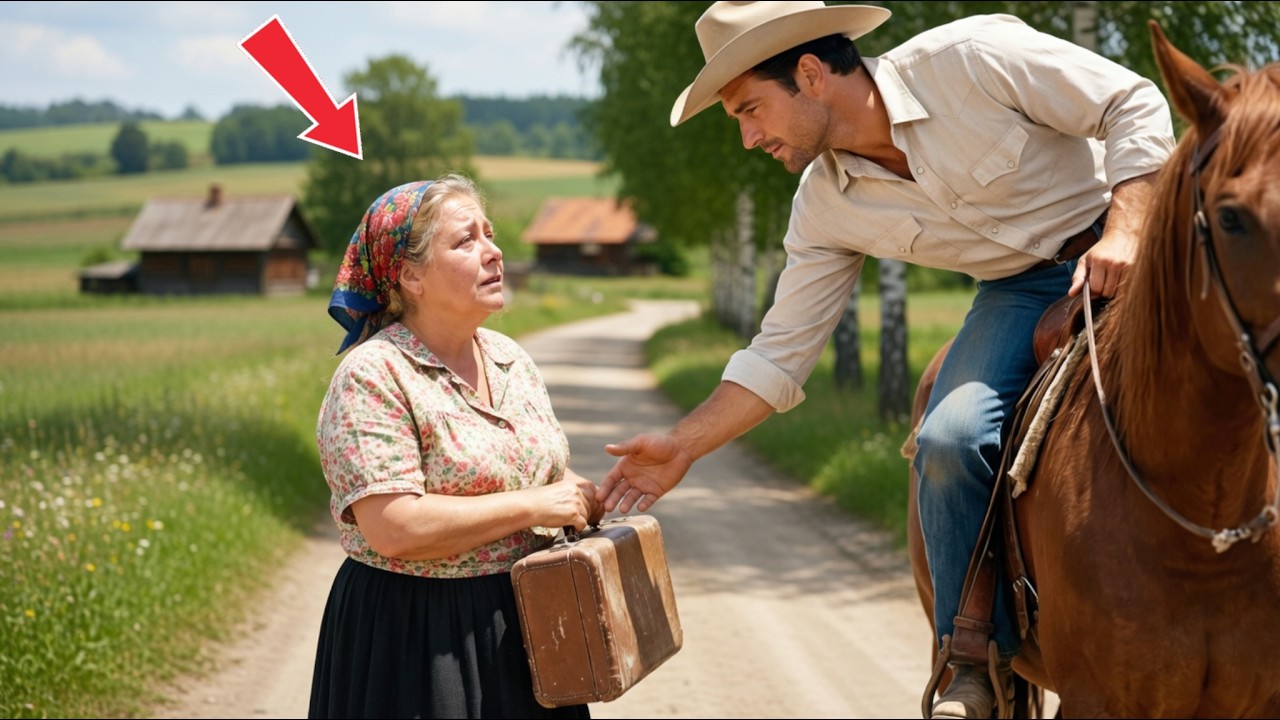
It was rock bottom. But she didn’t know that someone would come, that someone was looking for her—that less than a kilometer from where she had given up, a young man was riding his horse down the same road, as he did every day, and that he would recognize her before she even lifted her face. Helena heard the horse before she saw it. A soft rhythm on the earth that grew until it stopped right in front of her.
Slowly, she raised her face. The sun was in her eyes, and she could barely make out the silhouette. A young man, dark-haired, with broad shoulders, in a straw hat and a cleanly pressed light shirt, riding a chestnut horse that snorted from the heat. He couldn’t have been older than thirty-five.
He didn’t look like a farmhand. He looked like someone who was in charge. The man looked down at her, and something changed in his face. It wasn’t surprise, wasn’t pity; it was recognition—like when you see something you’ve been searching for for years, without knowing you were searching.
“Ma’am, are you all right? ” Helena didn’t answer. She had no voice. Her lips were cracked, her skin sunburned, her eyes hollow from lack of sleep and food.
She looked exactly as she was—a woman who had walked all night and half a day, with no one in the world stopping for her, until now. The man dismounted. He approached slowly, like someone approaching a wounded animal. No sudden movements, no hurry.
He took off his hat and crouched beside her. “Don’t worry. I know you. ” Helena looked at him, not understanding.
She searched her memory for any trace of that face and found nothing. She didn’t know him. She was sure. She had never seen this man.
But he knew her. Emilian didn’t ask for explanations. He didn’t ask what she was doing there, where she came from, or why she was alone on the road in forty-degree heat. He offered her water from a canteen tied to his saddle.
Helena drank as if she hadn’t had water in years. Then he offered his hand to help her up. “Come with me. My farm is nearby.
You can rest there. ” Helena wanted to say no—that she didn’t know him, that she couldn’t go with a stranger—but her body won over her mind. Her legs were trembling, the sun was conquering her, and this man’s hand was the first thing anyone had offered her in a long time without asking for anything in return. He helped her onto the horse with a gentleness Helena had never known.
He walked on foot, leading the horse by the reins without haste. He asked no questions, didn’t push. He just walked beside her in silence down the dirt road to his farm. Helena rode on that horse with her bag on her lap, watching the back of the man leading her.
And for the first time in thirty years, someone was leading her somewhere instead of throwing her out. She didn’t know his name. She didn’t know who he was. She didn’t know why he’d said, “I know you.
” But he had been waiting for over twenty years to give her something back. A piece of rustic bread, six words, and a debt he had never stopped feeling. Emilian’s farm was another world. Helena saw it from a distance and couldn’t understand how such a young man could own all this.
A large house of stone and brick with a tiled roof, a wide veranda with wooden columns, and an iron gate leading to a clean yard where three skinny dogs slept in the shade. Behind the house were pens—cattle, calves, goats, horses. Everything orderly, everything cared for. Hectare after hectare of green land disappearing toward the hills.
Emilian helped her down from the horse and led her inside without ceremony. “There’s a room here with a bed and blankets. I’ll leave water and a bowl of sour rye soup. Rest as long as you need.
I have to tend to the cattle, but I’ll be back before dark. ” And he left—no questions, no conditions, no uncomfortable looks. He just went to work, as if having a strange woman in his house was the most normal thing in the world. Helena was alone in the room.
She sat on the bed. It was soft, softer than any bed she’d ever slept in. She wanted to cry, but she couldn’t. Her body begged for sleep.
She lay down in her clothes and fell asleep within seconds. She woke as the sun was setting, orange light coming through the window. For three seconds, she didn’t know where she was. Then she remembered everything.
Grzegorz, the woman, the bag, the road, the man on the horse. She got up and walked through the house. Then she began to see. In the kitchen, dirty dishes were piled in the sink—at least three days’ worth.
The stove was covered in old grease no one had cleaned. On the table sat a half-drunk cup of coffee with a dried ring on the edge, as if it had been sitting there for days. The floor was dusty, the furniture dusty. On a chair were piles of clothes—work shirts, trousers, a rolled-up belt—as if someone changed there every day and never put anything away.
This house had no woman’s hand. It didn’t smell of food, or laundry soap, or anything Helena associated with the word “home. ” It was a functional house. A man came in, slept, left.
Nothing more. Helena walked to the salon window. From there, she could see the entire farm—full pens, grazing horses, a worker in the distance herding calves, and further off, Emilian on his horse checking the fences in the setting sun. He had everything: land, animals, work, money.
But the house inside was empty. Helena knew that emptiness. She recognized it instantly, only in reverse. She had had presence—hands, care, warm food, clean clothes, the smell of home—but nothing beyond that.
No recognition, no respect, no companionship. Emilian had everything else, but he didn’t have what she had always given. She stood at the window for a long time, feeling something she hadn’t felt in a long time. Silence.
But not Grzegorz’s silence, which was full of things ready to break. This was a different silence—clean, calm, one in which no one would insult her, shout at her, or throw her out. Helena took a deep breath. Her body still ached—her head, her chest—but for the first time in years, no one was yelling at her.
And for someone who had endured thirty years of shouting, that felt almost like peace. Now, about him. Because Emilian didn’t appear out of nowhere. No one does.
Emilian Wójcik grew up without a father. His mother raised him alone in a tin-roofed house at the edge of the village, three streets from the market where Helena set up her stall every Friday. They were poor—not poor like Grzegorz and Helena, who at least had land and animals, but truly poor. The kind who counted beans, and sometimes ran out.
His mother washed clothes for others to survive. She left at six in the morning with bags of dirty laundry and came back at eight at night with swollen hands and a few zlotys that barely covered the basics. Emilian learned to be alone from the age of five—heating up his own food, falling asleep without anyone saying goodnight. Fridays were different.
On Fridays, his mother gave him a few coins, the ones that were left over, and sent him to the market. “Go, my boy, buy yourself something. ” But the coins were never enough for much. Emilian walked between the stalls, looking at everything, smelling everything, touching nothing, until he reached Helena’s stall.
She was always there, in her apron, with her baskets, with that rustic bread that smelled like something Emilian couldn’t name. But many years later, he would understand that it was home. He would stand in front of the stall and say nothing, just watch. And Helena, without making him feel lesser, would cut a piece of bread, wrap it in a napkin, and give it to him with the same words as always: “Eat, little one, you’re very thin.
” Every Friday for almost three years, until his mother fell ill and Emilian had to leave the village. He was fourteen when he started working on other people’s farms. First as a helper—sweeping stables, carrying hay bales, cleaning troughs. He slept where they let him and ate what they gave him.
By seventeen, he knew how to handle cattle. By twenty, he was a manager on a farm in Kuyavia. By twenty-five, he had saved money no one had given him. He bought his first plot of land at twenty-seven—dry land no one wanted, not far from Brzozów.
He worked alone for two years. He put up fences, brought in water, bought ten cows and a bull. He built the house with his own hands, stone by stone, beam by beam, as if building proof that he could be someone. And he succeeded.
The farm grew, the cattle multiplied. Emilian Wójcik went from being a barefoot boy at the market to a young landowner respected by everyone in the region. His farm was less than an hour’s ride from Brzozów. On some Fridays, when he rode into the village for supplies or to sell a calf, he would pass the square.
And there she still was—at the same stall, by the same streetlamp, with the same baskets and the same apron. Greyer, more tired, with more wrinkles, but it was her. Emilian saw her from a distance and never approached. He didn’t know what to say.
He didn’t know if she remembered him, and part of him feared that if he approached, the memory would fall apart. So he watched her from the corner of the square, bought what he needed, and rode away. But every Friday he saw her, he confirmed the same thing: this woman was still there, giving what she had, receiving nothing in return. Then came Wiktoria.
He met her in Płock at a cattle fair. She was beautiful, from the city, with a smile Emilian had never received from anyone. She looked at him as if he were interesting, as if he were worth something. No one had ever looked at him that way.
It was enough. They married after six months. The mistake soon revealed itself. Wiktoria arrived at the farm with three suitcases and a mistaken idea of what awaited her.
She thought the farm was a phase, that Emilian would sell everything and move to the city. When she understood that he loved this land, that he would never leave the dust, the cattle, the sunrises over the hills, she began to despise everything. She didn’t cook, didn’t clean, woke at eleven, and spent the day on her phone, comparing her life to her friends’ lives in Warsaw and Płock. “They have husbands who take them out to dinner.
They live in decent places. I married a farmer who smells like cows. ” Emilian endured it for three years. Three years of coming home tired from work to find the house exactly as he’d left it.
Three years of being told he wasn’t good enough. Three years of trying to be what she wanted and failing every time. On a Tuesday morning, Wiktoria packed her suitcases—the same three she’d arrived with. She stood in the doorway and looked at him with a pity that was worse than an insult.
“You’ll never be enough, Emilian. I need someone who can give me the life I deserve. ” And she left without looking back. Emilian was left alone in the big house he had built to share with someone.
And for the first time since he was fourteen, he didn’t know what to do. It wasn’t the loneliness that destroyed him; it was the confirmation. Wiktoria had told him what he’d always suspected—that he wasn’t born to be loved, that he could build a farm, create an empire from nothing, earn the respect of half the world, but no one would stay with him. That was the wound Emilian carried when he found Helena on the road.
A wound that only she, unknowingly, could heal. On the third day, Emilian went out to work as always. He woke at five, put on his boots, drank the cold coffee from the cup that had been sitting on the table for three days, and went to the pens. Helena was still asleep—or so he thought.
In reality, she had been awake since four-thirty, staring at the ceiling, waiting for him to leave so she could do the only thing she knew how. When she heard the horse ride away, she got up. The kitchen first. She washed every plate, every glass, scrubbed off the old grease.
She scoured the stove until the metal shone. She cleaned the table, swept the floor, dusted the furniture. Then the salon—she gathered the piles of clothes, folded them, put them away. She opened the windows to let in air and light.
She swept the veranda, watered the plants that were dying in forgotten pots by the door. Then she cooked. She didn’t have much to work with—beans, rice, some dried peppers, yesterday’s potato pancakes, a few eggs. But Helena had never needed much.
She searched the pantry and found what she expected to find in any respectable farm: a sack of grain and dried corn, which Emilian stored for the animals. Helena smiled. That was enough. She made sour rye soup with sausage, red rice, chili pepper sauce ground in a mortar, potato pancakes reheated on the griddle until they puffed up.
And from the corn, eggs, and a little lard, she made what she did best in the world: rustic bread. It wasn’t the same as the market bread—she didn’t have the fine grains or the wood-fired oven from her own home—but she made it from what was available, as always. And the house began to smell of something these walls had never known. Home.
Emilian returned at seven in the evening. He was dirty, tired, his hat full of dust, his back aching from a day on the hills. He opened the door and stopped. He didn’t move for ten seconds.
The house was clean. The furniture gleamed. The floor was swept. Open windows let in the evening breeze, and from the kitchen came a smell that hit him somewhere that wasn’t his stomach.
It was deeper, further back, older. It was the smell of Fridays at the market. The smell of rustic bread from the lady at the stall by the streetlamp. The smell of a time when he was eight years old and the world was hard, but someone gave him a piece of bread without asking for anything in return.
Emilian walked to the kitchen. Helena was standing at the stove in an apron she’d found in a drawer. The table was set—two plates, two glasses, folded napkins. Everything simple, everything clean, everything done with a care Emilian had never seen in this house.
She looked at him, almost apologetically. “I hope you don’t mind. I just couldn’t sit idle. This isn’t work for me.
It’s what I’ve always done. ” Emilian was silent for a moment. He swallowed something that wasn’t saliva. His eyes blinked faster than usual, and when he spoke, his voice had changed—softer, more broken.
“No one… no one has ever done this for me. ” Helena didn’t understand the weight of that sentence. She thought he was talking about dinner.
But Emilian wasn’t talking about dinner. He was talking about everything—the years of solitude on other people’s farms, the nights with no one, Wiktoria, who had never even warmed up a pancake, an entire life of building things for others without anyone building anything for him. They sat down to dinner in silence. Then he asked if she’d added marjoram to the soup.
She said yes. He said he liked it that way. And she smiled for the first time since leaving her house—a small, almost invisible smile. But Emilian saw it.
A week passed before Helena spoke. Seven days of quiet routine. She woke early, made breakfast, cleaned the house, prepared meals, hung the laundry. He left at dawn with the cattle and returned at dusk.
They ate dinner together. He thanked her. She said it was nothing. And each of them went to their own room.
Emilian never asked. He didn’t ask why she was alone on the road. He didn’t ask if she had a family. He didn’t ask how long she planned to stay.
He gave her space, like someone letting a mistreated plant find its own rhythm, not pulling it, not forcing it. But Helena carried everything inside her, and the things you carry inside, if they don’t come out, they rot. It was a Thursday evening. They had eaten dinner early.
She had made potato pancakes with cheese and green sauce, and Emilian had eaten three extra pancakes than usual. They sat on the veranda—he on a wooden chair, she on the other. The sky was full of stars, and there was no noise except for crickets and the breathing of the dogs lying in the yard. Helena began to speak, without announcing she would.
“My husband threw me out of the house. ” Emilian didn’t move, didn’t look at her, didn’t say anything. He just listened. And Helena, once her mouth opened, couldn’t stop.
She told him everything. Thirty years condensed into one night. She spoke of Grzegorz—the good man he had been and the bad man he became; the vodka that transformed him; the nights of insults; the things he said that she repeated to herself until she believed them. She spoke of her children—Marek, who called her an aunt in front of his friends; Magda, who stopped answering her calls; the food she had taken to Warsaw and brought back untouched.
The promises that had turned to dust. She spoke of the market, the chickens, the cheese, the rustic bread, the Fridays that were the only day anyone spoke her name. And she told him about that night—the open door, the smell of strange perfume, Grzegorz with another woman in her bed, the old suitcase, the dark road, the truck that didn’t stop. When she finished, Helena was crying soundlessly—no noise, just tears running down a face accustomed to silent crying.
Emilian was silent for a long time, looking at the stars, breathing slowly, processing the weight of what he had just heard. And when he spoke, he said only one sentence: “You will stay here as long as you need. This is your home. ” Helena looked at him.
She searched his eyes for pity, obligation, embarrassment. She found none of that. She only found something she hadn’t seen in a long time: certainty. This man wasn’t saying it out of politeness.
He meant it. Helena nodded. She couldn’t say “thank you. ” The word stuck in her throat, too small for what she felt.
That night, for the first time since leaving her house, Helena slept without dreaming of anything bad. Weeks passed—three, four, five. Helena stopped counting. The days began to resemble each other, and for someone like Helena, that was the closest thing to peace.
She woke at five, made good coffee, the kind from a pot with cinnamon and honey, as they do in the countryside. She prepared breakfast before Emilian left. Scrambled eggs with mushrooms, potato pancakes with red sauce, zucchini flower pancakes when she found them in the pantry. Emilian would sit and eat without saying much, but Helena noticed the signs—he’d ask for seconds, leave a clean plate, and once, unconsciously, closed his eyes while chewing, as if storing the taste in some safe place.
Then he’d leave, and she’d stay with the house. But it wasn’t like the first week, when she cleaned only because she didn’t know what else to do. Now Helena was making this house her own. She rearranged the dishes so the kitchen made more sense.
She put flower pots on the veranda where the morning sun reached. She sewed curtains from fabric she found in a trunk. She fixed a chair with a loose leg. And one day, she went out to the pens.
She didn’t ask Emilian’s permission; she just went. She saw the chickens—few, poorly cared for, with an empty feeder—and she poured them grain, as she had done in her own home for thirty years. She checked for eggs. She found six, brought them to the kitchen, and that evening made farm-style eggs with a sauce that Emilian ate without looking up from his plate.
In the following days, Helena claimed more territory. She fed the chickens, helped with the goats, hung Emilian’s clothes on the line in the yard. And every evening when he returned from the hills, the house smelled of food and everything was in its place. Emilian didn’t know how to react.
He wasn’t used to it. Coming home with Wiktoria had meant returning to a cold place where someone waited with complaints. Now he came home to a warm plate, a clean house, and a woman who asked how his day had gone. He began to change without realizing it.
At first, small things. He brought her things from the village she hadn’t asked for—lavender soap he saw in a shop, a bag of honey because hers was running low, a bouquet of wildflowers, those yellow ones that grow between the stones, which he left in a glass vase on the kitchen table, saying nothing. Helena saw the flowers when she came down to make coffee in the morning. She stood and looked at them with trembling hands, because Grzegorz used to do the same thing once a year on her birthday.
But Emilian had done it on an ordinary Tuesday, for no reason, no special date, just because he wanted to. And that frightened her. The conversations deepened too. At first, it was just dinner.
Short, practical sentences. “More salt in the rice, right? ” “Yes, it’s perfect. ” But then they began sitting on the veranda.
She told him about the village, the market, how to make fresh cheese. He told her about a calf, about the rain that wasn’t coming, about a new horse he’d bought. One night, she accidentally said something funny—something about a chicken that had escaped and her chasing it all over the yard. Emilian laughed.
A real laugh—loud, open—as if he hadn’t laughed like that in a long time. Helena laughed too, and for a second, she forgot everything. Grzegorz, the children, the road, the suitcase. It was just two people laughing on a veranda with stars above them and crickets playing, and nothing else mattered.
It was because of a photograph. Helena was cleaning the salon when she found a cardboard box hidden under a piece of furniture. It was full of dust and had no label. She opened it without thinking much, expecting old junk to throw away.
Inside were papers—receipts for cattle, yellowed invoices—and at the bottom, a black-and-white photograph with folded corners and a water stain covering part of it. But it was clearly visible. A thin boy, barefoot, with messy hair and a huge smile. He was standing in front of a stall at the market, holding a piece of something wrapped in a napkin.
Helena sat down on the floor, looking at the photo, looking at the boy, looking at the stall behind him—the baskets, the cloth on the table, the streetlamp. It was her stall. Her stall at the market in Brzozów. And that boy—that thin, barefoot boy with hungry eyes—was Emilian.
Helena felt the air leave her body. She turned the photo over. On the back, in a child’s clumsy pencil handwriting, was written something barely legible: “The bread lady. ” Three words written by a nine-year-old boy who had nothing, who had kept this photograph for over twenty years as if it were the most precious thing he owned.
Helena covered her mouth with her hand. The memory hit her all at once. The boy who came every Friday. The boy who never said anything.
The boy she gave a piece of rustic bread and said, “Eat, little one, you’re very thin. ” The boy who one day stopped coming, and she never knew why. It was him. Emilian was that boy.
And now everything made sense. His “I know you” on the road. The care without questions. The way he looked at her when he first tasted her food, as if he were returning to a place he’d thought was lost.
The rustic bread. Always the rustic bread. Helena cried with the photograph in her hands. But she wasn’t crying from sadness.
She was crying from something that has no name—that mix of astonishment, pain, gratitude, and fear that overcomes you when you discover that something you did without thinking, something small, something that meant nothing to you, changed someone’s life forever. A piece of bread. Six words. And a boy who never forgot.
That evening when Emilian returned from the hills, Helena was waiting for him on the veranda. She held the photograph in her hands. Emilian saw it and stopped. He said nothing.
There was no need. Helena looked at him with still-swollen eyes and said in a trembling voice, “You were that boy at the market. It was you! ” Emilian nodded slowly.
“It was always me, Mrs. Helena. ” They stood in silence—a silence filled with what doesn’t need words. Helena understood in that moment that life is not a straight line; it’s a circle.
And the rustic bread she had given to a hungry child twenty-four years ago had just returned to her hands in the form of a roof over her head, food, clean silence, and a man who looked at her the way no one ever had. That night, Helena didn’t sleep. She lay in bed, closed her eyes, and all she could see was Emilian’s face. The way he looked at her when she set a plate on the table.
The way he brought her flowers for no reason. The way he’d said, “It was always me,” in a voice that wasn’t the voice of a friend, or a son, or a grateful tenant. It was something more. And that something more terrified her.
She got up at two in the morning, went to the bathroom, and looked in the mirror. What did she see? A woman of fifty-five. Grey hair tied back with a ribbon, wrinkles on her forehead, around her eyes, at the corners of her mouth.
Rough hands with calluses, short nails from constant work. A tired, worn body that was no longer the body of the girl Grzegorz had married. And she asked herself, at two in the morning, what a thirty-three-year-old man could possibly see in that. The answer she gave herself was: nothing.
It had to be something else. Gratitude. Habit. Pity.
Maybe Emilian was just a good man who felt he owed her something for the rustic bread and was repaying that debt. Nothing more. Confusing it with anything else would be absurd, dangerous, and above all, humiliating. Because if she gave in, let this feeling grow, named it, accepted it, and Emilian rejected her…
Helena closed her eyes. She couldn’t take that wound. She had no skin left for another scar. Grzegorz had broken her from the inside.
Her children had broken her from the inside. If Emilian broke her too—with his kindness, his respect, his quiet presence—she wouldn’t get up this time. Besides, there was the village. What would people say?
An old woman with a young man. A woman who could be his mother. They would laugh, they would gossip. “Look at Mrs.
Helena. She seemed so modest. And now she’s found herself a boyfriend. ” No.
She couldn’t bear that. Not after everything she’d already borne. She had to leave before it got worse. Before she destroyed herself.
At four in the morning, she took the bag from the wardrobe. The same bag, as always. She packed her clothes, the few she had, and closed it. She went to the kitchen, found paper and a pencil, and wrote a letter.
It wasn’t long. Helena didn’t know how to write beautifully, but what she wrote was true. She thanked him for everything—for the water on the road, for the room, for not asking questions, for letting her feel needed again, for the flowers on Tuesday, for saying “It was always me” in a voice she would never forget. She told him she was leaving because she didn’t want to be a burden, that he deserved a woman his own age, a woman who could give him what she no longer could.
That what he had done for her was more than anyone had done for her in her entire life. And that if one day he passed through the market and saw rustic bread, he should remember her. She left the letter on the kitchen table, next to the glass vase with the yellow flowers still in it. She took her bag, slowly opened the door, and stepped out onto the veranda.
It was still dark. The crickets sang, the dogs raised their heads but didn’t bark. They knew her already. Helena walked toward the gate.
Each step weighed more than the last. Something in her screamed not to leave—that for the first time in her life she had found a place where she was truly loved, that leaving here was the same thing Grzegorz had done to her, throwing her out of the only place where she had been happy. But fear screamed louder. She opened the gate, stepped onto the road, and started walking.
Again the bag, again the night, again alone. At six in the morning, Emilian woke. The house was silent, but not the good silence of recent weeks. A different silence.
The earlier one. The emptiness. He went to the kitchen, saw the letter, saw the flowers, saw the place on the table where Helena’s coffee should have been. He read the letter standing up, slowly, twice.
Then he did something he hadn’t done in years. He ran. Emilian saddled his horse in less than three minutes. He didn’t think, didn’t calculate, didn’t stop to wonder if it was right, if he was overreacting.
He read the letter, felt the ground give way beneath him, and left. Just like that. Because there are moments in life when thinking is a waste of time. And Emilian knew, with his whole body, that if he didn’t find her before sunrise, he would lose her forever.
He took the dirt road leading from the farm to the main road—the same road, same direction, same route where he had found her weeks earlier, lying at the side of the road with a broken life and an old suitcase. And there she was, less than two kilometers from the farm, walking slowly with the suitcase in one hand and her shawl in the other. From behind, she looked smaller than she was, as if each step was taking a piece of her. Emilian stopped the horse a few meters away.
He dismounted. He didn’t run to her. He walked slowly, because he didn’t want to frighten her, because he understood that this woman had spent her whole life running from people who shouted at her. The last thing she needed was another man approaching in haste.
“Mrs. Helena. ” She stopped but didn’t turn around. She stood with her back to him, shoulders trembling.
She knew who it was. She recognized that voice. And a part of her, the part that had wanted to stay, that had been fighting fear for weeks, felt such relief it almost knocked her over. But she didn’t turn.
“I read your letter. ” Silence. Only the wind over the fields and the horse snorting behind him. Emilian took the letter from his pocket.
It was folded, already crumpled from being clenched during the ride. He opened it and began to read aloud. Not all of it—just the part that hurt him most. “You deserve a woman your own age.
A woman who can give you what I no longer can. ” He stopped reading, folded the letter, and spoke. “Mrs. Helena, please look at me.
” She turned. Her eyes were red, her face wet. She looked at him the way you look at someone you love but believe you don’t deserve. With hunger and fear at once.
Emilian took another step. Just one. “I didn’t rescue you out of pity. I didn’t pick you up from that road because I felt sorry for you.
I picked you up because I recognized you. Because you were the only person in this world who saw me when I was nobody—a hungry child at the market—and you fed me without even asking my name. ” Helena tried to speak. He didn’t let her.
“You say you can’t give me anything. Do you know what you’ve given me in these weeks? You gave me a home. I had a farm, cattle, land.
But I didn’t have a home. You came and built one—with the soup, the coffee from the pot, the flowers in pots, and the laughter on the veranda I had never heard in my life. ” He took another step. “I don’t care about age.
I don’t care what people say. I don’t care if you have wrinkles, grey hair, or cracked hands. Those hands gave me bread when no one else did. Those are the most beautiful hands I’ve ever seen.
” Helena cried silently, as always. But this time it was different. She wasn’t crying from pain, or shame, or abandonment. She was crying from something new, something she didn’t know.
She was crying because she had been seen. Emilian looked into her eyes and said what he had wanted to say for weeks: “You are what I was looking for in all the wrong places. ” And then, in a voice that wasn’t the voice of a farmhand, or a landowner, but of a man who had finally found what was missing, he said: “You are my lady. And if you let me, I want you to be that forever.
” My lady. There, on that dirt road, under the same sun that weeks earlier had nearly killed her, in the same place where she thought no one was looking for her. Helena let go of the bag. The bag she had carried three times in her life—when she got married, when she was thrown out, and now, when she was leaving out of fear.
She let it go and didn’t pick it up. Emilian embraced her, and she let him. For the first time in thirty years, she let herself be held without wondering if she deserved it. Marek found out on a Tuesday evening.
Not out of worry, but by accident. He needed his mother’s gołąbki recipe for a dinner his wife was organizing. He dialed the home number. No one answered.
He dialed again. Nothing. He called Helena’s cell. It was off.
He felt something strange in his stomach. He didn’t know what it was. It had been so long since he’d worried about his mother that he no longer recognized the feeling. He called Magda.
“Have you talked to Mom? ” “No. Why isn’t she answering? ” “Probably at a neighbor’s.
You know how she is. ” But something didn’t fit. Helena always answered. Always.
No matter the hour, no matter if she was tired or if Grzegorz was shouting in the background. If her child called, Helena answered. That was her law. And the fact that she wasn’t answering meant something was very wrong.
Marek boarded a bus the next morning—six hours. The same six hours his mother had traveled every time she visited him. Except she had traveled with a bag of food and a hope of being welcomed. He traveled with a churning stomach and a fear that grew with every kilometer.
He reached the village at noon and walked to the house. The door was open. Inside, there was chaos. Grzegorz sat in a chair on the veranda—drunk, unshaven, in the same clothes for days.
The house was unrecognizable. Dirty plates everywhere. The kitchen greasy and filthy. Chickens running freely through the house because no one had closed the pen.
The smell was unbearable—spilled vodka, rotting food, neglect. “Dad, where’s Mom? ” Grzegorz looked at him with glassy eyes, struggling to focus. When he spoke, his voice was hoarse and broken, like a man who hadn’t spoken to anyone in weeks.
“She left. ” “What do you mean, left? Where? ” Grzegorz didn’t answer.
He lowered his eyes. And in that silence, Marek understood more than his father could ever explain in words. He called Magda. This time it wasn’t a casual question, but an urgent one.
“Mom left. Dad’s a wreck. I don’t know what happened, but it’s bad. ” Magda arrived two days later.
When she saw the house, when she saw Grzegorz, when she saw the empty pen and the dead kitchen, all her indifference fell away. What she had in front of her wasn’t a home. It was what remains when you remove the person who held everything up. They started looking.
They went to the neighbors, to Mr. Aureliusz at the shop, to Mrs. Koncha across the street, to the man at the pharmacy, to everyone. And everyone knew something.
They knew Grzegorz had thrown her out. They knew about the other woman. They knew Helena had left at night with a suitcase. And they knew the children hadn’t come around in years.
No one received them with pity. They received them with truth. Mrs. Koncha, Helena’s neighbor for twenty years, the one who bought her fresh cheese at the market, who borrowed her salt when she ran out, looked at Marek from head to toe and said without pulling any punches: “So now you’re looking for her, huh?
How interesting. Because when she was looking for you, you wouldn’t even open the door. When she came back from the city crying on the bus because her son was ashamed of her, none of you asked how she was. And now you come here with your frightened faces.
Well, go look. But don’t expect us to feel sorry for you. ” Marek didn’t answer. He couldn’t.
Because everything that woman said was true. Every word, every syllable. Magda stood behind her brother, silent, arms crossed, jaw clenched, as if holding something back. And when Mrs.
Koncha finished speaking, Magda did something she hadn’t done since she was fifteen. She cried. Not from anger, not from helplessness, but from shame—the deepest and most justified shame there is. The shame of knowing that everything bad that happens to you, you brought on yourself.
Someone in the village told them they had seen Helena getting on a horse with a young man, heading toward a large farm beyond the hill. Marek and Magda looked at each other. They didn’t know who this man was. They didn’t know what to think.
But they had no other option. They got in the car and drove down the dirt road toward Emilian’s farm, not knowing that what they would find there would hurt them more than anything Mrs. Koncha could have said. The farm gate was open.
Marek stopped the car at the side of the road. From there, they could see the stone house, the pens, the grazing horses, the dogs lying in the yard. Everything in order. Everything clean.
Everything alive. Magda got out of the car first. She walked slowly up the path to the house. Marek followed.
They didn’t talk. They couldn’t. Because what they saw wasn’t what they had expected. They had expected tragedy.
They expected a sick, lost, suffering mother somewhere in there. They expected to have to rescue her, take her back, fix what had broken. They expected to be the heroes who arrived late but arrived. What they found was worse.
Helena was sitting on the veranda of the house in a clean dress—one they didn’t know—with blue flowers that fit her well. Her hair was pinned up. Her face was rested. And she was smiling.
Not a forced smile, not a sad smile, but a real smile—the kind Helena hadn’t worn in years. Next to her, on another chair, a young man was drinking coffee. Dark-haired, strong, in a work shirt and a straw hat hanging from the back of his chair. He looked relaxed, at home.
And the way he looked at Helena—out of the corner of his eye, with a calm that only comes from someone who has found what they were looking for—was impossible to ignore. Marek and Magda stopped ten meters from the house. Silence. No one spoke for a few seconds that felt like hours.
Helena saw them first. First Marek, then Magda. Her smile didn’t disappear, but it changed. It became something else.
Not joy, not resentment. It was the calm of someone who is no longer afraid. Someone who no longer needs the approval of those who destroyed her. Emilian slowly stood, put on his hat, walked over to them, and bowed.
“Good morning. You must be Mrs. Helena’s children. Please, come in.
You are welcome here, children of Mrs. Helena. ” He said it with respect, without sarcasm, without reproach. But Marek felt it like a slap, because this man—this stranger who was twenty years younger than his mother—called her “Mrs.
Helena” with more dignity than Marek had ever given her in his entire adult life. They sat on the veranda. Helena poured them coffee before they asked, as always, as she had her whole life. And that image—their mother serving them coffee with the same devotion as always, but in someone else’s house, with another man, a happy man—turned everything inside them.
Magda spoke first, with her usual coldness, the armor she had built to feel nothing. “Mom, what are you doing here? Who is this man? This isn’t right.
He could be your son. ” Helena looked at her. She looked her straight in the eye, without lowering her head, without shrinking, without apologizing. And Magda saw something in those eyes she had never seen before.
Strength. Not the strength that shouts, but the strength that is no longer afraid. “Magda, my dear, you stopped calling me four years ago. Your brother introduced me to his friends as his aunt.
Your father threw me out of my own house at midnight to bring another woman into my bed. I walked the road without a penny, without food, without anyone looking for me. I walked all night and all day. A truck saw me lying there and didn’t stop.
No one stopped. No one called. No one asked. ” She paused—not to search for words, but to let each one settle.
“This man found me half-dead on the road. He gave me water. He took me here. He let me rest without asking a single question.
And when I cleaned his house and made him food—the same things I did for you for thirty years—he sat in that chair and thanked me. He thanked me, Magda. Something neither you, nor your brother, nor your father ever said to me. ” Marek stared at the floor, his eyes red, his hands clenched on his knees.
He couldn’t lift his face. Helena didn’t raise her voice. She didn’t need to. “I’m not going to hold anything against you.
I have no grudge. I love you just as I always have, because a mother doesn’t stop loving her children, even when they stop loving her. But I’m not leaving here. For the first time in my life, someone sees me.
Someone respects me. Someone says my name without being ashamed of it. And I will no longer apologize for that. ” No one said anything.
The dogs settled at Helena’s feet. The wind moved the curtains she had sewn, and from the kitchen came the smell of coffee from the pot with cinnamon and honey. Emilian stood at the door with his arms crossed, in silence. He didn’t intervene.
There was no need. This battle was Helena’s, and she had won it without raising a fist. Grzegorz didn’t get up the next day. Or the next.
Or the next. Without Helena, the house fell apart within weeks. The chickens died because no one fed them. The goats escaped through a post no one had fixed.
The grain withered. The kitchen collected dirt that spilled out through the windows. And the other woman—the one with the perfume, the one from that night—left after three days when she saw there was nothing there. No money, no food, no real man.
Just vodka and silence that no one held up anymore. One morning, Grzegorz sat in the kitchen, drunk as always, but this time something made him look at the table. In the corner stood the glass vase with the dried flowers inside. Yellow wildflowers—the ones that grow between the stones on the road, the ones he used to leave Helena once a year without saying a word.
No one had thrown them out. Helena hadn’t taken them. They were still there—dry, dead. But there.
As proof that he had once been a different man, and that the woman who had endured everything—the shouting, the insults, the nights of vodka—had still left the flowers in their place before she left. Grzegorz looked at the flowers for a long time, and for the first time, he understood what he had lost. Not a wife, not a servant, not someone to cook and do laundry for him. He had lost the only person who saw the good in him when he was no longer good.
The only one who stayed when everyone left. The only one who kept his dried flowers as if they were treasures. And now he was alone—with the flowers, with the vodka, with a house that was no longer a home, because Helena was gone. Wiktoria found out the way you find out about everything in small villages—from someone who knows someone.
A girl from Brzozów who had moved to Płock told a friend, who told another, who eventually told Wiktoria that Emilian was with a woman, that the woman was older, that the farm looked different—more alive, more full—that someone had seen new curtains and flowers in pots. She came on a Friday afternoon in a rented car, in heels, in a city dress with straight hair. She parked in front of the gate and walked up to the house as if it were still hers. Emilian received her on the veranda, standing, wearing his hat, not inviting her to sit.
Wiktoria looked around. She saw the clean house. She saw the curtains. She smelled the food coming from the kitchen.
She saw everything she had never wanted to do—and what another woman had done unprompted. “Emilian, I came because I wanted to talk to you. I think I made a mistake. ” Emilian looked at her without resentment, without anger, without anything resembling the wound she had given him.
Because that wound was gone. Someone had healed it with soup, cinnamon coffee, and a small smile on the veranda. “Wiktoria, you didn’t make a mistake. You made a decision.
You were looking for a man I wasn’t. I was looking for a woman you didn’t want to be. We were both wrong. But I’ve already found what I was looking for.
” Wiktoria stood for a moment, then looked toward the kitchen. Through the window, she saw Helena—an older woman in an apron with her hands in dough, humming something—a woman who looked nothing like her. And she understood, not with anger or jealousy, but with the icy clarity of someone who, for the first time, sees that the problem had always been her. She turned, got in her car, and drove away without a word.
Marek and Magda returned to their cities. There was no long goodbye, no reconciliation scene with hugs and music in the background. Real life doesn’t work that way. Helena walked them to the car.
She gave them a bag of food, as always, as she had her whole life. And she hugged each of them. To Marek, she whispered: “I don’t want you to carry guilt, my boy. I just want you to always open the door for your children.
” She held Magda with both arms: “You are strong, my dear. But strength isn’t being alone. Strength is allowing yourself to be loved. ” Magda couldn’t answer.
She got in the car with tear-filled eyes and didn’t look back. The guilt accompanied them on the ride home, and for a long time after. But Helena didn’t ask them to suffer. The forgiveness she gave them wasn’t for them; it was for her.
Because carrying resentment is like carrying a suitcase no one asked you to carry. And Helena was done carrying suitcases. They married on a Sunday in October. No printed invitations, no white dress, no wedding hall.
They married on the veranda of the farm, with a justice of the peace who came from the village, two neighbors as witnesses, and the three skinny dogs asleep under the chairs. Helena wore a new dress—the blue-flowered one Emilian had bought her. And Emilian wore a clean shirt and, for the first time, took off his hat in her presence. When the justice pronounced them husband and wife, Emilian looked at her and said, as if for the first time, “My lady.
” Helena smiled. Not the small smile from before, but a full, complete smile—the kind that appears when you no longer have to hide anything. Months later, Helena began to feel strange. Dizziness in the morning.
Fatigue that didn’t go away after sleeping. A sudden aversion to the smell of coffee she herself was making. She thought she was sick—thought it was age. She thought of everything except what it actually was, because at fifty-five, it seemed impossible.
But life sometimes doesn’t understand the impossible. Emilian took her to the village doctor. The doctor examined her, asked a few questions, requested tests. And when he gave the results, Helena went silent.
Not from fear, but from astonishment, because what that piece of paper said couldn’t be true. She was pregnant. Helena laughed first, then cried, then laughed again. Emilian, sitting beside her, was quiet for a long moment.
When he spoke, he said what he always said when life gave him something unexpected: “Then let it be welcome. ” No one had planned it. No one had asked for it. Neither Helena nor Emilian thought it possible at their ages.
But there it was—life reminding them that sometimes miracles don’t come when you expect them, but when you stop begging for them. A boy was born—dark-haired, big-eyed, with a loud cry. When Helena held him for the first time, she looked at him with a tenderness she knew well—the same one from thirty years ago—but now mixed with something new: the certainty that this time, what she gave would be received. She said to him the same thing she had said to a barefoot boy at the market twenty-four years earlier: “Eat, little one, you’re very thin.
” Emilian, standing in the doorway of the room, laughed and cried at the same time. Sometimes life takes everything from you to give you what you truly deserve. Helena lost a home, a husband, two children who turned away from her, and thirty years of sacrifice no one acknowledged. But on that same road where she thought no one was looking for her, someone found her—someone who, unknowingly, had been walking toward her his whole life—and called her “my lady.
” Not because it was a title, but because it was the truth.