He came home with roses to celebrate their wedding anniversary. The housekeeper stopped him at the bottom of the stairs. “Erik, don’t go up yet. ”
Lise Hansen’s hand closed around my wrist with a strength I never imagined a woman like her could have.
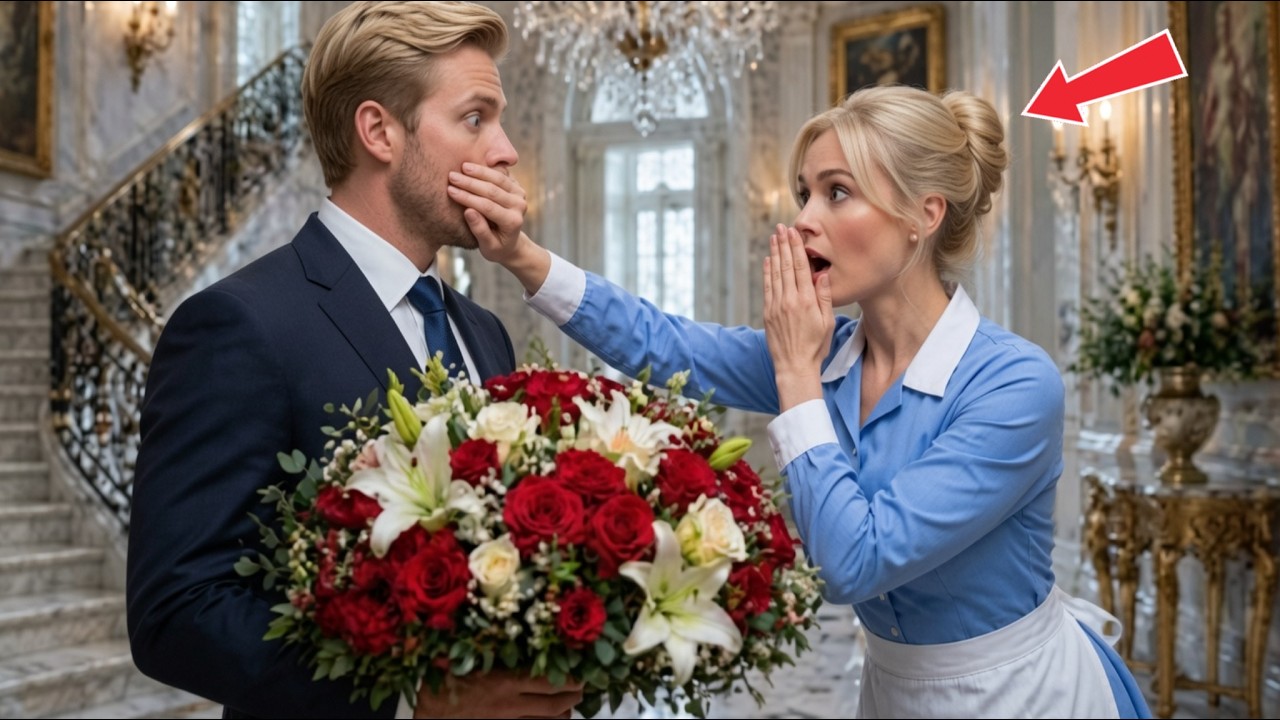
Her fingers, worn from years of cleaning other people’s floors, held me firmly at the foot of the marble staircase. I was carrying the most expensive bouquet I had ever bought—white and pink roses wrapped in silk paper, perfumed and ready to celebrate eight years of marriage. But in her eyes there was something no bouquet in the world could fix. “Don’t go up.
For God’s sake, don’t go up yet. ”
Her voice was barely a whisper, but it sounded like an alarm in my chest. Lise had never touched me. In all the time she had worked in my house, she had never once looked up when I walked past.
She served coffee with her head down, cleaned the furniture without a sound, and left the kitchen the moment I entered. She was the perfect shadow, the perfect employee. The woman my wife had hired through an agency was someone I barely noticed. Now she was gripping my wrist like I was a child about to step into traffic.
“What’s going on, Lise? Let me go. Katherine is waiting for me upstairs. ”
My name is Erik Madsen.
I’m a businessman, an only child, heir to a textile factory my father built from nothing before he died. I was, or believed I was, the luckiest man I knew. A thriving company, a lifelong best friend, a beautiful wife waiting for me every evening. And that afternoon, hours before our anniversary dinner, I decided to leave the office early and surprise her.
Let me tell you how a woman who scrubbed my floors stopped my life with a single sentence—and why I was never the same again. That morning I had woken early, still catching the scent of her perfume on the pillow. I watched her sleep and thought, “This man is lucky. ” Katherine looked like a painting.
I went down to the kitchen and found Lise preparing breakfast. As always, she stepped aside with her hands crossed over her apron, avoiding my gaze. I wished her good morning. She answered in a thin voice.
I briefly wondered what kind of story that silent woman carried, but I didn’t stop. I drank my coffee, read the paper, went to work. In the middle of the afternoon, in the boardroom at Madsen Textiles, my best friend and minority shareholder, Morten Nielsen, suggested we cancel the last meeting of the day. “My friend,” he said with the smile he had worn since university, “today is your anniversary.
Go home early. Buy something beautiful for Katherine. I’ll close everything here. ”
I embraced him with the trust you give a brother.
Morten had always been that person—the one who showed up when you needed him most. He was at my father’s funeral. He introduced me to Katherine years ago at an art exhibition. He sat by my side when I signed the company papers.
I trusted him completely. “Thank you, my friend. I don’t know what I’d do without you. ”
“You’d do the same for me,” he replied.
“Go. Don’t keep her waiting. ”
I stopped at the flower shop, bought the biggest bouquet they had, and drove home with the radio on, rehearsing what I would say. “Katherine, my darling.
Eight years of marriage, and a thousand more to come. ”
When I walked into the house, the first thing I noticed was the silence. The second was Lise standing at the foot of the stairs, gripping her cleaning cloth with both hands, her knuckles white. She looked like she had been waiting a long time for me to come back.
“You’re home early today,” she said. “Yes, I wanted to surprise her. Is she upstairs? ”
And then she did something that shattered every invisible protocol between employer and staff.
She looked me directly in the eyes without hesitation. “Erik, don’t go up there. ”
I laughed. I laughed like a fool because I thought it was a joke, or that my wife had prepared a surprise and this poor woman was struggling to keep it secret.
“Lise, please. I know she’s decorating something. Let me pass. ”
That was when she grabbed my wrist, and now we stood there—her trembling, me confused, the roses leaning crookedly in my arm.
“Mads, listen to me. Listen for a moment. I don’t want you to go up there like this. ”
“Like what?
What are you talking about? ”
Her eyes filled with tears. It wasn’t loud crying. It was the silent weeping of a woman who had cried inside her whole life and no longer knew how to cry any other way.
“I’ve wanted to tell you something for weeks. But a woman like me is nobody in this house. Who would believe me? I thought about leaving, quitting, disappearing.
But today… today I heard something that has kept me from sleeping since lunch. And when I saw you come in with those flowers, I knew God was telling me to open my mouth—even if it costs me my job. Even if it costs me more than my job. ”
“Lise, let me go.
”
But she didn’t let go. And in that moment, from the first floor, came a sound. Laughter. A woman’s laughter.
The most familiar laugh in the world to me—Katherine’s laugh. I had heard it on our honeymoon, at every birthday, at every Christmas dinner. I would recognize it among a thousand others. But she wasn’t alone.
There was another voice beside hers. A masculine voice, low, cheerful, almost guilty. A voice answering her something I couldn’t understand. And then new laughter from both of them, mixed, intimate.
I felt the floor shift beneath my feet. I let go of Lise’s grip—not to go up, but because my knees gave way. The bouquet tilted; a rose fell onto the marble floor with a ridiculously delicate sound. “No, no,” I muttered.
“This isn’t what it looks like. Maybe it’s a visit. Maybe it’s the television. ”
Lise’s voice was broken.
“They’ve been here all afternoon. I heard them when I went upstairs to put the clean laundry away. ”
“The television, Lise. Tell me it was the television.
”
She slowly shook her head. I took two steps up. Three. My legs felt like iron.
And then, before I could take the fourth step, I heard something you can’t mistake, invent, or explain another way. I heard Katherine say a name—a name spoken with the intonation wives use with their husbands in intimacy. But it wasn’t my name. “Morten, hurry up, before he comes back.
”
They say love is blind. But betrayal has a voice, and that afternoon I recognized the voice that left me speechless better than my own. The roses fell from my hands. All those white and pink petals rolled down the marble stairs like they were fleeing a wedding album.
The silk paper tore, the ribbon came undone, and I stood there in the house I had built with so much love, watching eight years collapse at my feet in seconds. I wanted to scream, to run upstairs and break the door down, to do whatever a betrayed man would do. But Lise’s hand grabbed me again—this time not my wrist, but my whole arm, the way a mother holds a child about to do something insane. “Please listen to me.
If you go up now, everything ends here. And everything I know, everything I’ve kept for you—it will be lost. ”
Something in her tone stopped me. Something in the way she said “everything I know,” as if she were carrying a secret too heavy for her shoulders.
I looked at her, truly looked at her for the first time. Not as the maid who scrubbed floors, but as a woman who had seen things I hadn’t. “What do you want, Lise? ”
Her eyes traveled over the stairs, over the fallen roses, over the walls with pictures my mother had chosen before she died.
Then they returned to me. “What you heard today is not the worst of it. What’s happening upstairs is only a small lie inside a much larger lie. I know things I discovered from the first day I came into this house—things about your wife, things about Morten Nielsen, and things about you that you don’t even know about yourself.
”
I felt the air thin. My own body stopped obeying me. “Lise, stop speaking in codes. What are you talking about?
”
She was silent for a moment. Then she looked up at the ceiling, as if asking permission from heaven, and said with the lowest, most steady voice I had ever heard in my life: “I came to work in this house for one reason only. It wasn’t the money. It was to get close to you.
Because I know who your father was. I know what he did. I know what he kept hidden his whole life. And I also know,” her voice broke again, this time not from fear but from an old pain, “what he left unfinished with my family many, many years ago.
Something no one in this house knows yet. ”
The laughter continued upstairs—distant, innocent to any other ear, devastating to mine. But I no longer heard it. The words of that humble woman, the maid I had never looked in the eye, had just shaken the entire ground under my life.
It wasn’t my wife’s betrayal that crushed me. Not even the betrayal of my best friend. It was the discovery that this woman knew things about my own family I had never suspected. “Lise,” I said with a dry throat, “come down to the kitchen with me.
Now. ”
And as we both walked down the stairs covered in rose petals, while the laughter continued above like a knife slowly entering my chest, I understood that the true story of my life only began that afternoon—and that the woman I had ignored for months was the only person in the world willing to save me. In the kitchen, Lise locked the door behind us. She walked to the spice cabinet, the one I had never opened, and from behind the pepper and sugar glasses she pulled out something wrapped in a cloth napkin.
She unfolded it, and on the wooden table fell an old mobile phone, a worn notebook, and two yellow envelopes tied together with string. “Now, Lise, before anything else—tell me why you’re doing this. Who are you, really? ”
She looked at me with eyes that weighed more than words.
“I’ll answer you. But first I want you to listen with your own ears to what I heard. If you still want to go up those stairs and confront them after listening, I won’t stop you. But at least go armed with the truth.
”
She turned on the phone with fingers that didn’t shake and pressed some keys. Suddenly my wife’s voice filled the kitchen. “Don’t worry, my darling. Erik suspects nothing.
He’s been sleeping like a lamb for years. He signs every paper for his best friend without reading it. He believes life is fair. ”
Katherine’s laugh—that complicit, low, catlike laugh.
A laugh I had heard a thousand times, and now, on that recording, it turned my stomach. Then Morten’s voice: “The last contract he signed like a lamb. He didn’t even look up. The transfer is already camouflaged as a fabric purchase.
When he finds out, he’ll be left without a company, without a house, without anything. ”
“And the inheritance, my darling? ” Katherine asked. “When will that matter be settled?
You know I married him believing it would go quickly. ”
“Patience, my angel. Eight years is nothing. We’ll get everything.
And for me, it’s not just about money. You know what I carry from that family—what the old man did to my mother, what he stole from me. ”
“I will miss him a little, though,” she said, laughing. “He’s so naive, so stupid.
Soon you’ll be able to call me by whatever name you want in front of the whole world. ”
Lise pressed a key. The recording stopped. The silence that followed was so heavy I could hear my own heartbeat in my shirt.
I didn’t cry. I didn’t scream. I didn’t knock over the chair. Strangely, I remained very still.
There are blows that hurt so much that the body numbs itself, as if it knows it would shatter completely if it reacted. “I’ve been listening to them for weeks,” Lise said. “Every time he comes, I pretend to clean the bathrooms on the first floor. That door they think is closed has a gap at the hinge.
Through it, I recorded. ”
“Morten is my best friend. He’s like a brother. He knew my father.
He was by my side when I buried my mother. And he’s here with my wife. Why didn’t you come to me before? ”
“Because I knew you wouldn’t believe me.
Who would believe a maid against your best friend and your wife? I needed proof. And here it is. ”
She opened the envelopes.
Inside were photocopies and documents—some stained as if she had read them a hundred times. Bank receipts with stamps from Solhøj Invest, a company I only knew by name because Morten had added it as a commercial partner in recent years to diversify risk. Lise pointed to it. “This company receives the transfers your signature approves from Madsen Textiles.
The amounts are not small. And the signatories from Solhøj Invest are three: Morten Nielsen, your wife Katherine Jensen, and a third name that’s not entirely clear here but looks like a cousin of Nielsen’s. ”
“How did you get these papers? ”
Lise lowered her eyes.
For the first time, I saw shame there. “Your wife is careless with her desk. She thinks nobody in the service staff can read financial documents. But I learned to read them a long time ago.
In another life. Before I stood alone with a grandchild in my arms and had to clean houses to survive. ”
There was silence. I wanted to ask her more about that other life, but something told me that part of her story was deep, and opening it right then would be opening a wound too large for a single afternoon.
“There’s more here. The worst hasn’t come yet. ”
I laughed—a broken laugh without humor. “How can there be anything worse than this?
”
Lise looked at me and said something that stuck in my memory like a pin on a map: “Papers steal money here. But secrets steal fates. ”
She took out the other envelope. Inside were old pictures—paper photographs from another time.
She spread them on the table with the calm of someone arranging tarot cards she knows by heart. “This picture I found behind the large painting in the study. It was taped to the back of the frame, hidden. Your wife doesn’t know it exists.
”
I took it with shaking hands. It was a black-and-white photo, faded by time. An older, elegant man sat on a park bench; beside him, a young woman smiled while he held her hand. Behind them stood a huge old tree full of roots.
The man’s face I knew perfectly. It was my father. “The young woman,” Lise said, her eyes growing moist, “was my older sister. ”
I felt the blood freeze in my veins.
“Your… sister? ”
“Yes. My sister Mette Hansen died many, many years ago. She died young, alone, without anyone knowing why.
And all my life I searched to understand what happened to her. Until one day, while opening some old drawers in my house, I found a box of letters signed with the initial R. Love letters. Letters from a married man who promised my sister he would arrange everything—talk to his wife, take care of her.
Letters that stopped right at the worst moment. ”
I closed my eyes. “My father’s name was Rasmus, Lise. ”
“You’re telling me my father loved your sister?
”
“Yes. And when she asked for his help in the worst moment of her life, he was afraid of his wife, afraid of the scandal, afraid of his company—and he abandoned her. My sister died waiting for an answer that never came. My whole family sank afterward.
My mother never smiled again. My father stopped working. And I, only a young girl then, promised in front of my sister’s coffin that one day I would know exactly who that man was. ”
She lifted her eyes—two sad embers.
“It took me my whole life, but I found him. When I saw the news in the paper that Rasmus Madsen had died, I knew I had found him. And when I read the notice, I knew he had a son—you. ”
“So you came to this house to take revenge on me?
”
Lise did something I never expected. She took my hands across the table, pressed them with her worn fingers, and for the first time I saw her smile—a sad, old, reconciled smile. “No. I came to get to know you—to understand what kind of man the son of that man was.
If you were like your father, I would have left and never spoken to you. But for months I’ve observed you, listened to you, talked to your employees, watched how you treat people. And I understood something. You are not like your father.
You are a good man—so good that you don’t notice when you’re being robbed. ”
A tear fell without permission. Then another. Then I couldn’t stop them.
“Lise, everything I believed about my life is breaking down in a single afternoon. What do I do? What do I do, for God’s sake? ”
“First, you breathe.
Then you hide all of this where no one will find it. And then you pretend—you pretend everything is fine. You smile at your wife, embrace your best friend, and continue as if you heard nothing. Because if they know that you know, everything can change tonight—and not in a good way.
”
“What they’re plotting against you is more advanced than it looks. The signature on the last contract is this week. If you sign, you lose the company. If you don’t sign, they grow suspicious.
We have a few days. ”
I looked at the phone, at the recording, at the photo of my father with her sister, at the bank photocopies. It was too much. But at the same time, for the first time in years, I felt something like waking up—like opening my eyes after a long dream.
“Lise, I have to ask you something. ”
“Anything. ”
“Don’t call me Mr. Madsen anymore.
If what you’re saying is true—if your sister loved my father, if our family changed yours—then we share a common history. I’m just Erik. ”
The woman who cleaned my floors closed her eyes and shed a tear. That tear ran down the old furrows of her cheek as if it knew the way by heart, as if it had been waiting to fall.
“Erik,” she said softly, and that name spoken by her sounded different than I had ever heard it. In that moment, the phone in the kitchen rang—the internal line connecting the ground floor to the bedroom. We both froze. Lise walked over, lifted the receiver with unnatural calm, held it to her ear without answering.
She listened. Then she slowly hung up. She looked at me. “Erik, your wife just asked Morten to leave through the back door because she heard a noise downstairs.
She said you might have come home early. ”
I felt the air dry in my throat. “What do I do, Lise? ”
She took a deep breath, put the evidence back in the napkin, and looked at me with the calm steadiness that only women who have already lost much and refuse to lose more possess.
“You go upstairs and meet her with a smile. You embrace her. You kiss her on the forehead and say the roses were on sale and that you dropped them on the stairs because you were nervous. You play the naive man.
They have to believe you are still the fool they think you are—tonight, tomorrow, for as many days as it takes until we have something bigger than this in our hands. ”
“Something bigger than this? ”
Lise looked at me and said with the lowest voice I had ever heard in my life: “Erik, your father left something written before he died. Something only one person in this world knows.
And that person is not me—and not your wife, and not your best friend. We have to find him before they do. ”
As I walked up the stairs, stepping on crushed rose petals, hearing my wife’s sweet, lying voice call to me from above, I knew the betrayal I had just discovered was only the tip of a much, much larger iceberg. And the woman I had ignored for months held in her hands the only keys that could open the doors I still had left to cross.
I walked up the stairs with heavy legs and a heart doing somersaults in my chest. Each step creaked under my shoes, as if the house itself knew something was broken and didn’t dare say it. Katherine appeared at the top of the hall with the smile that for years had been the postcard of my life. “My darling, you’re home early.
”
“It was madness, my darling. And the flowers—the flowers fell down the stairs. I was running, almost fell. I’ll buy others before dinner.
”
I kissed her on the forehead. A long kiss, maybe too long. But that kiss was no longer for her. It was for me.
It was to confirm that my hand still obeyed, that my face still obeyed, that I could still lie to the woman who had lied to me for months. “Is something wrong? Your eyes are red. ”
“Pollen, my darling.
The bouquet was enormous. ”
She accepted it with a distracted caress on my cheek. As she turned to go back to the bedroom, I memorized every gesture, every inflection in her voice, every movement. If I was going to pretend, I would do it like a film actor.
I went downstairs. Lise was waiting at the foot of the stairs with a cloth in her hand, her gaze lowered, the humble posture as always. She was again, to the world, the invisible maid. Only now I saw behind that costume a woman carrying enough stories to fill a library.
“Lise, tomorrow morning I need to talk to you alone. Far from here. ”
“I’m free tomorrow. I can meet you anywhere.
Where do you live? ”
For the first time I saw her hesitate for a moment. “A man like you has never visited. Tomorrow, you will.
”
That night I slept on the sofa in my own study under the excuse of back pain, which Katherine accepted without discussion. The truth was that sleeping beside her would have been impossible. I closed my eyes and saw roses falling. I opened them and saw a ceiling that felt foreign.
It was my house, but no longer mine. Early the next morning I drove my own car, no chauffeur, no protection. I turned off my work phone. I drove where Lise had directed, and as the streets changed, the landscape of my life changed too.
Lise’s little house was small and clean, painted with love. It had a small garden with a lemon tree and a clothesline drying in the sun. She waited for me at the door—no uniform, no apron. Just a woman with a scarf on her head and unsullied dignity.
“Come in, Erik. ”
It was the first time my name sounded in her house. Inside, sitting on the floor of the living room, was a boy drawing with crayons. He was young but old enough to understand what was happening around him.
He had shining eyes and a big smile. “Morning, sir. ”
“His name is Matt Hansen. My grandson.
He’s lived with me since he was a baby. ”
“I’m Matt, and I’m going to be an architect when I grow up. ”
Something inside me that had been sleeping for many years woke at those words. I, who could never have children, felt in that child a light I had never seen enter my house.
“Matt, my darling,” Lise said gently, “go into the room for a moment. Grandma and this man need to talk about serious things. ”
“Okay. But after that you’re making pancakes for me too, right?
”
“I’ll make the most delicious pancakes in the world for you. ”
The boy ran out, embracing a notebook of drawings as if it were a treasure. Lise watched him go with those eyes grandmothers have when they see in their grandchildren the last chance for life. “He’s everything I have, Erik.
Everything I protect. ”
We sat at the kitchen table, an old wooden table with a checkered cloth and a jug of fresh water. It smelled of toasted bread and freshly brewed coffee. It smelled of real life.
“Now, Lise. I want to know who you were before you came into my house. ”
She was silent for a long time, stirring her coffee with a small spoon. When she began to speak, her voice was different.
It was the voice of someone who had kept her whole life hidden and was finally allowed to let it out. “When I was young, I was one of the first in my family to finish my studies. I specialized in accounting. I worked for many years in a small firm, keeping books for merchants in the neighborhood.
I knew every paper, every balance, every transfer. I was not an accountant for large companies, but I did my job well and lived well. Modestly, but well. ”
“What happened?
”
She closed her eyes. “I married late. I had one daughter—my darling. I named her after my older sister, the one who died so young.
She grew up beautiful, intelligent, strong like me. She studied, graduated, fell in love with a boy from the neighborhood who seemed good. They had Matt. But the boy wasn’t what he pretended to be.
He got involved in shady things with shady people. My daughter wanted out, wanted to come home with the baby. And one day, on her way home from work, she never came home. ”
I wanted to stop her, but she continued.
“I waited for weeks. I waited for months. There was an investigation that led nowhere. And one day, exhausted, with a baby in my arms, I understood we would never find out what happened to my daughter—just like my sister before her.
One more silence. ”
“The pain was so great that I lost my job. I lost the house we lived in. I had to sell everything.
I kept this little house, which was my mother’s, and which no one could take from me. And to raise this grandchild, who is my life, I had to accept the only work offered without asking about background or explanations—cleaning houses. And that’s how I became a maid. A woman who could read balance sheets but scrubbed floors.
”
“Lise, you don’t have to be sorry for me. ”
“Pity doesn’t help me. I learned something cleaning houses that I never learned in an office. People are careless in front of those they consider invisible.
They talk. They leave papers open. They send messages aloud. For a woman in service, a rich house is a novel laid open on the table.
And when I knew who you were—when I knew you were the son of Rasmus Madsen—I came. I came to this house to understand, and I stayed because I understood that you weren’t your father. You were something else. ”
“What?
”
She smiled sadly. “A lonely man. A man who had also been swallowed by silence—he just hadn’t discovered it yet. ”
I drank my coffee to keep from crying.
“Tell me about my father, Lise. Tell me about Mette. The whole story. ”
She rose, went into the small room where she slept with her grandchild, and came back with a notebook—the worn notebook I had seen in my kitchen.
She opened it with the care one gives a relic. Between two yellowed pages was an old envelope. She opened it with trembling fingers and took out a key—a small golden key with a heart-shaped head. “This key opens something, Erik.
I don’t know what. But I know your father gave it to my sister before he died. He said to her: ‘If I am ever gone and you need the truth, go to the family’s old lawyer. ’ My sister could never go because she never knew who that lawyer was.
But you do. Lawyer Anders Bruun—your father’s lifelong lawyer. He’s still alive, very old, with his office in the center of town. So today we go visit him, Erik.
We take the key and find out what your father hid. ”
I nodded, but first there was something I had to ask—something that had been hurting me since the previous evening. “Lise, one more thing. Why are you helping me?
If my father betrayed your sister, if our family harmed yours—why don’t you just let life take revenge on me? ”
She looked at me with the calm that only years of processed pain can give. “Because when a person suffers what I suffered, there are two paths. Either you become like those who hurt you, or you swear never to be like them.
I chose the latter. And because there is something I have discovered observing you these months, Erik—something I still haven’t told you. ”
She took my hands across the table. “My sister Mette wasn’t just the young woman your father loved in secret.
When she died, she left behind more than letters. She left something he never knew about—something that could change everything you believe about your own family. ”
I felt the air thin. “What did she leave, Lise?
”
She looked toward the room where her grandson Matt was drawing castles in his notebook. “I can’t tell you yet, Erik. I need us to talk to Lawyer Bruun first. I need us to know what your father hid with that key.
If what I suspect is true, what’s happening in your house with your wife and your best friend is merely the shadow of a much, much older story. A story that began before you were born. ”
We left Lise’s house mid-morning. Before we got into the car, I made her a promise.
Whatever happened, that child would never again live under silence like those who had destroyed his mother and aunt. Lise pressed my arm and said nothing—it wasn’t necessary. Lawyer Anders Bruun’s office was in an old building, the kind that still has grilles in the elevators and doormen who know clients by name. The lawyer was a very old man—almost a relic, with thick glasses and slightly trembling hands, but with a still-sharp gaze.
When he saw me come in accompanied by Lise, his face changed, paled. He stood completely still, as if he had seen a ghost. “Little Erik,” he murmured, using the nickname only my father used when I was small. “Little Erik, my boy… Your father made me promise him before he died that one day you would come to find me.
He said when you came, you wouldn’t come alone—that you would come with someone carrying a golden key with a heart-shaped head, and that that person would be…” He looked at Lise, and his eyes grew moist. “A Hansen. ”
Lise let out a small cry and put her hand to her mouth. Lawyer Bruun rose very slowly, with the difficulty of years.
He walked to an old safe hidden behind a painting, turned the combination, and took out a sealed envelope with red wax. On the envelope, in my father’s handwriting—which I knew as well as my own—were a few words: “To my son Erik, so that he finally knows he is not the only son I had. ”
I felt the floor open beneath my feet. Lise held my arm, and for the first time since the previous evening, I knew that the betrayal by Katherine and Morten was nothing.
It was merely the first door in a corridor full of closed doors my father had left for me to dare to open. The red wax yielded in my hands as if it had a life of its own. Inside was a long letter several pages long, written in my father’s careful handwriting, and beside it a smaller, still-sealed envelope with a single word written on the front: “Brother. ”
“Before you read,” Lawyer Bruun said, “look at me.
I have to tell you something. Your father forbade me to tell you while he lived. Everything your father did in his last years, he did with guilt burning in his chest. He died asking forgiveness from a woman who could no longer hear him.
He died asking forgiveness from you without having the courage to look you in the eye. What’s inside that envelope is not an insult to you, my son. It’s a confession. And also a key, so you do not repeat his story.
”
I began to read aloud, my voice breaking from the first line: “My son, if you are reading this, it is because the right person has finally appeared to you. This person carries a surname I tried for years to erase from my memory without ever succeeding: Hansen. If you have met a Hansen, it means fate gave me what I deserved when I gave Mette that key. It means the silence I built with my own cowardly hands has finally fallen.
I want you to know, Erik, that I loved your mother. But before her, there was a young woman I betrayed. And from that young woman, a child was born—a child I never raised, never embraced, never called my son. A child who grew up far from me in a modest home without knowing who his father was.
His mother never told him. She took the truth with her when she died so young. And I, out of fear, out of pride, out of stupidity, let the silence grow taller than a wall. That child is now a man.
I looked for him in my last years. I found him, but I did not have the courage to introduce myself. I only observed him from a distance, followed him, made inquiries, and discovered something that changed me—this son of mine, whom I never embraced, knows who he is. I don’t know how, and he has not sought me out to get to know me, but to take revenge on me and on you for what life stole from him.
When you read these words, my son, look at the small envelope that accompanies this letter. His name is inside. I will not write it in this letter, because I want you to have the strength to open that other envelope on your own. And when you read his name, you will know why I write to you out of guilt.
You will know why there are people in your life who are too close to you for no apparent reason. Ask forgiveness on my behalf, Erik. And if you can, love him—for without knowing it, you share the same blood. ”
I closed the letter.
Lise squeezed my shoulder. I took the small envelope with the word “Brother” written on it, took a deep breath, and opened it. Inside was a single sheet with a single line written in my father’s handwriting: “Your brother’s name is Morten Nielsen. ”
The world stopped.
Lise let out a muffled scream and put both hands to her mouth. Lawyer Bruun bowed his head as if he had waited years for this moment and didn’t know how to endure it. I remained motionless. I didn’t breathe.
I didn’t think. I only heard a distant buzzing inside my head—as if all the memories of my life with Morten were rewinding at once in full speed. His smile the day he introduced me to Katherine. His embrace at my mother’s funeral.
His hand signing as my partner so many years ago. His voice telling me, “I love you like a brother,” again and again. It was literally true. And he had known it all along.
“Morten,” I whispered. “My best friend. My partner. The man who is in my house with my wife.
”
Lawyer Bruun looked up with a different urgency in his voice. “Erik, your father left something more with me. He left legal instructions—protected documents in a bank box in your name. And he left a separate fund.
A fund that only activates when you sign certain papers in front of me. A fund your best friend doesn’t know about. Your father wanted these funds, if you so chose, to be used to repair what he did not repair in his life—to your brother, to the heirs of Mette Hansen, to all those his silence harmed. ”
Lise lowered her gaze and bit her lip.
“Lawyer,” I said with a dry voice, “my best friend and my wife are emptying my company. The final signature on the last contract is this same week. If I sign, I lose everything. If I don’t sign, they grow suspicious.
What do I do? ”
Bruun looked at me over the glasses with the gaze of someone who had already seen too many family wars. “You don’t sign—but not out of stubbornness. You sign something else.
We let them believe you’re signing the contract they prepared. But in reality, you’ll sign a different document I will draw up tonight—a document that protects your entire company under a new temporary ownership. While they think they have control, they are in reality signing their own exit. And we collect the remaining evidence.
”
We left the office with a plan in motion. The contract signing was planned for Friday evening at my house during a small dinner Katherine had already arranged with Morten and his financial advisor. Two days remained. That same afternoon, Lise asked me to do something I never imagined.
“Erik, before Friday, you have to visit your brother alone—no wife, no advisor, no one. Just you and him. ”
“What good will that do? If I confront him now, everything falls apart.
”
“Not to confront him. To see him. To sit with him one last time as friends and keep that memory. Because when the operation is over, you may not be able to look at each other the same way.
And because there is something I need to give him—but I can’t give it to you until Friday. ”
That evening I called Morten. I said I needed to talk about an old memory that wouldn’t let me sleep. We agreed to meet at a small café the next morning in a neighborhood where no one knew us.
Morten arrived on time. His smile was the same as always—that brotherly smile I had learned to trust for years. And for the first time, looking at him, I knew that behind it lay a very old pain. “My friend, what a miracle.
What’s going on with you? ”
“Let me ask you something, Morten. Do you remember the day you met my father? ”
His face changed.
His jaw tensed—almost nothing, but I noticed. “Yes. I didn’t know him well. I only saw him a few times.
Why do you ask? ”
“Because I’ve been thinking a lot about him lately—about the family he had, the things he left unfinished. ”
“Do you feel your family left things unfinished? ”
Morten lowered his gaze, stirred his coffee longer than necessary.
“All families leave things unfinished, my friend. ”
“And have you ever felt your life was different than it should have been? ”
He looked up. For the first time in many years, I saw in his eyes something other than his usual smile.
I saw an old fatigue. I saw a wound. “All my life… Erik, there are things about me you don’t know. Things I hope you never find out.
”
“Come on. Tell me. ”
“I can’t. Not today.
”
“Then keep them, my friend. But I want you to know something. Whatever happens in the next few days, remember this conversation. Remember I sat across from you and looked at you as a brother.
If your heart ever asks you to return to the right side of the road, you will have a place to return to. ”
Morten looked at me with the intensity of a man on the verge of breaking but still holding on. He said nothing, paid for the coffee, and left. Before he went, he pressed my shoulder with a hand that barely trembled—and disappeared.
I sat on the café bench, feeling that I had just said goodbye to the Morten I knew. Friday came like the days you fear—fast, almost without warning. Katherine spent the whole afternoon organizing the dinner with suspicious joy. She called the florist, the caterer, played soft music.
She kissed my cheek as I changed. “My darling, tonight is very special. You’ll sign something that will change our lives forever. ”
I smiled at her in the mirror—a precise, well-groomed, practiced smile.
“Yes, my darling. Everything will change. ”
The doorbell rang. Morten arrived first, dressed in a dark suit with a bottle of wine.
Behind him came Olaf Carlsen—the third signatory on the Solhøj Invest papers. I hadn’t seen him in years. He was older, more gaunt, with the gaze of a man who had lied for too long. He extended his hand with false cordiality.
“Little Erik, how wonderful. Your father would be proud to see how far you’ve come. ”
I wanted to scream. I just smiled at him.
We went into the dining room. Lise set the table in her usual silence—apron on, head lowered. No one suspected a thing. To them, she was still invisible.
I wore the small microphone the prosecutor had given me that afternoon under my jacket. We ate, drank, toasted. Katherine told funny stories. Morten followed the conversation.
Olaf observed everything with calculating eyes. When the coffee came, Katherine took out the folder with the contract. “My darling, before dessert—let’s sign this quickly and get it over with. ”
I took the pen, turned it between my fingers, and said with the calmest voice in the world: “Before I sign, I want you to explain something to me.
I want you to explain why you want the company—without lies, just between us in confidence. We’re practically family, after all. ”
Olaf let out a low laugh—the most revealing laugh I had ever heard in my life. “Little Erik, do you really want to know?
The company has been ours before you were born. Your father stole it from the true son. Morten is a Madsen. You’ve only put your stamp on it.
And now, after so many years, things are falling into place. ”
Katherine laughed softly and caressed Morten’s hand. But Morten didn’t laugh. He remained very still.
Too still. “Olaf,” he said suddenly. “Shut up. ”
“What?
”
“Shut up. It’s not necessary to say more. ”
I looked at him. Morten’s eyes were filled with something I hadn’t seen before—tears.
An old pain surfacing. In that moment, Lise stepped into the dining room—but not as a maid. She stepped in straight-backed, head high, carrying a yellow envelope. She walked to the table and placed it in front of Morten.
“Young Morten, this is for you. From your real mother, Mette Hansen. My older sister. ”
Katherine stopped smiling.
Olaf stood up abruptly. “What is this? Who let this woman in? Erik, what is this circus?
”
Morten opened the envelope with trembling fingers. Inside was the original letter from his mother—a letter in old, stained ink, with tear marks. It said: “If my son one day knows who I was, tell him I was not born to hate anyone. Tell him I would rather he forget me than use me as an excuse to do harm.
”
Morten read it twice. Three times. And then the man who had spent his whole life building a wall to keep himself upright shed his first clean tears. Just one.
Then another. Then he couldn’t stop. “Mother,” he whispered, as if speaking to someone present. Olaf tried to snatch the letter from his hand.
“Morten, it’s a trap. That old woman is lying to you. ”
But Morten turned slowly toward him with shining eyes and terrifying calm. “Olaf, you raised hatred in me.
You filled my head with lies since I was a child. My mother never wanted this. My mother wrote the exact opposite. ”
Katherine began to retreat toward the door.
Just then the doorbell rang, and a firm voice came from the other side: “Police. Open the door. We have a warrant. ”
The glasses on the table rattled.
Lise came to me and squeezed my arm in silence. And as the prosecutor’s officers entered the room, as Katherine cried in rage, as Olaf tried to flee through the courtyard without success, Morten remained seated, staring at his mother’s letter—and for the first time in his life, my brother cried without asking anyone but himself for forgiveness. That night my house stopped being mine. It stopped being Katherine’s house.
It stopped being the house Olaf had arranged. It became simply an empty room where the truth had finally been able to sit down without asking anyone’s permission. The officers took Katherine first. She cried without looking at anyone, the way people cry when they finally realize their lies had an expiration date.
Olaf Carlsen was led away in handcuffs with an empty gaze, muttering that he had done all this for a mother he never knew. But Mette Hansen had already spoken for herself from an old letter and had forever rejected the hatred he had used to live. Morten remained at the table alone, the letter open in his hands. Prosecutor Ditte Pedersen approached him with respect, not harshness.
“Mr. Nielsen, you’ll need to come with us too. But given the circumstances and the agreement with Lawyer Bruun, your legal situation will be assessed separately. Your voluntary statement tonight will be crucial.
Decide in peace. ”
Morten looked up. His eyes, which for years had carried so much, were now clean—freshly washed by tears. “I will give a full statement.
Everything from the beginning. But first, can I embrace my brother? ”
The prosecutor nodded. I stood, walked to him, and Morten—the man I had for years called brother without knowing how literally that was true—clung to my chest like a shipwrecked man.
He cried unashamedly. He cried for the mother he lost before he was born, for the family that had been hidden from him, for the years he dedicated to a revenge that never belonged to him. He cried for my father, whom he never got to forgive in time. And I cried with him, holding him, repeating the only words that came out: “You’re home, my brother.
You’re finally home. ”
Lise watched us from the dining room door. She wasn’t crying. She just smiled softly with a tired, old smile—the smile of one who fulfills a very old promise made in front of a black-and-white portrait.
The following weeks passed like rainfall after great heat—washing, cleansing, straightening everything that had been crooked for far too long. Katherine was charged with complicity in financial crime. I only asked Lawyer Bruun for one thing: that the case be handled discreetly, not made into a public spectacle—not for her sake, but for the minimal dignity still attached to the history we once shared. Olaf Carlsen was not granted the same grace.
His years of document manipulation, forgery of kinship, and building hatred in an orphan’s head to seize another’s company finally fell back on him. The court decided. I didn’t decide. Morten cooperated with the prosecution from the very first statement.
He handed over everything—accounts, papers, conversations, recordings. His cooperation proved decisive. The prosecutor achieved a reduced alternative sentence with community service and financial restitution. My brother began to pay his debt not with money, but with time, with presence, with genuine effort.
Every afternoon for months, he showed up at a foundation helping young orphans learn trades. He worked with them, taught them what little he knew, and told them, looking them in the eye, that he was the worst teacher an orphan could have. And in the evenings, when he returned to the small house he had rented near Lise’s neighborhood, he sat reading and rereading his mother’s letter. That letter never left him.
He carried it in his shirt pocket over his heart like a shield, like a posthumous blessing. Lawyer Anders Bruun formally opened the separate fund in the bank box—true to my father’s last will. It turned out to be a substantial sum my father had hidden for decades with guilt in his chest, hoping someone would have the courage to use it well. We gave it a just destination.
Part went to Morten as the legitimate biological heir of Rasmus Madsen. It wasn’t a generous concession—it was a restitution of what blood had owed him all his life. Morten accepted it humbly, tearfully, without fighting for a single extra crown. He used it to establish a small technical school, which, by his own decision, was to bear the name Mette Hansen—so his mother would finally have something in this world that carried her name with pride.
Another part was used to improve the little house where Lise lived—the house where her sister had hidden letters, where her mother had kept a notebook with a false bottom, where so many silences had been raised. Lise refused to accept money for herself, but she accepted that we renovate the house for Matt—so the boy, besides his grandmother’s love, would have a stable roof, a new kitchen, his own room filled with books and school supplies. “Erik,” she said to me the day we handed over the keys, “my grandson is going to be an architect, like he said the first day you saw him. And he’s going to study at a real university.
I couldn’t give that to his mother, but I will give it to him. ”
“No, Lise. We will give it to him. Together.
”
And then I told her what I had been thinking for a long time. I asked her to lay down her apron forever, to stay with me—not as a maid, but as an aunt, to come to the big table at the head of the chair, to let Matt run through the halls where only crushed rose petals had once rolled. Lise looked at me for a long time. Then she said with a low, steady voice: “Erik, I will always be near.
But the big house is not for me. I was born in a small house, lived in a small house, and when I say goodbye, I will do it in a small house. But I promise you we will see each other often. The doors of the small house will always be open to you.
And Matt will be your true nephew, even if blood never knows it. ”
I accepted her condition. It was fair. Some women don’t need high ceilings to carry enormous lives.
It took me longer than I expected to feel like myself again. I slept poorly for a few months, reread every conversation with Katherine, asked myself whether she had ever truly loved me or whether everything had been one long theatrical performance. The answer, when it came, didn’t come as I expected. It came one ordinary afternoon while I was drinking tea in Lise’s little courtyard, watching Matt draw impossible building plans on the ground.
I understood that it didn’t matter whether Katherine had loved me in the beginning, middle, or end. The only thing that mattered was that I had learned to love better—that I could now distinguish love from calculation, companionship from convenience, a genuine embrace from a rehearsed one. And I understood something else watching that child draw. All my life I had believed the greatest pain was not being able to have children.
I finally understood that life had prepared me for something else—not to be the father of a child who carried my blood, but to be the uncle of a child who carried my name as an act of choice. Matt started calling me “Uncle Erik” without anyone teaching him, and I started answering him as if that word had been waiting for me all my life. Today, when someone asks me how a life falls apart and how it rises again, I tell the story of the day I came home early with a bouquet of roses. I tell them the flowers fell down the stairs.
I tell them a humble woman I hadn’t even looked in the eye for months held my arm and said, “Don’t go up yet. ” I tell them that behind that sentence lay three decades of silence—a dead sister, a lost daughter, a guilty father, a manipulated brother, a treacherous wife, a cold manipulator, and a child drawing castles on the floor. I tell them that Lise Hansen, the invisible maid in my house, was the only person in the world who dared to save me. Not because I deserved it, but because she had long ago decided never to become like those who had hurt her.
And above all, I tell them what I learned. I learned that the people who clean our houses also clean, without our knowing, the old wounds we carry around. I learned that a surname doesn’t guarantee family, and that true bonds are forged by actions. I learned that a father can die carrying enormous guilt and still leave you a golden key with a heart-shaped head so you can repair what he couldn’t.
I learned that a mother, even if she died alone, can protect you with a single handwritten line. I learned that a brother who learned to hate can learn to forgive, if someone has the courage to look at him with truth before judging him. And I finally learned what I so often heard Lise say without understanding: all families are a wound. The difference lies in who takes the needle to sew them.
Lise took the needle for all of us. She sewed a dead sister together with a living nephew. She sewed an angry orphan together with the mother he could never embrace. She sewed a naive son together with a guilty father.
She sewed two strange brothers together, who now call each other every Sunday. She sewed with her worn hands from years of cleaning other people’s floors everything three generations of Madsens had left broken. And when I thank her, she always answers the same with her half-smile: “Erik, I didn’t sew. I just gave you the needle.
It was you who sewed. ”
Sometimes I stop at the flower shop. The same old lady behind the counter still serves. I always buy two bouquets—one small for Lise’s little house, and another even smaller to lay on my father’s grave.
On the bouquet at the cemetery, I always write the same card: “Father, your son finally finished what you left unfinished. Both parts. ”
And that’s how a woman who scrubbed my floors ended up cleaning my entire life. That’s how a bouquet of roses that fell down a staircase gave me back the family I didn’t even know I had.
That’s how coming home early on an ordinary afternoon, instead of destroying me, saved me. If you ever, dear reader, feel that life is collapsing around you, remember this: sometimes what looks like the end of everything is merely the first door that opens. And sometimes the angel who comes to save you isn’t dressed in white—but carries a cloth in her hand, wears a worn apron, has tired hands, and speaks a simple sentence that changes everything. “Don’t go up yet.
Because upstairs is often the lie we already know. And downstairs, always waiting patiently, is the truth that saves us. ”