The brooch was her son’s, and the homeless man wearing it had no idea that the woman now blocking his path was a billionaire. “The brooch is my son’s! Stop him! ” Dagmar Jensen-Møller shouted, her voice cracking in a way her staff had never heard before.
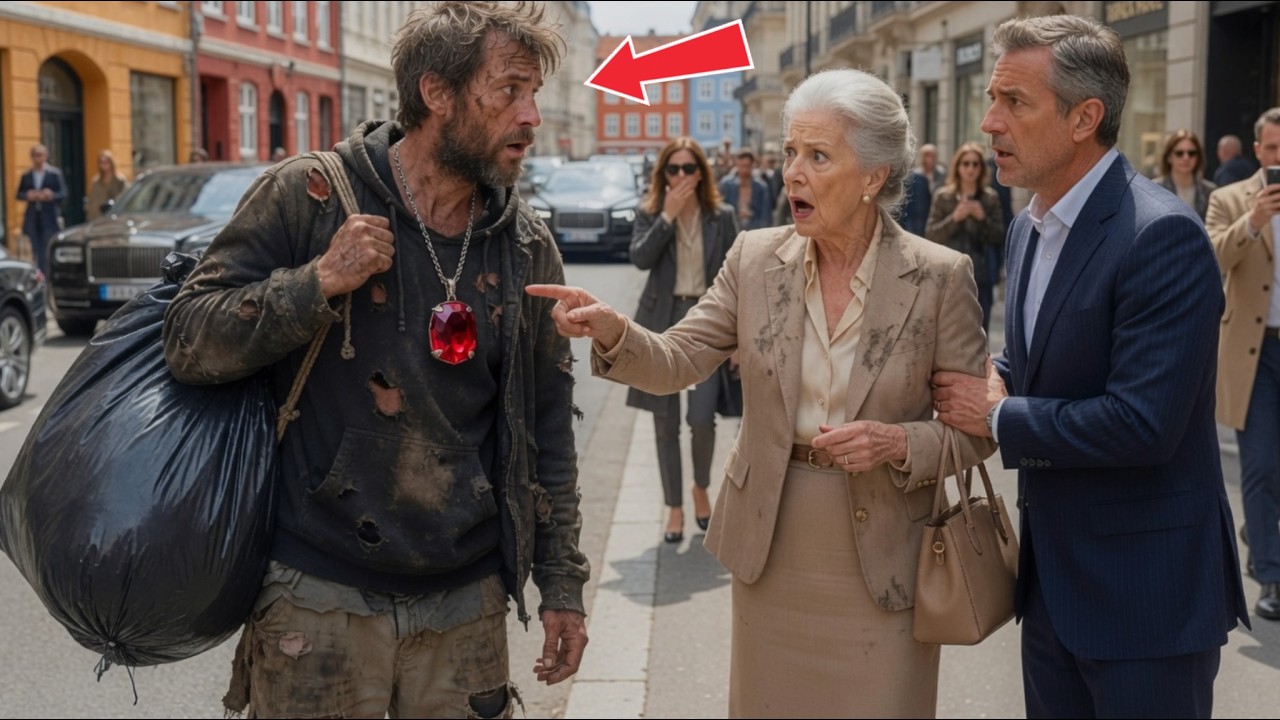
It wasn’t anger. It was something older, deeper—the sound a mother makes when something she thought was dead suddenly moves again. Rasmus froze, not because he understood what was happening, but because three large men in dark suits suddenly blocked his way. One of them held out his arm without a word.
“Hey, I haven’t done anything,” Rasmus said, his voice rough as sandpaper. He lifted his hands instinctively, the black plastic bag dangling from his fist. “What’s the problem? ”
The bodyguards just surrounded him.
The limousine door opened, and Dagmar stepped out without waiting for anyone to help her. She walked toward him with short, firm steps, as if her heels were nails sinking into the pavement. She stopped two steps away and studied his face. He looked back at her.
No one spoke for a moment that felt much longer than it was. “That brooch,” Dagmar said quietly, with a calm that was more frightening than shouting. “Where did you get it? ”
Rasmus frowned, looking down at the small round brooch—a central ruby surrounded by hand-filed silver threads—pinned to his ragged jacket.
He had found it years ago. It was beautiful. He wore it because it gave him a vague, foolish feeling of protection. “I found it,” he said.
“Where? ”
“In the trash. ”
Dagmar closed her eyes for a second. When she opened them again, something had changed.
“Get him in the car,” she ordered without turning to her bodyguards. Rasmus took a step back. His street instincts, sharpened by years of survival, told him nothing good could come from getting into a rich woman’s vehicle. “I’m not going anywhere with you.
I haven’t done anything wrong. If you want to call the police, do it. ”
“I don’t want to call the police,” Dagmar said. “I just want you to tell me where you got that.
Please. ”
The word “please” disarmed him. It wasn’t the tone of someone giving an order. It was the tone of someone desperately asking for something they were afraid to hear.
“Okay,” he said finally. “But I haven’t broken into anywhere, and I haven’t stolen anything from anyone. That needs to be clear. ”
“It’s clear,” Dagmar replied.
During the ride, Dagmar didn’t speak. She just kept looking at the brooch, her hands folded in her lap, fingers weaving together and loosening in a restless rhythm. Rasmus didn’t know where they were taking him. He didn’t know who she was.
All he knew, with a dark certainty, was that his life had just been changed forever—he just didn’t know yet if it was for better or worse. They passed through tall gates into an enormous property with manicured hedges, fountains, and a three-story colonial-style mansion. A butler led Rasmus to a library that smelled of old wood and old money. Bookshelves lined the walls, a mahogany desk sat in the center, and on the mantelpiece, between silver candlesticks, stood a framed photograph Rasmus couldn’t see clearly from where he sat.
Dagmar entered ten minutes later, having changed into a cream silk blouse. She sat across from him and looked at him for a long moment in silence. “How long have you been on the streets? ” she asked at last.
“Years,” he said. “Six, maybe more. I don’t know exactly. ”
“Do you have family?
”
“Not that I know of. ”
Dagmar blinked. It was a strange answer. Not “no,” but “not that I know of.
” “What does that mean? ”
“It means I don’t remember,” Rasmus said, looking at his own hands. “I woke up on a beach near Bornholm without knowing how I got there. No papers, no last name, no memory of who I was.
The first few weeks I thought it was temporary. It never came back. I can talk, I can read, I know the names of cities. But I don’t know who I was before that beach.
”
Dagmar listened without moving, her eyes wide, processing something faster than her mind could catch up. “And the brooch? ” she asked, her voice barely a whisper. “I found it at a landfill near the harbor, three or four years after I woke up.
It was wrapped in some cloth between trash bags. I cleaned it and kept it. It felt like mine. I know that sounds ridiculous—a homeless man saying an expensive brooch always belonged to him.
”
At that moment, the library door opened, and a man in his forties walked in without knocking. He crossed his arms, standing behind his mother’s chair, looking at Rasmus with open hostility. “Have you asked him where he stole the brooch? ”
“I didn’t steal it,” Rasmus said.
“Of course not,” the man said with a smile that didn’t reach his eyes. “Homeless men always find jewelry in the trash. ”
“His name is Søren,” Dagmar said, her voice carrying a quiet warning. “My son.
”
Rasmus looked between them. “You said the brooch belonged to your son. ”
“Her other son,” Søren corrected. “Alexander.
The one who died. ”
Dagmar walked to the mantelpiece, took the framed photograph, and turned it toward Rasmus. It showed a young man, perhaps twenty-eight, smiling, dark-haired, with light hazel eyes. In the pocket of his white shirt, barely visible at the corner of the image, was a ruby brooch.
“Who is this? ” Rasmus asked again, his voice different now, rougher. “My son,” Dagmar said. “Alexander Jensen-Møller.
He died five years ago. His car went into the sea off Bornholm. We never found his body. ”
The silence that followed was so heavy Rasmus felt it as a weight on his chest.
Bornholm. He had woken up on a beach there with no memory. “Geographical coincidence is not proof of identity,” Søren said, cutting through the silence. “No one has said it proves anything,” Dagmar replied.
But she turned to the man on the library couch. “You can keep the photograph tonight, if you want. ”
Rasmus couldn’t stop looking at the young man’s hazel eyes, searching the broken mirror reflection for something that answered who he had been before he woke up on that strand without a past. By the next morning, Rasmus had learned the full story.
A letter, sent anonymously to a woman named Hope Vejlegard who had helped him, revealed that the nameless patient with amnesia admitted to a psychiatric hospital in 1996 was a man named Rasmus Vejlegard—and that he had left behind a three-year-old son, a boy who had been placed in an orphanage in Valby. A boy who arrived with a silver pendant and a red stone around his neck, and when asked his name, could only say “Rasmus. ”
The boy on the beach was that child, now a man. Hope, an elderly woman who had worked for the family for decades, had believed him from the start.
But proving it was another matter. Axel, the only surviving son, was now publicly disputing everything, claiming Rasmus was nothing but a con artist exploiting a grieving mother. Rasmus had the brooch, the photograph, the battered hospital documents, and now—thanks to a frightened geneticist named Connie Riber who had kept evidence for twenty-eight years—recordings of Axel’s men trying to silence those who knew the truth. The DNA test had been confirmed: there was a 99.
97% probability that Rasmus was Hope Jensen-Møller’s grandson. Rasmus walked through the cold morning to the mansion, stopping at the gate. Spring had arrived, yet the air still carried winter’s bite. He pressed the intercom and gave his name.
The gate opened silently, as if it had been expecting him. Dagmar was standing in the garden, wearing a simple wool coat, waiting for him. She didn’t speak, only looked at his face, searching for something she’d been hoping to see for twenty-eight years. “I want to know everything,” she said.
“Everything you’ve discovered, everything you’ve kept hidden. ”
Rasmus reached into his jacket and pulled out a folder. He handed it to her without a word. She opened it, looked at the contents, and for the first time, her composure cracked.
The photograph of the young man with the brooch, the letter, the hospital documents, the DNA test result. Her hands trembled. “You are my grandson,” she said, more a statement than a question. “If the tests are right,” he said.
“I’ve known since the moment I saw the brooch on your chest,” she said, taking a step closer. “I didn’t believe it at first. It felt too impossible. But you wear it like he did, and when you looked at his picture, I saw him in your eyes.
”
Rasmus didn’t know what to say. He had spent his whole life being nobody, and now he was being claimed by a woman who had everything. But underneath that, he saw something else: a mother who had lost a son and had never stopped searching for him, even after everyone told her to let go. “Your grandfather.
My first son, Erik. The one who disappeared in the accident. He was the father of the man who raised you? ” Dagmar hesitated.
“No. Alexander was your uncle. Your father was Alexander’s older brother, Rasmus? ”
“No,” Rasmus said.
“The letter said my father was a man named Rasmus Vejlegard, who was admitted as the nameless patient. He was your son. ”
Dagmar’s hand with the folder dropped slowly to her side. Her face went pale.
“That can’t be. ”
“The hospital records confirm it,” Rasmus said. “The DNA matches you. And the man in the photograph—the one with the brooch—was my father.
Your firstborn son. ”
Dagmar sat down on the garden bench, her legs giving way beneath her. She stared at the ground for a long while. When she spoke, her voice was barely audible.
“I thought he died in the accident. I raised his brother, Axel, as my own. I never knew I had another son. ”
“He was taken to a psychiatric hospital without a name,” Rasmus said, his voice steady despite the trembling inside him.
“And when he was finally discharged, no one came for him. He disappeared into the city and lived a life that no one could trace. ”
When she looked up at him, her eyes were wet. “And you?
” She reached out her hand toward his face. “Where were you all this time? ”
“I was in a home in Valby. They called me Rasmus Hansen.
I never knew who I was until I found the brooch. ”
Dagmar closed her eyes, took a long breath, and looked at the young man standing before her. “You are not a Hansen. You are a Vejlegard.
And you are my blood. ”
She stood up, took his hand, and squeezed it. “Come inside,” she said. “You are home.
”
Rasmus looked at her, at the mansion, at the tall gates that had once seemed so intimidating. “What about your other son? Axel? ” he asked.
“Axel made his choices when he tried to have me believe a stranger was my long-lost son,” Dagmar said, her voice hardening. “He played a dangerous game. And he lost. ”
Rasmus didn’t know what the future held.
But standing there in the garden, with the spring sun warming his shoulders and her hand in his, he knew something for the first time in his life: he belonged somewhere. The next day, Axel was arrested at his office, charged with obstruction of justice, witness intimidation, and attempted fraud against the inheritance of the family’s estate. Dagmar did not visit him. She would not speak his name, except to say to the reporters gathered at the gate: “I had two sons.
I’ve been fortunate to find one of them, and to lose the other to the courts. ”
Rasmus stood at his grandmother’s side, the ruby brooch still pinned to his jacket. They had nothing more to say to each other, and nothing left to prove. The gate swung open and the world waited for him.
For the first time in his life, he walked through it not as a man with nothing, but as a man who had everything.