The brooch on that man’s chest—it was her son’s. The woman who stepped out of the black limousine was Dagmar Jensen Møller, seventy-two years old, owner of a property empire worth over four billion kroner. She had been reviewing documents in the back seat when something caught her eye through the tinted glass. Not the smell.
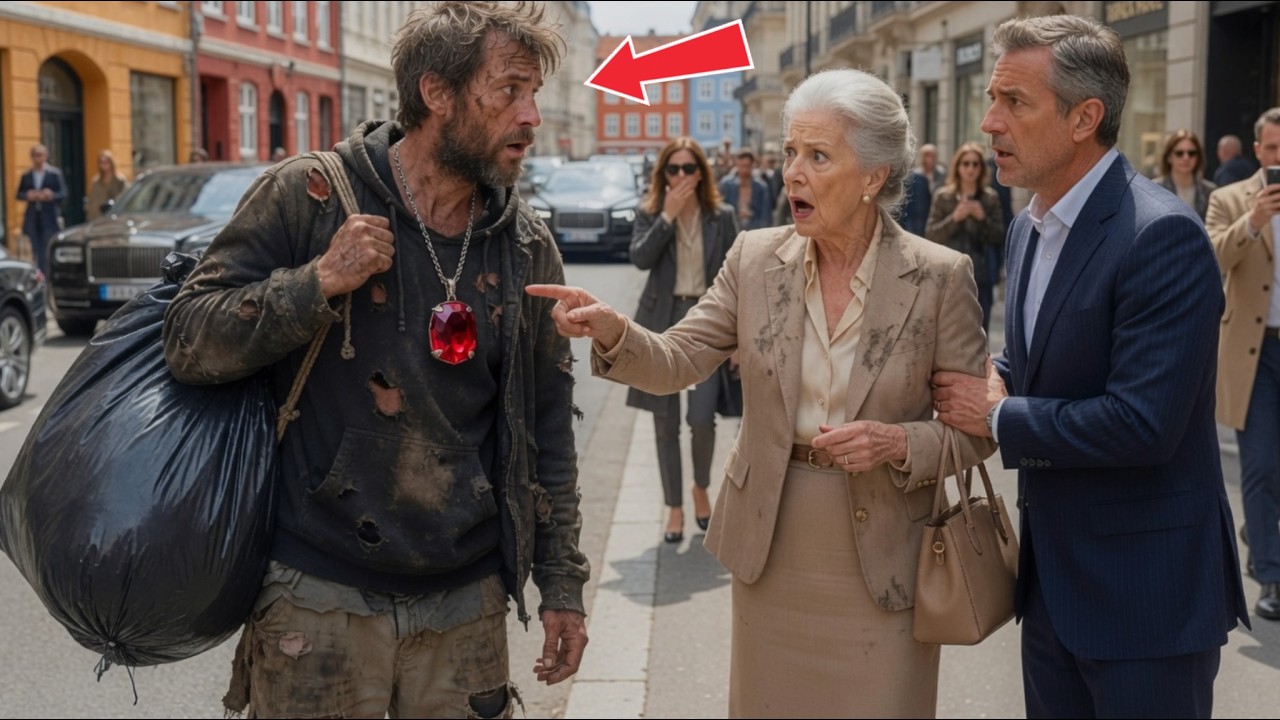
Not the movement. The glint. A small round brooch with a central ruby surrounded by hand-filed silver threads. She had ordered it from goldsmith Arne Ditlevsen in his workshop on Frederiksberg exactly eight years ago.
It had been designed only once, for one person: her son Alexander. And now it was pinned to the ragged chest of a homeless man. “Stop him! ” Dagmar shouted.
Her voice trembled in a way her staff had never heard. It wasn’t anger. It was something older, deeper—the sound a mother makes when something she thought was dead suddenly moves again. Rasmus stopped, not because he understood what was happening, but because three large men in dark suits suddenly blocked his path.
One of them extended his arm without a word. “Hey, I haven’t done anything,” Rasmus said, his voice rough as sandpaper. He raised his hands instinctively. “What’s the problem?
”
The bodyguards surrounded him. The limousine door opened, and Dagmar stepped out without waiting for anyone to offer her a hand. She walked toward him with short, firm steps, her dark honey-colored eyes behind tortoiseshell glasses never leaving his face. Two steps away, she stopped.
“That brooch,” she said quietly, with a calm that was more frightening than any shout. “Where did you get it? ”
Rasmus frowned and looked down at the brooch as if seeing it for the first time. “I found it.
”
“Where? ”
“In the trash. ”
Dagmar closed her eyes for a second. When she opened them again, something had changed.
“Get him in the car,” she ordered. Rasmus took a step back. His street instincts told him nothing good could come from getting into a rich woman’s vehicle. “I’m not going anywhere.
I haven’t done anything wrong. If you want to call the police, go ahead. ”
“I don’t want to call the police,” Dagmar said. “I just want you to tell me where you got that from.
” She pointed at the brooch with a trembling finger. “Please. ”
It was that “please” that disarmed him. It wasn’t the tone of someone giving an order.
It was the tone of someone begging for something only he could give her. Rasmus wasn’t a trusting man. He had fallen too deep, lost too much. But that plea cut through him.
“Okay,” he said at last. “But I haven’t broken into anywhere, and I haven’t stolen anything from anyone. That needs to be clear. ”
“It is clear,” Dagmar replied.
Fifteen minutes later, Rasmus sat in the back of the limousine with the city slipping away. His plastic bag of cans and cardboard boxes had been left on the sidewalk. Nobody picked it up. For the entire ride, Dagmar didn’t speak.
She only looked at the brooch, her hands crossed in her lap, fingers weaving and tightening and relaxing, as if searching for something to hold on to. Rasmus didn’t know where they were taking him. He didn’t know who this woman was. But with the dark certainty that sometimes comes before thought, he knew his life had just been changed.
He didn’t know if it was for better or worse. The limousine took Reformatorvej, then drove up toward the wealthy areas. The houses grew larger, the gardens quieter, the walls higher. A single observer watched him from the opposite seat with an expression Rasmus couldn’t decipher.
It wasn’t curiosity. It wasn’t sympathy. It was the calculation of a man deciding whether someone was a threat. “What’s your name?
” the man asked. “Rasmus. ”
“Rasmus what? ”
“Just Rasmus.
”
The man nodded slowly, as if confirming something he already suspected, then turned to look out his window. The estate on Dronninggårds Allé was hidden behind a four-meter-high wall topped with trimmed hedges. From outside, you could see nothing. The electric gate opened silently.
The courtyard was vast and symmetrical, palms lining the driveway, fountains murmuring with the constant, elegant sound that only exists in houses where silence is a price you can pay. Rasmus stepped out and looked up. The facade was three stories of modern colonial style. It wasn’t flashy in a vulgar way.
It was powerful in a calm way, which is the worst kind of power, because it doesn’t need to justify itself. Inside, a butler led them to a library that smelled of old wood and quiet money. Books lined the walls, some clearly read, others with paper markers sticking out. There was a mahogany desk in the center, two armchairs in tobacco-colored leather, and on the mantelpiece, between silver candlesticks, a framed photograph Rasmus couldn’t see properly from where he sat.
A tray with bread and fruit appeared. Rasmus ate. He was hungry. He had been since the day before.
Ten minutes later, Dagmar entered alone. She had changed into a cream silk blouse and held a glass of water she never touched. She sat across from him and looked at him for a long moment without speaking. It was a silence Rasmus recognized—the silence of someone gathering courage for a question she wasn’t sure she wanted answered.
“How long have you been on the street? ” she asked. “Years. I don’t know exactly.
Six, maybe more. ”
“Do you have family? ”
“Not as far as I know. ”
Dagmar blinked.
It was an odd answer. Not “no, I don’t” but “not as far as I know. ”
“What does that mean? ”
Rasmus set down the half-eaten bun.
He looked at his own hands as if the answer were written between the dirt under his nails. “It means I don’t remember. I woke up on a beach near Bornholm without knowing how I got there. No papers.
No last name. No idea where I came from. The first weeks I thought it was temporary. My memory would come back on its own.
But it didn’t. Or it came back in pieces that didn’t always fit together. I can talk. I can read.
I know the names of cities on a map. But I don’t know who I was before that beach. ”
Dagmar listened without moving, her lips slightly parted, her eyes wide. “And the brooch?
” she asked, her voice barely a whisper. “I found it at a landfill near the harbor. Three years after I woke up on the beach. Maybe four.
It was lying among trash bags, wrapped in a piece of fabric. I cleaned it and kept it. ” He shrugged. “It was beautiful.
It made me feel… I don’t know. Something. ”
Dagmar grabbed the glass with both hands.
At that moment, the library door opened and the man from the car stepped in without knocking. “May I ask what’s going on here? ” Søren asked. His tone suggested he already knew the answer and was only registering his formal disagreement.
“We’re talking,” Dagmar said without turning. “Have you asked him where he stole the brooch? ”
“I didn’t steal it,” Rasmus said, his voice steady. “Of course not,” Søren said with a smile that didn’t reach his eyes.
“People always find expensive jewelry in the trash. ”
“Søren,” Dagmar said, and in those two syllables lay an unmistakable warning. “Mother, we have to be realistic. This man appears with Alexander’s brooch and says he found it.
That’s not a story. That’s an alibi. ”
“The difference,” Rasmus said quietly, “is that I have no reason to lie to you. I don’t know who you are.
I don’t know who she is. I don’t know who Alexander is. I was just walking, and suddenly three men stopped me on the street. ”
Søren looked at him for a long time, then turned to his mother.
“Have you told him who Alexander is yet? Good. Because before we do that, I think we should call the police and check whether this man has a past, whether he’s stolen somewhere. ”
“We’re not calling the police,” Dagmar said firmly.
She turned to face her son. “I’m going to talk to him. And then I will decide what happens. You can stay or go, but you will not interrupt me again.
”
Søren crossed his arms, nodded with the calculated slowness of someone yielding in form but not in substance, and sat in the armchair on the other side of the fireplace, watching Rasmus with the calm, dangerous expression of an animal that has decided to wait. Rasmus turned to Dagmar. “Who is Alexander? ”
She hesitated a moment, then rose and walked to the mantelpiece.
She picked up the photo frame, held it in both hands for a few seconds, then turned it toward him. It was a photograph of a young man, maybe twenty-seven or twenty-eight, smiling, dark-haired, with light hazel-brown eyes. He stood in front of what looked like a manor with hedges in the background, wearing a white linen shirt with rolled-up sleeves, a hand in his pocket. And in the pocket, just barely visible at the corner of the image, was a ruby brooch.
Rasmus looked at the photograph for a long time. Something happened in his face he couldn’t have described. It wasn’t recognition, not exactly. It was like looking into a cracked mirror where some parts fit and others simply missing.
“Who is this? ” he asked again, but his voice had a different texture now. “My son,” Dagmar said. “Alexander Jensen Møller died five years ago in a car accident.
His car went into the water off Bornholm. ” She paused. “We never found the body. ”
The silence that followed was dense, almost physical.
“Bornholm,” Rasmus repeated slowly. “Bornholm,” she confirmed. Neither of them said anything more. They didn’t need to.
“This proves nothing,” Søren said from his chair, his voice soft. “A geographical coincidence is not proof of identity. ”
“No one said it proves anything,” Dagmar replied without looking at him. Søren stood and straightened his jacket with a precise, habitual gesture.
“If you want to know more about him, the proper course is formal verification. Documents. Background checks. A medical examination.
Not a coffee chat. ”
“You’re right,” Dagmar said. “We’ll do all of that, starting tomorrow. ”
Søren nodded, cast one last appraising glance at Rasmus, and left the library without saying goodbye.
Rasmus kept staring at the photograph. “May I… may I keep this for a moment longer? ” he asked.
Dagmar, who had been hard her entire life because she’d never been given another choice, felt something loosen inside her that hadn’t been open in years. “You can keep it tonight,” she said. Outside in the marble corridor, Søren took out his phone and dialed a number he hadn’t saved. “We have a problem,” he said quietly.
“I need you to make some calls tonight. ” Then he hung up. —
The next morning, Dagmar had her driver drop Rasmus at a hotel under a false name while DNA samples were taken at a private laboratory. Dr.
Håb Jensen, Dagmar’s longtime confidante and a retired physician, handled the arrangements personally, shielding the process from any formal trace that could be intercepted. They met in Frederiksberg Have before the lab work was completed. Dagmar had called in a favor to a woman she trusted with her life: “I need you to be my eyes for the next phase, Håb. There are people in my house who do not want this man to exist.
”
Håb was a retired doctor, a sharp woman in her late sixties who had known the family for decades. She had also been the one to handle Alexander’s death certificate and the legal closure of the case. She knew more than she’d ever said aloud. “I’ve arranged for the DNA test to be processed outside the usual channels,” Håb told Rasmus as they sat on a bench near the fountain.
“But I also found something that changes the picture. When I requested the old hospital records from the night Alexander’s car went off the road, I received more than an empty file. A separate dossier was filed under a different name. A man was admitted to Rigshospitalet that same night—brought in as ‘unknown male,’ severe head trauma, multiple burns, no identification.
He was transferred to Skotlands psychiatric hospital on the third of November 1996. Inducted without a name, without registered family, with profound amnesia. He stayed there four years. ”
Rasmus’s chest tightened.
“And that man… who was he? ”
Håb looked at him directly. “We believe that man was Rasmus Vejlegard.
Alexander’s real name, the name he was given at birth, was Rasmus. He changed it publicly to Alexander when he took over the company—a condition of the inheritance from his maternal grandfather, who wanted the Vejlegard name to die. No one outside the family knew. ”
Rasmus’s heart hammered.
“My father… Alexander… was my father? ”
“And you,” Håb said slowly, “were born at Rigshospitalet on the fifteenth of October 1996.
The same day your father was admitted. You were registered as a foundling and transferred to Solstrålen children’s home in Valby in January 1997. You arrived as an infant with no name, no family, and no visitors. ”
The image of a three-year-old child arriving at an orphanage with only a pendant around his neck surfaced in Rasmus’s mind.
That child. Him. “The pendant,” he said hoarsely. “The red stone.
”
“You were wearing it when you arrived,” Håb confirmed. “They logged it as ‘personal item, provenance unknown. ’ But the stone and the silverwork match the pieces your father ordered from the same goldsmith—the same one who made the brooch. Your father had two pieces made.
The brooch was for him. The pendant was for his child. ”
Rasmus touched the pendant under his shirt—the only thing he’d ever had from before the beach. A man who loved a woman named Valborg.
A son who arrived at an orphanage with a heavy name he never knew. —
But Dr. Håb had more to tell. A woman named Dr.
Conny Riber had been the registrar on duty at Rigshospitalet the night the unknown male was admitted. She’d kept documents in a safety deposit box, hidden for twenty-eight years—a burned photograph of a young couple, the man wearing the exact pendant now around Rasmus’s neck. Rasmus went to see her. It was a small apartment on Nytorv.
Dr. Riber, now in her sixties, opened the door trembling, as if she’d been waiting for him. “I’ve been waiting for you for twenty years,” she said. She handed him a sealed plastic bag containing a manila envelope.
Inside was a photo, burned at the edges, of a young man and woman. She was pregnant. He had his arm around her shoulder, both smiling, daylight around them. Around his neck hung the pendant with the red stone.
The woman’s name was Valborg. “You are the child in that pregnancy, aren’t you? ” Dr. Riber asked softly.
“I always suspected the young woman was Valborg Vejlegard. She was your father’s partner. She disappeared after the hospital. No paperwork, no trace.
I never knew what happened to her. ”
Rasmus looked at the photo for a long time. “My mother,” he said. “I believe so.
She never came forward to claim him. ”
Rasmus folded the photograph carefully, placed it back in the envelope, and put it in the inner pocket of his jacket beside the DNA documents. —
For two days, Rasmus existed in a strange bubble. Hope logged evidence.
The DNA result was delayed. Then it disappeared. A hushed phone call from the laboratory technician, a man named Mats Iversen, who sounded terrified: “I was offered money to destroy your sample and delete the record. I accepted at first.
But afterward I couldn’t. The analysis exists. I saved a copy on an external server before I deleted it from the system. ”
Mats gave him a time and a place.
But Rasmus never reached the café. Two men stopped him on a side street and bundled him into a black van. It was Søren’s doing, he realized later. No—it was Axel.
The man who now carried the family’s public name. Axel sat across from him in a darkened office. “How much do you want? ” Axel asked.
“I’m a businessman, not a film criminal. You have something valuable. I’m willing to buy it. ”
“It has no price.
”
Then Axel went silent. “You have no legal leg to stand on,” Axel said at last. “You’re a man with nothing. No name, no record, no identity.
I have money, lawyers, and time. You can leave with enough money to never sleep on a bench again. Or you can leave with nothing. Because everything you think you have will disappear.
Just like the hospital record disappeared. ”
Rasmus looked him in the eye. “I’m not leaving. ”
Axel nodded slowly, accepting the result of a bet he had already calculated.
—
The next morning, the journalists were already at the gates. So was the private investigator Søren hired. But Axel had already played his first card: a fake police record, leaked to the press, labeling Rasmus a fraudster and a thief for the past five years, with charges that never existed. The article ran without mentioning the family name, but everyone in the business world knew who it was about.
Håb called Rasmus, her voice brittle. “I’m sorry. I’ve been cut off from the house. Søren’s men are watching everything.
My recommendations are being ignored. ”
Rasmus hung up and looked at the burned photograph again. He had nothing left: no pending DNA result, no allies in the family, no public support. He was back on the streets, a discarded man with a dead name.
But he had one thing: urgency. —
The next day, he walked into the headquarters of the city’s largest media conglomerate and requested a meeting with the senior investigative editor. He showed them the photograph, the hospital documents, and the DNA chain records—and he told them the story of a boy who arrived at an orphanage wearing a silver pendant and who still wore it decades later, carrying the weight of a family that never wanted to know him. The editor was a veteran.
She had seen fabricated stories before. But the documents were verifiable. The photograph had been independently authenticated. And the pendant around Rasmus’s neck matched the one in the burned photo, authenticated by the same goldsmith who had made both pieces.
“You want to tell your story publicly? ” she asked. “I want to tell the truth,” Rasmus said. “And I want them to hear it.
”
—
The piece ran four days later. A long-form narrative with photographs, hospital records, and the DNA chain that independent experts had verified. It didn’t accuse Axel Jensen Møller directly of murder, but it laid out the evidence that Alexander Rasmus Vejlegard had survived the crash, been treated as an unknown man, and been transferred to a psychiatric facility—while his family publicly buried an empty coffin and never searched for him. The online edition was shared millions of times within hours.
A private investigator Håb had hired—with fees paid from her own pension—finally located Valborg. She was alive, sixty-four years old, living in a modest house on the outskirts of Aarhus under a different name. She had been threatened not to contact the family. She had believed, for twenty-eight years, that her son had been placed in a closed institution and that any attempt to reach him would bring him harm.
She had grieved in silence. Valborg contacted Rasmus through Håb. They spoke on the phone for the first time twenty-eight years after his birth. She told him the story of his father: a brilliant but tormented man who had been crushed by a family secret, who had loved her fiercely, and who had disappeared in a crash she’d never fully believed.
—
Two weeks later, in a quiet office, Dr. Håb Jensen sat Rasmus down across from a computer screen. “The mitochondrial DNA came back this morning. Your father’s sister, Håb’s own sister—the only surviving female line of the Vejlegard family—I had her test for a separate matter, using her consent for a genetic genealogy project.
The results are conclusive. ”
She turned the screen toward him. “Rasmus, you are the son of Alexander Rasmus Vejlegard. Your paternal grandmother was Dagmar Jensen Møller’s own sister, Lisbeth.
Your father was Dagmar’s nephew, not her son. The brooch you found in the trash—it belonged to your grandmother Lisbeth. She gave it to your father as a keepsake before she died. When you were born, he wore it around his neck.
It passed to you, though you never knew its meaning. ”
Rasmus stared at the screen. The final piece of the puzzle. The brooch that had stopped a billionaire’s car in the street—and that had belonged to his own blood all along.
—
The official inheritance was delivered six months later. Rasmus Riber Vejlegard, the boy from the orphanage who had grown up with no name, was legally recognized as the sole surviving heir of the Vejlegard estate—the legitimate son of Alexander Rasmus Vejlegard and Valborg Vejlegard. The fortune that had been preserved in trust for half a century now had a rightful owner. Axel Jensen Møller was arrested on charges of fraud and obstruction of justice after forensic auditors discovered a pattern of forged documents linked to the family estate.
He faced a trial that would take years. Rasmus stood on the porch of the estate on Dronninggårds Allé, looking out at the garden. Dagmar stood beside him, and Håb, and a woman who had only just come back into his life—his mother, Valborg. “What happens now?
” Rasmus asked. “Now,” Dagmar said, “you live. Without fear. Without borrowed names.
You are Rasmus Vejlegard. And you are finally home. ”
—
The afternoon light over Frederiksberg was the same as it had always been. Rasmus stood outside the estate gate, fists clenched at his sides, the pendant warm against his chest.
He had the story, the photograph, the legal confirmation. He had his mother back. He had a family that was finally his. He could have walked into the house and accepted everything that was handed to him.
He could have taken the inheritance, the name, the protection, the end of the streets forever. He didn’t.