The yellow taxi rolled past the towering Douglas firs, their branches dripping with the perpetual mist of the Tacoma suburbs. It was a strange, suffocating peace after 12 months of eating sand and dodging mortar fire in Afghanistan. But when the car crunched to a halt, the air was sucked right out of my lungs. There, staked into the center of my front lawn, was a sign that screamed in bright red letters: “Sold.
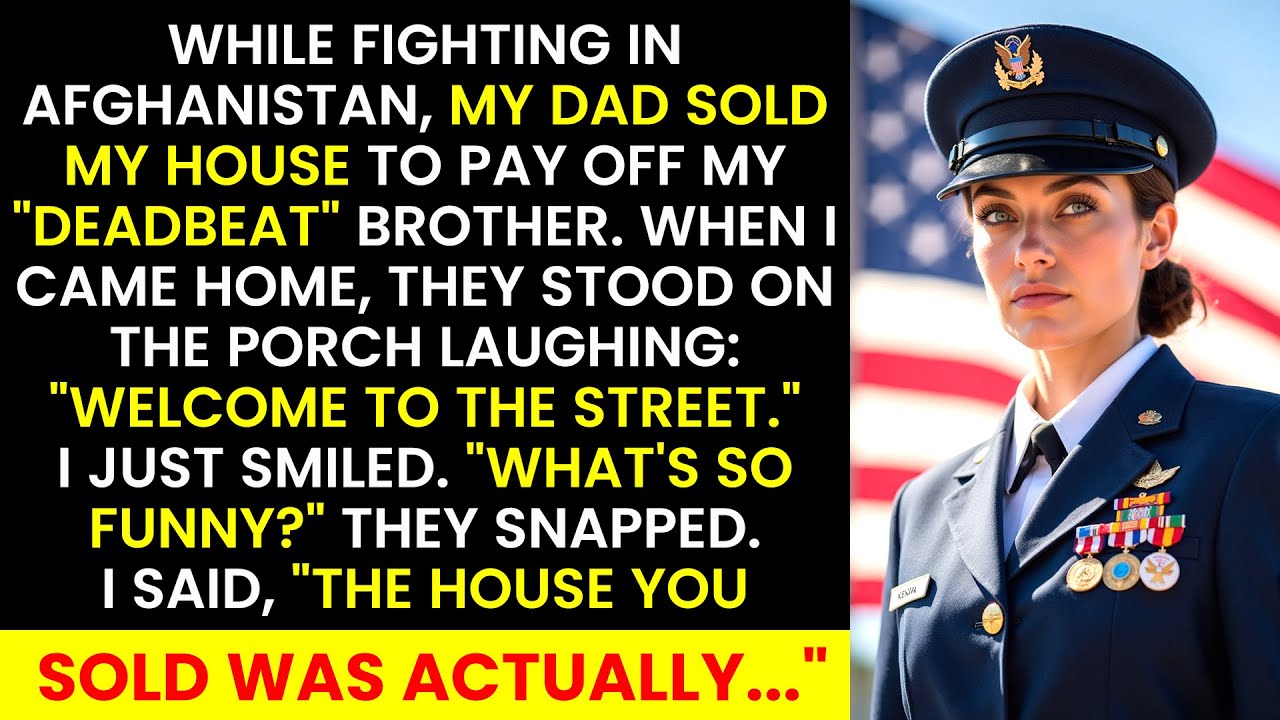
”
And on the porch, my father and my brother Chad were clinking beer cans, laughing and celebrating on property that was supposed to be mine. My blood turned to ice. My heart skipped a painful beat, and my hand, out of pure combat reflex, tightened around the strap of my duffel bag that still smelled of gunpowder. I had survived the Taliban, but looking at that sign, I felt like I had died right there on my own doorstep.
My father wasn’t surprised to see me. He didn’t even blink. He just smirked, wearing the cruel smile of a hunter who had successfully sprung a trap. “Welcome home, Sergeant Kenya James.
Or rather, welcome to the street. I sold the nest, kiddo. Chad needs to pay off some debts, and you’re the big sister. You make the sacrifice.
”
His words hit me like shrapnel. I stood there paralyzed, wondering if the power of attorney I had left behind to handle utility bills had just turned me, a Marine returning from hell, into a homeless woman in my own hometown. I stepped out of the cab, my combat boots still caked in the red dust of Helmand Province, grinding into the gravel of the driveway. There was no hug.
No “Thank God you’re safe. ” Just the wet gray chill of Washington state and the stare of two men who looked at me not as a daughter or sister, but as a broken ATM. Chad, my younger brother, looked healthier than I had ever seen him. He was flushed with the weight gain that comes from cheap beer and zero responsibility, fed by his unemployment checks and the stipend I wired home every month.
He was sprawled out on my old leather recliner, furniture that had been dragged out of my living room and left to rot on the damp porch. He took a swig from a can of Pabst Blue Ribbon, wiping his mouth with the back of his hand. “Back early, huh? ” He threw me a look that was pure dismissal.
“The direct deposit hasn’t even cleared yet. ”
My father, Frank, leaned against the railing, lighting a cigarette. The smoke drifted lazily, obscuring a face that had turned into stone. “Don’t stand there like a statue, Kenya.
You heard me. The house is gone. You’re a grunt. You’re used to sleeping in dirt holes and bunkers.
What does a brick-and-mortar house matter to you anyway? ”
“What does it matter? ” My voice cracked, not from fear, but from the sheer audacity of it. The rage started to boil in my gut, hot and fast.
“This was my retirement plan, Frank. This was my sanctuary for when I got out. By what right did you sell it? ”
Frank straightened up, tapping the breast pocket of his flannel shirt, where a thick folded envelope was bulging.
“By the right of being your father, and by that power of attorney you signed before you deployed. ” He stepped closer. The smell of stale whiskey and old tobacco hit me in a wave. It was the smell of my childhood.
The smell of disappointment. “Chad got into some trouble with the wrong people. Loan sharks. They threatened to cut his Achilles tendons, Kenya.
You want your brother in a wheelchair? ” He lowered his voice, adopting that manipulative tone I’d heard for 32 years. “Family means sacrifice. You’re strong.
You’re a Marine. You can take a hit and keep moving. You can handle being homeless for a bit. But Chad, he’s weak.
He needs me to save him. Stop being so selfish, Kenya. Don’t count pennies with your own flesh and blood. ”
I opened my mouth to scream that it wasn’t pennies.
It was $300,000 and my entire future. But my eyes snagged on something in Chad’s hand. He had spilled some of his cheap beer on the wooden floorboards of the porch. To wipe it up, he had grabbed a bundle of fabric from the pile of my belongings they had tossed outside.
It was my combat jacket. Not just any jacket. It was the one I wore during my first tour. The sleeve was still stiff with the dried blood of Corporal Perez, the man who had died dragging me to cover during an ambush in Kandahar.
I had kept it unwashed, wrapped in plastic, a sacred relic of what we lost. And Chad was using it as a rag. “Oops. ” Chad giggled, scrubbing the beer foam with the American flag patch on the shoulder.
“Making a mess. ”
The world narrowed down to a tunnel. The sound of the wind in the fir trees faded. All I could hear was the rushing of blood in my ears.
That wasn’t just fabric. That was honor. That was a life. I lunged forward, covering the distance in two strides, and ripped the jacket from his hands.
Chad flinched, then laughed, a high-pitched mocking sound. “Relax. It’s just a dirty old rag. You treat that garbage like gold.
You’ve gone crazy on your little vacation over there in the sandbox, haven’t you? ”
Vacation. To them, facing the Taliban, watching friends explode, sleeping with a rifle barrel under my chin. It was just an easy paycheck to fund their lifestyle.
My hand balled into a fist. Every instinct trained into me by the United States Marine Corps screamed at me to strike. I could break his nose before he even blinked. I could dislocate Frank’s shoulder before his cigarette hit the ground.
I wanted to hurt them. I wanted to make them feel a fraction of the pain they were inflicting on me. But then a voice in my head cut through the red haze. It sounded like my drill instructor.
*Discipline equals freedom. Emotion is the enemy of tactical decision-making. *
If I hit him now, I lose. Frank would call the sheriff.
I’d be arrested for assault. I’d lose my rank, my pension, and my freedom. They would win. They would paint me as the PTSD-ridden soldier who snapped.
And they would keep my money. I looked at the beer stain on Perez’s blood. I looked at Frank’s smug, triumphant face. He was waiting for me to explode.
He wanted me to throw a punch so he could play the victim. I forced my hand to open. I took a deep, shuddering breath, locking the rage away in a steel box deep inside my chest. My eyes shifted from the burning fire of betrayal to the cold, dead stare of a sniper acquiring a target.
“All right, Frank,” I said. I didn’t call him dad. I would never call him dad again. “You’re right.
I am a soldier. ”
I carefully folded the soiled jacket and shoved it into my duffel bag. I pulled the strap up onto my shoulder, standing tall, letting my shadow fall over them. “And a soldier never lets the enemy take a position without making them pay for it.
”
Frank’s smirk faltered for a second. “What does that mean? Where are you going? ”
“I’m not leaving, Frank,” I said, my voice dropping to a whisper that cut through the damp air.
“I’m just moving to a better firing position. ”
I turned my back on them. I walked down the driveway, my boots heavy on the gravel, walking straight out into the drizzling rain of the Pacific Northwest. Behind me, I heard Chad crack open another beer, laughing, thinking he had won, thinking I was running away.
It took everything I had not to turn around and level them both. But I knew I had to be smarter. He had no idea. The ambush at home had caught me off guard, yes, but the battle had just begun.
And unlike them, I knew how to win a war. The cold drizzle of Tacoma faded away, replaced instantly by a memory so vivid it burned my skin. Three months ago, Helmand Province, Afghanistan. The heat was a physical weight pressing down on us at 115 degrees.
It wasn’t just hot. It was a suffocating, dusty oven that sucked the moisture right out of your eyes. The air tasted of diesel fumes, burning trash, and the metallic tang of fear. We had just survived a happy Thanksgiving from the Taliban.
A mortar barrage that walked its way across our perimeter right as the mess hall opened. After the all-clear sounded, and we did a frantic headcount to make sure we still had ten fingers and ten toes, I sprinted for the MWR. My hands were still shaking, the adrenaline of the attack vibrating in my fingertips. It was Thanksgiving Day, the one day a year you pretend the world isn’t trying to kill you.
We were given a 15-minute window on the satellite phone to call home. 15 minutes to remember what we were fighting for. I stood in line, dust caked in the creases of my neck, clutching that heavy black handset like a lifeline. I was desperate.
I needed to hear Frank’s gruff laugh. I needed to hear the background noise of the Macy’s Thanksgiving Day Parade on the TV. I needed to hear Chad complaining about the turkey being too dry. I needed normal.
But when I dialed, all I got was the empty, hollow rhythm of a ringtone echoing halfway across the world. Ring. Ring. Nothing.
Chad didn’t answer. I redialed. My heart hammered against my ribs louder than the distant gunfire. Why weren’t they picking up?
It was 9:00 p. m. in Washington. They should be digesting pumpkin pie and watching football.
Ring. Ring. The silence on the other end was terrifying. Out here, silence usually meant an IED was waiting for you.
Back home, I was starting to realize silence meant something was rotting. Finally, on the tenth try, the line clicked open. “Yeah. Hello.
” It was Frank. But his voice wasn’t warm. It was impatient, breathless, and tiny through the satellite delay. “Dad, it’s me.
It’s Kenya. ”
“Happy Thanksgiving, Kenya. Make it quick, kid. The connection is terrible.
” He snapped. “I’m—uh—I’m out at the lake fishing with the boys. ”
I frowned, pressing the phone harder against my ear. “Fishing?
” It was late November in Washington. It was pitch black, freezing, and raining sideways. Nobody went fishing at night in that weather unless they had a death wish. “Fishing?
” I asked, suspicion tightening my chest. “At 9 at night? Dad, are you—”
And then I heard it. It was faint, filtering through the background of his end of the line, but to a trained ear, it was unmistakable.
It wasn’t the sound of wind or water. It was a digital rhythmic chime. *Ding ding ding ding. * Followed by the distinctive mechanical whir of shuffling cards and the electronic cascade of coins hitting a metal tray.
He wasn’t at the lake. He was at the Muckleshoot Casino. “You’re at the slots,” I said, my voice dropping. “You’re gambling on Thanksgiving.
”
“Don’t be ridiculous,” Frank barked, defensive immediately. “You’ve been in the sun too long. You’re hearing things. Look, this call is costing a fortune.
I got to go. Don’t get shot. ”
Click. He hung up.
He hung up on his daughter who was 7,000 miles away in a combat zone because he wanted to get back to his game. He was worried about the few dollars the call might cost while I was worried about surviving until sunrise. That night, sleep was impossible. I lay in my sleeping bag, staring at the canvas roof of the tent, reciting Psalm 23 in my head just to keep my breathing steady.
*Yea, though I walk through the valley of the shadow of death, I will fear no evil. * But the evil wasn’t outside the wire. It was back home. I pulled out my smartphone.
We didn’t have cell service, but we had a slow, intermittent Wi-Fi connection near the command post. I logged into my email. A notification from my credit monitoring service, something my commanding officer had practically forced us all to sign up for, was sitting at the top of my inbox. The subject line was red.
*Alert. Unusual credit activity. Mortgage payoff inquiry initiated. *
My blood ran cold.
Mortgage payoff. Why would anyone be inquiring about paying off my house? I had a 30-year fixed rate. I was making payments automatically.
Then it hit me. The power of attorney. The piece of paper I had signed and left with Frank so he could handle emergencies like a burst pipe or a tax issue. I had given him the legal authority to act in my name.
He wasn’t just gambling with his pension. He was putting my house on the roulette table. The next morning, I risked a sprint across the open compound to the metal shipping container that served as the JAG office. The Judge Advocate General.
Lieutenant Miller looked like he hadn’t slept in a week. Piles of paperwork surrounded him like sandbags. He took off his glasses and rubbed his eyes as I showed him the email and explained the phone call. “Sergeant James,” Miller sighed, leaning back in his creaking chair.
“I wish I could say this is rare, but half the battle out here is fighting the enemy. The other half is fighting the family members who treat your deployment pay like a winning lottery ticket. ”
He looked me dead in the eye. “You have to prepare yourself.
That power of attorney is a double-edged sword. You gave him the weapon he’s using against you. ”
“So I can’t do anything? ” I asked, my fist clenching.
“I just have to let them sell my home while I’m stuck here? ”
“No,” Miller said, his voice sharpening. “You bought that house with a VA loan, right? ”
“Yes, sir.
”
“That’s your ace in the hole,” Miller said, tapping the desk. “VA loans have federal protections. If he sells that house without disclosing your active duty status, he’s committing federal fraud. But you need proof.
You need to let him hang himself with his own rope. ”
He leaned forward, his voice dropping to a tactical whisper. “Don’t call him and scream. Don’t tip him off.
If he knows you know, he’ll hide the money. You need to go silent. Silent as a submarine. Document everything.
Save those emails. And when you get home, you surface and you fire. ”
I walked out of that container into the blinding Afghan sun. I felt a cold resolve settling in my gut, heavier than my body armor.
I was walking through the valley of the shadow of death. But I wasn’t afraid anymore. I was just waiting for the right moment to strike back. I arranged the meeting at Rusty’s, a roadside diner on the outskirts of Tacoma that smelled of burnt bacon grease, stale cigarette smoke, and bad life choices.
It was the kind of place where deals were made in hushed tones over chipped ceramic mugs. I arrived 10 minutes early, securing a booth in the back corner. I wanted to watch him walk in. Benson, the real estate agent whose name was plastered all over the sale documents I had pulled from the county clerk’s office, arrived 15 minutes late.
He was exactly what I expected. He wore a shiny, ill-fitting gray suit that looked like he’d bought it off a clearance rack at a discount warehouse. A wave of cheap cologne hit me as he slid into the booth opposite me, a pungent musk trying desperately to cover up the smell of old tobacco. He looked me up and down.
I hadn’t dressed up. I was still in my jeans, boots, and my green utility jacket. I saw the immediate dismissal in his eyes. To him, I wasn’t a homeowner or a sergeant.
I was just a dumb grunt, a girl who probably didn’t know how to read a contract without moving her lips. He didn’t even pick up the laminated menu. He just waved a hand at the waitress. “Black coffee, quick.
” Then he turned that oily, condescending smile toward me. “Miss James,” he said, leaning back and spreading his arms along the top of the red vinyl booth. “I hear you’re making quite a fuss. Your father told me you agreed to a quick cash sale.
Honestly, I did your family a favor pushing this through so fast. The market is volatile. ”
I stared at him, my hands wrapped around my glass of water. “A favor?
” I repeated, my voice flat. “You sold a three-bedroom house in a prime school district for 30% below market value to a cash buyer in less than 48 hours. ”
I took a slow sip of water. “That creates a significant gap, Benson.
About $60,000 of missing value. Where did that difference go? Did it go into your commission, or did it go directly to the people threatening to break my brother’s legs? ”
Benson scoffed, a short, sharp sound.
He flashed a set of teeth yellowed by years of coffee and nicotine. “That’s called a consulting fee and a risk assessment premium. Sweetheart, look, your brother owes bad people. Your dad begged me to help.
I am the savior of your family right now. You should be thanking me, not interrogating me like I’m a suspect in a cop show. ”
He leaned in, his voice dropping to a patronizing whisper. “You’ve been away playing soldier.
You don’t understand how the real world works. Just be grateful you have a little cash left over. ”
He was trying to gaslight me. He wanted me to feel small, ungrateful, and stupid.
It was a tactic that probably worked on desperate civilians, but he forgot who he was talking to. I reached into my bag. I didn’t rush. My movements were deliberate, calculated, and smooth.
First, I pulled out a thin manila folder and placed it on the sticky table. Then I pulled out my Glock 19. I didn’t point it at him. I didn’t wave it around.
In Washington state, open carry is perfectly legal if you have the permit, which I did. I simply set the matte black pistol on the table right next to the sugar dispenser, barrel pointing safely away from everyone. It sat there, heavy and undeniable, a piece of cold steel reality disrupting his little game. Benson froze.
His eyes bulged, glued to the weapon. The smirk vanished instantly. “I’m not a cop, Benson,” I said, my voice dropping an octave, cold as ice. “I’m a United States Marine, and I know exactly how the real world works.
”
I slid the folder across the table. He didn’t touch it. He was too busy sweating. “Open it,” I commanded.
He obeyed, his fingers trembling. Inside was a single sheet of paper with a government seal. “That is my certificate of eligibility,” I explained, leaning forward. “That house was purchased with a VA loan, a loan guaranteed by the Department of Veterans Affairs.
”
I watched the realization dawn on him. He wasn’t stupid, he was just corrupt, and he knew exactly what that meant. “You processed a title transfer on a property secured by the federal government without obtaining a waiver from the active duty service member. ” I continued reciting the regulations I had memorized in the JAG office back in Helmand.
“Do you know the difference between civil fraud and federal mortgage fraud, Benson? ”
He tried to swallow, but his throat was dry. “Civil fraud gets you sued,” I said, tapping the table near the gun. “Federal fraud gets you an FBI investigation and 10 years in a federal penitentiary.
You didn’t just cheat me. You cheated the United States government. ”
Benson’s face went gray. He knocked his coffee cup over with his elbow, brown liquid splashing onto his cheap trousers, but he didn’t even notice the burn.
He looked like a rat trapped in a corner, scanning for an exit that wasn’t there. “No,” he stammered, his voice shaking. “I didn’t know the paperwork. Your dad said—”
“My dad said what?
” I pressed, my eyes locking onto his. “What did Frank tell you that made you think you could bypass federal law? ”
Benson looked at me, then at the gun, then back at me. He was terrified, and in his terror, the truth spilled out, ugly and raw.
“He told me to just push the papers through,” Benson whispered. “He said not to worry about the signature. ”
“Why? ”
Benson gulped, tears of panic forming in his eyes.
“He said—Frank said—’Just sell it. Kenya is over in that hell hole. Bombs are dropping every day. She’s going to die in Afghanistan anyway.
Nobody will ever know. ‘”
The noise of the diner, the clatter of plates, the sizzling of the grill, the murmur of conversations—it all seemed to vanish. The world went silent. A coldness spread from the center of my chest, freezing my blood.
“He said,” Benson continued, his voice barely audible, “he told me to liquidate the asset before we got the death notification. He said it was better to have the cash now than wait for probate. ”
I sat back against the vinyl booth. I felt like I had taken a sniper round to the gut.
Frank hadn’t just sold my house because he was desperate. He hadn’t just stolen from me. He had bet against my survival. He was banking on my death.
To my own father, I wasn’t a daughter coming home. I was a lottery ticket that was worth more dead than alive. I looked at Benson, a pathetic, greedy little man who was just a pawn in my father’s monstrous game. I picked up my Glock and slid it back into my holster.
“You’re going to fix this, Benson,” I said, standing up. “You’re going to freeze that money, or I will bring the entire weight of the federal government down on your head. ”
I walked out of the diner without looking back, leaving him shivering in a puddle of spilled coffee. But as I stepped into the gray parking lot, I realized the gun hadn’t protected me from the one bullet that mattered.
My father had pulled the trigger months ago, and I was just now feeling the wound. I left the diner with Benson’s confession ringing in my ears like tinnitus, heavy and disorienting. I couldn’t bear to drive back to the house, *my* house, and see Frank and Chad living their parasitic lives in my living room. I couldn’t look at them without wanting to scream, and I knew screaming wouldn’t get my property back.
Instead, I drove the rented pickup truck to a gravel turnout near a construction site a few blocks away. I reclined the seat, pulled my woobie, the poncho liner I’d kept from my gear, over my chest, and tried to sleep. It was freezing, the damp Washington cold seeping through the glass. But I was used to sleeping in worse places.
At least here, no one was shooting at me. Or so I thought. A sharp rap on the window jolted me awake just as the gray dawn was breaking. My hand flew to my waistband out of instinct, but then I saw him.
It wasn’t a cop and it wasn’t a threat. It was Mr. Halpern. He lived in the rambler directly across the street from my house.
He was pushing 75, a man built of gristle and bone with a posture that was still ramrod straight despite a noticeable limp in his left leg. He was wearing his faded Vietnam veteran ball cap, the one with the silhouette of the three soldiers on it. I rolled down the window, the cold air rushing in. “Sergeant James,” he said.
He didn’t call me Kenya. He didn’t call me kid. He used my rank. My father hadn’t done that once.
“Mr. Halpern,” I rubbed the sleep from my eyes. “I’m sorry. I just needed a place to—”
“Don’t you dare apologize.
” He cut me off. His voice gravelly but kind. “And don’t you dare sleep on the street like a vagrant in your own neighborhood. Get out of that truck.
Martha just pulled a batch of buttermilk biscuits out of the oven. The coffee is hot. ”
The simple, unasked-for kindness hit me harder than a physical blow. I nodded, unable to speak, and followed him across the quiet street.
His house was a time capsule of warmth. The kitchen smelled of yeast, bacon, and strong coffee. On the wall next to the breakfast nook hung a shadow box displaying a row of medals: a Purple Heart, a Bronze Star, and the Combat Infantryman Badge. He set a steaming mug of black coffee in front of me.
Martha, his wife, gave my shoulder a gentle squeeze before retreating to the living room to give us privacy. “I saw everything, you know,” Mr. Halpern said, staring into his cup. “I’m an old man.
I don’t sleep much. I sit on my porch and I watch. ”
He looked up, his eyes filled with a deep, sorrowful anger. “While you were gone, Kenya, that house turned into a circus.
Loud music until 3 a. m. Strange cars coming and going. Looked like a drug den.
Your dad, he just sat there drinking while Chad tore the place apart. ”
He stood up and walked over to a drawer near the sink. “Chad didn’t just wreck the drywall, Sergeant. He wrecked the memories.
Last month, I saw him hauling a box of junk to the curb. He threw this into the mud because he said it looked creepy staring at him. ”
Mr. Halpern placed a wooden frame on the table.
My breath hitched. It was the portrait of my mother, the one taken just before the cancer got bad. She was smiling, wearing her Sunday best. It had been on the mantle for 10 years.
Chad had thrown Mom in the mud. I reached out, tracing the glass. Mr. Halpern had cleaned it.
There wasn’t a speck of dirt on it. He had rescued her when my own blood had discarded her. “There’s something else,” Halpern said, his voice hardening. He pulled an old, scratched tablet from the counter.
“I have a Ring camera on my front door. It picks up audio pretty well when the wind is right. This was from a week ago. ”
He pressed play.
The video was grainy, shot in the green hue of night vision. I saw Chad on my front porch, practically on his knees, sobbing. “They’re going to hurt me, Dad. You got to help.
” Chad’s voice whined through the tiny speakers. Then Frank stepped into the frame. He put a hand on Chad’s shoulder. And then I heard the words that would haunt me for the rest of my life.
“Don’t cry, son. I’ll sell the house. I’ll fix it. ”
“But what about Kenya?
” Chad blubbered. “It’s her house. ”
Frank laughed. It was a dismissive, ugly sound.
“Kenya? She’s a grunt. She sleeps in dirt holes for a living. Her skin is thick.
She’s used to suffering. She can handle being homeless for a while. She’s tough. But you—you’re my golden boy, Chad.
You’re sensitive. I’m not going to let you suffer. I’ll sacrifice her comfort for your safety any day. ”
The video ended.
I sat there frozen. My hands gripped the ceramic mug so hard my knuckles turned white, but I couldn’t feel the heat. *She’s used to suffering. *
That was his justification.
Because I had worked hard. Because I had endured Marine Corps boot camp. Because I had survived war. I deserved to lose everything.
My strength wasn’t something he was proud of. It was the excuse he used to exploit me. I was being punished for being competent. A tear slid down my cheek.
I didn’t wipe it away. Mr. Halpern reached across the table, his hand covered in liver spots and scarred from a war fought 50 years ago, covering mine. His grip was shaking but strong.
“When I came back from ‘Nam in ’72,” he said softly, “I walked through the airport in San Francisco. A college kid spat right in my face. Called me a baby killer. I thought that was the worst pain a man could feel.
To serve your country and be hated for it. ”
He looked me dead in the eye, the bond between warriors bridging the gap of half a century. “But watching your father do that to you—watching your own blood spit on your sacrifice. Kenya, that is a pain no soldier should ever have to carry.
”
He squeezed my hand. “Don’t you let them win, Sergeant. This country might owe us a lot of things we’ll never get. But that family of yours, they owe you justice.
You take back what’s yours. ”
He tapped the tablet. “I saved the video. I’ll testify.
I’ll stand right next to you in court. ”
I looked at the picture of my mother, then at the old soldier who had treated me with more dignity in an hour than my father had in a lifetime. The crushing loneliness that had been suffocating me since I stepped out of the taxi began to lift. “Thank you, sir,” I whispered.
I wasn’t alone anymore. And now I had the ammunition I needed to end this war. I walked into the Pierce County Sheriff’s Department wearing my dress blues. I had spent an hour ironing the midnight blue coat and the sky blue trousers with the red blood stripe running down the leg.
I polished the brass buttons until they gleamed under the harsh fluorescent lights of the precinct lobby. I wasn’t walking in there as Kenya James, the heartbroken daughter sleeping in a rental truck. I was entering as Sergeant James, United States Marine Corps. I needed them to see the rank, not the victim.
The lobby smelled of floor wax and stale coffee. A deputy buzzed me through the security gate, his eyes widening slightly at the sight of the uniform. He led me to a cramped office in the back where Lieutenant Donahue was buried behind a mountain of paperwork. Donahue was a middle-aged man with bags under his eyes and the weary posture of a cop who had seen too many domestic disputes turn violent.
He gestured for me to sit, picking up the file I’d submitted earlier. He flipped through the pages: Benson’s confession, the copy of the power of attorney, and the printout of the sale contract. He didn’t look impressed. He looked tired.
“Sergeant James,” Donahue sighed, tossing the file onto his desk. “I appreciate your service, really, and I understand you’re upset, but I’m going to be honest with you. This is a civil matter. ”
The words landed like a dull thud.
It was exactly what I had feared. “Civil matter,” I repeated, keeping my voice level. “Your father had a valid power of attorney,” Donahue explained, rubbing his temples. “He had the legal authority to sell the property.
If you think he misused the funds, you can sue him in civil court. But that takes years. And frankly, if the money’s gone, it’s gone. We can’t arrest a man for making bad financial decisions with permission you gave him.
We don’t interfere in family squabbles unless someone throws a punch. ”
He was trying to pass the buck. He wanted to push this off his desk and onto a lawyer’s pile so he could go back to his coffee. I didn’t blink.
I didn’t raise my voice. I just reached into my leather portfolio and pulled out my silver bullet. “You’re mistaken, Lieutenant,” I said, sliding a single document across the metal desk. “This isn’t a civil dispute.
This is a federal crime. ”
Donahue frowned, picking up the paper. It was the original VA loan closing document. “My home was purchased with a VA loan,” I stated, my voice cutting through the hum of the air conditioner.
“It is federally guaranteed by the Department of Veterans Affairs. Under the law, any transfer of title while the service member is deployed requires a specific affidavit regarding occupancy. ”
I pointed a gloved finger at the signature line on the copy of the sale deed Benson had processed. “My father and the real estate agent, Benson, falsified a residency affidavit.
They certified to the federal government that I was present and occupying the home, or that I had waived my rights under the Service Members Civil Relief Act. I did neither. I was in Helmand Province. ”
I leaned forward, locking eyes with him.
“They didn’t just steal my house, Lieutenant. They defrauded the United States government. They lied on federal forms to liquidate a protected asset. Are you telling me the Pierce County Sheriff’s Department refuses to process a clear case of bank fraud and conspiracy against a deployed Marine?
”
The air in the room changed instantly. The weariness in Donahue’s face vanished, replaced by a sharp alertness. He knew exactly what federal fraud meant. It meant the FBI.
It meant press conferences. It meant a scandal if he ignored it. “Wait here,” Donahue said. He stood up abruptly, grabbing the phone on his desk and turning his back to me.
I sat in silence, my spine straight, listening to the one-sided conversation. “Yeah, district attorney. ”
“Yes, she’s here now. ”
“No, it’s a VA loan.
”
“Yep, fraudulent affidavit. ”
“Okay, I understand. ”
10 minutes later, Donahue hung up. He turned back to me, his expression grim.
“The DA is willing to move forward,” he said, his voice heavy. “Because of the federal implications and the amount of money involved—over $300,000—this is a class B felony. We have enough probable cause with the documents you provided to issue immediate arrest warrants for Frank James and Chad James. ”
He paused.
He walked around the desk and leaned against it, looking down at me—not as a cop, but as a father. “But Kenya, look at me. Are you sure? Once I sign this warrant,” Donahue said softly, “there is no going back.
Your father is going to be handcuffed. He’s going to be booked into county jail. He’ll have a felony record. He’ll lose his voting rights, his reputation, everything.
This destroys the family. Are you absolutely certain you want to do this to your own dad? ”
The room went silent. The second hand on the wall clock ticked loudly.
*Tick, tick, tick. * Like a bomb counting down. I thought about the welcome home I got. I thought about the Sold sign.
I thought about Chad wiping beer with Corporal Perez’s blood. But mostly, I thought about what Benson told me in the diner. *He said she’s going to die in Afghanistan anyway. *
My father hadn’t just made a financial mistake.
He had bet on my death. He had cashed in my life before I was even in the ground. That wasn’t family. That was a predator.
“Family? ” I whispered. “Lieutenant, the man you’re talking about died the moment he signed that deed. ”
I picked up the black ballpoint pen from his desk.
My hand didn’t shake. My heart didn’t flutter. I felt a cold, metallic calm settle over me. “He didn’t hesitate to sell my shelter to save his son,” I said, my voice steady and cold.
“I won’t hesitate to protect my honor. ”
I signed my name on the bottom line of the criminal complaint. The ink flowed dark and permanent on the white paper. *Kenya James.
*
I capped the pen and set it down with a click that sounded like a gunshot in the quiet office. “Do it, Lieutenant,” I said, standing up and smoothing my uniform. “He killed the daughter in his heart months ago. I’m just burying her.
”
Donahue nodded slowly, picking up the paper with a newfound respect. He reached for his radio. “Dispatch, this is Donahue. Prepare a unit for a warrant service at the residence on nine-seater street.
Two suspects. Fraud and conspiracy. ”
The radio crackled back a confirmation. The wheels of justice had started turning, grinding forward to crush everything in their path.
And I was the one driving the machine. I pulled the rental truck up to the curb of my childhood home, cutting the engine. But the silence didn’t last. Before I even opened the door, I could hear the screaming.
I hadn’t come alone. Or rather, I had coordinated my assault. Emily, the young woman who thought she had bought my house, was already standing on the porch. She was shaking, clutching a sheaf of papers in one hand and her phone in the other, tears streaming down her face.
“You lied to me! ” Emily screamed, her voice shrill with panic. “The bank just called. They froze the escrow account because of a fraud alert.
They said the title isn’t clean! Give me my deposit back right now! ”
Frank and Chad were in the doorway, looking like deer caught in headlights. They weren’t dressed for a casual evening at home.
They were wearing heavy coats. Behind them, sitting right inside the foyer, I saw three large suitcases, packed and zipped. They were running. They knew the money had frozen, and they were trying to bail before the consequences caught up with them.
Frank was trying to shush Emily, his hands waving frantically. “Now hold on, sweetheart. It’s just a clerical error. We can fix this—”
“It’s not an error!
” I shouted, stepping out of the shadows of the fir trees. Frank froze. Chad dropped the duffel bag he was holding. “Kenya?
” Frank whispered, his face draining of color. “It’s over, Frank,” I said, walking up the driveway. “The bank didn’t freeze the money because of a glitch. They froze it because I told them to.
”
Before Frank could respond, the night was ripped apart. Blue and red lights exploded against the wet siding of the house, blindingly bright. The wail of a siren pierced the quiet suburban air, making neighbors’ porch lights flick on all down the street. Two sheriff’s department cruisers screeched to a halt behind my truck, boxing everyone in.
Panic took over. Chad, realizing the walls were closing in, did exactly what I expected a coward to do. He bolted. He shoved past our father and sprinted toward the side gate, heading for the backyard alley.
“Runner! ” I yelled, though I didn’t need to. A deputy was already waiting in the shadows of the side yard. He stepped out, flashlight beam hitting Chad squarely in the face.
“Police! Get on the ground now! ”
Chad crumpled. He didn’t fight.
He didn’t argue. He just collapsed into the wet grass, sobbing instantly. On the porch, Frank turned on me. The shock in his eyes was replaced by a feral, cornered rage.
He lunged down the steps, stopping inches from my face. Spittle flew from his mouth as he screamed. “What have you done?! ” he roared, his voice cracking.
“Are you insane? You called the cops on your own father, on your brother! ”
He pointed a shaking finger at the police cars. “Family is everything, Kenya!
You protect family! You don’t feed them to the wolves! Are you trying to kill your brother? ”
He was still doing it.
Even now, with the flashing lights illuminating his crime, he was trying to use the shield of family to deflect the blame. I didn’t flinch. I stood at parade rest, my back straight, my expression carved from stone. I looked him up and down.
This man who used to terrify me, who used to control my entire world. Now he just looked small. “Family,” I repeated, my voice calm and deadly quiet amidst the chaos. “Family doesn’t leave their own behind on the battlefield, Frank.
But you—you left me to die in Afghanistan so you could cash out my life insurance. You didn’t protect me. You sold me. ”
Lieutenant Donahue stepped onto the driveway, flanking Frank.
He wasn’t the tired desk cop anymore. He was all business. “Frank James,” Donahue announced, his voice booming. “You are under arrest for first-degree theft, mortgage fraud, and conspiracy to violate the Service Members Civil Relief Act.
”
Frank tried to back away, but another deputy was already behind him. He grabbed Frank’s wrists. Click. Click.
The sound of the handcuffs ratcheting shut was the loudest sound I had ever heard. It was the sound of a 30-year reign of terror ending. “Chad James,” Donahue continued, gesturing to the deputy in the yard. “You are under arrest as a co-conspirator.
”
They hauled Chad up from the mud. He was a mess of tears and snot. As they dragged him past me, he looked up, his eyes pleading. “Kenya, sis, please,” he wailed, sounding like a toddler.
“I didn’t mean it! Dad made me do it! Help me! I don’t want to go to jail!
I’m your brother! ”
He called me sis. He hadn’t called me that in years. He usually called me *the bank* or *the ATM*.
Now that he was drowning, suddenly we were related. I watched him with zero emotion. The brother I loved had died a long time ago, replaced by this addict who wiped beer spills with my bloodstained jacket. “You’re not my brother, Chad,” I said coldly.
“You’re just an accessory to a crime. ”
They marched Frank past me next. He wasn’t crying. He was staring at me with a mix of hatred and terror.
He realized, finally, that his authority was an illusion. The law didn’t care that he was the dad. As the deputy pushed his head down to put him in the back of the cruiser, Frank screamed one last desperate lie. “I did this for you!
” he yelled, his voice muffled by the Plexiglas. “I didn’t want you to have to carry his debts! I was trying to help! ”
I walked up to the patrol car.
I bent down, looking through the wire mesh that separated the front seat from the cage in the back. Frank was slumped against the seat, looking old and defeated. I tapped on the glass to get his attention. “Don’t worry, Dad,” I said, my voice projecting clearly through the open window partition.
“You always said your biggest worry was Chad having a roof over his head and food on the table without having to work for it, right? ”
Frank stared at me, confused. I leaned in closer, delivering the final payload. “Well, congratulations.
You got your wish. Prison gives you three hots and a cot for free. You and Chad are set for life. I just made your dream come true.
”
I stepped back and signaled the deputy. He nodded, put the car in gear, and slowly rolled away. I stood alone in the driveway as the red and blue lights faded into the distance, leaving me in the darkness. The wind rustled through the Douglas firs, and for the first time in my life, the air didn’t smell like fear.
It smelled like rain, and it smelled like victory. The red and blue strobe lights finally disappeared around the corner, taking the wailing sirens with them. The silence that rushed back into the cul-de-sac wasn’t peaceful. It was heavy, like the sudden drop in pressure after an IED goes off.
I stood alone in the driveway for a long time, listening to the wind hiss through the Douglas firs. Then, shivering, I turned and walked back into the house I had just fought a war to reclaim. I locked the front door, the dead bolt clicking into place with a sound that felt final. Inside, the house didn’t feel like a sanctuary.
It felt like a crime scene. The air was thick and sour, a nauseating cocktail of stale Pabst Blue Ribbon, old cigarette smoke that had seeped into the curtains, and the greasy scent of days-old pizza. I walked into the living room, my boots crunching on something. Broken glass, probably from one of Chad’s parties.
I had won. The deed was safe. The squatters were gone. But as I looked around at the stained carpet and the holes punched in the drywall, victory tasted like ash in my mouth.
I had saved the physical structure, sure, but to do it, I had to burn the last bridge connecting me to the people who were supposed to love me. I couldn’t just stand there. The Marine Corps trains you that inaction is death. If you stop moving, you start thinking.
And if you start thinking, you start falling apart. So I started cleaning. I grabbed a black heavy-duty trash bag from under the sink and started aggressively sweeping trash off the coffee table. Beer cans, fast food wrappers, lottery tickets.
Losers, every single one of them. I knelt down to clear out the junk from under the sofa, and my hand brushed against a cardboard box. It was an old Nike shoe box covered in a thick layer of dust. I pulled it out.
It was heavy. I sat back on my heels and lifted the lid. My breath hitched in my throat. Inside were letters.
Dozens of them. I recognized the handwriting immediately. It was mine. There were envelopes with postmarks from Camp Leatherneck, Helmand Province.
Envelopes from Camp Hansen, Okinawa. Envelopes from 29 Palms, California. Every letter I had written home over the last 13 years of service was in this box. I picked up the top one, dated 3 months ago, just before Thanksgiving.
My hands started to tremble. The envelope was still sealed. I picked up another. Sealed.
Another. Sealed. I frantically dug through the box, scattering the envelopes on the dirty floor. Every single letter was unopened.
They had never read a word I wrote. They didn’t know about the friends I lost. They didn’t know about the promotion I made. They didn’t know about the lonely nights I spent wondering if they were thinking of me.
But then I noticed something else. The envelopes had been tampered with. A small slit had been carefully sliced at the top of each one, just wide enough to slide out the contents without opening the letter itself. The checks were gone.
Every single dependency allotment check I’d included in those letters had been surgically removed and cashed. But the letters themselves—my thoughts, my fears, my love—had been tossed into a shoe box under the couch like garbage. A sound escaped my throat. A guttural sob that echoed in the empty room.
I wasn’t a daughter to them. I wasn’t a sister. I was a financial transaction. A recurring deposit.
I slumped forward, burying my face in the pile of unopened mail. And for the first time since I stepped off that taxi, I let myself break. I cried for the little girl who thought if she just worked hard enough, her daddy would finally be proud of her. I cried because I realized I’d been an orphan for a long time.
I just hadn’t admitted it until now. My phone buzzed against the floorboards, vibrating angrily. I wiped my eyes and looked at the screen. It wasn’t a text of support.
It was Aunt Linda. Then a call from Uncle Bob. Then a message from a cousin I hadn’t seen in a decade. I made the mistake of answering Linda’s text.
*How could you? He’s your father. You ungrateful brat. You have all that military money.
Why couldn’t you just help your brother? You’re cold-blooded. The Marines turned you into a robot. *
The flying monkeys.
That’s what the base psychologist called them—the enablers who fly around doing the narcissist’s bidding. Not one of them asked if I was okay. Not one of them asked why I was homeless. Not one of them asked where my money went.
In their eyes, I was the strong one. So I was obligated to suffer. Because I had the capacity to endure pain, they felt entitled to inflict it. To them, my boundaries were an act of aggression.
I didn’t reply. I held down the power button on my phone until the screen went black. I tossed it onto the sofa cushions. Their judgment didn’t matter.
They weren’t in the trenches with me. I stood up, my knees cracking. I walked into the bathroom and turned on the tap. The water ran cold.
I splashed it onto my face, scrubbing away the tears and the grime. I looked at myself in the mirror. Dark circles under my eyes, sun-damaged skin, the faint jagged white scar on my forehead from the shrapnel in Helmand. I looked like hell, but I was still standing.
I remembered a speech we watched during training. The admiral said, “If you want to change the world, start by making your bed. It’s a simple task. It establishes order.
”
I couldn’t change my family. I couldn’t change the past. But I could clean this floor. I went to the utility closet and grabbed the mop and a bucket of bleach water.
The smell of the chemicals was sharp and clean, cutting through the stench of stale beer. I dipped the mop into the bucket and slapped it onto the hardwood floor. I scrubbed hard. With every stroke, I imagined I was erasing Chad’s footprints.
With every ring of the mop, I was squeezing out the guilt Frank had planted in me. I was reclaiming my territory. Inch by inch. Tile by tile.
By the time I finished, it was 3 a. m. The house smelled of bleach and lemon. My muscles ached, but my mind was clear.
I grabbed my sleeping bag from my duffel, unrolled it in the center of the clean living room floor, and lay down. The house was empty. The furniture was gone. My family was in a cell.
But as I closed my eyes, listening to the rain tap against the roof, I realized something. For the first time in 32 years, I was safe. Three days later, I walked through the heavy security doors of the Pierce County Jail. The air inside was recycled and smelled faintly of industrial floor cleaner and unwashed bodies.
It was a smell that stuck to the back of your throat, cold and sterile. I sat on a metal stool in the visitation booth, waiting. My reflection stared back at me from the thick, scratched Plexiglas divider. I looked tired, but for the first time in months, the tension in my jaw was gone.
Then the door on the other side buzzed open. A guard escorted Frank in. I almost didn’t recognize him. In just 72 hours, my father had aged 10 years.
The bright orange jumpsuit hung loosely on his frame, which seemed to have collapsed in on itself. His skin was pasty and gray, covered in a sheen of cold sweat. His hands, usually steady enough to hold a cigarette or a winning poker hand, were shaking violently. The alcohol withdrawal was tearing him apart.
He sat down heavily, avoiding my eyes at first. He picked up the black phone receiver, his movements jerky and uncoordinated. I watched him for a moment, feeling a strange detachment. The terrifying giant of my childhood was gone.
All that was left was a trembling old man in a cage. I picked up my phone. “Kenya,” he breathed, his voice cracking through the static of the line. He looked up, his eyes bloodshot and desperate.
“Thank God you came. I knew you would. I knew you wouldn’t leave me in here. ”
He leaned closer to the glass, misting it with his breath.
“The public defender, he said—if you talk to the district attorney, if you agree to drop the charges or at least ask for leniency, I could get a suspended sentence. I could be out by Tuesday. ”
He offered me a weak, pleading smile. He still didn’t get it.
He thought this was just another mess I was going to clean up. Another bill I was going to pay. “I’m not dropping the charges, Frank,” I said. My voice was calm, steady, and devoid of anger.
It was just a fact. Frank’s smile vanished. “What? But I’m your father!
”
“I didn’t come here to bail you out,” I continued. “I came here for one thing. I want to know why. ”
He blinked, confusion clouding his eyes.
“Why me? ” I asked, pressing my hand against the cold metal counter. “You had a choice. You could have sold your truck.
You could have taken a loan. But you chose to commit a federal crime and sell my home. You chose to erase my life to save Chad’s. Why?
”
Frank looked down at his shaking hands. A tear leaked out of his eye, tracking through the stubble on his cheek. “I was scared,” he whispered. “Those guys, the loan sharks, they said they were going to kill him.
Kenya, they sent photos. ”
“So you sacrificed me. ”
He looked up, and for the first time he spoke the raw, ugly truth. “You’re strong, Kenya,” he said, as if that explained everything.
“You’ve always been the strong one. You’re a Marine. You can sleep in the mud. You can eat MREs.
You know how to survive pain. I knew—I knew you could handle losing the house. You’d figure it out. You always do.
”
He swallowed hard. “But Chad, he’s weak. He’s soft. He couldn’t survive that.
I had to protect him because he can’t protect himself. I thought you would understand. I thought you could take the hit for the team. ”
The words hit me like a physical blow to the chest.
I felt the air leave my lungs. Because I was strong. That was my crime. That was my sin.
“I’m not strong because I want to be, Frank,” I said, my voice rising, trembling with a sudden hot wave of grief. “I’m strong because you forced me to be. ”
I leaned into the glass, staring right into his soul. “Mom died when I was 10.
Ten years old. While you were falling apart, while you were coddling Chad—who cooked the dinner? Me. Who did the laundry?
Me. Who bandaged my own knees when I fell off my bike because you were too busy worrying if Chad had the sniffles? Me. ”
Tears pricked my eyes, but I refused to let them fall.
“I joined the Marines to escape this house. I fought in a war to build a future. And you punished me for it. You punished me for being competent.
You punished me for not being a failure like him. ”
Frank began to sob, his shoulders heaving. “I’m sorry, baby. I’m so sorry.
I love you. ”
I slammed my hand against the partition, making him flinch. “Don’t you dare say that. You don’t love Chad.
You crippled him by never letting him grow up. And you don’t love me. You love my paycheck. You love that I fix things.
You love my wallet. ”
“Please,” he moaned. “Please don’t leave me here. I’ll die in here.
”
I stood up. I straightened my jacket, smoothing out the wrinkles. I looked at the man who had given me life and then stolen it away piece by piece. “You need to learn the one lesson you never taught your son, Frank,” I said softly.
“Consequences. ”
“Kenya! ” he screamed, panic taking over. “Jail is the best thing that could happen to you.
You’re safe here. You’re sober here. And for the first time in your life, you have to face what you’ve done. ”
“No, Kenya, don’t hang up!
”
I looked at him one last time. I didn’t feel hate. I didn’t feel anger. I just felt finished.
“Goodbye, Frank. ”
I hung the receiver back on the hook. It clicked into place, severing the connection instantly. His mouth was still moving, screaming silent words behind the soundproof glass, but I couldn’t hear him anymore.
I turned my back on him. I walked toward the heavy steel door. I pushed it open and stepped out of the jail into the parking lot. The rain had stopped.
The clouds were breaking apart, and a shaft of pale winter sunlight was hitting the pavement. I took a deep breath. The air tasted clean. It tasted like freedom.
I had walked in there carrying the weight of a lifetime of abandonment. I walked out carrying nothing but my own future. The anchor was gone. I was finally truly free.
I spent the next seven days erasing them. It wasn’t just about cleaning. It was an exorcism. I went to the hardware store and bought five gallons of arctic white paint.
I needed something stark, something clean, something that would cover the nicotine-stained yellow that Frank had allowed to seep into the drywall over the years. I rolled the paint over the walls with a vengeance, back and forth, up and down. With every stroke of the roller, the smell of stale beer and old cigarettes was suffocated by the sharp, fresh scent of latex primer. I was taking my space back inch by inch, square foot by square foot.
The hardest part was the living room. Frank’s old leather recliner, the throne from which he had issued his manipulative commands, sat in the center of the room. It was cracked, smelling of sweat and cheap whiskey. I didn’t donate it.
I dragged it out to the curb myself, heaving it onto the wet pavement like I was disposing of a dead beast. I watched the garbage truck crush it the next morning with a grim sense of satisfaction. By Friday, the house echoed. It was empty, but it was clean.
That afternoon, a car pulled into the driveway. I tensed up, my hand instinctively reaching for the phone to dial 911. But then I saw who it was. It was Emily, the woman who had almost bought my house.
The woman whose dreams Frank had tried to steal along with my money. She walked up the porch steps holding a Tupperware container. She looked hesitant. “Kenya?
” she called out. I opened the door, wiping paint from my hands. “Emily. I—I didn’t expect to see you.
”
“I wanted to stop by,” she said, offering a shy smile. “My bank called. The fraud department released my down payment this morning. Because of your affidavit and the police report, I got everything back.
Every cent. ”
She held out the container. “I baked this. It’s apple pie.
My grandmother’s recipe. I figured—well, I figured you might need something sweet after everything you’ve been through. ”
I took the pie, feeling its warmth through the plastic. “You’re not angry that I ruined your purchase?
”
“You saved me from a nightmare,” Emily corrected me. “You’re brave, Kenya. Most people would have just rolled over. ”
“Thank you.
”
That evening, the clouds broke, and the rare Pacific Northwest sun bathed the backyard in a golden glow. I decided to break in the new grill I’d bought to replace the rusted one Chad had destroyed. I invited Mr. Halpern from across the street.
He hobbled over, looking sharper than usual in a clean flannel shirt, carrying a six-pack of a local IPA from a microbrewery in Seattle. “Thought you might need a cold one that doesn’t taste like dishwater,” he winked, referencing the cheap swill my father used to drink. Emily stayed too, bringing her six-year-old daughter, Sophie. We sat on the back deck, the smell of charcoal smoke and sizzling burgers filling the air.
It was such a quintessentially American scent, the smell of summer, of safety, of home. But I hadn’t smelled it in this yard for over a decade. Mr. Halpern sat in a lawn chair, nursing his beer, telling stories about his time in boot camp back in ’68.
They were funny stories, self-deprecating and warm, lacking the bitterness that usually coated my father’s words. Emily laughed. Her daughter chased fireflies near the fence line. And I flipped the burgers.
I looked around the circle: an old war veteran who lived across the street, a young mother I’d met in the middle of a crime scene, and me. We shared no blood. We shared no last name. But as I passed a plate of food to Mr.
Halpern, and he looked me in the eye and said, “Thanks, Sergeant,” I felt a warmth in my chest that had nothing to do with the grill. This was family. Family wasn’t about DNA. It was about the people who showed up.
It was about the people who respected you. My phone buzzed in my pocket. It was an email from the district attorney’s office. I stepped away from the party for a moment to read it.
The preliminary hearing was over. The judge had accepted the plea arrangement. Chad was being remanded to a state-run drug rehabilitation facility for 18 months, mandatory inpatient treatment. If he left, he went straight to prison.
Frank received a 3-year suspended sentence and 500 hours of community service. But the part that made my shoulders finally drop was the final line: *Permanent restraining order granted. 5 years. No contact permitted.
*
Frank had lost his power of attorney. He had lost his control over my finances. And he had lost the right to step foot on this property. I wasn’t happy, exactly.
You can’t be happy about putting your father in the system. But I felt a profound sense of peace. Chad was finally getting the help he actually needed—detox and discipline instead of the enabling he wanted. And Frank was finally facing consequences.
I slipped the phone back into my pocket. I didn’t need to reply. It was done. “Kenya!
” Emily’s daughter called out. “Can I have a hot dog? ”
“Coming right up. ”
I smiled.
And it was a real smile. It didn’t hurt my face. I walked back to the group, grabbing my beer from the railing. I raised the bottle.
“To what? ” Mr. Halpern asked, raising his own. I looked at the freshly painted white siding of my house.
I looked at the Douglas firs swaying in the wind. I looked at the people who treated me with dignity. “To new beginnings,” I said. We clinked bottles.
The glass rang out, a clear bell-like sound that replaced the memory of the slamming jail cell door. I took a sip of the cold, bitter IPA. It tasted fantastic. I took a deep breath of the cool Tacoma air, filling my lungs without fear of what I might smell or hear next.
I was home. I was alone in terms of bloodline. But looking at my motley crew of a new family, I knew I wasn’t lonely. I had fought the hardest battle of my life right here on this plot of land, and I had survived.
Sunday morning broke over Tacoma with a crisp, biting clarity that you only get after a week of heavy rain. The sky was a piercing blue, washed clean of the gray mist that usually clung to the Pacific Northwest. I stood in my bedroom, looking at the uniform laid out on the bed. It wasn’t my dress blues this time.
It was my utilities, the MARPAT digital camouflage cammies. I didn’t have to wear them. I wasn’t reporting for duty at the base. But today, putting them on felt necessary.
It was a ritual. I pulled on the trousers, buttoning them up. I bloused my boots perfectly. I shrugged into the blouse, checking the name tape over my heart.
*James. *
I walked out to the front porch. In my hands, I carried a heavy folded triangle of fabric. The old flag pole attached to the porch column was still there, but the flag hanging from it was a disgrace.
It was tattered, grayed by exhaust fumes and mildew, wrapped sadly around the pole. Frank hadn’t touched it in years. It was just another thing he had neglected. Another symbol he had let rot while he drank his life away.
I lowered it slowly, treating the damaged fabric with a reverence it didn’t receive from my father. I unclipped the grommets and set it aside to be retired properly at the VFW hall later. Then I unfolded the new one. It was vivid, the colors so bright they almost hurt my eyes.
Red, white, and blue. I clipped it to the halyard and hoisted it up. The wind caught it immediately. It snapped open with a sharp *thwop*, expanding fully against the morning sky.
I took a step back and saluted. This wasn’t just a display of patriotism. This was a planting of the flag. This was a declaration of territory.
This house. This land. This life. It was a sovereign nation now.
It was defended. And no enemy, foreign or domestic, would ever breach its perimeter again. As I turned to go inside, my cell phone buzzed on the porch railing. I looked at the screen.
Pierce County Detention Center. My stomach tightened for just a second. The old reflex of fear. But I breathed through it.
I swiped answer. “You have a prepaid call from an inmate. Chad James,” the automated voice announced. “To accept, press one.
”
I pressed one. “Kenya? ” The voice was small. Weak.
It didn’t sound like the arrogant, beer-swilling leech who had laughed at me a week ago. It sounded like the little brother I used to carry on my back when he scraped his knee. “I’m here, Chad,” I said, my voice neutral. “I—I just wanted to say—” He paused, and I heard a sniffle.
“It’s hard in here, Kenya. The withdrawals are hell. I’m shaking so bad I can’t hold a spoon. But the counselor said I have to own my stuff.
”
He took a jagged breath. “I’m sorry. I’m sorry about the house. I’m sorry about Mom’s picture.
I was just—I was so used to you fixing everything. ”
I leaned against the porch railing, looking at the new flag dancing in the wind. A part of me, the sister part, wanted to tell him it was okay. Wanted to promise him I’d put money in his commissary account so he could buy candy bars.
But that was the old Kenya. That was the enabler. “Thank you for the apology, Chad,” I said firmly. “I accept it.
”
“Can you—is there any way you could maybe visit? Or send a little cash, just for phone cards? ” He asked, the old begging tone creeping back in. “No, Chad.
”
The silence on the line was heavy. “You are exactly where you need to be,” I told him, my voice kind but immovable as granite. “You need to learn to stand on your own two feet. I am not your bank anymore.
I am your sister. And as your sister, the best thing I can do is let you figure this out. ”
“But I will be waiting for you when you walk out in 18 months,” I cut him off. “I’ll be waiting to meet the man you become.
But I won’t support the boy you were. Good luck with rehab, Chad. ”
I hung up. I didn’t feel guilty.
For the first time, I realized that true love isn’t about saving people from their consequences. It’s about letting them survive them. I walked inside and sat at my dining room table. I opened my laptop.
The cursor blinked on a blank white page. I cracked my knuckles and began to type. Title: *The Trenches at Home: A Field Manual for Protecting Your Finances from Friendly Fire. *
I started writing.
I wrote about the power of attorney trap. I wrote about the VA loan loopholes. I wrote about the red flags of financial abuse that I had ignored for years because they came from people who shared my last name. I poured every ounce of my pain, my anger, and my hard-won knowledge into that keyboard.
I wasn’t just venting. I was drafting a map for the next soldier who came home to an ambush. I pictured a young corporal somewhere, maybe deployed in Okinawa or Syria, reading this and deciding to check his credit report tonight. I was turning my scars into armor for someone else.
Hours passed. By the time I hit publish, the sun was high in the sky. I closed the laptop. My mission was complete.
I grabbed a fresh cup of coffee and walked back out to the porch. The neighborhood was quiet. Mr. Halpern was across the street watering his hydrangeas.
He saw me, tapped the brim of his hat, and gave me a thumbs up. I took a sip of the hot coffee, letting the steam warm my face. General James Mattis once said, “There is no better place than to live among American soldiers. ” He meant that there is safety and honor in the brotherhood of arms.
And he was right. But I had learned a harder lesson. I learned that sometimes the fiercest war isn’t fought in the mountains of Afghanistan. It’s fought in your own living room.
And the most dangerous enemy isn’t the one holding an AK-47, but the one holding a hug that turns into a shackle. I looked up at the flag, snapping proudly above me. There is a verse in the Bible that says, “And ye shall know the truth, and the truth shall make you free. ” I used to think that meant religious truth.
Now I knew better. It meant the truth about who people really are. It meant the truth about your own worth. Frank and Chad had tried to bury me.
But they forgot that I was a seed. I took a deep breath of the pine-scented air. I was Kenya James. I had fought.
I had bled. I had lost a family. But I had found myself.
And I was still standing.