Zofia had no idea that the day would come when she’d have to make such a radical decision—throwing a dirty rag on the floor and walking out of the restaurant in the middle of her shift, knowing she was losing her only source of income, all because of one man who decided to destroy her dignity in front of a full room of guests. Unaware that in the shadows at table number 8 sat someone who could end his career with a single phone call. Warsaw at that time of year was gray, wet, and merciless. Rain drummed against the windows of the elegant restaurant under the silver maple, creating a barrier between the warm, truffle-scented interior and the brutal outside world.
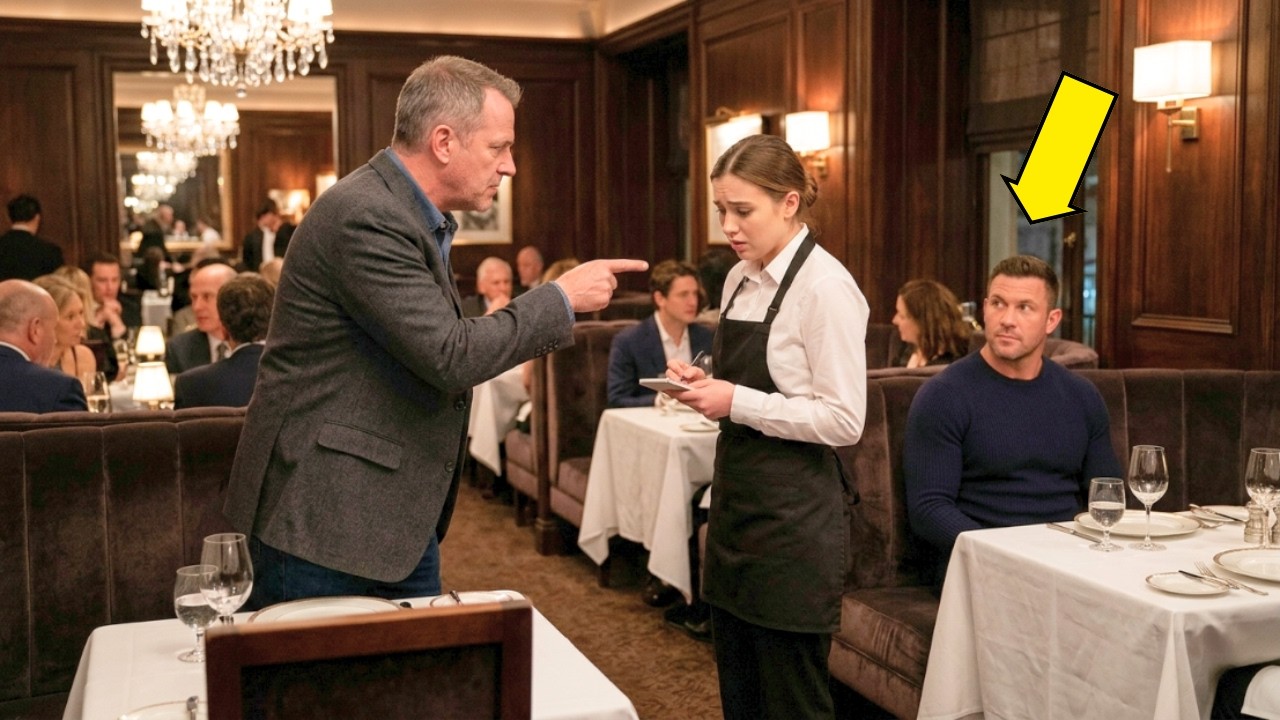
Zofia, a third-year architecture student, adjusted her tightly pinned bun and checked in the mirror by the kitchen that her white shirt still looked impeccable. It was her 14th day of work in a row. Her legs pulsed with a dull ache, and under her eyes, despite careful makeup, dark circles she could no longer hide had formed. She needed the money.
The rent for her tiny apartment in Praga Północ wasn’t going to decrease, and the materials for the model she had to turn in next week cost a fortune. Every tip was worth its weight in gold. The room buzzed with noise. The clinking of expensive porcelain mixed with muted conversations about the stock market, new contracts, and vacations in Dubai.
Zofia moved deftly between tables, smiling professionally, though inside she felt only mounting exhaustion. Then the heavy oak doors opened and he walked in. Tomasz didn’t need to say anything for everyone to know he considered himself the most important person in the room. He wore a suit that probably cost as much as Zofia’s yearly tuition and a watch so large it nearly blinded with reflected chandelier light.
A woman in a fur coat accompanied him, looking at the menu as if reading a death sentence. “A table for two. Reservation under the name Kwiatkowski,” he tossed at the young waiter at the entrance, without even looking at him. “And make sure it’s the best one.
I don’t intend to sit next to the toilet. ”
Paweł, the floor manager, immediately hurried over with a subservient smile. He knew Kwiatkowski. He was the type of client who left large bills but an even larger bad taste.
Zofia felt a knot in her stomach. She knew what this meant. Paweł signaled with his eyes to table number 4 by the window. It was her section.
She approached them a few minutes later, holding the wine list. “Good evening. My name is Zofia, and I’ll be serving you tonight. May I suggest something to drink to start?
” Tomasz interrupted his conversation with his partner and slowly raised his eyes. He scanned Zofia from head to toe with such contempt, as if she were a stain on the tablecloth someone forgot to wash out. “Zofia. Yes.
” He drew out her name as if it were something disgusting. “Listen to me carefully, Zofia. I’ve had a very long day and I have no patience for amateurs. Bring me a bottle of Montrachet 2015, and it better be at the perfect temperature.
If I feel even a degree of difference, I’ll send it back along with you. Understood? ”
Zofia felt the blood rush to her cheeks. Silence fell over the restaurant.
People at neighboring tables began to glance their way. “Of course, sir, right away,” she answered quietly, trying to keep her voice steady. As she walked toward the bar, she felt his gaze on her back. She knew this evening would not end well.
Tomasz wasn’t looking for good food. He was looking for a victim on whom he could vent his frustrations from the entire day. In the corner of the room, at a small, almost invisible table, sat an older man. He wore a plain gray sweater and glasses with thick frames.
In front of him stood only a glass of still water and a plate of simple pasta. His name was Franciszek, and had anyone in that room known that this man controlled half the port in Gdańsk and held shares in the three largest banks in the country, the waiters would probably have carried him around on their hands. But Franciszek liked his invisibility. He observed the world from the sidelines, rarely speaking up.
That evening, however, his attention wasn’t on the food. He was watching Zofia. He saw how her hands trembled as she opened the wine at Kwiatkowski’s table. He also saw how Tomasz deliberately moved his elbow to bump her.
“What are you doing, girl? ” Tomasz suddenly yelled, jumping back from the table. A few drops of white wine landed on his cuff. “Are you blind?
This suit cost 15,000 złoty. ” Zofia froze. The bottle in her hands was heavy as lead. “I’m so terribly sorry, Mr.
Kwiatkowski. I—” “You suddenly moved your arm. ” “I moved my arm? ” Tomasz stood up, towering over her.
His face turned red with fury. “Are you suggesting this is my fault? You stupid brat? Do you know who I am?
Do you know how much I earn in a minute while you have to run around here with plates for a month to pay for your miserable life? ”
People in the restaurant stopped eating. Martyna, Tomasz’s companion, yawned ostentatiously and started scrolling through her phone, as if the scene before her were a boring film. “Tomek, give it a rest.
She’s about to cry and it’ll get even worse,” she said casually. “Let her cry. Maybe it’ll teach her some respect for money and the people who have it. ” Tomasz didn’t let up.
“Call the manager. Now. ”
Paweł was with them in a second. He didn’t need to ask what happened.
He saw the wet cuff and the fury in the regular customer’s eyes. “Mr. Tomasz, my deepest apologies. This is unacceptable.
Zofia, go to the back room immediately. ” Zofia stood rooted to the spot. Something inside her broke. This wasn’t the first time someone had treated her badly.
In this industry, humiliation was part of the schedule. But the way this man looked at her—like subhuman, like an object you could kick because you were in a bad mood—made something she had been building for years, all that patience and humility, suddenly evaporate. “I’m not going to the back room,” she said clearly. “Go quietly,” hissed Paweł.
Tomasz raised his eyebrows, and Paweł paled so much he nearly blended with the wall color. “Excuse me? ” Tomasz drawled. “What did you say?
” “I said I’m not going to the back room until you apologize to me. You bumped me deliberately. I saw it, and you have no right to talk to me like that. I don’t care how much your suit costs.
It doesn’t give you the right to be rude. ”
The restaurant went so quiet you could only hear the hum of the air conditioning. Paweł grabbed Zofia’s arm, trying to pull her away. “Zofia, enough.
You’re fired. Take your things and leave. Mr. Tomasz, please accept our sincerest apologies.
Dinner of course on the house. And we—” Tomasz started laughing. It was a dry, unpleasant sound. “Fired isn’t enough.
I’ll make sure you don’t get a job in this city even cleaning stairwells. Do you have any idea who you’ve messed with? My company designs half the office buildings in this district. One phone call and you’re nobody.
”
Zofia felt tears sting under her eyelids, but she wouldn’t let them fall. She set the wine bottle down on the table. Slowly, with a dignity Tomasz so lacked. “Maybe I am nobody in your world,” she replied, looking him straight in the eye.
“But at least I can look in the mirror without disgust. ” She turned on her heel, ready to walk away, leaving behind her job, her rent money, and her illusion of safety. She knew she’d just destroyed her future. But at that one moment, she felt strangely free.
Then she heard the sound of a glass being set down. It was louder than it should have been, echoing through the silent room. “You know, Mr. Kwiatkowski?
” came a calm, deep voice from the corner. “I’ve always believed the true measure of a man isn’t how he treats his equals, but how he treats those he thinks can’t fight back. ”
Everyone turned toward table number 8. Franciszek sat there with his arms crossed, looking at Tomasz with an expression of deep boredom reserved for exceptionally poor actors in a theater.
Tomasz narrowed his eyes. He didn’t recognize the older gentleman. To him, Franciszek was just another retiree who’d somehow scraped together enough for dinner in a nice place. “And who are you?
Another defender of the oppressed? Mind your pasta before it gets cold and don’t interfere in adult matters. ”
Franciszek smiled slightly. It wasn’t a pleasant smile.
“My name is Franciszek Bielski, and I’m afraid this is my business. You see, I happen to be the owner of this building, as well as the main shareholder of the fund financing your latest project in Wola. The one you were so proudly telling your companion about a moment ago. ” Tomasz’s face changed in a split second from red to corpse-pale.
He began blinking nervously. “Bielski… the… the Bielski?
” he stammered. Franciszek stood up slowly. Though he was shorter than Tomasz, he suddenly seemed to fill the entire space of the restaurant. “Yes, that Bielski.
And you know what, Mr. Kwiatkowski? I’ve just come to the conclusion that I don’t want to do business with someone with such primitive manners. It reflects badly on the image of my investments.
”
Zofia stood halfway to the cloakroom, watching the scene in disbelief. Paweł, the manager, looked like he was about to faint. All the arrogance that had emanated from Tomasz a moment ago drained out of him like air from a punctured tire. “Mr.
Bielski, this was a misunderstanding. That girl was clumsy. I just—” Tomasz began to stammer, desperately trying to save the situation. Franciszek ignored him completely.
Instead, he turned to Zofia. “Ms. Zofia, please wait a moment. We haven’t finished talking.
”
Zofia approached his table uncertainly. Her heart was pounding so hard she could feel it in her temples. “Yes, sir. ” “You have a very steady hand when pouring wine, even though that gentleman was trying to rattle you,” Franciszek said, a hint of amusement in his eyes.
“You mentioned something about architecture. I heard you talking to your colleague at the bar at the start of your shift. ” “Yes, I’m studying architecture at the Polytechnic,” she managed to say, still unable to believe what was happening. “Good, very good.
We need people with a backbone in this industry. Too many build houses but have no foundations themselves. ” He cast a brief glance at Tomasz, who stood nearby, ignored by everyone, looking completely lost. Franciszek pulled a business card from his wallet—simple, black, with gold lettering.
“Call me tomorrow morning. My company is looking for interns for a new Cultural Center project. We pay considerably better than here, and our clients, well, they usually know how to behave. ”
Zofia took the card with trembling fingers.
She felt the world spinning. Five minutes ago she thought her life was in ruins. Now she held in her hand a ticket to a world she’d never even dared to dream of. “And as for you, Paweł,” Franciszek turned to the manager, who immediately straightened up like a string.
“Tomorrow I’ll speak to the owner of the restaurant about your management standards. Allowing employees to be humiliated isn’t good customer service. It’s complicity. ” Paweł couldn’t get a word out.
Tomasz, seeing that no one was looking at him anymore, grabbed his jacket and nearly ran out of the restaurant, pursued by the contemptuous looks of the remaining guests. Martyna, his companion, stayed at the table a moment longer. She finished her wine, then stood up and walked out without a word, not even waiting for him. Zofia stood in the middle of the room, clutching the business card.
“Thank you,” she whispered toward Franciszek. “I don’t know what to say. ” The old man smiled, this time genuinely warmly. “You don’t have to say anything.
Just go home and rest. And don’t forget that card. Such opportunities don’t come often, but when they do, they usually find the right people. ”
Zofia nodded, went to the cloakroom, took off her apron, and looked at the restaurant floor one last time.
She saw Paweł wiping sweat nervously from his forehead, and Franciszek calmly returning to his pasta, as if he hadn’t just changed the course of someone’s life. When she stepped outside, the rain was still falling, but Warsaw no longer seemed so gray and merciless. The cool air refreshed her face. She felt something had ended, but even more was just beginning.
That night, walking toward the metro, Zofia smiled to herself for the first time in a long while. She knew one thing: she would never again let anyone make her feel small. The next morning, when the sun struggled through the dirty windows of her apartment in Praga, Zofia didn’t wake up screaming, though she had every reason to. Instead, she lay in silence, staring at the crack in the ceiling.
For a moment she thought it had all been a dream—the fight, the wine on the suit, the old man who turned out to be some kind of modern-day King Midas. But the black business card on the nightstand was painfully real. The gold letters “Franciszek Bielski” glowed in the weak light, as if challenging her. She called at nine o’clock sharp.
The voice on the other end didn’t belong to Franciszek, but to a woman whose tone was so professional and cool that Zofia felt her throat tighten. “Bielski & Partners design office. How can I help you? ” “Good morning.
My name is Zofia Kowalska. Mr. Bielski asked me to call about an internship. ” There was a second of silence that felt like an eternity.
“Yes. The president informed me of your call. Please be here at 11:00. You have the address on the card.
Bring your portfolio if you have one. ”
Portfolio. Zofia looked at the stack of folders shoved under her desk. Her projects from two and a half years of study.
Visions of buildings that were supposed to change the world but were currently just collecting dust. She picked the best ones, fixed her makeup to hide the signs of a sleepless night, and put on her only decent jacket. The company’s headquarters was in one of those glass skyscrapers in Wola. When Zofia stood before the entrance, she felt like an intruder.
People coming and going looked like every step they took was worth 1,000 złoty. Quick steps, expensive perfume, phones glued to their ears. This was Tomasz Kwiatkowski’s world, but in a much more refined edition. The elevator took her to the 30th floor so fast her ears popped.
When the doors slid open, she didn’t see a typical office. The space was enormous, full of light, with a view of Warsaw’s skyline that took your breath away. Instead of cubicles, long oak tables were covered with plans and models. There was silence, but not a dead silence.
It was the silence of concentration. Franciszek sat at one of those tables, bent over a huge sheet of paper. He wasn’t wearing a suit, just the same gray sweater as yesterday. He looked more like a grandfather doing a crossword puzzle than a billionaire.
Only when he raised his head did Zofia see the same steely certainty in his eyes that had crushed Kwiatkowski the day before. “Punctuality is a quality I value highly, Ms. Zofia,” he said with a slight smile. “Please sit down.
This is Nikodem, our lead architect. ”
Next to Franciszek stood a man in his thirties with sharp features and a gaze that seemed to see right through Zofia. Nikodem didn’t look thrilled by her presence. To him, she was probably just another random person the president had decided to take in out of the goodness of his heart.
“I hear you study at the Polytechnic,” Nikodem said without bothering with pleasantries. “What do you have in that folder? ”
Zofia felt her hands start to tremble again, but this time she wouldn’t let them. She took out her projects.
There were drawings for the revitalization of an old factory in Praga, a design for a modern library, and a few sketches of single-family homes. Nikodem reviewed them in silence, flipping through the pages so fast Zofia was sure he was about to toss them in the trash. “Raw, not technical enough, too much emotion, not enough math,” he commented harshly, pushing the folder away. Zofia felt her hope die, but Franciszek only raised an eyebrow.
“Nikodem is always so cheerful in the morning,” the old man muttered. “But look at this floor plan, Nikodem. See how she’s channeled the light in this atrium. That’s not math, that’s intuition.
You can’t learn that in any course. ” Nikodem snorted, but didn’t contradict him. Franciszek turned to Zofia. “Ms.
Zofia, the matter is simple. I’m not hiring you because I feel sorry for you. I’m hiring you because yesterday, when that pompous buffoon was screaming at you, you didn’t look away. In this profession you need a thick skin and your own opinion.
But projects also have to hold up. I’m giving you a three-month probation period. Nikodem will work you hard, chase you with the worst jobs, and probably make you want to go back to serving soup. If you survive, we’ll talk about real work.
” “I’ll survive,” Zofia answered before she could think about it. “We’ll see. Nikodem, put her at station 12 and have her start checking errors in the Zielone Tarasy project. The one that just lost its lead designer.
”
Nikodem smiled maliciously. Zielone Tarasy was the project of Tomasz Kwiatkowski’s company—the one Franciszek had cut funding to yesterday. Now Zofia was supposed to sit over the plans of the man who wanted to destroy her and point out his mistakes. The irony wasn’t lost on her.
The work in the office was completely different from the restaurant, but in a way just as exhausting. For the first days, Zofia could barely see from sitting in front of the monitor. She analyzed every line, every dimension in Kwiatkowski’s documentation. The deeper she got, the more horrified she became.
These weren’t just mistakes from rushing. These were deliberate savings on materials that could lead to disaster. “He wanted to build a building on foundations that wouldn’t even hold a garden shed,” she whispered to herself one evening when only she and the cleaner were still there. “Did you notice that?
” She heard a voice behind her. It was Nikodem, standing in the door of his office with a cup of coffee. His face wasn’t as stern as on the first day. “Yes.
This is a crime, not architecture,” Zofia replied, pointing at the screen. “If this were built, in ten years we’d have cracks the size of a fist. ” Nikodem came closer and looked at her notes. “Kwiatkowski is a man who only counts profits.
Architecture is just a means to extract money from investors. Franciszek has suspected him for a long time, but we needed someone with fresh eyes, not involved in old arrangements, to point all of this out. Good work, Kowalska. ” It was the first “good work” she’d heard in years.
Something warm grew in her chest. Two days later, as she was leaving the building, she spotted a familiar figure by the entrance. Tomasz Kwiatkowski stood by his black Mercedes, nervously smoking a cigarette. He looked different than in the restaurant.
His suit was wrinkled, dark bags under his eyes. When he saw her, he straightened up, and in his eyes flashed hatred mixed with desperation. “You think you won? ” he hissed, blocking her way.
“You think that because Bielski patted you on the back, you’re someone now? ” Zofia tried to walk around him, but he grabbed her arm. His grip was strong and painful. “Let me go, or I’ll call security!
” she said calmly, though her heart was racing. “Call them. Before they come, you’ll hear one thing. Bielski is only using you to finish me off.
You’re a pawn to him. When he’s done draining my money, he’ll throw you out just like I would have. You destroyed the contract of my life, you little—”
“Mr. Kwiatkowski.
” Franciszek Bielski’s voice came through the speakers by the entrance, and a moment later he himself came through the revolving door, accompanied by two burly security guards. “I believe I made myself clear. You’re not welcome here, and touching my employees is something my lawyer takes very badly. ” Tomasz immediately released Zofia’s arm, stepping back.
His face twisted in a grimace of fear. “I was just talking,” he began. “Enough of these lies. Please leave this place, and I suggest you start looking for a good defense attorney, because the report Ms.
Zofia prepared on your project has just been sent to the construction supervision authority. ”
Kwiatkowski went pale. He looked at Zofia as if seeing her for the first time. In that single moment, he understood that the stupid brat he’d humiliated in front of an entire restaurant had become the nail in the coffin of his career.
Without a word, he got into his car and drove off, tires squealing. Franciszek walked over to Zofia and placed a hand on her shoulder. “Are you alright? ” “Yes.
I just didn’t know it would go this far,” she admitted quietly. “In this world, Ms. Zofia, every action has consequences. He made the whip for himself.
You only showed the truth, and the truth can be deadly for people like him. ”
That evening, Zofia returned to her apartment and sat on the bed. She had several missed calls from Paweł, the restaurant manager. She called him back.
“Zofia, listen, something terrible happened. The owner fired me. Apparently Bielski bought shares and did some cleaning. Listen, maybe you could talk to him?
You know, I always liked you. We were always on good terms. ”
Paweł’s voice was full of the obsequiousness that made her sick. “You always liked me,” Zofia repeated.
“Did you like me when you let customers wipe their shoes on me? Or when you told me to go to the back room and apologize for being treated like garbage? ” “Zofia, it was just work. Those are the rules.
” “Those aren’t my rules, Paweł. Good luck finding a new job. Maybe there they’ll teach you what respect for people means. ” She hung up and felt enormous relief.
A few days later, there was unusual excitement in the office. Franciszek called everyone to the middle of the room. “My dear colleagues, we have a new project. This will be something that redefines this city.
A contemporary art center on the old railway lands. A huge building, a challenge for the best. I want you to know the main design team will need support. ” Nikodem looked at Zofia.
There was no more skepticism in his eyes—something resembling respect. “Kowalska, you’ll be on the facade and lighting team. This is your chance. Screw it up and there’s no mercy.
But if you do it like those sketches in your portfolio, your name will be on the plaque. ”
Zofia couldn’t believe it. An intern who a week ago was crying in a restaurant bathroom was now set to co-create one of the most important buildings in Warsaw. But the joy was quickly overshadowed by unease.
That same afternoon, an anonymous envelope landed on her desk. There was no letter inside, only a photograph. Zofia entering her building in Praga, taken from a distance. On the back, scrawled in one sentence: “Every building can be demolished before it’s even built.
”
She felt a cold shiver run down her spine. She looked through the large glass window at the city skyline. Somewhere out there, in that maze of streets, was a man who had lost everything and had nothing left to lose but his hatred. Zofia knew this warning wasn’t a joke.
Kwiatkowski wasn’t going to watch her succeed on the ruins of his company. “What do you have there? ” Nikodem asked, coming over. Zofia quickly shoved the photo in the drawer.
She didn’t want them to think she was weak. She didn’t want Franciszek to regret his decision. “Nothing, just old notes,” she lied, trying to steady her voice. But Nikodem wasn’t stupid.
He noticed her reaction but didn’t push. Instead, he put a thick stack of documents on her desk. “Focus on the work, Zofia. That’s the only way not to go crazy in this business.
And if something’s bothering you, remember you’re not alone here. ”
That evening, walking home, Zofia looked over her shoulder at every step. Every shadow seemed suspicious. Every engine sound reminded her of Kwiatkowski’s Mercedes.
When she entered the stairwell, she noticed the light on her floor wasn’t working. The darkness was thick and sticky. She started climbing the stairs, holding her keys like an improvised weapon. When she reached her door, she froze.
It was ajar. She knew she’d locked it with two turns that morning. Inside was perfect silence. But she felt someone’s presence.
The smell of expensive tobacco and cheap cologne. A mixture she remembered well from the restaurant. “Mr. Kwiatkowski!
” she called out in a trembling voice, not entering. No one answered. Zofia pulled out her phone, ready to dial the emergency number, but at that same moment she felt a strong jerk. Someone pulled her inside and slammed the door.
In the darkness, she only saw a flash of eyes. But it wasn’t Kwiatkowski. This man was taller, more powerful. “What do you want?
” she gasped as the attacker pressed her against the wall. “You need to stop digging into the Zielone Tarasy project,” a hoarse voice said. “Kwiatkowski is small fry. He doesn’t matter to us.
But the people behind him don’t like it when someone looks into their wallet. Understand, girl? ” Zofia tried to break free, but the man slammed his hand into the wall right next to her head. “This is the first and last warning.
Next time, we won’t talk. ” He released her so suddenly she collapsed to the floor. She only heard quick footsteps on the stairs and the slam of the building’s entrance door. She lay in the darkness, her heart beating so hard she thought it would burst.
Then she understood what Franciszek had said earlier: the world of big money has its own demons. Tomasz Kwiatkowski turned out to be just the tip of the iceberg, and she had just crashed into its hardest part. Zofia stood up, shaking all over. She turned on the light.
Her apartment wasn’t ransacked. Everything was in its place, except one thing. On the table, in the center, lay her library model—the one she’d worked on for months. It was completely crushed, as if someone had deliberately stepped on it.
At that moment, Zofia felt something she’d never experienced before. It wasn’t fear. It was pure, icy rage. They thought they could intimidate her just like Kwiatkowski thought he could humiliate her.
But they didn’t know one thing: a girl who survived years of working in hospitality while studying architecture and fighting for every penny didn’t break that easily. She picked up the phone and, instead of calling the police, called Nikodem. “Nikodem, sorry to call so late. ” “Zofia, what happened?
You sound like you’ve seen a ghost. ” “Not a ghost, but I just found out the Kwiatkowski project is more than just cost-cutting. Someone very influential is behind those frauds, and they were just in my apartment to silence me. ” There was silence on the other end.
“Are you safe? ” Nikodem finally asked, no trace of irony in his voice. “Yes, but I need access to all the archives of the Bielski fund. I need to know who really financed Zielone Tarasy.
If they want a war, they’ll get one. ”
Nikodem arrived faster than he promised. When he entered her small apartment, his gaze immediately fell on the destroyed model, then on Zofia’s pale face. He didn’t bother with comforting words.
Instead, he walked to the window, checked the lock, and examined the door frame. “Professional job,” he muttered. “No signs of forced entry. They used a picklock.
These aren’t Kwiatkowski’s people. Tomasz is too stupid and too cowardly for something like this. Here we’re dealing with someone who guards real money. ”
Zofia sat on the only chair not covered in papers.
“They told me to stop digging into the Zielone Tarasy project. Nikodem, what’s hidden there? It’s just a residential building. ” Nikodem sat opposite her, elbows on his knees.
In the dim light of the night lamp, he looked older than he was. “It’s never just a building. Zielone Tarasy is a money laundry. EU funds, bribes from subcontractors, materials of such low quality the profit margin was probably 60%.
If you prove the foundations are defective, that whole tower collapses, and with it several people from the city hall and two very influential developers who officially have nothing to do with it. ”
Zofia looked at her hands. They were still trembling, but no longer with fear. “Then we have to finish this.
We can’t let them build this piece of junk. If people move in and the building starts to settle, it’ll be a catastrophe. ” “Exactly,” Nikodem finished. “But listen to me carefully, Zofia.
This is no longer a game of intern and architect. This is the moment you have to decide if you’re going all the way. Franciszek won’t abandon you, but he’s playing a different game. He wants to destroy the competition.
You want justice. Sometimes those paths meet, but sometimes… well, sometimes you have to watch your own back. ”
They spent the rest of the night securing data.
Nikodem had her pack the essentials and move to one of the apartments owned by the Bielski fund. It was a safe place with security and surveillance. Leaving her apartment in Praga felt like fleeing her own life, but she knew returning to the old reality was already impossible. The next day in the office, the atmosphere was thick as tar.
Franciszek Bielski didn’t appear in the morning, which was rare. Zofia sat at station 12, staring at the digital models of Zielone Tarasy. Her eyes burned from lack of sleep, but her mind was working at full speed. She was looking for proof no one had wanted to notice before.
She analyzed geotechnical reports. Something didn’t add up. Warsaw has specific ground conditions, especially near the Vistula where the investment was planned. She went through the archival maps and compared them with what Kwiatkowski had presented in the documentation.
Then she found it. “Nikodem! ” she called, not caring that other employees looked at her curiously. “Come here, quickly.
” Nikodem came over, holding a stack of printouts. Zofia pointed at the screen. “Look at the terrain data and bearing capacity tests. In Kwiatkowski’s report, the ground is recorded as stable to a depth of 10 meters.
But here, in old surveys from the 1970s, there was an old riverbed in the same place. There’s quicksand sand and peat lenses. ” Nikodem narrowed his eyes, leaning over the monitor. “Impossible.
No one would risk building a 14-story building on such ground without special piling. ” “That’s exactly the point,” Zofia said, growing more excited. “The cost estimate includes the piling. Millions of złoty went to ground reinforcement.
But look at the invoices from the subcontractor. They ordered only a third of the needed concrete and steel. They didn’t reinforce the ground, Nikodem. They just pretended to, and the money just disappeared.
”
At that moment, the office door slammed open. Franciszek Bielski walked in. He didn’t look like a calm retiree in a gray sweater. He wore a dark suit, his face a stone mask.
Behind him came two lawyers with briefcases. “My office. Both of you! ” he said curtly, looking at no one.
When the heavy, soundproofed doors closed behind them, Franciszek sat at his desk and threw today’s newspaper on the surface. On the front page was a photo of Tomasz Kwiatkowski entering the prosecutor’s office. “Our mutual friend has started to talk,” Franciszek said, contempt in his voice. “He thought if he cooperated, they’d spare him.
But he didn’t know the people he’s talking about have much longer arms than he does. ”
“Nikodem, Zofia found something,” Nikodem interrupted him. “This isn’t just theft of money. This building is a ticking time bomb.
The foundations are a fiction. ” Bielski looked at Zofia. For a moment, something like admiration flickered in his eyes, but quickly replaced by cold calculation. “This changes things.
If this comes to light now, the city will halt all investments in this district. My projects will suffer too. ”
Zofia felt the blood rush to her head. “Are you saying we should keep quiet about this?
People could die. ” Franciszek smiled bitterly. “Ms. Zofia, please don’t teach me morality.
I know what needs to be done. But in this world, truth is like surgery. If you cut in the wrong place or at the wrong time, the patient bleeds out on the table. We have to play this so we hit those really behind it, not just a small pawn like Kwiatkowski.
”
Over the next few days, Zofia felt like she was in a spy movie. She didn’t leave the office without protection, and Nikodem became her only link to the outside world. They worked on an alternative project to reinforce the structure, which the Bielski fund was to present to the city as a rescue plan for the investment. It was a brilliant strategy: take over the project for a song, fix it, and come out as heroes while destroying the opponents.
But Zofia couldn’t stop thinking about what happened in her apartment. Those people were still out there, and they weren’t going to let go. One afternoon, when Nikodem was out at a meeting with lawyers, Zofia answered a call on her desk phone. The number was unknown.
“Hello? ” she said cautiously. “Zofia, it’s me, Martyna. ” It was Tomasz’s companion from the restaurant.
The same one who had looked at her with such contempt. “What do you want? ” Zofia felt her body stiffen. “We need to meet.
Tomasz. He’s disappeared. The prosecutor’s office says he fled, but I know that’s not true. He was scared, talking about some documents he hid in his office.
You’re the only one who can get in there now that Bielski has taken control of the building. ” “Why should I believe you? ” Zofia asked, feeling this could be a trap. “Because if you don’t find it, they’ll kill us all.
Tomasz wasn’t alone. He was just the face. The real owners of Zielone Tarasy are people even Bielski is afraid to name aloud. Meet me at the café at Plac Zbawiciela in an hour.
Please. Tomasz’s life depends on it. And yours too. ”
Zofia hung up.
Her heart beat unevenly. She knew she should tell Nikodem or Franciszek. But something in Martyna’s voice—that genuine, animal panic—made her hesitate. Was Bielski really telling her everything?
Or was he part of an arrangement she knew nothing about? She left the office, bypassing the security guard who was on the phone. Warsaw in the afternoon sun looked so normal, so safe. People drank coffee, laughed, hurried to the metro.
None of them knew that beneath their feet, in the foundations of luxury apartment buildings, lay lies that could destroy more than one life. When she reached Plac Zbawiciela, Martyna was already there. She didn’t look like the confident woman in the expensive fur coat. She wore a plain hoodie and dark glasses, sitting in the farthest corner of the café, nervously biting her nails.
“You came? ” she whispered as Zofia sat down across from her. “Talk. What do you know?
I don’t have much time. ” Martyna leaned over the table. “Tomasz had a folder, real technical documentation and a payroll list. People from the ministry, bankers, architects who signed off on the lies.
He kept it in a safe hidden behind a bookshelf in his old office. The key, the key is in his locker at the gym he went to. ” “Why are you telling me this? ” Zofia narrowed her eyes.
“Because they’re watching me. If I go there, I’ll die. You work for Bielski, you have access to the building. You can get in in the evening under the pretext of an inventory.
Do it, Zofia, for yourself. If you have those papers, you’ll be untouchable. Even Bielski will have to deal with you. ”
Zofia looked at Martyna and suddenly understood one thing: in this world, there were no friends.
Only people trying to survive. Martyna didn’t want to help Zofia. She wanted to use her as a battering ram to break the wall behind which she herself could hide. “I’ll think about it,” Zofia said and stood up.
“You don’t have time to think! ” Martyna hissed, grabbing her arm. “They know you’re here. You think that’s why the security guard let you out?
” Zofia felt cold spread down her spine. She looked toward the exit. At the door stood a tall man in a black jacket. The same one who had pressed her against the wall in her apartment a few days ago.
“Oh damn,” she whispered. “Go through the back! ” Martyna said quickly. “I’ll stall them.
Go. ” Zofia didn’t wait for a second invitation. She slipped past the bar, into the kitchen, and ran out through the back exit into a narrow courtyard. She ran without looking back, her lungs burning from the cold air.
She plunged into the maze of streets in the city center, trying to lose any tail. When she finally stopped to catch her breath, she was near Kwiatkowski’s old office. The building stood empty, surrounded by a fence, with a large sign: construction site. No entry.
But Zofia had a magnetic card Nikodem had given her for inventory purposes. She hesitated only a second. She knew what she was doing was extremely dangerous, but she also knew that if she didn’t get those documents now, she would remain a pawn in Bielski’s game forever. She wanted to be an architect not only of buildings but of her own fate.
She went inside. The building was deathly quiet. Streetlight shining through uncovered windows cast long, eerie shadows on the bare concrete walls. Zofia took the elevator to the top floor, where Tomasz’s office was.
Her footsteps echoed through the empty corridor. The office was sealed with police tape, but Zofia knew how to get past it. Inside, there was chaos—documents scattered on the floor, overturned chairs. Tomasz must have fled in a hurry.
She approached the bookshelf Martyna had mentioned. She began to push aside heavy volumes on architecture—books Tomasz had probably never read. Then she felt it. A small indentation in the wall.
She pressed it, and the panel slid open with a soft click. Inside was a small digital safe. Zofia froze. Where was she supposed to get the code?
Martyna had mentioned a key at the gym, but this wasn’t a key safe. “Looking for this? ” she suddenly heard a voice behind her. She spun around.
Tomasz Kwiatkowski stood in the doorway. He didn’t look like a man of success. His face was bruised, his clothes dirty, and in his hand he held a gun. He wasn’t aiming it at her, but he held it as if it were his only friend in the world.
“Tomasz! ” Zofia whispered. “I thought—I thought you were dead or that you’d fled to Paraguay. ” Tomasz laughed, but it was a sound full of madness.
“They won’t let me escape, Zofia. I’m too valuable a witness to them, or too big a liability. ” He walked closer, limping on one leg. “Martyna sent you here, didn’t she?
She thought she could get those papers back through you. Stupid woman. She doesn’t understand that those people see everything. ”
“Tomasz, give me those documents.
Franciszek Bielski can help you. He has influence. He can get you protection,” Zofia tried to say calmly, though her heart was trying to leap out of her chest. Tomasz looked at her with pity.
“Bielski. You really don’t understand anything, girl. Who do you think was the main shareholder of the company that supplied that bad concrete? Who created the system where I was just a bumper?
” Zofia felt the world spin. “No. Franciszek—he hired me. He told me to look for errors because he wanted to make sure everything had been cleaned up properly.
He wanted to know what the prosecutor’s office might find before they went in. He hired you because you were perfect: ambitious, naive, and motivated by revenge against me. You were his private auditor, one he didn’t have to pay professionals for. ”
Zofia leaned against the desk.
Everything started to fall into a logical, though terrifying, pattern. Franciszek wasn’t her savior. He had been the architect of this entire charade from the beginning. “The code is the date of my first million,” Tomasz said, approaching the safe.
“04/97. ” He typed the digits and the door gave way. He pulled out a thick black folder. “Here.
Take it and run. Not to Bielski, not to the police. Go to the press. That’s the only way you’ll survive.
” Zofia took the folder. It was heavy, as if it contained all the sins of this city. “What about you? ” “I’ve already made my choice,” Tomasz said, sitting down in his old chair.
“Funny, isn’t it? So many years I built my power on lies, and now the only thing I have left is this one moment of truth. ”
Zofia had no time for sympathy. She heard the sound of the elevator below.
Someone was coming. “Tomasz, come with me! ” “Go! ” he shouted.
“Don’t let them take it! ” Zofia ran out of the office, heading for the stairwell. She ran down the stairs, hearing voices and heavy footsteps behind her. When she reached the ground floor, she didn’t run out the main exit—she knew they’d be waiting there.
She headed to the basement, where there were technical passages to adjacent buildings. She ran in the dark, lighting her way only with her phone. She felt each step bringing her closer to freedom, but also further from everything she knew. When she finally emerged outside, streets away, she was soaked and freezing cold.
She sat on a bench in a small park, clutching the folder under her coat. She pulled out her phone. Twenty missed calls from Nikodem and one from Franciszek. She looked at the screen.
For a moment she wanted to call them, ask for help, believe Tomasz was lying. But then she remembered Franciszek’s face in the office. That cold gleam in his eyes. It wasn’t the gleam of justice.
It was the gleam of power. Zofia stood up. She knew what she had to do. She wouldn’t go back to the office.
She wouldn’t return to the Bielski apartment. That night, Warsaw became a battlefield, and she had just stopped being a victim. She started walking toward the offices of one of the largest newspapers, but suddenly a black car stopped in front of her. The door opened slowly, and Nikodem stepped out.
“Zofia, get in,” he said quietly. “I know what’s in that folder, and I know what Tomasz told you. We need to talk now. ” Zofia stepped back.
Was Nikodem with her or against her? In his eyes she saw fear, but also something else—a desperate plea for trust. “Why should I believe you? ” she asked, feeling it was the most important question of her life.
Nikodem sighed and pulled something from his pocket that made Zofia freeze. It was an old, yellowed design for a single-family home, signed by her father—who had died in a construction accident years ago. A construction site supervised by a then-young Franciszek Bielski. “Because I have my own scores to settle,” Nikodem whispered.
“And you’re the only person who can help me. ” Zofia looked at him as the rain began to fall again, washing the dust from her face. She knew that getting into that car meant stepping into the center of a storm that couldn’t be stopped. But she also knew there was no way back.
The chain of events had started, and the final stop had to be the truth, no matter how much it hurt. She got into the car. The black Mercedes disappeared into the darkness of Warsaw’s streets, carrying secrets that would soon see the light of day. What happened next would change not only Zofia’s life but the entire map of influence in the capital.
Because when the foundations of lies begin to crack, no one can feel safe. Even those who think they sit at the very top of glass skyscrapers. The next day, Warsaw hosted a grand gala for the start of construction on the contemporary art center. It was supposed to be Bielski’s triumph, the crowning achievement of his career.
All of society’s elite gathered in a luxury hotel in the city center. Crystal chandeliers cast light on expensive dresses and tuxedos, and waiters—just like Zofia had been a week ago—nimbly carried champagne on silver trays. Zofia entered the hall through the staff entrance, thanks to Nikodem, who still had a valid pass. She wore the same white shirt she’d worn at the restaurant under the silver maple, but this time she didn’t feel small in it.
When she stood in the middle of the room, the buzz of conversation began to fade. People whispered, pointing at her. She looked like a guilty conscience amid all that luxury. Franciszek Bielski stood on the platform, holding a microphone.
When he saw her, his face hardened for a fraction of a second, but the professional mask quickly returned. “Ms. Zofia, what a pleasant surprise,” he said loudly, with that fatherly fake smile of his. “Did you want to give a speech about the future of architecture?
” Zofia walked toward the platform. Her every step echoed through the silent room. “I wanted to talk about foundations, Mr. Bielski,” she said, her voice amplified by the microphones, filling the entire space.
“About the foundations you build on lies, corruption, and the blood of people who trusted you. ”
Dead silence fell over the room. Bielski tried to laugh, but it was hollow. “Ms.
Zofia, I understand the emotions after recent events are strong, but this is not the place to—” “This is the perfect place,” she interrupted, pulling a stack of documents from her bag. “I have technical reports from Zielone Tarasy. I have a payment list for officials who turned a blind eye to your frauds. And I have something else.
Evidence of what happened 20 years ago at the construction site you supervised. The site where my father died because he refused to be like you. ”
Bielski’s face turned purple. He made a barely noticeable gesture toward security, but Nikodem, standing by the entrance, wasn’t alone.
Next to him stood officers from the Central Anti-Corruption Bureau, whom a journalist had alerted hours earlier. “These are forgeries! ” Bielski screamed, losing control. “That girl is mentally ill!
She’s just a waitress I pulled out of the gutter! ”
Zofia looked him straight in the eye. In that moment, she felt no hatred. Only peace.
“Maybe I am a waitress, Mr. Bielski. But waitresses see everything. They see how you treat people when you think no one is watching.
They see your arrogance and your fear. And you know what? Your 20,000-złoty suit can’t hide how small you are. ”
As the police led Franciszek Bielski away in handcuffs through the middle of the ballroom, no one moved to help him.
The same people who had been applauding him moments before now turned away, afraid their names would also end up in Zofia’s folder. Tomasz Kwiatkowski, watching from the sidelines trying to blend into the crowd, was also detained. His career, built on humiliating others, lay in ruins in a single evening. Zofia walked out of the hotel into the cool night air.
Nikodem waited for her by the stairs. “What now? ” he asked quietly. Zofia looked at the panorama of Warsaw.
The city was still alive, but to her it looked different now. Cleaner. “Now I’ll finish my studies and build something with real foundations. Not just concrete, but truth.
”
A few months later, Zielone Tarasy was demolished to ground level, and in its place, thanks to funds recovered from Bielski’s estate, a park and a modern education center for youth from poorer districts were created. Zofia, though still a student, was invited to consult on the project. She was no longer the girl from the restaurant. She was the architect of her own justice.
The restaurant under the silver maple closed after the owner’s ties to the Bielski scheme came to light. Paweł, the former manager, is said to now work washing dishes at a seaside resort where no one knows his name. Karma, as they say, always comes back, even if it sometimes walks. Zofia often returned in her thoughts to that evening when she threw the rag on the floor.
It was the hardest and best decision of her life. She understood that dignity has no price, and arrogance, no matter how rich, always eventually trips over its own feet. She now stood on the balcony of her new, small apartment—this time safe and paid for with an honest scholarship—and looked toward Praga. She knew her father would be proud of her.
Not because she defeated a giant, but because she never let herself become someone she didn’t want to be. Zofia’s story became a legend in Warsaw. It was told in kitchens and restaurant back rooms as proof that one person can change everything if they just stop being afraid.
Because in a world full of people like Kwiatkowski and Bielski, the most revolutionary thing you can do is remain a decent human being.