Janek gripped the steering wheel, his knuckles white. Nine years. Nine years since he’d driven down this dirt road, since he’d breathed this dust, since he’d watched his mother grow older through a phone screen. He’d sent money every month, called every few weeks, always with the same excuses.
But he knew the real reason he hadn’t come back was fear. Fear of seeing what he’d left behind. Three weeks ago, his neighbor Helena had called him in Berlin. “Janek, your mother is worse than she tells you.
Money isn’t what she needs. Come home, before it’s too late. ”
He’d asked for two weeks of leave, rented a pickup truck, and driven east. Now, as the village of Stary Kamieniec emerged between the hills, he felt his throat tighten.
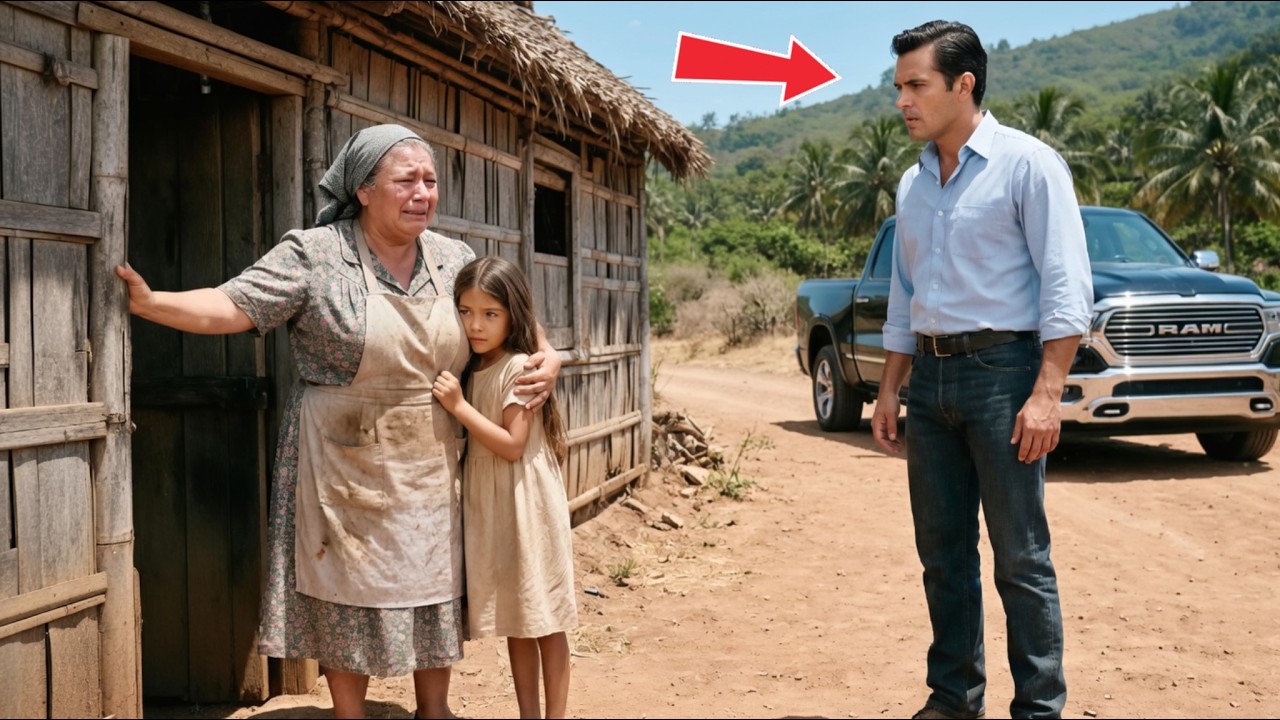
He saw the house first. The wooden walls were cracked, chunks of plaster missing. The roof had broken tiles exposing rotten wood. The front door, built by his father’s hands, was swollen, tied with wire where the lock used to be.
His mother appeared in the doorway. She was fifty-five but looked seventy. Her headscarf couldn’t hide her thin gray hair, her hands were skeletal, and her eyes were sunken with a tiredness that had nothing to do with sleep. “Son,” she said, as if one word could carry the weight of nine years.
He hugged her and felt her ribs through her blouse. Then he noticed the girl. She was hiding behind his mother’s skirt, dark hair falling over her face, wide eyes staring at him like he was a stranger. “Hello, little sister,” Janek said with a forced smile.
The girl didn’t answer. She backed away, turned, and ran into the house, slamming a door. “Don’t be scared,” Zofia said, wiping her eyes. “Lena is like that with people she doesn’t know.
”
With people she doesn’t know. The words stung. He was a stranger to his own sister. Inside was worse.
The cement floor was cracked. The gas stove leaked. The refrigerator sounded like a sick animal. Janek clenched his jaw, replacing guilt with anger because it was easier.
“I send you money every month, Mama,” he said. “Every month, without fail. Where does it go? ”
“Things are expensive, son.
A child needs things. ”
“Things? I send enough. ”
Zofia didn’t answer.
She went to the kitchen to make coffee, and Janek felt the first uneasy feeling that something was wrong. He looked down the hallway. Lena’s door was closed. Complete silence from behind it.
His younger sister, eight years old. He was nineteen when his mother had told him over the phone, almost casually: “Son, God has sent me another daughter. ”
He’d been stunned. His mother was forty-seven.
When he asked how it was possible, she’d said: “God sends children when He wants, Janek. We don’t set His dates. ”
And he hadn’t asked more. Not about the father.
Not about the pregnancy. It was easier not to know, easier to send money and continue his life in Berlin. Now that decision stood behind a closed door with frightened eyes. The next morning, Janek went for a walk to escape the house’s suffocating atmosphere.
The village was dying. Half the houses had boarded-up doors and broken windows. Only old people sat in doorways staring at nothing. Everyone had left.
“Not everyone,” a voice said from behind. Old Kazimierz, his father’s friend, sat on a plastic chair with a straw hat and squinted eyes. “Your father would be proud,” he said slowly. “Or maybe not.
”
Janek straightened. “I didn’t stay here to die like everyone else. I left to give my mother a better life. ”
Kazimierz looked at him for a long time.
Then he said, as if commenting on the weather: “That girl has the same way of walking, Janek. Exactly the same. With her feet pointing slightly inward. How you walked as a boy.
”
Janek forced a laugh. “She’s my sister. We must be alike. ”
The old man said nothing more.
He just closed his eyes, as if he had planted a seed and was content to wait. That night, Janek couldn’t sleep. He walked to the kitchen for water and passed his mother’s room. She was singing to Lena, the same lullaby she’d sung to him as a child.
Through the slightly open door, he saw a candlelit scene: Zofia stroking Lena’s hair, the girl’s eyes closed. Then Lena turned her head, and the candlelight fell on her face. Janek saw her eyes. They were closed, but he recognized them anyway.
Honey-colored, large, with long lashes and that slightly almond shape he saw every morning in the mirror in Berlin. Something cold gripped his stomach. They’re siblings, he told himself. It’s normal to look alike.
He went to his mother’s room later, catching her taking medicine. She tried to hide the bottle. He’d also found seven medicine bottles in the bathroom cabinet, including one that cost 480 PLN. He was sending 500 euros a month.
It suddenly seemed like a ridiculous amount. By the third day, Janek was tired of just looking. He found his father’s old tools, patched what he could, and climbed onto the roof. He was replacing broken tiles when he noticed Lena sitting in the corner of the yard on an upturned bucket, watching him.
She didn’t run. He didn’t speak, afraid she’d leave. They shared that space in silence, and it was the first time since his arrival. At noon, he confronted his mother.
“How much do you spend on medicine a month? ”
“About three thousand,” Zofia whispered. “Sometimes more. ”
He calculated.
Five thousand left for everything else. Food, electricity, gas, water, Lena’s school supplies. It wasn’t enough, and it had never been enough. All the pride he’d felt sending money, the belief that he was fulfilling his duty, was a lie he’d told himself to avoid feeling that he’d abandoned her.
The money arrived. Janek didn’t. The difference was visible in every crack in that house. One afternoon, while Zofia napped, Janek found Lena’s door ajar.
She was drawing on the floor with worn crayons. But what caught his attention wasn’t the girl—it was the walls. They were covered with her drawings, all depicting the same thing: a wooden house with a red roof, an old woman in the doorway, and a man. The man was always far away, sometimes on the other side of a thick line drawn down the page.
One drawing had a word written in trembly child’s handwriting: “Border. ”
On a newer drawing, the man wasn’t across the line. He was on the roof. “Who is this?
” Janek asked, pointing. Lena looked at him, then at the drawing, then back at him, as if deciding whether to trust him. “My brother,” she said softly. “Mama says he’s far away and he helps us.
”
Janek nodded. He pointed to another drawing, the one with the man across the border. “And this one? ”
“My brother too.
But from before, when he was farther away. ”
The room fell into a silence that was almost comfortable. Then Lena spoke again, still drawing, as if mentioning the weather: “My mama also says my father left. She says he went far away, but he’ll come back someday.
”
Janek felt the air stop. “What’s your father’s name? ” he managed. “I don’t know.
She just says he left. ”
Janek swallowed. He’d never once asked Zofia who Lena’s father was. Never.
Because not asking meant not thinking about his mother with another man, meant no complications, meant no questions leading to more questions. He’d chosen the simplest version of everything for nine years. But now, sitting on the floor of an eight-year-old girl’s room, watching her draw a father who was supposed to return, something inside him screamed for him to look closely. The next day, Janek overheard something he wasn’t supposed to hear.
His neighbor Helena was in the kitchen with Zofia. “Tell him the truth, Zofia. He’s here now. How much longer will you wait?
”
“Be quiet, Helena. Lower your voice. ”
“I’ve been quiet for years. Years, Zofia.
This boy will find out from someone else, and then it will be too late. ”
“What truth? ” Janek asked, walking into the kitchen through the back door. Both women froze.
Zofia started washing a plate that was already clean. “About what are you talking? ”
“Nothing, son. Helena was talking about debts.
You know how she is. ”
“I wasn’t talking about debts,” Helena said, looking at Zofia with a harshness Janek had never seen. “Helena! ”
Janek looked at both of them.
He knew they were lying, but he also knew pushing now would make them close up. So he did what he always did: he swallowed the question. But as he left, he saw his mother’s hands shaking, and the plate she’d been washing lay on the floor, broken into three pieces. That afternoon, while Zofia and Lena were at the store, Janek looked for a screwdriver in his mother’s room.
Under her bed, he found an old shoebox held shut with a thick rubber band. He knew he shouldn’t open it. He opened it anyway. Inside was a photograph of a young woman, seventeen or eighteen, with long dark hair and a smile that was half defiance, half sadness.
Ewa Kowalska. His first everything. The girl he’d grown up with, who taught him to kiss behind the church, who cried because her father beat her, who looked at him with rage the night before he left and said: “If you go, don’t come back. ”
There was also a hospital bracelet.
White plastic, with faded blue letters: “Lena, 32–Kl — General Hospital, Sanok. ”
But the third item was worse. A birth certificate, yellowed and folded. It read: Lena Kowalska Herrera.
Mother: Ewa Kowalska. Father: empty. Janek stared at the paper. Why does she have my surname?
his brain worked slowly. If she’s my mother’s child with another man, her name should be Wiśniewska—Zofia’s maiden name. Not Herrera. Unless Lena wasn’t Zofia’s daughter at all.
Unless Lena was a Herrera. At the bottom of the box was a letter, written in Zofia’s careful, trembling handwriting, never sent. It began: “Son, there is something I should have told you a long time ago. I don’t know how to start, because I don’t know how to say it without you hating me, but I can’t stay silent any longer.
Lena is not—” and the sentence ended with a blot of ink, as if the pen had been pressed too long to the paper. As if Zofia had written those four words and frozen, unable to finish the sentence that changed everything. Lena is not. What?
Janek sat on his mother’s bed. Your sister? Your daughter? Everything he’d believed for nine years began to tremble.
When Zofia and Lena returned from the store, Janek waited until the girl fell asleep. Then he went to his mother’s room with the shoebox. “Why do you have a picture of Ewa Kowalska? ”
Zofia’s face drained of blood.
“The birth certificate. Lena Kowalska Herrera. Ewa is the mother. But the surname is Herrera.
My surname. Not Wiśniewska. ”
“Son, let me explain—”
“And this letter. ‘Lena is not—’ She’s not what, Mama?
Lena is not what? ”
Zofia began to cry, an ugly, body-wracking cry. “Tell me who Lena’s father is! ” Janek shouted, louder than he intended, a sound he hadn’t made since he saw his father’s body covered with a tarp on the construction site.
From behind the wall, Lena began to cry, a frightened child’s wail. Zofia stood abruptly. Something in her eyes changed—not sadness or guilt, but fierceness. The fierceness of a mother protecting her young.
“Not in front of the child,” she said, her voice no longer trembling. “You want to question me? Fine. But not like this, not shouting, not with her listening.
”
Janek stood breathing hard. He slammed his hand on the nightstand. The glass of water fell and shattered. He walked out of the house, out into the cold Bieszczady night, and sat on the curb with his head in his hands, still clutching the birth certificate.
Inside, Lena’s crying faded, replaced by Zofia’s lullaby. It didn’t sound like a lullaby anymore. It sounded like an apology. At dawn, Janek found himself at the church.
Old Father Jan, who’d baptized him, buried his father, and baptized Lena, poured two glasses of moonshine. “You know who Lena’s father is,” Janek said. The priest held his gaze. “There are things told to me in confession, Janek, that I cannot repeat.
But I can tell you this: look at that girl. Look at her with clear eyes, as if you were seeing her for the first time. God doesn’t put answers in books. He puts them in faces.
”
Janek returned home in a daze. Mtwo nights without sleep had caught up with him. He collapsed onto his chair. A soft sound woke him—a door opening slowly, careful footsteps on the concrete floor, the front door creaking.
Lena’s bed was empty. “Lena! ” he yelled. She was gone.
Zofia ran out, her face a mask of pure terror. “Oh God, no. ”
Janek stopped her at the door. “You stay here in case she comes back.
I’ll find her. ”
He ran through the black village. “Lena! ” The hills swallowed his voice.
He checked the stream. Nothing. Then he heard old Kazimierz’s distant shout: “She’s here! On the hill, at the cemetery.
”
Janek ran. He found Lena sitting on the ground beside the grave of Ignacy Herrera—the grandfather she’d never known, the man Zofia told her about every night. She was barefoot, in a dirty white nightgown, hugging her knees, her face buried in her arms. “Why is everyone fighting about me?
” she asked, her voice cracking. “Did I do something bad? ”
“No, Lena, you did nothing wrong. ”
“Then why were you shouting?
”
“Because adults are sometimes stupid. It has nothing to do with you. ”
She looked at him with those honey-colored eyes, then reached out her arms. Janek picked her up.
She wrapped her arms around his neck and buried her face in his shoulder. She was so small, so light, trembling. He carried her down the hill, and by the time they reached the house, she was asleep. When Zofia had settled her, Janek looked at his mother.
“Now you will tell me everything. ”
This time, Zofia didn’t turn away, didn’t lie. She sat at the kitchen table and, for the first time in eight years, opened her mouth to tell the truth. “Ewa and you.
I knew. The whole village knew. You really loved each other, even though you were kids who knew nothing about life. The night before you left for the north, she came to the house.
I pretended to sleep. I heard you both in the yard. ”
Janek clenched his fists under the table. “When you left, Ewa didn’t know she was pregnant.
She found out weeks later. She didn’t tell you. Out of pride, out of anger, I don’t know. ”
“And you?
”
“No. Not then. I learned when she arrived. She came in her seventh month, Janek—thin, dirty, with a black eye.
She knocked on my door one December night. I opened it and saw her standing there with a huge belly and a face that said she had nowhere else to go. ”
Zofia told him how she took Ewa in. How Lena was born in the hospital in Sanok one February dawn.
“When I saw that girl, Janek, I knew she was yours. Because she looked at me with your eyes. ”
She told him about the first year, Ewa trying to be a mother, good days and bad months. Then the collapse—Ewa going out at night, coming back drunk, bringing men who looked at the girl in a way that made Zofia’s blood run cold.
“One day she told me: ‘If you say anything to Janek, I’ll go there and ruin his life. I’ll tell everyone he abandoned me pregnant. I’ll send people to find him. I’ll destroy everything for him.
‘”
“And I believed her, Janek. Because that girl had a rage in her that woke fear. ”
Then Ewa left. No goodbye, no note.
Lena was a year and a half old. “She cried for three nights calling for her. Then she stopped. ”
“Why didn’t you call me, Mama?
Why didn’t you tell me the truth that day? ”
Zofia’s eyes filled with tears. “Because at first, I thought it was temporary. I thought Ewa would come back, that things would settle, that I’d find the moment to tell you.
And then you started sending more money. You said you’d been promoted, that things were going well, that everything was finally going up. How was I supposed to call you then? ”
She wiped her eyes.
“And by the second year, Lena was already calling me ‘Mama. ‘ How do you take that away from a three-year-old? How do you tell her the woman caring for her isn’t her mother, and her father is two thousand kilometers away, not knowing she exists? ”
Then Zofia said something that destroyed him.
“Do you remember when you called me about five years ago? Lena was three. You asked how she was doing, and I said she was growing well, and you said—”
Janek felt cold before she finished, because he remembered. “Take good care of her, Mama.
At least she’ll grow up with you. ”
Janek sat frozen. The sentence entered him like a knife of ice. He had spoken those words about his own daughter, not knowing.
He’d asked his mother to care for a girl who carried his blood, his eyes, his name, while he slept alone in a Berlin apartment two thousand kilometers away. Zofia took a deep breath. “I’m sick, Janek. My kidneys are failing.
I need treatment in the city, and I don’t know how long I have. If I die without telling you the truth, Lena will be alone in the world. Without a father, without a mother, without anyone. I couldn’t allow that.
That’s why I told Helena to call you. That’s why you’re here. ”
She slid off her chair, falling to her knees on the kitchen floor, not as a dramatic gesture but as someone who could no longer bear her weight. “Forgive me, my son.
Forgive me. ”
Janek sat silent. He didn’t scream. He didn’t move.
He stood up, took the keys to the pickup truck, and walked out. He drove nowhere. He just drove until the village disappeared behind him, then stopped in the middle of nowhere, cut the engine, and got out. Above him, the Bieszczady sky was full of stars—the same sky he’d looked at as a child, when his father was alive and the world made sense.
He leaned against the truck and cried. He cried for nine years of lies, for Ewa, for the girl who drew a faraway man and called him ‘brother’—his own father. For the sentence: “Take good care of her, Mama,” spoken about his daughter. He wasn’t a brother.
He was a father who had left. And he’d never known. When the sky began to change color, Janek got back in the truck. He hadn’t made a decision with his head, but something in him had shifted.
Not forgiveness, not clarity. Something simpler and harder. The certainty that he couldn’t leave again. When he arrived home at dawn, Lena was sitting in the doorway alone, barefoot on the cold ground, looking at the road, as if she’d been waiting for hours.
“You’re going away again? ” she asked. The question hurt more than everything his mother had said. It wasn’t an accusation.
It was the question of a girl who was used to people leaving. Janek knelt in front of her. He wanted to tell her everything. No.
He looked into her eyes—his eyes—and said the two most difficult words of his life: “I’m not leaving. ”
Lena looked at him, not smiling, not hugging him, just looking with the clear gaze of a child who wants to believe but has learned not to so quickly. “Really? ”
“Really.
”
The sun rose over the hills, and Lena didn’t hug him, but she didn’t leave. For now, that was enough. Janek found Zofia in the kitchen, sitting where she’d told the truth hours earlier, waiting for a verdict. “I’m not forgiving you,” he said, his voice rough.
“I want you to know that. Not yet. ”
Zofia nodded. “But I understand why you did it.
I don’t accept the lies, but I understand the fear. ”
He took a breath. “Now tell me about the illness. Everything.
No lies. ”
Zofia told him. The doctor in Sanok had said her kidneys were functioning at less than half. She needed tests in Rzeszów or Kraków.
Maybe dialysis. Maybe worse. Without treatment, she had a year, maybe two. Janek listened without interrupting.
When she finished, he said: “I’ll take you. Wherever you need to go. ”
“And Lena? ”
“Lena comes with us.
”
“Your job in Berlin? ”
“Work can wait. ”
Then Janek said something harder. “Lena needs to be told the truth.
”
“Not yet, Janek. Let her get to know you first. Let her trust you as a brother. Then, when she’s ready—”
“Another lie, Mama.
That’s what you’re asking me for. ”
“It’s not a lie. It’s time. ”
“Time?
How much time? Another year? Another eight? ”
Zofia had no answer.
“I’ll tell her the truth,” Janek said, and it was not a question. “I don’t know when or how, but I’ll tell her. And this time, you won’t decide when. ”
Zofia looked at him, and among the pain and guilt and fear, something new appeared on her face.
Something like relief. For the first time in eight years, someone else was carrying part of the weight. For the first time in his life, her son wasn’t running. “Good,” said Zofia.
“Good, son. You decide. ”
Days passed. Janek didn’t leave.
He didn’t talk about Berlin or work. He woke early, ate breakfast with Zofia, and climbed onto the roof. He bought new tiles, new wood, nails that weren’t rusted. It wasn’t just the roof he was repairing.
It was something bigger, though he couldn’t put it into words yet. Every day, Lena watched him a little closer. The first day, from the corner of the yard. The second, from the kitchen door.
The third, sitting at the foot of the ladder. The fourth day, standing right below where he worked, her head tilted back, her honey-colored eyes following every movement of his hands. “I’ll help you,” Lena said. Janek stopped hammering and looked down at her.
She had her hair tied back with a red rubber band, bare feet full of dirt, and a look on her face he was beginning to recognize. The face of someone who wants to be close but doesn’t yet know if they can. He smiled. “Come up!
”
He lifted her carefully, holding her by the arms while she put her feet on the rungs. When she reached the top, Lena looked out at the village from the roof and her eyes widened. “You can see everything from here. Everything all the way to Berlin.
”
Janek laughed, a short, quiet laugh that hurt a little. “No, Berlin is very far away. ”
“Do you go back there? ”
Janek looked at her.
Eight years of drawings with a man across a line. Eight years of waiting for a father who didn’t know he had to return. And now this girl was sitting on the roof next to him, asking if he’d leave again. “No.
Not for a while,” he said, and it was the truth. Lena nodded, took a nail from the bag, and handed it to him. “I’ll hold the tiles,” she said very seriously, as if they were building a cathedral. They worked together in silence.
Janek laid tiles; Lena passed him nails and held wood with her small hands. They didn’t talk much. Sometimes silence between two people says more than any confession at midnight. At one point, Lena said: “Brother, thank you for fixing the roof.
When it rained, drops used to fall on my face, and Mama would set out buckets. ”
Janek swallowed, tightened his grip on the hammer. “The drops won’t fall anymore. I promise.
”
Lena smiled. That small, shy smile, opening the door a centimeter wider than yesterday. She’d called him brother. He didn’t correct her.
He knew he had time. The truth would come when it had to, not when he was ready, but when she was. Inside the house, Zofia watched them through the kitchen window. She cried, but it wasn’t the cry of the nights before, the cry of fear and guilt and secrets that weighed more than a body.
It was a different cry, from the same place but heading somewhere else. Relief, not forgiveness. Not yet. But something that resembled it.
On the wall of Lena’s room, next to all the others, hung a new drawing. The same house, the same old woman in the doorway. But the man was no longer across the line. He was no longer far away.
He was on the roof, and beside him, for the first time, was a little girl. This story doesn’t have a happy ending. It has something better: an honest one. Janek didn’t become a perfect father overnight.
Zofia wasn’t forgiven with a hug and a beautiful sentence. Lena didn’t learn the truth sitting on that roof. What happened was smaller and more real. A man who ran for nine years decided to stay.
A mother who lied for eight years decided to reveal the truth. And a girl who drew a faraway man began to draw him close. Sometimes all you can do is not fix what’s broken, but stop breaking it. And sometimes love doesn’t come with the word “father.
” It comes with a nail, a hammer, and a promise that the drops won’t fall anymore when it rains.