The porcelain cup slipped from his mother’s trembling hands and shattered across the kitchen floor before she could even say his name. “Szymon! ” she whispered. Her eyes, hollow and tired a second earlier, widened with disbelief.
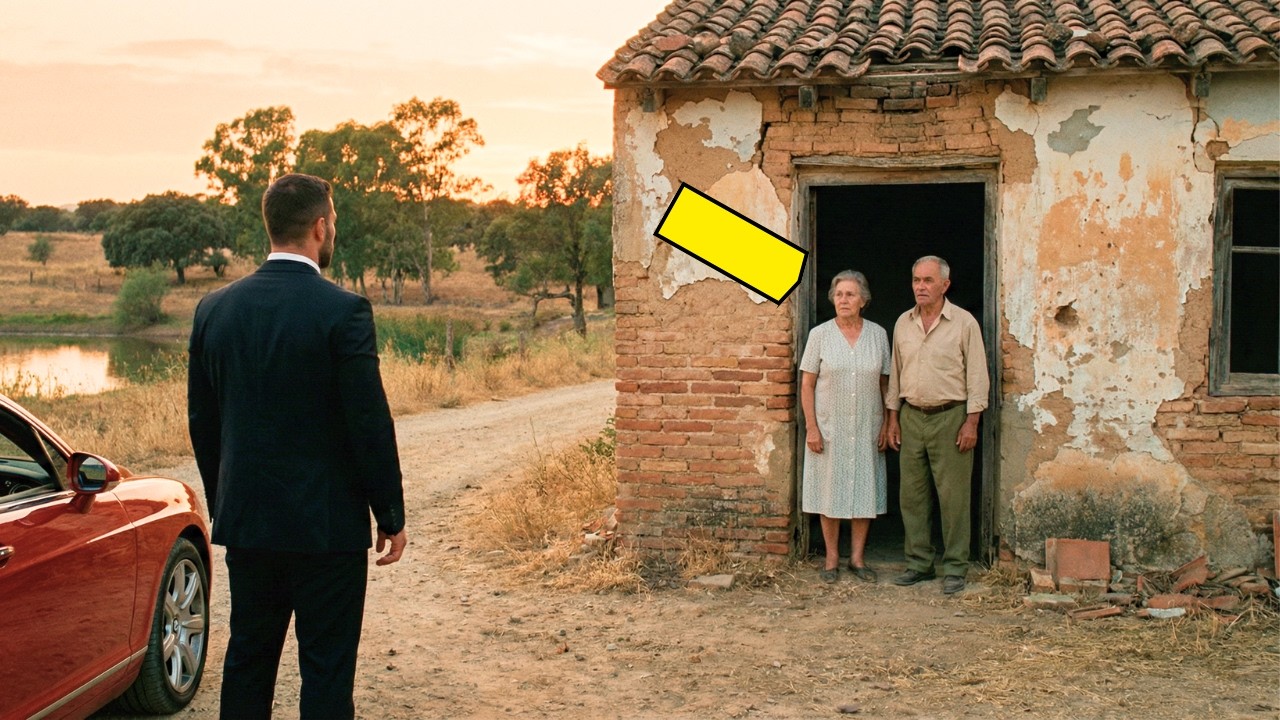
His father looked up slowly, his face carved with deep wrinkles, and for a moment seemed to be staring at a ghost. Szymon stood in the doorway of the small family home he had not seen in six years, his custom suit worth more than the roof over their heads, tears already burning his eyes. The sight of his parents—sitting at the old wooden table, discussing which heirloom to sell next—broke something inside him. He had come home as a billionaire.
He found his parents planning to sell his grandmother’s clock. The summer air was heavy and still. It had been a typical August in the Polish countryside, lazy and hot, but for Małgorzata every day had become a fight for survival. Her hands, once smooth, were now rough and calloused from working in the garden and tending to the cows.
Her husband Antoni rarely spoke anymore, staring at some distant point, wiping away tears when he thought no one was watching. She always saw. Six years. That was how long it had been since Szymon, their only son, had left the village.
He went to Warsaw, then abroad, chasing his ambitions. He had promised to call, to visit. At first, he did—once a month, then less often. He spoke of his successes, the company he founded, the money he was making.
He sounded so happy, so fulfilled. They didn’t want to bother him with their small problems. “We’ll manage,” Małgorzata would tell Antoni. “Let him have his life.
”
But the calls stopped. First he only rang on holidays, then came short texts, then silence. She tried calling, but he was often too busy, always in important meetings. A mother’s heart ached, but she understood.
The business world was merciless. Now she sat at the table, sorting through a pile of bills—electricity, water, taxes. Each one demanded payment they did not have. The cow, their only source of income, had been sick for weeks.
The vet said to wait, gave injections, but the milk was drying up. Antoni did odd jobs for neighbors, but there was less and less work. Once they had a proper farm; now all they had left was one cow, a few chickens, and a patch of land that barely grew potatoes. That morning, Antoni had gone to the forest to look for mushrooms, hoping to sell them at the Saturday market.
But the forest was dry this year. There were barely any. Hundreds of kilometers away, in a luxury apartment in the center of Warsaw, Szymon stared at his phone. A former elementary school classmate had sent him a photo from the market in their hometown.
It showed his father, head bowed, selling a few small baskets of meager porcini mushrooms. He looked exhausted, older than Szymon remembered. The strong, full-of-life man who had raised him was gone. The caption read: “Szymon, come by sometime.
Your parents are struggling. ”
Struggling? They always managed. They had a modest farm, sure, but they were proud, never complained.
He sent them money now and then, small amounts, pocket money for small expenses. He never thought they could have serious problems. He was a billionaire. His company was conquering markets.
He was too busy to think about it. He looked at his watch, worth more than his parents’ entire house. The latest phone, the sports car keys, the view of shining Warsaw—all of it suddenly felt empty. “What am I doing?
” he thought. Six years of silence. He felt like a fool, an ingrate. In one moment, he made his decision.
He cancelled all his meetings for the next few days. His assistant Natalia looked at him in surprise. “Mr. Szymon, you have an important meeting with US investors today.
”
“Reschedule them all. I’m going home. ”
He didn’t take the helicopter or private jet. He wanted to feel every hour, every kilometer that separated him from his past.
The highway gave way to blocks of flats, then small towns, then fields, forests, and scattered houses. His heart beat faster with every kilometer. His low-slung luxury car struggled over the rutted dirt road, tires screeching on the gravel. Finally, he saw the familiar signpost: Wulka, 2 km.
He passed houses he knew, people he remembered. Children playing froze, staring at the shiny car that looked like it had landed from another planet. At the end of the last lane stood his parents’ small house. The roof tiles were cracked, the facade hadn’t seen paint in years, and the fence was rotten and leaning.
He parked several dozen meters away, not wanting to startle them with the roar of the engine. The air was cooler, filled with the smell of damp earth and blooming linden trees. He walked to the gate; it creaked loudly. The garden, once meticulously kept, now looked neglected.
Weeds grew freely among the herbs. Where tomatoes once flourished, only a few stunted bushes remained. Light was on in the house. He heard quiet voices from the kitchen.
His heart pounded. He took a few deep breaths, then opened the door and stepped inside. The first thing that hit him was the smell—their home. A mixture of freshly brewed tea, old furniture, and something indefinable that he associated with childhood and safety.
His parents sat at the old wooden table, two mugs of steaming tea and a plate of bread between them. They were speaking quietly. “I’m telling you, Antoni, maybe we should try to sell that clock? It just sits in the corner.
No one uses it,” Małgorzata said, resignation in her voice. Antoni sighed heavily. “What clock, Małgosia? The one from your grandmother?
I would never agree. It’s a family heirloom. We can’t sell everything. ”
“But what are we supposed to do?
The bills are mounting, and the cow? The vet said if she doesn’t improve by the end of the week, then…”
She didn’t finish the sentence, but Szymon understood. Szymon stood in the doorway, invisible to them, hearing every word. A cold shiver ran down his spine.
Sell grandmother’s clock? The cow is sick? He, a billionaire, a man who could buy this entire house and everything in it, stood listening as his proud, hardworking parents discussed selling heirlooms to make ends meet. He saw their tired faces, their resigned expressions.
They looked so much older than he remembered. Much older, and far more beaten down. He felt his eyes burning. How could he have been so blind?
How could he have allowed his parents, who gave him everything, to suffer in silence? Małgorzata lifted her head and looked straight at him. Her eyes, empty and tired a moment before, suddenly widened in shock, then filled with disbelief. “Szymon!
” she whispered, and the cup slipped from her trembling hands, shattering on the floor. Antoni looked up. His face softened, but there was pain in his eyes. Szymon tried to speak, but the words stuck in his throat.
Tears came, hot and unstoppable. Seeing their worried faces, their modest life, so painfully poor compared to his own, struck him with full force. Silent but abundant tears of shame, regret, and unimaginable sorrow streamed down his face. “Why?
” he finally choked out, his voice trembling and broken. “Why didn’t you tell me? ”
Małgorzata stood stunned, her lips trembling. Antoni rose slowly, his movements heavy and tired, leaning on the table for support.
“We didn’t want to worry you, Szymon. We knew you had your own things. Big things,” his father said. There was no anger in his voice, just sadness and that strange pride they always had, even in the worst times.
Pride that now seemed like a curse to Szymon. “Big things,” Szymon repeated, feeling anger rise within him—not at his parents, but at himself. “I’m here, a billionaire, building an empire, and you’re worried about selling grandma’s clock to pay the bills and about a sick cow that’s your only livelihood. How could I have been so blind?
”
Małgorzata approached him. Her rough, cracked hands landed on his cheeks. She looked deep into his eyes, the same ones she remembered from his childhood, though now marked by fatigue and pain. “Darling, we’ve always been proud of you, of your successes.
We didn’t want you to think we were a burden. You always said the business world is merciless. We didn’t want to distract you. ”
“Distract me?
” Szymon pulled back gently. He looked around the kitchen—the worn countertops, cracked tiles, dim bulb. Even the smell he associated with safety now smelled of age and neglect. “For six years, I didn’t even call to ask if you were okay.
I sent pocket change, thinking it was enough. I was too busy to think about you. I was the blind one. I was the fool.
”
Antoni finally looked up. “Don’t say that, son. You were never a fool. You were always our clever Szymon.
It just happened. Life in the countryside is hard. It always has been. ”
His gaze fell on the broken cup.
“Małgosia, leave it, I’ll clean up. Come, Szymon, sit down. You must be tired from the journey. ”
Szymon sat at the table, his muscles protesting after the long drive.
But physical fatigue was nothing compared to what he felt inside. “What exactly happened? ” he asked, trying to steady his voice. “With the cow, the bills—tell me everything.
”
Małgorzata sighed, sitting opposite him. “The cow, Hanka. She’s been sick for weeks, giving less and less milk. The vet does what she can, but she said if she doesn’t improve, we’ll have to sell her.
” Pain was evident in her voice, as if she were speaking of a family member. Hanka was everything to them—a source of milk, butter, cheese to sell, and cash for unexpected expenses. “But she’s your only one,” Szymon said, his heart tightening. “And now even that isn’t what it used to be,” Antoni spoke up with more force.
“Farms are failing. Young people flee to the cities. We’ve been left alone. The land is worse, the harvests smaller.
The neighbors are struggling too, so there’s less and less odd work for me. And the bills? Electricity, water, land tax—everything is getting more expensive. ”
Małgorzata gestured to the pile of papers on the table.
“What you saw is only part of it. We’re two months behind on electricity. They threatened to cut us off. And the tax—if we don’t pay, they’ll take our land.
” Tears appeared in her eyes, which she tried to hide. “Grandma’s clock was one of the last things we had left. We thought maybe someone in Warsaw would appreciate it. ”
Szymon looked at the old-fashioned carved clock standing in the corner of the kitchen.
It was a heavy wooden piece with a pendulum that had chimed the hours for generations. He remembered listening to its ticking as a child, feeling safe. “No,” he said firmly, standing up and walking to the table with a determination he hadn’t felt in years. “You’re not selling the clock.
Or anything else. I’ll take care of all of it. Right now. ”
Małgorzata and Antoni exchanged glances.
Uncertainty was written on their faces. “Son, you have your own life, your millions,” Małgorzata began, but Szymon interrupted. “My millions mean nothing if you’re suffering here,” he said, hot tears welling again. “My life is nothing if I can’t take care of my own parents.
This is my duty, my fault that it came to this. ”
Antoni approached and placed a hand on his shoulder. His grip was strong but full of sadness. “Szymon, we didn’t want you to feel guilty.
That wasn’t the point. ”
“But I do feel guilty,” Szymon pulled back. Desperation crept into his voice. “I feel guilty for every day of those six years when I thought only of myself, built my empire while ignoring what was happening here.
How could I not have noticed? ”
He looked at his mother, then his father. He saw pain, fatigue, but also something new—hope. Fragile, delicate, but hope nonetheless.
“Hanka,” he said suddenly, changing the subject. “What about her? Is there a good vet? Maybe we should consult someone from Warsaw, from a clinic?
”
Małgorzata sighed. “Dr. Kowalska, she’s good, but treatment costs money, and we can barely make ends meet. ”
Szymon pulled out his phone—the latest model, worth a fortune.
“Don’t worry about costs. I’ll find the best specialists. I’ll do everything to make Hanka better, and then we’ll deal with the rest: the bills, the house, everything. ”
For the first time in a long time, he felt the weight on his heart lighten.
It didn’t disappear entirely, because he knew there was a long road ahead to repair the damage, both material and emotional. But for the first time in a very long time, he felt he was doing something truly important, something of real value. “Why only now? ” Małgorzata asked quietly, her voice trembling.
It was a question that had hung in the air for six years—a question for which Szymon had no simple answer. “I don’t know, Mom,” he said, looking at her with pain. “I was a fool. But I promise you, this will change.
I will never leave you alone again. ”
Looking at the tired faces of his parents, Szymon felt that his billions, his empire, his luxurious life in Warsaw—all of it was nothing compared to what he had lost. He had lost them. Now, standing in their simple, worn kitchen, he knew he had to win them back.
That would be his hardest and most important task. The evening passed in a strange mix of tension and relief. Małgorzata prepared supper—simple sandwiches with cucumber and tomato from the garden, tea to go with it. Szymon ate, tasting childhood, but also realizing how much had changed.
Every bite was bitter, reminding him of the years of his absence. After supper, he told them about his life in Warsaw, his company, his successes. But there was no pride in his voice anymore, only bitterness. These achievements seemed empty, worthless in the face of his parents’ suffering.
“I wanted to impress you,” he said quietly, looking at his hands. “I wanted you to be proud of me, to know your son had achieved something. ”
“We’ve always been proud, Szymon,” Małgorzata stroked his hair, just as she had when he was a little boy. “Even when you only called.
We knew you had your life. We just—we just missed you. ”
Those words hit him harder than anything else. Missed you.
Not money, not help—just his presence. His heart squeezed with pain. The next morning, before sunrise, Szymon got up. He couldn’t sleep, so he went to the barn.
Hanka lay on the straw, breathing heavily. Her coat was dull, her eyes cloudy. Szymon stroked her head. The warmth of her body was comforting, but also sad.
Soon, Dr. Kowalska arrived—an older woman with a tired face but a sharp gaze. She looked at Szymon with slight surprise, seeing his expensive car and elegant clothes. “Mr.
Szymon, right? ” she asked. “Your mother called. What’s wrong with Hanka?
”
Szymon told her everything. Dr. Kowalska examined the cow and shook her head. “The condition is serious.
I’ve been giving her medication, but there’s no effect. She needs more specialized tests, maybe even transport to a clinic in Lublin. But that costs money. ”
“Don’t worry about that,” Szymon interrupted.
“I’ll do whatever it takes. If necessary, I’ll take her to Warsaw. Just make her well. ”
Dr.
Kowalska looked at him with approval. “Alright. I’ll do what I can. I’ll contact Lublin and arrange transport and tests.
”
After the vet left, Szymon turned his attention to the house. He noticed so many things needing repair: cracked roof tiles, peeling paint, creaking doors. In his luxury apartment, every small flaw was fixed immediately. Here, time had stopped six years ago.
He started calling construction companies, renovation crews. He wanted his parents’ home to be beautiful and safe again. Małgorzata and Antoni initially protested. “Szymon, why all this?
We don’t need palaces,” Małgorzata said. “It’s not a palace, Mom. It’s your home, and it deserves to be in good condition. ”
Antoni just watched him.
There was pride and resignation in his eyes. He was a man of work, used to doing everything himself. Now he had to let his son help. It was hard for him.
Within days, the village came alive. Construction crews arrived, trucks with materials. Neighbors watched in disbelief. Some approached to talk; others watched from a distance.
Szymon rolled up his sleeves and helped. He carried bricks, painted walls. His hands, unaccustomed to such work, began to hurt, but he felt this was what he had to do. This was his penance.
Every nail hammered, every stroke of paint was a step toward rebuilding not just the house, but their relationship. Małgorzata and Antoni gradually adjusted to his presence. They started talking to him about daily life in the countryside, their problems, their joys. Szymon listened, absorbing every word, trying to make up for six years of silence.
One evening, when the sun was setting, painting the sky orange and pink, Szymon sat on the porch with his parents. They drank tea, the air filled with the scent of blooming linden trees. The silence was different now—not full of sadness, but of peace and hope. Małgorzata took his hand.
“Thank you, son,” she said quietly. “Thank you for coming back. ”
Szymon squeezed her hand. “I should be the one thanking you, Mom.
For taking me in, for giving me a chance to fix this. ”
He watched the sunset, a plan forming in his mind. A plan for a new life, where wealth wasn’t the goal but the tool. A tool for building happiness—not just for himself, but for those he loved most.
He understood that true success wasn’t the number of zeros in the bank account, but the warmth of a family home and the knowledge that you were needed. Antoni, sitting beside him, patted his back. “You know, Szymon, I guess grandma’s clock stays where it is after all. ” There was a small smile in his voice.
The clock, the symbol of the past, remained. It didn’t have to be sold, and that meant everything to all of them. In the following days, Hanka was transported to the clinic in Lublin. Szymon personally oversaw the transport and called the clinic several times a day.
After a few days, good news came: Hanka was slowly recovering. The costs were enormous, but Szymon didn’t even look at them. He knew this was an investment in something far more valuable than profit—in his parents’ peace and happiness. The house began to shine with new life.
A new roof, fresh paint, repaired windows. The garden was tidied up. Szymon, with the help of hired gardeners, began planning new plantings. He wanted their home to be a place people always wanted to return to—a place reflecting their dignity, not their struggle.
Szymon didn’t forget about his company. He set up a makeshift office in one of the upstairs rooms, once his childhood bedroom. From this small room, with a view of fields and forests, he managed his empire. It turned out you could run a global business while being in the heart of the Polish countryside.
“Mr. Szymon, the US investors are asking about you,” Natalia would say over the phone. “Tell them I’m in an important strategic meeting,” he would reply, watching Antoni proudly drive the new tractor across the field. “And that I’ll be back soon.
But right now, I have other priorities. ”
Over time, Szymon began thinking about how to connect his two worlds—how to use his knowledge and business experience to help not just his parents, but the whole community. He started talking to neighbors, to local officials, listening to their problems and needs. He saw potential in this land, in these people.
He understood his millions could be a catalyst for change. One evening, sitting on the porch with his parents, Szymon shared a new idea. “Mom, Dad, what would you say to creating something more here in Wulka than just our farm? Something that could help the whole village?
”
Małgorzata and Antoni looked at him curiously. “I’m thinking of creating an agricultural cooperative,” Szymon continued. “We could buy products from local farmers, process them, and sell them in the cities, even abroad. Use my distribution network, my contacts.
That way, farmers would get a fair price for their work, and we’d create jobs and revive the whole area. ”
A spark appeared in Antoni’s eyes, the same one Szymon remembered from childhood when his father talked about his dreams. “A cooperative—we tried once, but there was never enough money or organization. ”
“Now there’s both,” Szymon said, smiling.
“I’ll handle the funding and logistics, but I need your knowledge, your experience. You know these lands, these people. You know what’s needed. ”
Małgorzata looked at her son, then her husband.
She saw new energy awakening in Antoni. “Isn’t this too much, son? You have your big things. ”
“My big things are here now, Mom,” Szymon replied.
“And I believe that together we can create something truly special—something that gives this village, which means so much to me, a future. ”
That conversation was a turning point. From that moment, Szymon was no longer just the son who returned to fix past mistakes. He became a visionary building a bridge between his world as a billionaire and the world of the Polish countryside.
Małgorzata and Antoni, though initially full of doubts, began to engage in his plans. Antoni enthusiastically told him about the best potato varieties, where to buy the best seedlings, how to talk to neighbors. Małgorzata began planning what preserves they could produce, which traditional recipes to use. Szymon knew there was a long and difficult road ahead.
But for the first time in years, he felt he was exactly where he should be. Not in a luxury apartment in Warsaw, not in meetings with US investors, but in a small kitchen in Wulka, with his parents, planning a future that had real meaning. Peace settled in his heart—a peace that no amount of money could buy. He understood that true wealth wasn’t what you accumulated in bank accounts, but what you built in people’s hearts.
What you gave to others, and what you regained by returning to your roots. He had returned as a billionaire. But he found himself as a son, a man. That was his greatest achievement.
Małgorzata, who for years had carried the weight of worries and silence on her shoulders, finally allowed herself to breathe. She had let go of that stubborn pride, that holding onto suffering to avoid disturbing her son. She had chosen her own peace, her own happiness.
She had accepted help, allowed others to care for her.