“I need a translator now. ”
Erik Møller’s voice echoed against the tall windows on the top floor of the tower, then died in a silence heavy as lead. Outside, the city glowed, indifferent. Inside, an empire built over decades was crumbling, and no one in the room knew how to stop it.
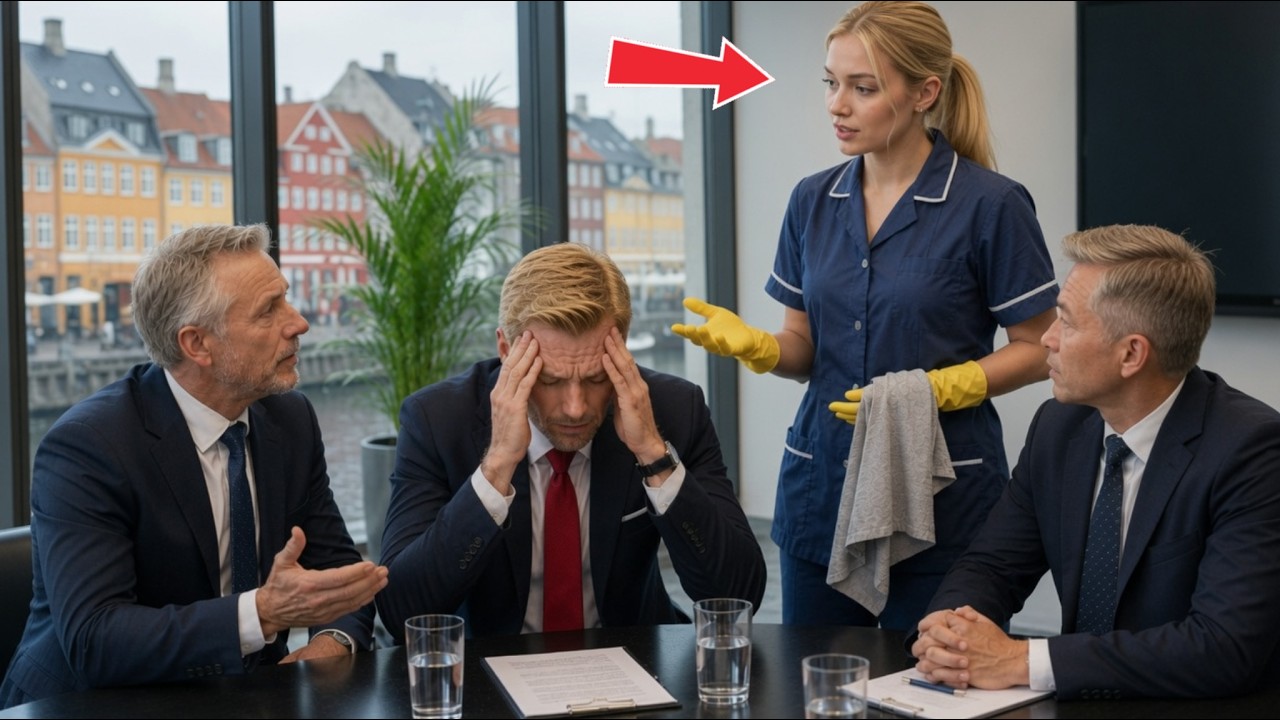
Across the meeting table, the delegation from the Nielsen Group stood up. In the world of big business, when the other side rises before a deal is signed, it means only one thing: they are leaving. “Erik, do something,” Gustav whispered, his face twisted with desperation. “They’re leaving.
Everything we’ve built is about to walk out that door. ”
On the screen, two words still glowed like a verdict: quota analysis. The investment that was supposed to save thousands of jobs, that was supposed to put Møller’s name on the world map. It all depended on a conversation no one could conduct because the only person capable of bridging two languages simply hadn’t shown up.
“Where is the interpreter? ” Erik muttered. “Valeria had a medical emergency,” said a young assistant, Rikke, her voice trembling. “She told us minutes ago.
We couldn’t find anyone else. No one with that level can arrive in less than a day. ”
“I don’t have a day,” Erik exploded. “I have ten minutes before those men get on a plane and sign somewhere else.
”
On the other side of the table, the delegation leader, Henrik Nielsen, said a few quiet words to his companions. No one on the Møller team understood a syllable, but they understood the gesture: Henrik picked up his folder and closed it. The period at the end of the sentence. Gustav stepped forward with a desperate smile, speaking clumsy, strained English.
“Please, one moment, we can explain. ”
The Swede looked at him with a politeness that hurt more than any insult. He barely nodded, and in that gesture lay a farewell. Then the unthinkable happened.
From the back of the room, where a cleaning cart had stood invisible against the wall for hours, a woman set down the cloth she was holding. She calmly took off her gloves one by one and placed them on the tray. And with the composure of someone who had waited a lifetime to be heard for the first time, she stepped forward and spoke. Not in Danish.
Not in English. But in Swedish—perfect, clean, respectful Swedish, with the inflections only a master who had thought, dreamed, and wept in that language could have. The effect was immediate. The entire delegation turned their heads at once, as if pulled by a single thread.
Henrik Nielsen, who already had one foot out the door, froze. His eyes locked on the woman by the cleaning cart as if he had just heard the voice of a ghost. “What is she doing? ” Gustav stammered.
“Get her out of here. This is a private meeting. ”
But Erik raised a hand, stopping him. Unlike his partner, he was watching the only thing that mattered in that moment: the faces of the Swedes.
And those faces no longer said no. They said: wait. Agnes, the woman who emptied the paper bins, whom no one greeted in the elevator, who only existed when the coffee ran out, kept talking. Her words flowed gently, carefully, like water finding its path after years of drought.
With each sentence, the delegation relaxed more. Henrik Nielsen placed his folder back on the table. He opened it. “Can someone tell me what’s happening?
” Gustav whispered, pale as a sheet. “What’s happening,” Erik answered without taking his eyes off her, “is that the cleaning lady just saved us. ”
Agnes turned to him, and for the first time since she had worked in the tower, the owner of it all looked her in the eyes. Really looked at her.
“With your permission,” she said in Danish, her calm voice contrasting with the chaos in the room. “The deal wasn’t failing because of the numbers. It was failing because of a word. ”
“A word?
” he repeated. “The person who translated their written proposal made a mistake. A small mistake for us. A huge one for them.
” She paused. “In the document, they promised to meet the deadlines if conditions allowed it. But in the translation, that sentence became: we will meet the deadlines only if it suits us. For the Nielsen family, that’s not business.
It’s a lack of respect. Telling them, in their own language, that their word means nothing. ”
The silence that followed was absolute. Erik felt the floor move beneath his feet.
This collapse, this humiliation in front of the most important investors of his life, was caused by one badly translated sentence. A bridge broken by a single wrong word. “I corrected it,” Agnes continued calmly. “I explained that it was a translation error, not an intention; that they honor their word.
And I apologized on the company’s behalf with the forms their culture requires. That’s why they sat back down. ”
Gustav found his voice, and as often happens with those who feel small, he used it to attack. “This is absurd,” he said with a nervous laugh.
“Are we supposed to trust a cleaning employee with the most important deal in our history? How do we know she isn’t making this up to make herself important? ”
Agnes didn’t lower her head. She lifted it.
“You’re right to doubt,” she said, looking at Gustav without a drop of fear. “I clean your offices. I empty your trash bins. I pick up your half-empty cups.
It’s natural that you find it hard to believe someone like me can do more than that. ”
She turned to the delegation and said a few words in Swedish. Henrik Nielsen nodded slowly and replied with a long, measured sentence, ending with a slight nod toward her. Agnes translated.
“Henrik Nielsen says that in thirty years of business relationships, he has never heard anyone speak his language with so much courtesy and respect. And he says that if this company has people like her within its walls, then it’s worth signing with them. ”
Gustav clenched his jaw. He had just realized that he, the vice president, the partner, the man in the expensive suits, had been close to losing everything.
And the one who had saved him was the person he didn’t even greet. “A language isn’t learned with money,” Agnes said, her words falling over the room like a verdict. “It’s learned with life. And life is sometimes hardest on those who want the most.
”
Erik Møller walked over to her. The man who shouted orders, who fired with a signature, who never said thank you because he never thought he needed to, stopped in front of a woman holding a cloth and felt something he hadn’t felt in years. Shame. Shame for having walked past her a thousand times without seeing her.
“What’s your name? ” he asked, his voice smaller than he intended. “Agnes. Agnes Lind.
I’ve been cleaning this floor for three years. ”
“Three years? ” he repeated, as if the air had been knocked out of him. “Three years, and the person who just saved my company has been emptying my trash bins.
”
“We all have a place in life,” she answered with a sad smile. “Mine was there. ”
It was then that the second earthquake of the afternoon struck, one no one saw coming. Agnes walked over to the table to pick up some cups, slipping back into her usual role, already becoming invisible again.
Her gaze fell by chance on the delegation’s open folder, on the logo engraved on the front. On a name written in two languages: Nielsen Group. The world stopped for her. The cups shook in her hands.
Her face, which had faced Gustav’s humiliation without blinking, which had spoken to the most powerful men without bending, suddenly lost all color. Her lips parted slightly. Her eyes filled with an old panic, a pain that had nothing to do with this room or this business. “Nielsen,” she whispered so low that only she could hear it.
On the other side of the table, one of the younger members of the delegation observed her with a strange intensity. A serious young man who had been silent the whole time, who had been watching her as if something about this woman seemed impossibly familiar. As if a memory he couldn’t name was scraping at his chest. Agnes didn’t notice.
She only saw the name in the folder. The name she had buried deep in her soul many years ago. The name that had given her everything and then taken everything from her. A glass slipped from her fingers and fell onto the thick carpet without breaking.
And for the first time in three years, the woman no one looked at had to hold onto the edge of the table to keep from falling. This was no longer a business meeting. It was the return of a past she believed was buried forever. Erik watched her, confused.
He had seen her face down the most powerful delegation of his life without trembling. He had seen her endure his own partner’s mockery with her head held high. And now, just by reading a name on a folder, the same woman seemed to be falling apart. “Are you all right?
” he asked quietly, stepping closer. Agnes closed her eyes for a moment. When she opened them, the panic was gone. She had locked it away, in the same place where she had locked away so many things over the years.
“I’m fine,” she answered. “Just a moment of dizziness. I haven’t eaten since early this morning. ”
It was a lie.
And Erik knew it. “I need to ask you something,” he said. For the first time in his life, those words didn’t sound like an order. “We still have to go through the contract clause by clause.
If they leave, it all falls apart. I’m begging you. Stay. And I will pay you for your time—which we never paid you for cleaning these floors.
”
Agnes looked at the folder. She looked at the name burning in her eyes. Every cell in her body screamed at her to run, to take her cart and disappear forever, that no amount of money in the world could pay the price of getting close to those people again. But then she thought of her small apartment, of the unpaid bills, of the cold.
“I’ll stay,” she said. The meeting resumed, and with Agnes bridging the two languages, the deal that seemed dead began to breathe again. She didn’t just translate words. She translated tones, intentions, the politeness that in the Swedish world is worth more than any signature.
The directors who had looked at her with mistrust minutes earlier now watched her with awe and gratitude. Everything went well until they reached the numbers. One of the men in the delegation, the one in charge of the figures, leaned forward and pointed at a line in the contract. He spoke quietly, quickly, to Henrik Nielsen.
Erik tensed. “What’s he saying? Is there a problem? ”
Agnes didn’t answer immediately.
She read the clause again and again, and with each reading, her expression changed. “Møller,” she said slowly. “Did your team personally draft this contract? ”
“No.
Gustav’s department handled the details. Why? ”
Agnes lifted her gaze, and it landed on Gustav Christensen. “Mr.
Hvitbjerg is asking why all distribution of the agreement, absolutely all of it, must go through a company called Kystfragt A/S. And why the costs that company charges are so far above market price—nearly triple. ”
A new silence fell over the room. Different from the previous one.
This wasn’t the silence of fear. It was the silence of a truth forcing its way to the surface. “Kystfragt A/S? ” Erik repeated, frowning.
“I’ve never heard that name. We have our own logistics. Why would an external company be involved in the core of our biggest deal ever? ”
“That’s exactly what they’re asking themselves,” Agnes said.
“And there’s more. This clause is written so that if the agreement generates profit, a significant portion of that profit doesn’t go to the company, but to Kystfragt A/S, accountable to no one. ”
All heads turned slowly toward one person. Gustav laughed a brittle laugh.
“This is ridiculous,” he said, rising. “Erik, are you going to let her question a contract that was reviewed by lawyers? And we’re supposed to believe the cleaning lady over the professionals? ”
It was a mistake, and everyone in the room felt it.
Agnes stepped toward him and answered with an icy calm. “I’m not questioning the lawyers, Mr. Christensen. I’m only reading what’s written.
And what’s written is that someone very close to you will line their own pockets behind this company’s back. ” She paused. “That’s why you wanted me out of here from the start. Not because I was a cleaning employee interfering where I shouldn’t, but because I was the only person in this room who could read, in both languages, what you didn’t want anyone to read.
”
“Erik,” Gustav said, his tone suddenly shifting. “You know me. We’ve worked together for years. Would you believe an unknown woman over me?
”
Erik rose from his chair, walked to the contract, took it, and read the clause with his own eyes. And as he read, his face changed from disbelief to something much colder. “Kystfragt A/S,” he said without lifting his gaze. “So tell me, Gustav: if I send someone to investigate who the real owners of this company are, whose name will I find?
”
Gustav opened his mouth. Nothing came out. “Look me in the eye,” Erik insisted, his voice low, sharp as a blade, “and tell me that your name isn’t behind this. ”
Gustav’s silence was the loudest answer the room had ever heard.
“Pack your things,” Erik said at last. “Tonight, the legal team and I will go through every contract that has passed through your hands. Every single one. And God help you if we find more phantom names.
”
The man who, an hour earlier, believed he was untouchable left the room with his head bowed. None of the directors dared to meet his eyes. When the door closed, Erik turned to Agnes and did something in front of everyone that none of them had ever seen him do. He bowed his head to her.
“I owe you an apology,” he said. “Not just for today, but for all the time you’ve been in this company and I never even learned your name. You just saved my business twice in one afternoon. The second time, you saved me from myself.
”
Agnes felt her eyes fill with tears. Not because of the praise, but because it had been so long since anyone had spoken to her as a human being that she had almost forgotten what it felt like. “I only did what was right,” she murmured. “Sometimes what’s right is right in front of our eyes,” Erik replied.
“You just have to stop looking down at people to see it. ”
The delegation’s youngest member stopped in front of Agnes on his way out. He looked at her, opened his mouth as if to say something, but didn’t. He only nodded slowly and left.
Agnes stood staring at the door he’d disappeared through, her heart beating strangely, not knowing why. The room emptied. Rikke hugged her before leaving. The directors shook her hand.
Someone apologized for never having greeted her. Little by little, Agnes was alone again with her cart, as on every other evening. Except nothing was the same. And then a voice spoke behind her.
In Swedish. Soft, heavy with unsaid words. “I thought I would never see you again. ”
Agnes stood frozen, a glass in her hand.
She turned slowly. Henrik Nielsen hadn’t left. He stood by the window, the city lights behind him, looking at her with eyes that were no longer the cold stare of the businessman at the meeting, but the eyes of a man carrying an old guilt. “Many years have passed,” he said, still in Swedish, so only she could understand.
“You’ve changed. But that voice… that voice you don’t forget. I would recognize it anywhere in the world. ”
The glass trembled in Agnes’s hand.
“You’re mistaken,” she whispered, stepping back. “I’m just the cleaning lady. ”
“No,” Henrik answered, his voice cracking slightly. “You are the woman who loved my brother.
You are the one we lost. ” He paused. “You are the mother of my nephew. ”
The glass fell to the floor.
And this time, it shattered. The pieces scattered across the floor, and with them crumbled the last wall Agnes had built around her heart. She sank to her knees and began picking up the shards with hands that no longer obeyed her. Not for the sake of tidiness.
But to avoid looking Henrik in the eyes. “Leave it,” he said softly. “Please, leave it, and look at me. ”
“You don’t know what you’re talking about,” she answered, clinging to the glass shards like a drowning woman clinging to a lie.
“I just clean these floors. ”
“Your hands tell me otherwise,” Henrik said, his voice breaking. “They’re shaking, just like they were that afternoon at the harbor. When I saw you get on that ship and did nothing to stop you.
”
Agnes closed her eyes. And the past, which she had buried under years of dirty water and trash, suddenly rose to the surface. She hadn’t always been Agnes, the woman with the cleaning cart. She had been Agnes Lind, the young woman who had come to Denmark on a scholarship, with a worn-out dictionary and a fierce hunger to know the world.
She had studied languages until Danish stopped being a wall and became her second skin. Over time, she became a certified interpreter for the best. She translated for diplomats, for businessmen, for conferences where a single wrong word could break agreements between nations. She built a name for herself in a country that doesn’t easily forgive foreigners.
One afternoon, at an industrial meeting, she met an engineer with an honest gaze and a shy smile. Thomas Nielsen. Henrik’s younger brother. “My brother, who barely spoke, who lived buried in his drawings and calculations, suddenly could talk about nothing but you,” Henrik said.
“The interpreter who makes words sound like music, he said. ”
“We married against his family’s will,” Agnes murmured. “I was a foreigner. I was poor.
For the Nielsen family, I was a stain on a lineage of generations. You were the only one who didn’t close the door completely. But you didn’t open it either. ”
Henrik lowered his gaze.
“I was a coward. I knew you made my brother happy, but I stayed silent when I should have spoken. And that silence cost us all more than I ever imagined. ”
Agnes walked to the window.
The city lights spread beyond the glass, but she didn’t see them. She saw a small bright house on the edge of a Danish town. She saw a wooden cradle Thomas had assembled with his own hands, slightly crooked, because an engineer doesn’t always know how to make furniture. She saw a child’s laughter.
“We had a son,” she said, her voice filling with a tenderness that hurt. “Kasper,” Henrik said. The name dropped into the room like a stone into a bottomless well. “Kasper,” she repeated, a tear rolling down her cheek.
“My Kasper. ”
“What happened, Agnes? ” Henrik asked. “Tell me, because I only ever heard my family’s version, and it has haunted me every day of my life.
”
Agnes wrapped her arms around herself, as if to keep from breaking apart. “Thomas was working on the construction of a large bridge. A huge, important structure. He was proud.
He said it would last a hundred years, that our grandchildren would cross it and know their grandfather had built it. ”
She paused. When she continued, it was the hardest part. “There was a storm.
Something failed. Not Thomas’s calculations—never his. He checked everything a thousand times. It was cheap material the company had approved to save money.
Material he had warned about in writing, saying it wasn’t safe. ”
Henrik closed his eyes. He knew where this was going. “That night, my husband didn’t come home,” Agnes said.
“I had to explain to a small child why his father wasn’t coming back. My Kasper looked at me with his small eyes and asked: ‘Mom, does heaven have bridges, so Daddy can come and visit us again? ’” Her voice broke. “I never answered that question.
I couldn’t. Still can’t. ”
“The company never acknowledged its guilt,” she continued, and now there was more than sadness in her voice. There was an old anger that time hadn’t extinguished.
“They called it an accident. A widow was offered a paper apology and asked to sign documents she could barely read in her weakest moment. ”
“And my family,” Henrik began. “Your family took the only thing I had left,” Agnes interrupted, her voice finally breaking.
“My son. Without Thomas, I had nothing. No money, no name. My visa depended on a husband who no longer existed.
Your family said they could give Kasper the life he deserved, that a Nielsen child should grow up among the Nielsen family. And their lawyers were an army. I fought. God knows I fought.
But I was alone in a country that wasn’t mine. I lost. ”
“They put me on a ship back to my homeland with a suitcase and one photograph. One single photograph,” she said, reaching into her uniform pocket and pulling out, with infinite care, a worn photograph wrapped in a small plastic bag.
“It’s the only thing they let me take. Every house I cleaned, every office where no one knew my name, this photo has always been with me. ”
Henrik had to lean on the table. “We told him you left,” he confessed, his voice barely audible.
“We told Kasper that his mother had abandoned him, that she had left and never came back. He grew up with that wound. He grew up believing his own mother didn’t want him. ”
Agnes covered her mouth with both hands.
“No. Please tell me you didn’t tell him that. ”
“I wrote hundreds of letters,” she said. “I never stopped.
I sent him drawings, told him about my life, told him I loved him, that I would come back for him one day. And today I found out those letters never reached him. ”
“They never reached his hands,” Henrik confirmed, a tear finally falling from him too. Agnes wept.
She wept as she hadn’t wept since the day the ship carried her away from her son. Henrik fell to his knees before her. A man of his position and age, kneeling in front of a cleaning employee who was really his brother’s wife. “Forgive me,” he said.
“I have no right to ask, but forgive me. I was part of all this. ”
Agnes looked at him through her tears and found, in a corner of her shattered soul, the strength of someone who had lost almost everything. “I don’t live on hate, Nielsen,” she said slowly.
“If I lived on hate, I would have died many years ago. What I want to know is only one thing. ” She took a deep breath. “Is my son alive?
Is Kasper well? ”
Henrik lifted his gaze, and in his eyes was something Agnes couldn’t read. Something between fear and an enormous truth impossible to hold back. “Agnes,” he said.
“Kasper isn’t just alive. He’s here. In this city. He came with me on this trip.
”
Agnes held her breath. “He’s the youngest in my delegation,” Henrik continued, his voice shaking. “The quiet young man who couldn’t stop looking at you today. The one who stopped in front of you on the way out, as if something inside him recognized you without knowing why.
”
The photograph slipped from Agnes’s hands. Her son. The baby in the picture, the child who had asked about heaven’s bridges, had been in the same room, only meters away from her, breathing the same air. And she hadn’t recognized him.
And he, who believed his mother had abandoned him, hadn’t either. “Fetch him! ” she begged, grabbing Henrik’s arm. “Please.
Fetch him now. I need to see him. I need to hold him. ”
But there was no joy in Henrik’s face.
There was fear. “Agnes, listen to me. It’s not that simple. If I bring him now and tell him the truth suddenly, I will destroy him.
For you, you are his mother. But for him, his mother is a woman who left and never came back. He grew up with that idea carved into his soul. If we confront him without care, he won’t see his mother.
He’ll see an unknown woman telling him his whole life was a lie. And his heart, already wounded, could close forever. ”
The silence that followed was different from all the previous ones. It was a mother’s silence, understanding that reunion with her son could be just as painful as the loss itself.
That was when the door opened. Erik Møller came in with two cups of coffee. He had gone out to instruct his legal team, to launch the investigation into Gustav, to try to fix the chaos of the impossible evening. But when he saw the scene—a shattered woman, a foreign businessman on his knees, a worn photograph trembling between two hands—he stopped short.
“What’s happening here? ” he asked, setting the cups down. Henrik looked at him, then at Agnes. She nodded weakly.
She no longer had the strength to hide anything. So Henrik spoke, telling him everything. Agnes and Thomas’s love, the bridge, the cheap material, the tragedy. The child torn from his mother’s arms, the destroyed letters, the lie sown across the years.
Erik’s face changed as he listened. He had built an empire by stepping hard, by firing people without looking them in the eyes, by walking past that woman a thousand times without ever seeing her. That evening, listening to the story of the person he called the cleaning lady, he understood he had been blind his whole life. “I lost my mother when I was young,” he said suddenly, his voice unfamiliar.
“She cleaned other people’s houses to pay for my education. She wore her hands raw so I could get to where I am. And when I finally had money, I was ashamed to say where I came from. I buried her memory under expensive suits and tall offices.
” He looked at Agnes. “Today I watched you defend the truth with a cloth in your hand. It was like seeing my mother again. And I realize what kind of man I had become.
”
He knelt down to her level. “Agnes, listen to me. Everything I have, everything this empire means, is at your disposal. Lawyers, resources, contacts.
Whatever it takes. You will never face this alone again, and your son will know the truth. I give you my word. ”
Agnes stared at him, unable to answer.
It had been so long since anyone had offered to protect her that the words sounded like a foreign language. “But there is a problem,” Henrik interrupted. “Time. We sign the agreement, and days later, the whole delegation returns to Sweden.
Kasper goes with us. He has his whole life there, his work, his future. If he gets on that plane without knowing the truth, Agnes may never see him again. ”
“Then there’s no time to waste,” Erik answered.
“We reach him before that plane, and we do it right. ”
Agnes rose, trembling but determined. “I want to see him tonight. Not tomorrow.
Not after the signing. Tonight. Even if he rejects me, even if he hates me, even if he looks at me like a stranger, I would rather a thousand times that he destroy me by looking me in the eye than spend one more day without facing my son. ”
Henrik looked at her for a long moment, and the strength and dignity in that woman, which neither years nor poverty had managed to break, made him nod.
“All right. I will talk to him. Let me prepare him. Let me open the door slowly.
”
Far away, in an elegant hotel room too large and too empty, Kasper Nielsen couldn’t sleep. He stood by the window, looking at the lights without seeing them. He had closed an important deal that day. He should feel proud.
Everything had gone according to the plan laid out for him since childhood. And yet something had been pressing on his chest all afternoon. The cleaning lady. He couldn’t understand why he couldn’t get her out of his head.
She had spoken his language with a perfection no professional interpreter had ever achieved in front of him. But it wasn’t that. It was her voice. There was, in that voice, a strange vibration, a warm echo that scraped at a memory so old he didn’t even know if it was real.
He went to his suitcase. From a hidden inner pocket, he pulled out an object he had carried everywhere for as long as he could remember: a small, slightly crooked wooden music box. No one knew why he kept it. Not even he knew, completely.
He only knew it was the one thing he had left from a phase of his life that had been erased. He wound it up, and the melody began to play, faintly, interrupted by the years. Then something happened that Kasper didn’t expect. Without noticing, he began to hum a tune.
A lullaby. In Spanish. Words he couldn’t remember ever learning, in a language he had never spoken, but which his mouth knew as if he had sung them a thousand times. He stopped, shocked, his heart pounding.
Where had that come from? His phone vibrated. His uncle. “Kasper,” Henrik’s voice said.
“I need to see you now. There’s something I should have told you a long time ago. ”
“Uncle, it’s late. We sign tomorrow.
We should rest. ”
“Kasper. ” Henrik’s voice cracked. “It’s about your mother.
”
The young man froze. “My mother left me,” he said, hardness hiding a wound. “There’s nothing to talk about. ”
“That is what I need to tell you.
Because all your life, we told you a lie. And I can’t carry it anymore. ”
In the tower, Agnes waited. Erik had prepared a private lounge, more intimate, warmer than the cold meeting room.
She had taken off her work uniform. Erik had insisted on getting her proper clothes, and she had accepted—not out of vanity, but because she didn’t want her son’s first memory of her after all these years to be his mother holding a cloth. The minutes passed like hours. Then footsteps in the corridor.
Two pairs. The door opened slowly. Henrik came in first. And behind him, pale, lost, out of breath, appeared Kasper.
Mother and son looked at each other for the first time in years. The air vanished from the room. In the eternal moment before either could speak, Agnes saw something in her son’s hands that made her stagger. Kasper was holding the little music box.
The crooked little box that his father Thomas had made with his own hands. The same one Agnes thought was lost forever. “That box,” she whispered, her voice breaking. “That box was made by your father.
”
And Kasper, the young man who had spent his whole life believing he had been abandoned, felt the ground open beneath his feet. He looked down at the object in his hands. The crooked music box, imperfectly made with more love than skill, that he had carried all his life without knowing why. No one had ever explained it to him.
He only knew that every time he opened it, something inside him settled, as if that melody was the only true thing in a world full of rehearsed versions. “You can’t know that,” he said, his voice harsher than he intended. “No one knows anything about this box. I’ve had it for as long as I can remember.
I’ve never shown it to anyone. ”
“I know it’s crooked on the left side,” Agnes answered, taking a step toward him. “I know your father struggled over it for three nights straight, and it still didn’t come out straight, because an engineer who builds giant bridges couldn’t make a simple wooden box, and he laughed at himself. He said: ‘I can build a structure over a harbor, but I can’t make a straight box for my son.
’”
Kasper went pale. “I know that a lullaby plays inside it,” she continued, her voice trembling. “And I know that song isn’t Swedish. It’s Spanish, because I sang it to you every night.
I sang it to you before you learned to speak. ”
The young man stepped back as if those words had hit him in the chest. “No,” he whispered. “You’re lying.
My mother… my mother left. She abandoned me. That’s what they told me my whole life. ”
“And did you believe it?
” Agnes asked, tears streaming down her face. “Deep in your heart, did you really believe it? ”
Kasper opened his mouth, closed it. The honest answer, the one he had never dared to say aloud, was no.
Somewhere inside him, something older than memory had always known there was a missing piece in that story. “This afternoon,” Agnes said, trembling all over, “when I saw you in that room, I didn’t recognize you. Forgive me for that. My body knew.
My heart beat strangely all afternoon, and I didn’t understand why. But a mother’s heart always knows, even when the mind doesn’t see it. ”
“Prove it,” Kasper said suddenly, his voice breaking, clinging to the last defense he had left. “If you are who you say you are, then sing the song.
The one from the box. Sing it without listening to it first. ”
Deathly silence. Agnes closed her eyes and sang.
She didn’t need the box. She didn’t need to think. The melody flowed out of her like water from a spring that had never dried. A soft, simple lullaby in Spanish, with the tender words only a mother invents to make her child sleep.
She sang with a broken voice, trembling with tears, but every note fell exactly, perfectly, identical to the crooked melody of the wooden box. And Kasper felt the world fall apart. Because it was her. It was the voice.
The same one he had hummed that very afternoon in his hotel room without understanding why. The same one sleeping at the bottom of his memory from before they had taught him to hate her. “It’s the same,” he whispered, shaking. “It’s the same song I hummed tonight.
I didn’t know why I knew it. ”
“Because it was the first language you ever heard,” Agnes said, her voice breaking completely. “Before Swedish. Before anything else.
The first thing you heard in this world was your mother singing to you in her language, promising you she would always take care of you. ”
Kasper let the music box fall onto the armchair. His hands shook. His whole world shook.
“Then why? ” he exploded, and in his voice was all the anger and all the pain of years of lies. “Why did you leave? Why did you abandon me, if you loved me so much?
If you sang to me, if you were my mother, why did you let me grow up alone, thinking I meant nothing to you? ”
Agnes didn’t defend herself. She didn’t rush. She walked slowly to him and took his face in her hands with infinite tenderness, as she had when he was a baby.
“I never left you,” she said, looking into his eyes. “They tore me from you. That is very different. ”
And she told him everything.
About his parents’ love, about Thomas’s shy smile. About the bridge and the cheap material and the warning his father had written that no one listened to. About the storm and the night his father didn’t come home. “You asked me, when you were very small,” Agnes said, weeping, “whether heaven had bridges so Daddy could come visit us again.
I never knew what to answer. I still don’t. ”
Kasper held a hand to his mouth. That memory, that sentence, was buried deep in his soul without a face, without a voice.
And now it fit like a piece that had been searching for its place his whole life. “When your father died, I was left with nothing,” she continued. “No money. No name.
No right to stay in the country. And the family decided that you would be better off with them. I fought for you, my love. I swear to everything holy, I fought with everything I had.
But I was alone, and they were an army. They put me on a ship with a suitcase and your photo. A single photo—the one that has kept me going every day of my life since. ”
She bent down, picked up the photograph, and showed it to him.
A smiling baby in the arms of a man with an honest gaze. His father. “I wrote, my Kasper. Hundreds of letters.
I never stopped. I sent you drawings, told you about my life, told you I loved you, that one day I would come back for you. Today I learned those letters never reached your hands. ”
Kasper slowly turned his head toward his uncle.
“Is that true? ” he asked, his voice no longer that of a powerful man, but of a wounded child. “Uncle, look at me. Is that true?
”
Henrik Nielsen stepped forward. His voice shook, but he didn’t look away. “It’s true, Kasper. Everything she says is true.
Your mother never left you. We stole that love from you. We told you a lie and repeated it until it became your story. Forgive me.
I failed your father. I failed you. And I failed this woman, who deserved none of what we did to her. ”
Kasper lowered his gaze to the photograph, to the music box on the armchair, to the weeping face of the woman in front of him.
His whole life, every certainty, every carefully cultivated belief, fell apart in seconds. And then the young man who had been taught not to cry, who had been raised to be strong, to show no weakness, broke. “Mom,” he said. One word.
The first in years. The one he had held in his throat his entire life without knowing he still had it. “Mom. ”
Agnes let out a sob that came from the depths of her soul and opened her arms.
And Kasper, the tall man, the heir, the serious young man with the hard gaze, ran to her like the child he had never stopped being inside, seeking refuge in the embrace they had stolen from him for so many years. They held each other. In that embrace were all the birthdays without her, all the nights without her song, all the letters that never arrived. All the suppressed love of a lifetime, bursting out at once.
“I’m sorry I doubted you,” Kasper whispered against his mother’s shoulder. “I’m sorry I believed you could leave me. ”
“No, my love,” Agnes answered, stroking his hair. “You have nothing to apologize for.
You were a child. They taught you to believe it. The blame was never yours. Never.
”
They stayed like that for a long time, reclaiming in a few minutes what time had stolen from them for years. But then, when the emotions had barely begun to settle, the door to the lounge opened abruptly. The young assistant, Rikke, came in, nearly breathless, her face contorted, her phone in hand. “Møller,” she said.
“Sorry for the interruption, but the legal team just called. It’s urgent. ”
“What’s happening? ”
“It’s about Christensen,” Rikke answered.
“Before he left last night, he didn’t leave empty-handed. He took documents. And he called someone. He told her everything.
He called the matriarch of the Nielsen family. Mrs. Karen. ”
The air froze in the room.
“He told her that her grandson was about to discover the truth, that the mother had appeared. ”
“And what did she say? ” Henrik asked, his face white. Rikke looked at Agnes, then at Kasper, and lowered her voice.
“She’s on her way. Mrs. Karen took the first flight. She arrives in hours.
And she said that no one will take her grandson from her. ”
Kasper lifted his head from his mother’s shoulder, and for the first time in his life, there was no obedience in his eyes. There was fire. Dawn crept over the city when the sound of firm footsteps echoed through the corridor of the tower.
Not hurried steps. The steps of someone who had never had to run after anything in her life. The steps of someone who always expected the world to adapt to her pace. The door to the lounge opened without a knock, and Mrs.
Karen Nielsen entered like winter enters a house without asking permission, freezing everything. Behind her, almost dragging himself along, with the nervous smile of a man who believes he’s bet on the winning horse, came Gustav Christensen. “Well,” Gustav said, letting his gaze drift around the room. “What a touching reunion.
Too bad it’s ending. ”
Agnes instinctively stood in front of Kasper, an old maternal gesture her body remembered before her mind did. Karen observed her from head to toe, and in her eyes was not hatred. It was worse.
The quiet contempt of someone who doesn’t even need to raise her voice. “So it’s you,” the older woman said in carefully articulated Danish, each word sharp as a needle. “After all these years, daring to appear again. To poison my grandson’s mind with sad stories.
”
“They’re not stories,” Agnes said with a calm that trembled inside. “It’s the truth. The same truth you buried. ”
Karen smiled coldly.
“The truth is that I gave this young man everything you could never have given him. The best education, the best name, a future. While you washed other people’s floors, I made him a man. ” She turned to Kasper.
“Nephew, pack your things. We’re leaving. This trip was a mistake. ”
Kasper didn’t move.
“Grandmother,” he said quietly, but without lowering his eyes. “Is it true that you hid her letters? ”
A moment of silence. For just a second, something crossed the older woman’s face.
But she recovered quickly. “I did what needed to be done,” she said, denying nothing. “That woman would only have chained you to a life of misery. I protected your fate.
”
“You stole my mother from me,” Kasper said, his voice cracking. “You made me grow up believing she didn’t want me. Every night of my childhood, every birthday, every time I saw another child hug his mother and wondered what was wrong with me because mine was gone—that was all a lie you invented. ”
“I did it for you.
”
“You did it for the name,” Kasper exploded, raising his voice for the first time in his life against the matriarch. “Not for me. Never for me. A child doesn’t need a name, Grandmother.
A child needs his mother. And you took her from me. ”
Gustav, sensing his gamble beginning to fail, decided to intervene. “Young man, don’t let yourself be manipulated.
This woman and this man,” he said, pointing at Erik, “only want to use you. You’re the heir. You’re a fortune. Do you really think the cleaning lady is interested in your heart, and not in what lies behind your name?
”
It was a mistake. The last in a long series. Agnes turned to him, and her calm, the calm that had withstood public humiliation, contempt, and years of pain, turned into something hard as steel. “Mr.
Christensen,” she said. “For years I cleaned offices for people who believed I was invisible, and I learned something that all their money could never teach them: some things are priceless. My son is not a fortune. He is the only thing life asked me for every night of those years.
And I didn’t come to take him away. I came to let him know that his mother never stopped loving him. If he decides, after this, to get on that plane and never see me again, I will let him go. Because true love doesn’t imprison.
True love sets free. ”
Erik stepped forward. “Speaking of phantom companies,” he said with a quiet coldness, “I want to thank you, Gustav, for coming. You saved me the trouble of finding you.
” He gave a signal. Two men from his legal team entered, followed by two police officers. “Kystfragt A/S. We investigated all night.
The real owners already have a name. Yours. You’ve been diverting funds for years. Not just from this deal—from many.
Justice wants to talk to you. ”
Gustav’s face fell apart. “Erik, you can’t. We’ve worked together for years.
”
“I can,” Erik answered. “And for the first time in a long time, I’m doing the right thing. ”
Gustav was led out of the lounge, stammering excuses no one listened to. Karen remained unmoved, as if her accomplice’s fall didn’t concern her in the least.
She fixed her gaze on her grandson again. “Kasper,” she said, and for the first time, her voice held a different tone. Not tenderness. But a certain urgency.
“Think carefully about what you’re doing. Everything you have, everything you are, comes from your family. If you choose this woman, you turn your back on all of it. Are you willing to lose everything for a hug?
”
The young man looked at his grandmother, then at his mother, then at the music box on the armchair, at the photograph in Agnes’s hands, at the weeping face of the woman who had sung to him before he learned to speak. And he smiled with a quiet sadness. “Grandmother,” he said, “you think I have everything. But my whole life, I have lacked the only thing that matters.
” He walked slowly to Agnes and took her hand. “I’m not losing anything. I’m getting back what you stole from me. ”
Henrik stepped forward, confronting his mother.
“Mother,” he said with a shaking but firm voice. “I stayed silent when I should have defended Agnes. I stayed silent when you destroyed her letters. I looked the other way.
And that silence has haunted me every day. I will not be silent again. What we did to this woman and this young man was an injustice, and no tradition, no name, no pride justifies it. Kasper stays, if he wants to stay.
And you will have to live with what you did. ”
Karen looked at her eldest son as if seeing him for the first time. She said nothing more. She didn’t ask for forgiveness—that word wasn’t in her language.
She simply turned with the same stiff dignity with which she had entered and walked toward the door. But before she left, she stopped and murmured, so low that almost no one heard it:
“He looks like him. He looks like Thomas. ”
Then she was gone.
Agnes brought a hand to her chest. In those five words, said with her back turned, there was something that looked like a regret arriving far too late. The lounge was quiet, but it was a different quiet. Not of fear or pain.
It was the silence remaining after a storm, when the air can finally be breathed. Kasper turned to his mother and embraced her again. This time without tears, without hurry, with the calm of someone who no longer fears being taken away. “I’m not leaving,” he whispered to her.
“And I won’t let you go either. ”
Erik approached them. His hard businessman’s face had softened. “Agnes,” he said, “I know no salary can pay what life owes you.
But allow me to begin to right, even a little, what the world did wrong to you. Never return to a cleaning cart. From today, you are the Director of International Relations for this company. No one in this country understands how to build bridges between cultures like you do.
I’m not saying this out of pity. I’m saying it because it will be an honor. ”
Agnes stared at him, speechless. “And there’s more,” Erik continued.
“My mother cleaned houses her whole life so I could study. I never had the chance to thank her, because she passed before I learned to see her. You gave me that lesson back tonight. So let me do for you what I can no longer do for her.
”
Agnes couldn’t answer. She simply nodded, her eyes full of tears, her son’s arm around her shoulders. And for a moment, everything finally seemed to fall into place. But life, which gives and takes in the same breath, still held one last trial.
Henrik’s phone rang. He looked at the screen, and his face changed. “It’s from Sweden,” he said, puzzled. “From the family’s lawyer’s office.
”
He answered and listened. As he listened, his eyes opened with a mixture of astonishment and something no one could name. He hung up slowly and looked at Agnes, then at Kasper. “Agnes,” he said, his voice shaking.
“There’s something I didn’t even know about. Before he died, my brother Thomas left a document hidden in a sealed envelope, with instructions to open it only if you ever appeared again. ”
Agnes felt her heart stop. “A document?
”
“Yes,” Henrik said. “And they just found it. ”
Erik didn’t hesitate for a moment. “Send it immediately,” he ordered.
“Scanned, certified, with all legal guarantees. And a physical copy on the first flight. This family has waited too many years. They won’t wait a minute more.
”
The following hours were the longest and most luminous Agnes had ever experienced. She sat with Kasper in the lounge Erik had arranged, and for the first time in so long, mother and son simply talked. She told him about his father. His shy laugh, his habit of checking everything a thousand times, the way he was moved by small things.
And Kasper listened with the hunger of someone reclaiming a part of himself that had been denied to him. When the sun began to peek over the city, the document arrived. Henrik received it with trembling hands and gave it to Agnes. “It’s yours,” he said.
“He wrote it to you. ”
Agnes took it as one takes something sacred. She recognized the handwriting the moment she broke the seal—the careful engineer’s script, the methodical hand of the man she had loved and lost. She pressed the paper to her chest before she could even read it.
Then she took a deep breath and read aloud:
“My dear Agnes, if you are reading this, it means life separated us earlier than we dreamed, and you have had to walk part of the road alone. Forgive me. An engineer calculates everything, except the day he is no longer here. I warned the company that the material for the construction was not safe.
I left it in writing. If something happens to me, I want you to know that it was not fate’s accident, but the consequence of a decision others made to save money. Don’t let them tell you it was my fault. It never was.
In this document, I have written everything and set out my will before the law: that everything due to me from the family goes to you and our son. That no one shall separate you. That no one shall decide for you. You are his mother, Agnes.
The best a child could have. And to our Kasper, if he ever reads these lines, I will say one thing: son, once you asked me if heaven had bridges so I could come visit you. I didn’t know what to answer that night. But I have thought about it a lot since then, and at last I have the answer.
I build bridges of steel and concrete, the largest there are. But the strongest bridge I have ever built in my life is not made of metal. It is made of the love between your mother and you and me. And that bridge, my son, no storm can tear down.
That bridge crosses heaven, so I can always reach you when you seek me in your heart. Wherever you are, however many years pass, I will be on the other side, watching you cross. ”
The whole lounge broke into tears. Kasper took the letter from his mother’s hands and read it again with his own eyes, touching each word as if he could feel the hand that had written them.
The question that had defined his childhood, the one his mother hadn’t even known how to answer, had just been answered by his father from the other side of time. “He answered,” Kasper murmured. “It took time, but he answered. ”
Agnes embraced him, and Henrik came closer, his face wet with tears, placing a hand on each of their shoulders.
“My brother left everything written down. His will was clear, and my family ignored it. This document proves not only his love. It proves an injustice was committed.
And I will make sure it is fully rectified. Thomas’s name will be cleared, and you will receive every last detail of what he wanted to give you. ”
The agreement between the Nielsen Group and the Møller Group was signed that same morning. But no one talked about numbers anymore.
The two men who shook hands did so not as business partners, but as people united by an evening that had changed all of them forever. And life slowly began to put every piece in its place. Weeks later, Agnes walked through the same corridors she had cleaned for years, but she no longer pushed a cart. She entered meeting rooms through the main door.
When a delegation arrived from another country, everyone knew that the woman who could build bridges between cultures, who understood not just the words but the soul behind them, was her. The people who used to ignore her in the elevator now rose when she entered, not because of her position, but because of her story. Rikke, the young assistant who had wept that evening, became her right hand and told everyone who would listen that she had learned more about dignity watching Agnes work than in any book. Gustav Christensen was heard from little after that.
Justice took its course, and the phantom companies he had created collapsed one by one. The power he had used to humiliate those he thought lesser ended up leaving him alone. Erik Møller became a different man. He stopped signing dismissals without looking people in the eyes.
He walked through his company, learning the names of everyone, from the highest director to the one who emptied the trash bins, because he had learned, the hard way, that you never know what story the person you’re looking past is carrying. He hung a single photograph in his office: a woman with worn hands who had cleaned other people’s houses so her son could study. His mother, whom he finally dared to look in the eyes every morning. And Kasper didn’t get on that plane.
He stayed. He learned his mother’s language, the one that had slept in his memory before words. With time, he made a decision that would have made his father weep with pride: he devoted his life to building—but to building well, to checking every material a thousand times, to never allowing corners to be cut on what holds lives together. Every structure he raised bore a small engraved bridge in a corner, his silent tribute to his father, and a son who had finally understood who his father was.
As for Mrs. Karen, ice takes a long time to break, but sometimes it gives way. A season later, an envelope arrived for Agnes from Sweden. Inside was no apology—that word never came from the matriarch.
But there was something Agnes hadn’t expected: the letters. All of them. Hundreds of yellowed letters tied with a string. The same ones she had written with her heart, which had never reached their destination.
Karen had kept them all along. She hadn’t destroyed them, as everyone believed. She had kept them. And now she returned them.
Perhaps it was the closest thing to forgiveness a woman like that could offer. And Agnes, who didn’t live on hate, received it as such. Much later, on a warm afternoon, Agnes stood at a large window, looking out over the city that had once seen her as invisible. Kasper came and stood beside her.
He was no longer the young man with the hard gaze and the wounded heart. He was a man at peace. “What are you thinking about, Mom? ”
Agnes smiled, her eyes glistening.
“I’m thinking that life took almost everything from me. It took your father. It took my best years with you. It made me invisible for so long that I almost forgot who I was.
” She took his hand. “But it never took the only thing that truly mattered: the hope that one day, even for a single day, I would hear you call me Mom again. ”
Kasper embraced her. And outside, between the buildings, the sun was slowly setting, tracing orange lines across the sky that sometimes, if you look at them with your heart, resemble the silhouette of a bridge.
A bridge that crosses heaven, from which an engineer with a shy smile, wherever he may be, still watches his loved ones cross. Because true love is not torn down by any storm, and no distance, not even that of heaven, is too great when there is a bridge made of love to cross it.