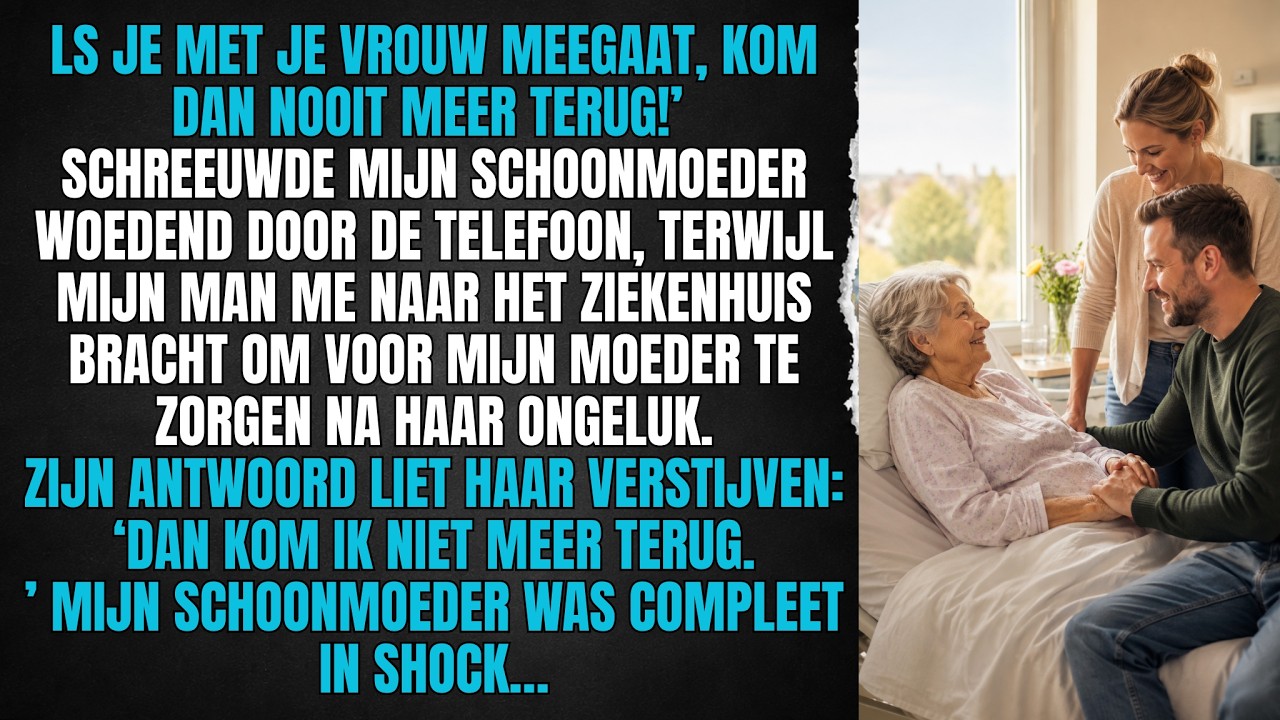
My husband smiled briefly, looked at me, and answered calmly. “Then I won’t come back. ”
To understand how he reached that point, I have to go back to that afternoon. I was thirty-five, working as a bookkeeper at a small furniture workshop on the edge of town.
The month was ending, my desk was buried under invoices and delivery notes, and I was puzzling over a discrepancy of less than a hundred euros when my phone started buzzing. I ignored the first two calls. On the third, I saw the name of our elderly neighbor, Henk. He never called during work hours.
When I picked up, I heard voices, brakes, sirens. Someone shouting for space. Henk’s voice trembled. “Stay calm and listen.
Your mother was hit by a car near the shopping square. She’s unconscious. They’re taking her away in the ambulance now. ”
The pen dropped from my hand.
I asked him twice to repeat it. The answer didn’t change. I sprang up, banged my knee on the desk, felt nothing. I managed to tell my colleague and boss I had to leave, grabbed my bag, and ran outside.
The first person I called was my husband, Pieter. He was at a client’s house, working as an air conditioning technician. The moment he heard my voice, I broke down. “Mama was run over.
They’re taking her to the hospital. I don’t know how bad it is. ”
He paused for one second, then said firmly, “Stand at the gate. I’m coming to get you.
You are not driving alone. ”
Less than twenty minutes later, his work van pulled up. He was still in his dusty work clothes, tool bag hastily tied to the back. He asked no questions, handed me a helmet, and said, “Get on.
I’m with you. ”
On the way, he called our children’s school. Our daughter Sofie was eight, our son Daan six. My mother-in-law Wilma was busy preparing a family gathering to honor her late husband, and Pieter’s younger sister Chantal had her own family.
There was no one to take the kids. Pieter arranged for a colleague who worked near the school to pick them up and bring them straight to the hospital. When we arrived, Henk stood in the corridor outside the treatment room. Dried blood was on his hands.
He told me my mother had hit her head on the curb and a wheel had rolled over her thigh. Through the window, I could only see her gray hair on the stretcher, her pale face, the matted strands at her forehead. The cheap plastic bracelet on her wrist was the one I’d bought her at a market stall years ago. I couldn’t stand on my own and leaned against Pieter.
That morning, my mother had called me. I was busy with the accounts and told her I’d call back. She’d asked if the kids would like her stuffed cabbage rolls, since she wanted to make extra. I said, “Mom, never mind.
I’m busy right now. ” In that hospital, I thought maybe those were our last words. The doctor came out and explained my mother had a complicated thigh fracture, head trauma, and significant blood loss. Her condition wasn’t immediately life-threatening, but the first twenty-four hours were critical.
If the CT scan showed no severe internal damage, she needed surgery that night. I listened with ice-cold hands. Pieter asked practical questions about the operation, possible blood transfusions, length of stay, and the implants needed to fix the bone. Most of the acute care was covered, but the specialized materials, our deductible, and an advance for rehabilitation would come to about twenty-five hundred euros.
We had just over a thousand in savings. Three months earlier, we had spent nearly all our savings on fixing the roof of Wilma’s house. She’d claimed it leaked every autumn and the ceiling could collapse at any moment. Pieter had taken almost twenty-four thousand euros from our joint account to pay the roofer without hesitation.
I told him I could call colleagues to borrow money. He shook his head. “Transfer everything we have. I’ll borrow the rest from the guys at work.
Your mother is lying in there. This is not the time to count whose money it is. ”
Sofie and Daan arrived soon after with Pieter’s colleague. Sofie understood what was happening and held her little brother tightly.
Daan asked if grandma was going to die. Pieter knelt, pulled them close, and said the doctors were doing everything they could to help her. That’s exactly when Pieter’s phone rang. It was Wilma.
She didn’t ask how my mother was doing or where her grandchildren were. She started shouting that the air conditioning in her bedroom still didn’t work and that someone needed to pick up the order from the butcher for the memorial lunch. Pieter stayed calm. “Mom, Annike’s mother had an accident.
She’s in the emergency room. We’re staying here tonight. ”
Wilma’s voice got louder. “That’s what doctors are for.
Do you think she’ll heal faster if you sit on a plastic chair? The whole family is coming tomorrow. You have obligations in this house. Come home immediately.
”
Pieter said my mother’s condition was uncertain and he wasn’t leaving his wife alone. Then came the sentence I would never forget. “If your wife’s family has problems, they need to solve them themselves. You are the son of this house.
Don’t forget your duty. ” She hung up. Her words were like a match in dry grass, because this conflict had been smoldering for years. We had been married for eight years.
The first two were quiet because Pieter’s father was still alive, a gentle, honest man who discussed decisions with everyone and didn’t let Wilma rule. When he suddenly died of a stroke three years ago, Wilma began treating her eldest son as the sole breadwinner and head of the family. To outsiders it almost sounded honorable when she said, “Pieter is the only man left here. If he doesn’t carry the weight, who will?
”
In reality, carrying just meant every financial problem automatically fell on his shoulders. Pieter earned well in busy summer months, but in winter and on rainy days, sometimes half as much. My salary was lower but steady, so school costs, clothes, and medicine for the children usually came from me. Still, Pieter gave his mother about two hundred fifty euros each month for energy and groceries while we paid for our own household.
Yet Wilma told neighbors that her naive son gave everything to his wife and was left with barely enough for cough syrup. I knew her blood pressure and joint medication were actually paid out of my wallet. When I protested, Pieter squeezed my hand under the table and whispered, “Let it go. Outsiders don’t understand anyway, and we’ll only have a fight.
”
His biggest weakness wasn’t that he loved his mother. It was that he was terrified of being called an ungrateful son. Wilma had reminded him since childhood how much she sacrificed to raise him and send him to vocational school. When he resisted, she didn’t even need to scream.
She grabbed her chest, refused to eat, and said, “You’re an adult, you have a wife. Your mother doesn’t count anymore. ” That was enough to make him give in. Two months before my mother’s accident, Chantal came with glossy visualizations of her own beauty salon.
She claimed the location was already chosen and she only needed the equipment, about ten thousand euros. Wilma summoned Pieter and spoke as if the decision was already made. He had to take out a loan in his name so his sister could build a future. Pieter refused.
The kids were in school, we had just paid for the roof, and no one knew if the salon would ever make a profit. Wilma went dark. “Then just say your wife forbids it. ” Chantal added that her brother apparently had plenty of money when his mother-in-law needed something, but not when his own sister asked for help.
That was a lie. My mother Els had never accepted money from us. Her small house had a leaky corner in the kitchen, but she saved herself and asked a handy neighbor to do a temporary fix. When Pieter tried to give her money, she’d say, “The kids cost enough.
My house can hold out a little longer. I’ll ask for help only when I really need it. ” She took the bus to the doctor, grew vegetables in her garden, and brought eggs or potatoes every time she visited. She never demanded anything.
That’s why Wilma’s words hurt so much. On that hospital corridor, while my mother lay inside, Pieter said after a long silence, “I thought there would be peace if I gave in enough. But the more I give, the more my mother thinks she owns everyone. ” I said carefully that I didn’t want him to choose between his mother and mine, only that my family be treated like human beings when they were suffering.
Around seven that evening, a young doctor came with the surgery form. The fracture had multiple fragments, and delay increased the risk of internal bleeding, embolism, and permanent disability. The operation had to happen that night. My hand shook as I signed consent.
Pieter held my wrist and told me to read carefully and ask questions. Just before she was wheeled into the operating room, my mother briefly regained consciousness. Her first question was whether the children had eaten. She lay there with a splinted leg and bandaged head, worrying only about her grandchildren.
Pieter took her hand and said clearly, “Don’t worry about anything, Mom. I’m here, and I’ll take care of everything. ” She looked at him in surprise and her eyes filled with tears. When the doors closed, Pieter called his colleague Camiel.
He set aside his pride and asked to borrow fifteen hundred euros, to be repaid in installments. This same man would rather take the bus for weeks than borrow money for a broken car, and he did this without hesitation for my mother. Camiel transferred the amount immediately. Around midnight, Wilma called again.
She screamed that the family was arriving, the tables needed to be set, the food picked up. Pieter repeated that my mother was in surgery and he wasn’t coming back. Wilma threatened that if we weren’t home by ten the next morning, she’d lock the doors and we could sleep somewhere else. Out of habit, I whispered he should maybe just go.
Pieter looked at the sleeping children and at me. “How are you supposed to do this alone? Your mother is under anesthesia, the kids are sleeping here, the money is barely arranged. If something goes wrong, what then?
”
He turned off his phone and said we’d go to my mother’s house after the operation. There was a free room on the ground floor. When she came home from the hospital, we could care for her there. He would take days off.
I stared at him. For years, he had postponed every suggestion to leave, and now he decided on his own that it was enough. “I’m not leaving because you’re forcing me,” he said. “I’m leaving because it’s the only right thing.
Helping a sick woman isn’t betrayal. If one person’s peace only exists because everyone else suffers, that’s not love, and it’s not respect. ”
Around eleven, the light above the operating room went out. The surgery had succeeded.
The bone was stabilized, the head scan was clear. The worst danger was over. Pieter caught me when my knees went weak. The doctor warned that my mother couldn’t stand on her own for the first month and would need constant help.
The house had to be adapted: no loose rugs, safety bars in the bathroom, enough room for a walker. We brought the children home to my mother’s small house. It was much smaller than Wilma’s spacious home, but clean and carefully cared for. Pieter checked the bathroom, replaced a flickering light, moved the bed so a walker could fit through, and removed a loose rug.
The children fell asleep within half an hour, Sofie holding Daan’s hand in sleep. I stood in the doorway and for the first time in years felt I could breathe freely. Around midnight, Wilma called via video. Behind her I saw a brightly lit living room, a table full of food, Chantal, some family members.
When she saw the old wallpaper behind Pieter, she shouted, “Are you actually there? ” Pieter said my mother needed constant care after discharge and we would live with her for the time being. Wilma slammed the table, demanded to know who gave him the right to decide alone, and said the family would laugh at him for dragging his kids to such a small house. Chantal cut in, saying he’d abandoned his father’s memorial and apparently preferred playing the son-in-law of strangers.
Pieter said it was a matter between him and his mother, and she should stay out of it. That’s when Wilma lost control. “If you choose that woman, pack your things and never come back. You will not set foot in this house again.
” Chantal smirked and added that he could also forget about the house and the inheritance. I reached for the phone to explain, but Pieter gently moved my hand away. He didn’t shout. He even smiled briefly, calmly and almost sadly.
“Then I won’t come back,” he said. Wilma froze. Pieter repeated that from that day on, he no longer lived in her house. Wilma and Chantal would have to take care of the monthly contribution, groceries, and household costs themselves.
Only then did Wilma get truly scared. She threatened he wouldn’t take a square meter of land, a piece of furniture, an appliance, or his motorcycle. Pieter answered that he could leave empty-handed. The house was hers.
She could do whatever she wanted with it. “But my wife is not someone you can insult without consequences. ”
He hung up, then said he didn’t want to erase his mother from his life, but he would no longer come crawling back after every outburst. Otherwise, she’d keep believing she could hurt anyone and still get her way.
The next morning, I stayed at the hospital with my mother while Pieter drove to Wilma’s house to pick up clothes, schoolbooks, ID documents, and the kids’ papers. An hour later, he called with a hoarse voice. Wilma had changed the locks on the gate and the front door. In front of the gate lay two black garbage bags with our clothes, shoes, and the children’s belongings.
On one bag was a note written in red by Chantal: “Since you chose the other family, you no longer have the right to the De Vries name. ” The kids’ shirts lay in the dust. Behind the fence stood Wilma with crossed arms, saying everything belonging to us was outside, but Pieter’s motorcycle stayed because it was bought while he lived under her roof. The motorcycle was in his name, and we had saved for it together.
Pieter started filming the situation and asked neighbor Anton to stay as a witness. Only then did Wilma grudgingly open the gate so he could get the essential documents. In our old room, his papers had been thrown around. He found the children’s birth certificates, the motorcycle registration, and an old folder.
At the bottom lay multiple copies of his ID, blank sheets with forged signatures, and a guarantee for a loan for Chantal. Some sheets had only his name and a signature, the rest blank. He photographed everything. Just then, a man with a briefcase came into the yard.
He introduced himself as a loan collector from a local private credit company, looking for Pieter regarding an overdue loan of twelve thousand euros, with Pieter registered as the main guarantor. Pieter said he’d never seen the man and signed nothing. The collector showed a contract with Pieter’s full details, his employer, an old phone number, and a signature that looked nearly real. The money had been transferred to Chantal.
Since she didn’t pay, the guarantor was pursued. Wilma tried to push the documents aside, saying it wasn’t a suitable moment. The collector replied that this wasn’t the only debt. As far as he knew, there were at least two other obligations in Pieter’s name, together about twenty-eight thousand euros.
One contract had been confirmed the previous morning, exactly on the day of the accident. When Pieter told me this, I remembered the two missed calls from my mother. Pieter took the papers to a lawyer named Thomas Meijer, who had experience with fraud and family contracts. The lawyer placed three loan agreements side by side: eight thousand, twelve thousand, and another eight thousand euros.
Each had Pieter’s correct personal data, address, employer, and even a copy of the motorcycle registration and an old payslip. The signatures on all three were exactly identical, down to the smallest deviation. That almost never happens with natural handwriting. They were likely traced or digitally copied.
More disturbing was the old phone number. Pieter had stopped using that SIM card almost a year before, but Wilma had asked to keep it because it was a shame to waste such a nice number. All the loans had been verified through that number: some with SMS codes, some with phone confirmations. The SIM had also been used to log into financial apps with Pieter’s details.
Copies of his ID, signature samples, an old payslip, and an active SIM card all lay in Wilma’s house. Chantal knew her brother’s personal details and could, with help, build a complete digital identity of him. Thomas prepared statements in which Pieter denied giving consent, didn’t recognize the signatures, and demanded access to original contracts, transfers, and verification calls. We decided to file a complaint once the evidence was safe.
Pieter called Wilma with the speaker on. He said three loans were under his name for a total of twenty-eight thousand euros and asked who signed the documents. Wilma first said he was scaring himself with con artists. Then she admitted she had given copies to Chantal because her daughter couldn’t get money for the salon without a guarantor.
Pieter said help only counts when someone knows what’s happening and signs voluntarily. Forging a signature and using an old SIM card is fraud. Wilma started crying, shouting she did it for the family, that Chantal would open the salon and pay everything back. When Pieter asked where the money was, Wilma only said it had gone to Chantal.
When Pieter mentioned the time the last loan was confirmed and that the SMS code had gone to Wilma’s SIM, there was silence. He asked if my mother had visited them that morning. Wilma reacted excessively, asking what Els had to do with it. Pieter ended the call and said he was going to the police and all the lenders the next day.
“I will always be your son, Mom, but I won’t pay for the mistakes of others. ”
The next day, my mother woke up enough to talk. As I fed her broth, she asked where Pieter was, then unexpectedly asked if I had seen Chantal. She asked me to close the door and told me what happened on the morning of her accident.
Chantal had come to her house around eight with fruit and a friendly smile, though they barely had contact. She complained about money problems and said she urgently needed to make a down payment on her salon. When my mother said she only had a small reserve for medicine, Chantal didn’t ask for money, but for a signature under a statement saying Els had once lent her money and it was already repaid. The lender would use it to show her reliability.
My mother read the document carefully. Pieter’s name was listed at the top as guarantor, the bottom had space for a witness, and the amount was eight thousand euros. She asked if Pieter knew about the loan. Chantal answered that he was busy and would sign later.
My mother put the pen down. She said Pieter had to come himself when he gave permission, and she signed nothing she didn’t understand. Chantal’s friendly tone vanished. She said Els was an outsider in the De Vries family and shouldn’t interfere with their business.
In the argument, papers fell from Chantal’s bag. My mother bent to help and saw a copy of Pieter’s ID with dozens of attempts to copy his signature, some crooked, some nearly perfect. Chantal snatched the page and told her to stay quiet to avoid problems between the families. After Chantal left, my mother tried to call me twice.
I didn’t answer. She didn’t want to disturb Pieter because he was working at height, so she decided to walk to my office personally with a small piece of paper that had fallen under the table, a sheet with practice signatures and Pieter’s old phone number. On the way to me, she was hit by a delivery van that swerved to avoid another car. The accident was coincidence, but the document in her bag was gone.
Henk remembered a young woman in a gray jacket grabbing the bag from the ground and claiming to be family. Pieter requested the municipal camera footage from the shopping square. There it was: Chantal appeared three minutes after the collision. She didn’t go to my wounded mother.
She went straight to the bag, opened it, pulled out a folded paper, and tucked it into her jacket before the ambulance arrived. She knew exactly what she was looking for. Pieter had the footage officially copied and authenticated. The accident itself was tragic luck, but Chantal’s choice to first steal evidence was deliberate.
He sent her a short message with the images: “Come to the hospital immediately. ” An hour later, she appeared with a hood and sunglasses, claiming she had simply secured an elderly woman’s belongings and thought the paper was her own note. Pieter paused the footage right at the moment she searched the bag and hid the page in her pocket. I asked why, if she only wanted to help, she never once asked about my mother’s health.
Chantal accused me of using the accident to turn Pieter against her. No one had accused her of causing the collision. We only asked why she stole a document. Pieter took her to my mother’s room.
Els turned her head to the window and refused to look at the woman who had gone through her bag while she lay unconscious on the street. Pieter placed the three loans on the bedside table and asked where the twenty-eight thousand euros had gone. Chantal said it was for her business. Pieter asked for the lease, the equipment, the invoices, the location.
Lawyer Thomas had already checked with the municipality and the owner of the supposed property. Chantal had viewed the property once but never rented it. The impressive visualizations came from the internet. The beauty salon had never existed.
Finally, Chantal whispered that her husband Ruben had taken almost all the money. He was going to invest in building materials that could be sold in three months for double profit. She had used a small part to pay old debts. At that moment, Wilma and Ruben walked into the room.
Wilma shouted that the investment was meant for Chantal’s future. Pieter asked if she knew the salon was invented. Wilma admitted it would come later, and Ruben had first found a sure investment. She also confessed she kept the old SIM card to receive verification codes.
Ruben tried to smooth things over: family temporarily used Pieter’s good credit history, and the money would come back. When Pieter asked for contracts, invoices, or proof, Ruben smiled and said, “Not everything in business is done on paper. ” That single sentence made every excuse worthless. Pieter said no one was allowed to use his name, phone, or personal data from that moment on.
Any new case would go straight to the public prosecutor. Wilma screamed that Ruben was his brother-in-law, not a stranger. Pieter answered that they were trusted precisely because they were family, and they had used that trust as a free pass to rob him. Chantal clung to his sleeve and begged him to help one more time.
If he filed a complaint, they would lose everything. Pieter calmly freed his arm. “You had many chances to tell the truth. You chose to copy my signature, steal from an injured woman, and treat me like a free ATM.
” My mother said from her bed that it was her hospital room and anyone making noise should leave. After that confrontation, Pieter contacted all the creditors, requested the original contracts, and worked late with lawyer Thomas. I cared for my mother and tried to keep a normal routine for the children. But Wilma kept pressuring.
On the day my mother was discharged, Sofie’s teacher called. Wilma was standing in front of the school, trying to take the children without permission. When we arrived, she was gripping Sofie’s wrist and pulling her toward Chantal’s car. Sofie was crying.
Daan was hiding behind the teacher. Pieter said calmly, “Mom, let her go. ” Wilma shouted they were her grandchildren. Pieter freed her hand and saw the red mark on Sofie’s skin.
He said Wilma could be angry with him, but she couldn’t use the children. Chantal sneered that he was probably afraid they’d keep the kids until he paid the debts. Pieter looked at her and said she had just said out loud what everyone suspected. From that moment, any attempt to take the children without permission would be reported to the police.
Standing there before the school were three men, including the collector. They were looking for Wilma because she had dodged creditors. The collector told her she had used her house as collateral, not just with him but at several places: the same property, the same copy of the deed, different loans together far higher than the value of the house. Chantal went pale and said Ruben had told her it was just formalities.
The men explained that repeatedly offering the same property as collateral without disclosing it was deliberate deception and financial fraud. Wilma turned to her daughter and demanded to know why Ruben had claimed his own assets covered everything. Chantal said she only did what he told her. One creditor told Pieter that as a son he should take responsibility.
Pieter answered he was responsible for what he signed himself. He would share documents and help establish the truth, but he wouldn’t pay fraudulent debts. If Wilma became ill or needed legitimate help, he would care for her, but he wouldn’t hide a crime under the guise of sonly love. Three days later, Pieter arranged a family meeting at the home of Uncle Jan, his late father’s eldest brother.
Family members, creditors, Wilma, Chantal, Ruben, lawyer Thomas, and us. Thomas presented the three contracts, the graphological analysis, the work records proving Pieter was dozens of kilometers away on installation jobs on the signing dates, and the phone records of the old SIM at Wilma’s house. One verification had been made just minutes before Wilma’s call about the family gathering. Wilma said anyone could have used the phone.
Chantal pointed at Ruben. Ruben pointed back at Chantal. Within minutes, they were accusing each other. Pieter then showed the camera footage from the shopping square on the television.
The family saw Chantal searching the bag of an unconscious elderly woman and removing a paper. An aunt burst into tears and said Chantal had told her she needed money for equipment and would give her daughter a job later. The collector laid down additional documents showing Chantal and Ruben had borrowed another fourteen thousand euros from other family members as investment in the fictional salon. Photos of the property and equipment proved to be from the internet.
Wilma tried to say everyone lent voluntarily and took the risk. Uncle Jan reminded her that she had personally guaranteed to family members that the salon was real. Then Ruben’s brother Michiel came in with an old voice recorder. Ruben tried to send him away, but Michiel said Ruben had also wanted to borrow money in his name.
On the recording were Wilma, Ruben, and Chantal. Wilma said literally that they could use Pieter’s signature because he was so afraid of seeming like a bad son that he wouldn’t file a complaint even after discovering it. Ruben asked about phone verification. Wilma answered that the old SIM was with her and they could have an acquaintance answer.
Chantal asked what would happen if Pieter found out. Wilma laughed and said she’d simply clutch her heart and cry. He would give in immediately. The room went dead silent.
Pieter was pale. For years, he had seen his mother’s manipulation as excessive motherly love. Now he heard that his fear had been deliberately planted and used as a tool. Wilma tried to grab the recorder, calling it fake.
Michiel said the original was safe and going to the police. He also revealed Ruben planned to flee and leave Chantal with all the paperwork. Pieter looked at his mother and said she had used his love and respect as a weapon against him. He announced that a full complaint would be filed the next morning with recordings, phone records, and handwriting analysis.
That night, neighbor Anton called. Chantal was loading suitcases into a black van with an unknown man. Wilma tried to stop her but was shoved aside. Anton heard Chantal shouting that she had to flee before being arrested and that Pieter wouldn’t let his mother fall anyway.
Shortly after, Wilma called that Chantal had taken her savings, three gold investment coins, and the deed to the house. Pieter told Wilma to lock the doors and stay inside. Despite everything, his first concern was her safety. Through an acquaintance at city surveillance, it turned out the van didn’t go to the station but stopped at a simple hotel on the edge of town.
Pieter went alone on the advice of lawyer Thomas, leaving me with the children and my mother. He knocked on Chantal’s door and said he wouldn’t use force. Inside were two suitcases, the wooden box with the coins, and the property deed. Chantal asked if he had come to turn her in.
Pieter said that when she fled with her mother’s belongings, she was no longer just a manipulated victim, but an ordinary thief. He asked where Ruben was. Chantal said he was arranging another car, but there were no belongings of his in the room. Pieter showed a message from Michiel with an international bus ticket in Ruben’s name.
The bus had left an hour earlier in the opposite direction. A screenshot of Ruben’s chat read: “I left Chantal with the papers and the gold. When the police come, they’ll take her first. Fleeing alone is safer.
”
Chantal called him desperately, but his phone was off. She sank to the floor and said he had promised to come back. Pieter didn’t humiliate her. He said she had forged his signature, robbed an injured woman, and taken her mother’s lifetime savings for a man who had planned to leave her carrying all the guilt.
Love shouldn’t mean letting yourself be pushed into an abyss. If she wanted to save any dignity, she had to stop now, return everything, and tell the truth in the morning. Chantal handed over the deed, the money, and the gold. Pieter asked the receptionist to be a witness, drew up a transfer statement, and informed Wilma her daughter was safe.
At dawn, he drove Chantal home and returned the belongings in the presence of Anton and two relatives. Wilma hugged the wooden box and screamed at her daughter. Then suddenly, she clutched her chest, her lips turned blue, and she sank to the carpet. Pieter laid her down safely, loosened her collar, checked her breathing, and called an ambulance immediately.
He told Chantal to find her blood pressure medication and open the gate. Wilma gripped his sleeve, and Pieter bent over her. “Don’t talk, Mom. I’m here.
”
At the hospital, she had dangerous heart rhythm disturbances from stress and sleep deprivation, but survived thanks to prompt help. Chantal had almost no money; the cash and gold were secured as evidence. Pieter paid the necessary costs and kept all receipts. When I asked if we could afford it, he said he’d take extra evening shifts.
Legal responsibility was one thing. His mother’s health was another. That distinction became the core of his change. He could care without being manipulated.
When Wilma woke, she took his hand and asked him to withdraw the complaint. She said she couldn’t handle an interrogation or a trial at her age. Pieter held her hand, gave her water, and answered that he would pay for her treatment and visit her, but he wouldn’t make evidence disappear or take on debts he hadn’t created. Wilma cried that she had borne and raised him.
Pieter said he had sacrificed for years, but wouldn’t make his wife and children pay for ten years because of crimes committed by others. Chantal knelt and promised to take any job. Pieter said recovery began with the full truth to the police. In the days that followed, I divided my time between two hospital rooms.
In the mornings, I helped my mother with rehabilitation. In the afternoons, I brought soup to Wilma. At first she refused my food, but on the second day she silently finished the whole bowl. She asked if I hated her.
I said honestly that I had been deeply hurt and angry, but illness was no reason to refuse her help. Pieter consulted with doctors and sometimes stayed with her at night. When she again asked him to withdraw the charges, his answer remained the same. “What’s happening now, I’m not taking from you.
These are the consequences of your own choices. I’m here because you’re my mother, but I’m no longer a shield against responsibility. ”
After she was stabilized, Chantal went with Pieter and lawyer Thomas to the police. She handed over her phone, her correspondence with Ruben, and revelations about fictitious transactions.
The investigation showed Ruben never bought materials. The photos of warehouses came from social media. His so-called investment company was a pyramid scheme. Money from new loans paid off old debts and small interest payments so victims would trust them.
The rest went to expensive items, friends’ accounts, and preparations for his escape. Many other people were defrauded for a total of hundreds of thousands of euros. The police also investigated my mother’s accident. Camera images and witnesses proved the van driver was sober and had to swerve for a car that suddenly appeared.
It was an unfortunate traffic accident, not an attack. That brought enormous relief. Chantal still bore responsibility for stealing the document, destroying evidence, and participating in financial fraud. She confessed she later burned the paper.
A scorched fragment was recovered. Ruben was arrested a few days later at a border checkpoint with a false passport. His possessions were seized for compensation. After his arrest, Chantal understood that the man for whom she risked everything had planned from the start to use her as the scapegoat.
Pieter said to me that he had always feared the truth would destroy the family, but the family had already been destroyed by lies and greed long before. Truth only made visible what was already there. After her discharge, Wilma asked us to come to her house. For the first time since she changed the locks, Pieter walked onto the yard.
The house looked the same, but the plants were withered and inside it was silent. Wilma seemed years older. Chantal sat thin and silent in a corner. Wilma confessed she knew the salon was fictional and that Ruben wanted the money for other purposes.
She had deliberately given Pieter’s documents to Chantal, kept the old SIM, passed on verification codes, and had signature samples from old accounts copied. She said she only wanted to borrow his name for a while and believed Ruben would pay back later. When the first loan went wrong, she took the second to save the first investment. Then she was stuck in a spiral.
She also admitted she had exploited Pieter’s fear of her pain. Every time he objected, she cried and reminded him of her sacrifices because she knew he would give in. Wilma showed the deed to a piece of land she had inherited. She wanted to sell it to repay a large portion of the debts and damages.
She also offered to transfer the old house to Pieter as compensation for the forged signatures and the humiliation. Pieter refused. The house was hers and should serve to pay debts and support her old age. He didn’t want Chantal to later say he had taken her inheritance, nor did he want to be bound by guilt through property.
Wilma asked if he would really never come back. He said we would rent a small place and later buy something of our own. He would visit her, help with care, and support her financially within reasonable limits. But he would never move back in, and he wouldn’t allow interference in our decisions.
She cried, but she didn’t scream, and she didn’t accuse me anymore. For the first time, she accepted that love doesn’t give ownership. A few days later, we rented a small, bright apartment close to my mother. Pieter moved our modest belongings: clothes, kids’ books, photo albums, a few personal items.
He took nothing of value from Wilma’s house. He did give her a key to our apartment, but with a clear condition: visits were welcome after calling ahead, and she could never again go to the school to pick up the children without our permission. As we left the yard, Pieter paused, looked at his father’s portrait in the window, then took my hand. A year passed.
Each morning, Pieter and I made breakfast, walked Sofie and Daan to school together, and came back to an apartment that wasn’t big but felt safe. On the balcony, Pieter planted tomato plants and flowers the children watered every evening. Happiness, it turned out, wasn’t in a big house or an inheritance, but in peace when you come home. My mother recovered almost completely.
She still felt pain in her leg when the weather changed, but she could go shopping and make her favorite dishes again. She often said the accident brought her much pain, but also showed who really cared for her. Ruben was sentenced to prison for fraud, identity misuse, forgery, and running a pyramid scheme. Part of the recovered money went to victims, though not all losses were covered.
Chantal received a suspended prison sentence, community service, and a repayment plan. She found work as a seamstress in a small workshop and took extra orders in the evenings. Neighbors initially looked down on her, but she stopped making excuses and blaming others. One day, she stood at our door with a bag of fruit.
Sofie ran to her happily. Chantal cried and said she wasn’t asking to be forgotten, only to thank Pieter for not letting her flee that night and destroy herself completely. Pieter put a hand on her shoulder and said she didn’t need to thank him, just live honestly every day. Her road to recovery remained long.
One sorry fixed nothing, but she finally had the courage to take responsibility. Wilma sold the land and paid the most urgent debts. She stayed alone in the old house. Pieter called her every evening to ask about her health, and on weekends we visited with the children.
She set out candy and fruit but no longer tried to control our schedule. No late-night calls, no demands that Pieter come home immediately, no reproaches when we visited my mother. One afternoon, I was washing dishes in her kitchen when she said quietly that she had treated me badly for years. She thought she could keep the family together only by keeping her son close through guilt and tears.
Only when she almost lost everything did she understand that forced love brings only exhaustion and pain. I said the past couldn’t be undone, but we could build new rules. Forgiveness didn’t mean forgetting, and it didn’t mean old boundaries disappeared. It meant change got a chance as long as behavior proved that change.
On a winter evening, both mothers sat at our table. They talked quietly about health, school, everyday things. A year earlier, I would have found that impossible. Pieter watched the children playing in the room and said his best decision wasn’t just the move, but learning to love wisely with boundaries.
I remembered the night Wilma screamed through the phone, “If you choose your wife, pack your things and never come back. ” And he answered, “Then I won’t come back. ” Then I thought our family was falling apart. Now I know he never stopped loving his mother.
He only rejected a sick form of love in which he had to constantly sacrifice himself, his wife, and his children. By leaving, he chose truth, safety, and responsibility. True love is never a license for everything. Forgiveness doesn’t erase the difference between right and wrong.
Sometimes the hardest thing isn’t leaving someone you love, but saying stop at the right moment, so that both you and the other person still get a chance at a better life. Even as all this unfolded, our daily life was completely changing. Pieter didn’t just take time off; he made a schedule showing exactly who stayed with my mother, who took the children to school, and when he could catch up on his installation jobs. He installed sturdy bars in the bathroom, built a temporary ramp at the back door, and borrowed a shower chair and walker through home care.
He carefully recorded every expense, not to charge my mother, but because after discovering the forged loans, he no longer wanted to leave any financial detail to chance. I saw how painful it was for him to suddenly have to be suspicious of his own family. Sometimes he sat late at night at the kitchen table with a stack of papers, a highlighter, and his laptop. He checked dates, phone numbers, transfers, and times of SMS codes.
Every time he found another agreement with his name, his face tightened as if he’d been hit again. He sent registered letters to the lenders, blocked his old SIM, changed all passwords, and activated a warning at the credit registry so no new obligation could be registered without extra identity checks. Lawyer Thomas advised us to inform the school in writing who was allowed to pick up the children. The principal organized a meeting and apologized that Wilma had been able to get so close to the exit.
Sofie was embarrassed because classmates had seen her grandmother shouting. Pieter sat beside her and said shame belongs to the one who crosses a boundary, not to the child who needs protection. Daan asked if Grandma Wilma was now a bad person. Pieter answered that people can make bad choices without one word summarizing their whole existence.
But when someone keeps repeating a bad choice, we need distance until it’s safe. My mother gradually learned more about the fraud. She felt guilty because her discovery had sped up the crisis. I told her she had caused nothing.
The fraud already existed, and her refusal to sign had protected us. She kept coming back to the missed call. “If you had answered, maybe I wouldn’t have gone outside,” she said. I answered that I had indeed missed her call, but the driver hadn’t deliberately run her down, and no one could rewrite the past.
We had to stop blaming people who were simply in the wrong place at the wrong time. Real responsibility lay with those who forged documents and then tried to destroy evidence. When the police found the scorched paper fragment from Chantal’s waste, part of Pieter’s old number and two forged signatures were still visible on it. A forensic examiner proved the same ink and the same copy source had been used as in the loan agreements.
The phone timeline was clear. On the morning of the accident, someone logged into a credit portal through Wilma’s Wi-Fi. The verification code was then received on Pieter’s old SIM. A few minutes later, Chantal drove to my mother to get a witness signature.
When Els refused, an argument followed, and Chantal took the practice sheets. The accident happened only after that. This precise reconstruction made clear that no one had planned the collision, but also that Chantal deliberately acted right after the accident to erase her own traces. The public prosecutor said this significantly worsened her position.
During an initial interrogation, Chantal still tried to say she panicked and only wanted to protect the paper from rain. But the images showed her pulling it purposefully from the bag, putting it into her inner pocket, and putting the bag back. She hadn’t touched my mother, had called no help, and had withdrawn out of sight. Only when she understood that the cameras, location data, and Ruben’s messages all supported each other did she start to fully confess.
She said Ruben had convinced her for months that everyone did business this way, that the first loan would be paid back quickly, and that Pieter, as family, would eventually agree. Each failure led to another loan. Each loan to a bigger secret. Wilma kept saying Pieter would cave after a few tears.
She had thereby lost all sense of the seriousness of what they were doing step by step. Not all creditors were professional companies. Among the victims were an aunt who had given her pension savings, a cousin saving for an adapted car for his disabled wife, and a former colleague of Ruben who invested his severance pay. Their stories finally made Wilma understand that her decisions weren’t about abstract numbers.
During a meeting with a mediator, she listened to a woman sobbing that she might have to sell her home. Wilma looked then not at Pieter to save her. She asked the woman directly how much she still owed and admitted she personally had guaranteed the investment was safe. That moment was small but important.
Responsibility began only when she stopped looking to her son. Pieter remained clear at every meeting that he didn’t recognize debts created through identity fraud. At the same time, he helped Thomas reconstruct the real money flows so victims could be paid as much as possible from Ruben’s assets. He took on extra evening jobs, not to pay off the fraud, but to cover our rent, the children, and care for both mothers.
For the first time, he drew a strict line between voluntary care and forced payment. Our relationship also changed. I had swallowed so much for years that even after the move, I automatically asked permission for ordinary decisions: whether we could buy a cabinet, whether the children could sleep at my mother’s, whether I could use joint account money for physiotherapy. Pieter noticed and said I no longer had to live as if someone above us held ultimate power.
We made a budget together, opened separate personal accounts alongside the joint one, and agreed that amounts above a certain limit would always be discussed by both of us. Not out of distrust, but to prevent either of us from ever again being pressured by family without the other knowing. Pieter saw a therapist who specialized in emotional dependency within families. He learned to recognize that caregiving is not the same as obedience and that guilt sometimes doesn’t mean you’ve done something wrong but that you’re breaking an old pattern.
He even practiced sentences he once would have found impossible: “I hear that you’re sad, but my decision stands. I’m happy to help you with the doctor, not with a loan I didn’t approve. ” And, “You can be angry, but you may not use my children. ”
Wilma found these new sides at first harder than shouting, because they left no opening for argument.
Later she understood that it was exactly that predictability that saved their relationship. She knew what Pieter would and wouldn’t do and no longer had to test through escalation whether he still loved her. When my mother walked to the garden on her own with her walker for the first time, Pieter stood beside her without grabbing her. He only kept his hand nearby.
Els took three slow steps, stopped, and said with a laugh that she didn’t want to feel like a fragile package. Pieter answered that he didn’t want to carry her when she could walk herself, but he wouldn’t let her fall either. For me, that summed up everything we had learned. Real help doesn’t take over for someone else.
It makes independence possible again. Sometimes at night, I still thought about that afternoon in the hospital, the phone call from Henk, the cold terror, and then the quiet, steady presence of my husband. We had lost a lot: our savings, a house, a part of the family that we would never get back. But we had gained something greater.
We learned how to say no without destroying love, how to set boundaries without breaking ties, and how to stand together when the whole world seemed to collapse. Not every wound healed cleanly, but we were finally free.