The conference room at Harper and Dunn smelled of old money and lemon furniture polish. I walked in wearing my service dress, white uniform, ribbons aligned, every crease sharp. To the Navy, I was Lieutenant Maria Holt. To the forty relatives crammed into that room, I was still the invisible daughter.
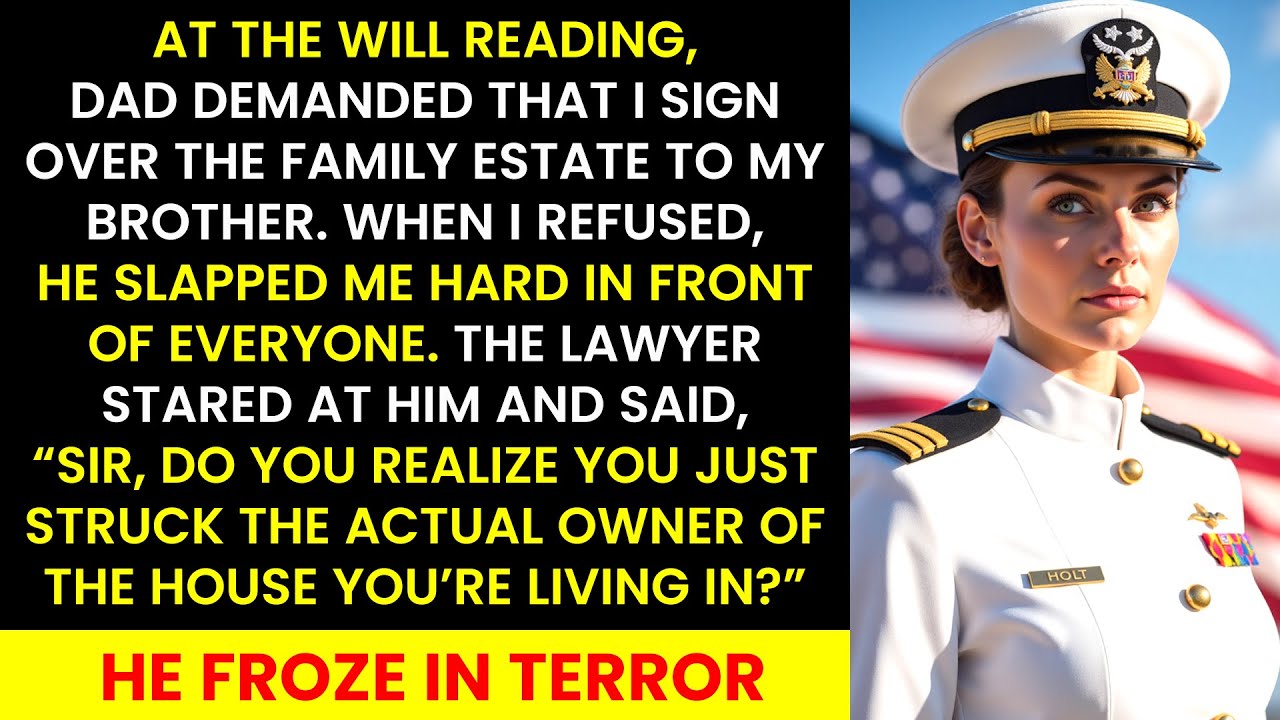
My father, Robert Holt, sat at the head of the mahogany table, already drunk at two in the afternoon. Beside him, my brother Eric scrolled through his phone, bored, as if reading our late grandfather’s will was an inconvenience to his unemployed schedule. Arthur Callahan, my grandfather’s attorney and oldest friend, cleared his throat. “Shall we begin?
”
“Cut the crap, Arthur,” my father interrupted, slamming his hand on the table. “We all know the drill. Dad left the house to me. Let’s just sign the papers so I can get back to work.
”
Work. My father hadn’t worked a real day in five years. He slid a crumpled piece of notebook paper toward me. A handwritten note stating I voluntarily relinquished any and all claims to the estate in favor of Eric Holt.
“Sign this, Maria,” he ordered. “I’m not signing that,” I said, my voice calm and trained. My father’s face twisted. He lunged across the corner of the table.
Before I could register the motion, his open palm connected hard with the side of my face. The sound echoed off the wood paneling like a gunshot. I tasted copper as my lip split against my teeth. Gasps filled the room.
Someone half rose from their chair but didn’t move to help. Eric actually laughed. I straightened my chair. I didn’t touch my face.
I didn’t cry. My father raised his hand again, his face purple with rage. Thump. A massive legal binder hit the table like a gavel.
Arthur Callahan was standing now. “Sit down, Robert! ” Arthur said. “I suggest you keep your hands to yourself, because you just struck the actual owner of the house you’re living in.
”
The silence was suffocating. This wasn’t an isolated incident. That slap was the punctuation mark on a sentence written since I was five years old. In the Holt household, there were two roles.
Eric was the golden child, the fragile prince who needed protection. And I was the insurance policy, the low-maintenance backup plan. I remembered my sweet sixteen. I came home from swim practice to a dark house and a store-bought cake with a clearance sticker on it.
My father was in the living room watching the Patriots game. He didn’t look up when I walked in. He just yelled at me to keep it down. When Eric turned sixteen, despite a failing GPA, my father threw him a catered backyard BBQ and bought him a new MacBook.
Throughout high school, I woke at 4:30 every morning to train. I broke the state record for the 100-meter butterfly. I stood on the podium, the gold medal heavy around my neck, searching the bleachers for my father. The seat was empty.
He was at the principal’s office because Eric had been caught smoking pot under the football bleachers for the third time. That night, my father screamed at the school district on the phone. Then he drained his 401k and took out a second loan to send Eric to a private boarding school that cost thirty thousand dollars a year. I told my mother I’d won the gold medal.
She kissed my forehead and said they were proud of me, but she told me not to make a fuss because my father was stressed. “You’re strong, Maria. You’ve always been the strong one. Eric is weaker.
He needs us more. ”
Because I was competent, I was punished. Because Eric was a mess, he was rewarded. The breaking point came the summer after graduation.
I’d been accepted to UConn with a partial scholarship, but I needed a co-signer for a small student loan. My father laughed in my face. His credit was tied up with Eric’s tuition, he said. I should figure it out.
Two days later, a brand-new jet ski appeared in the driveway. A graduation present for Eric. That was the day the little girl waiting on the bleachers died. The next morning, I walked into the Navy recruiting office in Norwalk and signed the papers before lunch.
Three months later, I left for boot camp with my entire life packed into two black garbage bags. As I dragged them toward my rusted Honda Civic, I caught my reflection. I looked like trash being taken to the curb. But when I slammed the trunk shut, I felt a cold, hard resolve settle in my chest.
I was never coming back. For five years, I built a life. I went from enlisted sailor to officer through sheer grit. I deployed across the Atlantic and the Mediterranean.
I paid off my student loans. I didn’t owe Robert Holt a single dime. Two weeks after I became a lieutenant, my father called. Eric had been pulled over for a DUI.
He needed five grand for bail and a lawyer. My father said he was a little tapped out and asked if I could wire the money. “No,” I said. “I don’t have five thousand dollars for Eric’s bail.
And even if I did, I wouldn’t give it to you. ”
“He’s your brother. He’s sitting in a cell. You selfish, cold-hearted—”
“He’s thirty-three years old, Dad.
Let him sit. ”
I hung up before he could finish the curse word. That moment was the first time I’d ever cut away the anchor that had been dragging me down for decades. Now, thirteen years after I left, I sat in that law office, staring at my father, my cheek throbbing, the metallic taste of blood still in my mouth.
Arthur Callahan opened the file and read my grandfather’s final letter aloud. “To my granddaughter, Maria. If you are hearing this, I am gone. I know your father has likely tried to bully you today.
I know your brother has likely expected a handout. I watched you leave for the Navy with nothing but two garbage bags. You are the only person in this bloodline who understands the value of a dollar and the weight of integrity. I didn’t leave the house to your father because he would sell it to pay for his mistakes.
I didn’t leave it to Eric because he has never earned a thing in his life. The house is yours, Maria. It has been yours since the day you left. Welcome home, kiddo.
”
My father’s mouth hung open. Arthur looked at him. “When you slapped Maria, you didn’t assault your daughter. You assaulted the landlord.
And I believe she has the right to evict you. ”
I walked out with a set of keys in my hand that felt heavier than a loaded pistol. I drove straight to 42 Oakwood Lane. The house looked like it was dying.
The paint was peeling, the shutters hung crooked, and the lawn was knee-high with a citation from the homeowners association slapped on the door. Inside, it smelled of stale beer and neglect. Eric’s domain was a fraternity house basement—pizza boxes stacked like towers, empty energy drink cans scattered across the floor. A laundry basket overflowed with designer clothes.
This was the life of a thirty-four-year-old man with no job, no prospects, and no shame. I went to my grandfather’s study. My father had taken it over. The mahogany desk was buried under mountains of unopened mail.
I started digging. The first layer was junk mail. The second layer was past-due notices for utilities. But at the bottom, I found a thick envelope from First National Bank.
Notice of default and intent to foreclose. Borrower: Robert Holt. Property: 42 Oakwood Lane. Outstanding balance: $845,000.
A cold wave of confusion washed over me. How could my father take out a home equity line of credit against a house that legally belonged to a trust? I scrambled through the papers until I found the loan application. Attached was a copy of a deed transfer—a deed signed by Walter Morgan.
Dated two years after my grandfather died. My breath hitched. My father had forged a dead man’s signature. He’d committed federal bank fraud to turn my grandfather’s legacy into a personal ATM.
I followed the money trail. $85,000 wired to BMW of Ridgefield. That was Eric’s M3. Cash withdrawals at Mohegan Sun Casino—five thousand, ten thousand, fifty thousand in a single weekend.
Monthly payments on an American Express platinum card, twelve thousand four hundred dollars, with Eric Holt listed as supplementary cardholder. They hadn’t just been mean to me. They were criminals. Parasites who hollowed out my family from the inside.
The front door slammed downstairs. My father’s voice roared from the foyer. He was coming up to confront me. I had less than two minutes.
I stayed calm. I aligned the papers in my hand. I checked my uniform in the window reflection. I wasn’t the scared teenager packing garbage bags anymore.
I was an officer about to confront a hostile threat. The door splintered. My father stood in the doorway, red-faced and sweaty. Eric peeked out from behind him.
“Who do you think you are? ” Dad snarled, stepping into the room. “You think that piece of paper Arthur read means anything? You’re going to sign that deed transfer, Maria.
Right now. Or so help me God, I will—”
“You’ll what? ” I interrupted, my voice dangerously low. “You’ll hit me again?
You’ll forge my signature like you forged Grandpa’s? ”
My father froze. Eric went pale. “I know everything,” I said, holding up the file.
“I know about the HELOC. I know about the $800,000. I know about the casino runs to Mohegan Sun. And I know you committed federal bank fraud to get it.
”
The color drained from my father’s face. He was a cornered animal. “Give me those papers, Maria. ”
“No.
”
He lunged at me, his hand raised to slap me again. My body moved before my brain processed the threat. Muscle memory drilled into me on the mats at Quantico. I intercepted his wrist, twisted, and slammed him chest-first onto the desk, right on top of the fraudulent loan documents.
He shrieked in pain. I leaned down, my mouth inches from his ear. “I am not a sixteen-year-old girl anymore, Robert. And I am not a punching bag.
If you ever try to touch me again, I won’t just hold you down. ”
I released him and shoved him backward. Eric found his courage. “You assaulted him!
I’m calling the cops! ”
“Go ahead, Eric. I’m sure they’d love to hear about the BMW you bought with a dead man’s money. ”
I threw the American Express statements at him.
They fluttered through the air like snow. “Bottle service. Dinners in New York. Weekends in the Hamptons.
Twelve thousand dollars a month. He stole Grandpa’s identity to pay for your delusions. ”
“Dad said it was an investment in my networking,” Eric stammered. “He stole it,” I said.
“And you’re a parasite. You sucked this family dry. You let your father commit felonies so you didn’t have to get a job at Starbucks. ”
I turned to my father.
“You aren’t the landlord. You aren’t the patriarch. You’re a fraud. ”
I pointed toward the door.
“Do you remember Grandpa’s favorite verse? Galatians 6:7. Do not be deceived. God is not mocked.
For whatever one sows, that will he also reap. You sowed neglect and abuse. You sowed lies and greed. Now you are reaping the harvest.
”
“Maria, please,” he whispered. “We have nowhere to go. ”
“That sounds like a you problem, not a me problem,” I said. “I am revoking your permission to occupy this property effective immediately.
I can have the sheriff here in ten minutes to remove trespassers. And while he’s here, I can hand him this file on bank fraud. Your choice. Leave on your own feet or leave in handcuffs.
”
The silence lasted five seconds. Then my father pushed himself off the bookshelf and walked out of the room, his shoulders slumped. A broken man. Eric grabbed his keys and muttered, “You’re crazy, Maria.
”
“Maybe,” I said. “But I’m crazy with a house, and you’re just a guest who overstayed his welcome. ”
But then something happened that I hadn’t expected. My father, Robert Holt, the man who had terrified me my entire childhood, collapsed onto the dusty floor and began to cry.
An ugly, heaving sob. He clutched his chest. “I can’t go to jail. I’m sixty-two years old.
They’ll kill me in there. Please. I’m your father. ”
I waited for an apology.
It never came. He was crying for himself. He wasn’t sorry he did it. He was sorry he got caught.
And then Eric turned on him. “You said you had it handled! You told me the trust was just a rumor. You let me buy that car.
You let me rack up the Amex. Now what? Now I’m supposed to go to jail too because of you? ”
“I paid your debts,” my father yelled back.
“You risked it because you’re a loser who couldn’t earn his own money,” Eric spat. “God, you’re pathetic. Look at you crying on the floor like a baby. ”
I stood there witnessing the golden child devouring the king.
My father had created a monster, and now that monster was feeding on its creator. Eric turned to me. “Maria, listen. I didn’t sign anything.
I didn’t know about the forgery. It was all him. You can’t report me. ”
“You spent the money, Eric,” I said quietly.
“Ignorance isn’t a defense when you’re driving a stolen BMW. ”
Eric snatched his keys and stormed out without looking back at his father. We heard the front door slam and tires screech. I looked at my father, slumped against the filing cabinet, abandoned by the son he worshipped.
I expected to feel triumph. Instead, I felt pity. Not the warm pity of compassion. The cold, distant pity you feel for a rabid animal that’s finally been put down.
And realizing he was pathetic stripped him of his power over me forever. I lowered the phone. I didn’t dial the FBI. Not yet.
“Get up, Robert,” I said. “We’re going to the kitchen. We need to talk about your surrender. ”
I visited my grandfather’s grave that evening.
I placed a quarter on his white marble headstone—a military tradition meaning I would have been there at his side if I could. I wrestled with a decision that felt heavier than the foreclosure notice. One phone call would send my father to federal prison. It would be justice.
It would be vengeance. It would be exactly what I wanted. But my grandfather had once told me, “Strength isn’t about how hard you can hit. It’s about how much you can lift.
”
I knew what I had to do. It wasn’t forgiveness. Not yet. It was discipline.
I drove back to the house. My father was sitting at the scratched kitchen table, looking small and deflated. I sat down opposite him and placed a single sheet of paper between us. “I’m not calling the FBI, Dad,” I said quietly.
His shoulders slumped. “Oh, thank God. Maria. Thank you.
I promise I’ll stop. ”
I raised a hand. “This isn’t a pardon. It’s a parole agreement.
You aren’t going to prison, but you’re under house arrest. My house. My rules. ”
“Item one,” I began.
“You’re selling the Ford F-150 tomorrow. You’ll use the proceeds to pay off the interest on the HELOC so the bank doesn’t take the house next week. ”
He nodded frantically. “Item two.
The master bedroom is no longer yours. You’re moving into the guest room. ”
He flinched but didn’t argue. “Item three.
You need a job. Walmart is hiring greeters. Home Depot needs stockers. Every paycheck will be garnished to pay back the equity you stole.
”
“But what will people say? ” he whispered. “They’ll say you’re an honest man trying to fix his mistakes. Or they can say you’re a felon in federal prison.
Pick one. ”
He lowered his head. “I’ll get a job. ”
“And finally, Eric,” I said.
“He’s banned from this property. If he shows up, I call the police for trespassing. ”
“He has nowhere to go, Maria. He’s sleeping in his car.
”
“He can’t survive out there because you never let him,” I said. “You crippled him. If I let him back in, he will just eat us alive until there’s nothing left. ”
My father picked up the pen.
His hand shook. He signed his name. “Thank you,” he whispered, not looking at me. “Don’t thank me,” I said, taking the paper.
“Make your bed tomorrow morning. That’s how you thank me. ”
Three months passed. It was Thanksgiving.
I stood on the front porch of 42 Oakwood Lane, holding a mug of hot apple cider. The house didn’t look like a foreclosure waiting to happen anymore. The peeling paint had been scraped. The lawn was raked clean.
It looked cared for. Inside, the house smelled like a home—roasting turkey, sage stuffing, pumpkin pie. And in the kitchen, standing over the oven, was my father. Robert Holt looked different.
The navy blazer was gone, likely sold at a consignment shop. He wore a simple flannel shirt and loose-fitting jeans. He had lost weight. He looked tired, but solid.
“Hey,” he said, pulling the twenty-pound bird out of the oven. “Check the temperature on this for me, will you? ”
“Sure, Dad. ”
“My back is killing me,” he groaned, but there was a strange note of pride in his voice.
“We had a double truck shipment at the store yesterday. Black Friday prep. ”
“Walmart keeps you busy. ”
“Yeah, well.
The manager said I might make shift lead next month. An extra dollar fifty an hour. ”
Three months ago, this man thought manual labor was beneath him. Now he was bragging about a potential promotion at Walmart.
We sat down to dinner. Simple plates. A bowl of mashed potatoes. Canned jellied cranberry sauce because that was the only kind my father liked.
He was sober for eighty-eight days. “Maria,” he said, putting the carving knife down. “I want to say grace. ”
We bowed our heads.
“Lord, thank you for this food. Thank you for this roof. ” He paused, swallowing hard. “And thank you for my daughter.
Thank you for giving her the strength to stop me when I couldn’t stop myself. I’m sorry, Maria. For everything. For the lost years.
For the fraud. For not being the father you deserved. ”
The silence that followed wasn’t heavy. It was peaceful.
“Thank you, Dad,” I whispered. “I forgive you. ”
And I meant it. I didn’t forget.
But I forgave. Just then, headlights swept across the dining room window. A battered ten-year-old Toyota Corolla pulled into the driveway, dented bumper and a muffler hanging low. Eric stepped out.
He wore a gray mechanic’s jumpsuit with a patch that said “Mike’s Auto Body. ” His hands were stained with grease. He reached into the back seat and pulled out a white bakery box. “He came,” my father said, his voice trembling.
“I told him he could come for dinner,” I said. “On one condition. He had to drive a car he paid for, wearing clothes he bought, bringing food he purchased with his own money. ”
Eric walked up the path.
He knocked. I opened the door. “Hey, Maria,” he said, holding up the box. “I brought an apple pie.
It’s not homemade, but I bought it with my paycheck. ”
“Apple pie is perfect,” I said, stepping aside. “Come in, Eric. Dinner is ready.
”
He walked in, the smell of grease and hard work mixing with the smell of turkey. He saw my father in the hallway. They looked at each other, two men who had lost their fake kingdom but found their real footing. “Hey, Dad,” Eric said softly.
“I like the flannel. ”
“Hey, son. ” My father smiled, a genuine, crinkly-eyed smile. “I like the jumpsuit.
Suits you. ”
As they walked into the dining room together, talking about Eric’s new job fixing transmissions, a warmth spread through my chest that had nothing to do with heating. I walked to the mantle above the fireplace. There was the framed photo of my grandfather standing next to his Mustang.
“We made it, Grandpa,” I whispered. “We finally cleaned the house. ”
The real inheritance wasn’t the house or the money. It was this moment.
It was the ability to take a broken, toxic mess and forge it into something real. It was the lesson that love isn’t about enabling people to be weak. It’s about challenging them to be strong. Looking back, I realize the hardest battles aren’t fought on the ocean.
They’re fought at our own kitchen tables. We’re often taught that loving family means saying yes to every request. But true love is brave enough to say no. By cutting off the lifeline, I didn’t hurt my father and brother.
I gave them back their dignity. The greatest inheritance isn’t the check you leave behind. It’s the character you build in the people you love.