The Red Rock Hall glittered with crystal chandeliers and the weight of medals on tuxedos. I sat in the third row, trying to disappear inside my plain class A uniform, invisible among the heroes being honored. In the VIP row ahead, my father, Colonel Henry Holmes, clapped the shoulder of the young major beside him. His voice boomed with regret.
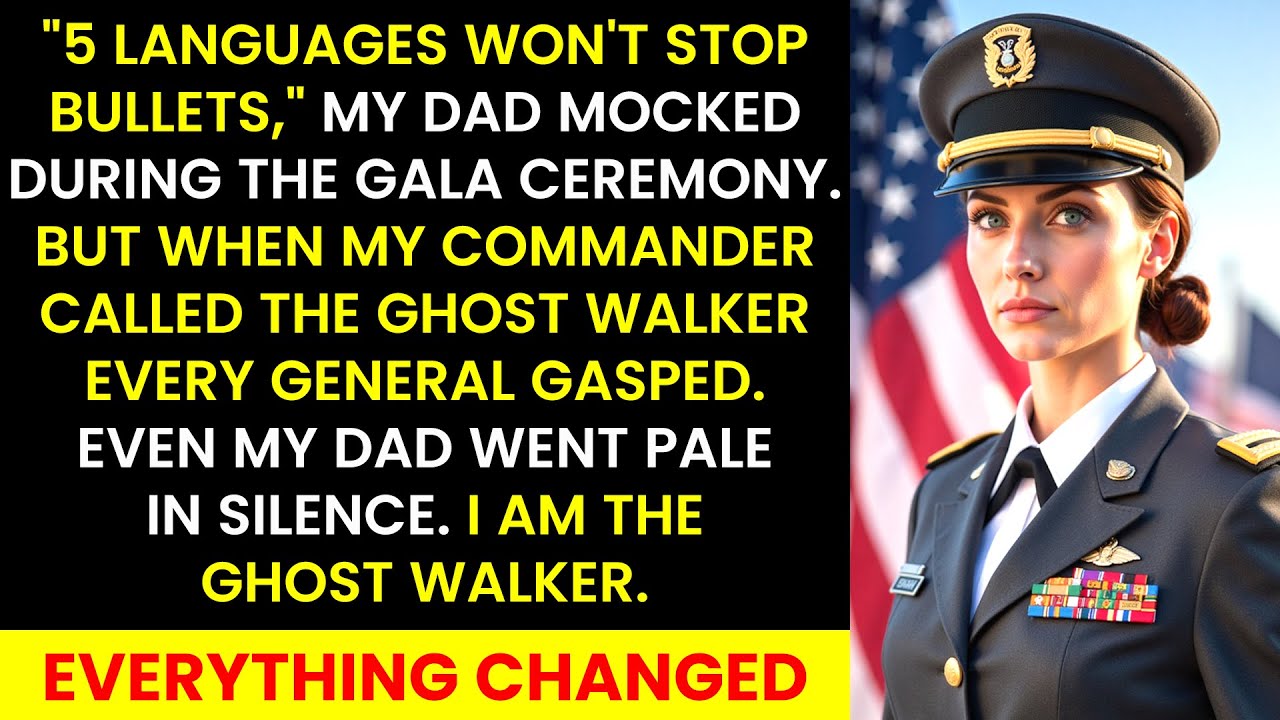
“Looking at you, I realize God is truly unfair. He gave me no heir. The Holmes line effectively died in the cradle 36 years ago. ”
Thirty-six years ago was the day I was born.
The words hit me like boiling water, ringing in my ears. He had just publicly declared me dead to the family honor while I sat less than three feet away. I gripped the classified file in my hand until my knuckles turned white. My father had no idea that the dead body he mentioned was Captain Kira Holmes, codename Ghost Walker, the asset the entire Pentagon was desperate for.
And he certainly didn’t know that his own arrogant signature had almost killed me. The ceremony ended. The crowd migrated into the VIP reception room, where the air grew heavy with expensive bourbon and thick cigar smoke, the smell of power in Washington. I stood against a cold marble pillar, clutching a glass of ice water, the only thing keeping me grounded, the only thing stopping me from screaming.
My father was the center of the universe tonight. He laughed that booming command voice that used to signal safety when I was a child. Now it just sounded like a gavel banging down a sentence. Aging generals and slick politicians toasted his legacy.
Then the young major from the front row stepped up. Major Mason, tall and square-jawed, the perfect poster boy for army recruitment. My father threw his arm around the boy’s shoulders with a warmth and physical affection I had not felt in thirty-six years. “Everyone, this is Mason,” my father projected, silencing the circle.
“If I could clone a warrior, he would look exactly like this. He just got back from Kandahar with a silver star. ”
The crowd murmured in admiration. Mason smiled, a humble, practiced expression.
“Thank you, Colonel. I only made it because of your mentorship. ”
I stood three steps away, watching. A silver star.
I took a sip of water to wash down the bile. I was the one monitoring the drone feeds that night. I was the voice in Mason’s ear. I flagged the ambush point so his team could flank the enemy and earn that medal.
But I couldn’t say a word. Ghost walkers don’t get medals. We get shadows. A woman in a silk evening gown, a senator’s wife, drifted toward me.
Her eyes scanned my uniform. My chest was bare. No ribbons. No medals.
To a civilian, a soldier without medals looks like a blank slate—or worse. “Excuse me, miss,” she said, her voice polite and absolutely devastating. “Could you be a dear and fetch me some cocktail napkins? The bar over there is out.
”
She thought I was the help. Blood rushed to my face. My mouth opened. I wanted to say, “I am Captain Holmes.
I speak five languages, and I can kill a man with a ballpoint pen. ” But before I could speak, my father turned. He had heard everything. This was the moment a father steps in.
Instead, he glanced at me with hard, unrecognizing eyes, the way one looks at a stain on a carpet. He turned his charming smile back to the woman. “My apologies, madam,” he said smoothly. “The staff here is a bit slow tonight.
Let me call the manager for you. ”
The air left my lungs. He would rather let me be humiliated, reduced to a servant, than admit the failure standing there was his own flesh and blood. I set my glass down on a passing tray and walked away, focusing on keeping my steps rhythmic.
Don’t run. Soldiers don’t run. In the ladies’ room, I locked the stall door. My breath came in jagged gasps.
I gripped the sink, staring at my reflection. The mirror showed a thirty-six-year-old woman with sharp features and dangerous eyes. Behind them was a child screaming for her dad to look at her. I thought of my mother.
I thought of the worn leather Bible she left on my nightstand before she died. Psalm 27:10. I whispered it like a tactical command: “When my father and my mother forsake me, then the Lord will take me up. ” I repeated it until the shaking stopped.
I would not cry. Tears were liquid weakness to him. The shock of the freezing water I splashed on my face took me back to a different night, twenty-four years ago, when I was twelve, in a house in Virginia that didn’t look like the other houses on the block. No tricycles in the driveway, no sound of baseball games.
Our home was not a sanctuary. It was a forward operating base. Shoes were aligned with a ruler, heels touching the wall. My bed had to be made so tight you could bounce a quarter off the sheets.
My father came home like a commanding officer conducting surprise barracks inspection. Dinner at 1800 hours sharp was always consumed in suffocating silence, broken only by the scrape of silverware. I remembered one night my spoon clattered against the bowl. He didn’t yell.
He just stopped chewing and looked at me with steel gray eyes. “Lack of motor control is a sign of a weak mind, Kira. Focus. ”
Love was never something you were born with.
It was a medal, a commendation, something you had to bleed for. And just like a medal, it could be revoked at any moment. But I had one gift: languages. I could mimic accents.
I spent hours on the shortwave radio, teaching myself Arabic and Farsi. One afternoon, I got my French essay back with a big red A+ circled at the top. I ran into my father’s study without knocking. He was cleaning his Colt 1911, the smell of gun oil thick in the air.
“Look, Dad,” I said, holding out the paper. “I got the highest grade in the class. ”
He didn’t look up. “French,” he scoffed.
“The language of those who surrender. ” He flicked his silver lighter and held the corner of my perfect essay to the flame. I stood frozen, watching my hard work curl into black ash on his pristine carpet. “Learn to shoot, Kira,” he said, blowing out the lighter.
“Words don’t stop bullets. ”
That was the day I stopped trying to impress him with who I was and started trying to become who he wanted. Six years later, at eighteen, I applied to West Point. It was his cathedral, his Holy Land.
I thought if I wore the gray uniform, he would have to see me. When the acceptance letter arrived, I placed it on the dinner table next to his steak. He read it twice. He dropped it back down.
“Did they lower the admission standards again? ” he asked, chewing slowly. “Or do they just need more people to handle clerical work? ”
That night it rained hard.
I packed my duffel bag. My father sat in the living room watching CNN. He knew I was leaving. He didn’t turn his head.
I stood on the porch, rain soaking my clothes, tears mixing with the water. I wanted to run back in and beg him to love me. But something inside me snapped. “I will not come back to this house,” I hissed into the storm.
“Not until I force you to stand at attention and salute me. Not because I am your daughter, but because I am better than you. ”
I turned my back on that house and walked into the darkness. That eighteen-year-old girl died in the rain that night.
The Ghost Walker was born. Two weeks before the humiliating night at the Red Rock Hall, I was in a place where medals didn’t matter, on the outskirts of Hama, Syria. The temperature was pushing 104 degrees. Inside my Stryker armored vehicle, the air conditioning had died three days ago, leaving me in a metal box filled with the hum of servers and the smell of ozone and three-day-old sweat.
My job was to listen. I sat hunched over glowing monitors, scanning every electronic signal within fifty miles. My mission was to shield Bravo team, a special forces unit moving to raid a suspected insurgent safe house. Sergeant Keller, a Texas native with a thick drawl and a wallet full of pictures of his five-year-old daughter Emily, commanded the team.
“Bravo One to Ghost. Give me a sitrep. ”
“The perimeter looks clear,” I replied, my eyes darting across the data. “No cell traffic, no radio chatter.
”
“Copy that,” Keller said. “Moving to breach the north entrance. ”
But something made me pause. There was a gap, a silence in the frequency range that shouldn’t be there.
Ambient noise had vanished in a specific ten-block radius. Insurgents don’t go that quiet unless they are waiting. “Stop! ” I screamed into the microphone.
“Bravo One, hold position. Do not breach. Passive triggers at the north door. They’re waiting for you.
”
One second of terrifying silence. Then, “Copy. Team, peel back. Go to the east wall.
”
The GPS dots scrambled away. Three seconds later, the north entrance of the safe house disintegrated in a massive fireball. If they had walked through that door, Keller and five other men would have been nothing but pink mist. “Holy hell,” Keller breathed.
“Ghost, you just saved my ass again. ”
I allowed myself a small smile. This was the difference between me and my father. He used soldiers like poker chips to win accolades.
I used my brain to make sure those chips got put back in the box at the end of the night. I didn’t need a medal. I just needed Keller to go home to Texas. But my smile vanished a minute later.
A red alert box flashed on my screen. Someone was walking through our firewall like they had the keys to the front door. A distorted, digitized voice cut through my headphones, broadcasting on the top-secret frequency that only I and the Pentagon could access. “Target identified.
Kira Holmes. ”
My blood froze. Not Ghost Walker. Not asset Alpha.
My birth name, buried under layers of clearance so deep even God would need a password. It was echoing across the Syrian desert. Before I could trace the signal, my threat warning system started screaming. Missile launch detected.
A laser-guided anti-tank missile had been fired from a ridge two miles away. The red crosshairs were locked directly on my Stryker. Someone had sold me out. They didn’t just want to stop the signal.
They wanted to erase me. The missile impacted less than ten meters away. The shockwave threw me against the steel hull. My head cracked against a support strut.
Warm liquid trickled down my face. Blood. I scrambled to my hands and knees through the acrid dust, shouting status reports. Through the haze, I saw the rear ramp drop open.
Sergeant Keller hadn’t made it to cover. He had turned back to pull me out. He was on the dirt, thrashing. A piece of shrapnel the size of a dinner plate had torn through his vest and embedded in his neck.
Bright arterial blood sprayed in rhythmic jets, painting the desert sand crimson. “Keller! ” I screamed, sliding on the blood-slicked floor. I jammed my hands directly into the wound, pressing down with everything I had.
“Stay with me. Think about Emily. She’s waiting for you in Texas. You are not dying in this dirt.
”
The medevac birds came. But I was ripped away from Keller by military police, slapped with plastic zip ties, and thrown into a transport. The accusation hit me harder than the missile. “You sold us out, didn’t you?
”
I watched the medical helicopter carry the only friend I had away. I didn’t get to ride with him. At Incirlik Air Base in Turkey, they took my rank patch. They yanked my dog tags off my neck.
I felt stripped of my name, my identity. A tall, balding investigator threw a thick file on the table. “Captain Kira Holmes,” he said. “You are facing charges of treason, espionage, and aiding the enemy.
If Sergeant Keller dies on the operating table, we’re adding manslaughter. ”
After forty-eight hours in a gray holding cell, they slid an old landline phone across the table. “You get one call. ”
I didn’t call a lawyer.
Muscle memory took over. I dialed the house in Virginia. He answered. “Dad, it’s me.
They arrested me. They’re saying I’m a spy. I didn’t do it. Someone hacked the system.
Please, Dad. ”
The silence lasted five seconds. Longer than the entire mortar attack. “The morning papers are already running headlines about a leak in a ghost unit,” he said.
“Is that you? ”
“Dad, I was set up. I swear on my honor. ”
“Honor?
” His voice rose to a shout. “You dare use that word? I warned you. I told you that intelligence work was garbage.
Now you’ve dragged the family name through the mud. ”
“Dad, I could go to prison for life. ”
“Then go to prison like a man,” he roared. “Do not drag me into your mess.
Next week I’m receiving the lifetime achievement award. I will not let a traitorous daughter destroy everything I built. ”
“Dad—”
“Do not call this number again until you have cleared that name. Or better yet, don’t call at all.
I don’t have a daughter who is a criminal. ”
Click. The dial tone signaled the end of my world. He didn’t ask if I was alive.
He didn’t ask about the blood on my face. He chose a plastic trophy over his own child. I collapsed onto the cold concrete floor and curled into a ball. I wanted to die right there.
But in the darkness, I saw Keller’s face. He had run back into the fire for me. He was fighting for his life because of a lie with my name on it. If I gave up now, the person who did this gets away with it.
The little girl who dialed that phone number was gone. She died the moment that phone clicked. “Fine, Colonel,” I whispered to the empty room. “You won’t help me.
I will save myself. ”
A month later, I was out on bail, suspended and reassigned to the Pentagon basement—the data graveyard. My new mission was digitizing logistics reports from the 1990s. Mind-numbing, soul-crushing work.
The brass assumed they had declawed me. They forgot that to do data entry, I needed a terminal. And that terminal was hardwired into the Department of Defense’s central nervous system. They thought they were burying me.
They had just handed the thief the keys to the vault. For three weeks, I played the part of the broken, obedient secretary. Then came Tuesday. My supervisor left for a latte.
The moment the door clicked shut, I pulled up a command line interface. I searched for a specific timestamp: three minutes before the missile hit my Stryker. There it was. A query had been sent to the personnel database, requesting my real-time GPS coordinates.
It didn’t come from Russia or Iran. It came from inside the house. It bypassed standard security protocols entirely, walking through a side entrance left wide open. I recognized the code structure.
It was a legacy software protocol called Horizon Echo, installed five years ago, notorious for being buggy and bloated. It allowed remote access without two-factor authentication if you had the administrative master key. The enemy hadn’t defeated our encryption. They had simply turned the doorknob of a door someone forgot to lock.
I pulled up the procurement contract. Scrolled past the legal jargon to the signature page. The date was May 12th, five years ago. The approving officer’s signature was sharp, slanted, and arrogant.
The same signature that had signed my report cards. Colonel Henry Holmes. My father. He wasn’t the spy.
But he was the one who bought the software. He didn’t pull the trigger, but he loaded the gun, took the safety off, and left it on the table for the enemy to pick up. His negligence had killed Sergeant Keller. His arrogance had put a target on my back.
I drilled into the metadata. The contract was signed at the Greenbrier, a luxury resort in West Virginia, where the Washington elite go to play golf and make handshake deals. The time: 2:00 PM on May 12th. My 30th birthday.
I remembered that day vividly. I sat by my phone all evening, waiting for one call. He never called. Now I knew why.
At the exact moment I was blowing out a candle on a lonely cupcake, my father was signing a $50 million contract, too busy with the CEO of the contractor to remember his daughter existed. I found an archived email from his Blackberry to the CEO. “Approved. Just get it installed, Bob.
And don’t bother me with that tech mumbo jumbo in the appendix. I trust you. ”
Tech mumbo jumbo. He called the encryption protocols that keep soldiers alive mumbo jumbo.
I printed the contract and the email. Three sheets of paper. They had the weight of a guillotine blade. If I filed this report, Colonel Henry Holmes was finished.
His award, his pension, his precious legacy, pulverized into dust. He had abandoned me in a Turkish prison, ready to let me rot for treason to keep his reputation spotless. “You drilled the honor code into me until I could recite it in my sleep,” I whispered. “‘A cadet will not lie, cheat, steal, or tolerate those who do.
‘ Well, Colonel, I am not going to tolerate you anymore. ”
I didn’t file under my own name. I drafted an eight-page report. No emotion, just raw data: the intrusion logs, the vulnerability analysis, the chain of custody, the contract signed at the Greenbrier, the email dismissing security protocols.
I signed it “A. Marsh. ”
My finger hovered over the enter key. Once I did this, there was no going back.
I thought of Keller’s daughter in Texas. She deserved to know why her daddy almost didn’t come home. I pressed send. For forty-eight hours, nothing happened.
No sirens, no agents. But the atmosphere shifted. Officers glanced at me in the corridors and quickly looked away. The building knew.
A storm was forming, and I was standing in the eye of it. Then late Friday afternoon, a crisp uniformed officer appeared at my cubicle. “Captain Holmes. General Anders requests your presence at the Red Rock Hall tonight.
1900 hours. ”
Tonight was the gala. The night my father received his lifetime achievement award. I went back to my cramped apartment.
My bank accounts were frozen. I had twelve dollars and half a jar of peanut butter. I pulled my class A uniform out of the closet, smelling of mothballs, and ironed it until the creases were sharp enough to cut skin. I put on the jacket.
It fit perfectly. I didn’t put on my ribbons. No decorations. I wanted to walk into that hall naked, stripped of everything except my name and my rank.
Just a soldier. I took a cab to the Red Rock Hall with my last cash. Through the heavy oak doors, I heard the string quartet playing Mozart, the rumble of polite laughter, the clinking of crystal glasses. It was my father’s world, a world where a signature on a golf course meant more than a soldier’s life in the desert.
The last time I was here, I was a victim, a daughter cowering in her chair. Not tonight. I squared my shoulders and pushed the doors open. I walked down the central aisle and sat in the third row, the exact same spot.
On stage, my father stood at the podium, basking in the golden glow, waiting for General Anders to pin the Lifetime Achievement Award on his lapel. Then his eyes flicked down. He saw me. The smile vanished.
He made a sharp motion with his head. Get out. General Anders stepped to the microphone. The room went quiet.
“Ladies and gentlemen,” Anders said, his voice grave. “We are here tonight to honor a legacy, but a legacy is not built on toasts or medals. It is protected by truth. ”
My father frowned.
“Two weeks ago,” Anders continued, “we almost lost an entire special forces team and a critical intelligence network in Syria. Not because of enemy action, but because of a systemic failure here at home. Negligence. ”
A murmur rippled through the crowd.
My father stiffened. “But fortunately,” Anders looked directly at him, “we have an officer brave enough to find that flaw, even when it meant standing alone against the entire system. A soldier who operates in the shadows, who asks for no credit. I would like to invite Captain Kira Holmes, codenamed Ghost Walker, to the stage.
”
Silence. Then a collective gasp. I stood up and stepped into the aisle. Click, click, click.
My heels echoed like gunshots. Every face turned toward me, seeing my bare chest, my lack of ribbons, and then the determination carved into my face. But I only saw one face. As I climbed the stairs, I watched the color drain from his.
He looked at me with horror and bewilderment. He didn’t understand why I was the hero. General Anders handed me a folder. On the projection screen behind us, a slide appeared: “Horizon Echo.
”
“Captain,” Anders said, handing me the microphone. “This is the software vulnerability you identified. ”
I took the microphone. My hand didn’t shake.
I looked at my father. I saw the moment the memory hit him. The golf course. The whiskey.
The casual signature on my 30th birthday. He knew. For the first time in thirty-six years, the arrogance was gone. In his place was a terrified old man who realized he had almost killed his own daughter.
I could say it. I could strip him of everything right here on live television. The room waited. My father held his breath, his eyes pleading.
But I looked at him, really looked at him, and I realized something. Breaking him wouldn’t bring Keller’s health back. And I didn’t need to destroy him to prove I was better. “The report is filed, General,” I said into the microphone, my voice calm and clear.
“The vulnerability has been patched. I was just doing my duty to protect my team. ”
I didn’t expose him. The truth was already screaming in his head louder than any accusation I could make.
I handed the microphone back and turned to face him. I snapped my heels together and looked him dead in the eye. Slowly, painfully, his right hand began to rise. It wasn’t the crisp salute of a commanding officer.
It was shaky, his fingers quivering against his temple. A salute of submission, of apology, of absolute respect from a subordinate to a superior. I held his gaze. Then I raised my hand, sharp and precise, and returned the salute.
In that moment, the war between us ended. I hadn’t just won the battle. I had won the peace. And as I lowered my hand, I was finally free.
The fallout came fast and quiet. The next morning, a short press release from the Department of Defense announced that Colonel Henry Holmes was voluntarily returning the Lifetime Achievement Award and resigning due to declining health. Health reasons. The oldest euphemism in the Beltway playbook.
I knew exactly what he had done. By resigning without a fight, he had killed the story. He had protected my anonymity. It was the first time in his life he had put my safety above his ego.
“He took the hit for you, Holmes,” General Anders said. “He knew if this went to trial, your cover would be blown. ”
It was the most fatherly thing he had ever done. My rank was restored and elevated.
I walked out as Major Kira Holmes, assigned to a new task force. The silence from Virginia remained. Then one week later, I found a small brown package in my mailbox. No return address, but I recognized the sharp, slanted handwriting.
I carried it upstairs, hands trembling, and opened it. Inside was a small velvet box, worn at the edges. Sitting on the white satin cushion was a massive gold ring set with a dark polished stone. His West Point class ring, class of 1978.
I gasped. He wore it every single day. He told me once when I was ten, “I will be buried wearing this. ” Now it sat on my counter.
There was no note. No apology. Men of his generation didn’t write apology letters. They dealt in symbols.
Sending me this ring was louder than any scream. He was surrendering his sword. By giving me the one object that defined his identity as a soldier, he was admitting the truth he couldn’t speak: You are the better soldier. I slipped it onto my right thumb.
It was cold at first, but as I held it there, the metal began to warm. For thirty-six years, I had carried a burning ball of anger in my gut. Looking at that ring, I realized it had evaporated. He had given me everything he had left.
It was enough. I wasn’t angry anymore. I was just free. The next morning, I stood by the window of my new office at the Pentagon, watching the Potomac flow toward the ocean.
The heavy gold ring glinted in the sunlight. It wasn’t a shackle anymore. Just a piece of metal, a reminder of where I came from, not a definition of where I was going. The secure phone on my desk rang.
I turned from the window and picked up the receiver. “Major Holmes,” I said, my voice steady. “We have a situation in the Black Sea,” the voice said. “We need a ghost.
”
I smiled. I touched the ring on my thumb one last time. Then I let go. “I’m ready.
Send the data. “