The phone vibrated across the cold metal table at 5:00 in the morning, shattering the rhythm of my boot polish. The screen lit up with a name that hadn’t called me at this hour in ten years: Commander Arthur. That’s how I saved my grandfather’s number. My hand froze.
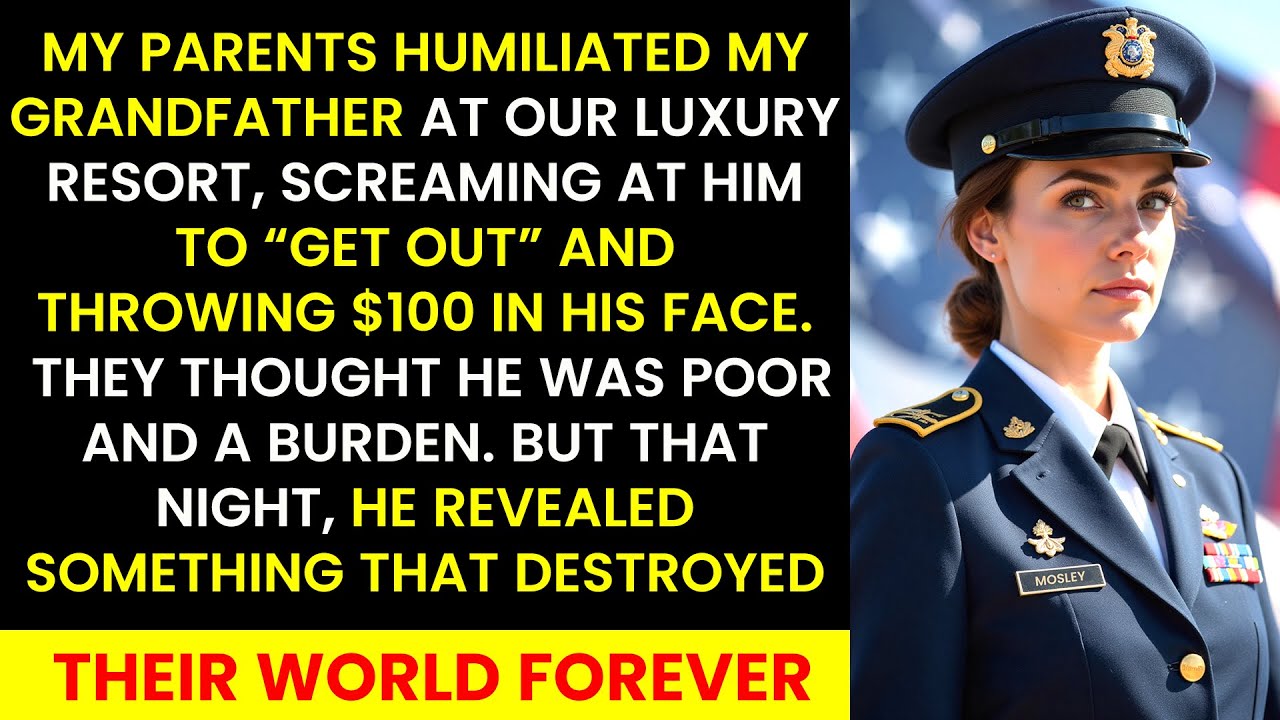
He never broke the rules of time. Had his weak heart finally given out? I answered, my voice steady out of habit. “Sergeant Jayda Mosley reporting.
”
But the voice on the other end wasn’t a dying wheeze. It was sharp, commanding—a tone I’d never heard from the pensioner living on social security. “Get home now. The whole family squad will be there.
Screening operation commences. ”
He hung up. Why would a poor old man, despised by his descendants for a lifetime, suddenly order an assembly? And what was waiting for me in Birmingham?
A funeral or a battlefield? I steered my battered Ford F-150 into the driveway of the two-story colonial house. The gravel crunched under my tires, a harsh, honest sound out of place amongst the silent fleet parked ahead: a black Mercedes, a silver BMW, and a cherry red Range Rover. Every single one was leased.
A showroom of debt polished to impress neighbors they didn’t even like. My mother, Nancy, opened the door before I cut the engine. She didn’t step out to hug me. She stood in the frame, scanning me from my dusty tactical boots to my olive drab T-shirt.
Her expression wasn’t warmth. It was the look you give a nasty stain on an expensive rug. “I told you to change, Jayda,” she hissed. “Aunt Patricia is here.
Can you please not let everyone think we have an unemployed daughter playing soldier? It’s embarrassing. ”
The words hit me like a sniper round, but I didn’t flinch. Ten years in the army teaches you to absorb impact without breaking formation.
“I am a sergeant, Mom. This is a uniform, not a pair of coveralls. ”
She rolled her eyes, already turning her back to inspect a smudge on the doorframe. “Just try not to embarrass us, and wipe those boots before you step on the hardwood.
”
Inside, the air was thick with Chanel No. 5, masking the smell of mediocrity. The living room looked like a catalog page—pristine, beige, and utterly soulless. My father, Robert, stood by the fireplace holding a glass of scotch he likely couldn’t afford, explaining some cryptocurrency scheme to my cousin Ethan.
“It’s all about yield farming, son,” Dad said, chest puffed. “Passive income. You leverage the debt to buy the coin. ”
Ethan, a twenty-something with bleach tips and zero ambition, nodded while admiring his sneakers.
“For sure, Uncle Rob. These Jordans were like $500 on resale. ”
I walked past them, my boots thudding softly on the rug. Dad gave me a curt nod, the kind you give a delivery driver you want to leave quickly.
No “How are you? ” No “Thank you for your service. ” I was a ghost in the house I grew up in. Then a distinct sound cut through the room: the sputtering wheeze of an engine that had seen better decades.
A weak car horn honked outside. Dad’s face twisted. He rushed to the window. “Oh god, the old man is here.
I hope he didn’t park that rust bucket next to my Merc. What will the neighbors think? ”
Grandpa Arthur stepped in, leaning heavily on a wooden cane, wearing a faded khaki jacket from Goodwill. The scent of Tiger Balm and old peppermint candy drifted in with him.
Aunt Patricia, on the plush sofa, visibly recoiled, waving her manicured hand in front of her nose. “Dad,” she whined. “Could you not have showered before coming? Honestly, it smells like a nursing home in here now.
”
Nobody moved. Robert, Nancy, Patricia, Ethan—they all stayed frozen, terrified that poverty might be contagious. I was the only one who moved. I crossed the room in three strides and took his elbow to support his weight.
His arm felt frail, like a bird’s wing. But when he looked at me, his eyes were sharp, devoid of the cloudiness I expected. “Welcome to the area of operations, Commander,” I whispered. He squeezed my hand.
“At ease, Sergeant. ”
We guided him to a stiff wooden chair in the corner, far away from the good furniture. Arthur cleared his throat, wet and rattling. “I don’t think I have much time left,” he said, his voice trembling with a frailty that seemed almost rehearsed.
“I wanted to use my entire life savings to invite the whole family to Hawaii. ”
The room went dead silent. Then the transformation happened—visceral, immediate, and absolutely disgusting. Dad’s sneer melted into a predatory grin.
Mom, who had just insulted his hygiene, sprinted to kneel beside him. “Oh, Dad,” Nancy gushed, grabbing his calloused hand. “You’re so generous. Hawaii?
Are we talking the Four Seasons? The one on Maui? ”
“Whatever is best,” Arthur murmured, looking at the floor. “I can look up flights right now,” Ethan shouted, phone already in hand.
“First class has lie-flat seats, Grandpa. ”
“We deserve a vacation,” Aunt Patricia added, suddenly forgetting the smell of Tiger Balm. “It’s been so stressful lately with the bills. ”
They swarmed him, talking over him about resorts, rental convertibles, and shopping sprees.
Not one asked about his health. Not one asked what he meant by “not much time. ” To them, he wasn’t a dying father. He was a broken ATM.
I leaned against the wall, watching the feeding frenzy. I looked at Grandpa Arthur. He wasn’t looking at them. He was looking at me over their heads.
His trembling had stopped. There was a cold, hard glint in his eye I’d never seen before—the look of a man who had just confirmed the enemy’s position. I realized then I wasn’t going on vacation. I was deploying.
Hartsfield-Jackson Atlanta International Airport was a chaotic hive of glass and steel. My family moved through the terminal like B-list celebrities, dragging an armada of Louis Vuitton suitcases, monogrammed and shiny, likely purchased on a maxed-out credit card. Trailing twenty feet behind them was Grandpa Arthur, struggling. His posture was crooked, his shoulder dipped low under the weight of an ancient olive drab canvas duffel bag.
Sweat beaded on his forehead; his breath came in shallow rasps. “Pick up the pace, old man,” my father shouted over his shoulder, not breaking stride. “We’re going to miss the flight because of you. ”
He didn’t offer to help.
Neither did Ethan, whose biceps were purely decorative. The blood rushed to my face. I stopped, jogged back to Arthur, and gently pried the strap from his trembling fingers. “I’ve got it, Commander,” I said softly.
The bag was heavy—suspiciously heavy for a week in Hawaii. Arthur looked at me, wiping his brow with a handkerchief. “Thank you, Sergeant. Just remember, Jayda, the heaviest backpack always holds the most valuable lesson.
”
At the TSA checkpoint, my family breezed through pre-check, which Arthur had paid for. Arthur and I were in the standard lane. He was slow. His arthritic fingers fumbled with his belt buckle.
Behind us, a businessman let out an impatient sigh. I knelt down to untie Arthur’s laces. As I did, I felt a shadow fall over us. Olivia and Ethan stood on the other side of the glass partition, holding up their iPhones.
Olivia was giggling, doing a mock sad face for the camera. I could practically see the caption: “POV: When you travel with a caveman. OMG, so embarrassing. #boomerproblems.
”
They were turning his physical pain into digital entertainment. I stood up slowly. I locked eyes with Olivia. I didn’t yell.
I just gave her the look I used on new recruits who flagged me with a loaded weapon. She flinched and lowered the phone, but it was too late. The story was already posted. When we finally got through the scanner, a TSA supervisor was waiting.
He looked at Arthur’s ID, then at Arthur, his eyes widening slightly. He opened his mouth as if to salute, but Arthur gave a microscopic shake of his head. The supervisor closed his mouth, nodded respectfully, and handed the ID back with two hands. “Have a safe flight, sir.
”
My family, busy checking their likes on TikTok, missed the entire exchange. At the boarding gate, the final humiliation was revealed. Robert stood with a fan of boarding passes. “Okay, listen up.
First class for me, Nancy, Patricia, Frank, and the kids. We need the legroom to rest up for the itinerary. ” He flicked two tickets toward me—they fluttered down like dead leaves. “These are for you and the old man.
Economy. Row 42. Way in the back. He’s small.
He doesn’t need the space. Plus, I saved $3,000 doing this. Smart investing, right? ”
Arthur had paid for every single ticket.
And they were shoving him into the cattle car. My fists clenched. I opened my mouth to tear Robert apart, but Arthur’s hand clamped onto my wrist, surprisingly strong. “Silence,” he ordered softly.
“Let them go. ”
We boarded last. To get to row 42, we had to walk through first class. I saw my mother sipping a mimosa, laughing.
My father was already reclined, an eye mask on his forehead. They didn’t even look up as Arthur shuffled past, his cane tapping rhythmically on the carpet. They acted as if we didn’t exist. Six hours later, we landed in Maui.
A stretch limousine idled at the curb, the driver holding a sign that said “Hahnott Family. ” My family shrieked with delight and piled in, fighting for the best seats. I guided Arthur to the curb. As I reached for the door handle, Uncle Frank blocked the way.
“Hey, bad news. The car is full. Too many bags, it’s going to be tight. ” He looked at Arthur, then at me.
“Jayda, you know how to use Uber, right? Just grab a cheap car and meet us at the hotel. ”
“Are you kidding me? ” I snapped.
“This is his car. He paid for it. ”
“And he would want us to be comfortable,” Frank said, and slammed the heavy door shut in my face. The tinted window rolled up.
I saw my mother inside, raising a toast. The limousine peeled away, leaving an 80-year-old man standing on hot asphalt in the blazing sun. My heart broke. Not for me, but for the sheer cruelty of it.
But Arthur wasn’t crying. He watched the white limousine fade into the distance. He pulled out a handkerchief and wiped his face. Then he smiled—a cold, calculating smile.
The smile of a tactician who had just lured the enemy into a kill box. “Note for the log,” Arthur whispered, his voice steady as steel. “Enemy formation has dispersed. Phase one is complete.
Prepare for phase two. ”
The lobby of the Four Seasons Resort was a cathedral of open-air luxury. My parents were screaming at the front desk manager, demanding an upgrade they hadn’t paid for. Finally victorious, my father turned to me and tossed a plastic key card through the air.
It hit my chest and fell to the floor. I had to bend down to pick it up. “Your grandfather’s room is on the first floor. Garden view.
We’re in the penthouse. Do not disturb us unless it’s an emergency. ”
In hotel speak, “garden view” is a polite euphemism. The reality was a damp, dark room at the very back of the property.
When I opened the curtains, there was no garden—just the concrete wall of the loading dock, a row of overflowing dumpsters, and the deafening hum of industrial air conditioning units. The room smelled of mildew. Arthur sat on the edge of the mattress, the springs creaking. He placed his cane between his knees and looked at the wall.
I felt a surge of hot shame, not for the room, but for the people whose diapers he had changed, whose tuition he had paid, treating him like luggage. “I’m sorry, Commander. I’ll go back up there. I’ll make them switch.
”
Arthur shook his head. “It’s fine, Sergeant. Compared to a sandbag bunker at Khe San in 1968, this is a palace. At least the roof doesn’t leak.
”
By the time we settled, my family had vanished. My mother and aunt were at the spa. My father and uncle were on the golf course. The cousins were shopping.
I checked my phone. Olivia had posted a selfie of the group, minus Arthur and me, raising cocktails by the infinity pool. Caption: “Family is everything. So blessed to be here.
#hawaiilife. ”
It was a lie wrapped in a filter. I found Arthur sitting alone on a bench at the far edge of the property, staring out at the Pacific. A couple walked past.
The woman pulled her cover-up tighter and whispered loudly, “Is that man homeless? How did he get onto the property? ”
I sat down next to him and gently took the glasses off his face, wiping away the salt spray with the hem of my T-shirt. We were two lonely islands drifting in a sea of shallow vanity.
At 1:00, Arthur’s stomach growled. I called my mother. “Mom, where is everyone eating? Grandpa is hungry.
”
“Oh, Jayda,” Nancy said, slurring slightly from day drinking. “We’re at the Seafood Bistro. Look, just get the old man a sandwich or something. ”
“He wants to eat with his family.
”
“It’s not a good idea. We’re ordering lobster thermidor. It’s messy. You know how his hands shake.
He drops food on his shirt. We don’t want him to embarrass us in front of the other guests. Just handle it. ”
The line went dead.
I wanted to march into that restaurant and flip the table. But I looked at Arthur, at his tired shoulders, and I knew a scene wasn’t what he needed. I bought two hot dogs wrapped in foil and two cans of soda. Total cost: $12.
We sat on a wooden bench facing the ocean. I unwrapped the hot dog. The bun was slightly stale, the mustard cheap yellow paste. Arthur took a bite, chewed slowly, and turned to me with a genuine crinkled smile.
“This is delicious. Thank you, Jayda. ”
That smile broke me. That night, the noise from the loading dock made sleep impossible.
I sat in a chair by the door, keeping watch. Around 2:00 AM, Arthur woke up. “Jayda. Why are you here?
You’re young. You should be out at the clubs with your cousins. Why are you suffering in this hole with a dying old man? ”
I stood and walked to his bedside.
“Because the army taught me a code, Commander. I will never leave a fallen comrade. And because you’re the only one who remembered my birthday last year. And the year before that.
”
Arthur went silent. Then I saw a single tear track its way through the deep wrinkles of his cheek. He brushed it away and looked up. In the dim light, his eyes were no longer the eyes of a victim.
“Get some sleep, Sergeant. Prepare your gear. Tomorrow, we launch the counterattack. ”
Le Pearl was the kind of restaurant that smelled of old money and silent judgment.
My family, however, had no concept of hushed. We sat at a large circular table in the dead center of the room, loud as a construction site. Robert snapped his fingers at the sommelier. “Bring us the Chateau Margot.
The $2,000 bottle. Put it on the corporate card. ”
In the corner sat Grandpa Arthur, wearing his best flannel shirt, faded from years of washing. He held the leather-bound menu close to his face, his hands trembling.
His eyesight was failing. Olivia snatched the menu out of his hands. “Oh, give it here. You wouldn’t know what escargot was if it bit you, Grandpa.
You’re used to what, canned beans? ” She turned to the waiter. “Just bring him the pumpkin soup. Pureed.
Like for a baby. ”
The whole table erupted in laughter. My mother covered her mouth with a napkin. I gripped my fork so hard the metal dug into my palm.
I held my breath. “Hold the line, Sergeant. Wait for the signal. ”
Halfway through the meal, Arthur stood up.
“Excuse me. Restroom. ” He grabbed his cane and shuffled away. The floor was polished marble.
As he navigated around a decorative display—a magnificent six-foot tower of champagne glasses—his bad knee buckled. He lurched forward, his cane slipped, and he fell hard, his shoulder slamming directly into the base of the glass pyramid. Crash! The sound was deafening.
Hundreds of crystal glasses shattered at once. Champagne exploded outward. Arthur lay sprawled on the wet marble amidst the shards. A jagged piece of glass sliced his forearm.
Bright red blood mixed with the golden champagne on the white floor. “Oh my god! ” my mother shrieked. But she didn’t rush to help.
She grabbed her menu and held it up to hide her face. “This is so humiliating. Don’t look at him. Everyone is staring at us.
”
“Useless old man,” my father hissed through clenched teeth. “He can’t even walk straight. ”
Not one of them moved. The maitre d’ ran over, his face pale.
“Monsieur, êtes-vous all right? ”
My father stood up. Not to help. He marched over to where Arthur lay, pulled out his wallet, ripped out a single $100 bill, crumpled it in his fist, and threw it at his own father.
The ball of paper hit Arthur in the chest and rolled into the wet mess. “Take that for the damage and get back to your room! ” Robert screamed. “You ruined our entire evening.
Why do you have to be such a burden? Why don’t you just die and save us all the trouble? ”
The air left the room. That was it.
The safety on my internal weapon clicked off. I stood up, kicked my heavy chair back so hard it fell over, marched through the puddle, glass crunching under my boots, and stepped between my father and my grandfather. I looked Robert straight in the eye. I didn’t see a father.
I saw a target. “You just violated the most basic rule of humanity. Your action was despicable. You are not worthy of the name Mosley.
”
Robert froze. His humiliation morphed into blind rage. “How dare you lecture me? ” He pulled his arm back and swung.
Smack! The slap caught me square on the cheekbone. My head snapped to the side. A sharp metallic taste flooded my mouth.
Blood from where my tooth cut my inner cheek. The room gasped. I stood perfectly still. With my training, I could have blocked that strike.
I could have ended him. But I didn’t. I took the hit like a soldier taking shrapnel for a civilian. I slowly turned my head back to face him.
I didn’t raise a hand. I looked at him with eyes that were absolute zero. I spat a mouthful of bloody saliva onto the floor next to his polished shoes. “Noted.
We are finished here. ”
I turned my back on him—the ultimate sign of dismissal—knelt down, ignoring the glass cutting into my knees, and helped the commander to his feet. We walked out of the restaurant, leaving Robert standing alone in the wreckage of his own ego. We crossed the lobby, blood dripping from Arthur’s arm onto the pristine marble.
Behind us, the heavy mahogany doors burst open. My family spilled out, screaming. “Get back here! You ungrateful little brat!
I will kick you out of the house, you hear me? You’re homeless as of tonight! And take that senile old fool with you! ”
They didn’t notice the atmosphere in the lobby had shifted.
As we moved toward the center of the room, the chatter at the front desk stopped. The bellhops stood at rigid attention. The concierge dropped the phone. A hush fell over the massive space—not the silence of emptiness, but the silence of respect.
A man in a black tailcoat with a gold name tag reading “General Manager” came sprinting across the floor, pale with panic. My father puffed out his chest, pointing an accusatory finger at Arthur. “Hey, you! Manager!
Get your security over here. Throw this old beggar out on the street. I want him gone. ”
The general manager ran right past my father as if he were invisible.
He skidded to a halt in front of Arthur. To my family’s absolute shock, he didn’t grab Arthur. He bowed. A deep, 90-degree bow of absolute subservience.
“Chairman Hanot! Sir, we—we did not know you were dining downstairs. Are you injured? Shall I call the paramedics?
”
“Chair… chairman? ” My mother stammered, the color draining from her face. Slowly, deliberately, Arthur reached out and removed my hand from his waist. He took a step forward.
As he did, a transformation occurred that made the hair on the back of my neck stand up. The hunched shoulders straightened. The trembling ceased. The frail, confused old man vanished.
In his place stood a lion. He rolled his neck, cracking the stiffness. He wiped the blood from his arm with a handkerchief, his movements precise and powerful. His eyes, previously cloudy, locked onto my father with the intensity of a laser sight.
“Robert. ” Arthur’s voice was no longer a wheeze. It was a deep baritone that commanded the entire room. “I thought this trip would heal this family.
I thought the ocean air might cure your greed. But I was wrong. I did not raise children, I raised hyenas. ”
Arthur snapped his fingers.
“Manager Henderson. ”
“Yes, Mr. Chairman. ”
“Show them where they are standing.
”
The manager hurried to a massive velvet curtain on the far wall—a feature my family had walked past a dozen times without noticing. He pulled the gold cord. The curtain swooshed upward, revealing a ten-foot oil painting. It depicted a younger Arthur Hanot, standing proudly in a military uniform, shaking hands with a president.
Behind him, a map of the United States with golden pins marking locations from New York to San Francisco. At the bottom, a brass plaque read: “Arthur Hanot, founder and chairman, Hanot Luxury Group. ”
My family stared at the painting. Then at the old man in the flannel shirt.
Then back at the painting. The realization hit them like a freight train. The man they had humiliated owned the floor they were standing on. Robert gasped, his mouth hanging open.
“You… you have money? You’re rich? ”
Arthur didn’t answer him. He turned to the manager.
“Manager Henderson, these people have been trespassing on my property. Effective immediately, their reservation is terminated. ”
“Wait! Dad!
” Nancy screamed, rushing forward. “Dad, wait! We didn’t know! It was a joke!
”
Arthur held up a hand. “The credit card I linked to your accounts? The one you used to buy those bags and that jewelry? It is locked, declined.
You will have to return every single item or you will face theft charges. ”
Panic erupted. Ethan dropped his phone. Olivia looked like she was going to be sick.
“And one more thing,” Arthur said, looking at the security team that had silently gathered. Four massive guards in dark suits stood ready. “Get them out of my sight. Remove them from my barracks.
”
“Dad, no! Please! ” Robert fell to his knees, grabbing at Arthur’s pant leg. “We have nowhere to go.
Our flights aren’t for three days. Dad! ”
Arthur stepped back, letting Robert grasp at empty air. The guards moved in, hoisting my father up by his armpits, taking my mother by the elbow.
My family was dragged across the marble floor, screaming, until the revolving doors spun and ejected them onto the humid street. Arthur watched them go. He didn’t smile. He just let out a long, heavy sigh.
“Bring the sergeant a medical kit for her face,” he said softly. “And bring me a bottle of the Chateau Margot. The real one. ”
Seventy-two hours later, we were back in Alabama.
Arthur insisted on returning to his small, weathering wooden house on the edge of town. But this time, the dynamic had shifted. It was a command post. Attorney Harlan, a man with a suit sharp as a razor blade, sat at the kitchen table.
Outside the chain-link fence, my family was huddled like wet rats, screaming, demanding to speak to Daddy. Arthur sat by the window, hidden by the blinds. “Read the draft, Harlan. Make sure the window is open just a crack.
”
Harlan began to read the preliminary will aloud, his voice projecting into the humid air. “I, Arthur Hanot, being of sound mind, hereby declare my intentions. To my granddaughter, Jayda Mosley, I bequeath this property and a yearly stipend of $1 million for her caretaker services. The remainder of my estate shall be liquidated and donated entirely to the Veterans of Foreign Wars and St.
Jude Children’s Research Hospital. To my children, I leave nothing. ”
The reaction from beyond the fence was instantaneous. “That little witch!
” my mother shrieked. “She brainwashed him! Do you hear me? She drugged him!
”
“Open this gate! ” my father roared. “That’s my money! That’s my inheritance!
”
They changed tactics. They deployed the weapon of the modern coward: social media. Olivia re-edited the videos she had filmed in Hawaii—the ones where she mocked Arthur. She applied a grainy gray filter, added sad piano music, cut out the parts where I helped him, and posted it to TikTok.
Caption: “The truth exposed. My cousin, Sergeant Jayda Mosley, is isolating my grandfather, manipulating his dementia to steal his fortune. She is dangerous. #justiceforgrandpa.
”
The internet swallowed the bait whole. Within four hours, the video had two million views. My personal information was doxxed. News vans parked on my lawn.
Someone threw eggs at the front door. Red paint spelled out “gold digger” across the driveway. Then came the call I feared most. “Sergeant Mosley,” my commanding officer barked.
“I have three reporters at the base gate asking why I employ a woman who abuses the elderly. CID is opening an inquiry. You are placed on administrative leave. ”
My career, my honor, my entire identity—stripped away by a twenty-second video clip edited by a teenager.
I sat on the floor of the living room, curtains drawn, holding my service pistol in my lap. I ejected the magazine, cleared the chamber, practiced disassembly over and over. The mechanical rhythm calmed my racing heart. I wanted to run outside, to scream the truth.
But Arthur put a hand on my shoulder. “Do not engage, Sergeant. Do not explain yourself to the enemy. Silence is the loudest noise you can make right now.
Let them scream. Let them exhaust their ammunition. ”
I put the gun back in its case. “Radio silence, understood.
”
I would not break. I would stay in this bunker, ignoring the eggs and the hate mail, and protect the commander until his final breath. Commander Arthur Hanot passed away on a Tuesday night as a severe thunderstorm rolled across the Alabama state line. I sat by his bed, holding his hand.
His breathing slowed to a shallow rasp. There were no dramatic last words. He simply squeezed my hand—a weak pressure from calloused fingers that had built an empire. “Jayda,” he whispered, barely audible over the thunder.
“You are my pride. ”
Then the grip loosened. The chest stopped rising. The commander was gone.
I did not cry. A soldier does not weep when she is still on duty. I pulled out his old service uniform—the one he loved, not the expensive suits of a chairman—and spent the next hour preparing him, buttoning the jacket with precision, smoothing the collar. I treated his body with the reverence of a national treasure.
The next morning, I typed a message into the family group chat: “Grandpa passed away last night. The funeral service will be held at 10:00 AM Thursday at St. Jude’s Chapel. Please come home to see him one last time.
”
Three minutes later, the replies came. My mother sent a selfie of herself holding a martini glass on a yacht in Miami. “The old man is finally dead. Good.
Do not expect me to come back to that depressing town. You have his $1 stipend. You handle it. ”
My father: “Just cremate him.
It’s cheaper and saves land. Don’t bother me with the details. ”
Olivia: “RIP. ” Followed by a smiley face emoji.
“Finally out of debt. ”
I let the phone slip from my fingers. They weren’t just ungrateful. They were inhuman.
Thursday morning arrived, gray and wet. St. Jude’s Chapel was a cavernous space designed to hold 200 mourners. At 10:00 sharp, the heavy oak doors closed.
The room was empty. No flowers, no cousins, no aunts, no uncles. Only me. I stood at the front of the aisle in my army dress blues, medals heavy on my chest.
I stood at the position of attention next to the casket draped in the American flag. The only sound was the rain drumming a relentless, lonely beat on the metal roof. The priest shortened the service. There was no need for a sermon about family values when the evidence of their failure echoed in the empty hall.
We moved to the cemetery. The rain had turned the Alabama red clay into slick mud. The casket had already been lowered. I picked up the shovel.
The handle was wet and slippery. I drove the blade into the pile of wet dirt and began to bury my grandfather myself. One shovel. For the father who raised them.
Two shovels. For the grandfather who paid their debts. Three shovels. For the man they left to die alone.
When the grave was filled, I dropped the shovel. I snapped my hand up in a sharp, crisp salute. I held it for a long count of three. “Mission accomplished, Commander.
You are relieved of duty. ”
I turned on my heel and walked away, my boots sinking into the mud. I didn’t look back. I left them buried in the past with the grandfather they didn’t deserve.
I was alone. But I felt a strange, steel-like strength hardening in my chest. Three weeks after the funeral, I received a summons from attorney Harlan. He was waiting for me on the 34th floor of the Wells Fargo Tower.
“Is this about the stipend? ” I asked. He smiled, a thin, enigmatic expression. “We will get to your mother in a moment.
First, we have to execute the final protocol. ”
He pressed a button. A large flat-screen monitor flickered to life, showing black-and-white security footage from St. Jude’s Chapel on the day of the funeral.
The pews were empty. In the center stood a single figure in Army dress blues saluting a flag-draped coffin. Me. “Arthur left a classified order,” Harlan explained.
“A conditional codicil. The instruction was simple: access the security feed of the funeral. Verify attendance. If and only if a blood relative stood by his grave was I authorized to open the red file.
”
He pulled out a thick folder bound in crimson leather. “The will I read at the house? That was a decoy. A psychological test to see if greed would outweigh loyalty.
Your family failed. ”
He opened the document. “I, Arthur Hanot, hereby declare: only the soldier who stands the watch when no one is looking deserves to hold the command. Therefore, I name Jayda Mosley as the sole and absolute beneficiary of the Hanot estate.
”
“Sole? ” I whispered. “Everything,” Harlan confirmed. He flipped through the asset inventory: fifty hotel properties across North America, the Le Pearl Resort in Maui, controlling interest in three commercial real estate conglomerates, a diversified portfolio of stocks and bonds.
“The total estimated value of the estate you now own is $4. 2 billion. ”
The room spun. I was a sergeant making $30,000 a year.
I clipped coupons to buy groceries. “And my family? ”
Harlan flipped to the last page. “This is the disinheritance clause.
Arthur dictated this himself. ” He read: “To my son Robert, my daughter Nancy, and their offspring: you chose to abandon me in life and in death. Therefore, you are legally severed from this family. You shall receive $0.
You are strangers to this estate. ”
Arthur hadn’t just given me money. He had given me a nuclear weapon. He knew they would skip the funeral to go on vacation.
He had let them dig their own graves. “What are your instructions, Ms. Mosley? ”
I looked out the window at the city below.
“Freeze everything. Cut off the stipend immediately. Send the eviction notices for any property they occupy that is owned by the trust. ” I stood up and smoothed my shirt.
“They wanted nothing to do with him. That is exactly what they are going to get. Nothing. ”
The press release hit the wires at 6:00 AM on a Monday.
By 7:00, it was the lead story on every financial news network: “Poverty-stricken soldier inherits $4 billion empire. ” My face was plastered across television screens from Times Square to Los Angeles. My family missed the morning news. They were too busy checking out of a five-star hotel in Miami.
Each card Robert swiped was declined. Then Nancy looked up at the lobby TV and heard the words “$4. 2 billion” and “disinherited. ” Her knees buckled.
She didn’t just faint for dramatic effect. Her body shut down under the weight of the money she had just lost. They drove back to Alabama like maniacs, breaking every speed limit across three state lines. They arrived at my gate just as the sun was rising.
I was drinking coffee on the porch. Somehow, I’d been expecting them. They stumbled out of the rental cars, disheveled and desperate. Robert threw himself onto the grass, arms up like a revivalist preacher.
“Jada! Jada, baby, Daddy is home! Oh, thank God you’re safe. I saw the news, honey.
I knew you were the special one. ”
Nancy pushed past him, mascara running in black streaks. “Jada, sweetheart, please, open the door. Mommy loves you.
I’m so sorry about what I said. It was the medication. ”
I set my coffee mug down. I didn’t have security guards.
I didn’t need one. I walked down the steps, stopping on the bottom stair, and looked down at them. I felt nothing. No anger, no sadness—just the cold, clinical detachment of a surgeon looking at a tumor.
“Who are you people looking for? ”
“We’re looking for our daughter,” Robert cried. “We’re looking for our family. ”
I shook my head slowly.
“My family died last Thursday at 10:00 AM at St. Jude’s Chapel. I waited for them. I stood by the casket and waited for just one of them to show up and hold my hand.
But nobody came. ”
“But we didn’t know,” Aunt Patricia shrieked. “We’re blood, Jada. You can’t turn your back on blood.
”
I laughed, a short, sharp sound devoid of humor. “Blood? You are not blood. You are cancer.
A malignant growth that attached itself to this family to feed off a good man until he died. And now I have surgically removed the tumor. ”
I held up my phone. “I am giving you three minutes to get off my private property.
If you’re still here at 7:15, the sheriff’s deputies idling just down the road will arrest every single one of you for criminal trespassing. ”
As if on cue, the wail of sirens began to rise in the distance. The color drained from Robert’s face. “You… you wouldn’t.
”
“Try me. ”
The tears stopped instantly. The love evaporated. “You bitch!
” Robert spat, scrambling to his feet. “You will rot in hell for this! ”
They scrambled back into their vehicles like cockroaches scattering when the lights turn on. Engine roared.
Gravel sprayed. They peeled out, fleeing before the law could catch them. I watched them go until the dust settled. Then I turned around, walked back up the stairs, picked up my coffee mug, and turned the lock on the front door.
Click. The sound of a vault closing. The sound of a chapter ending. The alarm clock buzzed at 5:00 AM.
I sat up, placed my feet on the hardwood floor, and took a deep breath. Old habits die hard, and the best ones don’t die at all. I was no longer on active duty, but the discipline remained. Everyone expected me to move.
When the wire transfer hit my account, real estate agents circled like sharks, showing brochures for mansions in Beverly Hills and private islands in the Caribbean. I threw them all in the trash. I stayed right here in Birmingham. I bought the land surrounding the cabin for privacy, renovated the structure, and installed a security system that would rival the Pentagon.
But the soul of the house remained. I kept Arthur’s old armchair by the window. I didn’t buy a yacht. Instead, I established the Arthur Hanot Foundation.
On the kitchen table, under the morning light, were the blueprints for our first project: the Barracks, a community of 500 high-quality tiny homes for homeless veterans. We were giving them what my family had denied Arthur—dignity, a roof overhead, and a community that wouldn’t leave them behind. I heard my parents had been forced to sell the colonial house. The bank foreclosed.
They were living in a two-bedroom apartment on the south side of town. Without Arthur’s secret credit cards, they turned on each other. The love they claimed was as leased as their BMWs. Once the payments stopped, the relationship was repossessed.
Olivia deleted her social media after the public backlash. Last I heard, she was working the morning shift at a diner off the interstate, forced to smile for a $2 tip. I finished my coffee and went to get dressed. In the full-length mirror, I saw a woman in a tailored black suit, sharp and professional.
The anger that had fueled me for so long was gone. The tension in my jaw had relaxed. The greatest inheritance Arthur left me wasn’t the $4 billion. It was the lesson of honor: character is what you do when the lights are off.
I drove to the cemetery. The late afternoon sun turned the Alabama red clay into deep, rich gold. The headstone was simple, as he requested: “Arthur Hanot, Commander, US Navy. Beloved father and grandfather.
” I knelt down in the grass. The air smelled of rain and honeysuckle. I placed a single white rose against the cold stone, then propped up my new business card: “Jayda Mosley, CEO, Hanot Industries. ”
“Report to Commander,” I whispered, my voice steady.
“The hostile elements have been neutralized. The squad has been purified. The legacy is secure. ”
A breeze rustled through the oak trees, shaking the leaves.
It felt like a hand resting on my shoulder. “Mission accomplished, Grandpa. You are relieved. ”
I stood up, brushed the grass from my knees, performed one final slow salute—not for the flag, but for the man.
Then I turned my back on the grave and walked toward the sunset. My family made a fatal calculation. They thought wealth was measured by the car you drive or the logo on your handbag. But Arthur taught me the ultimate truth: character is the only currency that doesn’t depreciate.
If you chase money at the expense of your soul, you are already bankrupt. But if you hold on to your honor, even when you are standing alone in the rain, that is a richness no one can ever take away. Be the person who stays when everyone else leaves.