I killed the engine of my Ford F-150, but I didn’t open the door. I just sat in the cab, the silence of the Colorado winter settling around me like a heavy blanket. I caught my reflection in the rearview mirror—tired eyes, faint lines of fatigue carved by a 20-hour flight from Syria. But there was a spark there, too.
A childish excitement. On the passenger seat sat a limited edition Lego Millennium Falcon set I’d spent a month tracking down for my nephew. Ten steps separated me from the front door. The smell of roasted turkey, the warmth I’d been hallucinating about for six months in the desert.
Then the phone in my breast pocket buzzed once. Dry, mechanical. I smiled, thinking it was Dad rushing me. He always hated cold food.
But the smile died the second the screen lit up. A text from Dad: “Paula, I think you shouldn’t come in tonight. Evan is here and your presence, your whole military success vibe, it’s going to make him feel insecure. Your mother and I want Evan to have a good night.
Please understand. Merry Christmas. ”
My phone slipped from my hand, hitting the rubber floor mat with a thud. The air in the cab seemed to vanish.
My chest constricted—a sharp, cold pain running down my spine that hurt worse than the shrapnel grazes I took last year outside Aleppo. I looked through the frosted windshield into the brightly lit living room. Dad was raising a glass of wine, the whiskey I’d wired the money for, toasting Evan. My brother, the 45-year-old man-child who had just completed his third rehab stint on my dime.
They were laughing. They were warm. They were happy because I wasn’t there. I looked down at the name tape embroidered on my chest: Pool.
The name I had spent my entire adult life trying to honor, protect, and fund. But right now, it felt heavy as lead. I wasn’t their daughter. I was a contingency plan, a walking ATM.
And worse, an obstacle to the fragile ego of their golden child. Why had I driven two hours through a blizzard to a place where I was considered surplus inventory? If this family wasn’t my base of operations, what exactly was I fighting for? I didn’t hit the gas immediately.
My eyes stayed glued to that window like I was running surveillance on a high-value target. Evan stood up, clapping Dad on the shoulder, laughing that wheezy laugh of his. And then I saw it. Evan was wearing a jacket—a sandstone duck canvas Carhartt, brand new, stiff, and brown.
My hands gripped the steering wheel so hard my knuckles turned bone-white. That was the jacket I had ordered from Germany, shipped specially for Dad’s birthday last month with a note: “So you stay warm when you go ice fishing. ” Dad hadn’t worn it. He’d thrown it to Evan.
To them, my love was transferable. My labor was community property to be redistributed to fatten up the failure they coddled. They took the jacket but rejected the giver. I restarted the truck.
The engine roared to life, sounding like a wounded animal. I didn’t knock. I didn’t leave the Legos. Tonight, Sergeant First Class Paula Pool was going AWOL from her own family.
Fifteen miles later, I pulled into a Waffle House off the interstate. The wind was howling, whipping snow across the asphalt. Inside, the place was empty except for a trucker asleep in the back booth. The speakers played a tinny, distorted version of “Silent Night.
” I ordered two eggs over easy and black coffee. The grease in the air clung to my skin—a stark contrast to the expensive roast turkey I knew they were carving back at the house. I pulled out my phone and opened my banking app. The balance was high.
Hazardous duty pay, imminent danger pay, tax-free combat zone exclusion. It adds up when you don’t have a life. But I scrolled down to the transaction history. It was a bleeding wound of outgoing funds.
Transfer to Frank Pool, $2,000. Payment, Evan’s Visa, $450. Utility company, $315. I had been living on MREs and sleeping in tents so they could live in comfort.
I was the scapegoat, the workhorse—the one they called when the roof leaked but ignored when the champagne was poured. I took a sip of the coffee. It was scalded and bitter. Perfect.
I remembered a quote from David Goggins, whose book got me through Ranger School when everyone said a woman couldn’t hack it: “You have to callous your mind. You have to build a layer of armor over your feelings so the pain can’t dictate your actions. ” I had calloused my body for the army. Now I had to callous my heart for my family.
I tapped the scheduled transfers tab. Monthly transfer to Dad: $2,000. Next transfer: January first. My finger hovered over the screen.
My heart hammered against my ribs—a conditioned response of guilt implanted in me since I was five. “Honor thy father,” he always quoted. But he forgot the part about fathers not provoking their children to wrath. I hit cancel.
“Are you sure? ” the app asked. Yes. Next: Evan’s car insurance, under my name because his credit score was sub-400.
Cancel policy. Next: the utilities for the house I wasn’t allowed to enter. Remove payment method. With every tap, a jolt of panic shot through me, followed immediately by a rush of oxygen.
It was the feeling of cutting away a parachute that wasn’t opening. I wasn’t taking revenge. Revenge is emotional. This was tactical.
I was simply ceasing to purchase love that was never for sale in the first place. “You okay, soldier? ”
I looked up. The waitress—a woman in her 60s with tired eyes and a name tag that read Barb—was refilling my mug.
She looked at my red eyes, then at the uniform. She didn’t ask stupid questions. She just poured the coffee. “I’m solid, ma’am,” I lied.
“Just regrouping. ”
“Well, coffee’s on the house for the troops. Merry Christmas, honey. ” She walked away.
A stranger at a Waffle House showed me more respect in thirty seconds than my father had in thirty years. I opened my laptop. If Colorado didn’t want me, I needed a new area of operations. I didn’t want a condo.
I didn’t want neighbors. I wanted a perimeter. I typed into the search bar: “Isolated property, northern Rockies, cash sale, immediate possession. ” A dozen listings popped up, but one caught my eye.
Montana. Forty acres of timber and rock backing up to national forest land. A derelict cabin that looked like it had been punched by a giant and was still standing. The name of the property made the hair on the back of my neck stand up: Pool Ridge.
A coincidence, obviously—Pool is a common name. But looking at that snow-covered valley surrounded by jagged peaks that looked like wolf teeth, I felt a pull. It was desolate. It was freezing.
It was broken. “Perfect,” I whispered. I didn’t need a home to host parties. I needed a fortress—a place where if someone wanted to reach me, they’d have to fight their way up a mountain.
I clicked “contact agent. ” The time for being the good daughter was over. The time for digging in had just begun. Montana didn’t welcome me with a warm hug.
It greeted me with a slap in the face as the wind howled down through the valley, stripping the heat right out of my bones the second I stepped out of the truck. It was a dry, biting cold—the kind that finds every seam in your uniform and digs in like a tick. I stood there, boots crunching on frozen gravel, looking up at Pool Ridge. The photos online had been generous; in person, the cabin looked like a skeleton.
The porch sagged on the left, the chimney listed slightly east. But the foundation was stone—river rock and granite piled high and thick. It was ugly, scarred, and abandoned. Which meant it was exactly like me.
Carol, the real estate agent who had driven out from Missoula, leaned against her pristine SUV, hugging a thick down coat around herself. She looked at my beat-up Ford with its Colorado plates, then back at the desolate property, blowing a plume of cigarette smoke into the frigid air. She told me the place had been sitting empty for two years. The furnace was shot, the septic probably needed pumping, and the fence line was down in three places.
She warned me that if a blizzard hit, the county plow didn’t come this far up, and nobody would be coming to save me. I looked back at the house, thinking about the text message from my father and the warm living room I wasn’t allowed to enter. “I’m used to not being saved,” I said. “I’ll take it.
”
We didn’t go inside to sign the papers. We used the hood of my truck as a desk because the engine block was still warm, melting the falling snowflakes as they landed. Carol laid out the purchase agreement, wind whipping the corners of the pages. She started explaining the mortgage application process—usually thirty days.
I cut her off. “There will be no mortgage. ” I reached into the glovebox and pulled out the envelope I’d picked up from a bank branch in Denver on my way out of town. I handed her the cashier’s check.
Carol took it, and her eyebrows shot up when she saw the number—the full amount for a cash sale. Every dime I had. Twenty years of savings, reenlistment bonuses, and hazard pay for diffusing IEDs in Syria. That piece of paper represented every time I had been shot at and every night I had slept in the dirt while my brother slept in a bed I paid for.
Carol stammered that she just needed to fill out the deed information. She pointed to a line at the bottom of the title transfer document for the beneficiary in case of death. I uncapped my pen, and my hand moved automatically from muscle memory. For twenty years, on every life insurance form and bank account, I had written the name Frank Pool.
The tip of the pen touched the paper, and I started to form the letter F—but then I stopped. The ink bled into the paper, forming a tiny dark blot as I saw my father raising that glass of wine and Evan wearing the jacket. If I died out here tonight, Frank would sell this land next week to buy Evan a new truck or pay off a gambling debt. My grip on the pen tightened until the plastic barrel creaked.
I crossed out the F with a violent slash. “Leave it blank,” I told Carol. She looked at me for a long second, saw something in my face that made her decide not to argue, and handed me a heavy brass key cold as ice. An hour later, Carol was gone.
The silence she left behind was heavy, broken only by the caw of a raven. I was hauling my green army duffel bags onto the rotting porch when gravel crunched behind me. I didn’t flinch. I set the bag down and turned to see a white SUV with “Sheriff” emblazoned on the side.
Sheriff Walt Hensley stepped out, looking like a man carved from the granite cliffs surrounding us. He was sixty, with a gray mustache and a hitch in his stride, but his hand rested casually near his hip. He didn’t smile as he told me he’d run my plates and seen that Sergeant First Class Paula Pool, three tours in EOD, was moving in. He assessed me not as a woman but as a threat level.
“Your record’s clean,” he said. “Welcome home. ” He tilted his Stetson back to look at the dilapidated house. “Dirt has bad history.
Bad decisions. ”
He told me old man Miller built that foundation himself but lost his sanctuary because he co-signed a business loan for a nephew in Boise who defaulted. Walt kicked a loose rock with his boot. “Miller shot himself in the barn out back rather than watch the bank auction it off.
Lost everything because he let family cross the fence line. ” The wind gusted, rattling loose shingles as if the house were groaning in agreement. Walt looked me in the eye. “In Montana, we believe in the Second Amendment and sturdy fences.
Don’t let anyone through that gate unless you invite them. Law enforcement takes a while to get up here. ” I told him I preferred it that way. He drove off, leaving me alone with the ghosts of old man Miller.
Night fell fast in the mountains. The cabin had no electricity, so I found dry wood stacked under a tarp and got a fire roaring in the massive stone hearth. The flames licked at soot-stained bricks and cast long shadows against bare log walls while I unrolled my sleeping bag on the floor. The air was still freezing; my breath plumed in front of my face.
But the radiant heat was a small mercy. I sat cross-legged on the sleeping bag and pulled out my phone. No signal. Which meant no texts from Dad and no missed calls from Evan.
In their world back in Colorado, they were probably still eating leftovers and drinking the wine I paid for, unaware that the host had just cut them off. I set the phone down and reached into my bag to pull out my Sig Sauer P320. The metal was cold and heavy in my hand—a tool I trusted more than any promise my father had ever made. I checked the empty chamber, grabbed a magazine, and saw brass casings of hollow points gleaming in the firelight.
I slammed the magazine home. The sound of the slide racking echoed through the empty house like a lock snapping shut. I placed the gun on the floor right next to my pillow, within arm’s reach. For the first time in my life, I wasn’t waiting for a text or orders.
I was just waiting. And I was ready. The morning sun in Montana didn’t provide heat. It only provided illumination, revealing the full extent of the neglect Pool Ridge had suffered.
I spent the first three hours of daylight working the perimeter, wrestling with a section of barbed-wire fence that had collapsed under the weight of last winter’s snow. My gloves were thick leather, but my fingers were numb, and every muscle in my back screamed. I liked the pain. It was honest.
A reminder that I was building something for myself. I had just finished re-ringing a stubborn post near the end of the driveway when I saw the mailbox. A rusted galvanized steel box mounted on a leaning cedar post, half buried in old hardened snow. The red flag was down, frozen in place.
I kicked the snow away with my boot, intending to straighten the post later, but the door of the box popped open. Inside, jammed into the back, was a frozen brick of mail—preserved by the dry cold like artifacts in a museum. I pulled the clump out, intending to toss it into the trash bag strapped to my waist. Most of it was what you’d expect: faded circulars, ads, a seed catalog from 2021.
But then, sandwiched between a flyer for tractor parts and a disconnect notice from the power company, I saw a thick white envelope. The return address was a bank home mortgage department, stamped with a priority seal. That wasn’t unusual for a foreclosed property. What stopped my heart cold was the name in the clear plastic window.
It didn’t say “current resident. ” It didn’t say “old man Miller. ” It said Mr. Evan Pool.
Underneath his name was the address: 1014 Ridge Road, Pool Ridge. The air in my lungs turned to ice. My hands began to tremble. Why was my brother’s name on a piece of mail at a property I had just stumbled upon and bought yesterday?
I looked at the postmark. Dated two years ago. I pulled my tactical folding knife from my pocket, the blade snapping open with a sharp click that cut through the silence. I sliced the top of the envelope open, careful not to damage the contents, treating it like evidence—because my gut told me that’s exactly what it was.
I unfolded the letter. A notice of adverse action. A mortgage denial. I scanned the lines, my eyes narrowing against the glare of the snow: delinquent past credit obligations, excessive debt-to-income ratio, credit score below 450.
Evan’s credit score in black and white wasn’t a surprise. But it was the handwritten note in red ink in the margin, likely scribbled by a loan officer during a phone consultation, that made bile rise in my throat: “Applicant states father Frank Pool guarantees co-signer participation. Co-signer identified as Paula Pool, active duty military. Income verification pending.
Need applicant to provide PA or sister signature. ”
I dropped the knife into the snow and sat down hard on the frozen ground. Two years ago. Two years ago, I was in a forward operating base in Syria, sleeping in body armor, dodging mortar fire, eating dust.
While I risked my life, my father and brother were here, trying to buy this exact property. They weren’t just looking for a house. They were looking for a host—using my credit, my military status, and my clean financial record to secure a loan for Evan’s dream ranch. The coincidence of the name Pool Ridge wasn’t a coincidence at all.
That’s why the listing had caught my eye. They had failed because the bank did its job. They couldn’t produce my signature. I looked up at the house.
Yesterday, I thought I had bought a fixer-upper. Today, I realized I had bought a crime scene. This was supposed to be Evan’s kingdom, paid for by Paula’s blood money. And yesterday, when I bought it with cash, I didn’t just buy a house.
I snatched their prey right out of their jaws. That explained the silence. Dad wasn’t ignoring me because he was mad I didn’t come to dinner. He was silent because he was in shock.
He was scrambling, calculating how to spin this—how to guilt me into handing over what I had legally purchased. In military intelligence, we are taught that there are no coincidences, only information that hasn’t been decoded yet. The code was broken. I wasn’t dealing with a difficult family.
I was dealing with predatory identity thieves who shared my DNA. I stood up, brushing snow off my pants. The sadness I had felt at the Waffle House was gone, replaced by a cold, hard rage. Useful anger—the kind that sharpens your vision and steadies your hands.
I grabbed the letter and the knife, marched back up the driveway to the cabin, and locked the door, throwing all three deadbolts. I opened my laptop, tethering it to my phone’s spotty signal. I ordered a four-camera solar-powered security system with cloud storage and night vision. Then six heavy-duty aluminum signs: POSTED, NO TRESPASSING, PRIVATE PROPERTY.
VIOLATORS WILL BE PROSECUTED. And one more for the front gate—red and black warning: OWNER IS ARMED. Finally, I picked up my phone. I opened Evan’s contact.
Block caller. Block FaceTime. Block messages. Then Dad.
My thumb hovered over the call button, but I knew if I heard his voice, I might falter. Instead, I bypassed the ring and went straight to voicemail. I waited for the beep. “This is Paula,” I said, my voice dropping an octave, devoid of warmth—sounding exactly like the soldier he claimed to be so proud of.
“I found the letter in the mailbox. I know about the loan application. I know you tried to use my name. Don’t call me, and do not, under any circumstances, come to my property.
If you step foot on this land, I will treat you like any other intruder. ” I hung up and tossed the phone onto the sleeping bag. The supply line was cut. The bridge was burned.
Now all that was left was to hold the line. Three days of silence passed. I spent them fortifying the cabin, installing the solar cameras, getting the wood stove to burn efficiently. Because cell service was nonexistent up here, the local telecom company had come out to hook up a landline—an old-school necessity, a copper-wire lifeline to the outside world.
I hadn’t given the number to anyone except the sheriff’s office and my father. That was my mistake. I assumed giving it to him was a safety precaution. He saw it as a direct line of fire.
The phone rang at 11 a. m. The sound was jarring in the absolute stillness—a shrill, mechanical scream that made me jump. I was sitting by the fire cleaning my Sig, the smell of gun oil sharp in the air.
I stared at the cheap beige handset mounted on the kitchen wall. It rang again and again, demanding, relentless. I knew exactly who it was. I walked over, heart rate spiking not from fear but from conditioned dread.
I didn’t just pick it up. I pressed the button labeled “speaker,” and with a shaking finger, I pressed “record. ” I took a deep breath. “Hello.
”
There was no greeting. No “Merry Christmas. ” No “Are you safe? ” Just: “You blocked your brother.
” The voice on the other end boomed—low, resonant, dripping with authority. The voice that had dictated every major decision of my childhood. “You leave in the middle of the night. You vanish.
And now I hear from a credit inquiry that the title for the Pool Ridge property has been transferred to you. Are you punishing this family, Paula? ”
“I’m not punishing anyone. I bought a home.
I needed a place to live. ”
“Live? ” Frank laughed—a dry, humorless sound. “All alone up there in the wilderness while your brother is battling severe depression in a cramped apartment.
You know he had his heart set on that land. You knew it. And you bought it out from under him like a thief in the night. ”
“I bought it with my money, Dad.
Money I earned while getting shot at. Evan doesn’t have a job, let alone a down payment. ”
“Money. ” He spat the word like a curse.
“Is that all you care about? The Bible says in 1 Timothy 5:8, ‘But if any provide not for his own, and especially for those of his own house, he hath denied the faith, and is worse than an infidel. ’ You are acting worse than an unbeliever, Paula. You are hoarding God’s blessings while your own flesh and blood suffers.
That is the behavior of a viper. ”
The scripture hung in the air like toxic smoke. He was weaponizing my faith, twisting the words of the Apostle Paul to justify his son’s entitlement. My knuckles turned white.
“Evan isn’t suffering, Dad. He’s suffering from a lack of consequences because you keep shielding him. ”
There was a pause. I could hear him breathing, recalibrating.
When he spoke again, the anger was gone, replaced by a smooth, sickening sweetness. The gaslighting. The trap. “Look, Paula, I know you’re independent.
I’m proud of that. ” He lied. “But you have to understand: Evan needs a win. He needs a foundation to rebuild his life.
He wants to start a business, maybe run a ranch. He can’t get a loan without collateral. You have your military pension. You have your career.
You don’t need the equity in that land. ”
I felt the blood drain from my face. “What are you asking me? ”
“I’m asking you to be a decent sister.
Put Evan’s name on the deed. Just add him as a co-owner. That’s all. It gives him the assets he needs to secure a business loan.
It costs you nothing, but it saves his life. Be the hero, Paula, like you are in the army. ”
The audacity was staggering. He didn’t want the house for Evan to live in.
He wanted Evan’s name on the deed so they could leverage my property to take out massive loans. And when Evan inevitably defaulted, the bank would take my house. They wanted to use my sweat and blood as their collateral. “So you want me to be a co-signer without signing the loan?
You want to use my house as an ATM for Evan? ”
“I want you to help your family. Don’t be selfish. ”
“No.
” The word fired out of me like a bullet. “Excuse me? ”
“No. I will not put his name on the deed.
I will not give you a dime. I will not be your collateral anymore. ”
“You listen to me, young lady—”
“No, you listen. I know about the loan application from two years ago.
I found the letter. I know you tried to use my name behind my back. That is fraud, Dad. And if you call me again asking for money, or if you send Evan up here, I will change this number and I will call the authorities.
”
“You wouldn’t dare. ”
I slammed the receiver back onto the cradle with enough force to crack the plastic casing. The loud clack echoed through the empty cabin, followed by ringing silence. I stood there gasping for air as if I’d just run a marathon.
My hands shook so badly I couldn’t unclench them from the counter. Tears pricked my eyes—hot and stinging. I wasn’t crying because I missed him. I was crying because I had just murdered the good daughter inside of me.
She was dead. I had killed the part of me that desperately wanted his approval. The part that would have signed that deed just to hear him say “Good job, honey. ” It took me forty-two years to say that one little word: no.
It is the hardest word to say to the people who raised you, even when they are destroying you. I looked at the phone. The red light on the recorder was still blinking. I pressed stop.
I had the recording. I had the letter. I had the text messages. I wasn’t just a daughter anymore.
I was a witness building a case. And I had a feeling Frank Pool wasn’t the type of man who took no for an answer. The silence before I hung up wasn’t defeat. It was the calm before a counterattack.
I walked to the door and checked the deadbolt again. Then I went back to the fire, picked up my gun, and resumed cleaning it. The phone didn’t ring again that night, but the silence was louder than any scream. Two days later, the war moved from the digital world to the physical one.
The notification came at 2:14 a. m. My phone lit up the dark room with a harsh white glow. A single ping broke the silence: “Motion detected.
Front gate. ”
I didn’t roll over and groan. I didn’t wonder if it was a deer. I sat up, adrenaline flooding my system, and grabbed the iPad I kept charged by the bed.
I tapped the notification, bringing up the live feed from the solar-powered cameras mounted on the pines flanking the driveway. The image was grainy—black-and-white infrared, ghostlike. But the subject was unmistakable. A white cargo van was parked on the county road about fifty yards back from my gate.
Headlights off. Engine idling. White plumes of exhaust puffing rhythmically into the freezing night air. Two figures walked along the perimeter of my fence line.
Even in the pixelated distortion of night vision, I knew them. The first walked with a distinctive hitch, favoring his right hip—a souvenir from a construction accident twenty years ago. My father. The second paced nervously, kicking at the snow, his posture slumped with resentment.
Evan. They had driven ten hours through winter passes from Colorado. They hadn’t come to knock on the door. They hadn’t come to talk.
They were creeping along the wire like coyotes, looking for a gap in the hen house. Running reconnaissance. I watched for ten minutes. Dad shined a flashlight on the padlock I’d secured the gate with, shaking it violently.
It held. He said something to Evan, pointed up toward the cabin—toward me—and then they retreated to the van. They didn’t leave. They just parked there watching.
I didn’t sleep for the rest of the night. I sat in the dark with my back against the wall, weapon in my lap, watching the screen until the sun came up and the white van finally drove away. The physical threat retreated, but the psychological flank attack arrived with the morning coffee. At 8 a.
m. , my phone buzzed with a text. Not from Dad or Evan. From Linda, my stepmother.
For a second, a foolish, childish part of me hoped she was checking in. Linda had always been the peacemaker—the one who whispered apologies to me after Dad’s rages. I opened the message. No greeting.
Just a photo: Evan sitting on the floor of what looked like a motel room, head buried in his hands, surrounded by empty mini bottles of liquor. Underneath, a wall of text: “Paula, please look at your brother. He’s falling apart. He told us last night he has nothing left to live for if he doesn’t get that land.
He’s talking about ending it all. Your father is beside himself with worry. I know you’re angry and you have every right to be, but is a piece of dirt worth your brother’s life? You’ve always been the strong one.
You can handle the loss. He can’t. Please, for me, just give in this one time. Be the bigger person.
”
I stared at the screen, my grip tightening until the phone creaked. Be the bigger person. You’re the strong one. Those were the phrases that had defined my abuse for two decades.
Linda wasn’t a peacemaker. She was an enabler—a human shield who used me to absorb blows so she could keep her own life comfortable. She wasn’t asking me to save Evan. She was asking me to sacrifice myself again so she wouldn’t have to deal with the fallout of their parenting failures.
She was weaponizing his threat of suicide to force submission. The ultimate emotional blackmail. I typed my reply, cold and clinical: “If Evan is threatening suicide, that is a medical emergency. Call 911 immediately and have them do a welfare check.
Do not call me. I am not a suicide hotline, and I am not a bank. ” I hit send, then blocked her number too. I threw the phone onto the couch.
They were here. They were desperate. Now that I had refused the emotional bait, escalation was inevitable. I put on my boots and drove the fifteen miles into town—not to run, but to reinforce.
I went straight to the hardware store’s security aisle. I grabbed ten feet of the thickest hardened steel chain they had, the kind used for logging. Two heavy weatherproof master locks that resisted bolt cutters. Then the signage aisle.
I bypassed the polite “Private Property” signs and grabbed the bright orange-and-black metal rectangle: “POSTED, PRIVATE PROPERTY, NO TRESPASSING, VIOLATORS WILL BE SHOT. ” I paid cash. The cashier, a young guy in a flannel shirt, weighed the chain in his hands. “Locking up something big?
” “Keeping something out,” I said. Back at the property, I wrapped the chain around the gate and the main post, securing it with the massive lock. I bolted the new sign to the center of the gate at eye level. It was a declaration of war.
As I tightened the last bolt, a white SUV slowed on the road. Sheriff Walt Hensley rolled down his window, looked at the sign, then the chain, then me. “White van? ” “White van.
Came by at 2 a. m. Two males pacing the line. ” Walt nodded slowly, his face grim.
“They’re testing the perimeter, checking for weaknesses. Typical behavior before a breach. ” He tipped his hat, his eyes hard. “Keep that gate locked, Sergeant.
In Montana, the law is on the side of the person inside the fence. Once they cross that line, the rules change. ” “I know,” I said, patting the pocket where my Sig rested. “I’m counting on it.
”
The attack didn’t start with a knock. It started with the scream of metal being tortured. I was asleep, drifting in that light, restless doze common to anyone who has spent time in a combat zone. My hand rested on the grip of the Sig on my chest—a habit I haven’t broken since Syria.
At 5:15 a. m. , the silence was shattered by the high-pitched, grinding whine of a power tool. I transitioned instantly from sleep to combat readiness.
I rolled off the mattress, grabbed the iPad. The notification banner was red: “Audio event detected. Front gate. ” I tapped the screen.
The high-definition night-vision camera flickered to life. The scene was grainy, washed out in shades of gray, but the players were distinct. There were four of them. At the gate, shivering in a thin coat, was my stepmother, Linda.
Next to her, stomping his feet to stay warm, was Evan. Directing the operation, pointing a flashlight at my heavy-duty master lock, was my father. But it was the fourth man who made my blood run cold. He wore coveralls and held a yellow-and-black cordless angle grinder.
Sparks flew in an arc as he pressed the spinning disc against the hardened steel shackle of the lock I had installed just yesterday. They weren’t visiting. They were breaching. I tapped the icon for two-way audio, muting my side so I could listen.
The grinding stopped. The locksmith pulled the tool back, looking at the sign I’d bolted to the gate. “Look, Mr. Pool,” he said, breath pluming in the freezing air.
“I don’t know about this. That sign says violators will be shot. And this chain—this isn’t standard residential. This is heavy duty.
You sure she’s expecting us? ”
Frank stepped into the frame, putting a hand on the locksmith’s shoulder, his face twisting into a mask of paternal concern so convincing it made my stomach turn. “Son,” Frank said, his voice trembling with fake emotion, “my daughter just got back from the Middle East. She’s not well.
” He tapped his temple significantly. “Severe PTSD. Paranoia. She thinks the enemy is everywhere.
She’s locked herself in there and hasn’t answered her phone in days. We’re terrified she’s going to hurt herself. ” Linda chimed in, her voice shrill and shaky. “We just want to make sure she’s alive.
Please. ” Frank pulled a folded piece of paper from his jacket. “I have a medical power of attorney right here. I’m her legal guardian when she has these episodes.
I need you to cut that lock so I can get my little girl the help she needs before she does something tragic. ”
I stared at the screen, my vision tunneling. It wasn’t enough to try to steal my property. Now he was stealing my mind.
He was using my service, my sacrifice, and the very real stigma of veteran mental health to paint me as incompetent. Manufacturing a crisis to legally bypass the no-trespassing sign. If the locksmith believed him, if they got through that gate under the guise of a wellness check, Frank could have me committed for a 72-hour psychiatric hold and take control of the property while I was locked away. I didn’t run outside screaming.
That’s what a crazy person would do. Instead, I operated with cold tactical precision. I minimized the camera app and opened the dialer. 911.
“Nine-one-one, what is your emergency? ” “This is Sergeant First Class Paula Pool. I am the homeowner at 1014 Ridge Road. I have four individuals attempting to forcibly breach my perimeter gate with power tools.
I am alone inside the residence. I am armed, ma’am. ” The dispatcher’s voice sharpened. “Are you in immediate danger?
” “They are cutting the lock now. I am declaring this a home invasion. I am requesting immediate sheriff assistance. One of the subjects is claiming to be my father.
He’s lying about my mental state to gain entry. I am lucid, compliant, and defending my property. ” “Officers are dispatched, ma’am. Sheriff Hensley is en route.
Do not engage unless necessary. ” “Understood. ” I kept the line open but set the phone down. The locksmith, seemingly reassured by Frank’s lie, revved the grinder again.
They were seconds from cutting the chain. I needed to buy time and make a statement. I opened the control app for the property’s irrigation system. The previous owner had installed high-pressure agricultural sprinklers along the fence line for fire suppression.
The nozzles aimed directly at the driveway to soak the ground and prevent wildfires from jumping the road. I checked the outside temperature gauge: 35 degrees. Two degrees above freezing. I selected Zone One—front gate.
Cranked the pressure to maximum. “Let’s see how much you care about my well-being now, Dad,” I whispered. I hit activate. A hiss.
The sound of pressurized water hitting the pipes was like a cannon shot. Outside, three high-output impact sprinklers popped up from the snow-covered brush flanking the gate. A split second later, a deluge of freezing water—pressurized to 80 PSI—blasted across the driveway. The stream hit the locksmith first.
He dropped the grinder as icy water slammed into his back, shouting in shock. The oscillating head turned, sweeping the jet of liquid ice directly across Frank, Evan, and Linda. Frank roared, throwing his hands up as if warding off a physical blow. His expensive wool coat soaked instantly.
Evan tried to run back to the van, but he slipped on the icy slush forming under his feet. He went down hard, flailing in the mud and snow like a fish on a dock. Linda just stood there screaming, hands covering her face. They were drenched, freezing, and the breach had stopped cold.
I walked to the corner of the living room where the previous owner had left a PA system microphone connected to a loudspeaker on the utility pole—another relic for scaring off bears or trespassers. I flipped the switch. The feedback squeal cut through the morning air louder than the grinder had been. I looked at the monitor.
They were scrambling for the van, slipping and sliding in the deluge. I brought the mic to my lips. My voice boomed across the valley—amplified, distorted, terrifyingly calm. It sounded like the voice of judgment itself.
“Leave now. ”
Frank froze, looking up at the house, water dripping from his nose. “The police are en route,” I announced, my voice echoing off the canyon walls. “I do not have PTSD.
I am not insane. But I am very, very angry. ” The locksmith didn’t wait for permission. He grabbed his wet grinder and sprinted for his truck, leaving my family shivering in the mud.
Frank stared at the house one last time. The mask was gone. No concern on his face—only the twisted, ugly rage of a predator who had just walked into a trap. I turned off the sprinklers.
The silence returned, broken only by the sound of approaching sirens in the distance. The raid was over. The siege was about to begin. Three sheriff’s department cruisers skidded to a halt at the base of my driveway, red and blue strobes turning the snowy landscape into a strobing nightmare.
Sheriff Walt Hensley was the first out, moving with speed that belied his age. Two deputies flanked him. The scene they walked into was pathetic. My father, Evan, and Linda huddled near the white van, drenched from head to toe, shivering violently as the Montana wind turned wet clothes into icy straight jackets.
The locksmith, realizing he’d been played, stood with his hands high in the air, terrified. “Sheriff’s Department! ” Walt’s voice boomed. “Everybody stay right where you are.
Let me see your hands now! ” The locksmith started babbling immediately. “I didn’t know! I’m just the contractor!
This guy told me it was a medical emergency! He told me the lady inside was crazy! ”
I watched from the window for a split second, checking my reflection in the dark glass. I wasn’t the scared little girl hiding in her room anymore.
I straightened my collar, checked my ribbons, adjusted the holster on my hip. Then I unlocked the deadbolt and stepped onto the porch. The effect was instantaneous. Frank, who had been stammering to a deputy, looked up and froze.
He had painted a picture of a disheveled, mentally unstable recluse. What stepped out of that door was the United States Army. Full operational camouflage uniform, freshly pressed. Boots polished to a mirror shine.
On my chest, the Combat Action Badge and my master EOD badge caught the strobe lights. On my collar, the chevrons of a sergeant first class demanded respect. On my hip, legally open carried, was my Sig. I walked down the steps, boots crunching rhythmically on the snow.
I ignored my family completely. I walked straight to Sheriff Hensley and snapped a sharp salute. “Good morning, Sheriff. Sergeant First Class Paula Pool.
Legal owner of this property. These individuals were attempting a forcible entry after being explicitly warned to stay away. ” Walt returned the salute, a ghost of a smile touching his mustache. “Morning, Sergeant.
We got a call about a disturbance. ”
Frank found his voice, stepping forward, water dripping from his nose, his expensive wool coat ruined. He looked small—a wet rat trying to bark at a tank. “Sheriff, you have to listen to me.
She’s not well. Look at her—who wears a uniform at six in the morning? She’s having an episode. I have a medical power of attorney.
I demand you take her into custody for a psychiatric evaluation. ”
“That’s a lie,” I said calmly. I pulled my phone from my pocket, already connected to a video call. I turned the screen so Frank, the sheriff, and the deputies could see it.
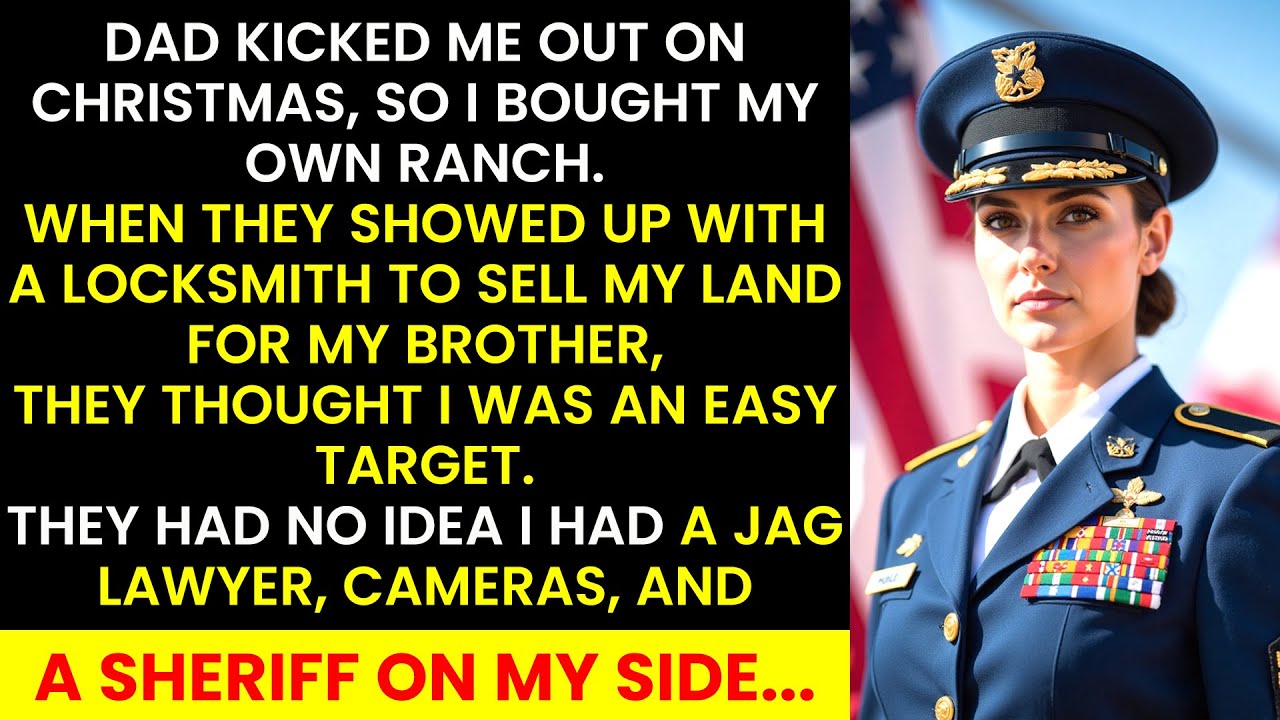
On the screen was a woman in an army dress uniform sitting in an office with an American flag behind her. “This is Captain Rachel Levine, Judge Advocate General’s Corps,” I announced. “She is my legal counsel. ” Rachel’s voice came through the speaker, sharp as a razor.
“Mr. Frank Pool, let me be crystal clear. I have reviewed Sergeant Pool’s medical records. She has a clean bill of mental health.
No history of psychosis. No court-ordered guardianship. You do not hold power of attorney. What you do hold is a potential indictment for attempted identity theft, filing a false police report, and stolen valor by proxy.
” Frank’s mouth opened and closed like a fish on a dock. “Sergeant Pool is an active-duty service member on leave,” Rachel continued. “Harassing her, attempting to seize her property through fraud, and defaming her character to law enforcement are federal offenses. If you do not vacate these premises immediately, I will personally ensure the U.
S. Attorney’s office takes an interest in your finances. ”
The color drained from Frank’s face. Evan cowered behind the van.
Linda sobbed into her hands. “You ungrateful—” Frank sputtered, his entire world crumbling. The narrative he had built for forty years—that he was the patriarch, the ruler of his tiny kingdom—was shattered. And then he snapped.
“It’s my house! ” he screamed, veins bulging in his neck. “I am your father! You owe me!
You owe me everything! ” He lunged across the snow, fist raised, aiming for my face. It was a clumsy, desperate attack. I didn’t flinch.
I didn’t even reach for my weapon. I just watched him come. “Hey! ” Walt roared.
Before Frank could get within five feet, Sheriff Hensley hit him like a freight train. A textbook takedown. Walt slammed into Frank’s midsection, driving him hard into the slush. Frank hit the ground with a sickening thud, the air leaving his lungs in a wheeze.
“Stay down! ” Walt barked, jamming a knee into Frank’s back. “Frank Pool, you are under arrest for trespassing, attempted burglary, and assaulting a federal employee. Give me your hands.
” The click of the handcuffs was the loudest sound in the valley. I stood there motionless, looking down at the man who had terrified me my entire childhood. Face down in the mud, water soaking into his gray hair, hands bound behind his back. He wasn’t a giant.
He wasn’t a monster. Just a pathetic, greedy old man who had overplayed his hand. Evan didn’t move to help him. Linda didn’t scream.
They just watched, paralyzed by the collapse of their leader. I felt a strange sensation in my chest. Not joy. Not happiness.
Lighter than that. The sudden absence of weight. The burden I had carried since I was five—the need to please him, the fear of his anger, the desperate hope for his love—evaporated into the cold morning air. “Thank you, Sheriff,” I said.
“I’d like to press charges. All of them. ” “Copy that, Sergeant,” Walt said, dragging a sputtering Frank toward the cruiser. “We’ll take care of the trash.
” I turned my back and walked into my house—my fortress, my home. For the first time in my life, I didn’t look back. The interrogation room at the county sheriff’s station smelled of stale coffee and industrial cleaner. I stood in the observation booth, watching through a one-way mirror.
Inside, my brother Evan slumped over a metal table, sobbing into his hands. My father sat next to him but offered no comfort. Frank stared at the cinder block wall, face gray and slack—stripped of the arrogance that had been his armor for forty years. The heavy steel door opened.
Sheriff Walt Hensley stepped in, holding a thick manila folder. He didn’t look like a man who had just made a big arrest. He looked like a man who had just uncovered a mass grave. “You need to see this, Paula,” Walt said, voice low and grave.
He tossed the file onto the desk. “It’s not just greed. This is survival. They didn’t come up here just to steal your equity.
They came because they’re running for their lives. ” I opened the folder. Forensic accounting of a disaster. Bank statements, credit card bills, printouts from online gambling platforms.
“Evan’s been bleeding money for three years,” Walt explained, pointing to a column of red ink. “Started with sports betting apps. Lost his savings betting on NFL spreads. Maxed out his credit cards chasing losses.
When the banks cut him off, he went to Vegas. ” I turned the page and felt a chill that had nothing to do with the Montana winter. “He went to a loan shark,” I whispered, looking at photocopies of threatening text messages pulled from Evan’s phone. “Not just a loan shark,” Walt corrected.
“Organized crime. He owes $150,000. The vigorish alone is five grand a week. He hasn’t paid in two months.
” “$150,000,” I repeated, the number feeling alien in my mouth. “They gave him a deadline. New Year’s Eve. If he doesn’t pay the principal, they told him they were going to liquidate the asset.
Meaning Evan. ” I looked at my brother. He wasn’t crying because he was sorry. He was crying because he was a dead man walking.
Then Walt said the words that stopped my heart completely. “Here’s the part that makes me sick. We found messages between your father and the collectors. When the sharks threatened to hurt Evan, Frank tried to make a deal.
He told them he had a solution—a property in Montana worth enough to cover the debt. ” I gripped the edge of the desk. “He told them about Pool Ridge. ” “He did more than that,” Walt said, looking at me with genuine pity.
“He gave them your address. He told these violent criminals that his daughter, a military veteran with deep pockets, was holding the property as a straw buyer for the family. He promised that if they waited until after Christmas, he would have the deed signed over to them. He explicitly told them, ‘Go to Pool Ridge.
My daughter is there. She’ll sign. She does what she’s told. ’”
The room spun.
I leaned against the wall to keep my knees from buckling. My father hadn’t just tried to steal my house. He had painted a target on my back. He had sent professional killers to my doorstep with my address and the belief that I was the only thing standing between them and their money.
He was willing to feed me to the wolves to save his golden child. “He sold me out,” I whispered. “He sold my safety to save Evan. ” “He did,” Walt confirmed.
“That’s why he was so desperate to get in. He needed that deed signed before the collectors showed up. ” I looked at Frank again. I didn’t see a father.
I saw a monster. A coward who would throw his own child into a fire to keep himself warm. As I turned the corner toward the exit, I saw Linda. She had been released pending charges since she hadn’t physically touched the gate or the lock.
She sat on a bench, looking frail and old. When she saw me, she scrambled up, eyes red and swollen. “Paula! Paula, wait.
” She grabbed my hand, her grip surprisingly strong, desperate. “I’m so sorry. I knew it was wrong. I told Frank it was wrong, but he said they were going to kill Evan.
He said it was the only way. ” She looked up at me, pleading. “You have to understand. Evan is my son, my flesh and blood.
I couldn’t let him die. And you, Paula—you’re so strong. You’re a survivor. You can handle anything.
We knew you could make more money. We knew you’d be okay eventually. But Evan, he would break. Please tell the sheriff to drop the charges.
Don’t let them go to prison. ”
The words hung in the air—toxic and clarifying. You’re so strong. You can handle it.
Because I was capable, because I was resilient, my suffering was deemed acceptable. My pain was a manageable cost in their equation while Evan’s comfort was non-negotiable. She wasn’t apologizing for the betrayal. She was apologizing that the betrayal hadn’t worked.
I ripped my hand away. The motion was violent, sharp, final. “Don’t touch me,” I said. My voice was unrecognizable—the voice of the Montana winter.
Zero degrees and lethal. Linda recoiled, gasping as if I had slapped her. I turned to the screen. “Rachel, I want a permanent restraining order.
For Frank, for Evan, and for Linda. ” “Understood. We’ll file for emergency protection immediately. ” I looked at Sheriff Hensley.
“I want them nowhere near me. Not within ten miles. If they step foot on my road, I want them arrested. If they call me, I want them arrested.
And if any collectors show up at my house looking for Frank Pool’s money, I will defend my home with lethal force—and their blood will be on Frank’s hands. ” “I’ll have the judge sign the order within the hour,” Walt promised. I looked at Linda one last time through the glass doors. I didn’t see my stepmother.
I didn’t see family. I saw a stranger who had tried to pick my bones clean. I pushed the doors open and walked out into the cold, clean air. I was alone, but for the first time in my life, I wasn’t lonely.
I was free. Two weeks had passed since the raid. The snow on Pool Ridge had settled into a hard, crusty layer that crunched loudly underfoot—a natural alarm system. Frank was gone, extradited to Colorado to await trial.
Linda had gone with him, posting bond and likely apologizing to him the entire drive home. But Evan hadn’t gone back. I was splitting logs for the evening fire when I saw him. He didn’t come in a car.
He didn’t come with a moving van or a lawyer. He walked up the center of the county road, a solitary stumbling figure against the gray mountains. Thin jacket, battered canvas backpack. He looked twenty years older than two weeks ago.
I put down the axe and walked to the gate. I didn’t unlock it. I stood inside, behind the heavy chain and the sign, and waited. Evan stopped five feet from the fence.
He didn’t look at me. He looked at his soaked boots. “You won, Paula,” he said, his voice raspy—stripped of the arrogance that had always defined him. “The creditors found me.
They know I don’t have the deed. They know Dad’s useless now. I’m done. ” He looked up, eyes hollow.
“I’m either going to prison or going into a ditch. I just wanted to come and say it. You won. ”
I gripped the cold steel of the fence.
“It wasn’t a game, Evan. It was my life. ” “I know,” he whispered. “Why?
” I asked. That question had been burning a hole in my gut since I found the loan application. “Why did you do it? Dad, I get—he’s a narcissist.
He needs control. But you—I paid your rent. I bought your cars. I bailed you out.
Why did you want to steal the only thing I had for myself? ”
Evan let out a laugh that sounded more like a cough. He slid down the fence post until he sat in the snow. “Because you were everything I wasn’t, and Dad never let me forget it.
” I frowned. “What are you talking about? You were the golden child. He worshiped the ground you walked on.
I was the scapegoat. ” “To your face, maybe,” Evan said, looking at the sky. “But behind your back, when it was just me and him? God, Paula, he tore me apart.
‘Why can’t you be like your sister? Paula’s a sergeant. Paula has savings. Paula’s a winner.
You’re a leech, Evan. You’re pathetic. ’” He looked at me through the wire mesh. “He played us.
He told you I was the prince so you’d feel inferior and work harder to buy his love. And he told me I was garbage compared to you so I’d stay dependent on him. I hated you because you were perfect. I wanted this house not just for the money.
I wanted to own something you built. I wanted to prove I could take something from the winner. ”
The revelation hit harder than the cold wind. Classic triangulation.
Frank hadn’t loved Evan. He had used Evan’s failures to torment me and my success to torture Evan. We were both puppets in his theater. Evan wasn’t the monster.
He was a broken product of the same factory. “I’m sorry, Paula,” Evan said, voice cracking. “I really am. ” He wiped his nose on his sleeve, and then came the familiar desperate glint—the look of an addict looking for a fix.
“Paula, look, I know I don’t deserve it, but I need to get out of the state tonight. Can you loan me five thousand, just to get to Canada? I swear I’ll never ask you for another dime. ”
My heart constricted.
The old reflex. The savior complex. It would be so easy. I had the money.
I could write a check, hand it through the fence, make the problem go away. Save him one last time. Then I remembered my father in handcuffs. Being sold to loan sharks.
I remembered a phrase: You cannot help a drowning man by letting him pull you under. Giving him money wasn’t helping. It was funding his destruction. I took a deep breath.
“No, Evan. ”
He flinched. “Paula, please. They’re going to kill me.
” “No,” I repeated, my voice steady. “I will not give you a single cent. My money has been killing you for twenty years. It made you weak.
It made you think there were no consequences. If I give you five thousand dollars, you won’t go to Canada. You’ll go to the nearest casino or dealer, and you’ll be dead in a week. I love you too much to pay for your suicide.
” Evan slumped, burying his face in his hands, sobbing. Ugly, racking sobs of a man who had hit rock bottom. I reached into my pocket. I didn’t pull out a checkbook.
I pulled out a folded piece of paper. “Get up, Evan,” I ordered—my sergeant voice. He looked up, wiping his eyes. I slid the paper through one of the diamond-shaped gaps in the chain link.
He reached out with trembling fingers. “That’s not a check,” I said. “That is the address for the Bitterroot Recovery Center in the next county. State-funded, with a mandatory work program.
A bed is open. They’re expecting you. ” He stared at the paper. “And underneath that is the number for a public defender.
I’ve retained him. His fees are paid. He’s working on a deal with the prosecutor to keep you in rehab and out of prison. He’s communicating with the police about the threats on your life.
If you go to that rehab, you’re safe. The sharks can’t touch you inside. ”
Evan looked at the paper, then back at me. “You… you paid for a lawyer?
” “I paid for your defense, not your escape. You have to walk there. You have to check yourself in. You have to do the work.
I can’t do it for you. This is the only help you will ever get from me again. ” He held the paper like a holy relic. For the first time in his life, he wasn’t given a handout.
He was given a ladder. It was up to him to climb. “Thank you,” he whispered. “Don’t thank me,” I said.
“Just go. ” He stood, looked at the warm cabin, then at the long, cold road. He nodded once—a gesture of respect I had never seen from him before—and started walking south. I watched until he was a speck.
I didn’t open the gate. I didn’t call him back for a ride. Tough love tastes bitter, but I knew it was the only thing that could save him. I had rebuilt my fortress.
Today I’d built a bridge—not back to the past, but toward a future where we might both survive as individuals. Montana keeps time differently. It doesn’t measure seasons by the calendar but by the thaw. It took four months for winter to release its grip on Pool Ridge.
The snow retreated up the granite peaks, leaving a valley exploding with life. The silence that had once been menacing was filled with snowmelt rushing through the creek and mountain bluebirds reclaiming their territory. I stood by the front gate, paintbrush in hand. The heavy logging chain was gone.
The aggressive “Violators Will Be Shot” sign had been taken down, replaced by a simple wooden address plaque. I was painting the fence post a crisp, clean white. I wasn’t reinforcing the perimeter against an enemy anymore. I was dressing it up for guests.
Drifting from the open cabin windows was the smell of a honey-glazed ham roasting in the oven. The smell of Easter. For the first time since December, this place didn’t smell like a bunker. It smelled like home.
A dusty Ford pickup turned into the driveway. Not a police cruiser. Sheriff Walt Hensley was behind the wheel, but he wasn’t in uniform. Flannel shirt and jeans—less the law, more a grandfather.
Next to him, Carol, the real estate agent who sold me this hopeless property. Walt stepped out carrying a cooler. “Afternoon, Paula. Brought the local craft brew.
Figured we needed something better than station coffee to celebrate. ” Carol hopped out, balancing a foil-covered dish. “Apple pie. Homemade.
Don’t insult me by asking. ” I wiped paint-stained hands on a rag and walked over, smiling—a real smile that reached my eyes. “You guys didn’t have to do this. ” Walt set the cooler on the repaired porch steps and looked me up and down—not scanning for weapons, just looking at a friend.
“You look good, Paula. Different. Last time I saw you, you looked like you were waiting for a bomb to go off. ” “I don’t feel like that anymore,” I admitted, looking out over the valley where wildflowers were pushing through the soil.
“I realized I don’t have to stand guard twenty-four hours a day. The war is over. I’m just living now. ”
We set up a makeshift table on sawhorses on the back porch.
Carved the ham—meat falling off the bone—passed mashed potatoes and green bean casserole, cracked open cold beers. A family gathering is supposed to be about blood relatives sharing history. But as we sat there—a retired sheriff, a real estate agent, and a recovering soldier—I realized family isn’t about whose DNA you share. It’s about who respects your boundaries.
Who shows up with a pie instead of a demand letter. This was my chosen family, and the food tasted better than any meal I’d ever eaten at Frank Pool’s table. Midway through the meal, my phone buzzed on the railing. Unfamiliar number, Colorado area code.
The conversation stopped. Walt looked at the phone, then at me. He knew. It was Frank, calling from the court-ordered care facility where he was serving probation.
Four months ago, seeing that area code would have sent me into a panic. I would have grabbed my gun. Today, I looked at the screen and felt nothing. No anger.
No fear. No pity. Just profound, quiet indifference. He was a ghost from a story I’d finished reading.
I didn’t decline the call. I didn’t block it. I reached out, flipped the phone face down, and picked up my beer. “Everything okay?
” Carol asked gently. “Everything is perfect,” I said. “Just a telemarketer. ” The buzzing stopped.
The silence that followed wasn’t heavy. It was liberated. I didn’t need his apology to heal. My silence was the answer—the loudest thing I could ever say to him.
As the sun dipped behind the peaks, painting the sky violet and gold, I stood at the edge of the porch and looked out at my forty acres—free and clear. “You know,” I said, gesturing toward the rolling hill on the west side, “I’ve been thinking about that ridge over there. ” “Thinking about selling it? ” Walt asked, sipping his beer.
“No,” I said. “I’m thinking about building. Not a big house. Maybe four or five tiny homes.
Simple, efficient, self-sustaining. ” Carol raised an eyebrow. “Rental units? Airbnb?
” “Sanctuaries,” I corrected. “There are a lot of female veterans coming back from deployment who don’t have anywhere to go. Stuck in the system, dealing with trauma, dealing with families who don’t understand them. They need a place to decompress.
A place to feel safe until they figure out their next move. I want to start a nonprofit. The Fortress Project. Give them what I found here.
Help them build their own fortresses. ”
Walt smiled—a slow, proud grin. He raised his bottle. “To the Fortress Project.
” “To the Fortress,” Carol echoed, raising her glass. I raised mine, the amber liquid catching the last light of day. “To resurrection,” I whispered. I took a sip, the taste of hops and citrus sharp on my tongue.
I looked at my hands—stained with white paint, calloused from hard work, but steady. My name is Paula Pool. I am a soldier. I am a survivor.
Standing here on this mountain, surrounded by people who respect me, breathing the air of a spring I fought to see, I finally knew exactly who I was. This was my land. This was my life.
I was finally, truly free.