I turned off the engine of my old Ford, adjusted my crisp dress uniform, and inhaled the familiar freezing air of Minnesota. The living room window glowed bright with laughter. But right outside, I saw Grandma sitting huddled on a wooden chair, trembling in a thin shirt amidst the deadly negative twenty-degree cold. My blood boiled.
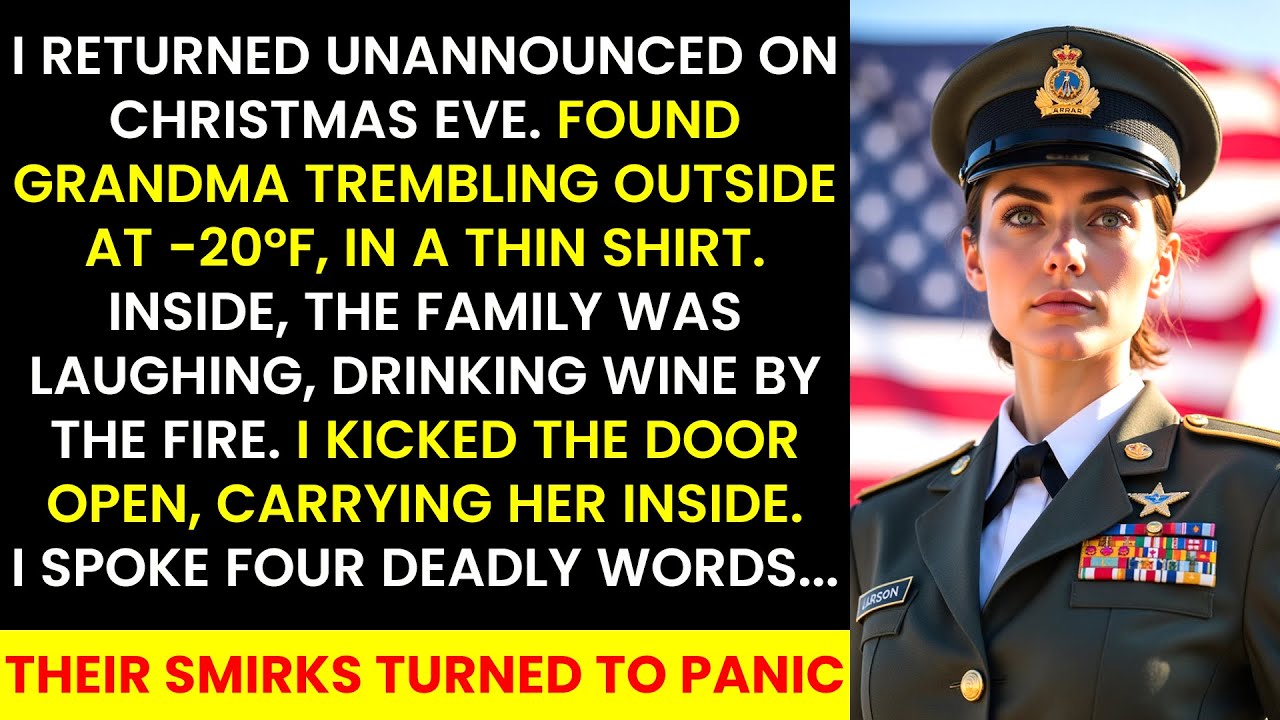
I rushed forward, scooped her up, and then used my shoulder to kick the door open. Wood splintered. Her tiny weight rested against my chest. Champagne glasses froze in midair.
The fire hissed as if it knew what I was about to say. The fake warmth inside made me nauseous. My badge reflected the firelight, but what burned my soul was the naked truth being exposed. Mom, Dad, and Tommy were uncorking expensive bottles of wine bought with the very disability checks I sent home to care for Grandma.
I looked into every eye in that warm room, seeing panic instead of the joy of reunion. Captain Elena Larson didn’t come home to party. I came home to witness the basest betrayal. I let my voice turn cold.
“Who locked this door? ” I didn’t wait for an answer. I carried her past them, kneeling down on the thick, plush Persian rug right in front of the roaring fireplace. I laid her down gently.
Up close, the damage was undeniable. Her skin was waxy and pale, almost translucent, pulled tight over her cheekbones. A distinct acrid smell of urine hit my nose, a classic sign of severe hypothermia. Her body had lost control of its basic functions.
My mother, Linda, let out a sharp gasp, but she didn’t rush forward to hold her mother’s hand. She didn’t scream for help. She scrambled backward, covering her nose with a manicured hand, her eyes wide and fixed on the floor. “Oh my god,” she shrieked, her voice shrill and piercing.
“You’re ruining the rug. Do you know how much that costs to import? She’s leaking on the weave. ” That was the first thing my mother said to me after two years of deployment.
Not “Welcome home. ” Not “Is Mom okay? ” Just the rug. I ignored her.
I stripped off my heavy dress coat, the medals clinking softly, and wrapped it tight around Grandma’s shivering frame. I began rubbing her hands and feet, checking for a pulse. It was thready, weak. “Call 911,” I barked, not looking up.
Now my father, Robert, set his wine glass down on the mantelpiece. He didn’t look remorseful. He looked annoyed, like I had interrupted a crucial business meeting. He smoothed his silk tie, his face flushing with irritation.
“Don’t be dramatic, Elena,” he said, waving a dismissive hand. “We just put her out there for a few minutes to get some fresh air. The house was getting stuffy. You know how old people smell.
We have guests arriving in twenty minutes. ” He spoke about the woman who birthed him as if she were a wet dog that needed to be chained in the backyard. My hands were busy trying to save a life, which was the only reason I didn’t stand up and dismantle him right there. “Fresh air,” I repeated, my voice low.
“It’s negative twenty, Dad. That’s not fresh air. That’s a death sentence. ”
From the corner by the wet bar, a familiar mocking laugh cut through the tension.
Tommy. My twenty-eight-year-old brother was leaning back, tapping away on the newest iPhone model. A device his waiter salary definitely couldn’t cover. He looked at me with glazed, slightly drunk eyes.
“Oh, come on, big sis,” he slurred, a smirk playing on his lips. “She’s senile. She keeps nagging us to turn up the heat in her room. And you know how expensive gas is these days.
Putting her out there cools her down, clears the head. And seriously, where did you rent that soldier costume? You look like one of those clowns from the circus. ” He was insulting the uniform that I had worn while bleeding in the dirt of foreign lands.
He was mocking the very thing that paid for the roof over his head. But I didn’t engage. My focus was on the woman trembling beneath my coat. Grandma Margaret’s eyes fluttered open.
The warmth of the fire and the heavy wool of my coat were starting to bring her back, but her mind was still trapped in the cold. Her milky eyes darted around frantically before locking onto my face. She didn’t see Elena, her granddaughter. She saw a figure in uniform, perhaps an authority figure, perhaps an angel.
She flinched violently, curling into a fetal position, trying to make herself as small as humanly possible. “I’m sorry. I’m so sorry, ma’am,” she whispered, her voice cracking like dry leaves. “I know I smell.
Please don’t hit me. I’ll go back outside. Just don’t hit me. ” The words hit me harder than any shrapnel ever could.
“Don’t hit me. ” My heart shattered in my chest. What had they done to this proud, strong woman to make her this terrified? I pulled her close, wrapping my arms around her frail body, burying my face in her silver hair as hot tears finally spilled over.
“No one is going to hit you, Grandma,” I promised, my voice fierce and shaking. “I swear it. ”
Outside, the faint wail of sirens began to rise in the distance, cutting through the winter night. The war had just begun.
I stood up. My shadow stretched long across the Persian rug, casting a dark silhouette over the three people standing by the fireplace. The warmth of the fire was behind me now, but the ice in my veins had spread to every inch of my body. “I have already called the police,” I announced.
My voice was calm, a stark contrast to the storm raging inside me. My mother, Linda, let out a screech that sounded more like a wounded animal than a human being. The crystal champagne flute in her hand slipped from her fingers. It hit the hardwood floor just off the edge of the rug, shattering into a thousand glittering shards.
“Are you insane, Elena? ” she screamed, her face twisting into a mask of pure panic. “Tonight is Christmas Eve. Councilman Miller and his family are going to be here in less than thirty minutes.
Do you want to destroy the reputation your father and I have spent years building? ” She didn’t ask if Grandma was breathing. She didn’t ask if she needed an ambulance. She was worried about a local politician and her holiday party.
She lunged at me, her hand raised high. It was an old reflex, a motion I had seen a thousand times in my childhood whenever I spoke out of turn. But I wasn’t twelve years old anymore. I was a United States Army captain.
I caught her wrist in midair. I didn’t squeeze hard, just enough to stop her momentum dead. The shock on her face was almost comical. She gasped, her eyes bulging, realizing for the first time that the power dynamic had shifted permanently.
I held her gaze for a second, letting her see the contempt in my eyes before I released her hand with a sharp shove. My father, Robert, stepped forward, trying to inflate his chest, attempting to summon the authority of the patriarch, a role he played terribly. “Let go of your mother,” he bellowed, adjusting his silk tie nervously. “You go off to play soldier for a few years and think you can come back here and run my house.
I am your father. This is my house. ” I let out a short, dry laugh. It sounded harsh in the quiet room.
“Your house? ” I asked, stepping toward him. He instinctively took a step back. “Really, Dad?
Is that a fact? Because according to my bank statements, I am the one who has paid the mortgage for the last twenty-four months. I am the one who paid for the new roof last October. And I am the one who paid for this central heating system.
The same system you are currently using to warm your ego while your mother froze to death on the porch. ” I took another step. He retreated again, bumping into the mantel. The cowardice in his eyes was pathetic.
“We managed the funds,” he stammered, his bravado crumbling. I turned my back on him, scanning the room. My eyes landed on the side table near the humidor. There, tossed carelessly next to a half-empty bottle of scotch and a cutter for expensive cigars, was a small velvet box.
My Bronze Star. The medal I had mailed home for safekeeping. They hadn’t even bothered to put it on a shelf. It was sitting there like a coaster.
But I wasn’t looking for medals. “Where are her pills? ” I demanded, my voice dropping an octave. “Where is her heart medication?
I don’t see the bottles on the counter. ” My mother averted her eyes, suddenly finding a spot on the wall. Very interesting. It was Tommy who answered, leaning against the bar with that arrogant smirk still plastered on his face.
“The doctor said those pills were getting too expensive,” Tommy said, swirling the ice in his glass. “And honestly, she’s eighty-two, Elena. It’s not like they were going to make her live forever. We switched her to some herbal supplements, much more natural, and it saved us a ton of cash to, you know, finally start the remodel on the kitchen.
” The room went silent. I felt a wave of nausea roll over me. “Herbal supplements,” I repeated. “I send three thousand dollars home every single month.
Her medication costs five hundred. You cut her life-saving medicine to remodel a kitchen. ”
I looked at them. Really looked at them.
My mother’s face was caked in layers of expensive makeup. My father’s suit was tailored Italian wool. And Tommy, Tommy was wearing a pair of brand-new Air Jordans that I knew retailed for over two hundred dollars. Every stitch of clothing they wore, every drop of liquor they drank was bought with the blood money I earned in a war zone.
And the cost was my grandmother’s life. I looked at my family, and for the first time, I didn’t see my flesh and blood. “You aren’t a family,” I said, my voice quiet and deadly, like the click of a safety coming off a rifle. “You are parasites.
You have been feeding on me and on her for years. ” My father opened his mouth to speak, but I cut him off. “But lucky for you,” I whispered, “I just brought home the insecticide. ” At that exact moment, the wail of sirens that had been a distant hum suddenly exploded into clarity.
Red and blue lights flashed through the front window, slicing through the artificial warmth of the room, tearing apart the comfortable lie they had been living in. The police were here, and the party was over. A heavy, authoritative pounding echoed from the front door, vibrating through the tense silence of the living room. It wasn’t the polite knock of a holiday guest.
It was the demand of law enforcement. I had texted Sergeant Mike Ruiz the second I saw Grandma on the porch. He was one of the few people in this town I still trusted. “Open up,” Mike’s voice boomed from outside.
My father Robert scrambled backward, his face draining of color. Panic replaced his earlier arrogance. “Don’t open that, Elena. Tell them it was a mistake.
Tell them we’re fine. ” I didn’t even look at him. I walked straight to the door, unlatched the deadbolt, the casing of which I had already splintered when I kicked it in, and pulled it open. The freezing wind rushed in again, but this time it brought justice with it.
Mike Ruiz stepped inside, flanked by two patrol officers. He shook the snow off his uniform, his eyes scanning the room for threats before landing on the huddle by the fireplace. Mike had grown up three houses down. He used to shovel Grandma’s driveway for free when we were kids just because she gave him homemade oatmeal cookies.
He looked at Grandma shivering on the rug, smelling of urine and neglect. Then he looked at my parents in their finery. His expression shifted from professional concern to sheer, unadulterated disgust. “Paramedics thirty seconds out,” Mike said, his voice tight.
He motioned for the other officers to secure the room. While the EMTs rushed in with their gear and began tending to Grandma, checking her vitals, and wrapping her in thermal blankets, I turned my attention to the dining table. I wasn’t done. The physical abuse was obvious, but I needed to find the motive.
I walked over to where Tommy was sulking in the corner. I grabbed his left wrist and yanked it up. “Hey, watch it,” he yelped. I stared at the heavy gold watch on his arm.
It was a Rolex Submariner. “Nice watch,” I said, my voice deceptively light. “Bought this with my credit card, didn’t you? ” Tommy stammered, trying to pull his arm away.
“You—you said I could have some pocket money while you were deployed. ” “For emergencies. ” I unclasped the watch from his wrist and held it up to the light. “Pocket money?
” I asked. “This is a twelve-thousand-dollar timepiece, Tommy. Do you know where I got twelve thousand dollars? ” I didn’t wait for an answer.
I turned and hurled the watch against the brick fireplace. It shattered with a satisfying crunch of metal and sapphire glass. My mother screamed, but I ignored her. “That was my hazard pay,” I said, pointing a shaking finger at him.
“That is the bonus the army gave me for surviving an IED explosion in Syria that killed two of my friends. You are wearing my blood money on your wrist to impress girls at the dive bar. ” The room fell deadly silent. Tommy looked at the broken pieces of the watch, then at me, terror finally dawning in his eyes.
I turned to the liquor cabinet. I knew exactly where Dad kept his important papers. I pulled open the bottom drawer and grabbed a thick manila folder. I dumped the contents onto the dining table, right next to the half-eaten appetizers.
Bank statements, credit card bills, and right on top, the document that sealed their fate: the power of attorney. I picked it up. It was the legal document I had signed over to my father two years ago, trusting him to handle my finances and Grandma’s care while I was serving my country. “Let’s see what we have here,” I said, flipping through the bank statements, reading the transaction lines out loud for the police to hear.
“Withdrawal, Mystic Lake Casino, five hundred dollars. Withdrawal, Mystic Lake Casino, eight hundred dollars. Mercedes-Benz of Minneapolis. Lease down payment, four thousand dollars.
Serenity Spa, three hundred dollars. ” I flipped to the medical section. “And here it is,” I said, holding up a letter from the home health agency. “Service cancellation notice.
Reason: client request. Estimated savings: two thousand dollars a month. ” I walked up to my father and shoved the paper into his chest. “You signed this the week after Grandma fell down the stairs, didn’t you?
” I hissed. “You fired her nurse. You cut her care to save two thousand dollars a month. ” I looked down at the table, spotting a receipt.
“And looking at the date on this receipt for the lift kit on your truck, it matches perfectly. ” My father couldn’t look me in the eye. He stared at his polished shoes. His silence was a confession louder than any scream.
Mike Ruiz placed a hand on my shoulder, pulling me back from the edge of violence. “Elena,” he said softly. “The EMTs are loading her up. Her heart rate is erratic.
She needs to get to the hospital now. ” I nodded, wiping a stray tear from my cheek. I looked at the three people who shared my last name. “Mike,” I said, my voice steady and official.
“Start the paperwork. I want you to file a report for first-degree elder neglect, fiduciary abuse, and embezzlement. ” My mother let out a wail, rushing forward to grab my arm. “You can’t do this.
I am your mother. Are you going to send your own parents to prison? ” I brushed her hand off my uniform as if it were dirt. “No, mother,” I said.
“I’m not sending you to prison. I’m just letting the law do what I should have done a long time ago. I’m taking Grandma, and you better pray your lawyer is good. ” I turned on my heel and walked out into the cold night, following the stretcher, leaving the warmth of the house behind forever.
The bridge wasn’t just burned. I had blown it up. The paramedics moved with practiced efficiency, collapsing the legs of the stretcher and locking it into position. I kept my hand wrapped tightly around Grandma’s bony fingers, whispering a constant stream of reassurance as they lifted her up.
“I’m right here, Grandma. I’ve got you. We are moving out. ” As we wheeled her toward the front door, the exit was blocked.
My mother stood in the doorframe, arms crossed over her chest. Her face twisted, not with grief, but with a pure, white-hot rage. She looked like a gatekeeper to hell. “If you walk out that door with her,” she hissed, her voice low and venomous, “don’t you ever think about coming back.
You are dead to this house, Elena. ” I signaled the paramedics to pause for a second. I looked at the woman who had given birth to me. I looked for any trace of maternal instinct, any shred of humanity.
I found none. “You are mistaken, Linda,” I said, using her first name. It felt like severing the final thread of a rope. “I have been dead to this house since the day you told me to enlist in the army.
You didn’t send me away to serve my country. You sent me away to get the signing bonus so you could pay off Dad’s gambling debts before the loan sharks broke his legs. I died that day. Now I am just salvaging the only survivor.
” I signaled the EMTs. “Move out. ” We pushed past her. She didn’t move, just stood there trembling with impotent fury as the cold night air rushed in to replace the stifling heat of her lies.
I stepped out onto the driveway. The flashing red and blue lights of the police cruisers painted the snow in a chaotic rhythm. Neighbors were starting to emerge from their homes, peeking through blinds or standing on their porches, wrapped in robes, whispering. My parents’ worst nightmare was coming true: a public scene.
Suddenly, a loud crash echoed from above. I looked up just in time to see my heavy travel suitcase hurtling down from the second-story window. It hit the frozen driveway with a sickening crunch. The latch burst open on impact.
My clothes, my books, and a stack of letters, letters I had written to them from the sandbox in Syria but never had the courage to mail, exploded across the snow. They scattered like confetti in the wind. “Get out! ” Tommy screamed from the open window above, his silhouette swaying drunkenly.
“Get out, you traitor. Take your trash with you. ” The wind caught one of the letters, blowing it across the yard. I watched it go.
For a split second, I thought about running to pick them up, to salvage the pieces of my life. But then I looked at the ambulance waiting with its back doors open. I turned my back on the scattered clothes. I left them there in the snow.
They were just debris from a past life I no longer needed. I climbed into the back of the ambulance. The interior was bright, sterile, and smelled of rubbing alcohol. The EMTs were hooking Grandma up to a monitor.
Her oxygen mask fogged up with every shallow breath. She reached out, her hand groping blindly until I caught it. Her grip was surprisingly strong, fueled by panic. “Annie,” she wheezed, her eyes wide with terror.
“Don’t—don’t leave me. Please don’t let them take me to the home. Please, Annie. ” The home.
The nursing home. It was the ultimate threat in our family. The place where old people were sent to be forgotten. I leaned in close, brushing a stray lock of silver hair from her forehead.
“No one is taking you to a home, Grandma,” I promised, my voice steady and calm. “I am taking you to the base. It’s a secure location. I’m going to stand guard.
No one gets in without my permission. ” “The base,” she whispered, the panic slowly receding from her eyes. “That’s right,” I said. “We are going to the forward operating base.
It’s safe there. ” She managed a weak ghost of a smile, her eyelids drooping as the warmth of the ambulance finally soaked into her bones. She felt safe, but I knew she wasn’t. Not yet.
Through the rear window, I saw Mike Ruiz pulling his patrol car out to escort us. The ambulance driver looked back at me through the partition. “We are heading to Mercy General Hospital,” the driver said. “ETA is twelve minutes.
” My mind raced. I thought about the paperwork I had seen on the table. The power of attorney. It wasn’t just financial; it was medical too.
If we went to a civilian hospital, my father could walk in with that document. He could legally demand to take her home against medical advice. He could block me from seeing her. He could bury this whole thing before morning.
I was a logistics officer. My job was to anticipate supply line failures. And I just saw a massive breach in our defenses. I tapped hard on the partition glass.
“Negative,” I said, pulling my military ID from my pocket and holding it up, though he could barely see it. My voice left no room for argument. “Do not go to the hospital yet. Reroute to the Oak Creek Police Station.
” The driver looked confused. “Ma’am, the patient needs—” “The patient is stable for transport,” I interrupted. “This is a security issue. My father has a medical power of attorney.
If we go to the hospital, he takes custody. I need an emergency protective order from a judge, and I need an immediate assessment from adult protective services to override his authority. ” I leaned forward, my eyes locking with the driver’s in the rearview mirror. “If you take her to the hospital, you are handing her back to the people who froze her.
Do you understand me? Drive to the police station now. ” The driver hesitated for a heartbeat, then nodded. He reached for his radio to alert dispatch.
The ambulance banked hard to the left, turning away from the hospital route and speeding toward the precinct. I sat back, holding Grandma’s hand. We weren’t going to a doctor. We were going to a war room.
I had to cut the enemy supply line before I could treat the wounded. The Oak Creek Police Station was deserted on Christmas Eve, save for the dispatch officer humming to a radio tune and the low, constant buzz of the heating vents. It smelled of floor wax and stale coffee that had been sitting in the pot since the morning shift. We bypassed the sterile holding cells and took Grandma straight to the employee break room.
It was the warmest room in the building, filled with mismatched chairs and a vending machine that hummed in the corner. Mike Ruiz disappeared for a moment and returned with a thick wool blanket and a Styrofoam cup steaming with hot cocoa. He’d even managed to find a packet of marshmallows. “Here you go, Mrs.
Graham,” Mike said, his voice dropping to a gentle, respectful tone that was miles away from the shouting police officer I had seen at my parents’ house. “Drink this. It will warm you up from the inside. ” Grandma sat in the corner of the worn-out sofa, her hands trembling so violently that Mike had to help her guide the cup to her lips.
She took a small sip, and the steam fogged up her glasses. Her eyes, still clouded with confusion, widened slightly as the sweetness hit her tongue. “Thank you, officer,” she whispered, her voice sounding small and fragile in the quiet room. “At home, they don’t let me have this.
They say sugar makes me wet the bed. They say it ruins the mattress. ” The innocence of her statement hung in the air like toxic smoke. She wasn’t complaining.
She was just stating a fact of her daily existence. She had been denied a simple cup of cocoa because her own daughter viewed her bodily functions as an inconvenience to the furniture. Mike stood up abruptly and turned away, pretending to check the coffee pot. But I saw him wipe his eyes.
I stared at the floor, my hands balling into fists, so tight my nails dug into my palms. Ten minutes later, a woman named Sarah from Adult Protective Services arrived. She was brisk, professional, and carried a clipboard that looked like a weapon. “Captain Larson, I need you to help me remove her wet clothing so we can document her physical condition,” Sarah said.
I nodded, stepping forward. “It’s okay, Grandma. We just need to get you into something dry. ” Grandma flinched when I reached for the hem of her sweater, but she let me lift it.
When the thin fabric peeled away from her skin, I had to bite my lip hard enough to taste blood to keep from screaming. Her body was a map of cruelty. Her ribs protruded sharply against her pale skin, a clear sign of severe malnutrition. But it was the bruises that made the room spin.
They were everywhere. A kaleidoscope of purple, black, and yellow, marking injuries old and new. “This one here,” Sarah said, her voice devoid of emotion as she pointed to a distinct set of bruises on Grandma’s upper arm. “See the spacing?
Three fingers on one side, a thumb on the other. This is a grab mark. Someone grabbed her here hard and dragged her. ” I looked at the bruise.
I knew that grip. I knew the size of that hand. It was the same hand that wore a platinum wedding ring. My father’s hand.
“And this,” Sarah continued, moving down to Grandma’s left leg. She rolled up the damp pant leg, revealing a jagged, angry-looking gash running down her shin. The skin around it was red and swollen with infection. It had been crudely bandaged with a paper towel and duct tape.
“This is a deep laceration,” Sarah noted, snapping a photo with her tablet. “It needed stitches weeks ago. How did this happen, Mrs. Graham?
” Grandma shrank back into the sofa, pulling her leg away. “It was an accident,” she stammered, her eyes darting to me. “Tommy—he was watching the game, the Sunday game. He said I was walking too slow.
I was blocking the television. He pushed the coffee table to get me to move. ” I felt like my chest was being crushed by a tank. Tommy, my little brother, the boy I used to carry on my back when we played in the park.
He had shoved a heavy table into an eighty-two-year-old woman because she blocked his view of a football game. I pulled out my phone. My hands were steady now, fueled by a cold, clinical rage. Click.
A photo of the grab mark. Evidence. Click. A photo of the infected leg.
A verdict. The door opened, and Mike walked back in. He was holding a thick file folder, and the softness was gone from his face. He looked like a cop now.
“Elena,” he said, placing the file on the breakroom table. “I ran a quick check on the address. In the last two years, there have been zero 911 calls from your parents’ landline or cell phones. ” He opened the folder, revealing medical records he had pulled from the local hospital database.
“However,” Mike continued, tapping a page covered in medical jargon, “your grandmother has been admitted to the emergency room three times for household falls. Each time, the attending physician recommended admitting her for long-term observation and physical therapy. And each time, your father, Robert Larson, used his medical power of attorney to refuse care and check her out against medical advice. ” He looked me dead in the eye.
“This isn’t just neglect, Elena. This is slow-motion homicide. They were waiting for her to die. ” He slid a form across the table toward me.
It was an emergency protective custody order. “If you sign this,” Mike said, “it strips your father of his legal authority immediately. It places Mrs. Graham under the protection of the state and into your temporary custody.
But once you sign it, there is no going back. Your parents will face felony charges. We are talking five to ten years in state prison. ” I looked at the paper.
I looked at Grandma, who was blowing on her cocoa, looking more peaceful than she had in years. I didn’t hesitate. I picked up the pen. I wasn’t signing a complaint against my parents.
I was signing a treaty of protection for an innocent citizen of the United States. The scratch of my pen against the paper sounded loud in the quiet room. It was the sound of a daughter becoming a soldier again. “File it, Mike,” I said, handing the paper back.
“And get ready, because they aren’t going to go down without a fight. ”
My phone began to vibrate against the metal surface of the breakroom table. It buzzed aggressively, like an angry hornet trapped in a jar. The screen lit up with a photo I hadn’t changed in years: a picture of my mother smiling at a garden party, looking perfect and completely fake.
I didn’t pick it up immediately. I looked at Mike Ruiz and Sarah from Adult Protective Services. “You both need to hear this,” I said. “This is what gaslighting sounds like.
” I tapped the green icon and hit the speakerphone button. “Elena! ” My mother’s voice shrieked through the tiny speaker, distorted by hysteria. “What are you doing?
The police just called your father. They said he is under criminal investigation. Are you trying to kill me? Is that what you want?
My chest is tightening, Elena. I’m having a heart attack right now. ” Sarah, the social worker, raised an eyebrow. She had seen this act a thousand times.
I leaned over the phone, my voice calm and devoid of sympathy. “You’re having a heart attack, mother? ” I asked. “Have you called 911, or do you need me to come back and dial the number for you, since you seem capable of screaming just fine?
” There was a split second of silence on the other end. The sobbing stopped instantly. The fragile victim vanished, replaced by the viper I knew so well. “You ungrateful little brat,” she hissed, her voice dropping to a venomous growl.
“I carried you for nine months. I gave you life, and this is how you repay us? By destroying our Christmas? ” “You didn’t give me life, Linda,” I said.
“You gave me a debt to pay off. ” There was a scuffling sound, the phone being fumbled, and then my father’s heavy breathing filled the line. “Listen to me, you little traitor,” Dad’s voice boomed, trying to project the authority he used in his board meetings. But I could hear the tremor underneath.
He was terrified. “If you do not walk back into that police station and retract every single word of that statement, I will ruin you. ” “Is that a threat, Robert? ” Mike whispered to me, signaling that he was noting this down.
“I will tell everyone,” my father continued, gaining steam. “I will tell the town about your suspension in high school. I will tell them about your episodes. I will tell them you have severe PTSD from the war.
I will paint you as a mentally unstable, paranoid veteran who is making up stories to hurt her loving family. Who do you think a judge is going to believe, Elena? A shell-shocked grunt with a history of violence, or a respected businessman and pillar of the community? ” He was doing it.
He was weaponizing my service against me. He was using the scars I earned defending his freedom to try and shackle me. It was a low blow even for him. I let out a dry, humorless laugh.
It echoed in the empty breakroom. “Go ahead, Dad,” I said, smiling at the phone. “Tell them. Put me on the stand.
But you are forgetting one thing. My PTSD isn’t from the war. ” “What? ” he stammered.
“My military psych evaluation,” I said, enunciating every word clearly. “The doctors at the VA and the army psychologists have a very thick file on me. And do you know what the conclusion is? My trauma didn’t start in a trench in Syria.
It started in a living room in Minnesota. My complex PTSD is documented as a result of prolonged childhood emotional abuse and domestic instability. My medical records will be exhibit A in court. Dad, they don’t prove I’m crazy.
They prove you are a monster. ” The silence on the other end was heavy, filled only by the sound of ragged breathing. I had struck the fatal blow. “And you know what else?
” I added, twisting the knife. “The army trusts me with classified intelligence. The courts trust me with a badge. You—you’re just a wife beater hiding in a three-thousand-dollar suit.
” “We are coming down there! ” It was Tommy’s voice now, slurring and screaming from the background. “You wait right there. I’m going to smash that station to pieces.
I’m going to—” I tapped the red button, ending the call. The silence that followed was ringing in my ears. I looked up at Mike. “Get your team ready,” I said, standing up and smoothing my uniform.
“They are on their way. And Tommy sounded like he had finished the rest of that scotch bottle. You can go ahead and add driving under the influence to the charge sheet. ” Mike nodded, grabbing his radio.
“All units, be advised. Suspects incoming, possible hostile intent. ”
Suddenly, the glass front doors of the precinct began to vibrate. A low rumble grew louder, turning into the roar of an engine being pushed to its limit.
Through the blinds of the breakroom, I saw it. High beams cut through the darkness, blindingly bright, sweeping across the parking lot like searchlights in a prison break. A car screeched to a halt right in front of the entrance, mounting the curb. They were here.
The final battle wasn’t going to be fought over the phone. It was going to be face to face. I stood alone in the center of the interrogation room. It was a cold, sterile box designed to break people, with cinder block walls painted a depressing shade of gray and a single steel table bolted to the floor.
I turned to face the large rectangular mirror on the wall. I knew it was a two-way glass. On the other side was the observation deck, dark and empty. I stared at my own reflection: the sharp lines of my dress uniform, the ribbons on my chest, the dark circles under my eyes.
My hands were trembling. It wasn’t fear of my father. And it wasn’t the cold. It was the adrenaline crash.
It was the crushing weight of what I was about to do. I reached into the breast pocket of my tunic and pulled out a small, tarnished piece of silver. It was a Saint Michael medal, the patron saint of law enforcement and paratroopers. Grandma had given it to me the day I shipped out for basic training.
“He will fight the wickedness and snares of the devil,” she had told me. I rubbed my thumb over the raised image of the archangel standing over a defeated dragon. “Lord,” I whispered to the empty room, my voice barely audible over the hum of the ventilation system, “give me the strength not to soften. Give me the strength to do what is necessary.
” In every culture, in every religion, turning against your parents is the ultimate taboo. The Bible says to honor your father and mother. Was I twisting scripture? Was I the villain here?
I was about to put the people who raised me behind bars. The guilt was a physical weight, pressing down on my lungs, making it hard to breathe. The heavy steel door clicked and swung open. I quickly shoved the medal back into my pocket and straightened up, expecting Mike.
But it was Grandma. Mike was supporting her by the elbow, guiding her shuffling steps into the room. She looked different. The warmth of the station and the hot cocoa had brought a little color back to her cheeks.
She wasn’t the trembling, terrified creature on the porch anymore. The fog in her eyes had lifted, replaced by a sharp, clear sadness. Mike nodded to me and stepped back, closing the door but staying just outside. Grandma sat down slowly on the metal chair.
She looked at me, really looked at me, analyzing my face the way she used to when I came home from school with a scraped knee. “You are thinking that you are a bad daughter, aren’t you, Annie? ” she asked softly. She hadn’t called me Annie in years.
That was the name she used when she tucked me in at night, back when my parents were too busy networking at country clubs to read me a bedtime story. I nodded, feeling a lump form in my throat. I sat down across from her, our knees almost touching. “They are my parents, Grandma,” I said, my voice cracking.
“I know they are cruel. I know they are selfish. But stripping them of everything, sending them to prison—am I being too harsh? Am I being evil?
” Grandma reached out and took my hand. Her skin was paper-thin, spotted with age and bruises, but her grip was surprisingly warm. “Annie, look at me. ” I lifted my head.
Her eyes were bright, fierce with a wisdom that only comes from eight decades of living. “Forgiveness is God’s business, child. It is not yours. Not tonight.
” She squeezed my hand. “Our job on this earth is not to enable sin. It is to stop it. If you let them walk away tonight, if you let them take me back to that house, you are not loving them.
You are helping them destroy their own souls. You are becoming an accomplice to their cruelty. ” She paused, taking a breath that rattled slightly in her chest. “Do you remember when you were ten?
” she asked. “Your father came home angry because he lost a contract. He took off his belt. He was coming for you.
” I flinched. The memory was vivid. The smell of scotch on his breath, the sound of leather snapping. “I remember,” I whispered.
“I stood in the doorway,” Grandma said. “I told him that if he wanted to touch you, he would have to go through me first. I didn’t do it because I hated your father. I did it because I loved him too much to let him become a monster who beats his child.
” She leaned forward, her gaze intense. “Now the tables have turned, Annie. You are the one standing in the doorway. You aren’t punishing them.
You are stopping them. That is the greatest act of love you can give them right now. You are stopping them from adding murder to their list of sins. ” Her words were like a strong wind blowing away the smoke of my doubt.
The guilt evaporated, replaced by a steel resolve. She was right. A soldier doesn’t fight because he hates what is in front of him. He fights because he loves what is behind him.
I lifted her hand to my lips and kissed her bruised knuckles gently. “I understand,” I said. “I will be your shield, Grandma, just like you were mine. ”
Suddenly, a commotion erupted from the front of the station.
It started as a dull roar, then escalated into shouting. I could hear the heavy thud of the main doors being thrown open against the wall. I heard Tommy’s drunken slurring and my mother’s shrill, demanding voice echoing down the hallway. “Where is she?
I demand to see the sheriff. Get your hands off me. ” The silence of the interrogation room shattered. The storm had made landfall.
I stood up slowly. I checked my reflection in the mirror one last time. The scared daughter was gone. The uncertain girl was gone.
I reached up and buttoned the top button of my dress tunic, securing it tight against my throat. It was a small gesture, but to a soldier, it meant one thing. I was buttoning up for battle. “Stay here, Grandma,” I said, my voice steady and commanding.
“Mike will keep this door locked. ” I turned and walked toward the chaos. Captain Larson was ready to engage. The double doors of the precinct lobby flew open with a violence that shook the glass panes in their frames.
A blast of freezing air rushed in, carrying with it the smell of expensive cologne and cheap scotch. My family had arrived. Tommy was the first through the breach. He stumbled, catching himself on the doorframe, his face flushed to a deep, blotchy red.
He wasn’t just tipsy. He was completely wasted. He scanned the room with blurry, aggressive eyes until he spotted me standing near the intake desk. “Where is she?
” Tommy screamed, his words slurring together. He pointed a wavering finger at me. “Give us the old hag back. You think you can just kidnap her?
” He lunged forward, ignoring the clearly marked authorized-personnel-only sign on the floor. “Sir, stop right there,” a patrol officer barked, stepping into his path. “Get out of my way,” Tommy yelled, shoving the officer. “Do you know who my father is?
” That was the wrong move. In less than a second, the officer swept Tommy’s legs out from under him. My brother hit the linoleum floor with a heavy, wet thud that made me wince. Before he could even process the pain, two officers were on top of him, twisting his arms behind his back.
Click. The sound of handcuffs ratcheting tight cut through his incoherent screaming. “Thomas Larson,” Mike Ruiz announced, his voice booming over the commotion. “You are under arrest for disorderly conduct, assault on a police officer, and suspicion of driving under the influence.
” My parents froze in the doorway. The sight of their golden child, the boy who could do no wrong, the boy they had coddled and protected from every consequence his entire life, being pressed face-first into the dirty floor of a police station seemed to short-circuit their brains. My father’s jaw dropped. The arrogant rage vanished, replaced by sheer shock.
But my mother, Linda, recovered quickly. She didn’t rush to help Tommy. She rushed at me. She threw herself onto her knees in the middle of the lobby, grabbing the hem of my trousers, putting on a performance worthy of an Academy Award.
“Elena, what are you doing? ” she wailed, her voice echoing off the cinder block walls. She looked around wildly, checking to see if the other officers were watching her tragic display. “He is your baby brother.
He has a bright future. How can you ruin his life like this? He’s just a boy. ” I looked down at her.
I felt nothing. No pity, no guilt, just a cold, hard clarity. “He is twenty-eight years old, mother,” I said, my voice flat. “He’s not a boy.
He’s a grown man who just drove drunk to a police station to assault his sister. I didn’t ruin his future. He did. ” “You monster!
” she shrieked, dropping the act instantly and scrambling to her feet, her face twisting into a snarl. “I should have—” “Linda. ” The voice was soft, but it stopped the room cold. The heavy steel door behind me opened.
Grandma stood there. She hadn’t stayed in the room like I told her. She had walked out, leaning heavily on the doorframe, still wrapped in the gray police blanket. My father’s eyes lit up with a desperate, pathetic hope.
He saw his escape route. He rushed toward the partition, gripping the counter. “Mom,” he pleaded, sweat beading on his forehead. “Mom, thank God.
Tell them. Tell these officers this is all a misunderstanding. Tell them you wanted to go outside. Tell them you locked yourself out by accident.
We can go home. We can fix this. ” The room went silent. The officers watched.
I watched. My father was asking the woman he had nearly killed to lie for him. He was asking his victim to save him from the consequences of his own cruelty, just like she had probably done a thousand times before. Grandma looked at him.
She looked at the son she had raised, the man she had protected from my grandfather’s temper, the man she had given her home to. She shook her head slowly. It was a small movement, but it carried the weight of a judge’s gavel. “No, Robert,” she said.
Her voice wasn’t shaking anymore. “I did not lock myself out. You locked that door. You watched me through the window.
” “Mom, please,” he begged, his voice cracking. “You locked the door to the house,” she continued, staring right through him. “And tonight, you locked the door on us. You are not my son anymore.
You are just a man who hurt me. ” My father recoiled as if she had slapped him. Mike Ruiz stepped forward, flanked by two deputies. He wasn’t smiling.
He wasn’t friendly. He was the arm of the law. “Robert Larson, Linda Larson,” Mike said, pulling a folded warrant from his belt. “I have an emergency warrant for your arrest on charges of first-degree elder abuse, neglect of a dependent adult, and financial fraud.
” “You can’t do this,” my father sputtered, backing away until he hit the wall. “I know the mayor. We play golf on Sundays. I will have your badge for this.
” Mike didn’t even blink. He reached for his handcuffs. “The mayor actually just called me, Mr. Larson,” Mike said calmly.
“He saw the preliminary report. He told me to tell you that he is very disappointed. Turn around. Hands behind your back.
” My mother started screaming again, a high-pitched sound of denial, as a female officer spun her around and cuffed her wrists. My father slumped against the wall, defeated, offering no resistance as the steel cuffs clicked shut around his wrists. I stood there watching the people who had defined my life, who had controlled me, who had haunted my nightmares, being led away toward the booking cells. I expected to feel happy.
I expected to feel triumphant. But as the heavy security door buzzed open to swallow them into the system, I didn’t feel joy. I felt a massive, crushing weight lift off my shoulders. The air in the room suddenly felt lighter.
The constant, low-level anxiety that had hummed in my background for thirty years simply vanished. The nightmare hadn’t just faded away with the morning light. I had ended it. Grandma looked at me and offered a tired, small smile.
I walked over and put my arm around her. “It’s over, Grandma,” I whispered. “They can’t hurt us anymore. ”
Bad news travels fast in a small town, but scandal travels at the speed of light.
By the time the sun rose on Christmas morning, the Oak Creek Gazette had already hit the driveways. The headline was printed in bold, unforgiving black ink: “Christmas Eve Tragedy: Councilman’s Family Arrested for Elder Abuse. ” I drove past the house on Maple Street, the house that my parents had treated like a palace, the house they had prioritized over their own mother’s life. It looked like a tomb.
The curtains were drawn tight, sealing the inside from the prying eyes of the neighborhood, but the judgment was inescapable. The driveway, usually showcasing my father’s pride and joy, was empty. The customized truck and my mother’s leased Mercedes had been towed away, seized as evidence of financial fraud. I saw the neighbors, the same ones my mother had tried so desperately to impress with her parties, standing on their lawns.
They weren’t gossiping with excitement. They were shaking their heads with cold, hard disdain. In the court of public opinion, the verdict had already been handed down. My parents had spent their entire lives worshiping their reputation.
Now they had lost it all. Their status, their freedom, and the respect of every single person in this zip code. Later that morning, I sat in a conference room with a forensic accountant and the lawyer I’d hired to represent Grandma. We were going through the wreckage of the finances.
“It is worse than we thought, Elena,” the accountant said, sliding a spreadsheet across the table. I looked at the final tally. Over the last three years, I had sent home nearly one hundred fifty thousand dollars. Every cent of it was gone.
“There is zero savings left for Mrs. Graham’s care,” the lawyer confirmed. “The account is overdrawn. ” I felt a hollow ache in my chest.
That money was supposed to be her safety net. Instead, it had been converted into toys for selfish adults. I looked at the asset list the police had compiled from the house. Tommy owned three motorcycles, two dirt bikes, and a cruiser.
All registered in my father’s name to hide the assets. My mother’s closet contained a collection of designer handbags, Chanel, Louis Vuitton, Hermès, that was appraised at forty thousand dollars. I looked at those numbers and laughed. A dry, bitter sound.
“Sell them,” I ordered. “Liquidate everything. The bikes, the bags, the jewelry, the furniture. Sell it all.
” “That will take time,” the lawyer warned. “I don’t care,” I said. “Every penny we get goes into a trust for Grandma’s medical bills. They wanted to live in luxury while she rotted.
Fine. Now their luxury will pay for her recovery. ”
That afternoon, I made the trip to the county jail. I needed to sign the formal deposition regarding the financial theft.
The visiting area smelled of industrial bleach and despair. When the guard brought my parents out, I almost didn’t recognize them. Without the expensive suits, the hair dye, and the layers of makeup, they looked ancient. They looked small.
My father refused to look at me, staring at the table. But my mother, Linda, pressed her face against the Plexiglas divider. Her eyes were red and swollen. “Elena,” she sobbed, her voice tinny through the intercom phone.
“Please, you have to post bail. It’s Christmas. You can’t leave us in here with these criminals. ” I looked at her.
Really looked at her. And realized she still didn’t get it. She still thought she was better than the other inmates. “I can’t, mother,” I said calmly.
“I spoke to the judge this morning. Because your victim is the primary witness, and because you have a history of intimidating her, the judge has denied bail. He considers you a flight risk and a danger to the witness. ” “But we are your parents,” she wailed.
“And she is your mother,” I countered. “This is the consequence of the choices you made. You chose the rug over her. You chose the kitchen remodel over her heart medication.
” I hung up the phone. My mother continued to scream silently behind the glass, but I turned my back. Walking down that long, gray corridor, I expected to feel guilt. I waited for it, but it never came.
My heart felt cold, yes, but it was light. It was peaceful. When I returned to the police station, the scene couldn’t have been more different. The lobby, usually a place of stress and paperwork, looked like a flower shop had exploded.
The front desk was covered in bouquets, boxes of cookies, and handmade Christmas cards. Grandma was sitting in the captain’s chair, wrapped in a warm blanket, holding a stuffed bear. She was surrounded by three burly officers who were listening intently as she told a story about her childhood. “They call her the Christmas grandma,” Mike said, walking up beside me.
“People heard what happened. Half the town dropped off gifts. Someone even brought a casserole. ” I watched Grandma laugh, a real, genuine laugh that crinkled her eyes.
She wasn’t scared. She wasn’t shrinking away. She was holding court, surrounded by people who treated her with the dignity she deserved. In that moment, standing in the middle of a police precinct, I realized I had been wrong about one thing.
I hadn’t destroyed my family. I had just pruned the dead branches so the tree could finally breathe. Blood makes you relatives, but loyalty, protection, and care—that is what makes you family. And looking at the officers sharing donuts with my grandmother, I knew we had finally found one.
Two days later, the discharge paperwork was finally signed. The hospital automatic doors slid open, and I wheeled Grandma out into the crisp, bright afternoon. I didn’t turn the car toward the affluent, manicured streets of the suburbs where my parents lived. I pointed the hood of my truck north, toward the deep woods.
We drove for two hours, watching the gray city sprawl give way to endless stretches of snow-covered pines and frozen creeks. The radio was playing soft classic rock, low and easy. Grandma sat in the passenger seat, looking like a little snowbird. I had bought her a heavy down-filled parka that morning, the kind that makes you look like a marshmallow but keeps you warm in a blizzard.
She was clutching the small teddy bear Mike Ruiz had given her at the station, holding it tight against her chest as if it were a diamond. “Where are we going, Annie? ” she asked, her voice still raspy but clear. She looked out the window at the passing trees.
“This isn’t the way to Maple Street. ” I smiled, keeping my eyes on the winding road. “No, Grandma. We are never going back to Maple Street.
We are going home. A real home. ”
We pulled up a gravel driveway that crunched satisfyingly under the tires. Nestled between the tall pines, overlooking a frozen lake that stretched out like a sheet of white glass, sat a small log cabin.
It wasn’t grand. It didn’t have crystal chandeliers or imported Persian rugs. It was made of rough-hewn timber and stone. I had bought it with the money I saved during my first tour in Iraq.
Honest money. Clean money. “This is it,” I said, putting the truck in park. I helped her out of the truck and guided her up the wooden steps.
Before I could even get the key in the lock, I heard a familiar bark from inside. I opened the door, and a seventy-pound ball of golden fur launched himself at us. “Buster, down! ” I laughed.
My golden retriever, who had been looked after by a neighbor while I was dealing with the crisis, skidded to a halt. His tail wagged so hard his entire back half wiggled with it. He looked at Grandma, sniffed her hand gently, and then immediately pressed his head against her leg, whining softly. Grandma froze for a second, then reached down and buried her fingers in his soft fur.
She giggled. It was a light, bubbly sound I hadn’t heard in twenty years. “Hello, you big lug,” she cooed. I let her inside.
The cabin smelled of cedar and pine. I settled her into the big leather armchair and went straight to the stone hearth. Unlike the gas fireplace at my parents’ house, that fake, instant flame that offered no soul, this was real. I stacked seasoned oak logs and struck a match.
Within minutes, a genuine fire was roaring, popping, and crackling, filling the room with a deep, penetrating heat that soaked right into your bones. I went to the kitchen and ladled out two big bowls of homemade chicken noodle soup I had prepared earlier. We sat by the fire, Buster resting his chin on Grandma’s slipper. She ate hungrily, spooning the broth without her hands shaking.
The fear that had defined her existence for so long was melting away, replaced by the orange glow of the firelight. The bruises on her face seemed to fade in the soft illumination. “Look, Grandma,” I said, pointing to the mantel above the fire. She looked up and gasped.
Hanging there were two red wool stockings. One was embroidered with “Annie. ” The other, brand new and fluffy, had “Grandma” stitched in white thread across the cuff. Her eyes filled with tears spilling over onto her cheeks.
“Oh, Annie,” she whispered, her voice trembling. “My whole life, I have always been the one filling the stockings. I—I never had one with my name on it before. ” I stood up and wrapped my arms around her shoulders, resting my chin on her head.
“Well, things are different now,” I said softly. “From now on, you will always have a stocking, and I promise you, it will always be full. ” She leaned back into me, closing her eyes and letting out a long, contented sigh. It was the sound of a woman who had finally put down a heavy load after walking for miles.
Later that night, after Grandma had fallen asleep in the guest room with Buster snoring on the rug beside her bed, I stood by the large window in the living room. The moon was high, casting a silver path across the frozen lake. It was quiet. Peaceful.
I began to unbutton my dress uniform. I took off the tunic, heavy with ribbons and medals, and hung it carefully on the coat rack. I ran my hand over the fabric one last time. The war back at the house on Maple Street was over.
The lawyers would handle the rest. I had lost my parents. I had lost my brother. I had lost the house I grew up in.
But as I looked toward the bedroom where my grandmother was sleeping safe and warm, I knew I had won the only battle that mattered. I thought about the oath of enlistment I took when I was eighteen. “I, Elena Larson, do solemnly swear that I will support and defend the Constitution of the United States against all enemies, foreign and domestic. ” For years, I thought the enemy was across the ocean.
I thought the trenches were made of dirt and sand. But sometimes the enemy is in your own living room holding a glass of champagne while someone freezes on the porch. I had faced the domestic enemy, and I had held the line. “Mission accomplished,” I whispered to the silent, snowy night.
I turned off the lamp, leaving only the embers of the fire glowing in the dark, keeping watch over my family.